Billboards in Hamilton Township, NJ
No Minimum Spend. No Long-Term Contracts. Just Results.
Trusted by Leading Brands


Billboard advertising
in Hamilton Township has never been easier
How much is a billboard in Hamilton Township?
Why Choose Blip for Billboard Advertising in Hamilton Township
-
Choose Blip in Hamilton Township to launch fast on I-295 and I-195, reaching commuters, shoppers, and Trenton travelers without a sales rep.
-
Hamilton Township budgets stay flexible with Blip—start small, then scale for Route 130 retail and weekend I-195 shore traffic.
-
Daypart your Hamilton Township ads for 6-9 a.m. and 4-7 p.m. to catch the daily commuter rush on I-295, Route 33, and NJ TRANSIT flows.
-
No contracts with Blip means you can test Hamilton Township around Veterans Park events or Hamilton Marketplace peaks, then pause anytime.
-
Track Hamilton Township results in real time and shift spend when traffic spikes on I-195 summer weekends or Route 130 midday retail runs.
-
Use Blip's creative tools to make clear, local billboards for Hamilton Township with next-exit cues, hospital messages, or family-friendly offers.
Frequently Asked Questions About Billboard Advertising in Hamilton Township
How much does a billboard cost in Hamilton Township, New Jersey with Blip?
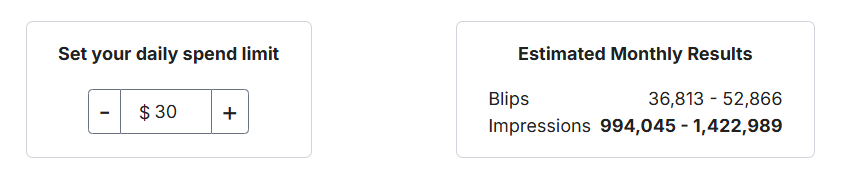
With Blip, you control exactly what you spend by setting a daily budget that can be adjusted anytime, so advertising on Hamilton Township billboards can fit almost any marketing plan. Each “blip” is a brief 7.5–10 second ad on rotating digital billboards, and you only pay per blip, similar to pay-per-click online ads. Pricing for billboards in Hamilton Township, New Jersey varies based on when and where your ads run and current advertiser demand, and your total cost is simply the sum of all the blips you receive.
Where can I advertise with Blip in Hamilton Township, New Jersey?
Hamilton Township sits at the crossroads of some of the busiest travel corridors in central New Jersey, making it an ideal environment for flexible digital billboard campaigns. Major routes and estimated average daily traffic in and around Hamilton include Interstate 295, Interstate 195, U.S. Route 130, and U.S. Route 206 and Route 33. These corridors connect commuters, regional shoppers, and through-traffic, giving Hamilton Township billboards strong reach.
What kind of audience do Hamilton Township, New Jersey billboards reach?
Hamilton Township is Mercer County about 92,300 residents as of the 2020 Census, spread across roughly 40 square miles of land area. That creates a hybrid audience: deeply local residents plus a significant volume of through-traffic that makes billboards in Hamilton Township attractive for both neighborhood businesses and regional brands. The township also has a strong mix of commuters, families, and healthcare workers.
When is the best time to run Blip ads on Hamilton Township, New Jersey billboards?
Hamilton’s economy is heavily commuter-oriented, and the busiest windows are typically 6:30–9:00 a.m. and 4:00–7:00 p.m. Midday traffic on retail corridors like U.S. 130 and Route 33 is also steady from 11:00 a.m.–2:00 p.m. With Blip’s flexible scheduling, campaigns can be tailored to morning commute, midday, evening, or off-peak traffic patterns.
What highways in Hamilton Township, New Jersey get the most billboard traffic?
Interstate 295 and Interstate 195 are the main commuter and regional reach corridors, and combined they generate well over 100,000 vehicle trips per day through or immediately around Hamilton. U.S. Route 130 and Route 33 are better for hyperlocal commerce, with up to 40,000+ daily vehicles on busy segments. These roads are especially effective for directional and proximity messaging like “Next exit” or “3 miles ahead.”
Do I need a contract to advertise with Blip in Hamilton Township?
No, Blip has no long-term contracts or minimum commitments. You can start, pause, or stop your campaign at any time.
How fast can I launch a billboard campaign with Blip in Hamilton Township?
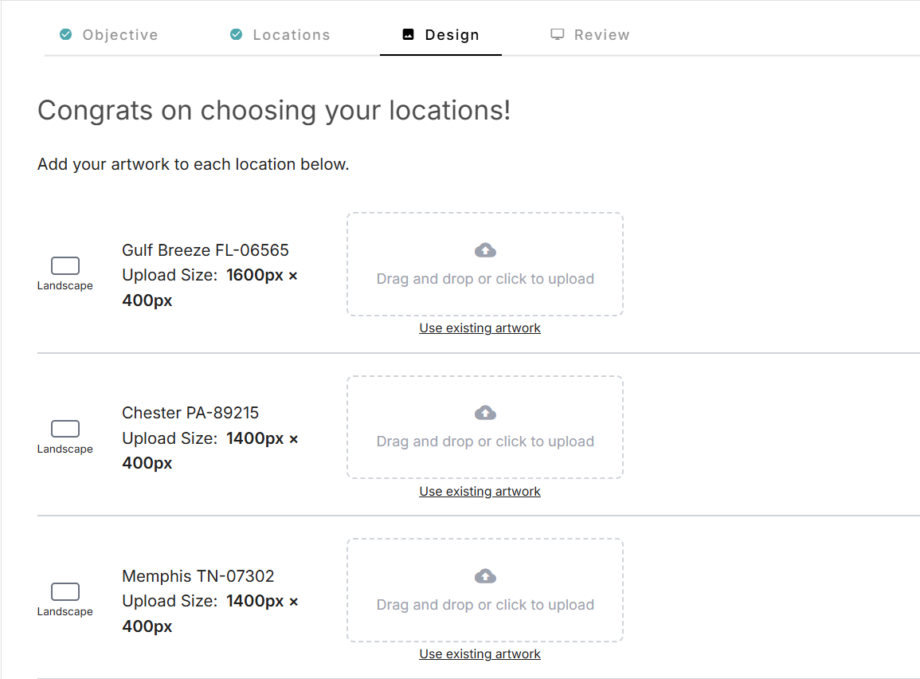
You can have your campaign live in minutes. Create a free account, select your locations, set your budget, upload your design, and start running once approved.
Where can I advertise with Blip in Hamilton Township?
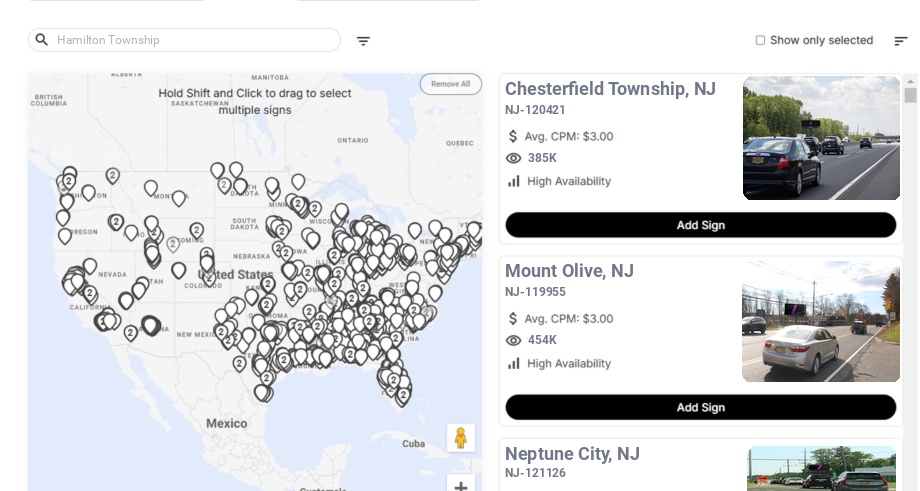
Blip has digital billboards in Hamilton Township. You can browse available locations on a map, choose the ones that fit your audience, and start advertising right away.
Still have questions? Launch a campaign in minutes — no contracts, no commitments.
Start Your CampaignHamilton Township Billboard Advertising Guide
Hamilton Township, New Jersey
Understanding the Hamilton Township Market
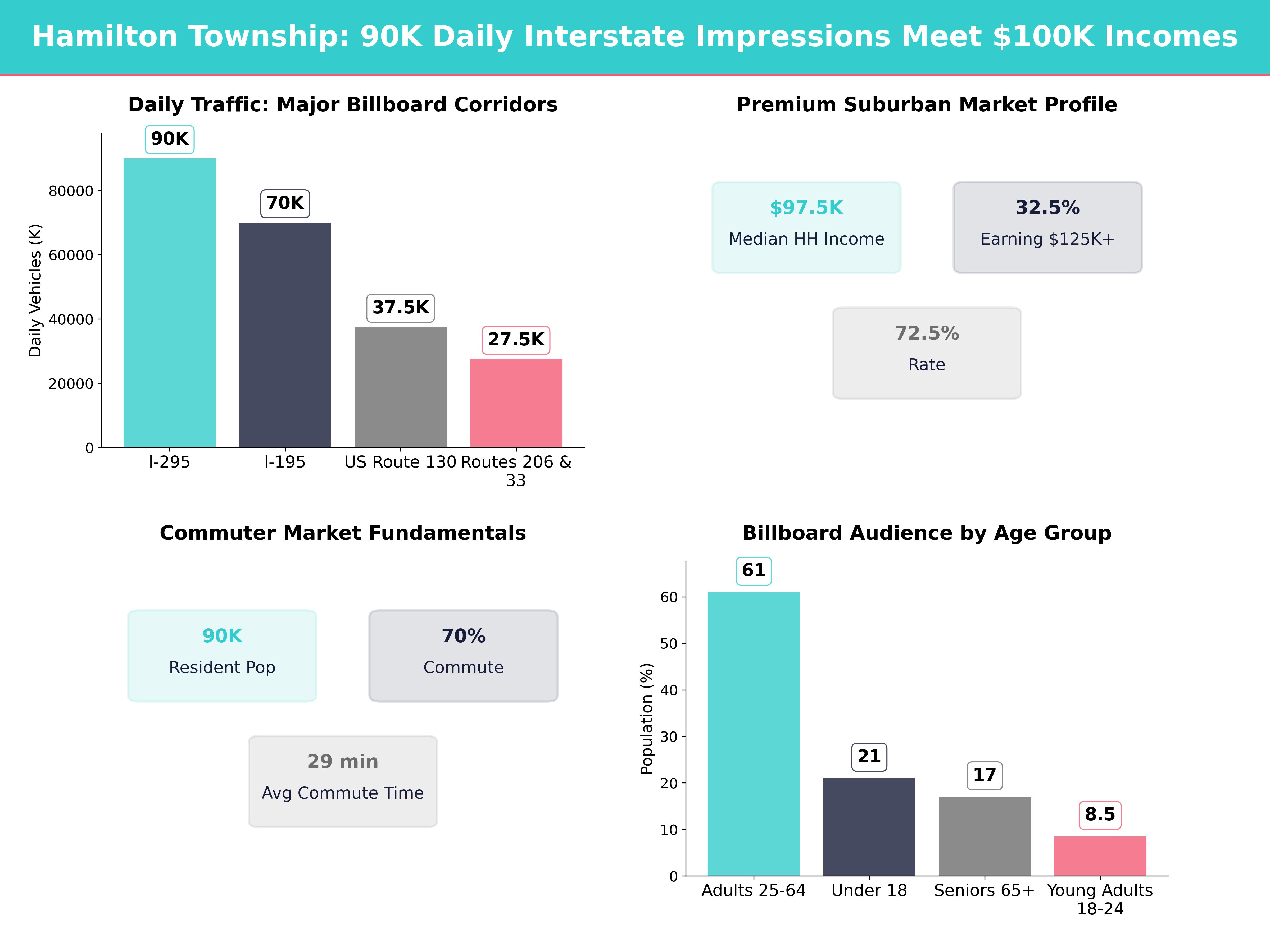
Hamilton Township is Mercer County about 92,300 residents as of the 2020 Census, spread across roughly 40 square miles of land area. That yields a density of around 2,300 residents per square mile, giving billboards strong reach over a relatively compact geography. The township borders Trenton
- 35–40 miles northeast of Philadelphia
- 55–60 miles southwest of New York City
This location creates a hybrid audience: deeply local residents plus a significant volume of through‑traffic that makes billboards in Hamilton Township attractive for both neighborhood businesses and regional brands.
Key demographic characteristics that influence campaign strategy:
-
Population size & density
- Population: ~92,300
- Land area: ~39–40 square miles
- Density: roughly 2,300–2,350 people per square mile, much higher than the U.S. average (about 94 people per square mile), which supports high impression counts for local‑targeted boards and makes the most of Hamilton Township billboard advertising.
-
Age profile
- Children and teens (under 18): roughly 20–22% of residents.
- Young adults (18–24): about 8–9%.
- Core working‑age adults (25–64): about 60–62%, providing a large base for retail, healthcare, financial, and commuting‑related offers.
- Seniors (65+): around 16–18%, a meaningful audience for healthcare, financial planning, and senior living.
-
Households & income
- Household count: roughly 34,000–35,000 households.
- Median household income: approximately $95,000–$100,000 based on recent American Community Survey estimates, notably above both New Jersey and national medians from just a decade ago.
- About 30–35% of households have incomes above $125,000, supporting campaigns for discretionary purchases like autos, elective healthcare, home improvement, and travel.
-
Tenure & homeownership
- Roughly 70–75% of occupied housing units are owner‑occupied.
- Stable homeownership supports recurring demand for long‑term services: HVAC, roofing, landscaping, financial advisory, and local healthcare, which all benefit from ongoing billboard rental in Hamilton Township.
-
Commuter culture
- A large majority of workers (70%+) drive alone to work, with average commute times around 28–30 minutes.
- A smaller but significant share (8–10%) use public transit, largely via regional rail and buses.
- Thousands of residents commute daily to jobs in Trenton, Princeton, the I‑295 corridor, and into the New York/Philadelphia metro areas via rail and highway, creating predictable commuter flows we can target by time of day and direction of travel.
We can reinforce or expand on local reach depending on whether we want to capture township residents, regional commuters, or long‑distance travelers using Hamilton as a pass‑through, tailoring Hamilton Township billboard advertising to each of these audiences.
For detailed local context, we recommend reviewing the township’s own information hub at the Hamilton Township official website Hamilton Township Economic Development
Traffic Patterns and High‑Value Corridors
Hamilton Township is defined by its road network. Understanding where people travel and when helps us choose the best boards and scheduling strategies for Hamilton Township billboards.
Major routes and estimated average daily traffic (ADT) in and around Hamilton include:
-
Interstate 295
- Cuts north–south through the township.
- NJDOT counts on central Mercer County segments commonly range 80,000–100,000 vehicles per day, with some stretches exceeding 100,000 ADT in recent pre‑pandemic counts.
- Carries a mix of daily commuters, trucking traffic, and regional shoppers.
-
Interstate 195
- Runs east–west, linking I‑295 to the New Jersey Turnpike (I‑95) and the Jersey Shore.
- Segments near Hamilton often see 60,000–80,000 vehicles per day, with summer weekend volumes spiking even higher as shore‑bound traffic increases.
-
U.S. Route 130
- A key commercial corridor with strip retail, auto dealers, and services.
- Busy segments within or adjacent to Hamilton typically record 30,000–45,000 vehicles per day.
- Because speeds are often 35–50 mph with traffic signals, dwell time and message recall can be higher than on limited‑access highways, making these corridors ideal for local billboard rental in Hamilton Township.
-
U.S. Route 206 and Route 33
- Important local and regional routes connecting Hamilton to Trenton, Robbinsville, and surrounding towns.
- Typical ADT runs 20,000–35,000 vehicles per day, depending on segment.
- These corridors link directly to retail, residential neighborhoods, and business districts, making them ideal for “nearby” calls‑to‑action.
NJDOT publishes traffic counts and corridor plans through the New Jersey Department of Transportation, which we can reference when we want to get more granular about certain exits and intersections or validate estimated impressions for particular boards.
Implications for our campaigns:
-
I‑295 & I‑195 = commuter & regional reach
- Combined, these interstates generate well over 100,000 vehicle trips per day through or immediately around Hamilton.
- These corridors are best for reaching daily commuters, regional shoppers, and travelers heading between Philadelphia, central Jersey, and the Turnpike.
- Use them when our goal is broad exposure and regional brand awareness, or when we serve multiple counties and want billboards in Hamilton Township to catch both locals and pass‑through travelers.
-
U.S. 130 & Route 33 = hyperlocal commerce
- With up to 40,000+ daily vehicles, these roads are ideal for geo‑specific calls‑to‑action: “Next exit,” “3 miles ahead,” or “Turn right on Route 33.”
- They tend to serve local shoppers already in a buying mindset (errands, dining, big‑box retail), driving measurable foot‑traffic lift.
-
Directional & proximity messaging works extremely well
- On roads like 130 and 33, short directional cues—“2 minutes ahead on 130 North” or “Exit 60 – Hamilton Marketplace”—drive immediate response because viewers are often within 1–5 minutes of the advertised location.
- With traffic signals and moderate speeds, drivers have more time to read and act on specific directions.
Commuter Flows and Daypart Strategy
Hamilton’s economy is heavily commuter‑oriented. In Mercer County overall, a majority of workers travel out of their home municipality for work, and Hamilton mirrors this pattern with thousands of residents leaving the township each morning and returning at night. The highways also carry commuters from surrounding towns, which further increases the reach of Hamilton Township billboard advertising during peak hours.
Typical flow patterns:
-
Morning inbound/outbound
- Eastbound and northbound routes (toward New York commuter rail, Princeton‑area employment, and industrial parks) peak roughly 6:30–9:00 a.m., with the 7:00–8:30 a.m. window often the heaviest.
- Westbound toward Trenton also sees a surge during this window as state government and office workers travel downtown.
-
Evening commute
- Reverse flows dominate from 4:00–7:00 p.m., when homeward traffic on I‑295, I‑195, and Route 1 increases.
- Congestion is especially noticeable near major interchanges, which increases average billboard viewing time by several seconds per pass.
-
Midday traffic
- Retail corridors like U.S. 130 and Route 33 see steady 11:00 a.m.–2:00 p.m. activity from errands, lunch breaks, and local services.
- For some service businesses, midday customers can make up 30–40% of daily walk‑ins, making lunchtime impressions valuable.
Rail commuters also shape patterns. The nearby Hamilton rail station on NJ TRANSIT’s Northeast Corridor, accessible via local roads from the township, provides direct service to New York and Trenton. Pre‑pandemic weekday boardings at Hamilton station were in the low thousands per day, underscoring the scale of the commuter base.
With Blip’s flexible scheduling, we can tailor campaigns to these patterns:
-
Morning commute (6–9 a.m.)
- Ideal for coffee, QSR, transit‑oriented offers, and workplace services (“Need IT help today?”, “Same‑day dental appointments”).
- Messaging: urgency, convenience, “today only,” “on your way to work.”
- Many commuters are making decisions about meals, errands, and after‑work plans during this window.
-
Midday (11 a.m.–2 p.m.)
- Perfect for restaurants, retail promotions, and medical/beauty appointments.
- Messaging: “Lunch specials until 2 p.m.,” “Walk‑in urgent care – no appointment needed.”
- For healthcare and personal services, this can align with same‑day or next‑day appointment availability.
-
Evening (4–7 p.m.)
- Best for family dining, grocery, fitness, and entertainment.
- Messaging: “Dinner tonight?”, “Open until 10 p.m.,” “Order online – pick up on your way home.”
- Many households make purchase decisions for the evening within 1–2 hours of the commute home.
-
Off‑peak & late‑night
- Lower competition for impressions can stretch smaller budgets, sometimes allowing higher share of voice at a lower effective cost per thousand impressions (CPM).
- This is useful for brand awareness campaigns, e‑commerce, and late‑night services (pharmacies, urgent care, 24‑hour businesses).
Seasonal and Event‑Driven Opportunities
Hamilton Township has distinct seasonal rhythms that we can tap into for time‑sensitive campaigns. Mercer County as a whole sees noticeable shifts in traffic volume and consumer spending across the year, particularly around holidays, school calendars, and major outdoor events. Planning billboard rental in Hamilton Township around these cycles can significantly increase relevance and response.
Key seasonal anchors:
-
Spring (March–May)
- Home improvement, landscaping, and exterior services typically see inquiries rise by 20–40% compared with winter months in northeastern markets.
- Township events, youth sports, and graduation season drive heavy family activity in parks and school facilities.
- Use bright, “fresh start” creative with strong visuals of homes, lawns, and outdoor living.
- Tie offers to tax‑refund timing (many refunds are received between late March and early May), when households often make big‑ticket purchases.
-
Summer (June–August)
- Proximity to the Jersey Shore (via I‑195) and major parks creates strong weekend and holiday travel. On key Fridays and Sundays, east‑west volumes on I‑195 can spike 10–20% above typical weekdays.
- Families traveling east on I‑195 toward the Turnpike and shore points are receptive to messages about roadside attractions, automotive services, and summer retail.
- Use countdowns and limited‑time offers: “Summer sale ends in 5 days,” “Book your camp by July 1.”
- Promote cooling‑related services (AC, pools, ice cream, cold beverages) when average daily highs climb into the 80s°F.
-
Fall (September–November)
- Back‑to‑school and back‑to‑routine campaigns resonate strongly: tutoring, healthcare checkups, fitness, and financial services.
- Retailers often see a back‑to‑school sales bump in August–September, followed by another surge during November holiday shopping.
- Local fall festivals and events at township parks and farms draw residents; creative can mention “this weekend” or “this Saturday only” for ticketed experiences.
- Flu‑shot and preventive‑care campaigns typically ramp up as clinics prepare for higher fall/winter demand.
-
Winter (December–February)
- Holiday shopping and end‑of‑year promotions can account for 20–30% of annual retail revenue for some categories.
- Tax preparation, healthcare open enrollment, and winter home services (heating, insulation, roofing) also peak in this period.
- Use high‑contrast, simple holiday themes and strong offers to stand out during darker commutes (sunset before 5 p.m. in December).
- For emergency and on‑call services, emphasize 24/7 availability when winter storms or cold snaps are forecast.
We can track town activities, recreation programs, and event calendars via the Hamilton Township Recreation and Community Events pages Community Events Calendar
Local Landmarks and Behavioral Context
Hamilton Township is more than a bedroom community. It includes notable regional destinations and institutions that influence where people travel and how they spend, providing natural focal points for Hamilton Township billboards:
-
Robert Wood Johnson University Hospital Hamilton
- A major healthcare employer and service hub that attracts patients from across Mercer, Burlington, and Monmouth counties.
- Hospitals of this scale typically employ hundreds to over a thousand workers, plus associated medical offices nearby.
- Visitors, staff, and patients generate steady traffic throughout the day, not just during peak commute hours.
-
Hamilton Marketplace and other retail clusters
- Power centers along Route 130 and Route 33 draw shoppers from a 10–15 mile radius, capturing residents from neighboring towns like Robbinsville, Bordentown, and East Windsor.
- Weekend days and pre‑holiday periods can produce double‑digit percentage increases in visit volumes compared with off‑peak weeks.
- Visibility from high‑traffic corridors amplifies last‑mile advertising impact (“Turn right at the next light”).
-
Veterans Park and other large parks
- Veterans Park spans more than 330 acres, making it one of the largest municipal parks in New Jersey.
- It hosts athletic fields, walking paths, playgrounds, and township events, which can bring thousands of visitors on major event days.
- Other township parks and open spaces collectively support year‑round recreation, from youth sports to festivals.
-
Proximity to Trenton
- Many government, legal, and administrative workers travel between Hamilton and downtown Trenton every weekday.
- State offices, courts, and corporate campuses in Trenton create consistent cross‑border travel flows.
We tailor creative based on proximity to these anchors:
- Near hospitals: promote pharmacies, urgent care, medical specialists, rehab, insurance, or legal services with clear, reassuring messaging (“Seen in 30 minutes or less,” “Open 7 days”).
- Near retail centers: push time‑sensitive sales, “last‑chance” offers, and comparison statements (“Save 20% vs. big box”).
- Near parks and family venues: emphasize family‑friendly branding, events, and quick‑service dining (“Kids eat free on Tuesdays,” “5 minutes from Veterans Park”).
For location context, park and facility information is available via Hamilton Township Parks & Facilities
Creative Strategy for Hamilton Audiences
Because most Hamilton billboard impressions occur at highway speeds (45–65 mph), our creative must be clear and instantly digestible. National out‑of‑home benchmarks indicate that drivers have roughly 6–8 seconds to view a typical roadside billboard; at higher speeds, this can drop to 3–5 seconds. Based on local conditions, we can design Hamilton Township billboard advertising that captures attention quickly and converts that brief exposure into action.
1. Prioritize ultra‑simple messaging
-
Aim for 6–8 words or fewer on the main line to stay easily readable at 55–65 mph.
- Use one primary offer or benefit: “Same‑Day Urgent Care” or “0% APR Auto Loans.”
- Pair a short, readable URL or search cue: “Search: ‘Hamilton HVAC’” or “Visit AutoShop130.com.”
- Keep phone numbers to 7 digits + area code and avoid multiple calls‑to‑action.
2. Use directional and distance‑based cues
Given the structure of I‑295, I‑195, Route 130, and Route 33:
- Add distance: “Next Exit – Hamilton Marketplace,” “1 mile on your right,” “2 lights ahead.”
- Reference known intersections or corridors: “On Route 33 near Kuser Rd.”
- Directional cues can lift response significantly; industry case studies often show double‑digit percentage increases in store visits when boards include explicit “next exit” language versus generic branding.
3. Design for daylight & nighttime visibility
Hamilton drivers encounter boards in bright sun, cloudy conditions, and nighttime commuting:
- Use high‑contrast color pairs (dark background with light text or vice versa).
- Avoid thin fonts and overly detailed images that blur at a distance.
- Keep logos large and simple—recognizable in under 1 second of viewing.
- For digital boards, ensure that any motion or rotation adheres to NJDOT guidelines on dwell time and brightness.
4. Align imagery with local lifestyle
- Families, commuters, healthcare workers, and small business owners dominate the market.
- Visuals showing families, professionals, and local landmarks tend to resonate more than generic stock cityscapes.
- If we serve multiple nearby counties, we can test creative that references “serving Mercer, Burlington & Monmouth” vs. strictly local language to see which pulls better.
- Including “Hamilton” or “Mercer County” in the creative can boost perceived relevance and trust.
Using Time‑of‑Day and Day‑of‑Week Targeting
Blip’s flexibility lets us buy only the times that align with our audience. In Hamilton, that precision makes billboard rental in Hamilton Township more efficient, since every impression is purchased for a reason.
-
Weekday‑heavy campaigns
- Great for B2B, professional services, healthcare, and commuting‑related offers.
- Focus impressions 6–9 a.m. and 4–7 p.m. Monday–Friday.
- These windows correspond to the bulk of commuter flows, often accounting for 40–50% of daily traffic on key corridors.
-
Weekend‑focused campaigns
- Ideal for leisure, retail, dining, and home services.
- Boost bids on Friday afternoon–Sunday evening, especially on Route 130 and I‑195 (shore‑bound and returning traffic).
- Many retail and dining businesses see 25–40% of weekly revenue concentrated between Friday evening and Sunday.
-
Event‑based bursts
- For a local festival, sale, or grand opening, we can concentrate budget in the 3–5 days before the event, then taper off.
- Use copy like “This Saturday Only,” “Opens Friday,” or “Grand Opening – Hamilton” for urgency.
- Align bursts with township‑promoted events listed on the Hamilton Township Events Calendar
Vertical‑Specific Opportunities in Hamilton Township
Certain industries are particularly well‑positioned to benefit from Hamilton’s patterns and from the flexibility of Hamilton Township billboards.
Healthcare and Wellness
With major hospital and medical facilities in and around Hamilton:
- Targets: primary care, urgent care, dental, specialty clinics, imaging centers, behavioral health, fitness centers.
-
Market context:
- In many New Jersey suburbs, healthcare and social assistance account for 10–15% of local employment, and Hamilton fits this profile.
- An aging population segment (about 16–18% of residents 65+) drives demand for ongoing healthcare services.
-
Strategy:
- Emphasize convenience and speed: “Same‑day appointments,” “Walk‑ins welcome,” “Open evenings & weekends.”
- Use boards along commuter routes to catch workers deciding where to schedule appointments—especially near interchanges leading to medical campuses.
- Rotate creatives seasonally: flu shots in fall, sports physicals in summer, weight‑loss and wellness in January, allergy and asthma care in spring.
Auto Sales, Service, and Insurance
Route 130 and surrounding corridors host strong auto‑related activity:
- Targets: dealerships, repair shops, tire centers, car washes, insurance agents.
-
Market context:
- With suburban commuting patterns, vehicle ownership rates in Hamilton are high; many households have 2 or more vehicles.
- Auto‑related spending tends to spike ahead of winter and summer travel seasons.
-
Strategy:
- Spot campaigns ahead of bad‑weather seasons (“Get winter‑ready tires,” “Spring tune‑up specials”).
- Proximity messages: “1 mile ahead on 130 North,” “Exit 60, then right.”
- Time ads for commuting windows when car worries are top‑of‑mind (engine lights on in traffic, winter storm forecasts).
- Use simple price points or discounts (e.g., “Oil change $39.99,” “Save 15% with code HAMILTON”).
Home Services and Local Contractors
Given relatively high homeownership in Hamilton and neighboring suburbs:
- Targets: HVAC, roofing, landscaping, pest control, solar, remodeling, plumbing, and electrical.
-
Market context:
- With roughly 70–75% owner‑occupied housing, a large base of residents makes long‑term maintenance and improvement decisions.
- Seasonal weather swings (summer highs in the 80s°F and winter lows in the 20s°F) drive HVAC and weatherization demand.
-
Strategy:
- Seasonal messaging: heating/roof in fall–winter, AC/landscaping in spring–summer.
- Use simple, trust‑building language: “Locally owned since 1995,” “24/7 emergency service.”
- Highlight service area: “Serving all of Hamilton & Mercer County.”
- Consider using different creatives for owner‑occupied vs. renter‑heavy corridors if your service mix varies.
Education and Tutoring
Families form a substantial share of the population:
- Targets: private schools, tutoring centers, test prep, enrichment programs, camps.
-
Market context:
- With roughly 20–22% of residents under 18, the local youth population is large enough to support multiple overlapping educational services.
- Back‑to‑school and exam seasons (September and April–June) see heightened interest in tutoring and enrichment.
-
Strategy:
- Intensify campaigns in August–September and January (semester changes, New Year resolutions).
- Mention specific grades or programs: “K–8 math tutoring,” “SAT prep – Hamilton.”
- Use family‑oriented imagery and simple benefit statements: “Boost grades in 8 weeks.”
- Align flight dates with Hamilton school calendars available via local school district and township links from Hamilton Township’s education resources
Local News, Trust, and Brand Positioning
Hamilton residents follow regional and local news through outlets such as:
- NJ.com’s Mercer County coverage
- The Trentonian
- CentralJersey.com’s Mercer/Greater Trenton coverage
These channels shape local topics and concerns (property taxes, traffic, schools, safety, and healthcare). We can build trust and relevance by:
- Using consistent brand elements between digital billboards and any local news sponsorships or online ads.
- Avoiding overly generic messaging—speak to “Hamilton” or “Mercer County” directly when relevant.
- Mirroring community values—safety, family, local pride, and convenience.
- Featuring community involvement stats when possible (“Over 1,000 Hamilton families served,” “Proud sponsor of local youth sports”).
Compliance, Regulations, and Community Fit
Billboards in New Jersey must comply with state and local rules on placement, brightness, and content. While Blip and our sign partners manage permitting and technical compliance, it’s helpful to understand the context when planning billboards in Hamilton Township:
- Hamilton Township’s zoning and land‑use regulations, available via the Hamilton Township Planning & Zoning pages
- New Jersey has state regulations covering outdoor advertising near highways, overseen by the NJDOT
From a creative standpoint, we:
- Avoid misleading claims, overly fine print, or anything that could be seen as distracting or unsafe.
- Keep offers clear and easily verifiable (price points, time frames, locations).
- Maintain community‑friendly imagery that aligns with Hamilton’s family‑oriented character.
- Consider acknowledging community ties (“Serving Hamilton for 20+ years”) to reinforce local legitimacy and make Hamilton Township billboard advertising feel like a natural part of the local landscape.
Measuring Results and Optimizing Over Time
To make the most of Hamilton Township’s market, we should treat billboard campaigns as test‑and‑learn programs, using clear data points to gauge performance and refine future billboard rental in Hamilton Township.
-
Use trackable elements:
- Short URLs specific to the campaign (e.g., “BrandNameHamilton.com”).
- Unique phone numbers or text codes for billboard viewers.
- Promo codes tied to Hamilton campaigns only (“HAMILTON10”).
- QR codes can be effective on lower‑speed corridors like Route 130 or 33, where a meaningful share of drivers are stopped at lights; avoid them on high‑speed interstates.
-
Align with business metrics:
- Track changes in web traffic from Hamilton and neighboring ZIP codes (e.g., 08610, 08619, 08620, 08690, 08691) during the campaign.
- Monitor store traffic or appointment volume by day and time, especially immediately after we increase impressions.
- Look for percentage changes (e.g., 10–20% lift in calls or site visits during flighted periods) rather than only raw numbers.
-
Iterate creative and scheduling:
- Test 2–3 variations of headlines or offers on the same audience to see which drives more redemptions or inquiries.
- Shift dayparts or days of week if we see stronger response patterns at specific times—for example, moving spend from midweek to weekends if in‑store sales data show higher weekend conversion rates.
- Adjust targeting seasonally, concentrating budget in months when your category historically sees the highest revenue.
By leaning on Hamilton Township’s specific traffic patterns, demographics, and seasonal rhythms—and leveraging Blip’s ability to precisely adjust timing, budget, and creative—we can run billboard campaigns that are both efficient and highly relevant to local audiences. This approach turns Hamilton Township billboards into a measurable, data‑driven channel that maximizes impressions and conversions within a locally grounded strategy.