Billboards near Oak Ridge, NJ
No Minimum Spend. No Long-Term Contracts. Just Results.
Trusted by Leading Brands


Billboard advertising
near Oak Ridge has never been easier



How much is a billboard near Oak Ridge?
Why Choose Blip for Billboard Advertising near Oak Ridge
-
Blip lets you launch Oak Ridge billboards yourself and target Route 23, Route 15, or I-80 commuters without big-agency hassle.
-
Set a flexible budget for Oak Ridge and adjust anytime—ideal for commuter families, lake visitors, and weekend shoppers.
-
Daypart your Oak Ridge campaign for rush hour or weekend lake traffic on Route 15 and I-80, when drivers are most likely to act.
-
No contracts means you can test Blip in Oak Ridge, then scale during summer boating or winter ski-season surges.
-
Track Oak Ridge results in real time and shift creative fast as traffic changes across Jefferson, Butler, and Wharton.
-
Use Blip creative tools to make bold, local Oak Ridge ads that read fast for 45-65 mph drivers on busy North Jersey corridors.
Frequently Asked Questions About Billboard Advertising near Oak Ridge
How much does a billboard cost near Oak Ridge, New Jersey with Blip?
With Blip, you control exactly what you spend on Oak Ridge billboards by setting a daily budget that can be adjusted anytime, so you never go over what you’re comfortable investing. Each ad “blip” is a brief 7.5–10 second display on digital billboards near Oak Ridge, New Jersey, and you only pay for the blips you receive. Your cost per blip depends on when and where you choose to appear in the Oak Ridge area and on real-time advertiser demand, making the platform flexible for both small and larger budgets.
Where can I advertise with Blip near Oak Ridge, New Jersey?
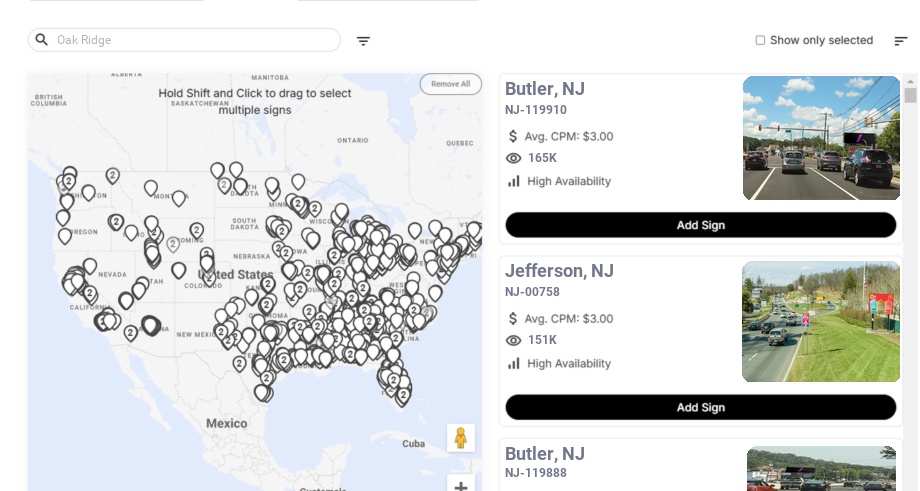
Our 10 digital billboards serving the Oak Ridge area are located in Jefferson, NJ, Butler, NJ, and Wharton, NJ. These locations offer convenient billboard rental near Oak Ridge and sit on or near some of North Jersey’s most important regional routes. Because these boards are within 10 miles of Oak Ridge, they are ideally positioned to reach residents, regional shoppers, and recreation traffic.
What kind of people will see Oak Ridge billboards?
The Oak Ridge area spans parts of Jefferson Township in Morris County and West Milford Township in Passaic County, and together they form a high-income, car-dependent suburban market. Median household incomes in the immediate area are generally in the $95,000–$115,000 range, with many lake-community neighborhoods exceeding $120,000. Driving is the norm, with close to 9 in 10 workers relying on private vehicles.
When should I run Blip ads in the Oak Ridge area for the best results?
Because the Oak Ridge area is commuter-heavy, timing is as important as location. The evening commute is typically the single busiest period, often representing 30–35% of weekday daily volume on highways, while mornings and weekends also offer strong opportunities. With Blip, you can allocate more budget to specific time windows and days of the week instead of paying one flat rate for 24/7 exposure.
Why are billboard ads near Oak Ridge, New Jersey effective for local businesses?
Commute patterns skew toward New York City and major job centers like Parsippany, Morristown, and the I-80 corridor, giving the billboards frequent, repeated exposure to the same drivers. Repetition along commute routes is critical; campaigns near Oak Ridge should emphasize frequency and consistency more than one-off bursts, aiming to reach the same driver 20–40 times per month. That makes Oak Ridge billboards a reliable touchpoint for neighborhood businesses.
Do I need a contract to advertise with Blip near Oak Ridge?
No, Blip has no long-term contracts or minimum commitments. You can start, pause, or stop your campaign at any time.
How fast can I launch a billboard campaign with Blip near Oak Ridge?
You can have your campaign live in minutes. Create a free account, select your locations, set your budget, upload your design, and start running once approved.
Where can I advertise with Blip near Oak Ridge?
Blip has digital billboards near Oak Ridge. You can browse available locations on a map, choose the ones that fit your audience, and start advertising right away.
Still have questions? Launch a campaign in minutes — no contracts, no commitments.
Start Your CampaignOak Ridge Billboard Advertising Guide
Oak Ridge sits at a powerful crossroads of suburban neighborhoods, lake communities, and major commuter routes feeding the New York City metro. With 10 digital billboards serving the Oak Ridge area from nearby Jefferson, Butler, and Wharton, advertisers can tap into a steady stream of daily commuters, families, and outdoor enthusiasts on some of North Jersey’s most important corridors—without paying New York media prices. For brands specifically seeking billboards near Oak Ridge, this cluster of nearby placements offers a concentrated, high‑impact footprint.
Understanding the Oak Ridge Area Market
The Oak Ridge area spans parts of Jefferson Township in Morris County and West Milford Township in Passaic County. Together they form a high‑income, car‑dependent suburban market that is ideal for ongoing billboard advertising near Oak Ridge:
- Jefferson Township counts about 21,500 residents (2020) and promotes itself as a “small town with a big heart,” highlighting strong schools and lake communities on the township website 1,700–1,900 students in grades 6–12, giving advertisers steady exposure to school‑age families following daily bus and drop‑off routes that can be reached with nearby Oak Ridge billboards.
- West Milford Township has roughly 25,500 residents (2020) and over 80% owner‑occupied housing, according to township planning documents referenced by West Milford Township. Local school enrollment is typically in the 3,000–3,500 student range across multiple elementary schools and West Milford High School, reinforcing the area’s family‑oriented character and making billboard advertising near Oak Ridge effective for family‑focused brands.
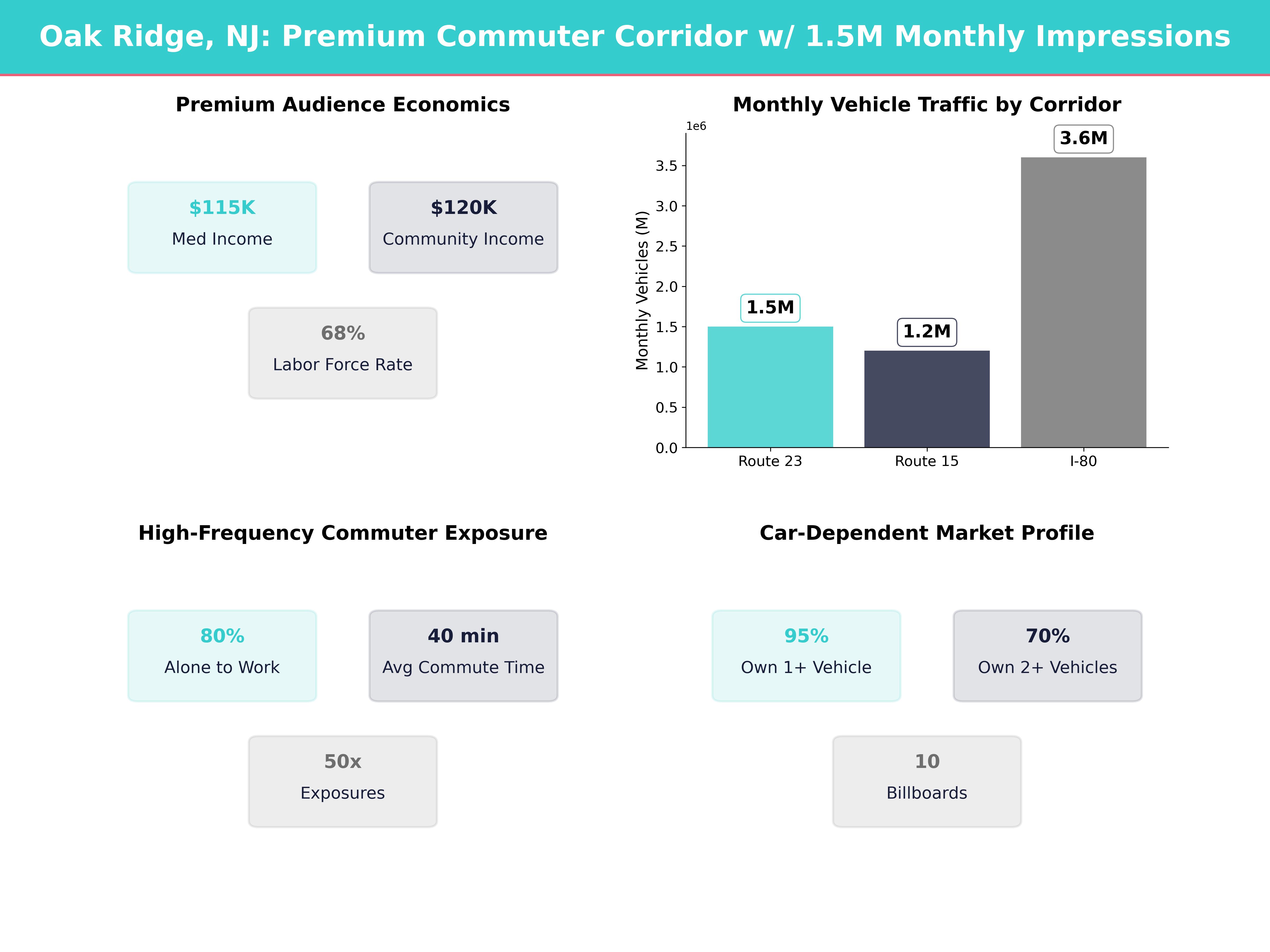
- Median household incomes in the immediate area are generally in the $95,000–$115,000 range, with many lake‑community neighborhoods exceeding $120,000, well above the U.S. median. This supports robust discretionary spending on dining, home improvement, services, recreation, and healthcare. Nearby Morris County as a whole regularly reports median household income above $115,000, underscoring the broader affluence of the region.
Driving is the norm:
- In Morris County overall, about 78–80% of workers drive alone to work, and another 7–9% carpool, so close to 9 in 10 workers rely on private vehicles. Passaic County’s drive‑alone share is similar, in the 75–80% range.
- Average one‑way commute times for many Oak Ridge, Jefferson, and West Milford residents fall in the 30–40 minute band, with a sizable segment commuting 45 minutes or more toward New York City and regional employment hubs.
- Vehicle ownership is high: in many Jefferson and West Milford neighborhoods, over 95% of households have at least one vehicle, and 60–70% have two or more.
Commute patterns skew toward New York City and major job centers like Parsippany, Morristown, and the I‑80 corridor, giving our billboards frequent, repeated exposure to the same drivers. This repetition is exactly what makes Oak Ridge billboards so valuable for local awareness campaigns.
For advertisers, that means:
- You’re speaking to stable, middle‑to‑upper income households with vehicles and steady commuting routines.
- Repetition along commute routes is critical; campaigns near Oak Ridge should emphasize frequency and consistency more than one‑off bursts, aiming to reach the same driver 20–40 times per month.
- Because people rely heavily on local roads and highways, well‑placed digital billboards serving the Oak Ridge area can act as a “front page” for local businesses, similar to a daily local news placement but with tens of thousands of visual impressions instead of a few thousand readers.
For context on local demographics, land use, and economic trends, advertisers can review planning resources from Morris County and Passaic County Jefferson Township West Milford Township. These resources can inform where billboard rental near Oak Ridge is likely to reach the most relevant residents.
Where Our Billboards Are and Who Sees Them
Our 10 digital billboards serving the Oak Ridge area are located in:
- Jefferson, NJ (about 7.2 miles from Oak Ridge)
- Butler, NJ (about 8.1 miles from Oak Ridge)
- Wharton, NJ (about 9.8 miles from Oak Ridge)
These locations offer convenient billboard rental near Oak Ridge and sit on or near some of North Jersey’s most important regional routes:
- Route 23 near Butler: According to New Jersey Department of Transportation traffic count data, sections of Route 23 carry roughly 45,000–50,000 vehicles per day through the Butler/Kinnelon area. Over a 30‑day period, that translates to 1.3–1.5 million vehicle trips, capturing Oak Ridge–area commuters heading toward Wayne, I‑80, and ultimately New York City. NJDOT’s traffic count program, referenced on NJDOT, consistently identifies Route 23 as one of North Jersey’s highest‑volume non‑Interstate corridors.
- Route 15 and local Jefferson roads: Route 15 north–south near Jefferson often sees 35,000–40,000 vehicles per day, or roughly 1.0–1.2 million vehicles per month, connecting lake communities (Lake Hopatcong, Berkshire Valley, Oak Ridge area) to I‑80 and industrial/commercial centers to the south. Seasonal peaks occur in summer boating months and winter ski season, when weekend traffic can surge 10–20% on fair‑weather days.
- I‑80 near Wharton: I‑80 through Morris County is one of the state’s busiest highways, with NJDOT counts typically in the 100,000–120,000 vehicles per day range near Wharton and Rockaway—3.0–3.6 million vehicle trips per month. This is a key artery for long‑distance commuters and regional shoppers heading to major retail destinations like Rockaway Townsquare, which itself draws several million shoppers annually, according to center data shared on the Rockaway Townsquare
Because these boards are within 10 miles of Oak Ridge, they are ideally positioned to reach:
- Residents of the Oak Ridge area commuting daily toward I‑80, Route 23, and Route 46. Even capturing just 5–10% of daily traffic as Oak Ridge–area residents can yield several thousand local exposures per day, making these Oak Ridge billboards a reliable touchpoint for neighborhood businesses.
- Regional shoppers heading to Morris County retail hubs (Rockaway Townsquare, Route 10 corridors) and Passaic/Bergen County shopping centers along Routes 23, 46, and 80.
- Recreation traffic accessing lakes, state parks, ski areas, and campgrounds in Sussex, Passaic, and northern Morris Counties. On peak summer and winter weekends, visitor volumes can push corridor traffic 10–30% above weekday averages, significantly increasing impressions for tourism‑related campaigns.
To understand broader regional context and growth trends, advertisers can monitor planning and transportation resources from Morris County and Passaic County NJDOT, which regularly posts traffic count and project information affecting Route 23, Route 15, and I‑80. Combining these insights with flexible billboard rental near Oak Ridge ensures campaigns stay aligned with real‑world traffic conditions.
Audience Insights for Campaign Planning
The Oak Ridge area sits at the intersection of several valuable audience segments that can be efficiently reached using billboards near Oak Ridge:
1. Commuter Families
- High rates of commuting (often 30–60 minutes each way) mean your message may be seen twice per day by the same person, five days a week—up to 40–50 exposures per month for heavy commuters regularly passing the same board.
- In both Jefferson and West Milford, family households typically account for 65–75% of all households, and local schools serve a combined 4,500–5,500 students across K–12. Daily school‑related traffic—buses, carpools, teen drivers—adds thousands of additional weekday trips on key roads.
- In nearby Morris County, labor force participation often exceeds 66–68%, and a large share of residents work in professional, managerial, and healthcare roles, supporting demand for higher‑end services and experiences.
Implication for advertisers: Emphasize time‑saving, local convenience, and family‑oriented benefits (“Skip the highway traffic—shop local on Route 23,” “Family dental care 10 minutes from home”). These messages align with the reality that many households juggle two working adults plus multiple school and activity schedules, and they leverage the strengths of everyday billboard advertising near Oak Ridge.
2. Outdoor and Recreation Enthusiasts
The Oak Ridge area is surrounded by lakes, forests, and recreation areas:
- Lake Hopatcong is New Jersey’s largest lake, with nearly 4 square miles of surface area and dozens of marinas, restaurants, and rental operations. Summer weekends can bring thousands of boaters and visitors per day to the lakefront, many traveling via Route 15 and local Jefferson roads promoted through outlets like the Lake Hopatcong Foundation.
- Greenwood Lake spans the New Jersey–New York border and supports boating, fishing, and waterfront dining. While year‑round population is modest, summer and holiday weekends attract large visitor spikes, with lake‑area businesses highlighted by regional tourism sources and local guides linked from West Milford Township.
- Mahlon Dickerson Reservation, managed by the Morris County Park Commission, is the county’s largest park, covering over 3,400 acres with campgrounds, hiking, and boating access. The broader Morris County park system reports over 3 million visits per year across its facilities, a significant share of which flow through Oak Ridge‑area roads.
- Mountain sports and winter recreation (including destinations like Mountain Creek in nearby Vernon, which advertises over 160 skiable acres and multiple lifts and trails on its Mountain Creek site) draw seasonal weekend traffic through the region via Routes 15 and 23.
Implication: Great opportunities for seasonal campaigns for marinas, outdoor retailers, restaurants, campgrounds, ski/snowboard shops, and tourism businesses. Boards can be timed to peak seasons—late May through September for lakes and June–March for mountain recreation—to coincide with visitor surges that can add thousands of extra vehicles per day. Strategic billboard rental near Oak Ridge during these peaks helps capture both local and visitor spending.
3. Local Service Seekers
With many residents commuting out of town for work, key purchases and services still happen close to home:
- Local healthcare systems and independent practices draw from catchment areas of 20,000–60,000 residents within a 15–20‑minute drive of Oak Ridge. Urgent care centers frequently report that 60–70% of patients live within 5–7 miles.
- Auto services (repair, tires, car washes) benefit from the high vehicle ownership rate; with two cars in many driveways, the local market for maintenance, detailing, and accessories is substantial.
- Home improvement and contractors tap into an older housing stock; in many neighborhoods, 40–60% of homes were built before 1980, creating steady demand for roofing, siding, windows, docks, and decks.
- Real estate brokerages and home services benefit from relatively low vacancy and high ownership; when only 5–8% of homes turn over annually, agents compete heavily for awareness and listing opportunities.
Implication: Use billboards serving the Oak Ridge area to keep your brand top‑of‑mind during the drive, before residents make decisions at home or online. Even modest shifts—such as capturing an extra 2–3 customers per week—can generate strong ROI for higher‑ticket services, especially when combined with consistent Oak Ridge billboards along primary commute routes.
Crafting Creative That Works Near Oak Ridge
Because drivers often travel at 45–65 mph on these corridors, creative must be instantly readable. Legibility studies suggest drivers have 6–8 seconds to absorb a message at highway speeds, which aligns with best practices for digital out‑of‑home (DOOH). Winning artwork for the Oak Ridge area usually follows these rules:
1. Hyper‑local language
- Say “Serving the Oak Ridge area,” “Minutes from Oak Ridge,” or “Just off Route 23 in Butler,” to signal proximity.
- Reference recognizable landmarks or corridors: “Near Route 23 & 94,” “Next to ShopRite,” “Between Oak Ridge and Lake Hopatcong.” Local anchors such as the ShopRite of West Milford, Butler’s downtown core featured on Butler Borough, or Wharton’s historic Main Street highlighted on Wharton Borough help orient drivers quickly and strengthen the local relevance of your billboard advertising near Oak Ridge.
2. Minimal text, bold hierarchy
- Aim for 6–8 words or fewer, plus your logo and a short URL or keyword. Tests across DOOH campaigns show recall can drop 20–30% when word counts exceed this range.
-
Prioritize one main message:
- “Oak Ridge area urgent care – 7 days a week”
- “Dog daycare near Route 23 – Book now”
- Use high‑contrast color pairings (dark background, light text or vice versa) to combat sun glare and winter weather conditions. Studies of roadside visibility show that strong contrast can improve legibility distance by 30–50%, effectively extending your “viewing window” by several hundred feet.
3. Strong calls to action tied to driving behavior
Given the commuter patterns:
- “Exit at Wharton – 2 miles ahead”
- “Turn at the next light in Butler”
- “Order online tonight, pickup tomorrow” for restaurants and retailers.
Messages that connect directly to imminent actions (“next exit,” “next light,” “today”) consistently outperform generic branding, often yielding double‑digit percentage lifts in direct response when measured via unique URLs or promo codes.
4. Seasonal creative variants
With Blip’s flexible creative rotation, we can easily swap designs to match seasons:
- Winter (Nov–Feb): Emphasize heating, snow removal, holiday shopping, winter sports, and health (flu shots, urgent care). Local snowfall can exceed 30–40 inches per season, driving demand for plowing, firewood, and winter gear.
- Spring (Mar–May): Focus on home improvement, landscaping, youth sports, tax services. Spring cleanup and renovation often account for 30–40% of annual exterior project volume for contractors.
- Summer (Jun–Aug): Promote lake activities, outdoor dining, camps, summer programs; North Jersey camps routinely market limited capacity, and many aim to fill 80–90% of spots by early June.
- Fall (Sep–Oct): Back‑to‑school services, fall festivals, Halloween attractions, real estate listings. Fall is commonly a “second peak” for real estate and retail, sometimes representing 25–30% of annual sales in certain categories.
Rotating 2–4 creatives over a campaign allows you to test messaging and align with changing needs without increasing your overall budget, while maintaining a fresh look for returning commuters who may see your board 40+ times per month. This approach maximizes the impact of your billboard rental near Oak Ridge throughout the year.
Timing and Dayparting Strategy
Because the Oak Ridge area is commuter‑heavy, timing is as important as location. With Blip, you can use dayparting to run more impressions when your audience is most likely to respond.
Typical traffic patterns (supported by regional commuting studies and NJDOT counts) suggest:
-
Morning commute (6:00–9:00 a.m.)
- Often accounts for 25–30% of weekday traffic on major corridors.
- Best for coffee, breakfast, transit, news, and work‑related services.
- Also strong for healthcare (“Same‑day appointments today”) and automotive (“Hear a noise? Visit us tonight.”)
-
Afternoon / school hours (2:00–4:00 p.m.)
- Captures school dismissals and after‑school activity runs, representing a noticeable bump on local roads around schools and recreation sites.
- Ideal for tutoring, after‑school programs, youth sports, music/dance schools promoted through school calendars and recreation departments on Jefferson Township West Milford Township.
-
Evening commute (4:00–7:00 p.m.)
- Typically the single busiest period, often representing 30–35% of weekday daily volume on highways.
- Prime for restaurants, grocery, fitness, and entertainment.
- Use short, action‑oriented CTAs: “Order takeout now,” “Join tonight’s class,” “Stop in on your way home.”
-
Weekends
- Traffic shifts toward shopping centers, recreation, and events, with Saturday mid‑day often rivaling weekday peaks on retail corridors.
- Boost delivery on Saturdays for retail, real estate open houses, and weekend attractions. Seasonal events promoted by organizations like Morris County Tourism
With Blip, you can allocate more budget to specific time windows and days of the week instead of paying one flat rate for 24/7 exposure. That’s particularly useful in the Oak Ridge area, where weekday peaks and weekend patterns differ sharply, allowing you to concentrate spending during the 40–50% of hours that deliver 60–70% of your potential impressions. This flexibility helps you get the most from your billboard advertising near Oak Ridge without overspending during low‑value hours.
Leveraging Local News, Events, and Community Culture
The Oak Ridge area has a strong community identity, anchored by local news and civic organizations:
- Regional news coverage comes from outlets such as NJ.com (Morris County section) NorthJersey.com, which frequently report on Jefferson, West Milford, Butler, and Wharton. These outlets reach tens of thousands of digital readers in North Jersey each month, shaping local conversation and awareness.
- Local municipal sites like Jefferson Township West Milford Township, Butler Borough, and Wharton Borough regularly share calendars of festivals, parades, and community events, including summer concerts, town days, and holiday parades that can draw hundreds to several thousand attendees per event.
- Community organizations such as the Jefferson Arts Committee
We recommend:
- Aligning campaigns with local event calendars: town days, fireworks, parades, sports tournaments, and school milestones. For example, promoting a restaurant or ice cream shop in the 2–3 weeks leading up to a major town festival can help you capture increased foot traffic from the 1,000+ residents who may pass by en route.
- Running short flight boosts during major events: fall festivals, summer concerts, or lake events promoted by tourism pages like VisitNJ.org’s North Jersey section. Boards located on main access routes can see 15–25% higher weekend impressions during well‑attended regional events.
- Highlighting your support for local schools or charities (“Proud sponsor of Jefferson youth sports,” “Supporting West Milford events”) to build trust in a close‑knit community. Surveys of local consumers often show that 60–70% are more likely to patronize businesses that publicly support community causes.
Because these communities value local connection, calls‑to‑action that emphasize local ownership, long‑time presence, or community support tend to perform well. Including simple proof points (“Serving Oak Ridge families since 1998,” “Family‑owned in Jefferson”) can reinforce that message and increase the effectiveness of your billboards near Oak Ridge.
Example Campaign Approaches by Business Type
Here are some tailored strategies for advertisers near the Oak Ridge area using our Jefferson, Butler, and Wharton billboards:
Local Restaurant or Pizzeria
- Target: Commuters and families within 10–15 minutes of your location.
-
Strategy:
- Run heavier in 4–7 p.m. weekday windows and on weekends, when traffic is highest and dinner decisions are being made—often within 30–60 minutes of the actual meal.
- Use creatives like “Tonight: 2 large pies – Oak Ridge area delivery” or “Exit at Butler – Hot pizza in 10 minutes.”
- Rotate a second creative with online ordering or QR codes during slower nights (Mon–Wed) to drive incremental visits. Even capturing an extra 5–10 orders per night can translate into hundreds of additional orders per month during a sustained campaign, making Oak Ridge billboards a core part of your local marketing mix.
Home Improvement Contractor
- Target: Homeowners in Jefferson, West Milford, and Oak Ridge area lake communities, where homeownership rates exceed 75–80% in many neighborhoods.
-
Strategy:
- Keep campaigns live March–October, when exterior projects dominate and weather allows consistent work; these months often account for 70–80% of annual exterior project revenue.
- Focus on morning commute and mid‑day when homeowners are planning, and Saturdays for weekend warriors making purchasing decisions at local hardware stores or showrooms.
- Creative ideas: “Decks & docks for Oak Ridge area lake homes,” “Free roofing inspection – Call today.”
- Consider emphasizing financing (“0% for 12 months”) or limited‑time discounts; even a 1–2 extra projects per month can easily cover a billboard budget at typical project values, especially when you use precisely targeted billboard rental near Oak Ridge.
Healthcare Provider or Urgent Care
- Target: Families and workers across Oak Ridge area, Butler, and Wharton.
-
Strategy:
- Maintain a year‑round presence for trust and recognition. Healthcare decisions are often made under stress; repeated exposure (e.g., 20–30 impressions per month per frequent commuter) builds familiarity that pays off when a need arises.
- Emphasize proximity (“5 minutes from Route 23,” “Exit 34 on I‑80”) and convenience (“Walk‑ins welcome,” “Open 7 days”).
- Boost impressions during flu season (Nov–Feb) and back‑to‑school (Aug–Sep), when respiratory illness and sports injuries traditionally spike.
- Tie messaging to community health campaigns promoted on county health pages linked from Morris County and Passaic County
Recreation, Camps, and Seasonal Attractions
- Target: Families across North Jersey plus visiting traffic.
-
Strategy:
- Run spring/early summer campaigns for camps and summer programs, focusing on school‑year pickup times; many camps aim to enroll 80%+ of capacity by late May, so billboards can support that final enrollment push.
- Autumn campaigns for pumpkin patches, corn mazes, haunted attractions with heavier Friday–Sunday presence, when weekend outings peak.
- Creative examples: “Summer camp near the Oak Ridge area – Register now,” “Fall fun 15 minutes ahead – Exit in Wharton.”
- Highlight drive times (“Just 15 minutes from Oak Ridge”) and ticketing urgency (“Limited tickets,” “Weekends sell out”) to convert impressions into visits and maximize your return from billboard advertising near Oak Ridge.
Using Blip’s Tools to Reach the Oak Ridge Area Efficiently
Blip allows you to treat the Oak Ridge area as a focused, high‑value zone rather than blanketing the entire region. Key tactics:
1. Geo‑Focused Board Selection
-
Choose only the Jefferson, Butler, and Wharton boards that best align with your customer paths:
- Route 23 boards for Oak Ridge area residents heading south or east.
- I‑80/Wharton boards for regional shoppers and long commuters traveling toward Rockaway, Parsippany, or beyond.
- Combine multiple boards in a small radius to increase frequency among the same drivers. For example, running on 2–3 boards that share similar traffic can effectively double or triple the number of times a daily commuter sees your message, turning these boards into a powerful cluster of billboards near Oak Ridge.
2. Budget Control and Bid Strategy
- Set a daily or total campaign budget and a maximum bid per “blip” (play of your ad). Digital billboard slots typically refresh every 8–10 seconds, enabling fine‑grained control over how often your ad appears each hour.
- Start with a moderate bid to ensure baseline presence during your core dayparts, then adjust upward for peak seasonal windows (e.g., pre‑holiday, back‑to‑school), when advertiser competition and traffic volume both rise.
- Because digital billboards are auction‑based, you can often gain visibility at efficient prices during off‑peak periods; in some markets, off‑peak CPMs (cost per thousand impressions) can be 20–40% lower than peak times.
3. Creative Testing and Iteration
-
Run two creatives at once and compare performance over several weeks:
- Different offers (“$50 off vs. % discount”)
- Different CTAs (“Visit tonight” vs. “Book online”)
- Use geographic cues in one version (“Serving the Oak Ridge area”) and specific landmarks in another (“Next to the Butler ShopRite”) to see what resonates. In many DOOH tests, tightening the geographic reference can improve response metrics by 10–20%.
- Rotate in new creative at least every 60–90 days to prevent “creative fatigue” among repeat commuters who may otherwise start to tune out a static message.
4. Tracking and Measuring Impact
While billboards are primarily an upper‑funnel medium, you can still track impact:
- Monitor website traffic and call volume during and after campaign flights, especially in the zip codes closest to the boards (Jefferson/Oak Ridge/Butler/Wharton). A noticeable 5–15% increase in local web sessions or calls during flight periods is a strong signal of success.
- Use simple vanity URLs or promo codes visible only on your billboards (“/oakridge,” “Code OAK23”) to measure direct response. Even small redemption numbers can represent strong ROI given billboard reach.
- Compare store visits or sales in the Oak Ridge area before, during, and after campaigns; even a 5–10% lift can be meaningful for many local businesses, especially in higher‑margin categories.
- Coordinate with local partners—such as community groups and event organizers promoted via Jefferson Township West Milford Township—to track attendance changes when billboard support is added to existing promotion.
Putting It All Together
Advertising on digital billboards serving the Oak Ridge area allows you to reach a concentrated, high‑value audience of commuters and families who are already traveling the same few routes every day. By:
- Targeting boards in Jefferson, Butler, and Wharton strategically,
- Aligning your messaging with local commuting patterns and community culture,
- Adjusting your schedule and budget with Blip’s flexible tools, and
- Continually refining your creative based on seasonal needs and performance,
you can turn these nearby highways into reliable, cost‑effective drivers of awareness, foot traffic, and sales for your business. Whether you are testing billboard advertising near Oak Ridge for the first time or expanding a long‑running local campaign, this market offers scalable options for businesses of all sizes.
The Oak Ridge area may feel like a small community, but with tens of thousands of daily impressions available across our 10 boards—adding up to hundreds of thousands to over a million monthly exposures—it offers the reach of a much larger market, without the cost and clutter of big‑city media. By tapping into this data‑rich, hyper‑local environment, advertisers can build durable brand presence and measurable results close to home using a smart mix of Oak Ridge billboards and surrounding placements.