Billboards near Paramus, NJ
No Minimum Spend. No Long-Term Contracts. Just Results.
Trusted by Leading Brands


Billboard advertising
near Paramus has never been easier
How much is a billboard near Paramus?
Why Choose Blip for Billboard Advertising near Paramus
-
Blip lets you launch Paramus billboards in minutes, reaching Route 4 and Route 17 shoppers without traditional buying hassles.
-
Use flexible budgets in Paramus to follow peak traffic on the Garden State Parkway and I-80, then scale up when results grow.
-
Daypart with Blip for Paramus blue-law rhythms: push Mon-Sat retail messages, and shift Sunday to awareness or online offers.
-
Track Paramus campaigns in real time and adjust fast as holiday backups and back-to-school rushes change along Route 17.
-
No contracts mean you can test Paramus, Hackensack, and Lodi corridors, then move spend to the routes driving the best response.
-
Blip's creative tools help tailor Paramus ads for commuters, shoppers, and high-income Bergen County families on the go.
Frequently Asked Questions About Billboard Advertising near Paramus
How much does a billboard cost near Paramus, New Jersey with Blip?
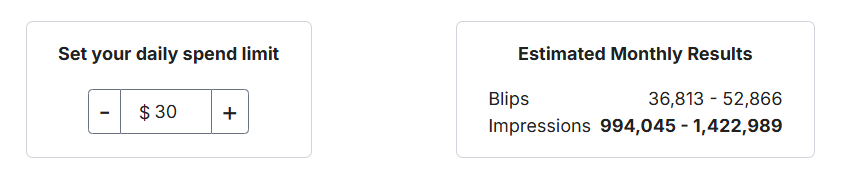
With Blip, you can advertise on Paramus billboards on any budget thanks to flexible, pay-per-blip pricing. Each blip is a brief 7.5 to 10-second ad on rotating digital billboards near Paramus, New Jersey, and you only pay for the blips you receive. You simply set a daily budget, and Blip automatically keeps your campaign within that amount, so you stay in control of your spend while reaching drivers in the Paramus area.
Where can I advertise with Blip near Paramus, New Jersey?
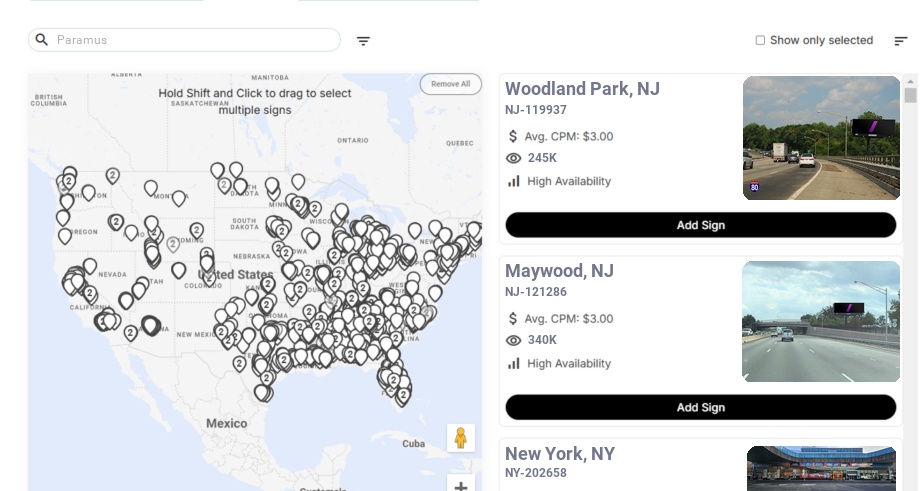
Blip’s 46 digital billboards within 10 miles of Paramus give advertisers access to a cluster of inventory surrounding the borough. These boards are positioned in nearby municipalities like Maywood, Hackensack, Lodi, Bogota, Woodland Park, Little Falls, Totowa, Ridgefield, and Ramsey. Because they sit on the main approach routes, advertisers can use Blip to reach people just before they enter the Paramus retail and business ecosystem.
Why is Paramus, New Jersey a strong market for billboard advertising?
Paramus is one of the most powerful retail corridors in the United States, with massive daily traffic on Route 4, Route 17, the Garden State Parkway, and I-80. The borough is dense and affluent, with a daytime population that can swell to 150,000–200,000 people on busy shopping days. It also has some of the highest retail sales per square mile in the country, making it a high-value market for advertisers.
When is the best time to run billboard ads in Paramus, New Jersey?
Monday through Saturday are prime for retail because Paramus stores are closed on Sundays under the borough’s blue laws. Regional news coverage routinely shows Thursday through Saturday as the heaviest mall traffic days, with parking lots near capacity on peak weekends and during the mid-November to late-December season. Morning and evening commute windows also matter, with 6–9 a.m. and 3–7 p.m. capturing major traffic.
What kind of audience can I reach in Paramus, New Jersey with billboards?
Within about a 10-mile radius of Paramus, advertisers can reach an affluent, family-oriented, commuter-heavy audience. Bergen County median household income is described as being in the $110,000–$120,000 range, and many nearby communities have high shares of households with children under 18. The area also includes diverse communities with strong immigrant and bilingual populations, creating opportunities for targeted creative.
Do I need a contract to advertise with Blip near Paramus?
No, Blip has no long-term contracts or minimum commitments. You can start, pause, or stop your campaign at any time.
How fast can I launch a billboard campaign with Blip near Paramus?
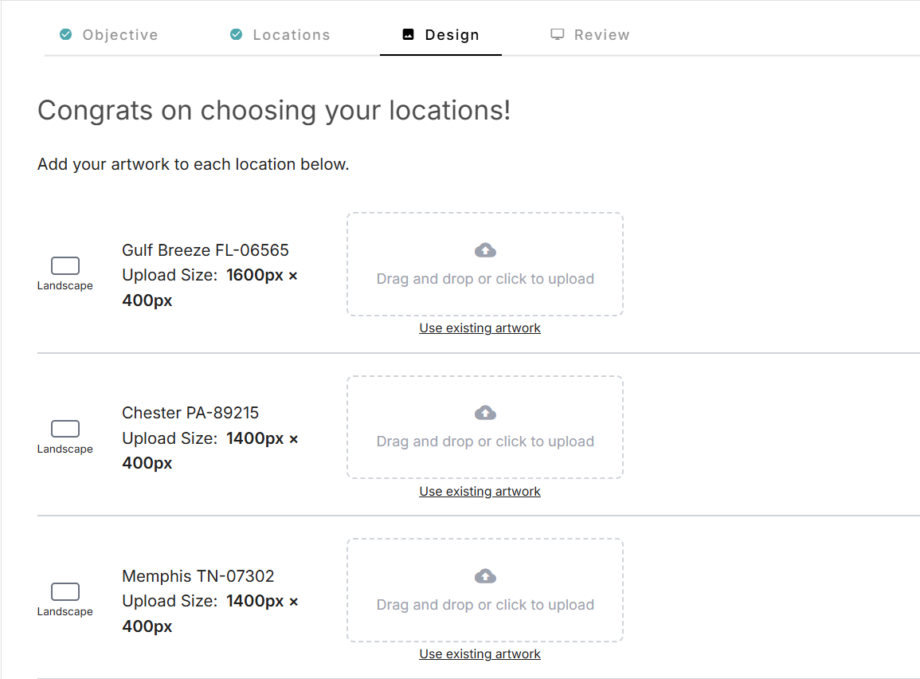
You can have your campaign live in minutes. Create a free account, select your locations, set your budget, upload your design, and start running once approved.
Where can I advertise with Blip near Paramus?
Blip has digital billboards near Paramus. You can browse available locations on a map, choose the ones that fit your audience, and start advertising right away.
Still have questions? Launch a campaign in minutes — no contracts, no commitments.
Start Your CampaignParamus Billboard Advertising Guide
Paramus, New Jersey is one of the most powerful retail corridors in the United States, and our 46 digital billboards within 10 miles give us a unique way to tap into that buying power. With massive daily traffic on Route 4, Route 17, the Garden State Parkway, and I‑80, plus some of the highest retail sales per square mile in the country, advertisers can use Blip’s flexibility to reach shoppers, commuters, and high‑income households moving through the Paramus area all week long. For brands specifically looking for billboards near Paramus, this cluster of inventory functions as an integrated, high‑impact network surrounding the borough.
Understanding the Paramus Area Market
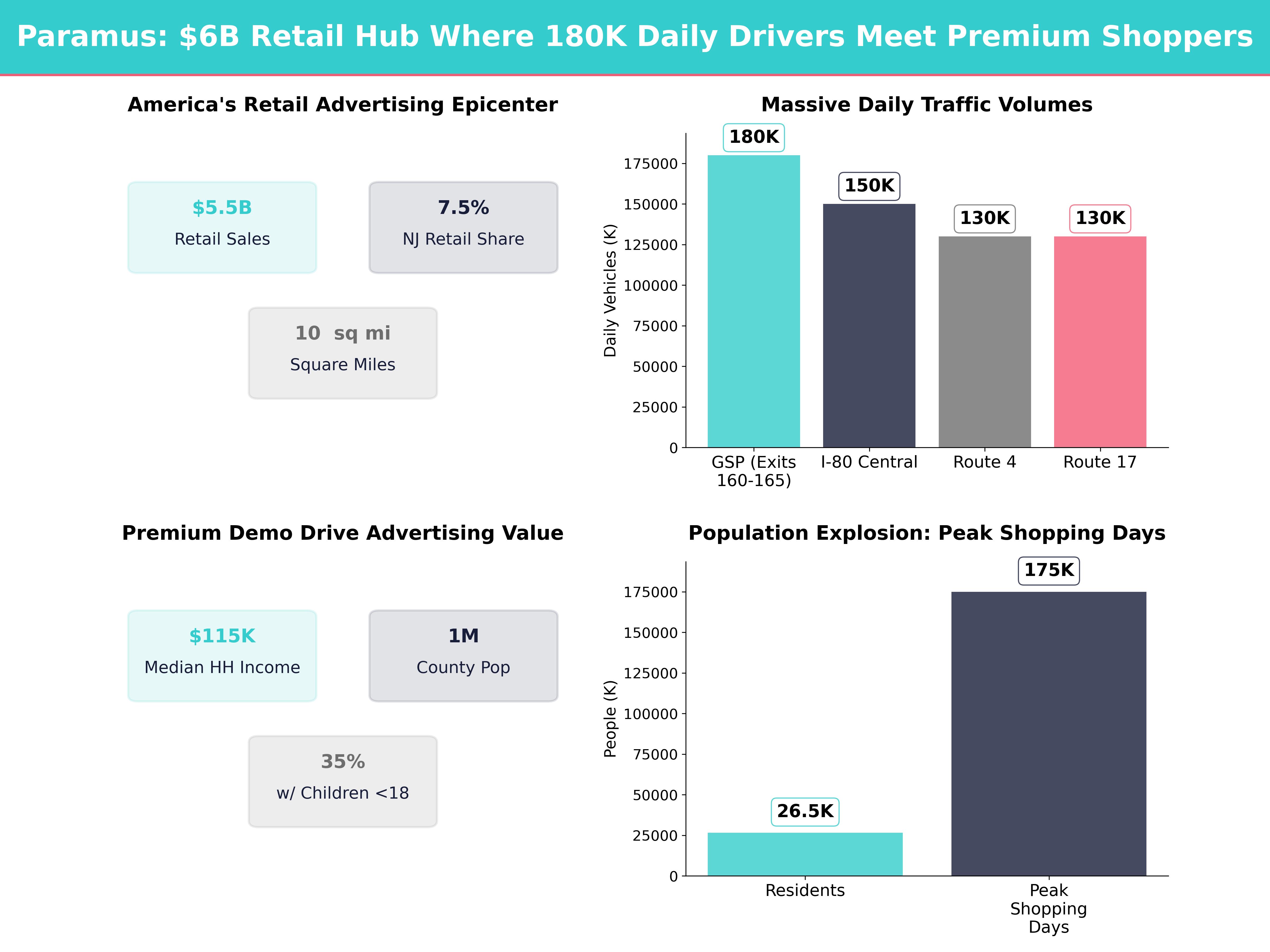
Paramus is a dense, affluent Bergen County suburb just 10 miles from Midtown Manhattan. The Borough of Paramus reports a population of roughly 26,000–27,000 residents within just over 10 square miles, for a density of around 2,500–2,700 residents per square mile according to local planning documents from the Borough of Paramus. The borough regularly notes that its daytime population can swell to 150,000–200,000 people on busy shopping days as workers and visitors pour into the area’s malls, big‑box centers, medical offices, and corporate facilities.
Bergen County as a whole has close to 1 million residents, and county demographic summaries from Bergen County government show that it consistently ranks among New Jersey’s largest and most affluent counties. Paramus sits at the center of many of these residents’ weekly shopping and commuting patterns, with local traffic studies identifying the Paramus retail corridor as one of the region’s highest‑volume shopping destinations.
A few key indicators of the market’s strength:
- Paramus has long been cited as one of the top retail ZIP codes in the U.S., with local officials and regional media often noting annual retail sales exceeding $5–6 billion, concentrated in just over 10 square miles. Local reporting in outlets such as NorthJersey.com has estimated that Paramus retail alone accounts for roughly 7–8% of all retail sales in New Jersey, despite the borough’s small size.
- The borough hosts multiple major shopping centers, including Westfield Garden State Plaza, Bergen Town Center, Paramus Park, and Fashion Center 2+ million square feet of retail space and 300+ stores, while Bergen Town Center lists over 100 retailers and eateries.
- Local news outlets like NorthJersey.com and Paramus Patch frequently highlight Paramus traffic, mall expansions, and redevelopment projects, with individual mall expansion or renovation plans often exceeding $100 million in investment.
For advertisers, this means a relatively small geographic area near Paramus delivers outsized access to consumers with disposable income who are already in a buying mindset and often come prepared for significant spend on apparel, electronics, home goods, and dining. Investing in Paramus billboards or other formats along the surrounding corridors allows brands to plug directly into this concentrated demand.
Where Our Billboards Reach the Paramus Area
While our 46 digital billboards are located in nearby municipalities, they are positioned on the same major arteries Paramus shoppers and commuters use every day, including a range of billboards near Paramus that function as de facto gateways into the borough:
- Maywood and Hackensack (4.0 miles): Ideal for reaching drivers heading toward the Route 4/Route 17 retail core, Hackensack University Medical Center, and downtown Hackensack. Hackensack University Medical Center alone employs 9,000+ staff and reports hundreds of thousands of annual patient visits, creating heavy, year‑round professional and visitor traffic on adjacent routes.
- Lodi and Bogota (6.0 miles): Close to I‑80 and Route 46, capturing east‑west commuters traveling between Passaic/Bergen counties and the George Washington Bridge. Local traffic counts referenced by the New Jersey Department of Transportation show several I‑80 and Route 46 segments in this area carrying 120,000–150,000 vehicles per day.
- Woodland Park Little Falls (8.6 miles), and Totowa (9.0 miles): Great for intercepting I‑80 and Route 46 traffic coming from western suburbs into the Paramus area. These corridors link densely populated Passaic and Essex County suburbs, where local planning boards report tens of thousands of resident commuters traveling toward Bergen County and New York City each weekday.
- Ridgefield (8.3 miles): Reaches traffic destined for the George Washington Bridge, Hudson River waterfront, and eastern Bergen County corridors that feed Paramus. The Port Authority of New York and New Jersey has reported over 90 million vehicle crossings annually at the George Washington Bridge in recent years, underscoring the volume flowing through Ridgefield‑adjacent approaches.
- Ramsey (9.8 miles): Captures affluent northern Bergen County and Rockland County NY residents traveling south toward Paramus for shopping and work. Community economic profiles from Ramsey Borough describe a high proportion of professional and managerial workers commuting along Route 17 and the parallel NJ Transit Main/Bergen County lines.
Because these structures sit on the main approach routes, advertisers can use Blip to reach people just before they enter the Paramus retail and business ecosystem, capturing intent while shoppers are still deciding where to stop, eat, or spend. For marketers specifically searching for billboard advertising near Paramus, this layout offers a ready‑made framework to reach both inbound and outbound traffic with minimal waste.
Traffic, Commuting, and Travel Patterns to Leverage
Paramus is defined by roadways. According to the New Jersey Department of Transportation, average annual daily traffic (AADT) volumes on key corridors around Paramus commonly reach:
- Route 4: Often over 130,000 vehicles per day on segments approaching Paramus, with certain ramps and interchanges regularly flagged in regional congestion reports.
- Route 17: Frequently in the 120,000–140,000 vehicles per day range near the Paramus commercial strips, with weekend and holiday peaks pushing well above weekday averages.
- Garden State Parkway (Exits 160–165): Regularly above 180,000 vehicles per day on key Bergen County segments, making this one of the state’s busiest north–south corridors.
- I‑80 near Woodland Park, Totowa, and Lodi: Generally 150,000+ vehicles per day on central segments, connecting western and central New Jersey with the George Washington Bridge and New York City.
Regional commuting data cited by Bergen County government and transportation planners indicate that well over 60% of employed residents in many nearby municipalities travel to jobs outside their home town, with thousands commuting daily to Paramus, Hackensack, and New York City. NJ Transit ridership reports for nearby rail lines and bus routes also show strong weekday utilization, with popular Bergen County bus routes carrying thousands of passenger trips per day along the same corridors.
These numbers tell us several things:
- Heavy peak‑hour congestion: Slow‑moving traffic near malls and interchanges increases dwell time and ad readability; local media often highlight “stop‑and‑go” conditions on Route 4 and Route 17 during Friday evenings and the December holiday rush.
- Regional draw: Shoppers frequently travel 10–25+ miles to reach Paramus malls, a range that takes in large parts of Bergen, Passaic, Essex, Hudson, and Rockland counties. Boards in nearby cities are still strongly relevant to Paramus‑focused messaging.
- Bidirectional opportunity: Morning peaks (often 6–9 a.m.) are dominated by commuters heading toward job centers, while evening peaks (3–7 p.m.) capture both homebound commuters and shoppers. Weekends, particularly Saturdays, see full‑day elevated volumes, especially in November and December.
We can use Blip’s location and daypart controls to selectively appear on the corridors and time windows that matter most for each campaign, maximizing impressions when traffic volumes and consumer intent are highest. This is especially valuable for brands seeking cost‑efficient billboard rental near Paramus, where timing and placement can dramatically improve return on spend.
Local Nuance: Paramus Blue Laws and Sunday Strategy
Paramus is nationally known for its strict blue laws. Most retail stores are closed on Sundays, particularly in the large malls. The Borough of Paramus explains these laws on its official website, and local coverage in outlets like Patch Paramus often revisits their impact on retail and traffic. Local officials note that, even with one day of major retail closure each week, Paramus still generates multi‑billion‑dollar annual retail sales, underlining the intensity of Monday–Saturday activity.
What this means for billboard strategy:
- Monday–Saturday are prime for retail: Retailers effectively compress seven days of shopping into six. Regional news coverage routinely shows Thursday–Saturday as the heaviest mall traffic days, with parking lots near capacity on peak weekends and during the mid‑November to late‑December season.
- Sunday traffic is more residential and through‑travel: While Paramus stores are closed, the Garden State Parkway, I‑80, and cross‑county routes still carry visitors returning from shore trips, sporting events, and family activities. Traffic counts show that Sunday volumes on major highways often remain at 70–85% of weekday levels, even though Paramus retail is largely dark.
- We can adjust budgets by day: Use Blip to push more impressions Monday–Saturday for shopping messages, and shift Sunday to brand awareness, upcoming‑week promotions, online offers, or non‑retail categories (healthcare, education, entertainment outside Paramus, etc.).
Instead of paying a flat weekly rate, advertisers can down‑weight or up‑weight specific days in line with local laws and behavior, reflecting the real distribution of shoppers on the road. For many brands, this dynamic control turns Paramus billboards and surrounding inventory into high‑efficiency media rather than blunt instruments.
Who You’re Reaching in the Paramus Area
Within about a 10‑mile radius of Paramus, we tap into a broad but consistently high‑value audience:
- Affluence: Bergen County ranks among New Jersey’s highest‑income counties. County economic profiles published by Bergen County government and referenced by state labor agencies indicate a median household income in the $110,000–$120,000 range, well above New Jersey’s already‑high statewide median and significantly above national figures. Many Paramus‑area suburbs, such as Ramsey, Ridgewood, and parts of Paramus itself, post even higher medians, supporting demand for premium products and services.
- Family‑oriented: Local school district data and county demographic summaries show that in many Bergen County communities, 30–40% of households include children under 18. The Paramus Public Schools district alone serves several thousand students across multiple elementary schools, a middle school, and Paramus High School, underscoring the importance of family‑driven spending on education, healthcare, activities, and dining.
- Commuters to NYC and regional hubs: NJ Transit reports that nearby rail lines (such as the Main/Bergen County Line) and express buses carry tens of thousands of daily riders into Manhattan and regional job centers. In many Paramus‑area municipalities, over 60% of workers commute out of town, and thousands cross into New York City each weekday. High volumes of drive‑alone commuters along Routes 4, 17, I‑80, and the Garden State Parkway create consistent exposure for roadside media.
- Diverse communities: Nearby communities such as Hackensack, Lodi, and Ridgefield are racially and ethnically diverse, with strong immigrant and bilingual populations. Local school and municipal reports in these towns often show 30–50% of residents speaking a language other than English at home, with Spanish among the most common.
Implications for creative and targeting:
- Price‑flexible messaging: Upscale services (cosmetic dentistry, financial advisors, luxury auto, high‑end home improvement) can lean into quality, trust, and lifestyle benefits rather than heavy discounting, as household incomes and home values support premium positioning.
- Family benefits front‑and‑center: Highlight convenience, safety, education, and “for the kids” angles for most consumer offerings—after‑school programs, pediatric care, family restaurants, and weekend activities all resonate with local household structures.
- Bilingual opportunities: In some corridors, Spanish‑inclusive ads can increase relevance—especially near Lodi, Hackensack, and Bogota. With digital creative, we can alternate English and bilingual messages by time of day or day of week, for example running Spanish‑inclusive creative during evening commute windows when family decision‑makers are most likely to be together in the car.
Seasonality in the Paramus Retail Calendar
Paramus area traffic is relatively high year‑round, but certain months stand out, both on the roads and in sales performance:
- Back‑to‑School (late July–early September): Mall operators such as Westfield Garden State Plaza and Paramus Park promote extended hours and large‑scale back‑to‑school events during this period. Regional retail reporting for northern New Jersey often notes double‑digit percentage increases in apparel, footwear, and electronics sales compared with early summer weeks. Parking utilization and traffic reports show consistently full lots on August weekends, with Route 4 and Route 17 congestion extending farther from mall exits.
- Holiday Season (mid‑November–December): This is one of the busiest retail corridors in New Jersey. Local coverage on NorthJersey.com frequently highlights pre‑Thanksgiving and December weekends where mall parking lots reach or approach capacity, and Route 4/17 backups stretch 1–2 miles from major shopping centers. Retail trade associations and state economic agencies often report that, statewide, 20–30% of annual retail sales are concentrated in November–December, and Paramus is a key contributor to that spike.
- Spring Home Improvement (March–May): As temperatures warm, home services, furniture, and garden centers see strong demand. Regional building permit data referenced by Bergen County towns show an uptick in residential remodeling and renovation applications in spring, and large home‑improvement chains on Route 17 and nearby corridors heavily promote seasonal sales.
- Summer Weekends: More traffic is oriented toward the Jersey Shore and vacation routes via the Garden State Parkway and I‑80, but Paramus‑area malls still pull steady footfall for air‑conditioned shopping, movies, and dining. State tourism statistics from Visit New Jersey show tens of millions of leisure trips across the state each summer, and the Paramus corridors benefit from both origin‑and‑return traffic for these trips.
How we can align campaigns:
- Increase budget caps and expand dayparts during back‑to‑school and holiday periods, especially Thursday–Saturday, when both traffic and purchase intent are highest.
- For home services, ramp up impressions in March–May and August–October, when homeowners are planning and scheduling projects before winter.
- For attractions, camps, and experiences, push earlier in the year (January–April) when families in the Paramus area plan summer activities and enrollments, taking advantage of strong household incomes and a high share of families with school‑aged children.
Creative Best Practices for Billboards Serving the Paramus Area
Given the mix of high‑speed highways and congested local arteries, creative should be optimized for readability and immediate impact. Advertisers using Paramus billboards or boards in neighboring towns can apply the same set of best practices to ensure messages land with fast‑moving audiences.
1. Design for quick comprehension
- Limit to 6–8 words of main copy when possible, which matches industry research showing that shorter copy significantly improves recall on billboards viewed for 3–6 seconds.
- Use large, high‑contrast fonts; avoid thin type that disappears at a distance.
- Keep one clear focal element: a logo, product image, or bold headline—especially important in heavy‑traffic environments where visual clutter is already high.
2. Emphasize proximity and convenience
People in the Paramus area know the road network well. Copy like:
- “Exit 160 – 5 Minutes Ahead”
- “On Route 17, Next to Paramus Park”
- “Free Parking off Route 4 West”
helps drivers connect your message to their mental map. If your business is in or near Paramus malls, make that clear; local shoppers respond strongly to precise landmarks such as “across from Garden State Plaza” or “by the Route 17/Ikea exit.” Positioning copy this way can significantly improve performance for billboard advertising near Paramus because it grounds your offer in familiar reference points.
3. Time‑sensitive offers tied to shopping patterns
- “This Weekend Only – Route 17 Location”
- “Tonight: Kids Eat Free in Paramus Area”
- “Holiday Sale – Through Dec 24”
We can rotate creatives throughout the week—one version for weekday commuters, another for Friday/Saturday shoppers. Digital rotation enables you to respond quickly to weather swings, flash sales, or local events promoted on sites like NorthJersey.com and Paramus Patch.
4. Reflect local lifestyles
- Use images that match the area: families, commuters, local sports culture, and suburban home life. Youth sports participation and school activities are high across Bergen County, giving family‑and‑kids imagery broad appeal.
- For campaigns targeting NYC commuters, show the contrast between city grind and local convenience or relaxation—“Skip the City Crowds, Shop in Paramus,” or “15 Minutes from the Bridge, Worlds Away from the Rush.”
5. Lean into brand building on congestion‑prone routes
Segments approaching the Paramus retail zone often move slowly, especially near holiday periods and big sale weekends. This gives us freedom to run cleaner, brand‑forward creative that people see repeatedly on their regular routes, such as:
- Short taglines
- Distinctive color blocking
- Simple icons or mascots
The frequency of exposure—commuters may pass the same board 200+ times per year—supports long‑term brand recognition and preference, even when a specific offer is not in market.
Using Blip’s Tools to Match Paramus Area Rhythms
Blip’s flexibility is especially powerful around Paramus because travel patterns and shopper intent shift hourly. Whether you’re exploring billboard rental near Paramus for a short‑term push or planning an always‑on presence, these controls allow you to fine‑tune delivery.
Dayparting (time‑of‑day control)
- Morning drive (6–10 a.m.): Target commuters with coffee, breakfast, transit options, news, and financial services. Healthcare and education messages also perform well here, as many residents schedule appointments and school choices around work hours.
- Midday (10 a.m.–3 p.m.): Focus on stay‑at‑home parents, retirees, and shift workers. Great for retail deals, medical appointments, fitness centers, and lunchtime dining, particularly near malls and medical campuses like Hackensack University Medical Center.
- Evening (3–8 p.m.): Prime time for mall trips and errands; Route 4, Route 17, and Garden State Plaza‑adjacent roads often see their highest shopper counts in this window. Ideal for retail, grocery, QSR, and family entertainment.
- Late evening (8–11 p.m.): Branding for streaming services, entertainment, late‑night dining, and next‑day promos. This window also captures shift workers in healthcare, hospitality, and logistics.
Day‑of‑week strategy
- Mon–Thu: Emphasize upcoming weekend offers, appointments, and routine services (auto repair, primary care, financial planning). Many Bergen County households plan weekend outings and purchases during these days.
- Fri–Sat: Run your strongest retail and restaurant pushes; consider higher bids or more boards on these days, as traffic counts and in‑mall spend peak.
- Sun: With Paramus retail restrictions, shift messaging toward online sales, subscription services, or businesses outside the Paramus blue‑law zone, while also reinforcing top‑of‑funnel branding that prepares audiences for Monday–Saturday action.
Location control
We can select specific boards in Maywood, Hackensack, Lodi, and other nearby cities to:
- Hit inbound shoppers heading toward Paramus from outlying towns, especially along I‑80, Route 46, and local connectors.
- Reach employees of major employers in Hackensack and the surrounding medical and corporate corridor, where large campuses and office parks employ thousands of professionals.
- Capture through‑traffic heading to or from NYC via Ridgefield and Bogota, leveraging the massive flows to the George Washington Bridge and Hudson River waterfront.
This location and schedule control gives advertisers a practical way to make billboard advertising near Paramus behave more like a targeted digital channel, emphasizing only the routes and hours that align with their goals.
Example Campaign Strategies for the Paramus Area
1. Regional Retailer with a Paramus Location
- Objective: Drive weekend store traffic and brand awareness.
-
Tactics:
- Concentrate impressions on Thursday–Saturday, 11 a.m.–8 p.m., aligning with the heaviest mall visitation days and evening peaks.
- Use boards near Hackensack, Maywood, and Lodi to catch inbound shoppers from Passaic, Essex, and western Bergen counties.
- Rotate creatives: midweek “Coming This Weekend” teaser; weekend “Today Only – Extra 20% Off Route 17 Store.”
- Track lift in store traffic and sales from Paramus and neighboring ZIP codes, watching for percentage‑point increases during flighted weeks versus baseline.
2. Healthcare System or Clinic
- Objective: Book appointments and build trust.
-
Tactics:
- Always‑on presence weekdays, 6 a.m.–8 p.m., to reach commuters and caregivers.
- Simple messaging: “Same‑Day Urgent Care – 10 Minutes from Paramus Area” plus URL or short code.
- Emphasize locations in Hackensack, Paramus, or nearby towns where patients already travel; local hospital and clinic networks often draw from a 10–15‑mile radius.
- Use different creatives for primary care, urgent care, and specialties, then correlate impressions with appointment volume for each service line.
3. Home Improvement or Contractor Serving Bergen County
- Objective: Generate leads within specific ZIP codes.
-
Tactics:
- Heaviest spending March–May and September–October, aligning with local peaks in renovation permits and outdoor work.
- Focus on boards in Ramsey, Totowa, Little Falls, and Woodland Park to reach homeowners who routinely drive toward Paramus area stores and show higher rates of single‑family home ownership.
- Creatives highlighting “Bergen County’s #1 Roofer” or “Free Estimates – Serving Paramus Area Homes,” plus a trackable URL or phone number.
- Monitor call volume and web inquiries by ZIP to identify which corridors generate the most leads; then increase bid levels on the best‑performing boards.
4. Restaurant or Entertainment Venue Near Paramus
- Objective: Capture same‑day and next‑day visits.
-
Tactics:
- Daypart around lunch (11 a.m.–2 p.m.) and dinner (4–8 p.m.), when congestion near malls and restaurant clusters peaks.
- Use time‑related copy: “Tonight,” “This Weekend,” or “Kids Eat Free Mondays.”
- Shift budgets away from Sunday in line with local blue laws if venue is inside Paramus; or, if outside, lean into Sunday as a differentiator (“Open Sundays – 5 Minutes from Paramus”).
- Tie creative to major calendar moments—back‑to‑school celebrations, holiday shopping breaks, or movie releases at mall cinemas.
Measuring and Optimizing Your Campaign
We encourage advertisers to treat Paramus area campaigns as ongoing experiments:
- Align boards with store or web analytics: Watch for lifts in traffic or conversions from ZIP codes along the selected corridors (Hackensack, Lodi, Maywood, etc.). Even a 5–10% increase in visits or online orders from targeted ZIPs during campaign windows can signal strong ROI.
-
Test multiple creatives:
- Version A: Brand‑forward, simple tagline.
- Version B: Offer‑driven with a promo code or vanity URL.
- Rotate via Blip and compare downstream performance in your POS or analytics tools.
- Adjust bids by performance: If a specific corridor (e.g., Hackensack inbound to Route 4) drives more conversions, shift more spend to those boards and timeframes. Likewise, reduce bids on routes that show weaker response over time.
- Sync with other media: Coordinate messaging with local digital ads or placements on news outlets such as NorthJersey.com or community sites like Paramus Borough and Bergen County government. Reinforcing the same offer or tagline across channels can significantly lift recall and response.
By combining these local insights with Blip’s flexible, data‑driven tools, we can build Paramus area campaigns that reach the right people, on the right roads, at the right times—maximizing every advertising dollar on our 46 digital billboards serving this powerful retail market. For advertisers comparing options for billboards near Paramus, this approach offers a scalable, testable way to turn area traffic patterns into measurable business outcomes.