Billboards in Jersey City, NJ
No Minimum Spend. No Long-Term Contracts. Just Results.
Trusted by Leading Brands


Billboard advertising
in Jersey City has never been easier
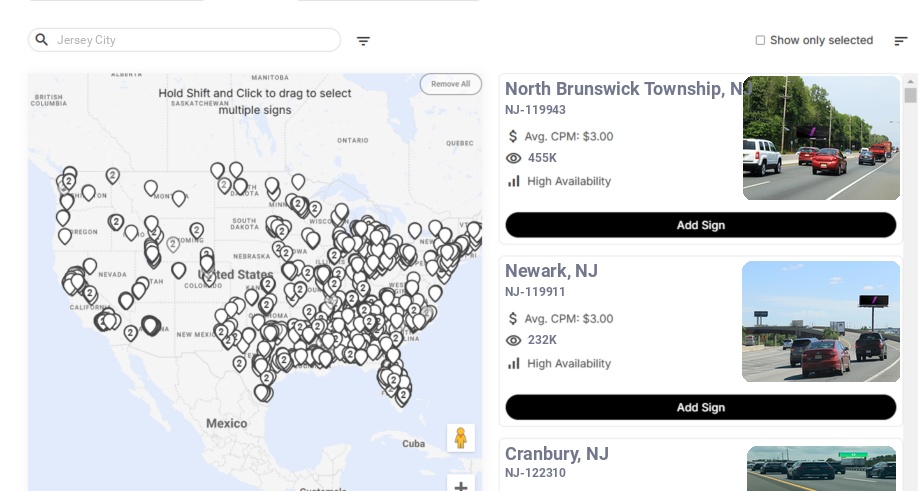



How much is a billboard in Jersey City?
Why Choose Blip for Billboard Advertising in Jersey City
-
Blip lets you launch Jersey City ads in minutes, reaching Holland Tunnel and I-78 commuters without long-term contracts.
-
Set a flexible budget in Jersey City and focus on Route 1&9, JFK Boulevard, or Route 440 when traffic is heaviest.
-
Use Blip dayparting to catch Jersey City rush hours, lunch crowds in Newport, and weekend visitors to Liberty State Park.
-
Track Jersey City performance in real time and shift spend fast as Journal Square, Exchange Place, or waterfront traffic changes.
-
Blip’s creative tools help Jersey City campaigns stand out with bold, local copy for commuters, students, and diverse neighborhoods.
Frequently Asked Questions About Billboard Advertising in Jersey City
How much does a billboard cost in Jersey City, New Jersey with Blip?
With Blip, you set a daily budget that works for you, and your ad appears in short, 7.5 to 10-second “blips” on rotating digital Jersey City billboards, so you only pay for the exposure you actually receive. Because each blip is priced based on when and where it runs and current advertiser demand, you stay in control of how much you spend while reaching people on busy roads and in key areas. You choose your own spend, adjust it anytime, and let Blip maximize your impressions on billboards in Jersey City, New Jersey.
Where can I advertise with Blip in Jersey City, New Jersey?
High-traffic approaches to the Holland Tunnel, I‑78/Turnpike Extension, and Route 1&9 are ideal when your goal is regional reach. Use neighborhood-facing boards along JFK Boulevard, Route 440, and cross-town arterials for hyperlocal campaigns. These corridors can reach commuters, residents, and shoppers throughout Jersey City and the broader New York metro area.
What kind of audience do Jersey City billboards reach?
Jersey City is one of the fastest-growing cities in New Jersey and a vital part of the broader regional economy, making billboards especially valuable for advertisers looking to tap into the New York metro without Manhattan-level costs. The city has dense neighborhoods, high-income waterfront districts, and some of the region’s heaviest commuting corridors. More than 40% of residents are foreign-born, and over 50% speak a language other than English at home.
When is the best time to run Blip ads on Jersey City billboards?
Blip’s ability to schedule ads by time of day and day of week is particularly powerful in Jersey City because the city’s traffic patterns are so tied to commuting and events. Morning rush is strong for traffic heading east toward Manhattan, midday is great around Newport, Exchange Place, and Grove Street, and evening rush works well for westbound traffic and local trips. Weekends can be effective for Liberty State Park, Liberty Science Center, shopping, and local events.
Which Jersey City neighborhoods are best for Blip billboard campaigns?
Downtown and Waterfront areas like Newport, Exchange Place, and Paulus Hook are strong for high-income professionals, young renters, and office workers. Journal Square and Newark Avenue work well for commuters, students, and diverse immigrant communities, while Bergen-Lafayette, Greenville, and the West Side fit family services, value messaging, and campus-adjacent offers. The best neighborhood depends on whether you want premium, transit-heavy, family-focused, or student-focused reach.
Do I need a contract to advertise with Blip in Jersey City?
No, Blip has no long-term contracts or minimum commitments. You can start, pause, or stop your campaign at any time.
How fast can I launch a billboard campaign with Blip in Jersey City?
You can have your campaign live in minutes. Create a free account, select your locations, set your budget, upload your design, and start running once approved.
Where can I advertise with Blip in Jersey City?
Blip has digital billboards in Jersey City. You can browse available locations on a map, choose the ones that fit your audience, and start advertising right away.
Still have questions? Launch a campaign in minutes — no contracts, no commitments.
Start Your CampaignJersey City Billboard Advertising Guide
Jersey City sits at the heart of the New York metropolitan area, but it has a distinct identity, economy, and rhythm that make it a powerful standalone market for digital billboard advertising and Jersey City billboard advertising. With dense neighborhoods, high-income waterfront districts, and some of the region’s heaviest commuting corridors, Jersey City allows us to use Blip’s flexibility with Jersey City billboards to reach both local residents and New York–bound commuters with highly tailored campaigns.
Why Jersey City Is a High-Impact Digital Billboard Market
Jersey City is one of the fastest-growing cities in New Jersey and a vital part of the broader regional economy, which makes billboards in Jersey City especially valuable for advertisers looking to tap into the New York metro without Manhattan-level costs.
-
Population scale and density
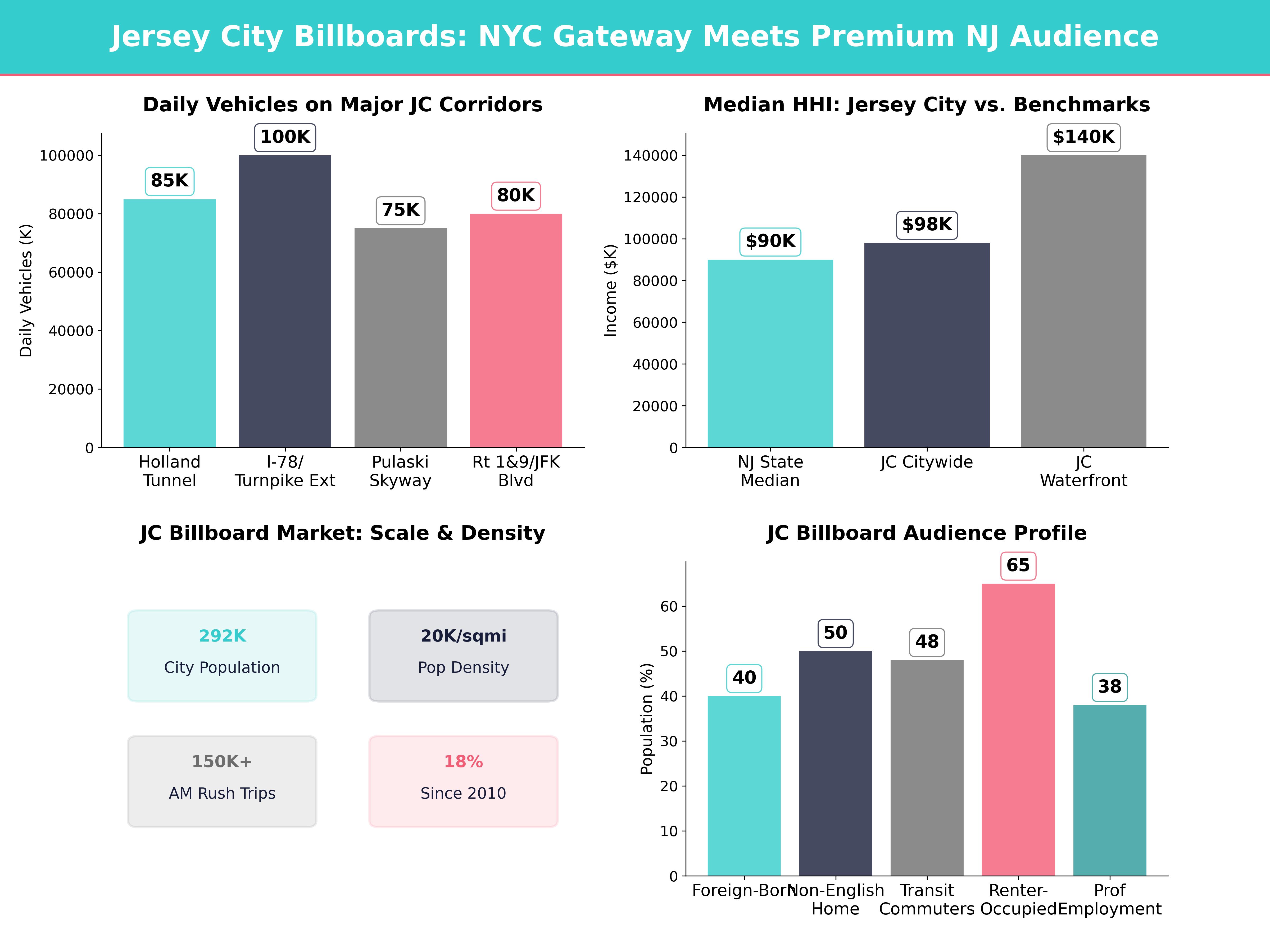
- Jersey City’s population is roughly 290,000–295,000 residents, making it New Jersey’s second-largest city and accounting for well over 30% of Hudson County’s total population. Current city estimates place the population near 292,000.
- The city’s land area is about 15 square miles, which means population density exceeds 19,000–20,000 residents per square mile—more than double Newark’s density (about 11,700 per square mile) and similar to some New York City borough averages.
- More than 75% of residents live in multi-unit structures (3+ units), creating intense concentration along major arterials and near transit hubs.
- High density translates directly into frequent repeat exposure for billboards along main corridors like Route 1&9, I‑78, and JFK Boulevard, where daily traffic counts routinely exceed 60,000–100,000 vehicles, based on New Jersey Department of Transportation (NJDOT) traffic monitoring.
-
Economic strength
- Median household income in Jersey City is around $95,000–100,000, outpacing the New Jersey statewide median (low $90,000s) and placing the city among the higher-income urban cores in the region.
- In waterfront neighborhoods such as Newport and Paulus Hook, median household incomes frequently top $130,000–$150,000, reflecting the strong presence of finance, tech, and professional services workers in luxury high-rise buildings.
- Professional, scientific, management, finance, and information jobs account for roughly 35–40% of local employment, supporting demand for premium brands, financial services, and business-to-business offerings.
- Major employers include global financial firms (Goldman Sachs, JPMorgan, Barclays, DTCC), healthcare systems such as Jersey City Medical Center/RWJ Barnabas (with more than 3,000 employees), and large public-sector institutions including the City of Jersey City, Hudson County, Hudson County Community College, and New Jersey City University.
-
Local government and growth focus
- The City of Jersey City emphasizes continued development and mixed-use growth in its master plans and redevelopment studies, with dozens of residential towers either built, under construction, or approved along the waterfront and in Journal Square, Bergen-Lafayette, and West Side. City planning and redevelopment information is available through the City Planning Division jerseycitynj.gov
- Over the past decade, Jersey City has added tens of thousands of new housing units, with thousands more entitled or in the pipeline, helping drive a population increase of roughly 15–20% since 2010.
- This growth trajectory means more residents, more small businesses, and more demand for local advertising to stand out, making Jersey City billboard advertising increasingly effective.
For advertisers, these numbers point to a market with high purchasing power, heavy repeat exposure potential, and strong growth—ideal conditions for building brand presence using Blip’s flexible, budget-friendly buys and on-demand billboard rental in Jersey City.
Understanding Local Audience Patterns and Traffic Flows
To make digital billboards work in Jersey City, we need to follow how people actually move through the city and metro area.
-
Regional commuting into and through Jersey City
- The Holland Tunnel, connecting Jersey City to lower Manhattan, typically carries 80,000–90,000 vehicles per day, according to traffic data from the Port Authority of New York and New Jersey. Annual traffic through the tunnel is on the order of 30+ million vehicles.
- The New Jersey Turnpike Hudson County Extension (I‑78) and Route 139 funnel traffic toward the Holland Tunnel and the waterfront. On key segments approaching Jersey City, average annual daily traffic often runs above 100,000 vehicles, per NJDOT counts.
- The Pulaski Skyway (Route 1&9), linking Newark and Jersey City, carries in the neighborhood of 70,000–80,000 vehicles per day, functioning as a critical east–west commuter artery for both New Jersey and New York–bound travel.
- Regional corridors like Route 440 and Truck Route 1&9 add tens of thousands more daily trips, particularly from freight, industrial workers, and shoppers accessing big-box retail.
-
Transit-heavy commutes
- Jersey City has one of the highest public-transit commute shares in New Jersey: roughly 45–50% of workers use PATH, light rail, buses, or ferries to reach work, and more than 30% of households have no vehicle available, making transit corridors especially important for message frequency.
-
Major transit hubs:
- Journal Square Transportation Center – A core hub for PATH trains and extensive NJ TRANSIT and private bus routes, serving tens of thousands of passengers daily.
- Newport and Exchange Place – PATH, Hudson-Bergen Light Rail, and proximity to Hoboken Terminal and ferries; these stations serve large waterfront office towers and residential complexes.
- Liberty State Park and West Side Avenue – Hudson-Bergen Light Rail stations that connect dense residential areas and emerging redevelopment zones to downtown and Hoboken.
- PATH’s systemwide ridership runs in the tens of millions of trips per year, and Jersey City’s stations account for a significant share of that volume, injecting thousands of impressions per hour around key platforms and access roads.
- For advertisers whose boards are visible from transit corridors or near park-and-ride facilities, messaging must be readable in 1–3 seconds and tailored for repeat daily viewers who pass the same locations 10+ times per week.
-
Local vehicle patterns
- While transit is strong, a substantial portion of residents still rely on cars for local trips between neighborhoods—e.g., from Greenville and West Side to Downtown, or from Bergen-Lafayette to the waterfront. Local car-commute shares are typically around 40–45%.
- Key intra-city routes include JFK Boulevard, Communipaw Avenue, Grand Street, Montgomery Street, and Route 440, where average daily traffic can range from 20,000 to 50,000+ vehicles depending on the segment, per NJDOT corridor data.
- These corridors produce frequent reach among residents, families, and service workers, not just commuters to New York, making them ideal for hyperlocal and service-focused campaigns that rely on strategically placed billboards in Jersey City.
What this implies for your Blip campaign:
- Prioritize high-traffic approaches to Holland Tunnel, I‑78/Turnpike Extension, and Route 1&9 when your goal is regional reach (Northern NJ + NYC commuters). These corridors alone can deliver exposure to hundreds of thousands of unique drivers per week.
- Use neighborhood-facing boards along JFK Boulevard, Route 440, and cross-town arterials for hyperlocal campaigns—restaurants, services, retailers, and events targeting residents within 1–3 miles.
Demographics and Messaging Strategy
Jersey City is one of the most diverse cities in the country, and that should shape both creative and campaign strategy.
-
Ethnic and cultural diversity
- Roughly 30–35% of residents are Hispanic/Latino.
- Around 25–30% are Asian, with large Indian, Filipino, Pakistani, and Chinese communities—particularly in areas near Journal Square and along Newark Avenue (often referred to as “India Square”).
- Black residents account for about 20–25%, with strong communities in Greenville, Bergen-Lafayette, and parts of West Side.
- White (non-Hispanic) residents represent roughly 20–25% of the population, contributing to a true “majority-minority” city where no single group holds a majority share.
- More than 40% of residents are foreign-born, and over 50% speak a language other than English at home, including Spanish, Hindi, Gujarati, Tagalog, Arabic, and others.
Implications for creative:
-
Consider bilingual or multilingual creatives—for example:
- English + Spanish for general consumer brands, healthcare, and family services, especially in central and south Jersey City corridors.
- English + Hindi or English + Tagalog when targeting specific corridors near India Square (Newark Avenue) or Filipino communities around Journal Square and West Side.
-
Use inclusive visuals reflecting the city’s racial and cultural mix—audiences notice when they see themselves represented, and in a city where nearly 70–75% of residents are people of color, this can materially improve recall and favorability.
-
When targeting specific neighborhoods with boards primarily seen by local residents, experiment with localized copy (e.g., referencing “Journal Square,” “Bergen-Lafayette,” or “Greenville”) to tap into neighborhood pride.
-
Age, households, and lifestyle
- Median age is around 34–35, younger than both the U.S. average (about 38–39) and the New Jersey average (about 41), reflecting a large population of young professionals and students.
- Roughly 20–25% of residents are in their 20s, and another 20–25% are in their 30s, which supports demand for nightlife, fitness, tech, and on-demand services.
- Families remain a core audience: about 30% of households have children under 18, and household sizes average around 2.4–2.6 persons.
- About 60–70% of housing units are renter-occupied, indicating a mobile, brand-switching consumer base open to new services and experiences—an ideal audience for awareness and trial campaigns.
- Internet and smartphone penetration are very high, with broadband subscription rates above 85–90% in most neighborhoods, making it easier to attribute billboard exposure to digital actions.
Creative guidance:
- For waterfront and commuter-facing boards, emphasize convenience, tech, finance, lifestyle, dining, and premium retail; short, sleek creative works best for time-pressed professionals who may be earning $100,000+ per year.
- For neighborhood boards, highlight value, family benefits, and clear calls to action (e.g., “5 minutes away on West Side Ave”), knowing that many viewers live within a 5–10 minute drive of the board locations.
Timing Your Blip Campaign in Jersey City
Blip’s ability to schedule ads by time of day and day of week is particularly powerful in Jersey City, because the city’s traffic patterns are so tied to commuting and events. Smart timing makes Jersey City billboard advertising more efficient and helps you get more from each impression.
-
Weekday daypart patterns
-
Morning rush (6:30–9:30 a.m.): Strong traffic volumes heading east toward Manhattan via the Holland Tunnel, Turnpike Extension, and Route 139. Combined, these facilities handle well over 150,000 vehicle trips per weekday.
-
Ideal for:
- Coffee shops and breakfast spots targeting commuters.
- Transit-focused apps, financial services, and productivity tools.
- Brand awareness for employers recruiting regional talent into downtown and waterfront offices.
-
Ideal for:
-
Midday (11 a.m.–2 p.m.): Downtown and waterfront employees move out for lunch. Office occupancy and foot traffic surge around Newport, Exchange Place, and Grove Street, where thousands of workers are within a 5–10 minute walk.
-
Great for:
- Quick-service restaurants, cafes, gyms, and lunchtime retail.
- “Walk over now” messaging for businesses in Newport, Exchange Place, and downtown.
-
Great for:
-
Evening rush (4:30–7:30 p.m.): Heavy westbound traffic returning to the suburbs and inner neighborhoods, plus local trips to grocery stores, malls, and schools.
- Perfect for grocery, family dining, delivery apps, and after-work entertainment; boards on Route 440, JFK Boulevard, and Communipaw Avenue see a strong mix of commuters and local households in this window.
-
Morning rush (6:30–9:30 a.m.): Strong traffic volumes heading east toward Manhattan via the Holland Tunnel, Turnpike Extension, and Route 139. Combined, these facilities handle well over 150,000 vehicle trips per weekday.
-
Weekends
- Liberty State Park attracts large visitor volumes, especially April–October. The park and its waterfront paths, picnic areas, and ferry terminals draw hundreds of thousands of visitors annually, including tourists heading to the Statue of Liberty and Ellis Island. See more at Liberty State Park – NJDEP.
- Liberty Science Center, one of the state’s leading science museums, welcomes hundreds of thousands of visitors per year—with peak days often drawing several thousand families and school groups.
-
Weekend traffic skews toward:
- Families and tourists heading to Liberty Science Center and waterfront attractions.
- Shoppers visiting Hudson Mall, Newport Centre, and local commercial corridors such as Central Avenue, West Side Avenue, and Communipaw Avenue.
-
Use weekend-heavy schedules to promote:
- Tourist attractions and cultural institutions.
- Retail sales events and local festivals.
- Real estate open houses and model-home tours, especially in fast-growing neighborhoods like Journal Square, Bergen-Lafayette, and West Side.
-
Seasonality
- Summer (June–August): Outdoor events, waterfront concerts, and park activities peak—Liberty State Park alone hosts numerous public events and draws heavy picnic and bike traffic. This is ideal for seasonal products, ice cream/food brands, tourism, and events.
- Back-to-school (August–September): Target parents and students during commutes to schools and campuses like New Jersey City University (njcu.edu), Saint Peter’s University (saintpeters.edu), and Hudson County Community College (hccc.edu), which collectively enroll tens of thousands of students each year.
- Holiday season (November–December): Shopping, services, and events see a spike. Malls like Newport Centre and big-box clusters along Route 440 experience particularly high weekend traffic. Short, urgency-driven creatives (“This week only,” “Holiday special”) perform well.
- Winter: Darker commuting hours give digital creatives more visual punch. This is a strong period for visibility on evening commutes, especially on I‑78, Route 1&9, and Route 440, where illuminated digital boards can stand out even in bad weather.
With Blip, we can shift spend toward rush hours on weekdays for commuter brands, then reallocate budget toward weekend and midday impressions for retail, dining, and tourism campaigns as seasonal patterns change. This flexible approach to billboard rental in Jersey City allows advertisers of any size to match spend with real-world demand.
Creative Best Practices for Jersey City Billboards
Because so many impressions come from fast-moving vehicles and transit corridors, our creative approach must be ruthlessly clear and targeted to get the full value from billboards in Jersey City.
-
Keep it fast and bold
- Aim for 6–10 words max on key commuter boards. With average highway speeds of 35–55 mph and typical eye-on-board times as low as 2–3 seconds, brevity is essential.
- Use high-contrast color combinations that stand out against skyline and roadway environments—e.g., white/yellow on dark blue, or bold brand colors against a simple background.
- Large logos and big CTAs like “Exit at Grand St” or “5 min to Journal Sq” help viewers map your brand to their surroundings and improve directional recall.
-
Localize visuals
- Images referencing recognizable icons—Manhattan skyline views from Jersey City, the Colgate Clock, or Liberty State Park—anchor your message in place and signal that your business is local, not generic.
- For boards on corridors leading to the waterfront, creative featuring skyline imagery plus “Tonight on the Waterfront”–style headlines can be highly persuasive for the tens of thousands of professionals leaving Manhattan and downtown each evening.
-
Use Blip’s rotational flexibility
-
Run multiple creatives:
- One for morning commuters (“Skip cooking tonight—order early”).
- Another for evening viewers (“Dinner in 20 minutes – Order now”).
- A separate version for weekends (“Brunch on the waterfront today”).
-
Test bilingual versions – for instance:
- English-only vs. English + Spanish along JFK Boulevard or Communipaw Avenue.
- English + Hindi or Tagalog in corridors with strong South Asian or Filipino populations near Journal Square and West Side.
- Rotating 2–4 creatives across dayparts can quickly reveal which messages resonate best with specific audiences.
-
Run multiple creatives:
-
Drive measurable action
- Use short, trackable URLs, unique promo codes, or location-specific offers (“Show this code for 10% off at our Newark Ave location”) to connect impressions to store or online activity.
- Combine geotargeted mobile ads and social campaigns with billboard campaigns in the same corridors to reinforce recall; research consistently shows that cross-channel exposure can boost ad recall by 20–30% compared to single-channel campaigns.
- For time-sensitive promotions, consider countdowns (“2 days left,” “Ends Sunday”) to create urgency.
Neighborhood and Corridor-Specific Strategies
Jersey City is not one monolithic market. Choosing where to focus your Blip impressions should depend on your target audience and offer.
-
Downtown & Waterfront (Newport, Exchange Place, Paulus Hook)
- Audience: High-income professionals, young renters, tourists, and higher-density office workers. In some census tracts, 50%+ of residents hold a bachelor’s degree or higher, and household incomes exceed $130,000.
- Messaging: Premium dining, fitness, tech, finance, lifestyle, real estate, and luxury services.
-
Strategy:
- Prioritize weekday daytime and rush hours when office and PATH traffic is highest.
- Use aspirational, clean design and short CTAs (“Walk 3 min to Newport Centre”).
- Lean into commuter-focused offers—happy hours, delivery, quick workouts, and app sign-ups.
-
Journal Square & Newark Avenue / India Square
- Audience: Commuters, students, diverse immigrant communities, mid-income households, and small-business owners. Journal Square PATH alone sees tens of thousands of riders per weekday.
- Messaging: Transit-friendly services, education, immigration/legal services, budget-friendly retail, ethnic food and groceries, and student-focused offers.
-
Strategy:
- Consider multilingual creatives (especially English + Hindi/Urdu for India Square, and English + Spanish for surrounding blocks).
- Focus on rush hours + early evening, when commuters, students from Saint Peter’s University and Hudson County Community College, and shoppers pass through the hub.
- Use “Just off Journal Sq” or “1 block from PATH” type CTAs to capitalize on foot traffic.
-
Bergen-Lafayette & Greenville
- Audience: Longtime residents, families, working-class and middle-income households, and growing numbers of new residents in emerging redevelopment zones.
- Messaging: Family services, healthcare, local retail, education, community-based events, and value messaging around groceries, dining, and home services.
-
Strategy:
- Emphasize price, convenience, and trust—“Serving Greenville for 20+ years,” “Family doctor on Ocean Ave,” etc.
- Boards along Communipaw Avenue, Ocean Avenue, and MLK Drive can reach neighborhoods where car ownership rates are lower than citywide averages, making nearby and transit-accessible services particularly appealing.
- Align creatives with school calendars and community events promoted by the Jersey City Office of Cultural Affairs
-
West Side & Route 440 Corridor
- Audience: New Jersey City University students, families, industrial/warehouse workers, and big-box shoppers visiting plazas along Route 440 and Hudson Mall.
- Messaging: Groceries, discount retail, automotive, quick-service restaurants, healthcare, and campus-adjacent offers (tutoring, wireless plans, student housing, fitness).
-
Strategy:
- Schedule around class times and typical shift changes, with extra weight in late afternoon and early evening when students and workers are on the move.
- Consider “Today only” deals to drive spontaneous visits to Route 440 retailers and eateries.
- Use “Student discounts” and “Show your ID” offers in creative near NJCU and HCCC corridors.
-
Regional Corridors (I‑78/Turnpike Extension, Route 1&9, Pulaski Skyway)
- Audience: Northern New Jersey and New York metro commuters; not just Jersey City residents. Daily vehicle counts on these routes run into the hundreds of thousands, offering broad regional reach.
- Messaging: Regional brands, insurance, banking, auto, media, large event promotions, and tourism.
-
Strategy:
- Focus heavily during weekday rush hours and Sunday afternoon/evening travel.
- Simple, brand-first headlines that can be processed in under 2 seconds—think 4–7 words with a large logo.
- Use numeric benefits when possible (“Save 15% on car insurance,” “0% APR for 12 months”) for quick comprehension.
By mapping your audience to these corridors and using Blip’s ability to concentrate impressions where they matter most, we can avoid wasted spend and significantly increase campaign relevance for any Jersey City billboard advertising strategy.
Leveraging Events, Tourism, and Higher Education
Jersey City is event-heavy, tourist-friendly, and packed with students—fertile ground for timely, context-aware campaigns.
-
Tourism and attractions
- Liberty State Park and Liberty Science Center (LSC) draw large crowds of families, school groups, and tourists year-round. LSC is one of New Jersey’s most visited cultural attractions, with hundreds of thousands of visitors annually. Learn more about LSC at lsc.org
- Visitors heading to the Statue of Liberty and Ellis Island often pass through Jersey City roadways and transit, with ferry departures from Liberty State Park accounting for hundreds of thousands of passenger trips per year.
- The regional tourism board Visit Hudson promotes festivals, tours, art events, and waterfront activities that increase weekend and summer traffic across the city and county.
- City-sponsored events and waterfront concerts promoted by Jersey City’s official site a few thousand for neighborhood events to tens of thousands for the largest festivals and fireworks.
Campaign ideas:
-
Promote museums, tours, cruises, and family attractions with weekend- and summer-heavy schedules, especially on boards feeding Liberty State Park, downtown, and the waterfront.
-
Pair creative with seasonal visuals—fireworks for July 4th, skyline winter scenes in December, outdoor scenes in summer—matching imagery to the event calendar featured by Visit Hudson.
-
Annual events and festivals
- Jersey City Pride Festival in late summer brings tens of thousands of visitors to downtown streets, with Pride-related events spanning multiple days.
- The All About Downtown Street Fair routinely draws 20,000–30,000+ attendees to Newark Avenue and the city center in a single day.
- Major July 4th celebrations, waterfront concerts, and cultural festivals (Indian, Filipino, Caribbean, Latin American) bring surges of local and regional visitors. Event details and updates are frequently highlighted on city and county channels, as well as outlets like NJ.com/Hudson
- Smaller neighborhood events and farmers markets in Hamilton Park, Van Vorst Park, and Journal Square add recurring foot traffic spikes throughout spring, summer, and fall.
How to use Blip:
-
Run countdown creatives (“Pride Festival – 3 days away – Newark Ave”) starting 1–2 weeks before major events; research on event marketing shows that short countdown windows can significantly boost intent to attend.
-
Switch to day-of messaging early on event days—“Today: Street Fair 11–6 – Walk to Newark Ave.”
-
Target boards on routes feeding downtown and the waterfront—JFK Boulevard, Newark Avenue approaches, Marin Boulevard, and Columbus Drive—to catch both drivers and parkers heading in.
-
Higher education
-
New Jersey City University, Saint Peter’s University, and Hudson County Community College together serve tens of thousands of students plus faculty and staff each year:
- New Jersey City University (NJCU) – A public university with several thousand undergraduate and graduate students concentrated around the West Side campus and along Route 440. Details at njcu.edu.
- Saint Peter’s University – A private university near Journal Square with several thousand undergraduates and graduates. Learn more at saintpeters.edu.
- Hudson County Community College (HCCC) – A growing institution with campuses near Journal Square and the waterfront, serving thousands of local and commuting students. See hccc.edu.
- Students cluster in West Side, Journal Square, and adjacent neighborhoods, often living within 1–2 miles of campus and heavily using PATH, light rail, buses, and rideshare.
-
New Jersey City University, Saint Peter’s University, and Hudson County Community College together serve tens of thousands of students plus faculty and staff each year:
Campaign angles:
-
Use semesters and exam periods to promote cafes, study spots, student housing, transportation, food delivery, and financial services tailored to younger consumers.
- Time creatives around start-of-term (August/September and January) for “Welcome back” or “Student discount” messages; these “high-churn” periods see spikes in new leases, new accounts, and new habits.
- Highlight mobile-first CTAs (“Scan to order,” “Text to save”) that align with student smartphone usage patterns.
Testing, Optimization, and Measurement With Blip
The greatest advantage of digital billboards in a complex city like Jersey City is the ability to test, learn, and refine.
We can:
-
A/B test creatives:
- Version A: English-only.
- Version B: English + Spanish.
- Version C: English + Hindi or Tagalog in specific corridors.
- Measure response via promo codes, landing pages, QR codes, or store traffic patterns; even a 5–10% lift in redemptions can justify shifting budget toward the winning variant.
-
Compare corridors:
- Run one creative on boards near Journal Square and another near Newport/Exchange Place.
- Analyze which locations drive more website visits, calls, or redemptions, using simple tools like Google Analytics UTM tags and POS code tracking.
- Over a 4–8 week test window, reallocate impressions toward corridors delivering higher conversion per dollar.
-
Adjust timing quickly:
- If we see stronger performance from evening rush-hour impressions on Route 1&9 than morning slots, we can shift budget there in near real time.
- During festival weeks or holiday periods, temporarily increase impressions near downtown and waterfront-facing boards and reduce spend on quieter corridors.
- Use weather or event triggers—for example, pushing hot-weather creatives when temperatures exceed 85°F, or indoor-activity messaging during rainy weekends.
For local businesses, this means we can start small—testing specific audiences, messages, and times—then scale up once we know what works. For regional and national brands, Jersey City becomes a high-density test market where we can validate creative and strategy before broadening across the rest of North Jersey or the New York metro area.
By combining Jersey City’s unique density, diversity, and traffic patterns with Blip’s flexibility, we can craft billboard campaigns that are locally resonant, highly targeted, and measurably effective. Whether you are exploring your first billboard rental in Jersey City or optimizing an established presence, this approach helps maximize every impression on Jersey City billboards.