Billboards near Hamilton Square, NJ
No Minimum Spend. No Long-Term Contracts. Just Results.
Trusted by Leading Brands


Billboard advertising
near Hamilton Square has never been easier

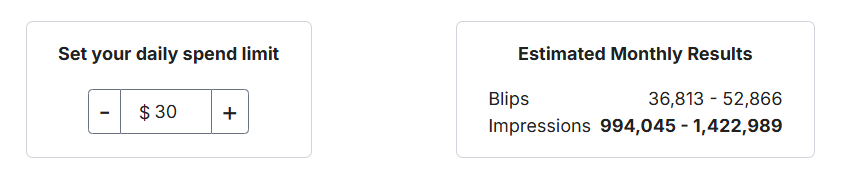
How much is a billboard near Hamilton Square?
Why Choose Blip for Billboard Advertising near Hamilton Square
-
Blip lets you launch fast on Hamilton Square boards near I-195, I-295, and the Turnpike—perfect for reaching commuter traffic in minutes.
-
Set a budget that fits Hamilton Square, then adjust anytime. Blip's pay-per-blip model helps you test ads without long-term contracts.
-
Target Hamilton Square commuters by time of day—run morning coffee ads on the 6:30–9:00 a.m. rush and dinner offers at 4:00–7:00 p.m.
-
Track real-time results from Hamilton Square campaigns and shift spend toward the boards and hours driving more calls, visits, or clicks.
-
Use Blip's creative tools to build simple, high-contrast ads for Hamilton Square families, students, and Trenton/Princeton commuters.
Frequently Asked Questions About Billboard Advertising near Hamilton Square
How much does a billboard cost near Hamilton Square, New Jersey with Blip?
With Blip, you decide exactly how much you want to spend each day, and our pay-per-blip model only charges you for the 7.5–10 second ad displays you actually receive on Hamilton Square billboards. You can start with any budget, adjust it whenever you like, and still show up on premium billboards near Hamilton Square, New Jersey. Because each blip’s price changes based on time, location, and advertiser demand, you stay in full control of your total cost over time.
Where can I advertise with Blip in Hamilton Square, New Jersey?
Our 21 digital billboards within 10 miles of Hamilton Square are positioned around the area’s most important travel routes. Key nearby corridors include Robbinsville Township, Hamilton Township, Chesterfield Township, Trenton, Princeton, and Ewing Township. This network gives you flexible options when choosing specific Hamilton Square billboards or nearby boards that still serve the same audience.
Why are Hamilton Square, New Jersey billboards a good choice for local businesses?
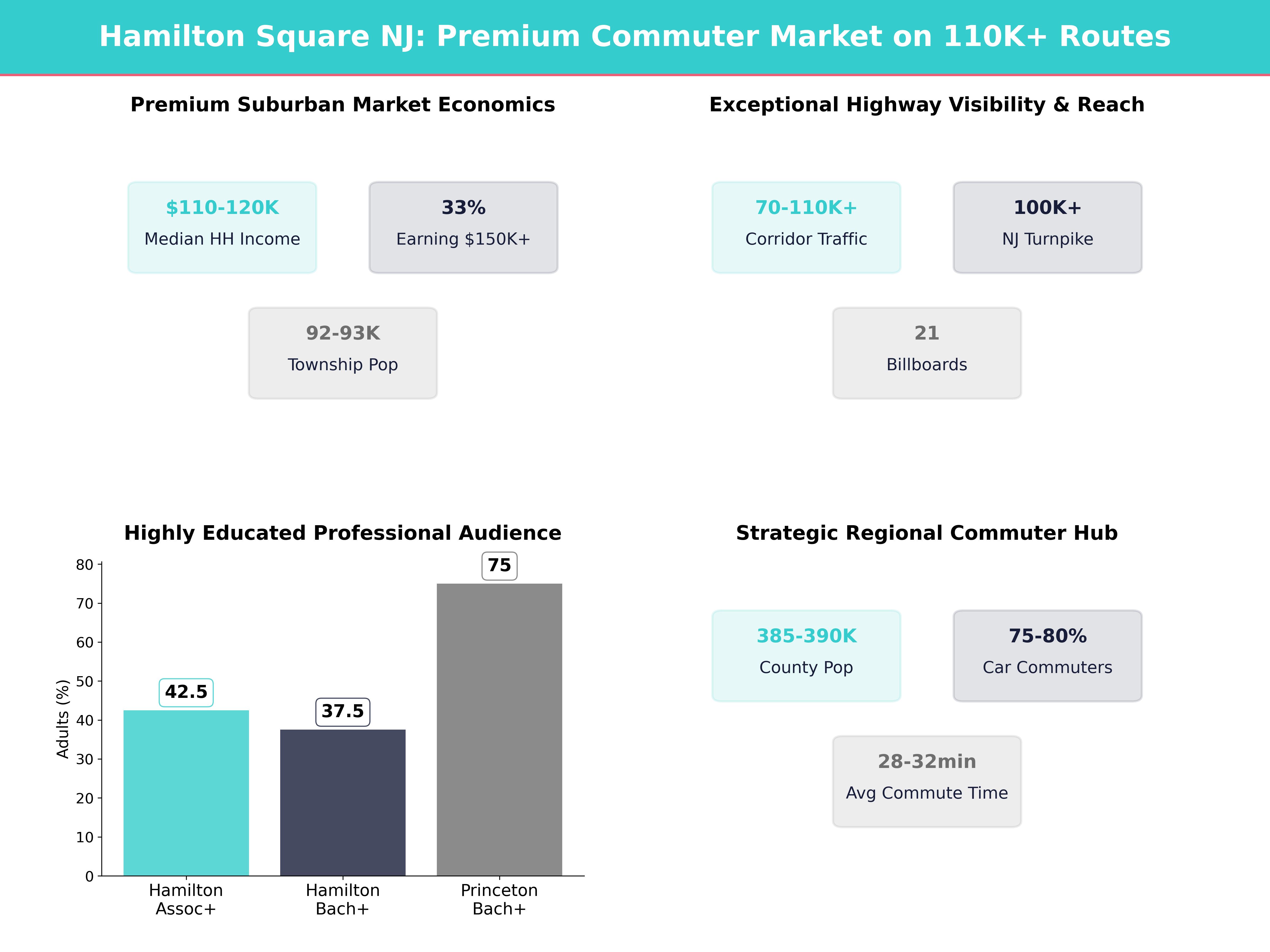
The Hamilton Square area benefits from strong demographics, strategic highways, and proximity to major job centers. Hamilton Township has roughly 92,000–93,000 residents, and the Hamilton Square census-designated area alone has about 12,500–13,000 residents packed into just a few square miles. Household income is also strong, with estimates for the Hamilton Square area often around $110,000–$120,000.
When is the best time to run Blip billboards near Hamilton Square, New Jersey?
Weekday commute windows are especially valuable, with heavy traffic in the morning from 6:30–9:00 a.m. and in the evening from 4:00–7:00 p.m. Lunchtime from 11:00 a.m.–2:00 p.m. and weekend midday from 10:00 a.m.–3:00 p.m. are also strong periods. Seasonal opportunities include back-to-school in August–September, holiday shopping in November–December, and summer travel from May–August.
What kind of people do Hamilton Square, New Jersey billboards reach?
The Hamilton Square area skews family-oriented, with a median age in the low-to-mid 40s and nearly 20–23% of residents under age 18. Another 50%+ fall in the key 25–64 working-age bracket, and many households are owner-occupied, which supports home services, medical and dental offices, education, youth sports, and financial planning. The area also has strong commuter traffic, with around 75–80% of workers commuting by car in Mercer County.
Do I need a contract to advertise with Blip near Hamilton Square?
No, Blip has no long-term contracts or minimum commitments. You can start, pause, or stop your campaign at any time.
How fast can I launch a billboard campaign with Blip near Hamilton Square?
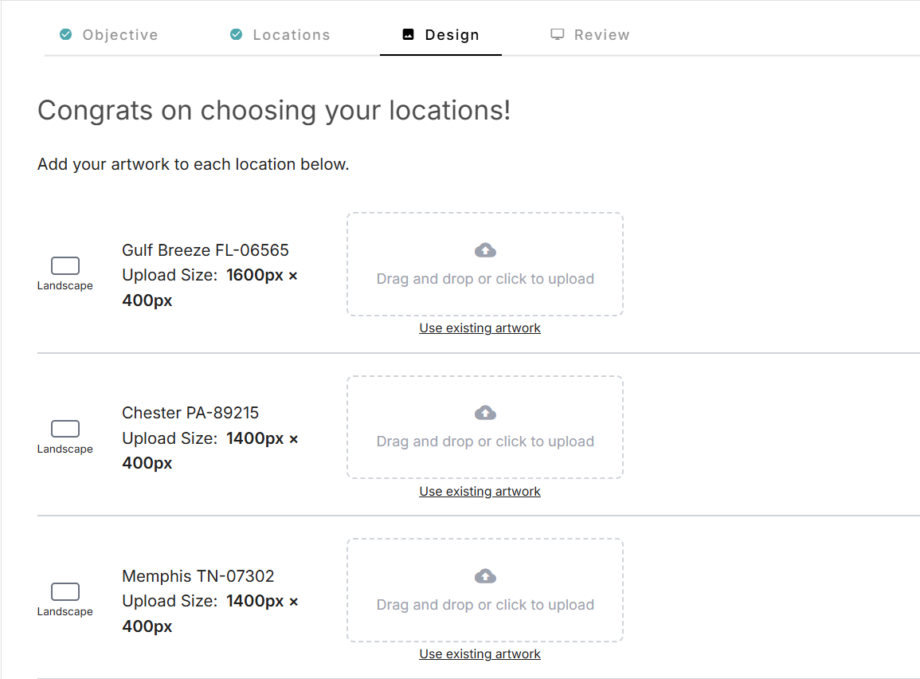
You can have your campaign live in minutes. Create a free account, select your locations, set your budget, upload your design, and start running once approved.
Where can I advertise with Blip near Hamilton Square?
Blip has digital billboards near Hamilton Square. You can browse available locations on a map, choose the ones that fit your audience, and start advertising right away.
Still have questions? Launch a campaign in minutes — no contracts, no commitments.
Start Your CampaignHamilton Square Billboard Advertising Guide
Nestled within Hamilton Township Robbinsville Township, Hamilton Township Trenton Princeton Ewing Township, advertisers can use Blip to reach both local residents and pass-through traffic with precision. Many of these corridors carry 70,000–110,000+ vehicles per day, giving even modest campaigns the ability to generate hundreds of thousands of weekly impressions with billboards near Hamilton Square.
Why the Hamilton Square Area Is a High-Value Billboard Market
The Hamilton Square area benefits from strong demographics, strategic highways, and proximity to major job centers—elements that make Hamilton Square billboards especially effective for local and regional brands:
- Population density: Hamilton Township has roughly 92,000–93,000 residents, and the Hamilton Square census-designated area alone has about 12,500–13,000 residents packed into just a few square miles, with neighborhood densities often exceeding 4,000 residents per square mile. Mercer County as a whole has around 385,000–390,000 residents, with more than 50% living in or adjacent to key commuter corridors.
- Household income: Hamilton Township’s median household income has climbed into the $95,000–$105,000 range in recent surveys, while estimates for the Hamilton Square area trend higher, often around $110,000–$120,000. More than 1 in 3 households in many Hamilton Square–adjacent tracts report incomes above $150,000, pointing to strong purchasing power for retail, automotive, home services, elective healthcare, and financial services.
- Age mix: The Hamilton Square area skews family-oriented, with a median age in the low-to-mid 40s and nearly 20–23% of residents under age 18. Another 50%+ fall in the key 25–64 working-age bracket—ideal for campaigns related to education, family activities, commuting, healthcare, and youth programs.
- Education level: In Hamilton Township, about 40–45% of adults hold an associate’s degree or higher and roughly 35–40% hold a bachelor’s degree or higher, with the Hamilton Square area and nearby Princeton and West Windsor Township pulling that average up. In adjacent Princeton, over 75% of adults hold at least a bachelor’s degree, which supports more specialized and higher-value offerings (financial services, professional services, niche healthcare, B2B).
- Commuter connectivity: Residents have quick access to I‑195, I‑295, the New Jersey Turnpike, plus nearby rail via Hamilton Station on the Northeast Corridor line. Hamilton Station handles thousands of riders on busy weekdays, feeding daily traffic to and from New York City, Newark, New Brunswick, and Trenton.
Local government and regional resources like Hamilton Township unemployment rates below or near state averages, and county economic development updates note millions of dollars in annual private investment in retail, logistics, and healthcare facilities within a short drive of Hamilton Square. This creates a strong foundation for billboard advertising near Hamilton Square to drive measurable business results.
Understanding the Local Audience
To make the most of your Blip campaign near Hamilton Square, we want to align messaging with who actually passes these boards. Whether you’re running a one-time promotion or ongoing billboard rental near Hamilton Square, understanding these segments will help shape your creative and scheduling.
1. Suburban families and homeowners
- Roughly 65–70% of housing units in Hamilton Township are owner-occupied, a strong indicator of residential stability and long-term investment in the community.
- Many homes in the Hamilton Square area are single-family houses in well-established neighborhoods, often built on lots of 0.25–0.5 acres, with a high share of 3–4 bedroom homes—supporting home improvement, landscaping, and family services.
- Local school enrollment in the Hamilton Township School District numbers in the tens of thousands across elementary, middle, and high schools, reinforcing demand for tutoring, youth activities, and family healthcare.
- Home services (HVAC, roofing, landscaping), medical and dental offices, education, youth sports, and financial planning all resonate strongly with this audience, especially when ads reference nearby schools, parks, or neighborhoods.
2. Commuters and regional workers
- In Mercer County, around 75–80% of workers commute by car, with average one-way commutes of roughly 28–32 minutes. More than 1 in 4 residents commutes to a different county, underscoring the importance of highway access.
- Many Hamilton Square–area residents work in Trenton, Princeton, New Brunswick, and even into Philadelphia New Jersey Turnpike segment serving Mercer County routinely carries 100,000+ vehicles per day, much of it commuter and business traffic.
- This commuter profile is ideal for auto dealerships, quick-service restaurants, coffee shops, fitness centers, and convenience retailers. Short, time-sensitive offers (e.g., “$5 Breakfast Combo – Next Exit”) can capitalize on the estimated 20–30 seconds most drivers have to read and process a typical digital billboard.
3. Students and professionals
- The region includes major institutions like Princeton University 8,000+ students plus thousands of faculty and staff), Rider University in nearby Lawrenceville (about 3,800–4,000 students), and The College of New Jersey in Ewing (roughly 7,000 students).
- Combined, these campuses bring 18,000+ students and many thousands of employees through nearby corridors daily, with significant weekend travel as well.
- Corporate and research parks along U.S. Route 1 and in the greater Princeton area house hundreds of companies spanning pharmaceuticals, finance, and technology, with tens of thousands of jobs.
- That brings tens of thousands of students, faculty, and professionals through nearby corridors daily—strong audiences for technology, banking, housing, higher education, restaurants, and lifestyle brands.
By tailoring your creative to these core groups and selecting key boards near their routes, we can use Blip to make sure your messaging lands with the right people at the right moments.
Key Corridors and Where Our Digital Billboards Shine
Our 21 digital billboards within 10 miles of Hamilton Square are positioned around the area’s most important travel routes. This network gives you flexible options when choosing specific Hamilton Square billboards or nearby boards that still serve the same audience:
- Robbinsville Township (about 2.1 miles away)
Close to the New Jersey Turnpike (near Exits 7A and 8) and I‑195, Robbinsville boards are great for capturing regional traffic heading toward the shore, Trenton, and the Turnpike corridor. NJ Turnpike traffic near Exit 7A frequently surpasses 110,000 vehicles per day on busy summer and holiday weekends, according to NJDOT traffic counts Robbinsville Township, includes expanding residential communities and commercial centers such as the Town Center and warehouse/distribution hubs, making it a valuable suburban audience in its own right. - Hamilton Township (about 3.5 miles away)
Boards here serve key arteries like NJ Route 33, I‑295, and local connectors toward Hamilton Square neighborhoods and Hamilton Station. Daily traffic on segments of Route 33 and I‑295 commonly falls in the 50,000–90,000 vehicles per day range. These are ideal for hyper-local campaigns: healthcare practices, local restaurants, gyms, schools, and community events promoted through Hamilton Township - Chesterfield Township (about 5.7 miles away)
More rural and exurban, Chesterfield boards pick up Turnpike and regional cross-county traffic—useful for outdoor recreation, agritourism, and businesses drawing from a wider radius. Seasonal agritourism destinations in nearby Burlington County tens of thousands of visitors during peak fall and summer seasons, making this a strong corridor for farms, markets, and regional attractions. - Trenton (about 5.7 miles away)
As the state capital, the City of Trenton tens of thousands of jobs, and inbound weekday traffic into the city spikes during the 7:30–9:00 a.m. and 4:00–6:00 p.m. windows. Boards serving the Trenton area help you reach government employees, legal and nonprofit professionals, and visitors attending events covered by local media such as The Trentonian and NJ.com’s Trenton & Mercer coverage - Princeton (about 6.5 miles away)
U.S. Route 1 near Princeton regularly carries 80,000–95,000 vehicles per day, depending on the segment and season. With Princeton’s academic and corporate presence and tourism promoted by Visit Princeton–Mercer hundreds of thousands of annual visitors to the region’s museums, downtowns, and events, these boards are excellent for higher-end retail, hospitality, education, and professional services. - Ewing Township (about 8.8 miles away)
Close to Trenton–Mercer Airport and The College of New Jersey, Ewing boards capture student and travel traffic. Trenton–Mercer Airport has seen annual passenger counts in the hundreds of thousands, driven by low-cost carriers and leisure travel. Ewing Township notes ongoing development in retail and office uses, strengthening this market and supporting steady weekday and weekend traffic.
NJDOT traffic counts 70,000–110,000 vehicles per day, while stretches of U.S. Route 1 near Princeton can top 90,000 vehicles per day. Over the course of a four-week flight, even a modest share of these daily impressions can translate into millions of gross impressions for a well-placed digital billboard schedule. Leveraging boards along these high-volume corridors lets you extend your reach far beyond the Hamilton Square neighborhoods while still serving that core audience with billboards near Hamilton Square and its main commuting routes.
Timing Your Blips Around Local Patterns
Blip’s flexibility allows us to schedule “blips” only when they are most valuable. In the Hamilton Square area, consider these patterns to get the most from your billboard rental near Hamilton Square:
Weekday commute windows
-
Morning (6:30–9:00 a.m.): Heavy traffic on I‑295, I‑195, NJ Route 33, and local roads leading to Hamilton Station and Trenton. Many segments experience peak-hour volumes at 8:00 a.m. that are 30–40% higher than mid-day traffic.
- Best for coffee shops, breakfast QSRs, transit services, and urgent-care reminders.
-
Evening (4:00–7:00 p.m.): Return traffic plus stops for groceries, gyms, and restaurants. Shopping centers in Hamilton and Robbinsville report some of their highest daily foot traffic between 5:00–7:00 p.m. on weekdays.
- Ideal for retailers, fitness centers, and family dining.
Midday and retail peaks
- Lunchtime (11:00 a.m.–2:00 p.m.): Office workers from Trenton and nearby business parks drive local spend in Hamilton Township and Robbinsville shopping areas. Commercial corridors often see a 15–25% uptick in traffic counts versus early morning non-commute hours.
- Weekend midday (10:00 a.m.–3:00 p.m.): Shopping centers along Route 33, Route 130, and U.S. Route 1 see heavy activity from families. Regional malls and power centers in the Princeton–Hamilton area often report Saturday as their single busiest day, with foot traffic 30–50% higher than typical weekdays.
Seasonal variation
- Back-to-school (August–September): Strong demand for tutoring, after-school programs, pediatric care, and retail. Local school calendars from the Hamilton Township School District show major back-to-school spending concentrated in the last 2–3 weeks of August and early September. Boards serving the Hamilton Square area during this window can focus on family and education messaging.
- Holiday shopping (November–December): Princeton and Hamilton area malls and downtowns attract regional visitors, with retailers often recording 20–30% of their annual sales during this period. Increase blips near Princeton and Hamilton Township during evenings and weekends for gift and dining campaigns.
- Summer travel (May–August): I‑195 and Turnpike traffic spikes toward the Jersey Shore, with weekend volumes that can rise 20–40% above off-season averages. Robbinsville and Chesterfield boards are prime for tourism, attractions, and auto service messaging, including campaigns tied to coastal destinations promoted through regional tourism sites like Visit Princeton–Mercer Discover Central New Jersey.
By concentrating your budget on these high-value time blocks, you can often achieve more impact with fewer total impressions and a lower effective cost per thousand views (eCPM).
Crafting Creative That Resonates Locally
For digital billboards serving the Hamilton Square area, effective creative follows a few key principles that apply whether your goal is broad branding or hyper-local billboard advertising near Hamilton Square:
Keep it simple and high-contrast
- Aim for 6–8 words max plus a strong logo and call-to-action; traffic traveling at 55–65 mph typically has 6–10 seconds of clear viewing time.
- Use large, high-contrast fonts that remain legible from 500–700 feet away, especially along highways like I‑295 and U.S. Route 1. A minimum letter height of 18–24 inches is a useful guideline for highway boards.
- Avoid clutter: One main message per creative increases recall; industry studies often show 20–30% higher ad recall for simple, single-idea creatives versus crowded layouts.
Reflect local identity
Tie into landmarks and local language the audience will recognize:
- Mention proximity to Hamilton Square, Mercer County Park, Hamilton Station, or “minutes from I‑295 / I‑195.” Mercer County Park hundreds of events annually, including festivals, sports tournaments, and concerts, drawing visitors from across Central Jersey.
- Use phrases like “Serving the Hamilton Square area” or “Near Hamilton Square” to immediately establish relevance.
- Highlight local credibility: “Trusted by Hamilton families since 2005” or “Proud to serve Mercer County.” Referencing coverage in local outlets such as NJ.com’s Mercer section Community News can reinforce that local connection.
Address commuter needs
- For weekday commuters: focus on speed and convenience.
Example: “Skip the Trenton traffic—Telehealth Visits Tonight – [Practice Name]” - For weekend shoppers and families: emphasize experiences and savings.
Example: “Family Fun Near Hamilton Square – Save 20% This Weekend”
Leverage dynamic capabilities
With Blip, you can rotate multiple creatives and update them easily:
- Test different offers by daypart: a breakfast offer in the morning, a dinner promotion in the evening.
- Swap seasonal messaging: back-to-school, holiday, tax season, summer travel, and local festival tie-ins such as Hamilton’s community events calendar published on Hamilton Township
- Run A/B tests: two creatives targeting the same board set, then watch which generates more website visits or calls. Even a 10–15% difference in response rate can justify shifting spend toward the better-performing message.
Using Blip Tools to Test, Learn, and Scale
Digital billboards serving the Hamilton Square area are most powerful when used iteratively:
-
Start narrow
- Select a small set of boards closest to your primary trade area—often Hamilton Township and Robbinsville for Hamilton Square–focused businesses. For many local businesses, a 5–7 mile radius covers 70–80% of their customers.
- Run for 2–4 weeks to gather performance insights (web traffic, search volume, direct inquiries). This window is typically long enough to see directional changes in KPIs like branded search and call volume.
-
Daypart intelligently
- Use Blip’s scheduling tools to bid more during your “money hours” (for example, weekday morning and evening commutes) and less in off-peak times. Shifting just 20–30% of impressions into the highest-traffic hours can materially increase effective reach.
- For businesses with weekend focus (events, attractions, restaurants), concentrate budget Friday–Sunday midday and evenings, aligning with local retail and entertainment peaks.
-
Expand by corridor
- Once you see which creatives and time windows perform best, expand to boards serving Trenton, Princeton, and Ewing to broaden your reach while maintaining messaging that highlights easy access from the Hamilton Square area.
- A phased approach—adding 2–4 boards at a time on new corridors—helps you see which routes deliver the strongest incremental lift.
-
Adjust bids dynamically
- Increase bids during highly competitive seasons (e.g., November–December retail, early summer travel) and pull them back when competition and rates drop.
- For event-based campaigns (festivals, concerts, sports), ramp spend in the final 7–14 days before the event, when up to 50% or more of ticket sales often occur.
Sample Strategies for Common Advertiser Types
Local retail or restaurant near Hamilton Square
- Focus boards in Hamilton Township and Robbinsville within a 5–7 mile radius, which for many storefronts captures the majority of repeat customers.
- Daypart: 11:00 a.m.–2:00 p.m. and 4:00–8:00 p.m., heavier on Friday–Sunday, when restaurant and retail spend typically peaks.
- Creative: “Dinner Near Hamilton Square – Kids Eat Free Tues” + distance or exit reference (e.g., “2 Minutes from Hamilton Square” or “Off Route 33”).
- Consider aligning promotions with community events listed on Hamilton Township Community News, which can push additional traffic on specific weekends.
Professional or medical practice
- Use boards serving Route 33 and I‑295 with clear direction: “Exit 63 – 5 Minutes from Hamilton Square.” Route-based cues can improve navigation recall by 20%+ compared with generic branding alone.
- Daypart: Commuter windows and early evening for appointment-related services; 7:00–9:00 a.m., 4:00–7:00 p.m., and Saturday mornings tend to be key planning times for healthcare and personal services.
- Messaging: Trust and convenience—“Same-Day Appointments,” “Open Until 8 P.M.,” or “Accepting New Patients in the Hamilton Square Area.” Include a simple URL or phone number; research consistently shows that 2–3 contact elements max is optimal for recall.
Regional attraction or event (festival, concert, sports)
- Target Robbinsville, Chesterfield, and Turnpike/I‑195 facing boards to catch regional travelers. These corridors serve both shore-bound visitors and residents from neighboring counties.
- Ramp up impressions 2–3 weeks before the event. Many regional events see 60–70% of ticket or RSVP activity in the final three weeks.
- Include date and simple CTA: “Tickets at [Short URL].” Reference nearby destinations promoted by Visit Princeton–Mercer Discover Central New Jersey to signal that your event is part of the broader regional experience.
Education, youth sports, or extracurriculars
- Concentrate on boards near suburban neighborhoods (Hamilton Township, Robbinsville, Ewing) where families with children make up 30–40% of households.
- Time flights around registration periods (January–March for spring, July–September for fall), aligning with local league and school calendars often published in outlets like NJ.com’s Mercer section
- Messaging: “Now Enrolling Near Hamilton Square – Ages 6–14.” Including a specific age range can increase relevance and response among parents scanning the message at speed.
Local media such as the Times of Trenton via NJ.com’s Mercer section Community News can offer additional context on upcoming events, school calendars, and community issues that may inspire timely creative angles or limited-time offers.
Measuring Success and Optimizing Over Time
Because billboard impressions are directional rather than individually trackable, we recommend combining a few measurement techniques:
- Traffic and search lift: Monitor your website analytics for increases in direct visits and branded search from ZIP codes around Hamilton Square, Hamilton Township, Robbinsville, and Ewing during your flight. Even a 10–20% lift in branded search or direct traffic in these ZIP codes can indicate strong billboard performance from Hamilton Square billboards and nearby placements.
- Simple, trackable URLs or promo codes: Use a short URL or code unique to your billboard campaign (e.g., “HAMILTON20”) to attribute responses. When used consistently, businesses often see 10–30% of redemptions clearly tied to these billboard-specific codes.
- Call volume and appointment tracking: Train staff to ask, “How did you hear about us?” and log “billboard near Hamilton Square” as a response option. Aim to track at least 80–90% of inbound calls or new-patient intakes to build a reliable dataset.
- Incremental testing: Alternate on/off weeks or rotate creatives to see how leads or sales fluctuate. For example, a 4-week test with 2 weeks on / 2 weeks off can reveal whether key metrics (calls, web forms, in-store visits) rise by 15–25% when boards are active.
Over several weeks, these indicators will clarify which corridors (Hamilton Township vs. Princeton vs. Trenton), dayparts, and creatives deliver the most value. From there, we can refine your Blip campaign so that every dollar spent on digital billboards serving the Hamilton Square area is pushing measurable business outcomes.
By combining the Hamilton Square area’s strong demographics, heavy commuter flow, and our network of 21 strategically placed digital billboards, we can build campaigns that reach the right local audience, at the right time, with messages that truly resonate and convert—making billboard advertising near Hamilton Square a powerful part of your marketing mix.