Billboards in Florence, SC
No Minimum Spend. No Long-Term Contracts. Just Results.
Trusted by Leading Brands


Billboard advertising
in Florence has never been easier
How much is a billboard in Florence?
Why Choose Blip for Billboard Advertising in Florence
Blip lets Florence advertisers launch fast on I-95 and I-20, reaching commuters, road trippers, and hospital visitors without sales calls or delays.
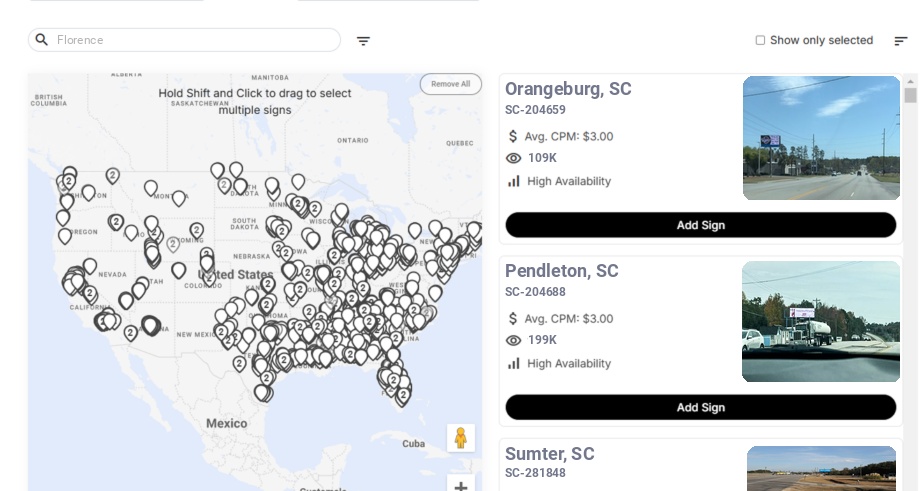
In Florence, Blip-optimized campaigns can auto-place ads near Exit 157-169, Downtown Florence, and the Florence Center to match your goals and budget.
No contracts in Florence means you can scale around Darlington Raceway weekends, the Pecan Festival, or beach traffic, then pause anytime.
Blip's real-time analytics help Florence brands track what works on commuter routes and adjust creative as traffic shifts from rush hour to weekend travel.
With flexible budgets, Florence businesses can test billboard ads on US 52, US 76, and SC 327, then increase spend when results start coming in.
Blip's creative tools make it easy to build bold Florence ads for 65-70 mph corridors, with clear messaging for travelers, students, and local families.
Frequently Asked Questions About Billboard Advertising in Florence
How much does a billboard cost in Florence, South Carolina with Blip?
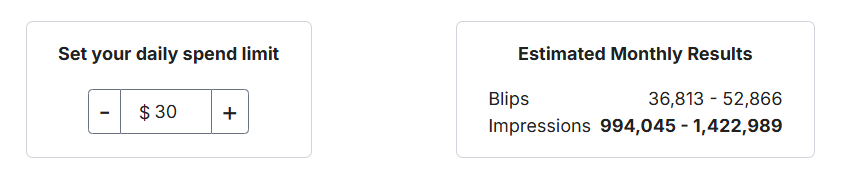
With Blip, billboard advertising in Florence is flexible and affordable because you only pay when your ad actually appears. Each “blip” is a 7.5-to-10-second display on a rotating digital billboard, with prices starting at just $0.01 per display. Your daily budget helps Blip’s algorithm bid for open ad slots, and the cost per blip can vary based on time of day, location, and advertiser demand.
Where can I advertise with Blip in Florence, South Carolina?
Florence gives advertisers strong options because it sits at the junction of I-95 and I-20, and those corridors bring together daily commuters, regional shoppers, hospital visitors, college students, race fans, and East Coast road trippers. In-town routes like US 52, US 76, US 301, and SC 327 also carry steady local traffic and are valuable for repeat exposure. West Florence around the Florence Center and Magnolia Mall is the market’s highest-intensity commercial zone.
Why is Florence, South Carolina a strong market for digital billboards with Blip?
Florence works well for billboard advertising because it is large enough to support consistent local repetition, but compact enough that a relatively small set of major roads carries a very large share of movement. The city had 39,899 residents in 2020, Florence County had 137,059, and more than 90% of local workers commute by car, truck, or van. That means digital billboards can build both high frequency and steady fresh reach.
What kinds of people can Blip reach in Florence, South Carolina?
Florence is a diverse local market that includes working families, retirees, professionals, students, and rural households coming into the city for shopping and services. Healthcare is a major audience driver, with McLeod Health reporting more than 15,000 employees systemwide, and education adds another layer with roughly 10,000 students across Francis Marion University and Florence-Darlington Technical College. Florence also attracts travelers, tourists, and event crowds for Darlington Raceway and the Florence Center.
When is the best time to run billboard ads in Florence, South Carolina with Blip?
Spring is one of the best times to advertise in Florence because tax-season consumers, spring shoppers, race fans, graduation households, and early vacation traffic overlap. Summer is also strong because Florence sees beachbound and interstate travel, while fall brings back-to-school campaigns, the Southern 500, and the South Carolina Pecan Music and Food Festival. For timing within the day, commuter value is highest in the 6 a.m. to 9 a.m. and 4 p.m. to 7 p.m. windows.
Do I need a contract to advertise with Blip in Florence?
No, Blip has no long-term contracts or minimum commitments. You can start, pause, or stop your campaign at any time.
How fast can I launch a billboard campaign with Blip in Florence?
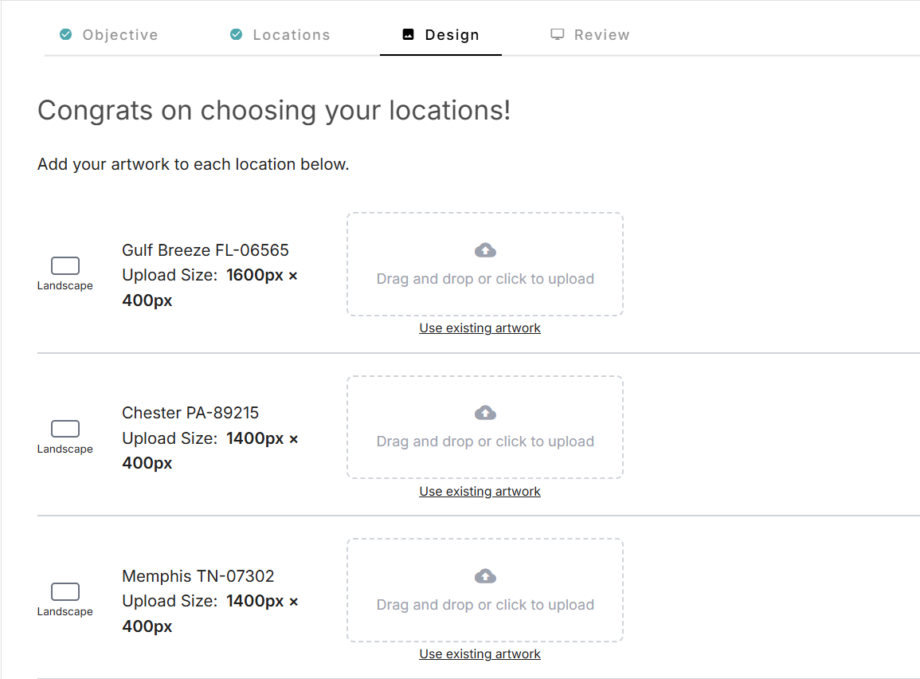
You can have your campaign live in minutes. Create a free account, select your locations, set your budget, upload your design, and start running once approved.
Where can I advertise with Blip in Florence?
Blip has digital billboards in Florence. You can browse available locations on a map, choose the ones that fit your audience, and start advertising right away.
Still have questions? Launch a campaign in minutes — no contracts, no commitments.
Start Your CampaignFlorence Billboard Advertising Guide
Florence, South Carolina, gives us an unusually strong billboard market because it combines a solid local population base with nonstop pass-through traffic. The City of Florence had 39,899 residents in 2020, Florence County had 137,059, and the city sits at the junction of 2 major interstates, I-95 and I-20. That crossroads brings together daily commuters, regional shoppers, hospital visitors, college students, race fans, and East Coast road trippers in one market. Because Florence is still a drive-first city, with more than 90% of local workers commuting by car, truck, or van, and a year-round stopover for inland and coastal travel, we can use digital billboards here to build both high frequency and steady fresh reach.
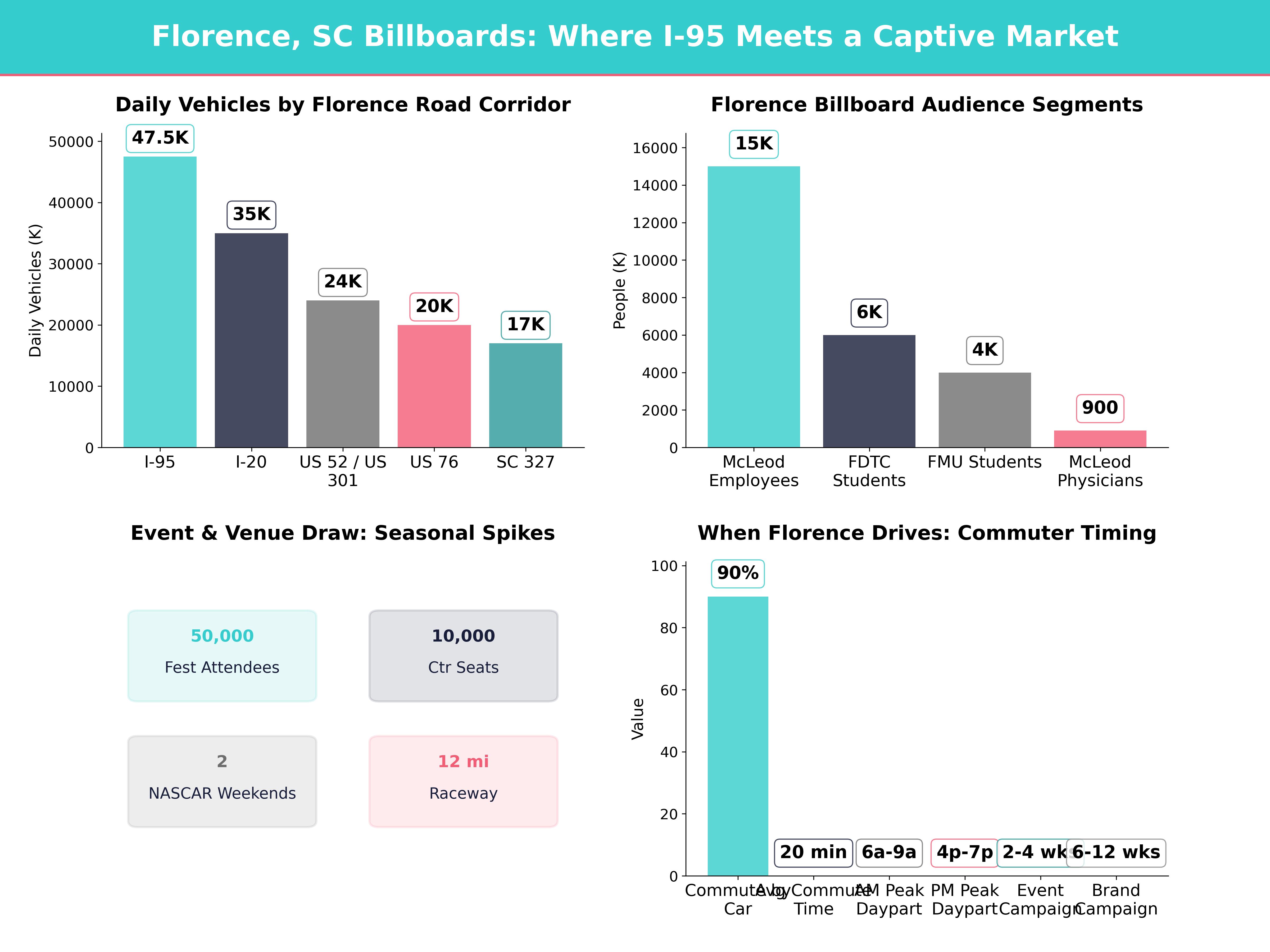
Florence Market Overview for Billboard Advertisers
Florence population, growth, and commuter behavior
Florence works well for billboard advertising because it is large enough to support consistent local repetition, but compact enough that a relatively small set of major roads carries a very large share of movement. The city grew from 37,056 residents in 2010 to 39,899 in 2020, which is a 7.7% increase. Florence County was much steadier, moving from 136,885 residents in 2010 to 137,059 in 2020, which is roughly 0.1% growth.
That pattern matters for advertisers. It tells us the market has not sprawled dramatically across far-flung suburbs. Instead, Florence’s core commercial corridors have stayed important, which is exactly what we want in an out-of-home market. Well-positioned boards on established routes can stay relevant for years because traffic and commerce still concentrate around the same retail, medical, downtown, and interstate zones.
Commuting behavior also supports billboard performance. American Community Survey estimates for Florence County regularly place commuting by car, truck, or van above 90%, and average travel time to work at roughly 20 minutes. Even with service from the Pee Dee Regional Transportation Authority
Florence is also a diverse local market, not a single-audience college town or a pure tourist stop. We reach working families, retirees, professionals, students, and rural households coming into the city for shopping and services. That broad profile rewards simple, inclusive creative with clear local relevance.
Florence’s economic anchors and regional draw
Florence punches above its city-population weight because it is the service hub for the Pee Dee Greater Florence Chamber of Commerce, the Florence County Economic Development Partnership
Healthcare is one of the most important audience drivers. McLeod Health reports a system with more than 15,000 employees and more than 900 physicians and advanced practice providers, and Florence is its home base. MUSC Health also has a strong Florence presence, which reinforces the city’s role as a medical destination for surrounding counties. For billboard advertisers, that means healthcare is not just a vertical in Florence. It is a daily traffic generator.
Education adds another dependable audience layer. Francis Marion University enrolls about 4,000 students, and Florence-Darlington Technical College serves more than 6,000 students, for a combined audience of roughly 10,000 students. Together, those institutions support campaigns for apartments, banking, restaurants, wireless, employment, events, and healthcare.
Events and entertainment matter as well. The Florence Center is a 10,000-seat venue, and the revitalized Downtown Florence district has become a stronger dining and event destination. Add in access from Florence Regional Airport Columbia and Myrtle Beach
Key Traffic Corridors for Digital Billboards in Florence
I-95 through Florence County
According to traffic count mapping from the South Carolina Department of Transportation, I-95 segments around Florence generally carry about 40,000 to more than 55,000 vehicles per day, depending on the segment and count year. The highest volumes are typically near the Florence interchange area, where long-distance East Coast traffic mixes with local and regional trips.
This is Florence’s most important traveler corridor. It is where we reach people who are making quick decisions about food, gas, hotels, urgent care, attractions, and stopover retail. Boards on I-95 are especially effective when we keep the message immediate and directional.
The most useful Florence-area interstate decision points are around Exits 157, 160, 164, and 169. Those exits connect travelers to downtown access, the I-20 split, US 52, and SC 327.
- Hotels and travel services perform well on I-95 because many drivers decide where to stop only a few miles before an exit.
- Quick-service restaurants, fuel, and convenience brands benefit because interstate travelers respond to speed, visibility, and distance-to-exit messaging.
- Healthcare, legal, and insurance advertisers can also use I-95 for broad awareness because the route delivers fresh regional impressions every day.
I-20 at Florence’s eastern terminus
I-20 ends in Florence at I-95, and SCDOT counts near the interchange generally land in the 30,000s to 40,000s AADT range on major segments. This corridor matters because it ties Florence directly to Columbia and the Midlands, about 80 miles to the west.
I-20 is ideal when we want to reach travelers entering Florence from inland South Carolina, as well as local residents moving between western Florence retail areas and the rest of the city. The route also catches freight, regional workers, and college traffic.
Advertisers that usually benefit most from I-20 placements include the following groups.
- Automotive brands and dealerships benefit because shoppers can compare options across a broad regional trade area.
- Furniture, mattresses, and major retail benefit because Florence serves as a shopping destination for nearby communities.
- Colleges, technical programs, and healthcare systems benefit because I-20 reaches households making high-consideration decisions across county lines.
US 52, US 76, US 301, and SC 327 inside Florence
Once we move off the interstates, Florence’s in-town commercial network becomes the real frequency engine. SCDOT traffic counts on major non-interstate corridors in and around Florence often fall into these approximate ranges:
- Key segments of US 52 and US 301 often run around 18,000 to 30,000 vehicles per day.
- Important sections of US 76, including Palmetto Street and related commercial routes, often land in the 15,000 to 25,000 range.
- Parts of SC 327, including the Second Loop area, commonly fall around 12,000 to 22,000 vehicles per day.
These numbers are lower than interstate counts, but the audience is often more local, more repeatable, and closer to the point of purchase. That makes in-town Florence boards extremely valuable for businesses that need local action rather than pass-through awareness.
The strongest local-use cases usually include the following categories.
- Retail, grocery, and dining brands benefit along Palmetto Street, Five Points, and the retail zones around Magnolia Mall Florence Center.
- Home services, legal services, and healthcare providers benefit on these routes because residents see them over and over during regular weekly routines.
- Local events and downtown businesses benefit because these routes connect neighborhoods to Downtown Florence, schools, and major employment centers.
Audience Segments We Can Reach in Florence
Florence commuters and local households
The first Florence audience is the everyday commuter. Since more than 90% of local workers travel by car, truck, or van, billboard advertising becomes a repetition medium here. We are not counting on a one-time impression. We are often building memory over a week, a month, or an entire season.
This audience is ideal for banks, grocery stores, healthcare practices, insurance agencies, home improvement companies, HVAC, roofing, auto repair, and local retail. In a market with average commute times near 20 minutes, a strategically placed board can become part of the same daily visual routine.
Students, parents, and education audiences in Florence
Higher education gives Florence a younger and more transitional audience than the population numbers alone might suggest. Francis Marion University brings about 4,000 students into the market, and Florence-Darlington Technical College adds more than 6,000. Together, those students influence nearby restaurants, apartment demand, banking, phone plans, apparel, healthcare, and job recruiting.
Parents are another valuable segment. Florence 1 Schools and nearby private schools create strong back-to-school, youth sports, and family-service timing windows. Campaigns for tutoring, orthodontics, family restaurants, after-school programs, and household retail can all gain from that rhythm.
Healthcare, industrial, and service-sector workers in Florence
Healthcare workers are one of Florence’s most powerful professional audiences. McLeod Health alone lists more than 15,000 employees and more than 900 physicians and advanced practice providers systemwide. That is a major concentration of shift workers, office staff, clinicians, recruiters, and patients moving across the city throughout the day.
Florence also has an industrial and logistics audience because of its interstate access and regional distribution role. Businesses in and around Florence, Timmonsville Darlington Lake City Hartsville
Travelers, tourists, and event crowds around Florence
Florence is also a traveler market. Visit Florence
The biggest event audiences include these groups:
- Darlington Raceway 1950 and brings large motorsports crowds to the area during 2 major NASCAR weekends.
- The South Carolina Pecan Music and Food Festival draws more than 50,000 attendees.
- The Florence Center brings concerts, sports, conventions, and family shows into a 10,000-seat venue.
Florence also benefits from its location about 70 miles from Myrtle Beach
Seasonal and Timing Opportunities for Florence Billboard Campaigns
Spring and early summer in Florence
Spring is one of the best times to advertise in Florence because multiple audience layers overlap. We can reach tax-season consumers, spring shoppers, race fans, graduation households, and early vacation traffic in one stretch.
Race-related campaigns should ramp up before the spring NASCAR weekend at Darlington Raceway 12 miles north of Florence. That is a great window for hotels, restaurants, auto services, sports bars, apparel, convenience retail, and tourism messaging. Graduation season also makes spring ideal for colleges, technical programs, jewelers, restaurants, and family-focused retailers.
Summer travel and beachbound traffic through Florence
Summer in Florence is built around road travel. July highs are typically around 90°F, and interstate traffic picks up as families head toward the beach, move between states, or stop overnight on I-95. Florence’s proximity to Myrtle Beach
This is also a strong season for home services. Air conditioning, roofing, pest control, and lawn care are highly relevant in summer heat. If we are promoting a local service business, we should lean into immediate need states and neighborhood familiarity.
Fall events and holiday retail in Florence
Fall is arguably Florence’s richest local-event season. Back-to-school campaigns start in late July and August. The Labor Day weekend Southern 500 South Carolina Pecan Music and Food Festival brings more than 50,000 people downtown.
This is a great season for the following campaign types:
- Retail and dining campaigns benefit because event traffic and cooler weather increase local outings.
- Healthcare and family services benefit because school-year routines return.
- Political, legal, and public-awareness campaigns benefit because fall is a high-attention local information season.
Holiday shopping then compresses demand into roughly 5 weeks between Thanksgiving and Christmas. That window rewards tight scheduling, strong offers, and visible retail corridors.
Weather-driven opportunities in Florence
Florence is inland, but it still feels the effects of coastal weather. During hurricane season and tropical threats, travel patterns can change quickly as coastal residents reroute inland and local households shift into preparation mode. The Atlantic hurricane season runs from June 1 to November 30, and we can use digital boards in Florence for fast-turn campaigns involving generators, storm prep, pharmacies, urgent care, grocery, hardware, lodging, and insurance. This is one of the clearest cases where flexible digital scheduling has an advantage over static long-term inventory.
Billboard Design Tips for the Florence Market
Creative for interstate travelers in Florence
Interstate creative in Florence should be built for speed first. Much of I-95 and I-20 operates at 65 to 70 mph, so we should treat those boards as high-speed reading environments. In practice, that means we usually want 6 to 8 words, one strong visual, and one obvious action.
Distance and direction matter more in Florence than in many purely local markets. Messaging such as “Exit 160,” “Next 2 Exits,” “5 Minutes Ahead,” or “Near Florence Center” can outperform softer branding when we are targeting travelers. Gas, lodging, restaurants, urgent care, pharmacies, tire stores, and attractions all benefit from that approach.
Creative for local Florence households and professionals
For local boards, we can be slightly more detailed because many in-town roads move slower and deliver repeated views. On these boards, 8 to 10 words can work if the hierarchy is strong. Florence also responds well to practical messaging. Offers, trust cues, and geographic familiarity usually beat abstract brand copy.
Specific local cues that often fit Florence well include the following choices:
- Healthcare, legal, and financial advertisers usually perform best with calm, credible color palettes such as navy, white, green, and deep red.
- Family and household brands often benefit from imagery that reflects multigenerational local life instead of generic stock-city scenes.
- Regional businesses can improve relevance by naming Florence, the Pee Dee, Downtown Florence, or nearby communities such as Darlington Lake City Timmonsville
Creative for event, sports, and tourism campaigns in Florence
Event-driven Florence creative should match the season without trying too hard. Around race weekends, checkered flags, motorsports visuals, and bold black-red-white palettes can work well because the audience immediately recognizes the context. Around the South Carolina Pecan Music and Food Festival, warmer colors, downtown imagery, and food-forward visuals can feel more native to the moment.
For tourism and stopover campaigns, we should focus on convenience and confidence. Clean hotel imagery, easy parking, family friendliness, and recognizable local landmarks tend to work better than vague destination language. Florence often serves people who are en route, so the ad should answer one question quickly: “Why stop here now?”
Regional Strategies Across Florence and the Pee Dee
Downtown Florence and the medical core
Downtown Florence is the right zone for restaurants, entertainment, arts organizations, civic campaigns, boutique retail, financial services, and professional offices. It is also close to important medical activity, so healthcare branding and patient-awareness campaigns fit well here. If our goal is credibility, local presence, or event participation, downtown-facing inventory is often better than a pure interstate buy.
West Florence around I-95, I-20, the Florence Center, and Magnolia Mall
West Florence is the market’s highest-intensity commercial zone. This is where the interstates, Magnolia Mall Florence Center create a dense mix of local and visitor traffic.
We should prioritize this submarket when we need fast action from any of the following categories:
- Hotels, restaurants, gas, and travel services benefit from immediate interstate intent.
- Retail, entertainment, and family attractions benefit from destination shopping patterns.
- Healthcare, colleges, and large employers benefit because the area catches both local commuters and regional visitors.
North Florence and the Darlington connection
The Florence-to- Darlington Darlington Raceway 12 miles away, we can think of Florence and Darlington as a connected event corridor during NASCAR windows.
This area is especially strong for auto parts, tire stores, sports bars, hotels, staffing, and any brand that wants to tap motorsports culture without buying deeper into a larger metro.
South and east toward Lake City, Timmonsville, and the beach route
If we want household reach beyond Florence’s urban core, we should think about the corridors that connect to Lake City Timmonsville
Using Blip Tools to Execute Florence Strategies
When we should use manual selection in Florence
Manual selection makes the most sense when we already know the Florence audience we want. If we are promoting a hotel near I-95, a restaurant near Exit 160, or an event at the Florence Center, we should choose boards near those decision points directly. The same is true if we want to dominate a corridor such as Palmetto Street, Second Loop Road, or the Darlington approach during a race weekend.
When we should let Blip optimize across Florence
A Blip-optimized campaign is often the better fit when our goal is broader market coverage. If we want to reach Florence households, commuters, and travelers without manually balancing every sub-area, optimization can distribute budget across the city and interstate network more efficiently. That is especially helpful for healthcare systems, colleges, staffing, political awareness, regional retail, and service businesses that benefit from many touchpoints rather than a single corridor.
How we can daypart and refresh creative in Florence
Florence is a good dayparting market because the audience changes meaningfully by time of day. We usually get the most commuter value in the 6 a.m. to 9 a.m. and 4 p.m. to 7 p.m. windows. Lunch and errand traffic often rises from 11 a.m. to 2 p.m.. Interstate traveler value often increases on Friday afternoons, Saturday midday, and Sunday return windows.
We can also rotate creative based on season and intent. In Florence, it often makes sense to keep 3 or 4 ad versions ready, such as commuter, event, traveler, and seasonal-service creative. Then we can compare performance in real time and shift spend toward the boards and dayparts that best match our actual audience behavior.
Getting Started With Billboard Rental in Florence
How to choose the right Florence billboard locations
The first step in Florence billboard rental is deciding whether we need local households, regional commuters, interstate travelers, or event traffic. That decision should drive everything else. If our business depends on immediate visits, we usually want boards within 1 to 3 exits of the location or within about 5 to 10 miles of the destination. If our goal is awareness, broader corridor coverage often works better.
We should also evaluate Florence boards by these practical questions:
- Which direction is the traffic moving? Northbound and southbound I-95 can behave very differently from eastbound and westbound I-20.
- How close is the board to a decision point? Distance to exit, major intersection, or retail cluster matters.
- Is the audience local or transient? In-town boards usually build frequency, while interstate boards deliver more fresh reach.
- Does the surrounding land use match our customer? Medical, retail, downtown, and event corridors each support different campaign goals.
What to expect when renting a Florence billboard
Traditional billboard companies often push advertisers into long commitments, fixed inventory packages, and slower creative changes. Florence is a market where that can be limiting because demand shifts with race weekends, beach traffic, school calendars, and weather events. A digital, self-serve approach gives us far more control.
With Blip, we can test a Florence strategy without locking into a large static buy. We can start small, compare corridors, update creative quickly, and scale what works. That is especially helpful in a market like Florence, where the difference between a downtown awareness campaign and an I-95 traveler campaign is substantial.
How to judge campaign fit and improve results in Florence
We usually recommend starting with one clear success metric. That metric might be store visits, website traffic, phone calls, event attendance, recruiting leads, or general awareness in Florence and the Pee Dee. From there, we can match the board type to the goal.
A simple Florence launch plan often looks like this:
- We choose an initial flight of 2 to 4 weeks for event-driven or promotional campaigns.
- We plan 6 to 12 weeks for brand-building, recruiting, or healthcare awareness campaigns.
- We run at least 2 creative versions so we can compare messages.
- We review results after the first 7 days and refine our board mix, timing, or artwork.
Florence rewards advertisers who respect context. If we align the board with the right corridor, the right season, and the right audience, this market can deliver far more than its population count suggests. That is why Florence remains one of the most practical and scalable digital billboard markets in South Carolina.