Billboards in Lake City, SC
No Minimum Spend. No Long-Term Contracts. Just Results.
Trusted by Leading Brands


Billboard advertising
in Lake City has never been easier



How much is a billboard in Lake City?
Why Choose Blip for Billboard Advertising in Lake City
Blip lets Lake City advertisers launch fast on U.S. 52 and S.C. 341—ideal for reaching daily commuters and Florence-bound drivers without contracts.
Use Blip-optimized campaigns in Lake City to auto-lean into ArtFields, Darlington weekends, and healthcare trips to Florence when demand spikes.
Lake City budgets stay flexible with Blip, so you can scale up for spring events or keep steady on car-heavy local routes without long commitments.
Daypart your Lake City ads for morning and afternoon commute windows, when Florence County's car-first traffic is most likely to see them.
Track Lake City performance in real time with Blip, then shift spend toward the U.S. 52 corridor or Florence gateways that deliver the best results.
Blip's creative tools help Lake City businesses build clear, directional billboards fast—perfect for 'Next Right' messaging on destination-driven roads.
Frequently Asked Questions About Billboard Advertising in Lake City
How much does a billboard cost in Lake City with Blip?
With Blip, billboard advertising in Lake City can fit a wide range of budgets because you only pay when your ad actually appears. Each “blip” is a 7.5-to-10-second display on a rotating digital billboard, with pricing starting at just $0.01 per display. You set a daily budget, and Blip’s algorithm uses it to bid for open ad slots, helping stretch your spend as far as possible.
Where can I advertise with Blip in Lake City?
Lake City billboard advertising works especially well along U.S. 52 through Lake City, which generally carries about 9,000 to 13,000 vehicles per day. S.C. 341 is another important local connector, with recent counts generally in the 5,000 to 8,000 AADT range depending on the segment. For broader reach, Florence County gateway traffic on I-95 and I-20 can help extend your catchment area.
Why is Lake City a good billboard market for Blip?
Lake City is a strong billboard market because we are not speaking only to a city of 6,449 people; we are speaking to a regional trade area inside Florence County with 137,059 residents and daily travel ties to Florence and the broader Pee Dee. The market is highly vehicle dependent, and about 84% of Florence County workers drive alone and about 10% carpool, which means roughly 94% commute by car. That combination of steady local frequency and event-driven spikes makes Lake City especially well suited to flexible digital billboard advertising.
When is the best time to run a Blip campaign in Lake City?
Spring is the clearest seasonal opportunity in Lake City because ArtFields turns the city into a destination, and its 9-day schedule gives us a defined promotion window. Summer is also useful for family movement and local trips, while fall is anchored by football, cooler weather, community events, and race activity at Darlington Raceway. From November into December, regional shopping traffic rises again, so billboard campaigns can compete for holiday dollars before people lock in where they will buy.
Do I need a contract to advertise with Blip in Lake City?
No, Blip has no long-term contracts or minimum commitments. You can start, pause, or stop your campaign at any time.
How fast can I launch a billboard campaign with Blip in Lake City?
You can have your campaign live in minutes. Create a free account, select your locations, set your budget, upload your design, and start running once approved.
Where can I advertise with Blip in Lake City?
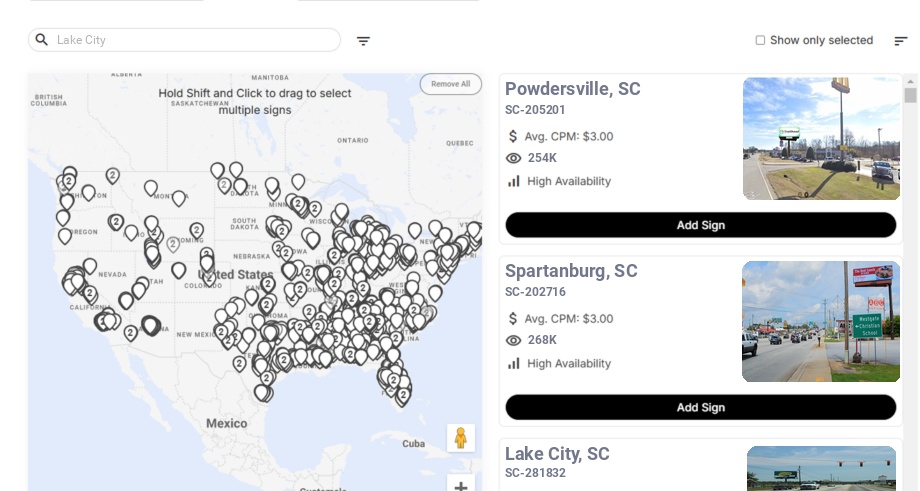
Blip has digital billboards in Lake City. You can browse available locations on a map, choose the ones that fit your audience, and start advertising right away.
Still have questions? Launch a campaign in minutes — no contracts, no commitments.
Start Your CampaignLake City Billboard Advertising Guide
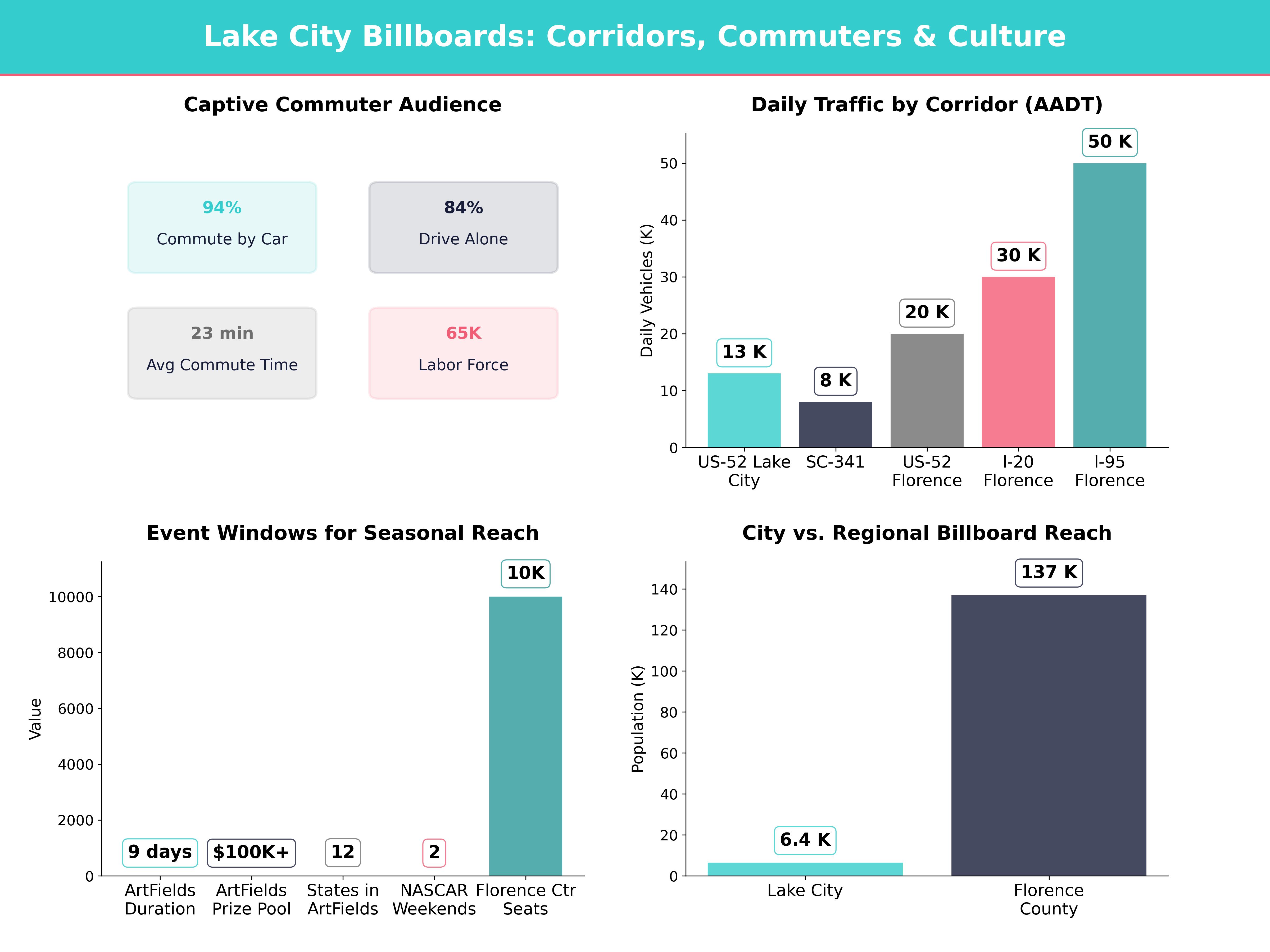
Lake City is a strong billboard market because we are not speaking only to a city of 6,449 people; we are speaking to a regional trade area inside Florence County with 137,059 residents and daily travel ties to Florence and the broader Pee Dee. The market is highly vehicle dependent, and Data USA reports that about 84% of Florence County workers drive alone and about 10% carpool, which means roughly 94% commute by car. We also get seasonal bursts from ArtFields 9-day run), regional shopping, healthcare trips to McLeod Health, MUSC Health, and HopeHealth, and the 2 race weekends at Darlington Raceway
Lake City Market Overview
When we evaluate Lake City, we need to think beyond the municipal boundary. The South Carolina Revenue and Fiscal Affairs Office lists Lake City at 6,449 residents in the 2020 census, while Florence County stood at 137,059. County growth over the 2010s was modest, at about 0.1%, which tells us this is a stable market rather than a boom-and-bust one. Stable markets reward consistency, repeated exposure, and clear calls to action.
Population, commuting, and everyday mobility in Lake City
Lake City benefits from the same travel pattern that shapes much of rural and small-city South Carolina: people drive for work, school, shopping, healthcare, worship, and entertainment. Data USA puts the average commute in Florence County at about 23 minutes, which is long enough for outdoor ads to matter but short enough for people to stay within a practical regional radius. With about 84% of workers driving alone and another 10% carpooling, roadside visibility reaches people during their most routine and repeated daily behavior.
Transit exists through the Pee Dee Regional Transportation Authority
Economic signals that matter for advertisers in Lake City
Florence County’s labor force is roughly 65,000 workers in recent reports from the South Carolina Department of Employment and Workforce. The county economy is anchored by healthcare, logistics, education, manufacturing, government, and retail. Lake City itself functions as a local service center, while nearby Florence serves as the region’s larger medical, retail, and event hub through institutions such as McLeod Health, MUSC Health, Francis Marion University, Florence-Darlington Technical College, Florence Regional Airport Florence Center.
For advertisers, that means we are often targeting a blended audience. Some viewers are truly local and highly repeatable. Others are driving in from nearby communities for appointments, classes, shopping trips, or events. In Lake City, that mix makes billboard advertising especially useful for businesses that depend on both frequency and regional pull, including healthcare, legal services, auto dealers, home services, colleges, restaurants, banks, and retail chains.
Key Traffic Corridors for Lake City Billboards
Lake City’s travel patterns concentrate around a few predictable corridors. Once we understand how people move between Lake City, Florence, and the wider county, we can match placements to intent instead of buying visibility for visibility’s sake.
U.S. 52 through Lake City
South Carolina Department of Transportation traffic count maps show that U.S. 52 in and around Lake City generally carries about 9,000 to 13,000 vehicles per day, with the busiest in-town stretches topping 12,000 AADT. That is meaningful volume for a city this size, especially because U.S. 52 combines local errands with regional movement between Florence and communities farther south.
This corridor works well for advertisers that need dependable, repeated impressions. Restaurants, convenience stores, pharmacies, urgent care centers, auto repair shops, financial services, and value retail all benefit here because people on U.S. 52 are often making practical, destination-based trips. Messaging such as “Next Right,” “Open Today,” “2 Miles Ahead,” or “Same-Day Appointments” tends to fit the way people actually use the route.
S.C. 341 and the Florence connection
S.C. 341 is one of the most important local connectors for Lake City because it ties the city to surrounding residential areas and to Florence County movement beyond downtown. Recent SCDOT counts along S.C. 341 generally fall in the 5,000 to 8,000 AADT range depending on the segment. Those are smaller numbers than an interstate, but they are highly useful because they represent targeted local traffic rather than anonymous pass-through volume.
We should think of S.C. 341 as a precision corridor. It is a strong fit for schools, churches, local healthcare practices, farm and outdoor suppliers, insurance agents, contractors, and family-focused retailers. If our objective is to stay top of mind with people who live in the area and make repeat trips every week, this road can be more efficient than a higher-volume but less relevant placement.
Florence County gateway traffic on I-95 and I-20
Even though Lake City is not directly on an interstate, the county’s identity is strongly shaped by nearby gateway traffic in Florence. SCDOT traffic maps commonly show 50,000-plus AADT on I-95 near Florence and 30,000-plus AADT on I-20 around the metro approaches. Urban segments of U.S. 52 in Florence also rise above 20,000 AADT on busier approaches.
These corridors matter for Lake City advertisers because they expand the catchment area. If we want to reach people traveling to events at the Florence Center, appointments at McLeod Health or MUSC Health, flights through Florence Regional Airport Darlington Raceway
This regional layer is especially valuable for these advertiser types:
- Healthcare providers can use it to catch patients and caregivers before they reach Florence’s medical district.
- Hospitality brands can use it to intercept race fans, event attendees, and business travelers.
- Colleges, trade schools, and employers can use it to recruit from a multi-county audience.
- Retailers can use it to reinforce destination shopping trips before consumers make their final stop choices.
Audience Segments We Can Reach in Lake City
Lake City is most effective when we treat it as a layered audience market rather than a single demographic block. The same billboard can influence a daily commuter at 7:45 a.m., a family on a Saturday shopping run, and an event visitor during a spring weekend.
Lake City commuters and everyday errand traffic
The first audience is the everyday local mover. With roughly 94% of Florence County workers commuting by car when solo driving and carpooling are combined, local roads produce repeat exposure at scale. These viewers respond well to practical offers, recognizable brand names, and service categories that solve immediate needs.
This segment is especially valuable for banks, insurance agencies, quick-service restaurants, tire shops, pharmacies, telecom providers, grocery chains, and home-service businesses. Because the average commute is about 23 minutes, we can often justify frequency-oriented creative that builds familiarity over time instead of depending on one perfect impression.
Lake City visitors, arts travelers, and event audiences
Lake City has an unusually strong arts identity for a small South Carolina city, and that creates a distinct visitor segment. ArtFields 9-day annual event that awards more than $100,000 in prizes and is open to artists from 12 Southeastern states. During that window, the audience shifts noticeably. We see more leisure travelers, more cultural visitors, and more higher-intent spending on food, shopping, hospitality, and local experiences.
That audience extends beyond ArtFields. Moore Farms Botanical Garden adds destination appeal with its 65-acre garden campus, and Discover South Carolina continues to market the Pee Dee as a regional travel area. For tourism, restaurants, boutiques, hotels, and attractions, spring is not simply “busy season.” It is a chance to speak to consumers who are actively looking for something to do next.
Students, families, and education-minded households near Lake City
Lake City also sits within reach of a meaningful education audience. Francis Marion University enrolls more than 4,000 students, and Florence-Darlington Technical College adds another strong pool of career-minded students, adult learners, and families making education decisions. Back-to-school timing matters for K-12 households as well, especially in a market where school calendars shape shopping, healthcare visits, and after-school routines.
For this segment, the best billboard categories are colleges, tutoring, youth sports, family entertainment, pediatric care, wireless, fast casual dining, and affordable retail. In Lake City, education-oriented advertising often succeeds when it feels practical and aspirational at the same time.
Healthcare, race fans, and regional destination consumers
Healthcare is one of the region’s biggest demand drivers. McLeod Health, MUSC Health, and HopeHealth pull patients and families from across the Pee Dee. Healthcare trips are often scheduled, repeated, and emotionally important, which makes billboards effective for specialists, dental offices, urgent care, rehab, imaging, and pharmacy messages.
The same is true for entertainment traffic. Darlington Raceway 1.366-mile track and brings major crowds during its 2 headline NASCAR weekends. The Florence Center adds another event audience with its 10,000-seat capacity. Whenever those event calendars fill up, regional hospitality, dining, fuel, and retail advertisers have a clear reason to increase digital billboard weight.
Seasonal Opportunities for Lake City Campaigns
Seasonality in Lake City is real, and we can use it to our advantage. The market does not need the same message in every month because local behavior changes with events, school calendars, weather, and travel patterns.
Spring in Lake City
Spring is the clearest seasonal opportunity. ArtFields 9-day schedule gives us a defined promotion window. We should consider heavier rotation from late March through April for restaurants, boutiques, galleries, hotels, home tours, tourism offers, and civic campaigns.
Spring is also a good season for outdoor and home-related advertisers. Garden centers, HVAC companies, landscapers, pest control firms, roofers, and allergy-care providers all align with how people spend and plan during this period.
Summer and back-to-school timing around Lake City
Summer brings family movement, local trips, and more flexible daytime traffic. For value retail, QSR, convenience, healthcare, and entertainment, this is a useful time for midday and weekend emphasis. As we move into July and August, the message should shift toward back-to-school offers, family scheduling, sports physicals, dental appointments, and technology upgrades.
For education and family service advertisers, the late July through early September window is especially useful. We can use fresh creative tied to school routines rather than simply keeping spring ads running too long.
Fall and holiday timing in the Lake City region
Fall is anchored by football, cooler weather, community events, and race activity at Darlington Raceway
From November into December, regional shopping traffic rises again. Because many Lake City households shop both locally and in Florence, we can use billboard campaigns to compete for holiday dollars before people lock in where they will buy.
Billboard Design Tips for the Lake City Market
Creative that works in Lake City usually feels grounded, direct, and locally aware. We do not need flashy metro-style messaging if it does not match how people drive and decide here.
Use place cues that fit Lake City driving behavior
Because U.S. 52 and S.C. 341 are destination-driven roads, directional language works unusually well. Phrases such as “Next Right,” “Ahead on 52,” “Open in Lake City,” or “Worth the Drive to Florence” match the way people navigate the area. On faster corridors, we should keep headlines to about 7 words or fewer and let one offer or one benefit carry the whole board.
Distance cues also help. If a location is 2 miles away or just off a familiar turn, we should say so. In a practical driving market, clarity often outperforms cleverness.
Match creative to Lake City’s culture and calendar
Lake City has a real arts identity, so spring creative can confidently use floral palettes, gallery-style imagery, and cleaner typography during ArtFields Darlington Raceway
For year-round campaigns, we usually see better performance from creative that emphasizes trust, value, family usefulness, and straightforward benefits. In this market, “Locally Trusted,” “Same-Day Help,” “Since 19XX,” “Affordable,” and “Open Saturday” often fit the audience better than abstract branding.
Show real utility, not just abstract awareness
Lake City consumers often use billboards as decision helpers. That means price points, service promises, appointment availability, and simple category naming can be very effective. If we are advertising healthcare, auto service, banking, or home repair, we should say exactly what we do. If we are advertising retail or food, we should make the next step obvious.
Regional Strategies Around Lake City
Lake City works best when we divide the geography into zones instead of treating every board as interchangeable. Different parts of the market serve different jobs.
Downtown Lake City and the immediate trade area
Downtown and near-downtown placements are best for frequency, civic presence, and local relevance. This is where restaurants, events, local shops, service businesses, and community campaigns can stay visible to repeat drivers. It is also the right place to support ArtFields
If our business depends on Lake City residents first, this is where we should begin. These boards create familiarity and help us feel present in the community.
The Lake City-to-Florence corridor
Lake City sits roughly 25 miles from Florence, so the corridor between the two cities is strategically important. This zone works well for businesses that draw from both places, including healthcare, colleges, furniture, legal services, auto dealers, and larger retail.
In this submarket, we should think in both directions. One face can pull Florence-area consumers toward Lake City, while another can remind Lake City residents about a destination in Florence. The best campaigns here acknowledge that the trip itself is normal and expected.
Interstate gateway strategy for the wider Florence County region
If our objective is regional scale, we should add Florence-area interstate inventory. I-95 and I-20 introduce Lake City brands to travelers, business visitors, and residents making major shopping or medical trips. This strategy is ideal for hotels, event promotion, destination dining, attraction marketing, and multi-location healthcare or retail brands.
The key is not to rely on interstate traffic alone. We get the best results when gateway boards introduce the message and Lake City-area boards close the loop.
Rural feeder roads and surrounding communities
Secondary roads around Lake City reach a slower, more local audience. These placements are useful for agriculture-related businesses, building supply, outdoor equipment, churches, schools, healthcare clinics, and community banks. They are less about mass reach and more about trust, repetition, and proximity.
Using Blip Tools in Lake City
Lake City is a good example of why flexibility matters. We do not always need the same mix of boards in April that we need in August or on race weekends. With Blip, we can build around the market’s rhythms instead of forcing one fixed plan to cover every objective.
When to use manual selection in Lake City
Manual selection makes sense when we know exactly which corridors matter. If we are promoting a restaurant, clinic, local event, or retail location in Lake City, we can hand-pick boards along U.S. 52, S.C. 341, or the Florence approach routes and focus budget where intent is strongest. This is especially useful for directional messaging and short promotional windows.
When Blip optimization helps in the Lake City region
If our goal is broader awareness across Lake City and Florence County, a Blip-optimized approach can be more efficient. It can spread budget across local boards, regional connectors, and higher-demand time periods without requiring us to micromanage every move. That is helpful when we want reach among commuters, event visitors, and cross-county travelers at the same time.
Dayparting is particularly valuable here. We can lean into morning and late-afternoon commuter windows, increase midday presence for errands and appointments, and add weekend weight around events, dining, and shopping. Real-time analytics help us compare which corridors are actually delivering the best response patterns, and artwork tools make it easier to rotate spring, back-to-school, race-week, and holiday creative without a long production cycle.
Getting Started with Billboard Rental in Lake City
Renting a billboard in Lake City starts with one question: what action do we want the audience to take? In a market this size, the best locations depend on whether we want immediate store visits, regional awareness, event turnout, healthcare appointments, or longer-term brand familiarity.
How we should evaluate Lake City billboard locations
We should look at each board through four lenses:
- We should confirm whether the board sits on a true decision corridor, such as U.S. 52, S.C. 341, or a Florence gateway route.
- We should decide whether we want local repetition or broader regional reach, because those are not always the same buy.
- We should match the board to the audience’s trip purpose, such as commuting, shopping, school, healthcare, or event travel.
- We should check whether the creative can be understood quickly given road speed, intersection complexity, and direction of travel.
For many advertisers, a 2- to 4-week test is the smartest starting point. We can run one set of boards in Lake City, one set on the Florence approach, compare results, and then scale what performs.
Why Blip simplifies billboard rental in Lake City
Traditional billboard buying often pushes us toward larger commitments, longer lead times, and fewer chances to adapt once a campaign is live. Blip simplifies the process by letting us launch, adjust, pause, and refine based on what the local market is actually doing. That matters in Lake City because timing is a major part of performance. A campaign during the 9 days of ArtFields
If we are new to Lake City, we should start with a clear geographic hypothesis. We can test downtown visibility, commuter reach, or Florence gateway exposure, then let the results guide our next move. That is the most practical way to rent billboards here, and it is also the fastest way to find the combination of local trust and regional scale that makes Lake City such a productive outdoor market.