Billboards near Garden City, SC
No Minimum Spend. No Long-Term Contracts. Just Results.
Trusted by Leading Brands


Billboard advertising
near Garden City has never been easier
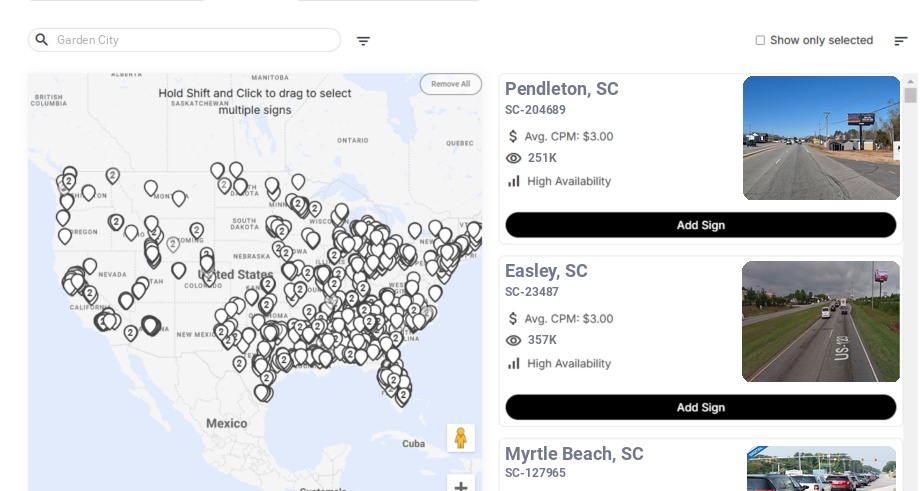



How much is a billboard near Garden City?
Why Choose Blip for Billboard Advertising near Garden City
-
Blip lets you launch fast in Garden City and reach US 17 Business shoppers near Murrells Inlet when intent is highest.
-
Garden City campaigns can flex by budget with Blip, so you can lean into summer beach traffic and pause when coastal demand slows.
-
Daypart Garden City ads for lunch, dinner, and 6-9 a.m. commutes on SC 707 and SC 544 to catch locals and visitors in motion.
-
With no contracts in Garden City, you can test weekend MarshWalk traffic, then shift spend based on what real-time analytics show.
-
Blip's creative tools help Garden City ads stand out in bright coastal glare, with simple copy built for beachgoers and year-round residents.
Frequently Asked Questions About Billboard Advertising near Garden City
How much does a billboard cost in Garden City with Blip?
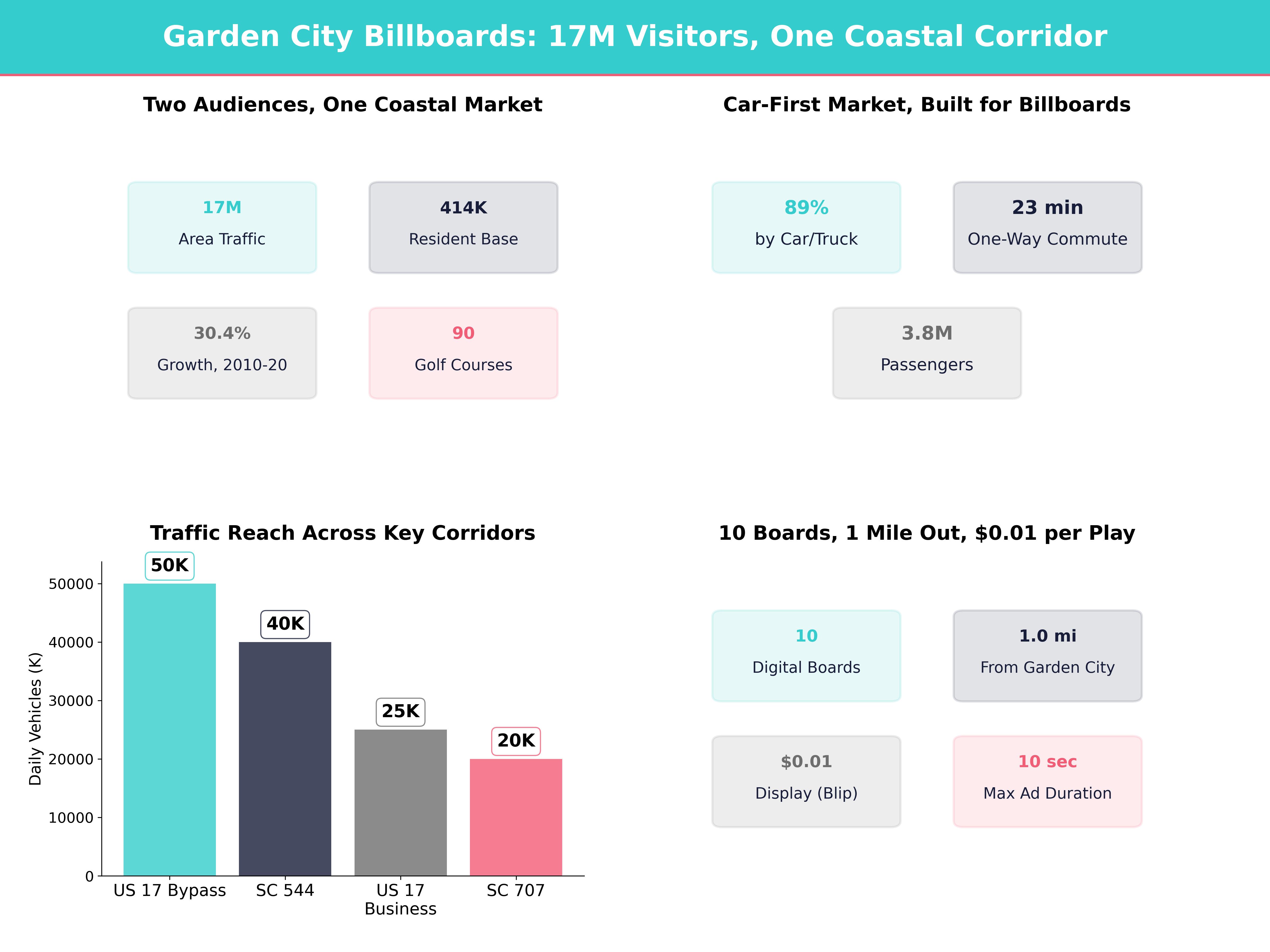
Blip makes billboard advertising in the Garden City area flexible and budget-friendly. With pay-per-play pricing, you only pay when your ad actually appears, starting at just $0.01 per display for a 7.5-to-10-second “blip” on a rotating digital billboard serving the Garden City area. Your daily budget is what Blip’s algorithm uses to compete for open ad slots, and the cost per blip can vary based on time of day, location, and advertiser demand.
Where can I advertise near Garden City with Blip?
We can reach that audience with 10 digital billboards in nearby Murrells Inlet, only 1.0 mile from Garden City, where drivers are already moving along the same roads that feed beaches, marinas, neighborhoods, and shopping trips. Because all 10 of our digital billboards serving the Garden City area are in nearby Murrells Inlet, this is the obvious starting point for businesses that want quick-turn response.
What traffic and audience conditions make Garden City good for billboard ads?
Garden City benefits from its position on the southern end of the Grand Strand, the region’s famous 60-mile stretch of coastline. In Horry County, about 89% of workers commute by car, truck, or van, and the average one-way commute is about 23 minutes. That means outdoor advertising near Garden City is speaking to people already spending meaningful time on the road.
When is the best time to run Blip ads in Garden City?
Spring is one of the best times to start or scale a campaign serving the Garden City area, and March through May combines golf travel, spring break traffic, warming weather, and the first strong wave of beach demand. From Memorial Day through Labor Day, the Garden City area shifts into full family beach mode. We also recommend refreshing creative every 2 to 3 weeks during peak season.
What roads around Garden City get the most billboard exposure?
Recent maps from the South Carolina Department of Transportation place US 17 Business through the Garden City to Murrells Inlet stretch in the mid-20,000s vehicles per day. US 17 Bypass near the Town of Surfside Beach and the SC 544 connection is roughly 50,000 vehicles per day, and SC 544 reaches 40,000-plus vehicles per day on higher-volume segments. SC 707 also serves growing residential areas and has major southern Horry County segments above 20,000 vehicles per day.
Do I need a contract to advertise with Blip near Garden City?
No, Blip has no long-term contracts or minimum commitments. You can start, pause, or stop your campaign at any time.
How fast can I launch a billboard campaign with Blip near Garden City?
You can have your campaign live in minutes. Create a free account, select your locations, set your budget, upload your design, and start running once approved.
Where can I advertise with Blip near Garden City?
Blip has digital billboards near Garden City. You can browse available locations on a map, choose the ones that fit your audience, and start advertising right away.
Still have questions? Launch a campaign in minutes — no contracts, no commitments.
Start Your CampaignGarden City Billboard Advertising Guide
Advertising near Garden City works because the market sits at the meeting point of beach leisure traffic, local residential growth, and the restaurant-heavy pull of nearby Murrells Inlet. We can reach that audience with 10 digital billboards in nearby Murrells Inlet, only 1.0 mile from Garden City, where drivers are already moving along the same roads that feed beaches, marinas, neighborhoods, and shopping trips.
Garden City Area Market Overview
Population, growth, and regional scale near Garden City
Because Garden City is an unincorporated coastal community, we usually size the market with southern Horry County data and nearby Georgetown County 351,029 residents in 2020, up from 269,291 in 2010. That was an increase of 81,738 people, or 30.4% growth in one decade, which is exactly the kind of expansion that supports home services, healthcare, retail, dining, and real estate advertising near Garden City.
Georgetown County had another 63,404 residents in the broader south Grand Strand catchment. Together, those two counties represent a resident base of 414,433 people who can be reached by campaigns serving the Garden City area. The nearby City of Myrtle Beach had 35,682 residents in 2020, and the southern Grand Strand functions as one connected coastal market that also includes the Town of Surfside Beach Murrells Inlet, and the Town of Pawleys Island.
Garden City also benefits from its position on the southern end of the Grand Strand 60-mile stretch of coastline. That geography matters because people do not experience the market one town at a time. They move between beaches, condos, restaurants, golf courses, healthcare providers, and shopping districts across the full coastal corridor.
Economic drivers and commuting patterns serving the Garden City area
Tourism is the headline industry, but it is not the only one. The Myrtle Beach Area Chamber of Commerce and Visit Myrtle Beach 17 million visitors annually, and that visitor economy supports hospitality, dining, attractions, retail, construction, transportation, and seasonal employment.
Air access amplifies that draw. Myrtle Beach International Airport 3.8 million passengers in 2023, which helps explain why the Garden City area sees waves of fly-in leisure travel as well as drive-in visitors from the Carolinas and the Southeast. Healthcare employers like Tidelands Health Grand Strand Health, and Conway Medical Center add year-round economic stability beyond tourism.
For billboard planning, the most important behavioral fact is that this is a car-first market. In Horry County, about 89% of workers commute by car, truck, or van, and the average one-way commute is about 23 minutes. That means outdoor advertising near Garden City is not competing with a transit-heavy environment. It is speaking to people already spending meaningful time on the road.
Key Traffic Corridors Serving the Garden City Area
US 17 Business and the coastal spine near Garden City
Recent maps from the South Carolina Department of Transportation place US 17 Business through the Garden City to Murrells Inlet stretch in the mid-20,000s vehicles per day. That is the corridor we watch most closely for advertisers who want to influence beachgoers, restaurant traffic, short local trips, and people moving between the Town of Surfside Beach Murrells Inlet.
US 17 Business is especially valuable because it carries intent-rich traffic. People on that road are often close to making a choice about where to eat, where to shop, where to book an activity, or which business to visit next. For brands serving the Garden City area, that makes nearby Murrells Inlet digital inventory a practical way to intercept real decision moments.
US 17 Bypass, SC 707, and SC 544 as feeder routes for Garden City
US 17 Bypass is the bigger regional funnel west of the shoreline. Near the Town of Surfside Beach 50,000 vehicles per day. That heavier flow is ideal when we want reach across the broader Garden City area rather than just immediate beach circulation.
SC 707 is another key route. SCDOT counts place major southern Horry County segments above 20,000 vehicles per day, and that road serves growing residential areas, schools, healthcare campuses, and neighborhood retail. It is a smart feeder for local-service advertisers, including HVAC, roofing, legal, urgent care, storage, and home improvement brands.
SC 544 matters because it connects the inland population base to the coast. On higher-volume segments, SC 544 reaches 40,000-plus vehicles per day as it links Socastee, Coastal Carolina University Horry-Georgetown Technical College, the City of Conway, and the beach side. Even though our boards serving the Garden City area are in nearby Murrells Inlet, these feeder routes still matter because they shape when people arrive, how they circulate, and which dayparts produce the strongest audience concentration.
Coast RTA
Audience Segments We Reach Near Garden City
Commuters, residents, and household decision-makers in the Garden City area
The Garden City area is not only a vacation market. It is also a residential market with daily school, work, healthcare, and errand traffic. Horry County Schools enrolls about 48,000 students, which tells us just how much family movement exists across southern Horry County on weekday mornings and afternoons.
That audience responds well to practical categories. We regularly see the strongest local-market fit from healthcare, dentistry, urgent care, attorneys, auto services, furniture, storage, insurance, home improvement, pest control, roofing, and restaurants. Because the county’s resident base has grown by 30.4% since 2010, the market also supports a steady stream of newer homeowners and recent transplants who are still choosing service providers.
Tourists, second-home owners, and leisure travelers serving Garden City demand
Tourism is the obvious second audience. The Grand Strand’s 17 million annual visitors do not stay in just one place. They travel between hotels, condo rentals, golf courses, shopping districts, and attractions across the coast, which means a message near Garden City can influence behavior well beyond a single beach access point.
Golf is a major piece of that audience. The Myrtle Beach area is home to roughly 90 golf courses, and golf travelers are high-value consumers for dining, retail, nightlife, medical spas, real estate, and transportation offers. Visitors also circulate through major attractions like Brookgreen Gardens Huntington Beach State Park, the Myrtle Beach Convention Center Broadway at the Beach, and The Market Common
The nearby Murrells Inlet 2020 Chamber of Commerce promotes the MarshWalk, a half-mile waterfront dining corridor that keeps afternoon and evening traffic active near Garden City. Farther north, the Myrtle Beach Boardwalk spans 1.2 miles, reinforcing how the whole coastal strip functions as one entertainment ecosystem. If your business serves visitors near Garden City, we should assume those visitors are mobile and willing to drive.
Students, young adults, and event-goers near Garden City
The market also includes a younger and more event-driven audience than many advertisers expect. Coastal Carolina University 10,000 students, and Horry-Georgetown Technical College adds thousands more across its campuses. Those students travel between inland housing, beach jobs, nightlife, and recreation, especially during the academic year.
Event traffic broadens the audience further. The Myrtle Beach Marathon Carolina Country Music Fest, Myrtle Beach Pelicans, and convention activity at the Myrtle Beach Convention Center
Seasonal and Timing Opportunities in the Garden City Area
Spring campaign windows near Garden City
Spring is one of the best times to start or scale a campaign serving the Garden City area. March through May combines golf travel, spring break traffic, warming weather, and the first strong wave of beach demand. We usually recommend launching creative 2 to 4 weeks before major spring weekends so the message builds familiarity before people finalize plans.
Events matter here. The Myrtle Beach Marathon Myrtle Beach Bike Week 10-day draw that benefits restaurants, bars, retail, lodging, repair shops, entertainment venues, and urgent care providers. Spring is also a strong time for real estate, landscaping, pest control, outdoor gear, and home services because residents are getting active after winter.
Summer peak season and weather-aware strategy near Garden City
From Memorial Day through Labor Day, the Garden City area shifts into full family beach mode. This is when we lean hardest into restaurants, attractions, souvenir retail, mini golf, ice cream, beachwear, vacation rentals, and family-friendly entertainment. Arrival days and meal times matter, so we often emphasize afternoon and evening exposure when visitors are deciding what to do next.
Summer also requires weather awareness. Atlantic hurricane season runs from June 1 through November 30, and coastal advertisers should plan for both normal summer travel and storm-related needs. Roofing, HVAC, generators, hardware, grocery, pharmacy, insurance, and restoration companies can benefit from flexible creative that can be swapped quickly when weather becomes a local concern.
Fall and winter opportunities serving the Garden City area
Fall is an underrated sweet spot near Garden City. September and October often bring warm weather, lighter congestion, golf traffic, seafood dining, and a more local-feeling pace. That is a strong window for healthcare, luxury services, financial planning, senior living, home remodeling, and brands that want affluent coastal homeowners rather than purely summer tourists.
Late fall and winter still offer meaningful activity. Holiday draw from Brookgreen Gardens Nights of a Thousand Candles, helps keep the south end active. Winter is also a solid time for tax prep, legal services, medical appointments, furniture, storage, gyms, and home-improvement categories that target residents and seasonal snowbirds.
Billboard Design Tips for the Garden City Market
Creative choices that fit coastal roads near Garden City
The Garden City area is bright, reflective, and humid, so contrast matters. We recommend strong combinations like navy and white, teal and white, coral and charcoal, or sand tones paired with a dark background. Pastel-on-white often looks washed out against coastal glare.
We also recommend short, high-impact copy. A moving driver should grasp the message in one glance, so aim for 7 to 10 words, one clear offer, and one obvious brand cue. Because a Blip ad appears for 7.5 to 10 seconds, we want the brand name and value proposition to appear immediately, not at the end.
Messaging angles that resonate in the Garden City area
Local relevance helps. Coastal consumers respond to messages that sound geographically aware, such as references to Murrells Inlet seafood, Grand Strand savings, beach-day essentials, golf specials, or urgent services after storms. We should only use directional claims like “1 mile ahead” or “next right” when they are exact, but distance-based messaging can work very well near Garden City because drivers are often close to their decision point.
The strongest categories usually match the area’s real trip purposes. For the Garden City market, that means:
- Seafood, waterfront dining, and happy-hour creative works well during lunch and evening traffic.
- Healthcare, dental, urgent care, and pharmacy messages fit commuter and family routines.
- Roofing, HVAC, pest control, flooring, and remodeling ads connect with the area’s growing homeowner base.
- Golf, beachwear, attractions, and family entertainment promotions fit spring and summer travel.
We also like refreshing creative every 2 to 3 weeks during peak season. Visitor traffic turns over quickly, and a fresh headline can keep a campaign from blending into the background.
Regional Strategies Near Garden City
Close-in Murrells Inlet strategy for immediate action
Because all 10 of our digital billboards serving the Garden City area are in nearby Murrells Inlet, just 1.0 mile from Garden City, this is the obvious starting point for businesses that want quick-turn response. Restaurants, bars, clinics, boat tours, tackle shops, retail stores, local attractions, and real estate teams usually benefit most from close-in placements because the consumer is already nearby.
This strategy works especially well when we daypart toward actual intent. Lunch, dinner, and evening entertainment advertisers often get the most value by concentrating spend on Thursday through Sunday and on late-afternoon to evening hours.
Commuter-capture strategy on the northern and western approaches
For resident-focused brands, we often build around the routes that feed the Garden City area rather than only the final destination corridor. That means aligning messaging with US 17 Bypass, SC 707, and SC 544 travel patterns. Home services, legal, healthcare, schools, and hiring campaigns often perform best when they catch people during the workday routine rather than during leisure time.
In practical terms, that usually means weighting exposure around 6 to 9 a.m. and 3 to 7 p.m. on weekdays. Those are the hours when commuters, school traffic, errand traffic, and service-call decision-makers are most concentrated.
Southbound and upscale coastal strategy beyond Garden City
The Garden City area also benefits from southbound flow toward Pawleys Island, Litchfield, and Georgetown County
If your brand also serves the broader Grand Strand, we can pair south-end messaging with regional cues that connect Garden City-area travel to destinations like Broadway at the Beach, The Market Common
Blip Tools for Campaigns Serving the Garden City Area
How we use Blip features to match Garden City traffic patterns
Blip is especially useful near Garden City because the market changes by hour, by weekday, and by season. We can select the exact digital boards we want on a map, test a smaller group of 2 to 3 boards or use all 10, and adjust quickly when weather, events, or visitor patterns shift. That flexibility matters more here than in a purely commuter market.
Pay-per-play pricing also helps when we want to follow real demand. We only pay when the ad actually runs, with pricing starting at $0.01 per display, so it is practical to lean into weekend dining traffic, pull back during slower periods, and then ramp again for holiday weeks, event weekends, or school-calendar shifts. Real-time analytics help us see which days and windows are producing the strongest delivery.
Blip tactics that work well near Garden City
A few tactics tend to fit this market particularly well:
- We can schedule heavier presence from Thursday through Sunday for restaurants, nightlife, attractions, and retail.
- We can emphasize weekday commute windows for healthcare, legal, schools, hiring, and home services.
- We can rotate 2 or 3 creative versions so visitors see a fresh message while locals still build recall.
- We can start with a small test budget, identify the strongest hours, and then scale without waiting for a contract reset.
Those are simple tools, but they matter in a place where Saturday beach traffic, weekday local errands, and shoulder-season golf trips all create different audience moments.
Getting Started with Billboard Rental Near Garden City
How we evaluate the right billboard fit for the Garden City area
The best place to start is with the goal, not the board. If the goal is immediate visits, we should prioritize close-in inventory serving the Garden City area from nearby Murrells Inlet. If the goal is broad awareness, we should think more about feeder routes, commuter windows, and high-volume travel patterns.
We usually recommend this checklist:
- If your business is within 1 to 5 miles of Garden City, prioritize the closest Murrells Inlet boards and write copy for immediate action.
- If your business serves the full south Grand Strand, prioritize broader lifestyle or brand messaging rather than hyper-local directions.
- If your audience is mostly residents, target weekday commute and errand periods.
- If your audience is mostly visitors, target arrival days, meal times, and event weekends.
Creative evaluation matters just as much as location evaluation. A short headline, one phone or web action, and a readable brand mark will usually outperform a crowded design. We rarely recommend QR codes for this market because most impressions happen at driving speed.
What to expect from the rental process near Garden City
Traditional billboard buying often involves sales calls, availability checks, fixed reservations, and limited flexibility once the campaign is live. Blip simplifies that process. We can choose boards online, upload artwork, set a daily budget, select time and day targeting, and change the campaign whenever the market changes.
For most advertisers serving the Garden City area, we suggest a 7- to 14-day initial test. That is usually long enough to compare weekdays versus weekends, identify whether lunch or evening performs better, and decide whether the campaign should stay concentrated near Murrells Inlet or expand to a broader regional mix. After that, we can optimize based on real delivery instead of guesswork.
The final step is measurement. Before launch, we should decide whether success means more website visits, more walk-ins, more calls, more branded search, or more bookings. Once we know the outcome we care about, choosing the right Garden City-area billboards becomes much easier, and the campaign can grow from a smart local test into a repeatable regional strategy.