Billboards in Summerville, SC
No Minimum Spend. No Long-Term Contracts. Just Results.
Trusted by Leading Brands


Billboard advertising
in Summerville has never been easier
How much is a billboard in Summerville?
Why Choose Blip for Billboard Advertising in Summerville
-
Blip makes Summerville billboard buying self-serve, so you can launch fast on I-26 or US 78 and reach daily commuters in minutes.
-
Set any budget in Summerville and only pay when your ad plays—great for testing the Flowertown Festival season without long commitments.
-
Use Blip's dayparting in Summerville to hit 6-9 a.m. commuters on I-26 and afternoon shoppers near Bacons Bridge Road.
-
No contracts mean Summerville brands can pause or pivot as growth shifts from Nexton to downtown, keeping campaigns flexible.
-
Track Summerville performance in real time and shift spend toward the routes driving the most clicks, calls, or awareness.
-
Blip's creative tools help Summerville ads stand out with local cues for commuters, families, and Charleston-bound traffic.
Frequently Asked Questions About Billboard Advertising in Summerville
How much does a billboard cost in Summerville with Blip?
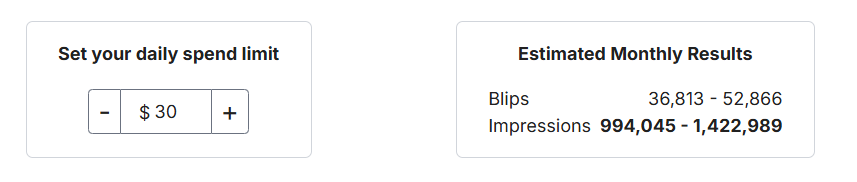
With Blip, billboard advertising in Summerville can fit a wide range of budgets because you only pay when your ad actually appears. Each “blip” is a 7.5-to-10-second display on a rotating digital billboard, with pricing starting at just $0.01 per display. Your daily budget tells Blip’s algorithm how much to spend bidding for open ad slots, and the cost per blip can change based on time of day, location, and advertiser demand.
Where can I advertise with Blip in Summerville, South Carolina?
The strongest campaigns in Summerville usually align with high-volume roads that connect suburban neighborhoods to job centers, retail districts, and visitor destinations. I-26 through the Summerville corridor commonly runs from roughly 80,000 to 100,000 vehicles per day, while US 78 between Summerville, Ladson, and North Charleston is often in the 30,000 to 40,000-plus AADT range. US 17A and the Main Street and North Main network also give advertisers access to the heart of Summerville.
Why is Summerville, South Carolina a good market for billboard ads?
Summerville gives us an unusually strong billboard market because it combines rapid suburban growth, heavy daily driving, and easy access to the broader Charleston region. The town itself had 50,915 residents in the 2020 census, and its surrounding footprint across Dorchester County, Berkeley County, and Charleston County totaled 799,636 people. Most households in the Summerville trade area rely on personal vehicles, which gives digital billboards repeated visibility on the same routes people use for work, school, shopping, and recreation.
What kinds of businesses work best for billboard advertising in Summerville with Blip?
Summerville is especially effective for local services, recruiting, healthcare, retail, education, events, and regional brands that want to connect suburban residents with Charleston-area destinations. Fast-growing communities generate new rooftops, new retail trips, new school traffic, and more demand for healthcare, home services, childcare, restaurants, and entertainment. Recruiting campaigns, patient-acquisition campaigns, enrollment pushes, awareness campaigns for service businesses, and destination campaigns for hospitality all fit well here.
Do I need a contract to advertise with Blip in Summerville?
No, Blip has no long-term contracts or minimum commitments. You can start, pause, or stop your campaign at any time.
How fast can I launch a billboard campaign with Blip in Summerville?
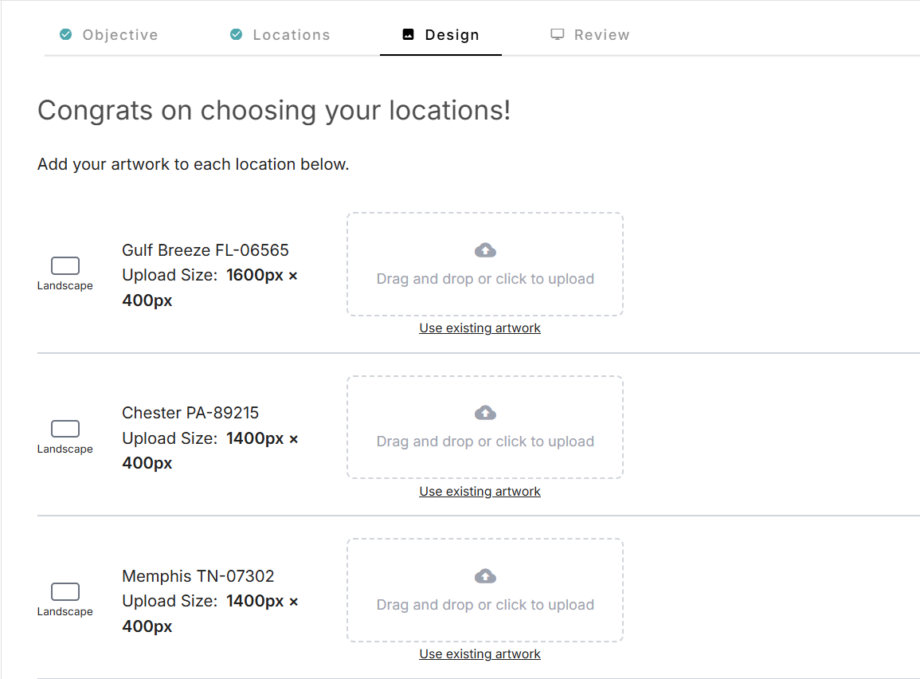
You can have your campaign live in minutes. Create a free account, select your locations, set your budget, upload your design, and start running once approved.
Where can I advertise with Blip in Summerville?
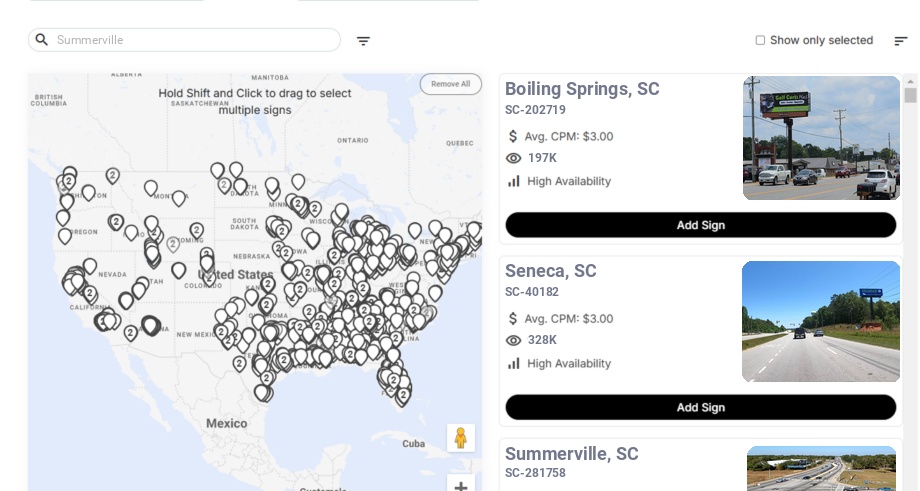
Blip has digital billboards in Summerville. You can browse available locations on a map, choose the ones that fit your audience, and start advertising right away.
Still have questions? Launch a campaign in minutes — no contracts, no commitments.
Start Your CampaignSummerville Billboard Advertising Guide
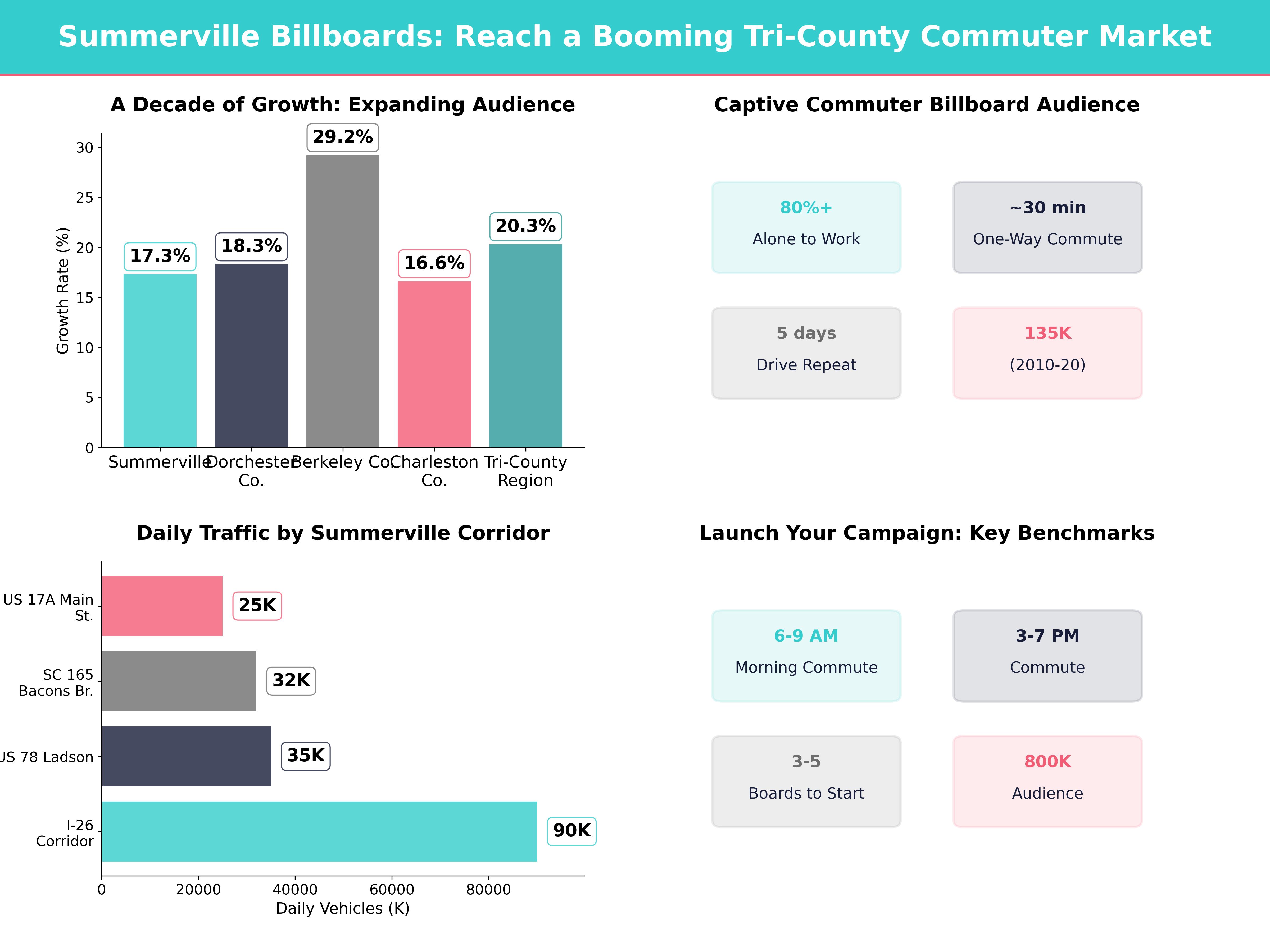
Summerville roughly 4 out of 5 workers commute by driving alone, with one-way commute times generally around 30 minutes), and easy access to the broader Charleston region. The Town of Summerville 50,915 residents in the 2020 census, and its surrounding footprint across Dorchester County Berkeley County Charleston County totaled 799,636 people. Most households in the Summerville trade area rely on personal vehicles, which gives digital billboards repeated visibility on the same routes people use for work, school, shopping, and recreation. That makes Summerville especially effective for local services, recruiting, healthcare, retail, education, events, and regional brands that want to connect suburban residents with Charleston-area destinations.
Summerville Market Overview
Summerville sits inside one of South Carolina's most active growth corridors, and that matters directly for billboard performance. The town itself grew from 43,392 residents in 2010 to 50,915 in 2020, which was an increase of 17.3%. Over the same decade, Dorchester County 136,555 to 161,540, or 18.3%, Berkeley County 177,843 to 229,861, or 29.2%, and Charleston County grew from 350,209 to 408,235, or 16.6%. Combined, those three counties expanded from 664,607 residents in 2010 to 799,636 in 2020, which was a gain of 20.3% in just one decade.
What growth means for advertisers in Summerville
That kind of expansion creates exactly the conditions we want for billboard advertising. Fast-growing communities generate new rooftops, new retail trips, new school traffic, and more demand for healthcare, home services, childcare, restaurants, and entertainment. In Summerville, those patterns are visible in communities such as Nexton, a 5,000-acre master-planned development, and in the continued suburban spread toward Ladson, Knightsville, Goose Creek, and Ridgeville 135,029 residents from 2010 to 2020.
Summerville also benefits from its position inside the Charleston employment shed. Residents regularly commute toward North Charleston, Charleston International Airport South Carolina Ports, medical campuses, industrial sites, and higher-education centers. That means a business in Summerville can advertise not only to town residents, but also to a broader stream of workers, contractors, students, and visitors moving between suburban neighborhoods and regional job centers.
Car dependence and commute behavior around Summerville
This is still a vehicle-first market, with roughly 4 out of 5 workers commuting by driving alone. Recent community profiles and ACS-based planning documents show that in Dorchester and Berkeley counties, roughly 4 out of 5 workers commute by driving alone, and one-way commute times are generally around 30 minutes. CARTA
For billboard advertisers, that means frequency matters. When people make the same drive 5 days a week, a well-placed digital board can build recognition quickly. That is especially useful for:
- Employers that need applicants to remember a job opening during a long commute.
- Healthcare providers that want top-of-mind awareness before an urgent need arises.
- Retailers and restaurants that benefit from same-day decisions on the drive home.
- Home-service brands that need familiarity before the next repair, replacement, or seasonal emergency.
Economic anchors that support ad demand in Summerville
Summerville's economy is strengthened by the broader Charleston region's mix of logistics, manufacturing, aviation, healthcare, education, tourism, and professional services. Major institutions and employers in the regional travel shed include Volvo Cars South Carolina Boeing South Carolina MUSC Health, Roper St. Francis Healthcare, Trident Health Summerville Medical Center Charleston Southern University, Trident Technical College, and the College of Charleston.
This mix supports a wide range of billboard categories. We can run recruiting campaigns for skilled trades and manufacturing, patient-acquisition campaigns for healthcare, enrollment pushes for schools and colleges, awareness campaigns for service businesses, and destination campaigns for entertainment and hospitality. In a market like Summerville, the diversity of local demand is one of the biggest advantages.
Key Traffic Corridors for Summerville Billboard Campaigns
Summerville's billboard value is driven by a handful of high-volume roads that connect suburban neighborhoods to job centers, retail districts, and visitor destinations. The strongest campaigns usually align creative and timing with the role each corridor plays in daily life.
I-26 through the Summerville corridor
According to South Carolina Department of Transportation traffic counts I-26 in the Summerville-to-North Charleston corridor commonly run from roughly 80,000 to 100,000 vehicles per day, and busier metro segments farther east rise well above 100,000 AADT. This is the dominant regional spine for people traveling between Summerville, Ladson, North Charleston, the airport area, and downtown Charleston.
We usually view I-26 as the best corridor for broad-reach advertisers, including:
- Regional healthcare systems that want visibility across multiple communities.
- Colleges, trade schools, and training programs that recruit from the full Charleston labor shed.
- Large employers that need shift workers, mechanics, technicians, drivers, and warehouse staff.
- Attractions, hotels, and event venues that want to catch both residents and visitors.
Because I-26 serves both daily commuters and weekend leisure traffic, it also works well for split scheduling. We can emphasize commuting hours from Monday through Friday, then shift to tourism, dining, and family entertainment messages on weekends.
US 78 between Summerville, Ladson, and North Charleston
US 78 is one of the most useful secondary corridors in the market. SCDOT counts on busier stretches between Summerville, Ladson, and North Charleston are commonly in the 30,000 to 40,000-plus AADT range, depending on the segment. This route collects local trips, lower-speed commuter traffic, commercial traffic, and neighborhood-serving retail demand that I-26 alone does not capture.
US 78 is often a strong fit for advertisers that need action, not just awareness. That includes urgent care, tire and auto repair, quick-service restaurants, discount retail, storage, furniture, HVAC, and staffing agencies. When we want people to make a decision on today's drive, a corridor like US 78 can outperform a purely regional placement because the route is more local and more transactional.
US 17A, Main Street, and North Main in Summerville
US 17A and the Main Street and North Main network give advertisers access to the heart of Summerville. Traffic counts vary by segment, but many town-centered stretches land in the 20,000 to 30,000 AADT range. These roads capture school trips, errands, dining, medical appointments, and everyday local movement through one of the region's strongest suburban downtowns.
This corridor is especially valuable for brands that depend on trust and local familiarity. We often like these placements for:
- Dentists, pediatricians, family medicine practices, and specialists.
- Banks, insurance agencies, and real estate professionals.
- Churches, private schools, and community events.
- Local restaurants, boutiques, and downtown merchants near Visit Summerville
Because speeds are lower than on I-26, Main Street-area boards can support slightly more nuance in the message. We still want brevity, but we can often include a neighborhood cue, an exit reference, or a local place name that feels relevant to Summerville drivers.
Bacons Bridge Road and Dorchester Road
SC 165, Bacons Bridge Road, and nearby retail corridors are important because they connect dense residential areas to shopping centers, schools, and medical offices. On busier stretches, SCDOT counts often climb into the 25,000 to 40,000 AADT range. Dorchester Road also handles heavy commercial traffic deeper into the metro and is a practical route for reaching households that move between Summerville, Ladson, and North Charleston.
These corridors are ideal for advertisers that serve families and homeowners. We regularly see good alignment here for grocery-adjacent retail, childcare, urgent care, orthodontics, home improvement, fitness, and local event promotion. If a business wins by being top-of-mind right before a stop, this part of the market deserves attention.
Airport, convention, and event routes east of Summerville
Many Summerville residents travel east for flights, meetings, concerts, and regional events. Charleston International Airport more than 6 million passengers in 2023, and the airport area is also anchored by the Charleston Area Convention Center and the North Charleston Coliseum & Performing Arts Center. Corridors linking Summerville to North Charleston therefore matter for hospitality, entertainment, and B2B campaigns, even when the advertised business is not physically inside Summerville.
For tourism and event-driven brands, we usually think about these routes as gateway inventory. The audience includes residents heading to flights or shows, visitors renting cars, and business travelers moving through the convention district. That broadens Summerville's usefulness beyond a purely local buy.
Audience Segments We Can Reach in Summerville
A strong Summerville campaign starts with understanding not only where people drive, but also why they drive. The market offers several distinct audiences, and each responds to different creative and timing.
Summerville commuters and workforce audiences
Commuters are the most dependable audience in the market. With driving-alone rates at roughly 80% or higher in Dorchester and Berkeley counties, billboard advertising gets repeated exposure from people who make the same work trips every week. That is one reason recruiting campaigns work so well here.
We can target workers connected to manufacturing, logistics, healthcare, retail, construction, and office employment throughout the Charleston region. Campaigns for Volvo Cars South Carolina Boeing South Carolina
Families and household decision-makers in Summerville
Summerville is deeply family-oriented, and the school footprint shows it. Dorchester School District Two serves more than 26,000 students, Berkeley County School District serves more than 39,000 students, and Charleston County School District serves more than 50,000 students. Taken together, that is well over 115,000 students across the three districts connected to the greater Summerville travel shed.
That scale makes families a core billboard audience. Parents are constant drivers, and they make frequent decisions about food, healthcare, after-school activities, tutoring, camps, youth sports, family entertainment, and home services. Businesses that solve practical household needs can do very well in this market.
Students and education audiences near Summerville
The region also gives us a meaningful student and continuing-education audience. Charleston Southern University enrolls roughly 3,400 students, while the College of Charleston serves about 10,000 students. Trident Technical College adds a large workforce-development and commuter-student population to the mix.
For education advertisers, the opportunity is broader than just traditional college recruiting. We can also promote certification programs, skilled-trades training, adult education, test prep, and continuing-healthcare credentials. In a fast-growing market with strong industrial demand, education messages tied to employment outcomes tend to resonate.
Visitors, eventgoers, and regional leisure travelers
Summerville also benefits from regional visitor flow. The Flowertown Festival more than 200,000 visitors over 3 days each spring, and the broader Charleston calendar includes the 10-kilometer Cooper River Bridge Run, the spring Credit One Charleston Open 17-day Spoleto Festival USA
This audience is especially useful for restaurants, hotels, attractions, boutiques, entertainment venues, and medical practices that benefit from seasonal boosts. Even if an event is not in Summerville proper, the town often participates in the same regional movement patterns.
Seasonal and Timing Opportunities in Summerville
In Summerville, timing can be just as important as location. The market has clear seasonal moments when message relevance jumps, and digital billboards are well suited to those shifts.
Spring in Summerville is a peak visibility season
Spring is arguably Summerville's signature advertising season. The town's identity as a flower-filled Lowcountry destination becomes especially visible during azalea bloom and the Flowertown Festival 200,000-plus visitors. We usually see strong fit in spring for home and garden brands, outdoor living, local dining, boutiques, real estate, healthcare checkups, and event promotion.
Spring also aligns with heavy regional event traffic because the Cooper River Bridge Run, Credit One Charleston Open Spoleto Festival USA
Summer in Summerville favors travel, family, and heat-related services
Summer brings school break, family activity planning, and higher travel volumes to and from Charleston International Airport
Weekend and late-afternoon scheduling often works especially well in summer. People are making more discretionary trips, and many decisions are same-day or next-day decisions.
Back-to-school and fall in the Summerville area
The back-to-school window is one of the most dependable annual triggers in the market because of the region's 115,000-plus K-12 students. Campaigns for pediatric care, tutoring, orthodontics, eye care, extracurricular programs, youth sports, school fundraisers, and family restaurants all have natural relevance from late July through September.
Fall also brings football, festival traffic, and major regional events such as the Coastal Carolina Fair in nearby Ladson. For employers, fall is often a productive hiring window because routine is back, commuting patterns stabilize, and audiences are again driving predictable schedules.
Holiday and year-end timing for Summerville billboards
From November through December, Summerville supports strong retail and service messaging. Local shopping, gift purchases, holiday dining, and medical open-enrollment reminders all compete for attention. We often like to shift creative during this period toward urgency, convenience, hours, and giftability.
Year-end is also useful for healthcare, tax services, storage, moving, and personal-improvement offers. Because digital boards can change quickly, we can move from Black Friday language to holiday events, then into January reset messaging without changing the overall market strategy.
Billboard Design Tips for the Summerville Market
Good creative in Summerville should feel local, practical, and easy to read at speed. This market responds well when the message clearly reflects how people actually live in the Lowcountry suburbs.
Use Summerville cues that feel native to the market
Summerville is known as the "Flower Town in the Pines," and that local identity gives us useful creative direction. Colors inspired by azalea pink, palmetto green, coastal blue, and clean white often feel more native than generic national-brand palettes. We do not need to over-theme every design, but subtle local cues can make a board feel more relevant.
When appropriate, we should also use local place names people instantly recognize, such as Summerville, Nexton, Ladson, Knightsville, Goose Creek, and North Charleston. Specificity helps because audiences in this market are highly place-aware.
Write for commuting behavior in Summerville
Because so much of the market is vehicle-based, concise copy matters. On faster roads such as I-26, we usually want 6 words or fewer in the main message, plus a clear brand mark and one action. On lower-speed corridors such as Main Street or Bacons Bridge Road, we can sometimes include one extra detail, such as "Exit 199," "Open Late," or "Downtown Summerville."
For local service brands, practical language tends to outperform abstract branding. "Same-Day HVAC," "Now Hiring Welders," "Pediatric Urgent Care," and "Brunch in Downtown Summerville" are the types of messages that fit local decision-making.
Match imagery to Summerville's strongest demand categories
In this market, some categories naturally deserve bolder treatment than others.
- Recruiting creative should highlight pay, shift, location, and urgency whenever possible.
- Healthcare creative should emphasize immediacy, trust, hours, and ease of access.
- Home-service creative should lean into seasonal need, such as heat, storms, roofing, plumbing, or pests.
- Restaurant and retail creative should signal value, convenience, and family friendliness more than aspirational luxury.
If we are advertising to suburban families, imagery with real people, homes, vehicles, or clear service outcomes usually fits better than highly stylized or ambiguous visuals.
Regional Strategies Across Greater Summerville
Summerville is not one uniform billboard market. Different sub-areas support different goals, and we usually get better results when we treat them as complementary zones instead of one undifferentiated buy.
Historic downtown Summerville and Main Street
Downtown Summerville is best for brand familiarity, dining, retail, events, and community-rooted businesses. The audience here is more local, more frequent, and more likely to respond to neighborhood relevance. We typically favor boards in this zone for restaurants, boutiques, local healthcare, banks, schools, churches, and civic events.
This is where we can lean into local identity most confidently. Creative that references downtown, weekend plans, brunch, live music, or seasonal events often feels especially natural.
North Main, Bacons Bridge, and retail-heavy Summerville
The retail-heavy parts of Summerville are ideal for action-oriented campaigns. These are the places where we want to catch shoppers, parents, and errand traffic near decision points. We usually prioritize this zone for quick-service food, urgent care, optical, grocery-adjacent retail, fitness, and family services.
If a business depends on convenience, availability, or same-day action, this is often the right regional strategy. The messaging should stay direct and transactional.
Nexton, I-26, and the growth corridor
The Nexton and I-26 zone is where Summerville's future-facing growth becomes especially visible. This area blends residential development, office activity, logistics access, and commuter flow. It is a strong fit for employers, healthcare systems, financial services, real estate, telecom, and large-format retail.
We also like this zone for campaigns that need to reach both existing residents and newly arrived households. Newcomers often have high need for local providers, from dentists and pediatricians to internet service, insurance, furniture, and home improvement.
Ladson, Goose Creek, and the eastbound employment shed
When we expand east toward Goose Creek and North Charleston, we gain stronger access to workforce traffic, industrial employment, airport-related trips, and event travel. This is where recruiting, healthcare, trade education, automotive, and regional attractions often become more efficient.
For many advertisers, this eastbound strategy is the best way to connect Summerville households with broader Charleston opportunities. It is especially useful when the business serves multiple cities or needs labor from a wide area.
Using Blip Tools for Summerville Campaigns
Summerville is a market where flexibility matters because different times of day serve very different audiences. We can use Blip's scheduling tools to focus on the 6 a.m. to 9 a.m. commute for recruiting and coffee, the 3 p.m. to 7 p.m. window for retail and family services, and weekend blocks for events, dining, and tourism.
How we can apply Blip in Summerville
We do not need to commit to one giant market-wide buy on day one. Instead, we can test a few boards on I-26, compare them with more local placements on US 17A or Bacons Bridge Road, and let performance guide expansion. That approach is especially useful in Summerville because a local-service advertiser may find that town-centered boards outperform higher-speed commuter boards, while an employer may find the opposite.
Blip also makes it easier to localize artwork by sub-area. We can run one version that says "Now Hiring in Ridgeville," another that says "Minutes from Nexton," and another that points drivers toward Downtown Summerville. Real-time analytics help us see which message mix deserves more budget.
Getting Started with Billboard Rental in Summerville
Renting a billboard in Summerville works best when we start with the outcome, not the board. We first decide whether the goal is awareness, store traffic, recruiting, patient acquisition, event attendance, or lead generation. From there, we can choose placements based on where the target audience actually drives.
How to evaluate Summerville billboard locations
We usually ask three practical questions.
- Does the board sit on a route our audience uses at least several times per week?
- Does the road environment match our message, such as high-speed awareness on I-26 or lower-speed action near local retail?
- Does the surrounding area support our category, such as families near schools, workers near industrial corridors, or visitors near airport and event routes?
For example, a pediatric clinic may prefer family-heavy Summerville retail corridors, while a logistics employer may prioritize I-26 and eastbound commuter flow. A restaurant in downtown Summerville may benefit most from nearby local repetition, while a regional attraction may want broader corridor reach.
What to expect from the rental process in Summerville
Traditional billboard buying often means longer timelines, limited flexibility, and packages that are larger than a local advertiser really needs. A self-serve digital approach gives us more control over which boards to use, how much to spend, and when to show ads. That is especially helpful in a market like Summerville, where seasonality, growth pockets, and commute timing can change what works.
We can start small, learn quickly, and adjust as we go. If spring festival traffic is outperforming, we can lean into it. If recruiting messages are working better on weekday mornings, we can increase that window. If a local retail board near Summerville is beating a broader commuter board, we can reallocate accordingly.
A practical first plan for Summerville advertisers
A smart first campaign in Summerville is usually simple. We pick 3 to 5 boards that align with one audience, run one or two creative variations, and concentrate spend on the most relevant dayparts. After we gather enough data, we expand by geography, message, or timing.
That approach keeps the campaign grounded in local reality. Summerville gives us population growth, strong car dependence, family density, regional event spillover, and Charleston-connected commuting. When we pair those conditions with the right locations and a message built for the road, billboard advertising in Summerville can be both efficient and scalable.