Billboards in Johns Island, SC
No Minimum Spend. No Long-Term Contracts. Just Results.
Trusted by Leading Brands


Billboard advertising
in Johns Island has never been easier
How much is a billboard in Johns Island?
Why Choose Blip for Billboard Advertising in Johns Island
-
Blip lets you self-serve Johns Island ads fast, reaching Maybank Highway and Main Road commuters without long negotiations.
-
Use Blip-optimized campaigns in Johns Island to auto-aim at Kiawah and Seabrook traffic, then scale where your goals hit best.
-
No contracts on Blip means Johns Island brands can test weekend beach traffic or weekday repeats and pause anytime.
-
Set flexible budgets in Johns Island and pay only when your ad plays on routes like Bohicket Road and Betsy Kerrison Parkway.
-
Track Johns Island performance in real time and shift spend as visitors, commuters, and resort traffic change by daypart.
-
Blip's creative tools help Johns Island ads stand out with clear, local copy for drivers on the island's key corridors.
Frequently Asked Questions About Billboard Advertising in Johns Island
How much does a billboard cost in Johns Island with Blip?
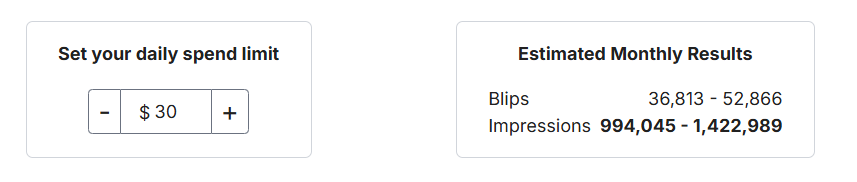
With Blip, billboard advertising in Johns Island is designed to fit real budgets. You choose a daily budget, and Blip’s algorithm uses it to bid for open ad slots on rotating digital billboards, so you only pay when your ad actually appears. Each “blip” is a 7.5-to-10-second display, with prices starting at just $0.01 per display. Because cost per blip can vary by time of day, location, and advertiser demand, Blip helps maximize your reach without locking you into a big upfront spend.
Where can I advertise with Blip in Johns Island to reach local drivers?
Johns Island travel patterns are defined by a small number of connectors, which is good news for billboard strategy because limited route choice tends to increase repeated exposure. Maybank Highway is one of the island’s essential east-west routes, while Main Road, US 17, and the regional approach help capture residents, workers, and island-bound visitors. River Road, Bohicket Road, and Betsy Kerrison Parkway also lead toward Freshfields Village, Kiawah Island Golf Resort, and Seabrook Island Club.
Why is Johns Island a good market for Blip billboard ads?
Johns Island gives us a rare mix of neighborhood growth, commuter repetition, and destination travel. The island now has more than 21,000 residents and serves as a gateway to Kiawah Island, Seabrook Island, and the broader Charleston market. Because most trips here still happen by car, digital billboards can build frequency quickly.
What kind of traffic and commuters does Johns Island have for billboard advertising?
Recent household survey estimates for the Charleston area show that well over 80% of workers commute by private vehicle, and the typical one-way commute is about 28 minutes. Johns Island itself is overwhelmingly road-dependent, which is exactly the condition that out-of-home advertising needs. When drivers use the same corridors day after day, our messages can build recognition through repetition.
When is the best time to run a Johns Island Blip campaign?
Spring is one of the most active seasons in the market, and events like Charleston Wine + Food, the Credit One Charleston Open, and Spoleto Festival USA help elevate regional travel and discretionary spending. Summer also changes trip purpose, with weekend patterns becoming especially strong for restaurants, grocery, fuel, beach retail, urgent care, and family entertainment. Fall is another strong shoulder season, and holiday campaigns work well from November through December.
Do I need a contract to advertise with Blip in Johns Island?
No, Blip has no long-term contracts or minimum commitments. You can start, pause, or stop your campaign at any time.
How fast can I launch a billboard campaign with Blip in Johns Island?
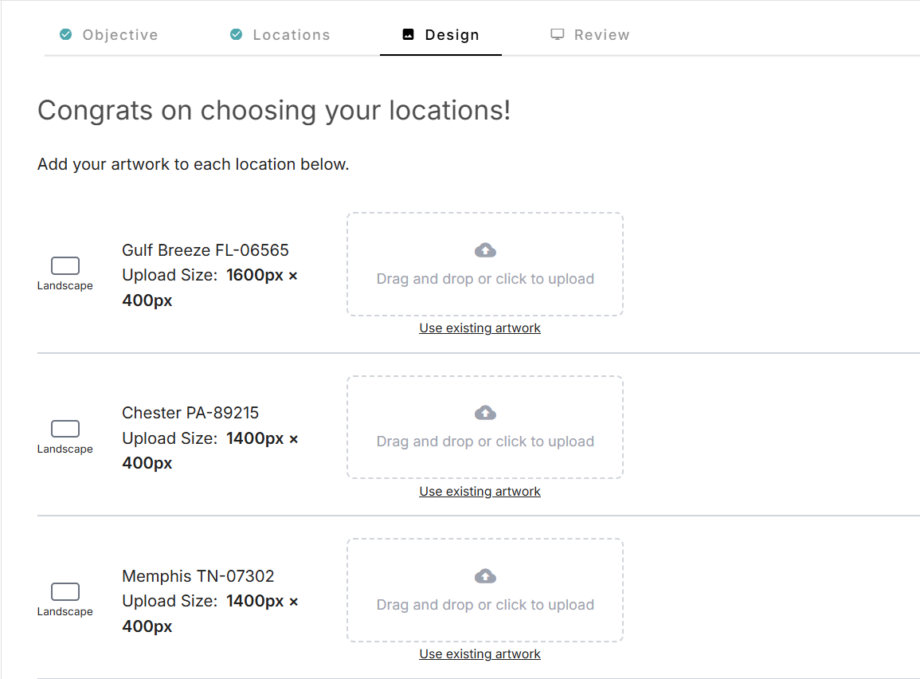
You can have your campaign live in minutes. Create a free account, select your locations, set your budget, upload your design, and start running once approved.
Where can I advertise with Blip in Johns Island?
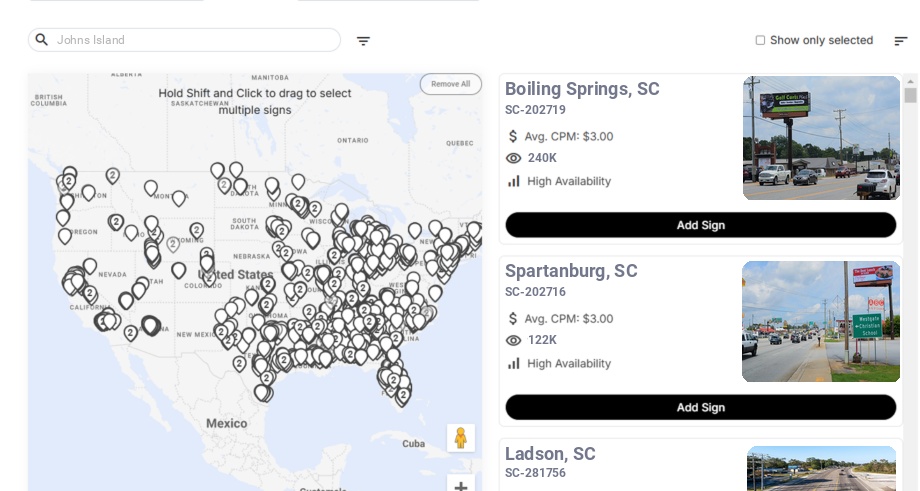
Blip has digital billboards in Johns Island. You can browse available locations on a map, choose the ones that fit your audience, and start advertising right away.
Still have questions? Launch a campaign in minutes — no contracts, no commitments.
Start Your CampaignJohns Island Billboard Advertising Guide
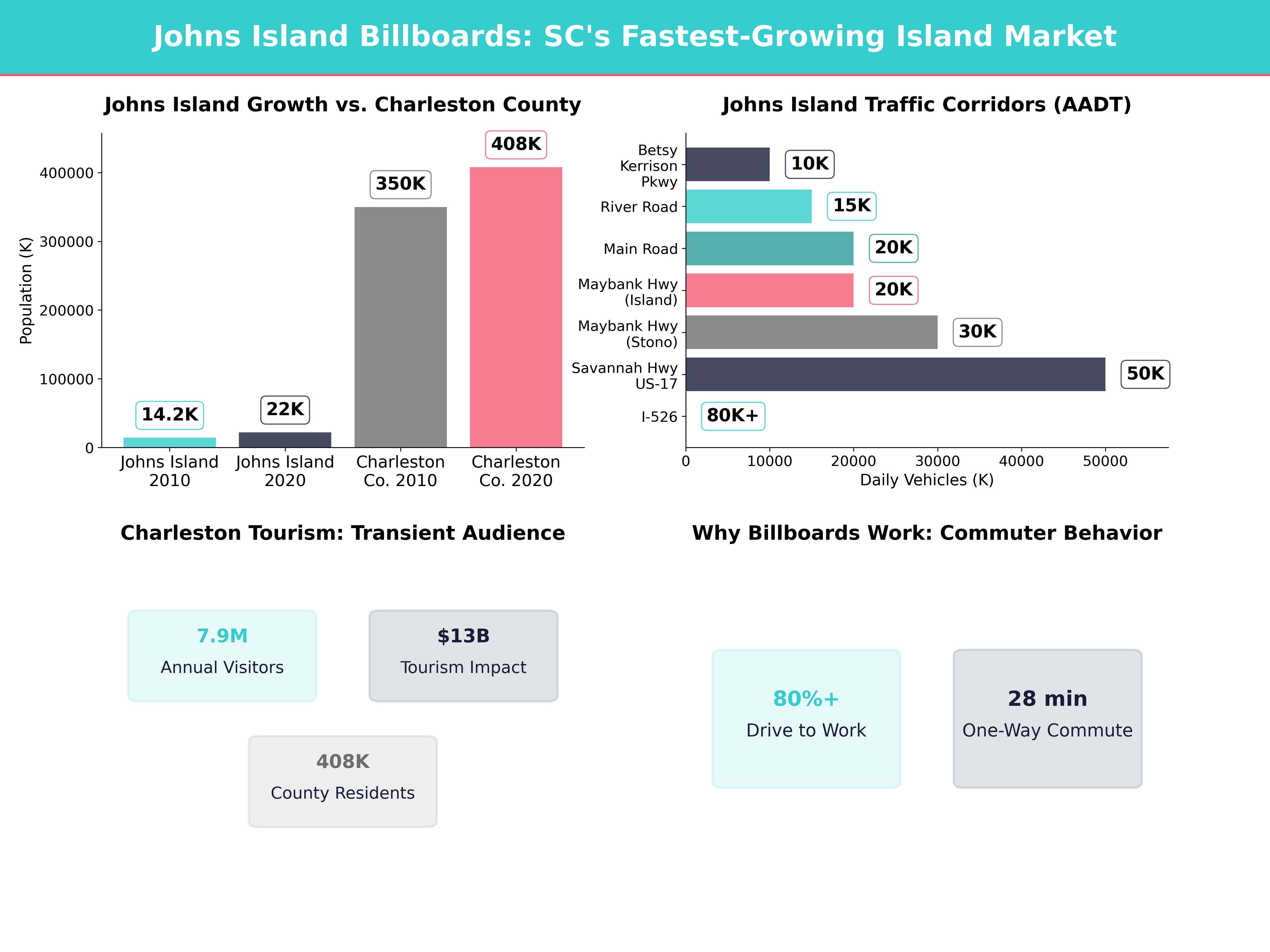
Johns Island gives us a rare mix of neighborhood growth, commuter repetition, and destination travel. The island now has more than 21,000 residents (21,985 in the 2020 Census), sits inside Charleston County, and serves as a gateway to Kiawah Island, Seabrook Island, and the broader Charleston 80% of workers in the Charleston area commuting by private vehicle, and because the island’s road network funnels drivers onto a small number of heavily used routes, digital billboards can build frequency quickly. That combination makes Johns Island especially attractive for local services, retail, healthcare, real estate, hospitality, and event promotion.
Johns Island Market Overview for Billboard Advertising
Johns Island is the largest island in South Carolina, covering roughly 84 square miles, so it gives us a surprisingly large geographic footprint with a relatively concentrated road network. The community has also grown quickly. Its population rose from 14,187 in 2010 to 21,985 in 2020, which means growth of roughly 50% in just one decade. For billboard advertisers, that matters because rising population usually brings new rooftops, more service demand, more school traffic, and more daily trips for work, shopping, and recreation.
The surrounding market is large enough to support regional campaigns, not just hyperlocal ones. Charleston County reached 408,235 residents in 2020, up 16.6% from 2010, and Johns Island benefits from that larger consumer base every day through commuting and visitor traffic. We are not advertising to an isolated island. We are advertising inside a fast-growing coastal county that is tightly connected to West Ashley James Island, downtown Charleston, and the resort communities to the south.
What the Johns Island numbers mean for advertisers
Johns Island is still overwhelmingly road-dependent. Recent household survey estimates for the Charleston area show that well over 80% of workers commute by private vehicle, and the typical one-way commute is about 28 minutes. Charleston Area Regional Transportation Authority
The local economy is also more diversified than many advertisers first assume. Regional demand is driven by tourism, healthcare, higher education, logistics, construction, home services, and professional services. Institutions such as the Medical University of South Carolina, the College of Charleston, South Carolina Ports, and the Charleston Regional Development Alliance
Tourism strengthens the case even more. Recent reporting from Explore Charleston 7.9 million visitors annually and above $13 billion in economic impact. Charleston International Airport has also handled more than 6 million passengers in a recent year, which helps feed the visitor pipeline into rental cars, hotels, resorts, and vacation rentals across the region. For us, that means Johns Island billboards can work for both local frequency and visitor interception.
Key Traffic Corridors Around Johns Island
Johns Island travel patterns are defined by a small number of connectors. That is good news for billboard strategy because limited route choice tends to increase repeated exposure. When we select placements well, we can reach the same drivers during weekday commuting, weekend shopping, and resort travel.
Maybank Highway on Johns Island
Maybank Highway is one of the island’s essential east-west routes, linking Johns Island with James Island and the urban core beyond. Recent South Carolina Department of Transportation counts and corridor studies commonly place many Johns Island segments in the high teens to low-20,000s AADT, and volumes rise above 30,000 vehicles per day closer to the Stono River crossing and the approach to James Island. That is exactly the kind of corridor where frequency-based local advertising performs well.
Maybank Highway is especially effective for several categories. Restaurants, coffee shops, and convenience retail perform well here because we can catch drivers on habitual morning and evening trips. Healthcare, urgent care, dental, and pharmacy brands benefit because commuters remember practical services they may need within the same week. Home services, builders, landscapers, and real estate teams work well because Johns Island’s residential growth creates constant demand for trusted local providers. Community events and public notices gain traction here because Maybank is part of the everyday life pattern for many residents.
The corridor also tends to support simple, directional creative. Because traffic can slow at intersections and bridge approaches, drivers often have enough dwell time to absorb a short offer, a local landmark reference, and a clear call to action.
Main Road, US 17, and the regional approach to Johns Island
The Main Road Corridor mid-teens to around 20,000 vehicles per day range in SCDOT planning documents, while the nearby US 17 / Savannah Highway approach in West Ashley climbs much higher. Selected Savannah Highway segments exceed 50,000 AADT, and nearby stretches of I-526 carry well over 80,000 vehicles per day.
That combination gives us two useful approaches. When we want Johns Island relevance, we can focus on Main Road because it captures residents, workers, and island-bound visitors. When we want regional scale, we can add US 17 and I-526 area boards because they intercept people before route choice narrows. When we need share of voice across the whole south/west Charleston side, this corridor helps us move beyond the island without losing local intent.
This route mix is especially strong for hospitals, colleges, legal services, auto dealers, major retailers, entertainment venues, and political campaigns. It is also a smart play for businesses located on Johns Island that want awareness before drivers actually make the turn toward the island.
River Road, Bohicket Road, and Betsy Kerrison Parkway near Johns Island resorts
If Maybank is the everyday corridor, then River Road, Bohicket Road, and Betsy Kerrison Parkway are the lifestyle corridors. SCDOT counts generally place River Road in roughly the 10,000 to 15,000 AADT range on many sections, while Bohicket Road and Betsy Kerrison Parkway often sit in the upper single digits to around 10,000 vehicles per day. Those volumes are lower than Savannah Highway, but the audience is highly valuable.
These routes lead toward Freshfields Village Kiawah Island Golf Resort Seabrook Island Club. The traffic here includes full-time residents, second-home owners, short-term renters, golfers, wedding guests, restaurant diners, and shoppers. That makes these roads particularly attractive for premium brands and high-consideration purchases.
- Luxury real estate, design, and home improvement advertisers fit this corridor because the audience includes affluent property owners and vacation-home users.
- Fine dining, specialty retail, and wellness brands fit because the trip purpose is often leisurely and discretionary.
- Resort, recreation, and event marketers fit because travel volume rises around weekends, holidays, and tournament periods.
Audience Segments We Can Reach in Johns Island
Johns Island is not a one-audience market. The strongest campaigns recognize that the same road network carries very different people at different times of day and different times of year.
Daily commuters and local household decision-makers in Johns Island
The first core audience is the local household base. With more than 21,000 residents on Johns Island and a county population above 408,000, we can reach a large pool of adults making recurring decisions about healthcare, groceries, schools, banking, restaurants, churches, insurance, and home services. These are not one-time impressions. They are repeated exposures to people who drive the same roads every weekday.
This audience matters because household purchasing decisions tend to reward familiarity. If we are advertising a pediatric clinic, HVAC company, veterinary office, pest service, grocery store, or neighborhood restaurant, daily commuting routes can outperform flashier placements that have less repetition.
Johns Island’s geography also creates a useful “funnel effect.” Many residents rely on the same limited corridors to leave the island, return home, or move between neighborhoods and shopping areas. That allows us to build strong local recall even without a huge number of boards.
Affluent leisure travelers, beach visitors, and second-home owners near Johns Island
The second audience is the resort and leisure market moving through Johns Island. Kiawah Island Golf Resort 10 miles of beach and 5 golf courses, and Seabrook Island Club adds 2 championship golf courses of its own. That visitor profile is meaningful for brands that sell premium experiences, high-end services, and home-related products.
Johns Island also benefits from nearby attractions that create side trips and day traffic. The Angel Oak 300 to 400 years old, stands about 65 feet tall, and shades more than 17,000 square feet. Freshfields Village
This audience is ideal for: - Real estate brokerages and luxury communities. - Interior design, furnishing, and renovation firms. - Restaurants, spas, med spas, and specialty retail. - Charter fishing, recreation, and wedding-related businesses.
Students, families, and service consumers around Johns Island
The third audience is the family-and-services segment that ties Johns Island to the broader Charleston area. Charleston County School District serves about 50,000 students, and the College of Charleston enrolls more than 10,000 students. Even though Johns Island is not a classic college district, many island households are tied to school calendars, school commuting, youth activities, and university employment patterns in the metro.
We also see strong relevance for healthcare and professional services. Johns Island residents routinely travel toward larger medical, employment, and shopping nodes in Charleston, so we can use billboard campaigns to influence where they choose specialists, elective care, financial services, or regional retail destinations. For family-focused advertisers, the island’s growth and its suburban-rural character make trust and familiarity especially important.
Seasonal and Timing Opportunities in Johns Island
Johns Island campaigns work best when we align them with the local calendar. The area has clear swings tied to tourism, school schedules, weather, and signature Charleston events.
Spring opportunities on Johns Island and in greater Charleston
Spring is one of the most active seasons in the market. Charleston Wine + Food Credit One Charleston Open Spoleto Festival USA 17 days, which creates a prolonged window for event, dining, lodging, retail, and transportation messaging.
Spring is also strong for golf, weddings, patio dining, garden centers, and home improvement. On Johns Island, the approach roads to Kiawah and Seabrook become especially valuable in this season because they catch both destination visitors and locals enjoying the weather. We usually recommend heavier spring weight for hospitality, restaurants, attractions, medical aesthetics, and real estate.
Summer beach traffic and weekend timing in Johns Island
Summer changes trip purpose. From Memorial Day through Labor Day, Johns Island becomes even more important as a gateway to beach and vacation travel. Weekend patterns matter most. Friday afternoon, Saturday morning, and Sunday return periods can be especially strong for restaurants, grocery, fuel, beach retail, urgent care, and family entertainment.
This is a good season for concise, action-oriented creative. Drivers heading toward vacation check-in, dinner reservations, or beach days respond well to messages that feel immediate and useful. Examples include same-day dining, nearby essentials, last-minute services, and location-based offers.
For local businesses, summer can also be a reminder season. Even year-round residents have shifting routines in warmer months, so billboard frequency helps keep our brands top of mind while people are making more spontaneous decisions.
Fall, holiday, and storm-season planning for Johns Island
Fall is a strong shoulder season in the Lowcountry. School resumes in August, football and community events return, and the weather often stays favorable for outdoor dining and weekend travel. That makes fall especially effective for healthcare, school-related services, home services, legal, and retail advertisers.
We also need to respect the region’s weather reality. Atlantic hurricane season runs from June 1 through November 30, so preparedness categories such as generators, storm repair, roofing, insurance, hardware, and emergency supplies can benefit from flexible short flights on Johns Island corridors. During active weather periods, quick-turn creative and fast schedule changes can matter.
Holiday campaigns also work well here. The routes to Freshfields Village
Billboard Design Tips for the Johns Island Market
Strong Johns Island creative should feel like it belongs in the Lowcountry. That does not mean every ad needs a marsh photo, but it does mean the visual language should match the audience’s surroundings and mindset.
Creative that feels native to Johns Island and the Lowcountry
We generally see better performance when creative reflects the area’s real identity. Marsh greens, oyster-shell whites, deep blues, sunrise oranges, and live-oak silhouettes often feel more authentic here than harsh, generic palettes that could run anywhere in the country. The local visual environment includes tidal creeks, farms, docks, beaches, golf, and large oak canopies, so our creative can borrow that context without becoming cliché.
Local references also help. On Johns Island, place names such as “Maybank,” “Main Rd,” “Bohicket,” “Freshfields,” “Kiawah,” and “Angel Oak” can make a message feel immediately relevant. For example, a restaurant ad that says “Before Freshfields” or a service ad that says “On Maybank Today” usually feels more useful than a generic countywide line.
Messaging that matches Johns Island traffic behavior
The road environment here supports slightly different messaging depending on corridor.
On Maybank and Main Road, we usually want direct utility. We can lead with the business name, one offer, and one local cue because commuters are processing practical information. On Bohicket Road and the Kiawah approach, we can often lean more aspirational. Premium imagery, elegant typography, and lifestyle positioning make more sense when the audience is headed toward a resort, golf round, wedding, or dinner.
We should also respect how people feel in traffic. Johns Island drivers know congestion and bottlenecks, so ads that are easy to read and immediately relevant tend to outperform clever-but-obscure concepts. If we have only 7 to 10 seconds of attention, we should make the value unmistakable.
A few Johns Island-specific creative principles usually help. - We should keep copy especially tight on the fastest regional approaches, such as US 17 and I-526 area boards. - We can use slightly more place-based context on slower island routes where drivers have more dwell time. - We should match product tier to corridor tone, with more practical messaging on commuter routes and more refined creative on resort approaches. - We should avoid visuals that feel too urban or too generic if the goal is local trust on Johns Island.
Regional Strategies Across Johns Island and Nearby Corridors
The best billboard plans for Johns Island usually combine more than one zone. The island’s own traffic is valuable, but nearby mainland approaches can add scale and earlier decision influence.
East Johns Island and the Maybank gateway
This is our frequency zone. If the goal is to stay in front of residents over and over, the Maybank side of the island is often the first place to look. We use this zone for restaurants, dentists, pediatricians, banks, gyms, churches, grocery, pharmacies, and home services. These campaigns win by becoming familiar during repeated weekday exposure.
Main Road, US 17, and West Ashley support for Johns Island campaigns
This is our amplification zone. A business on Johns Island does not always need to wait until drivers are already on the island. If the goal is broader awareness, we can place boards along the regional approach so people see the brand before making their route decisions. This strategy works especially well for hospitals, colleges, regional retailers, legal services, entertainment venues, and island-based businesses that draw customers from beyond Johns Island.
Bohicket, Freshfields, Kiawah, and Seabrook strategy from Johns Island
This is our premium-intent zone. We use it when the audience is smaller but more affluent or more likely to spend on discretionary categories. Luxury real estate, custom building, design, fine dining, weddings, golf, and resort experiences are natural fits. These placements are also useful when we want our brand to feel aligned with the area’s higher-end leisure identity.
Rural interior Johns Island positioning
Because Johns Island covers about 84 square miles, some communities are spread out and commercial nodes are limited. In those cases, we usually recommend a gateway strategy rather than trying to over-localize too narrowly. If inventory on the exact micro-corridor is limited, it often makes more sense to own the entrance routes that most residents still use.
Using Blip Tools for Johns Island Campaigns
Blip works especially well in a market like Johns Island because local traffic patterns are so time-sensitive. We can use the platform’s flexibility to match commuter windows, resort waves, and seasonal bursts without locking ourselves into a rigid traditional schedule.
Using optimization for Johns Island reach and efficiency
When our goal is broad coverage, a Blip-optimized approach usually makes sense. We can let the system spread budget across the most relevant Johns Island and Charleston-area digital boards, then watch performance in real time. That is useful when we want to cover Maybank, Main Road, and regional approach routes together without manually managing every board.
This approach is often best for: - Local businesses that want dependable awareness. - New entrants that are testing Johns Island for the first time. - Service brands that need both island frequency and mainland scale. - Seasonal campaigns that need to ramp up or down quickly.
Using manual controls for Johns Island dayparting and local timing
Manual control becomes especially useful when we already know the traffic pattern we want. On Johns Island, that often means weekday morning and evening commute windows, Friday afternoon beach traffic, Saturday shopping periods, and short weather-driven bursts. If we are promoting brunch near Freshfields Village
Creative variation matters too. We can run one version for commuters, another for leisure traffic, and another for weekend family audiences. Johns Island is a great market for testing message fit by route because the audience intent changes so clearly from corridor to corridor.
Getting Started with Johns Island Billboard Rental
Getting started in Johns Island is usually simpler when we first decide what kind of result we want. The location strategy for a family dentist is different from the strategy for a resort restaurant, a luxury builder, or a regional hospital.
How we evaluate Johns Island billboard locations
We usually start with three questions. Are we trying to reach local residents repeatedly, regional shoppers once or twice, or high-value resort travelers? Do we need drivers before they choose the Johns Island route, or do we want them once they are already committed to the island? Is our message practical and immediate, or is it more aspirational and brand-building?
From there, we evaluate each board for approach direction, likely trip purpose, traffic speed, and proximity to decision points. A board near a merge or bridge approach can be more valuable than one with technically higher traffic if the slower speed increases noticeability. Likewise, a Savannah Highway board may outperform a Johns Island board for some goals because it captures people earlier in the path.
What to expect when launching a Johns Island campaign with Blip
For most advertisers, the easiest path is to start with a focused test. We can launch on a few strategically chosen boards, watch which corridors generate the strongest response, and then expand. That is far easier than the old billboard process of negotiating long flights, large commitments, and fixed market packages.
On Blip, we can move faster, test more intelligently, and adapt to Johns Island conditions as they change. If Friday resort traffic is outperforming weekday commuting, we can lean into it. If Maybank is building stronger recall than US 17, we can shift weight. If a seasonal event or weather window appears, we can react quickly instead of waiting for the next contract cycle.
For Johns Island specifically, the smartest starting plan is usually one of these two options. We begin with a commuter-focused mix on Maybank, Main Road, and selected regional approaches if our audience is local households. Or we begin with a gateway-and-resort mix on Bohicket, Freshfields, and the approach corridors if our audience is leisure travelers or affluent homeowners.
That flexibility is what makes digital billboard rental so effective here. Johns Island has clear travel patterns, strong local identity, and a valuable blend of residents and visitors. When we match the right corridors, the right creative, and the right timing, it can be one of the most efficient out-of-home markets in the Charleston area.