Billboards in Mullins, SC
No Minimum Spend. No Long-Term Contracts. Just Results.
Trusted by Leading Brands


Billboard advertising
in Mullins has never been easier

How much is a billboard in Mullins?
Why Choose Blip for Billboard Advertising in Mullins
-
Blip lets you launch in Mullins on your terms, reaching U.S. 76 commuters and Marion County drivers with self-serve simplicity.
-
Use Blip-optimized campaigns in Mullins to auto-bid on the right boards and timing for local errands, school runs, and Florence-bound traffic.
-
No contracts in Mullins means you can start small, pause anytime, and scale with flexible budgets as beach-season traffic grows.
-
Daypart your Mullins ads for 6-9 a.m. school traffic or 3-7 p.m. commuter rush, so Blip hits drivers when they’re most attentive.
-
Track Mullins results in real time and shift spend fast if U.S. 501 travelers or Tobacco Festival bursts perform better.
-
Use Blip’s creative tools to build clear, local Mullins ads that stand out on short 7.5-10 second billboard plays.
Frequently Asked Questions About Billboard Advertising in Mullins
How much does a billboard cost in Mullins, South Carolina with Blip?
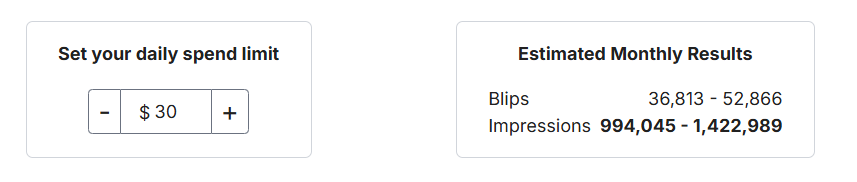
With Blip, billboard advertising in Mullins is designed to fit a wide range of budgets. You choose a daily budget, and Blip’s algorithm uses it to bid on open ad slots for your selected billboards. You only pay when your ad actually appears, and pricing starts at just $0.01 per display.
Where can I advertise with Blip in Mullins, South Carolina?
U.S. 76 is the core in-town corridor for Mullins, and traffic levels generally place it around 6,000 to 8,000 AADT. S.C. 41 is another important route for Mullins-area visibility, with local counts commonly in the 3,000 to 5,000 AADT range near smaller communities and junctions. For broader reach, U.S. 501 near Marion and I-95 near Florence can help capture regional shoppers and travelers.
Why is Mullins, South Carolina a good market for billboard advertising with Blip?
Mullins is a small market with outsized billboard value because it sits in a road-driven part of the Pee Dee region where daily life, shopping, school trips, and regional travel still happen largely by car. The city had 3,885 residents in the 2020 count, and Marion County had 30,657 residents, which gives us a compact but highly reachable audience with less media clutter than a larger metro. Mullins’ position between Marion County, Florence, and the Grand Strand travel orbit also means local boards can serve both hometown frequency and regional pass-through traffic.
When is the best time to run billboard ads in Mullins, South Carolina?
Timing matters in every market, but it matters even more in Mullins because travel patterns are tied closely to school calendars, local events, weather, and regional leisure travel. Spring is a good window for HVAC, pest control, clinics, pharmacies, tax services, and community events, while summer increases the value of regional corridors that connect toward the beach. Late July, August, and September are key for school-oriented spending, and the South Carolina Tobacco Festival in October is another important local timing opportunity.
What kinds of businesses work best for billboard ads in Mullins, South Carolina with Blip?
The local economy is broad enough to support many advertiser categories, including healthcare, education, government, retail, logistics, and small business services. In Mullins, billboard campaigns usually perform best when they focus on retention, trust, convenience, healthcare access, value pricing, and recurring local needs. Strong fits include healthcare providers, restaurants, auto services, home services, schools, and regional employers.
Do I need a contract to advertise with Blip in Mullins?
No, Blip has no long-term contracts or minimum commitments. You can start, pause, or stop your campaign at any time.
How fast can I launch a billboard campaign with Blip in Mullins?
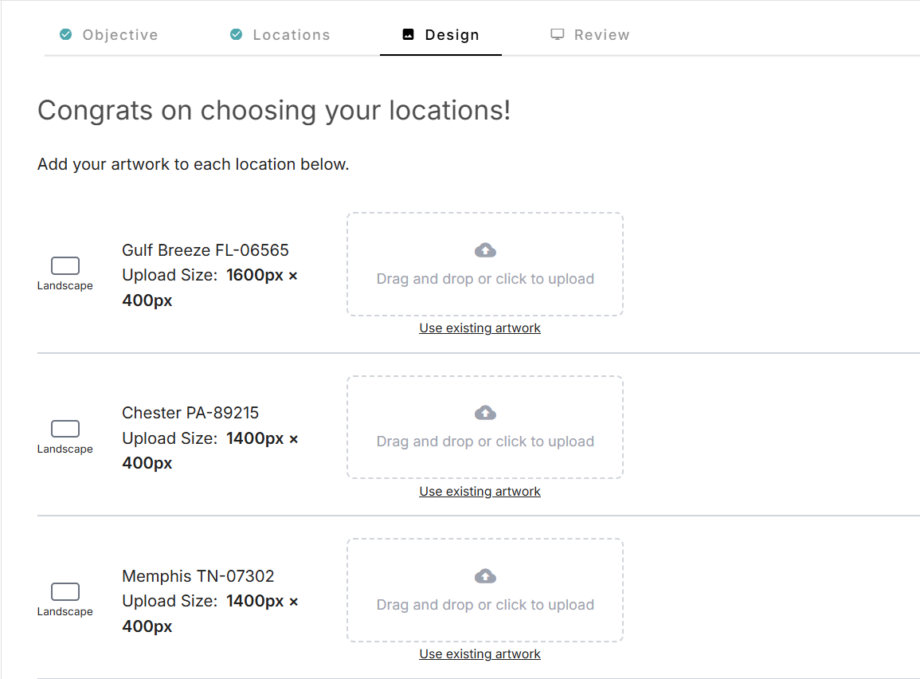
You can have your campaign live in minutes. Create a free account, select your locations, set your budget, upload your design, and start running once approved.
Where can I advertise with Blip in Mullins?
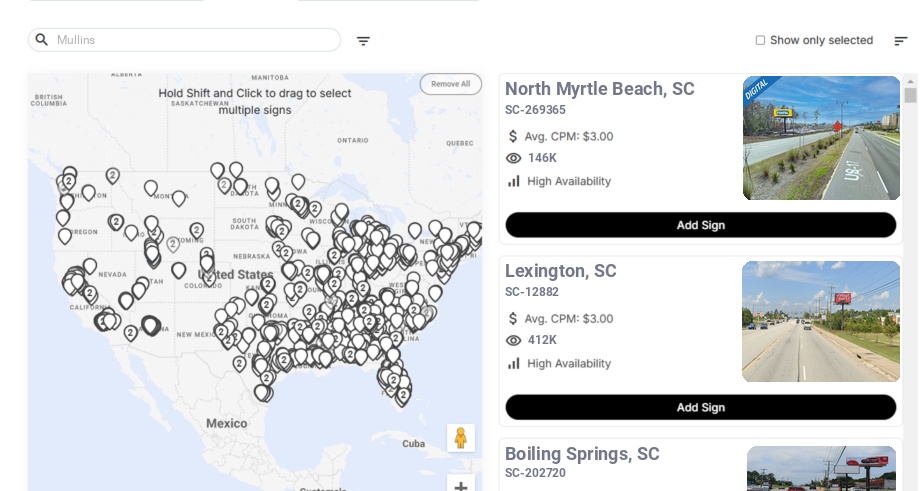
Blip has digital billboards in Mullins. You can browse available locations on a map, choose the ones that fit your audience, and start advertising right away.
Still have questions? Launch a campaign in minutes — no contracts, no commitments.
Start Your CampaignMullins Billboard Advertising Guide
Mullins Pee Dee region 3,885 residents in the 2020 count, and Marion County had 30,657 residents, which gives us a compact but highly reachable audience with less media clutter than a larger metro. We also benefit from Mullins’ position between Marion County, Florence, and the Grand Strand travel orbit, which means local boards can serve both hometown frequency and regional pass-through traffic across a corridor that draws millions of visitors annually. For advertisers that want efficient reach, memorable repetition, and flexibility, Mullins is stronger than its size alone might suggest.
Mullins Market Overview
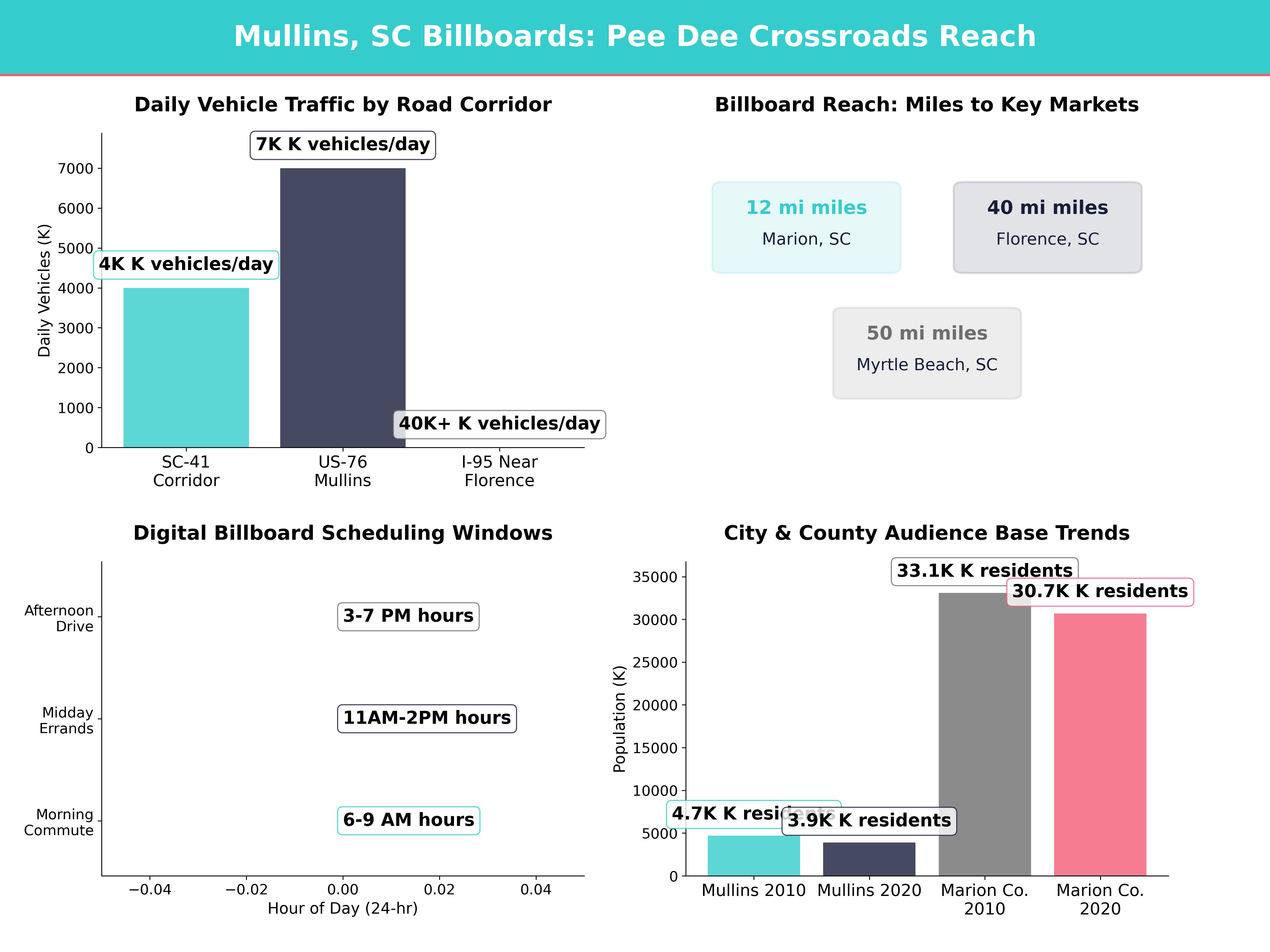
Mullins works best when we think of it as both a local city and a regional trade-area stop. The city’s 2020 population of 3,885 was down from 4,663 in 2010, a change of about 16.7%, while Marion County moved from 33,062 residents in 2010 to 30,657 in 2020, a decline of about 7.3%. Those numbers tell us that growth messaging alone is not enough here. In Mullins, our billboard campaigns usually perform best when they focus on retention, trust, convenience, healthcare access, value pricing, and recurring local needs.
Geography matters as much as raw population. Mullins is roughly 12 miles from Marion, about 40 miles from Florence, and roughly 50 miles from Myrtle Beach, depending on route and destination. That positioning gives us a realistic multi-county draw for businesses that sell beyond city limits, including healthcare providers, colleges, restaurants, legal services, auto dealers, and home services.
Commuting patterns strongly favor out-of-home advertising. In rural South Carolina markets like Marion County, work trips are overwhelmingly vehicle-based, and local travel behavior is shaped by personal driving rather than transit. Pee Dee Regional Transportation Authority
The local economy is also broad enough to support many advertiser categories. Agriculture remains part of the area’s identity, while healthcare, education, government, retail, logistics, and small business services all contribute to day-to-day spending across a county of 30,657 residents. MUSC Health Marion Medical Center McLeod Health, Francis Marion University, Coastal Carolina University, and businesses clustered around Florence and the beach corridor all influence where residents travel and what they buy.
For advertisers, the takeaway is simple. We are not buying Mullins as an isolated dot on the map. We are buying access to a concentrated local audience, plus a wider road network that connects Marion County to Florence, Conway, and the Grand Strand.
Key Traffic Corridors for Mullins Billboards
Mullins advertising works best when we match the message to the road. South Carolina Department of Transportation traffic maps show that a few corridors carry most of the market’s meaningful movement.
U.S. 76 Through Mullins
U.S. 76 is the core in-town corridor for Mullins. Depending on the exact count location, SCDOT traffic stations in and near town generally place this route in the high single-thousands of vehicles per day, often around 6,000 to 8,000 AADT. That is meaningful daily circulation for a city of Mullins’ size, especially because the same drivers often pass the same boards multiple times each week.
This corridor is especially useful for:
- Local retail and restaurants, because it captures routine errands and repeat exposure.
- Healthcare and dental providers, because it reaches residents headed toward appointments in Mullins, Marion, and Florence.
- Auto service, insurance, banks, and legal services, because these categories benefit from familiarity and trust.
- Community events and political campaigns, because recognition matters more than one-time impressions in a small market.
Creative on U.S. 76 should assume both local familiarity and moderate travel speed. We should emphasize simple offers, clear branding, and easy location cues such as “In Mullins,” “Near Marion,” or “Worth the short drive.”
South Carolina 41 in the Mullins Area
S.C. 41 is another important route for Mullins-area visibility. Traffic levels vary by segment, but local counts are commonly in the 3,000 to 5,000 AADT range near smaller communities and junctions. That is not metro-level volume, but it is high-value traffic because it tends to be highly local, habitual, and less distracted by competing ad clutter.
S.C. 41 is a strong fit for:
- Farm and outdoor businesses.
- Home improvement and repair services.
- Churches, schools, and community organizations.
- Regional employers and recruiting campaigns.
Because S.C. 41 serves more routine and relationship-based travel, we can use these boards to build trust over time. Campaigns with consistent colors, the same logo, and one repeated promise usually outperform more complicated concepts here.
U.S. 501 Near Marion for Regional Reach
While U.S. 501 does not define daily in-town Mullins traffic the way U.S. 76 does, it is essential for the larger Marion County and beach-bound strategy. On key Marion County segments, SCDOT counts move into the low five figures, and traffic increases even more as we head southeast toward Conway and the Grand Strand.
This route is ideal for advertisers that need regional shoppers and travelers, including:
- Attractions, hotels, and restaurants.
- Colleges and workforce training programs.
- Specialty healthcare and elective services.
- Auto dealers, furniture stores, and destination retail.
If our target customer can come from Mullins, Marion, Aynor Conway, or beach-bound traffic, U.S. 501 becomes one of the most efficient ways to scale beyond city-only reach.
I-95 and the Florence Gateway
For brands that want to catch travelers earlier in the trip, Florence matters. Many segments of I-95 near Florence carry 40,000-plus vehicles per day, making it one of the strongest reach corridors in the region. Mullins advertisers do not need to treat that interstate as “too far away.” Instead, we can think of it as the high-volume feeder that introduces a brand before local roads close the sale.
This strategy works well for:
- Regional healthcare systems.
- Hotels and event venues.
- Tourism and entertainment.
- Truck stops, travel centers, and quick-service food.
- Colleges and military recruiting.
Boards near Florence also connect well with Florence Regional Airport Francis Marion University, Darlington Raceway Visit Florence
What the Corridor Mix Means for Advertisers
In Mullins, we usually see the best results when we layer corridors instead of treating them separately.
- Use U.S. 76 for local frequency and familiarity.
- Use S.C. 41 for community-rooted messaging and nearby rural households.
- Use U.S. 501 for regional shopping and beach-direction traffic.
- Use I-95 near Florence when we want earlier reach at bigger scale.
That mix lets us build a practical funnel, from broad awareness to local action.
Audience Segments We Can Reach in Mullins
Mullins is not a one-audience market. It is a cluster of overlapping local and regional segments, and each one responds to slightly different timing and creative.
Daily Commuters and Errand Traffic
This is the foundation of the Mullins billboard audience. Residents regularly drive between Mullins, Marion, and Florence for work, school, healthcare, banking, and shopping. With Mullins about 12 miles from Marion and about 40 miles from Florence, daily and weekly travel naturally spills across city lines.
This audience is a strong fit for:
- Grocery and dollar retail.
- Medical, dental, and urgent care.
- Insurance and financial services.
- Auto repair and tire shops.
- Quick-service restaurants and takeout.
For these customers, repetition matters. A message seen 3, 4, or 5 times in a week often does more than a one-time high-impact placement.
Families and Household Decision-Makers
Families are central to the Mullins market. Marion County School District calendars, sports schedules, and seasonal shopping patterns create regular peaks for household spending. We can reach parents on school commutes, after-school pickup runs, grocery trips, and weekend errands.
The strongest household categories usually include:
- Healthcare and pediatric services.
- School-season retail.
- Tax preparation and legal services.
- Furniture, appliances, and home improvement.
- Family restaurants and local events.
Because this is a lower-clutter market, family-oriented advertisers should not be afraid of straightforward value language. “Open late,” “Same-day service,” “Affordable payments,” and “Now enrolling” can work very well when the offer is real and easy to understand.
Students, Parents, and Education Seekers
Mullins is not a college town, but it sits within reach of several higher-education pulls. Francis Marion University enrolls roughly 4,000 students, and Coastal Carolina University serves more than 10,000 students. That matters because prospective students, parents, and staff move through the region all year.
Educational advertisers can use Mullins-area boards for:
- College recruiting.
- Trade school and certificate programs.
- Student housing farther out in the region.
- Laptop, wireless, and banking offers aimed at young adults.
- Part-time and seasonal job recruitment.
The most effective timing is usually late summer, early fall, and the spring decision window for the next academic year.
Beach-Bound and Leisure Travelers
Mullins also sits within practical driving distance of the Grand Strand. For many inland South Carolina travelers, the route toward Conway and Myrtle Beach is part of a familiar leisure pattern, especially from late spring through summer. Even if a visitor never sleeps in Mullins, our boards can still intercept them while they are deciding where to stop, eat, book, or shop.
This segment is a strong match for:
- Restaurants and convenience retail.
- Attractions and seasonal entertainment.
- Hotels and short-stay lodging.
- Fuel, tires, and roadside services.
- Destination medical or urgent care options.
Visit Myrtle Beach Discover South Carolina, and the broader Grand Strand tourism machine keep that corridor active well beyond local resident demand alone.
Agriculture, Trades, and Workforce Audiences
Mullins’ history is closely tied to agriculture, and that identity still shapes the market. Advertisers in equipment, building materials, trucking, staffing, and industrial services should pay close attention to early-morning and weekday traffic patterns. These consumers often respond better to practical benefit statements than to image-heavy branding.
For workforce-focused campaigns, we should emphasize:
- Pay rates.
- Shift availability.
- CDL or trade requirements.
- Hiring urgency.
- Commute distance.
In a market like Mullins, “Hiring in Marion,” “Paid training,” or “Benefits on day 1” can outperform a more abstract employer-brand message.
Seasonal and Timing Opportunities in Mullins
Timing matters in every market, but it matters even more in Mullins because travel patterns are tied closely to school calendars, local events, weather, and regional leisure travel.
Spring in Mullins
From March through May, we usually see strong conditions for home services, tax preparation, lawn and garden, allergy care, and spring retail. This is a practical spending season. People are cleaning up property, planning repairs, and getting back into regular travel patterns after winter.
This is a good window for:
- HVAC and pest control.
- Outdoor power equipment.
- Clinics and pharmacies.
- Tax and legal services.
- Churches and spring community events.
Summer Tourism and Heat
From Memorial Day through Labor Day, the coastal pull gets stronger. Even though Mullins is inland, summer leisure traffic increases the value of regional corridors that connect toward the beach. Summer highs in this part of South Carolina regularly reach the low to mid-90s, which affects both travel behavior and ad visibility.
During summer, we should prioritize:
- Cold drinks, food, and convenience offers.
- Auto care and tire safety.
- Family attractions.
- Hotels and beach-related services.
- Urgent care and healthcare reminders.
Bright, high-contrast creative tends to read well in intense summer light, especially on routes with faster traffic.
Back-to-School and Fall in Mullins
Late July, August, and September are key for school-oriented spending. This is the season for enrollment, pediatric care, sports physicals, shoes, phones, financial services, and part-time hiring. Football season also matters in smaller Southern markets because local identity and Friday-night routines increase community attention.
Fall is also important because of the South Carolina Tobacco Festival October. For local businesses, we should begin festival-related campaigns about 2 to 3 weeks in advance, then intensify them during the event window.
Holiday and Year-End Opportunities
From November through December, retailers, churches, nonprofits, restaurants, and healthcare providers can all benefit from higher emotional attention and gift-related spending. In a community market, holiday messaging often performs best when it feels local and service-driven rather than luxurious or abstract.
Strong year-end categories include:
- Holiday meals and catering.
- Gift and furniture retail.
- Toy, apparel, and family promotions.
- Toy drives and nonprofit fundraising.
- Insurance and healthcare reminder campaigns.
Winter Planning and New-Year Campaigns
From January through April, we often see strong response for tax prep, healthcare enrollment periods, legal services, gyms, and budget-oriented retail. Winter is also a good time to refresh creative, test a new offer, or introduce a year-round brand campaign before spring competition increases.
Billboard Design Tips for the Mullins Market
Mullins rewards clear, grounded creative. This is not a market where we should depend on irony, dense copy, or highly urban visual cues. Our strongest boards usually feel direct, local, and useful.
Use Familiar Language and Real-World Benefits
In Mullins, people respond well to messages that answer practical questions quickly. We should lead with one benefit, one brand, and one next step. Instead of a clever line that takes time to decode, we should use language like “Same-Day Appointments,” “Worth the Drive,” “Open Saturdays,” or “Hiring Now in Marion County.”
Because digital billboard ad windows are only about 7.5 to 10 seconds, this market especially rewards simplicity.
Design for Rural and Small-City Road Speeds
Approach speeds in and around Mullins often range from about 35 to 55 mph, depending on whether we are in town or on the edge of town. That means our boards need oversized type, strong contrast, and a short message hierarchy.
We generally recommend:
- 1 headline.
- 1 logo.
- 1 supporting visual.
- 1 call to action, if needed.
If we add too many details, we reduce comprehension and memorability.
Reflect Pee Dee Culture Without Stereotyping
Mullins has deep roots in agriculture, small business, church life, school pride, and family networks. Creative that feels authentic to the Pee Dee usually performs better than generic stock imagery. We should consider using real local people, recognizable regional cues, and plainspoken offers.
Messages that often resonate include:
- Family-owned credibility.
- Faith-friendly and service-oriented tone.
- Local pride.
- Value and dependability.
- Community support.
We do not need to overdo “country” imagery, but we should avoid making the market feel anonymous.
Match Colors and Imagery to the Season
Summer boards should use bold contrast because of bright daylight and heat glare. Fall creative can lean into school colors, festival energy, harvest themes, and football-season urgency. Holiday campaigns should feel warm and community-centered, while spring campaigns can emphasize clean visuals, renewal, and action.
If we are targeting beach-direction travelers, brighter tourism colors can work. If we are targeting local healthcare or legal services, a steadier and more trustworthy palette is usually better.
Regional Strategies Around Mullins
A strong Mullins campaign often includes more than one sub-area. The right mix depends on whether we need local conversion, county-wide awareness, or broader regional reach.
Mullins Core Strategy
Inside and immediately around Mullins, we should focus on frequency. This is where restaurants, clinics, schools, churches, banks, insurance agents, and local retailers can win with repetition. We are trying to become the familiar choice, not just the visible one.
This strategy is best for businesses drawing from a radius of about 5 to 15 miles.
Marion and the U.S. 501 Strategy
Marion is the county seat and a natural complement to Mullins. At roughly 12 miles away, it is close enough to share audiences but large enough to justify distinct placements. If we need to pull shoppers, patients, or diners from both communities, combining Mullins-area boards with Marion or U.S. 501 boards can increase both reach and frequency.
This approach works particularly well for:
- Regional healthcare.
- Furniture and destination retail.
- Auto dealers.
- Workforce recruiting.
- Education and training offers.
Florence Expansion Strategy
Florence is about 40 miles from Mullins, and it functions as a major employment, medical, education, and retail hub for the Pee Dee. Advertisers that depend on a wider draw should think seriously about using Florence boards to prime the audience and Mullins boards to localize the message.
We often like this sequence:
- A broader awareness board in Florence or on I-95.
- A reinforcement board closer to Marion County.
- A local conversion board in or near Mullins.
That structure is especially effective for hospitals, colleges, legal firms, and events.
Grand Strand and Conway Strategy
For advertisers tied to leisure traffic, Conway and Myrtle Beach are part of the same planning conversation. Mullins is roughly 50 miles from Myrtle Beach, so brands with tourism, dining, roadside retail, and attractions should consider how inland boards can support coastal conversions.
This strategy is ideal for:
- Hotels and attractions.
- Restaurants with beach-direction locations.
- Auto, tire, and roadside services.
- Real estate and relocation messaging.
- Seasonal entertainment.
Using Blip Tools in Mullins
Blip fits Mullins especially well because the market benefits from flexibility more than fixed long-term buying. We can use that flexibility to match the town’s practical travel patterns.
Use Manual Selection When Geography Matters Most
If we know we need specific roads such as U.S. 76, S.C. 41, or a Marion-adjacent route, we can manually choose boards that align tightly with our audience. This is helpful for local businesses that care about exact drive paths rather than broad regional coverage.
Examples include:
- A Mullins restaurant that needs in-town dinner traffic.
- A Marion County clinic that wants weekday appointment demand.
- A church or community event with a very local target area.
Use Blip Optimization for Regional Spillover
When our customer can come from Mullins, Marion, Florence, or the beach corridor, Blip’s optimization tools can help us spread budget intelligently across the region. That is useful when we want to test whether our best response is coming from closer-to-home boards or from feeder corridors farther away.
Daypart Around Real Travel Rhythms
Mullins is a strong dayparting market. We should think about:
- 6 a.m. to 9 a.m. for commuters and school traffic.
- 11 a.m. to 2 p.m. for lunch, errands, and appointments.
- 3 p.m. to 7 p.m. for pickups, shopping, and dinner decisions.
- Thursday through Saturday for retail and dining.
- Event-specific bursts before festivals, games, and holiday weekends.
Use Analytics to Refine the Trade Area
Because Mullins is a smaller market, small shifts can be revealing. If one corridor consistently outperforms another, we should reallocate quickly. If summer beach-direction messaging works better than winter healthcare messaging, we should respond to that pattern rather than assume the same mix will work year-round.
Getting Started with Billboard Rental in Mullins
Renting a billboard in Mullins is easier when we begin with the audience, not the map. We should first decide whether we want local residents, county-wide households, regional commuters, or leisure travelers. Once that is clear, location choices become much more obvious.
Start with a Clear Geographic Goal
We should ask three questions first:
- Do we need people who live in Mullins itself?
- Do we need people across Marion County?
- Do we need regional traffic from Florence, Conway, or the Grand Strand?
A local insurance office may only need frequent exposure in town. A college, hospital, or destination retailer may need a much broader footprint.
Match the Board to the Buying Journey
Not every billboard should do the same job.
- In-town boards are best for frequency, reminders, and trust.
- County connector boards are best for building consideration.
- Regional highway boards are best for reach and traveler capture.
If our goal is immediate visits, proximity matters. If our goal is awareness, corridor volume matters more.
Keep the Offer Simple and Local
In Mullins, the strongest billboard offers are usually practical. We should highlight one reason to act now, make the location obvious, and avoid clutter. “In Marion,” “In Mullins,” “Off 76,” or “Short drive from Florence” can make a meaningful difference.
Expect Faster and Simpler Execution with Blip
Traditional billboard buying can be slow, inflexible, and contract-heavy, which is not always ideal for a market where we may want to test school season, festival season, beach season, and healthcare timing separately. Blip simplifies that process by letting us launch, adjust, pause, and refine without the usual friction. That is especially helpful in Mullins, where a business may want to start with a small local test, measure results, then expand toward Marion, Florence, or beach-direction routes.
Evaluate Success the Right Way
In Mullins, we should judge a billboard plan by the outcome we actually want:
- More walk-in traffic.
- More calls.
- More appointment bookings.
- Better hiring flow.
- Higher event attendance.
- Stronger regional awareness.
When we choose boards that match the road network, the season, and the real trade area, Mullins can be a highly efficient digital billboard market. It may be a smaller city, but for advertisers willing to think locally and regionally at the same time, it offers a very workable path to consistent visibility.