Billboards in Manning, SC
No Minimum Spend. No Long-Term Contracts. Just Results.
Trusted by Leading Brands


Billboard advertising
in Manning has never been easier
How much is a billboard in Manning?
Why Choose Blip for Billboard Advertising in Manning
-
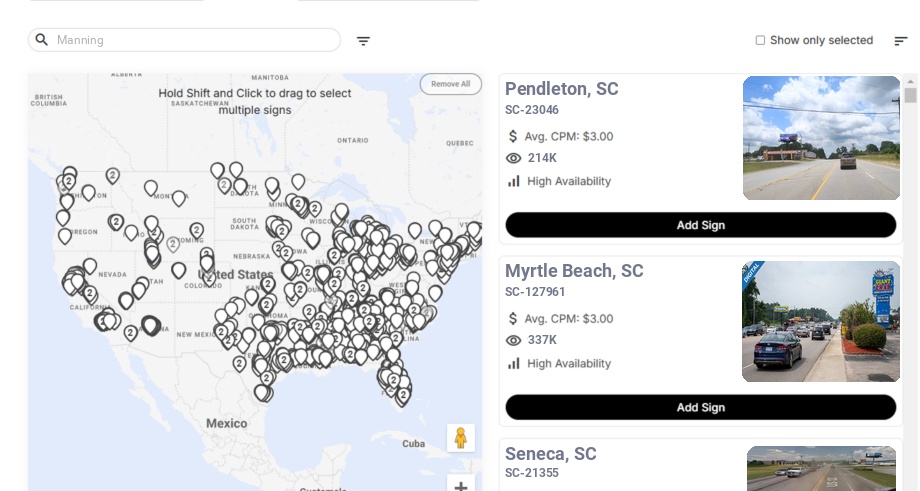
Choose Blip in Manning to launch self-serve ads fast on I-95, US 301, or SC 261—no calls, no fuss.
-
Blip-optimized campaigns help Manning reach I-95 travelers and county locals, auto-shifting spend to what works.
-
In Manning, set a flexible budget and pay only when your ad plays, so you can test lake season or holiday traffic.
-
Use dayparting in Manning to hit morning commuters, afternoon errand runs, and weekend Lake Marion visitors.
-
Track Manning billboard results in real time and adjust fast for Exits 119 and 122 or downtown routes.
-
Blip's creative tools make it easy to tailor Manning ads for lake-country visitors, local services, and interstate stops.
Frequently Asked Questions About Billboard Advertising in Manning
How much does a billboard cost in Manning with Blip?
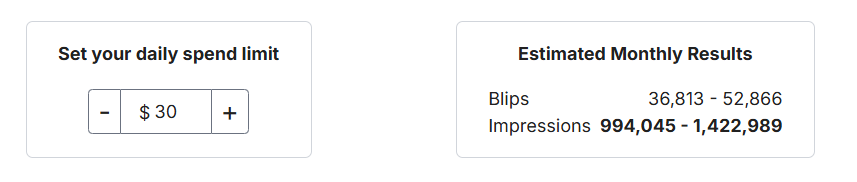
With Blip, billboard advertising in Manning can fit a wide range of budgets because you only pay when your ad actually appears. Each “blip” is a 7.5-to-10-second display on a rotating digital billboard, with pricing starting at $0.01 per display. You set a daily budget, and Blip’s algorithm uses it to bid for open ad slots, helping you get the most reach for your spend.
Where can I advertise with Blip in Manning to reach the most drivers?
I-95 is the defining advertising asset in this market, and traffic near Manning often falls in the roughly 45,000 to 55,000 vehicles per day range. US 301 is the town’s core local business corridor, generally in the 8,000 to 12,000 vehicles per day range, while SC 261 connects I-95 travelers into downtown Manning. These roads let advertisers capture both regional scale and local repetition.
Why is Manning good for Blip billboard advertising?
Manning is a small South Carolina market with unusually strong billboard potential because it combines a local population base with a major interstate audience. The town had 3,909 residents in the 2020 Census, and Clarendon County had 31,144, which gives advertisers a meaningful local customer pool while Interstate 95 delivers constant pass-through traffic. It works well as both a hometown market and a gateway market.
What kinds of people can I reach in Manning with Blip billboards?
Manning gives advertisers a layered audience rather than a single audience. The market includes local residents and commuters, interstate travelers on I-95, and lake and outdoor recreation visitors around Lake Marion and Lake Moultrie. It also serves students, families, and civic audiences in Clarendon County.
When is the best time to run a billboard campaign in Manning with Blip?
Spring is one of the strongest windows for outdoor-oriented advertising in this market as Lake Marion traffic picks up. From Memorial Day through Labor Day, Manning also benefits from increased family road trips and vacation travel on I-95. Holiday periods can be especially efficient because they combine resident shoppers with heavy interstate movement.
Do I need a contract to advertise with Blip in Manning?
No, Blip has no long-term contracts or minimum commitments. You can start, pause, or stop your campaign at any time.
How fast can I launch a billboard campaign with Blip in Manning?
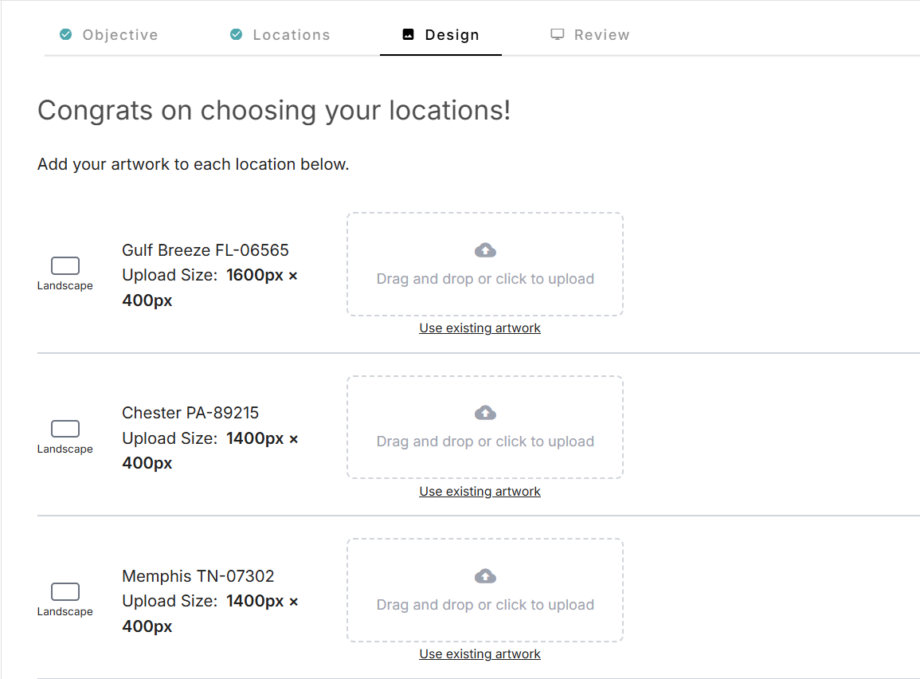
You can have your campaign live in minutes. Create a free account, select your locations, set your budget, upload your design, and start running once approved.
Where can I advertise with Blip in Manning?
Blip has digital billboards in Manning. You can browse available locations on a map, choose the ones that fit your audience, and start advertising right away.
Still have questions? Launch a campaign in minutes — no contracts, no commitments.
Start Your CampaignManning Billboard Advertising Guide
Manning is a small South Carolina market with unusually strong billboard potential because it combines a local population base with a major interstate audience, with Interstate 95 traffic near Manning often in the roughly 45,000 to 55,000 vehicles per day range. The town had 3,909 residents in the 2020 Census, and Clarendon County had 31,144, which gives us a meaningful local customer pool while Interstate 95 delivers constant pass-through traffic.
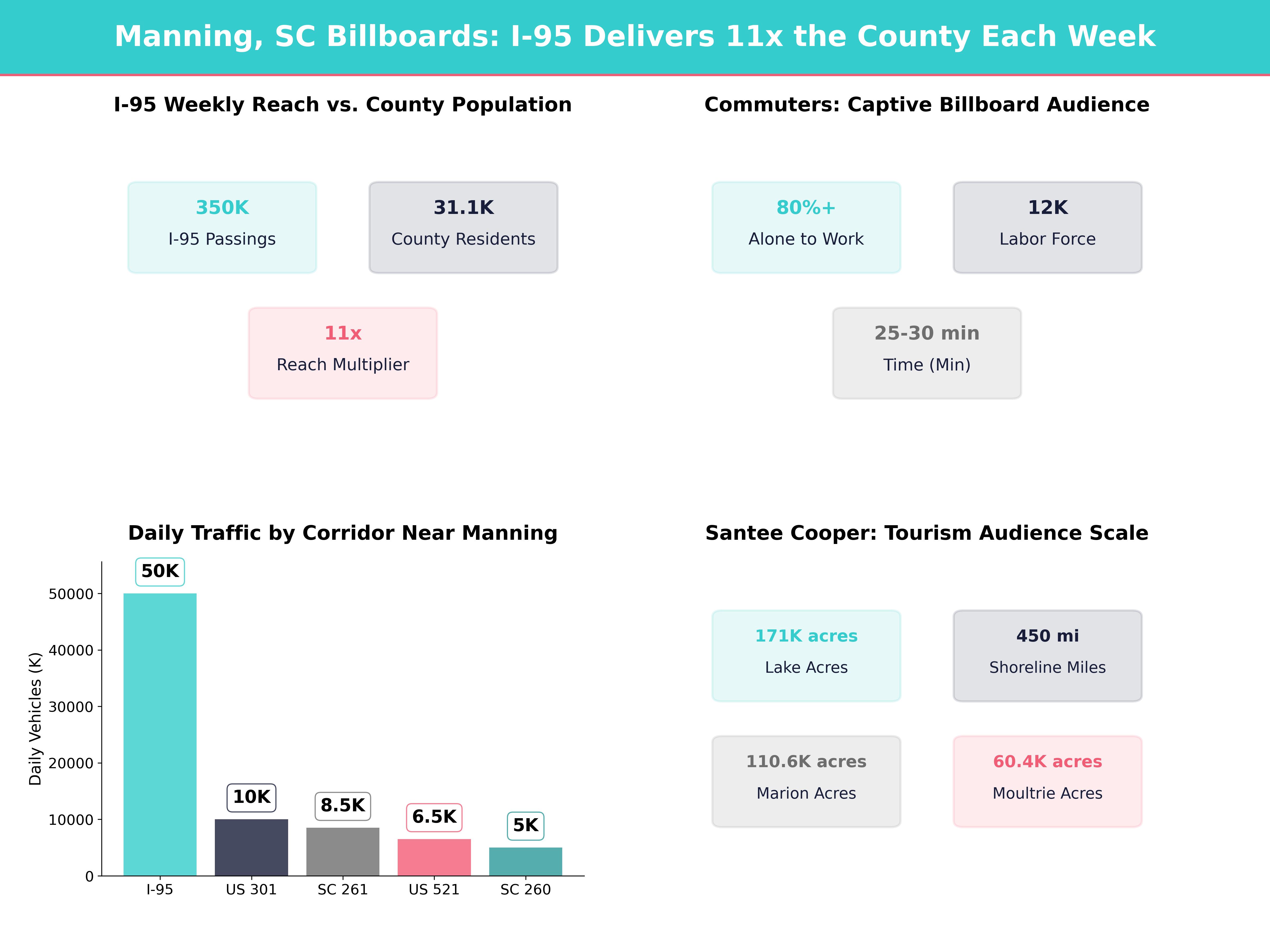
Our opportunity is strengthened by a car-dependent travel pattern, with more than 80% of workers commuting by car in Clarendon County, a county-seat business core, and easy access to the lake and outdoor tourism economy around the Santee Cooper region, where Lake Marion covers about 110,600 acres and Lake Moultrie about 60,400 acres. When we advertise in Manning, we are not choosing between local reach and traveler reach, because we can capture both.
Manning, South Carolina Market Overview
Manning works best when we view it as both a hometown market and a gateway market. As the county seat of Clarendon County, it concentrates government, healthcare, retail, and education functions that draw people from across the county’s rural communities. At the same time, it sits beside one of the most important north-south routes on the East Coast, which gives advertisers access to a much larger mobile audience than the town’s population alone would suggest.
The local population trend shows why outdoor matters here. Manning’s population moved from 4,108 in 2010 to 3,909 in 2020, a change of about -4.8%. Clarendon County moved from 34,971 in 2010 to 31,144 in 2020, a change of about -10.9%. That is not a hyper-growth story, but it is still a strong billboard story, because stable rural markets often rely more heavily on driving for shopping, healthcare, school, and errands.
Our economic lens in Manning should focus on essential categories rather than speculative categories. South Carolina Department of Employment and Workforce county profiles have recently placed Clarendon County’s labor force at roughly 12,000 people, and much of that workforce depends on road travel every day. Major demand drivers include public services, healthcare, education, agriculture, local retail, travel services, and recreation tied to the lakes. Institutions such as McLeod Health, Clarendon County School District, and the county government create regular in-town movement that advertisers can reach repeatedly.
Commuting behavior also favors outdoor. County-level survey sources, including County Health Rankings & Roadmaps, consistently put the drive-alone share in Clarendon County above 80%, with typical commute times in roughly the 25- to 30-minute range. That is long enough for daily route familiarity to matter and short enough for repeated billboard exposure to build memory quickly. In practical terms, that means our boards can influence where people stop, shop, book, call, or visit later that same day.
Key Traffic Corridors for Manning Billboard Campaigns
Manning’s billboard value is concentrated along a handful of roads that serve very different purposes. Some corridors are about broad reach, while others are about repeated local frequency. When we understand which corridor does which job, we can match our creative and our budgets to the right kind of audience.
Interstate 95 through Manning
I-95 is the defining advertising asset in this market. South Carolina has about 198 miles of I-95, and Manning sits on a section that routinely carries heavy through traffic. South Carolina Department of Transportation traffic count maps generally show I-95 near Manning in the roughly 45,000 to 55,000 vehicles per day range, with strong activity around Exits 119 and 122.
That kind of traffic gives us true regional scale. At 50,000 vehicles per day, we are looking at around 350,000 vehicle passings in a single week, which is more than 11 times Clarendon County’s resident population. That makes I-95 especially effective for the following advertisers:
- Fuel, convenience, and quick-service brands benefit because travelers often make stop decisions only a few miles before an exit.
- Hotels, attractions, and tourism businesses benefit because they can intercept visitors before they book elsewhere or continue farther down the highway.
- Healthcare, legal, and service brands benefit because repeated interstate exposure also reaches local and regional drivers who use I-95 regularly.
For Manning, interstate boards are usually our best top-of-funnel option. They create awareness at scale, and they are especially valuable when we need to catch people who are not yet familiar with a local business name.
US 301 in Manning
US 301 remains the town’s core local business corridor. Through Manning, SCDOT count locations on US 301 generally fall in the 8,000 to 12,000 vehicles per day range, depending on the segment and the count year. That is far below I-95 in sheer volume, but it is much stronger for local repetition and proximity to the places where residents actually spend time.
US 301 is where we can build community familiarity. It connects downtown Manning, civic destinations, retail activity, and daily service stops. Advertisers such as local restaurants, medical practices, banks, insurance agencies, auto dealers, home services, and political campaigns often benefit most from this corridor because the audience is more local, more repeat-oriented, and more likely to act within the next few hours.
SC 261 between I-95 and downtown Manning
SC 261 is the bridge between highway travelers and the town itself. On the approach from I-95 toward Manning, SCDOT count points commonly show traffic in the 7,000 to 10,000 vehicles per day range. That matters because this route captures people who have already exited the interstate and are actively headed into town.
This is one of the most useful corridors for directional advertising. If our goal is to convert I-95 awareness into an actual stop, SC 261 is ideal for messages tied to food, lodging, healthcare, auto service, grocery, or local attractions. It is also strong for brands that want both visitors and residents, because it serves as a shared path for both groups.
SC 260, US 521, and the wider Clarendon County road network
Beyond the immediate town core, SC 260 and US 521 help us reach the broader county and lake-oriented trade area. SC 260 west of Manning generally runs around 4,000 to 6,000 vehicles per day on many segments, while US 521 through western Clarendon often lands in the 5,000 to 8,000 vehicles per day band.
Those roads matter because rural markets are spread out. They connect communities such as Summerton Sumter. For advertisers in farm supply, outdoor recreation, healthcare, furniture, auto sales, and regional retail, these feeder corridors can produce strong efficiency even without interstate-level traffic.
Audience Segments We Can Reach Around Manning
Manning gives us a layered audience rather than a single audience. The best campaigns usually work because they are built for at least 2 of these groups at once.
Local residents, commuters, and errand traffic in Manning
Our local base starts with Manning’s 3,909 residents and Clarendon County’s 31,144 residents. In a rural county, that base is more valuable than it looks on paper because many households drive into Manning repeatedly for school, healthcare, banking, government services, and shopping. With more than 80% of workers commuting by car, repeated billboard exposure can create strong familiarity over time.
This segment is especially important for businesses with longer consideration cycles. Dentists, attorneys, real estate professionals, home improvement companies, funeral homes, financial services, and medical specialists often need trust more than impulse. In Manning, repeated visibility on familiar routes can build that trust efficiently.
Interstate travelers on I-95
The traveler segment is what makes Manning different from many similarly sized towns. I-95 delivers an audience that includes vacationers, truck traffic, long-distance family travelers, and regional drivers moving between the Northeast, the Southeast, and Florida. Even when we use a conservative traffic assumption of 50,000 vehicles per day, the route can generate roughly 350,000 vehicle passings in a week.
This audience is ideal for businesses that can satisfy immediate travel needs. Fuel stations, chain restaurants, local diners, hotels, emergency care, attractions, and destination retailers all benefit when we use simple, urgent copy tied to distance, exit number, and convenience.
Lake Marion and outdoor recreation visitors near Manning
Manning’s tourism story is closely tied to the Santee Cooper lakes. Lake Marion covers about 110,600 acres, and Lake Moultrie covers about 60,400 acres. Together, the lakes span more than 171,000 acres and about 450 miles of shoreline, according to Santee Cooper Country and the South Carolina Department of Natural Resources
That outdoor audience includes anglers, boaters, campers, hunters, second-home visitors, and weekend families. It is a strong fit for marinas, tackle shops, lodging, restaurants, golf, convenience stores, outdoor outfitters, automotive repair, and insurance. It is also a strong fit for businesses that want to connect their brand with recreation, hospitality, and the South Carolina outdoors.
Students, families, and civic audiences in Clarendon County
Manning is also a civic center. Clarendon County School District serves more than 4,000 students, which means school calendars, sports schedules, and family routines create predictable local traffic patterns. Venues such as The Weldon Auditorium
For family-oriented advertisers, this audience is often more dependable than tourist traffic. Childcare providers, after-school programs, healthcare clinics, churches, colleges, retailers, and community events can all benefit from billboard placement that aligns with school-day and after-school driving patterns.
Seasonal and Timing Opportunities in Manning
Because Manning serves both locals and travelers, timing matters almost as much as location. We usually get the best results when we line up campaigns with the seasonal reason people are on the road.
Spring in Manning and the Santee Cooper lakes
Spring is one of the strongest windows for outdoor-oriented advertising in this market. As temperatures improve and fishing activity picks up, the Lake Marion area draws more recreational traffic. Businesses in lodging, dining, marine services, bait and tackle, home improvement, lawn care, and weekend entertainment can all benefit from stronger spring visibility.
This is also a smart season for healthcare, tax services, and local service businesses because traffic is steady without yet reaching summer-travel clutter. When we want awareness before Memorial Day, March through May is an efficient build period.
Summer highway travel through Manning
From Memorial Day through Labor Day, Manning benefits from increased family road trips and vacation travel on I-95. Summer is usually when we want more interstate emphasis, longer operating-hour messages, and highly legible convenience-driven creative. Cold drinks, fast food, lodging, roadside attractions, and emergency automotive services often become especially relevant.
Summer also rewards midday and weekend scheduling. Tourist traffic does not behave exactly like commuter traffic, so we usually see value in adding exposure from late morning through early evening, rather than concentrating only on rush hour.
Fall back-to-school, football, and hunting season around Manning
Late summer and fall bring a different mix of demand. School resumes in August, family routines tighten, and local travel becomes more predictable. With a district serving 4,000-plus students, back-to-school messaging, tutoring, healthcare visits, youth activities, retail, and food offers can all benefit from route-based frequency.
Fall is also a strong season for hunting and outdoor categories in the Clarendon area. South Carolina Department of Natural Resources
Holiday travel and year-end spending in Manning
Holiday periods can be especially efficient for Manning because they combine resident shoppers with heavy interstate movement. Thanksgiving, Christmas, and New Year’s travel all increase the value of clear highway creative, especially for lodging, restaurants, retail, churches, and urgent services.
This is also a useful period for short campaign bursts. Instead of committing to a long fixed run, we can emphasize the 7- to 14-day windows when holiday traffic peaks and buying intent is highest.
Billboard Design Tips for the Manning Market
In Manning, the strongest creative usually feels local, practical, and easy to process at speed. We should design for the road environment first, and for brand personality second.
Use exit-based messaging for Manning interstate boards
On I-95, drivers are making fast decisions. Our best interstate creative usually includes an exit number, a distance marker, and one concrete reason to stop. In Manning, Exits 119 and 122 are powerful shorthand because they tell travelers exactly where the action is.
Messages such as “Exit 122 Food & Fuel,” “Lake Marion Lodging Next Exit,” or “Hospital Care Near Exit 119” work because they reduce thinking. For highway boards, we should favor short copy, bold numerals, and one action rather than multiple offers.
Reflect lake-country imagery in Manning tourism campaigns
When we advertise to visitors, we should use creative that feels like Manning’s recreational identity. Blues, greens, water imagery, fish, boats, docks, pines, and sunrise or sunset scenes can connect immediately with Lake Marion traffic. That approach tends to feel more authentic here than slick big-city imagery.
This is especially useful for restaurants, short-term rentals, golf, marinas, boat storage, campgrounds, and outdoor brands. In a market shaped by 171,000-plus acres of nearby lake water, visual cues tied to the outdoors are not decorative; they are strategic.
Build trust with straightforward local messaging in Manning
For local service businesses, simple and credible usually beats clever. Residents responding to healthcare, legal, insurance, education, church, or home-service ads often want reassurance more than novelty. We should use real service names, clear categories, and visible contact cues.
Phrases such as “Serving Clarendon County,” “In Manning,” or “Local Care Close to Home” often fit the market well because they reinforce familiarity. On slower local routes like US 301, we can also support trust with a logo, a short URL, or a phone number, but we should still keep the board clean and readable.
Rotate creative by audience, not just by season
Manning is one of those markets where multiple versions of the same campaign can make a big difference. One version can speak to travelers, and another can speak to residents. One version can emphasize convenience, while another emphasizes trust or community roots.
That is especially helpful when we are using both I-95 and in-town boards. The traveler board can say “Exit 122,” while the local board can say “Downtown Manning.” The offer stays consistent, but the framing matches the audience.
Regional Strategies Across Manning and Clarendon County
The right strategy in Manning depends on which sub-area we are trying to influence. A county-seat town with interstate access needs a more segmented plan than its size suggests.
Manning’s I-95 interchange zone
The interstate zone is our best reach play. We should prioritize it when we want awareness from travelers, truckers, regional drivers, and people who may not know the brand yet. This is where gas, food, lodging, automotive, healthcare access, and tourism offers usually perform best.
For many advertisers, the smartest entry strategy is to start with one or more interstate-focused boards and use them to build broad recognition quickly.
Downtown Manning and the local business core
Downtown and central Manning are our frequency play. This is where civic identity, healthcare, schools, and recurring errands shape traffic. If our campaign needs trust, repetition, or community credibility, boards closer to the town core usually deserve a larger share of attention.
This area is especially relevant for local retailers, financial services, medical offices, public notices, churches, campaigns, and family services. It is also where we often want longer-running continuity rather than purely seasonal bursts.
Summerton, Lake Marion access, and the western county approach
The Town of Summerton
This is also a useful zone when we want to catch drivers before they reach the interstate or after they leave the lakes. For some businesses, this western approach can be the bridge between recreation traffic and in-town conversion.
Regional pull from Sumter, Santee, Florence, and Columbia
Manning does not operate in isolation. It sits within the broader economic orbit of places such as Sumter, Santee Florence, and Columbia Central Carolina Technical College USC Sumter reinforce that regional flow.
For advertisers with multi-county ambitions, Manning can work as a strategic spoke rather than a standalone point. It is especially useful for healthcare networks, colleges, legal services, staffing firms, and regional retail brands that want coverage beyond one town.
Using Blip Tools to Win in Manning
Blip’s strengths line up well with a market like Manning because we often need to balance local precision with traveler reach. We do not always need a large, fixed buy to test that balance effectively.
When we want broad coverage across different road types, a Blip-optimized campaign is often the easiest starting point. It lets us pursue a mix of interstate reach and in-town frequency without overcommitting to one audience too early. In Manning, that matters because I-95, US 301, and SC 261 each do different jobs.
When we want more control, a manual campaign can be powerful. We can hand-pick boards near Exits 119 and 122 for traveler acquisition, then add in-town coverage for reinforcement. That structure works well for restaurants, medical providers, event promotions, tourism offers, and retailers with both local and pass-through demand.
Dayparting is also useful here. We can emphasize morning and late-afternoon windows for Manning commuters, then shift toward midday, evening, and weekend weight for lake visitors and interstate travelers. Real-time reporting helps us compare which geography is producing the most efficient exposure, and Blip’s artwork tools make it easy for us to test separate creative versions for travelers, residents, and outdoor audiences.
Getting Started with Billboard Rental in Manning
Renting a billboard in Manning is usually simpler than advertisers expect, but we get the best results when we start with a clear plan. The market is smaller than Columbia Florence, so location quality matters more than raw board count.
How we should evaluate billboard locations in Manning
Before we launch, we should decide whether our main goal is local frequency, traveler capture, or a mix of both. From there, we can judge each board against a few practical questions.
- We should ask which road function matters most. An I-95 board is best for scale, while a US 301 board is better for repetition and local trust.
- We should ask how close the board is to the decision point. For fuel, food, lodging, and urgent services, boards near Exits 119 and 122 usually matter more than boards farther away.
- We should ask which direction of travel matters. A northbound message and a southbound message can perform very differently depending on our audience and our location.
- We should ask whether the creative matches the traffic speed. Faster roads demand simpler copy, while slower local routes can carry slightly more detail.
What to expect from the Manning billboard market
Manning is not a high-density urban inventory market, and that is actually an advantage for many advertisers. Fewer boards can mean less visual clutter, clearer positioning, and more strategic value per location. A well-placed board in Manning can do the work of both awareness and direction, especially when it sits on a route people use repeatedly.
Traditional billboard buying can feel rigid in smaller markets because contracts, fixed terms, and package deals often limit flexibility. Blip changes that equation. We can start small, test specific routes, adjust timing around fishing season or holiday travel, rotate creative by audience, and scale only when the results justify it.
A practical first campaign for Manning
For many advertisers, a smart first campaign in Manning includes a simple 2-part structure. We can use one interstate-facing board or group of boards to build broad awareness, and one in-town or connector-route board to reinforce the message for locals and people who exit into Manning. That combination mirrors how the market actually works.
If we stay focused on the audience, the route, and the season, Manning can be one of the most efficient billboard markets in inland South Carolina. It is a place where the right board can speak to residents in the morning, lake visitors in the afternoon, and interstate travelers all day long.