Billboards in Garden City, MI
No Minimum Spend. No Long-Term Contracts. Just Results.
Turn local traffic into customers with 21 digital Garden City billboards serving the Garden City area. With Blip, you can instantly launch eye-catching billboards near Garden City, Michigan on any budget, tweaking timing, spend, and creative whenever inspiration strikes.
Trusted by Leading Brands


Billboard advertising
in Garden City has
never been easier
HERE'S HOW IT WORKS
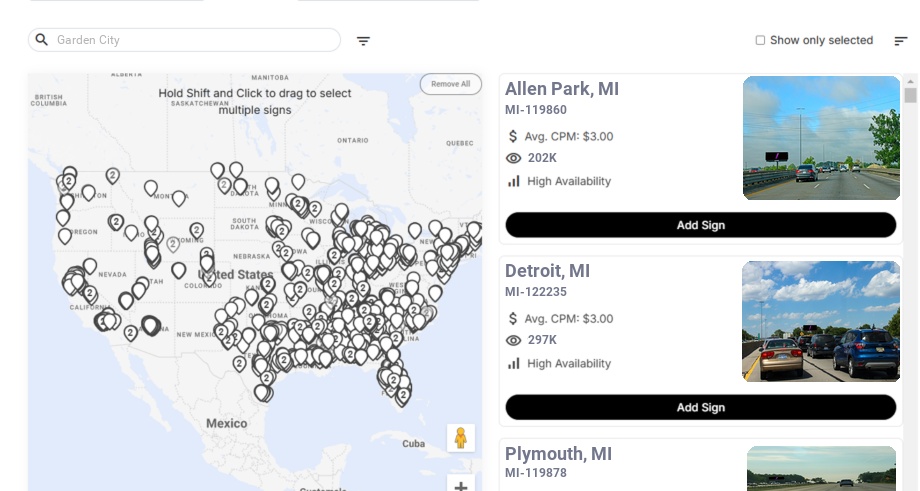
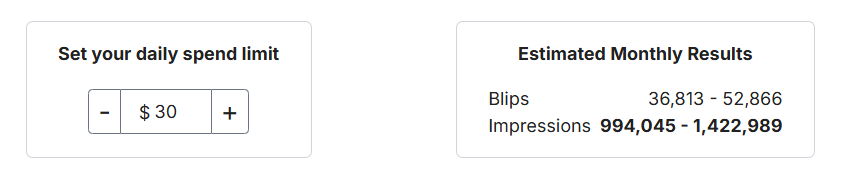
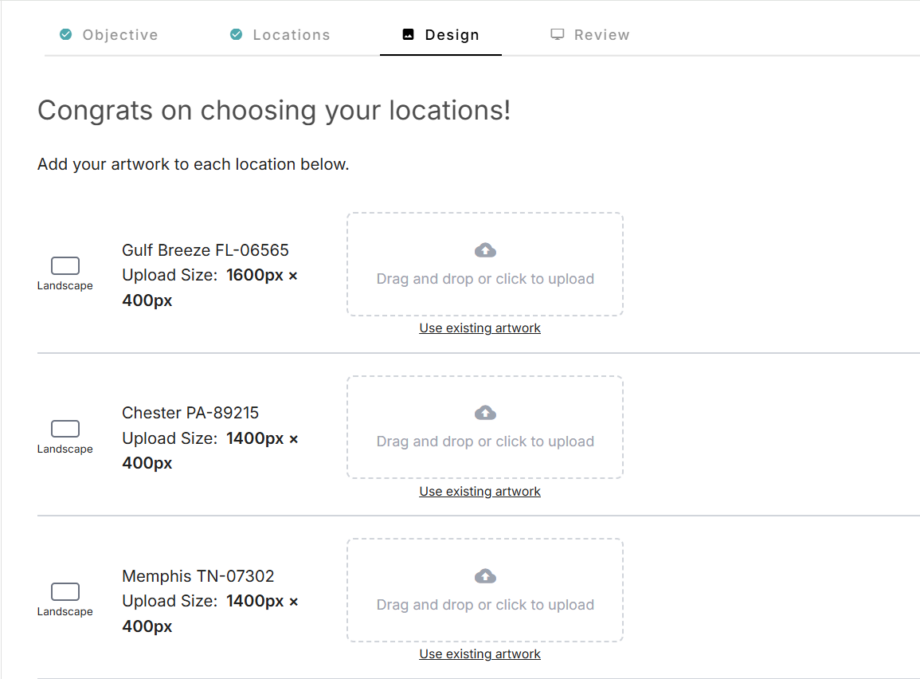
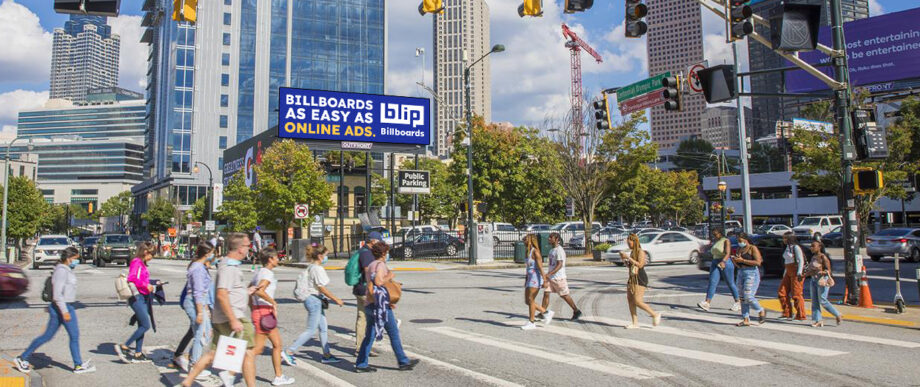
How much is a billboard in Garden City?
Billboards in other Michigan cities
Garden City Billboard Advertising Guide
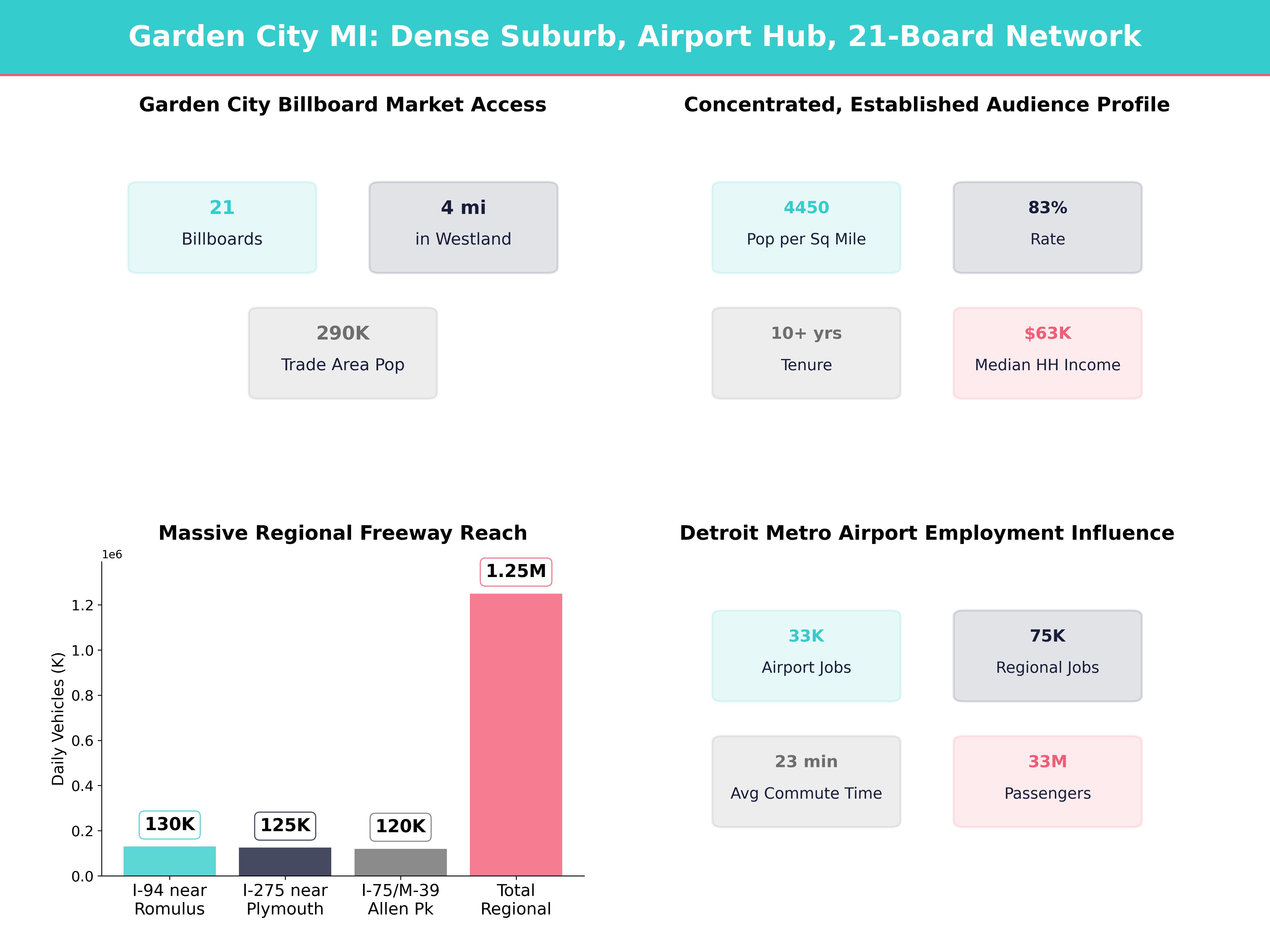
Garden City, Michigan sits in the heart of western Wayne County’s inner-ring suburbs, surrounded by high-traffic commercial corridors, major freeways, and one of the nation’s busiest airports. With 21 digital billboards serving the Garden City area from nearby Westland, Romulus, Plymouth, and Allen Park, we can help advertisers tap into a dense, commuter-heavy audience that still maintains a strong neighborhood identity and “small town” feel. For brands specifically looking for billboards near Garden City, this concentrated network provides broad reach with highly local relevance.
Understanding the Garden City Area Market
Garden City is a stable, middle-class community of about 26,000 residents, according to recent local demographic summaries, with a land area of just 5.9 square miles. That translates to a population density of roughly 4,400–4,500 people per square mile—significantly denser than many outer-ring suburbs in metro Detroit, and nearly triple the overall density of Wayne County (about 1,700 residents per square mile). The city sits about 15 miles west of downtown Detroit and just north of Detroit Metropolitan Wayne County Airport in Romulus, making Garden City billboards particularly effective for reaching both residents and regional travelers.
Key local context (rounded from recent community profiles and regional planning data):
- Population: Approximately 26,000–26,500 residents
- Median age: Around 40–41 years, indicating a mix of young families, working-age adults, and older residents
- Households: Roughly 10,500–11,000 households, with average household sizes near 2.4–2.6 people
- Median household income: Roughly $60,000–$65,000, consistent with a solid working- and middle-class base
- Owner-occupied housing: Often reported around 80–85% of occupied units, reflecting rooted, long-term residents
- Median home value: Commonly cited in the $160,000–$190,000 range, more affordable than many northern and western suburbs
Nearby communities that interact heavily with Garden City include:
- Westland: ~80,000–85,000 residents – a major retail and employment hub; see the City of Westland and Westland Chamber of Commerce
- Romulus: ~24,000–25,000 residents, home to Detroit Metro Airport; see the City of Romulus
- Plymouth (city + township): Combined trade area of roughly 35,000–40,000 residents; see the City of Plymouth
- Allen Park: ~27,000–28,000 residents, with strong freeway access; see the City of Allen Park
For official local information, the City of Garden City and the Garden City Downtown Development Authority provide helpful insights into community initiatives, events, and business activity. At the county level, Wayne County posts updates on infrastructure, economic development, and regional demographics that help inform billboard advertising near Garden City.
From an advertising standpoint, this combination of density, homeownership, and middle-income stability means campaigns near Garden City can effectively reach:
- Long-term residents who repeatedly travel the same local corridors (many households have lived in the same home 10+ years)
- Commuters heading to jobs across Wayne County and Detroit (over 80–85% of workers commute by car)
- Families prioritizing local shopping, services, and schools
Our nearby billboards in Westland (4 miles), Romulus (5.9 miles), Plymouth (8.5 miles), and Allen Park (8.8 miles) are strategically positioned to intercept this audience along their most common travel routes. For advertisers considering billboard rental near Garden City, these placements provide the practical coverage needed to hit everyday driving patterns without paying downtown Detroit rates.
Who You’re Reaching in the Garden City Area
Garden City is part of a broader western Wayne County cluster that includes Westland, Livonia, Dearborn Heights Inkster. Together, these nearby cities account for:
- Westland: ~80,000–85,000
- Livonia: ~93,000–95,000
- Dearborn Heights: ~55,000–60,000
- Inkster: ~24,000–25,000
- Garden City: ~26,000–26,500
That’s a combined local trade area of 280,000–300,000+ residents, before you even factor in travelers from Detroit and other suburbs who will also see Garden City billboards along regional corridors.
Demographic themes that matter for billboard advertisers:
-
Family and school focus:
- Children under 18 typically make up about 20–23% of Garden City’s population.
- The Garden City Public Schools district serves roughly 3,500–4,000 students across its schools, plus numerous students attend parochial or nearby district schools in Westland, Livonia, and Dearborn Heights.
- Local reports show that 60–70% of school-aged children participate in extracurricular or youth recreation programs, amplifying daily trips on local roads.
- Messaging that speaks to families, children’s activities, education, and local pride performs well here.
-
Working-class commuters:
- A substantial share of residents commute to jobs in manufacturing, healthcare, logistics, education, and service sectors across Wayne County and nearby Oakland County.
- Average commute times for Garden City and adjacent suburbs typically fall around 24–28 minutes, aligning with the broader Detroit metro average.
- More than 85–90% of workers commute by car, creating predictable, twice-daily exposure windows for highway-facing and arterial billboards near the Garden City area.
-
Age mix: A roughly even distribution among:
- Young adults in their 20s and early 30s starting households
- Parents in their 30s–50s (this group often represents 35–40% of the population)
- Older adults and retirees (residents 60+ often account for 20–25% of the population) who have lived locally for decades
This age diversity allows multi-segment campaigns: everything from first-time homebuyers and new parents to retirees managing healthcare and financial planning.
-
Ethnic and cultural diversity:
- Western Wayne County has steadily diversified over the past decade, with non-white residents now representing 30–40% of the population in several nearby communities.
- Significant African American, Arab American, Latino, and multi-ethnic populations live or shop in the Garden City trade area, influenced by migration from Detroit, Dearborn, and other suburbs.
- Ads that reflect inclusive imagery and acknowledge cultural variety can resonate across the Garden City area.
Local news outlets like Hometown Life – Westland/Garden City and the Detroit Free Press frequently cover neighborhood-level issues, events, and human-interest stories. Regional coverage from the Detroit News and ClickOnDetroit / WDIV Local 4 also shapes conversation. Reviewing local coverage can help shape campaigns that feel grounded in what residents care about and ensure your billboard advertising near Garden City speaks directly to current community interests.
Key Traffic Corridors and Billboard Coverage
While Garden City itself is largely residential, it is ringed by major corridors where our 21 digital billboards capture daily movements in and out of the community. Using Blip, you can concentrate impressions on the routes that best align with your customer base, making it easy to secure billboards near Garden City that match where your audience actually drives.
Important roadways and travel patterns (based on recent Michigan Department of Transportation
-
Ford Road (M-153):
- Runs east–west along the northern edge of the Garden City area, through Westland and Dearborn Heights.
- In segments between Middlebelt and Wayne Road, traffic can average around 35,000–45,000 vehicles per day, with some Westland stretches approaching 50,000 vehicles per day on peak weekdays.
- This corridor is a primary shopping and dining destination, with big-box retailers, auto dealerships, and quick-service restaurants.
- Our billboards serving Ford Road in nearby Westland allow you to reach Garden City residents during daily errands and retail trips.
-
Middlebelt, Merriman, and Inkster Roads:
- Major north–south routes used by Garden City residents to reach I-96, I-94, and other job centers.
- Daily traffic counts commonly fall in the 20,000–30,000 vehicles per day range, with peak directions often exceeding 1,500–1,800 vehicles per hour during rush periods.
- These arterials also host neighborhood retail, medical, and service businesses, making them ideal for “last-mile” directional messages and hyper-local Garden City billboards.
-
Freeways in Allen Park, Romulus, and Plymouth:
- I-94 near Romulus: A key connection between Detroit, the airport, and western suburbs. Select segments carry 120,000–140,000 vehicles per day, driven by airport traffic, commuters, and freight.
- I-275 near Plymouth: A circumferential freeway drawing commuters from Garden City toward jobs in Novi, Ann Arbor, and other tech/industrial hubs. Certain stretches see 120,000–130,000 vehicles per day.
- I-75 and Southfield Freeway (M-39) near Allen Park: Vital commuter routes from western Wayne County toward Detroit’s core and the Downriver communities, with segments around 100,000–140,000 vehicles per day.
Positioning your Blip campaigns on displays in Westland, Romulus, Plymouth, and Allen Park allows you to:
- Capture Garden City residents as they head to and from work
- Reach visitors traveling between the airport and Detroit
- Intercept shoppers and diners along one of metro Detroit’s most active suburban corridors (Ford Road)
- Tap into regional traffic volumes that easily exceed 1–1.5 million vehicle trips per weekday across the main freeways encircling western Wayne County
For additional local transportation context, the Southeast Michigan Council of Governments Wayne County Roads Division publish traffic and infrastructure data that can inform targeting and improve the effectiveness of billboard advertising near Garden City.
When to Run Your Campaign: Seasonality and Dayparting
Using Blip’s flexible scheduling, we can tailor your digital billboard flights around the Garden City area to real-world activity patterns, ensuring your Garden City billboards appear when local audiences are most active.
Seasonal considerations:
-
Spring (March–May):
- Home improvement, landscaping, and automotive services see strong demand as weather improves; in Michigan, home centers and garden retailers often report 20–30% of annual sales in this window.
- Garden City’s high homeownership rate (around 80–85%) means many residents invest directly in their properties as soon as temperatures rise above the 50–60°F range.
- Focus on late March through May with intensified weekday and Saturday schedules when weekend project planning peaks.
-
Summer (June–August):
- Youth sports, festivals, fairs, and outdoor activities peak. Community calendars from the Garden City DDA and City of Garden City typically list dozens of summer events—concert series, farmers markets, and family activities.
- Across Wayne County, parks and recreation departments report summer program participation in the tens of thousands of registrations, driving extra trips on local roads.
- Great for restaurants, family entertainment, ice cream and dessert shops, and local attractions.
- Increase evening and weekend impressions when families are out, often between 5:00–9:00 p.m.
-
Back-to-School (August–September):
- Parents shop for clothing, electronics, and school supplies; national retail data often shows 30–40% of annual school-related spending compressed into a 4–6 week period.
- Local districts in western Wayne County collectively send more than 40,000–50,000 students back to classrooms, increasing morning and afternoon traffic.
- Concentrate impressions during the two to three weeks before the first day of school and the first weeks of the term, with weekday afternoon/early evening emphasis.
-
Fall and Holiday (October–December):
- Automotive service before winter, retail promotions, charitable drives, and holiday events dominate. Tire, brake, and maintenance shops commonly see 10–20% volume spikes ahead of the first major snowfall.
- Downtown Garden City and nearby communities like Westland and Plymouth often host Halloween and holiday activities that attract thousands of visitors across multiple weekends; check the Garden City DDA and City of Westland events calendar.
- Plan early November through mid-December campaigns, combining commute hours with weekend retail peaks.
Daypart strategies:
-
Morning commute (6:30–9:00 a.m.):
- Ideal for coffee shops, quick-service breakfast, traffic-driving morning specials, and brand awareness.
- In metro Detroit, 70–75% of workers start their commute between 6:00–9:00 a.m., making this one of the highest-impression windows.
- Commuters from the Garden City area heading toward Detroit, Dearborn, and airport-area employment nodes will see boards in Westland, Romulus, Plymouth, and Allen Park.
-
Midday (11:00 a.m.–2:00 p.m.):
- Effective for restaurants, medical clinics, and local services aiming to catch errand runs and lunch breaks.
- Many quick-service and fast-casual concepts see 30–40% of daily transactions in this window.
- Consider rotating creative promoting same-day services and “walk-in welcome” messaging.
-
Afternoon and evening (3:00–7:30 p.m.):
- Capture parents picking up kids, after-school activities, and the drive home.
- This period typically covers both school dismissal and the core retail shopping window; traffic volumes on arterials can rise 20–30% above midday levels.
- Great for grocery, retail, fitness, and at-home service businesses (HVAC, plumbing, home repair).
-
Late evening (after 8:00 p.m.):
- Lower CPM opportunities using Blip’s bidding model; effective for entertainment, streaming, and brand-building campaigns targeting younger, nightlife, or shift-worker audiences.
- Airport, healthcare, and manufacturing workers on second and third shifts contribute to steady late-night freeway traffic in Romulus and Allen Park.
Crafting Creative That Resonates Near Garden City
The Garden City area combines a tight-knit community feel with big-city adjacency. Your creative should reflect both so that your billboard advertising near Garden City feels locally authentic and regionally relevant.
- Emphasize local and neighborhood pride
- Use phrases like “Serving Garden City families,” “Your Garden City area dentist,” or “Proud to serve western Wayne County.”
- Feature recognizable locations—Ford Road shopping areas, local parks, or references to community events like the Garden City summer concerts—to signal that you truly understand the area.
- Consider nods to high school sports or community traditions (without infringing on trademarks or school logos). Local high school football and basketball games can draw 1,000–2,000+ attendees on big nights, reinforcing community identity your ads can tap into.
- Keep messages ultra-clear for commuter traffic
Most drivers are moving at 35–70 mph when they see your ad. Follow these rules:
- Limit copy to 6–8 words whenever possible; recall time for billboard messages at highway speeds is often just 3–5 seconds.
- Use one main focal point: either a product, logo, or person.
- High contrast colors—light text on dark background or vice versa—improve readability, especially in Michigan’s variable weather and winter darkness (Detroit averages roughly 50% of days per year with significant cloud cover).
- Include only one call to action: “Exit at …,” “Visit Ford & Middlebelt,” or a short URL / simple domain.
- Speak to value and practicality
With median household incomes in the $60,000–$65,000 range, many residents are value-conscious but quality-focused:
- Emphasize clear offers: “Oil Change $39,” “New Patient Exam $99,” “0% Financing Available.”
- Highlight convenience: “Same-Day Appointments,” “Walk-Ins Welcome,” or “Online Ordering & Pickup.”
- For larger-ticket items (vehicles, renovations), stress easy financing, warranty length, or long-term savings (“Save up to $600/year on energy bills”).
- Reflect regional sports and culture
Detroit-area sports and culture are influential in the Garden City area:
- Timed creative around Detroit Lions, Tigers, Red Wings, or Pistons seasons can catch attention—be careful to avoid trademark misuse, but themes like “Game Day Specials” or team colors (without logos) can be effective.
- Major games and playoff runs can spike bar, restaurant, and snack sales by 10–25% on game days in metro areas.
- Coordinate campaigns around regional events promoted by Visit Detroit—concerts, festivals, and major sports events drive additional traffic along primary routes used by Garden City residents.
Strategies for Different Business Types
Different sectors can leverage the Garden City area’s patterns in specific ways when choosing billboards near Garden City and setting up campaigns.
Local retail and restaurants
- Target boards in Westland along Ford Road and in Allen Park for heavy shopping and dining traffic; Westland’s commercial corridors serve a retail trade area well over 100,000 residents.
- Run heavier rotations Thursday–Sunday and around lunch/dinner hours, when restaurant and retail sales typically peak by 20–40% over early-week days.
- Use distance messaging (“5 minutes north of Ford & Venoy”) and urgency (“Tonight Only,” “Weekend Sale”).
- Highlight local convenience—more than 60–70% of suburban shoppers report choosing stores within a 15-minute drive for everyday needs.
Home services (HVAC, roofing, landscaping, contractors)
- Focus on spring and fall, plus pre- and post-winter messaging; in Michigan, heating and cooling contractors often see service calls spike 30–50% during first heat waves and cold snaps.
- Emphasize licensed/insured status and local roots (“Serving western Wayne County since 1998”).
- Use Romulus and Plymouth displays to catch commuters who own homes in the Garden City area but travel to jobs farther afield.
- Directional messages can capture impulse calls from homeowners stuck in traffic, especially when paired with simple phone numbers or URLs.
Healthcare, dental, and urgent care
- The Garden City area is anchored by facilities such as Garden City Hospital
- In metro Detroit, hospital and urgent care visits commonly peak during weekday evenings and winter months, when respiratory and injury-related cases rise.
- Run campaigns during weekday mornings and early evenings when families plan appointments.
- Highlight insurance acceptance (Medicare, Medicaid, major private plans), new patient availability, same-day scheduling, and quick access from Ford Road and nearby intersections.
Automotive sales and service
- Western Wayne County is heavily auto-dependent: vehicle ownership rates commonly exceed 1.7–2.0 vehicles per household in the suburbs.
- Promote service discounts during shoulder seasons (March–April and September–October), when tire and maintenance shops often experience 15–25% higher volume than mid-summer.
- Use Romulus and Allen Park boards along I-94 and I-75 / M-39 corridors to reach commuters who might switch shops closer to home or work.
- For dealerships, highlight certified pre-owned inventory and payment-focused offers (“Payments from $249/mo”) to match middle-income budgets.
Professional services (banks, credit unions, insurance, legal)
- Target consistent, year-round presence with lower daily budgets using Blip’s flexible bidding, reinforcing brand recognition over many months.
- The Detroit metro has a high share of residents using community banks and credit unions; local credit unions often show membership penetration of 30–40% of households in core markets.
- Focus on trust-building messages: “Serving Garden City area residents for 30+ years,” or “Local decisions, local people.”
- Time messaging tied to tax season (February–April), home-buying season (late spring through summer—often 40–50% of annual home sales), or back-to-school spending.
Leveraging Airport and Regional Travel
Detroit Metropolitan Wayne County Airport, located in Romulus and managed by the Wayne County Airport Authority, handles tens of millions of passengers annually and employs tens of thousands of workers. Recent airport statistics show:
- Passenger volume: Roughly 30–36 million passengers per year in recent years, placing DTW among the top U.S. airports by traffic.
- Employment impact: Tens of thousands of on-site and related jobs; local economic impact studies often cite 30,000–35,000 direct jobs and 70,000–80,000 total regional jobs tied to the airport and its supply chain.
This creates two powerful opportunities:
-
Airport workers who live near Garden City:
- Many airport employees reside in nearby suburbs like Garden City, Westland, Taylor, and Dearborn Heights, typically within a 15–30 minute commute.
- Boards near Romulus can repeatedly hit this commuting audience with recruitment, financial services, or everyday retail messaging.
- Shift work patterns mean strong impression potential during very early morning (4–7 a.m.) and late-night (9 p.m.–midnight) periods.
-
Visitors and business travelers passing near the Garden City area:
- Travelers driving to and from downtown Detroit or other suburbs use I-94 and connecting routes by Romulus and Allen Park; key segments carry 100,000+ vehicles per day, including rental cars, ride-share, and hotel shuttles.
- Hospitality businesses, conference centers, and attractions can position Garden City-adjacent offerings as convenient, budget-friendly alternatives to downtown.
- Budget and midscale hotels in suburban markets often achieve occupancy rates within 5–10 percentage points of downtown properties while offering lower average daily rates, a compelling value message for price-sensitive travelers.
If your business serves travelers (hotels, extended stay, rental cars, attractions), we can use Blip’s location tools to concentrate on boards that intersect with the heaviest airport traffic flows and pair them with directional copy (“10 minutes north of DTW off I-275”). This is a powerful example of billboard advertising near Garden City reaching both locals and visitors with one coherent strategy.
Using Blip’s Flexibility to Optimize Your Campaign
Digital billboards serving the Garden City area give you levers that traditional static boards cannot:
-
Bid-based budgeting:
- You choose how much to bid per “blip” (each 7.5–10 second ad display).
- This allows smaller businesses to compete along high-traffic corridors by prioritizing off-peak hours or shoulder seasons when inventory is more affordable—often lowering effective CPMs by 20–40% compared with fixed, all-day placements.
-
Granular location control:
- Select only the boards in Westland, Romulus, Plymouth, and Allen Park that align with your customer flows.
- For example, a Garden City-based restaurant might prioritize Westland (Ford Road) and Allen Park (commuter traffic returning home), while a logistics or staffing firm might focus on Romulus and I-94 for airport worker reach.
- Concentrating impressions on 3–5 high-value boards rather than spreading thin across many locations can significantly improve frequency among your core audience, making your billboard rental near Garden City more efficient.
-
Dayparting and day-of-week scheduling:
- Increase bids during your highest-value times (e.g., lunch hours, weekend shopping periods) and lower them or pause when your audience is less active.
- Many advertisers see 10–30% better response when matching billboard exposure closely to business hours or peak demand times.
- Rotate tailored creative by time—breakfast specials in the morning, family dinners in the evening, “call tonight” service offers after 4 p.m.
-
Rapid creative testing:
-
Because digital creative can be swapped quickly, you can A/B test messages:
- Offer A vs. Offer B
- Image-focused vs. text-focused designs
- Different calls to action (“Exit at…” vs. “Order Online”)
- Some advertisers report 15–50% improvements in clickthrough or call volume after a few test cycles.
- Monitor which periods and messages align with spikes in web traffic, calls, or store visits, then reallocate budget toward the top-performing combinations.
-
Because digital creative can be swapped quickly, you can A/B test messages:
Measuring Impact and Refining Over Time
To make the most of campaigns reaching the Garden City area, we recommend a measurement plan from day one:
-
Correlate ad flight dates with business metrics:
- Track store traffic, online orders, phone calls, or appointment requests by day.
- Compare periods when your Blip ads are running heavily to periods when they are off or running lightly.
- Even simple before/after comparisons can reveal 5–20% lifts in key metrics when campaigns are active.
-
Use simple, trackable CTAs:
- Promo codes specific to billboard campaigns (e.g., “Mention FORD ROAD for 10% off”).
- Dedicated landing pages or short URLs unique to your billboard creative; monitor sessions, form fills, and calls.
- QR codes optimized for at-a-glance scanning at red lights or slow-moving traffic (use sparingly and only where safe). Some advertisers see 5–10% of response volume via QR when designed large and clear.
-
Refine geographic and temporal focus:
- If you see stronger results when boards closer to Ford Road and Westland are active, shift more of your budget there.
- If lunchtime or evening impressions correlate with more web traffic, narrow your dayparts accordingly.
- Revisit your plan at least every 4–8 weeks; small adjustments to bids, boards, or creative can compound into substantial ROI gains over a campaign’s lifespan.
By combining the demographic strengths of the Garden City area with strategic board selection and Blip’s flexible buying tools, advertisers can cost-effectively reach a concentrated, loyal, and commuter-heavy audience. With 21 digital billboards serving the Garden City area from nearby Westland, Romulus, Plymouth, and Allen Park, there is ample opportunity to build awareness, drive foot traffic, and grow market share across western Wayne County and the broader Detroit region, especially for marketers seeking billboards near Garden City and scalable billboard rental near Garden City that can adapt to changing business needs.