Billboards in Walker, MI
No Minimum Spend. No Long-Term Contracts. Just Results.
Put your message in lights with Walker billboards powered by Blip. Our self-serve platform makes it easy to launch eye-catching billboards near Walker, Michigan, giving you flexible budgets, full control, and real-time results in the Walker area.
Trusted by Leading Brands


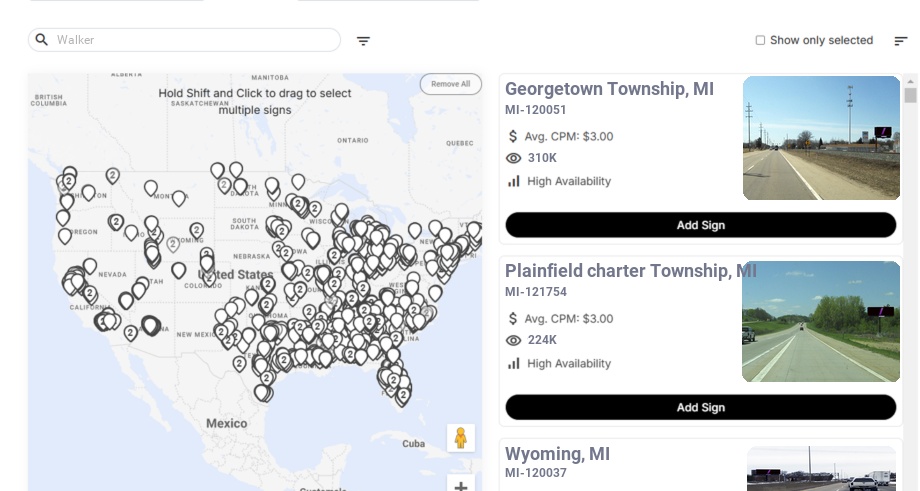
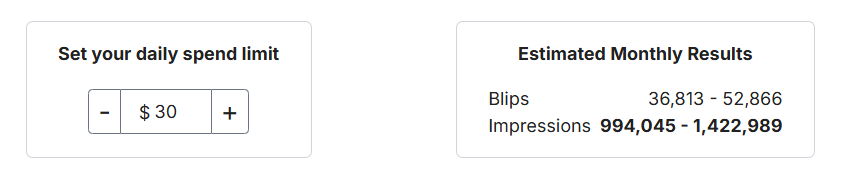
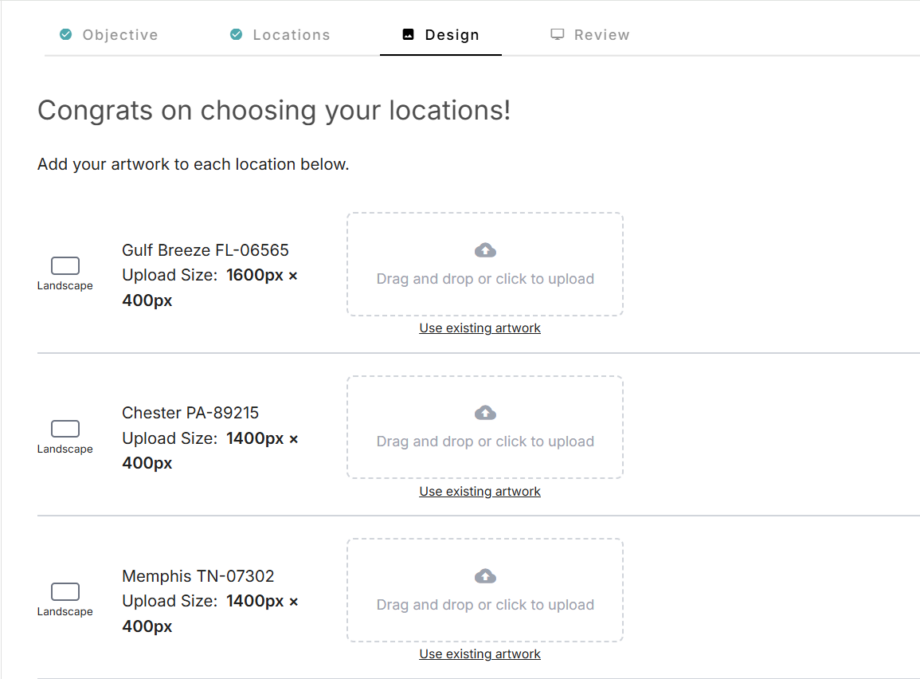
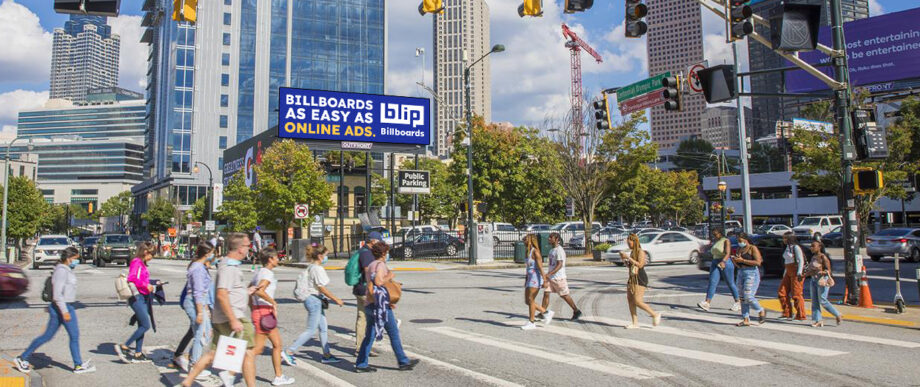
How much is a billboard in Walker?
Billboards in other Michigan cities
Walker Billboard Advertising Guide
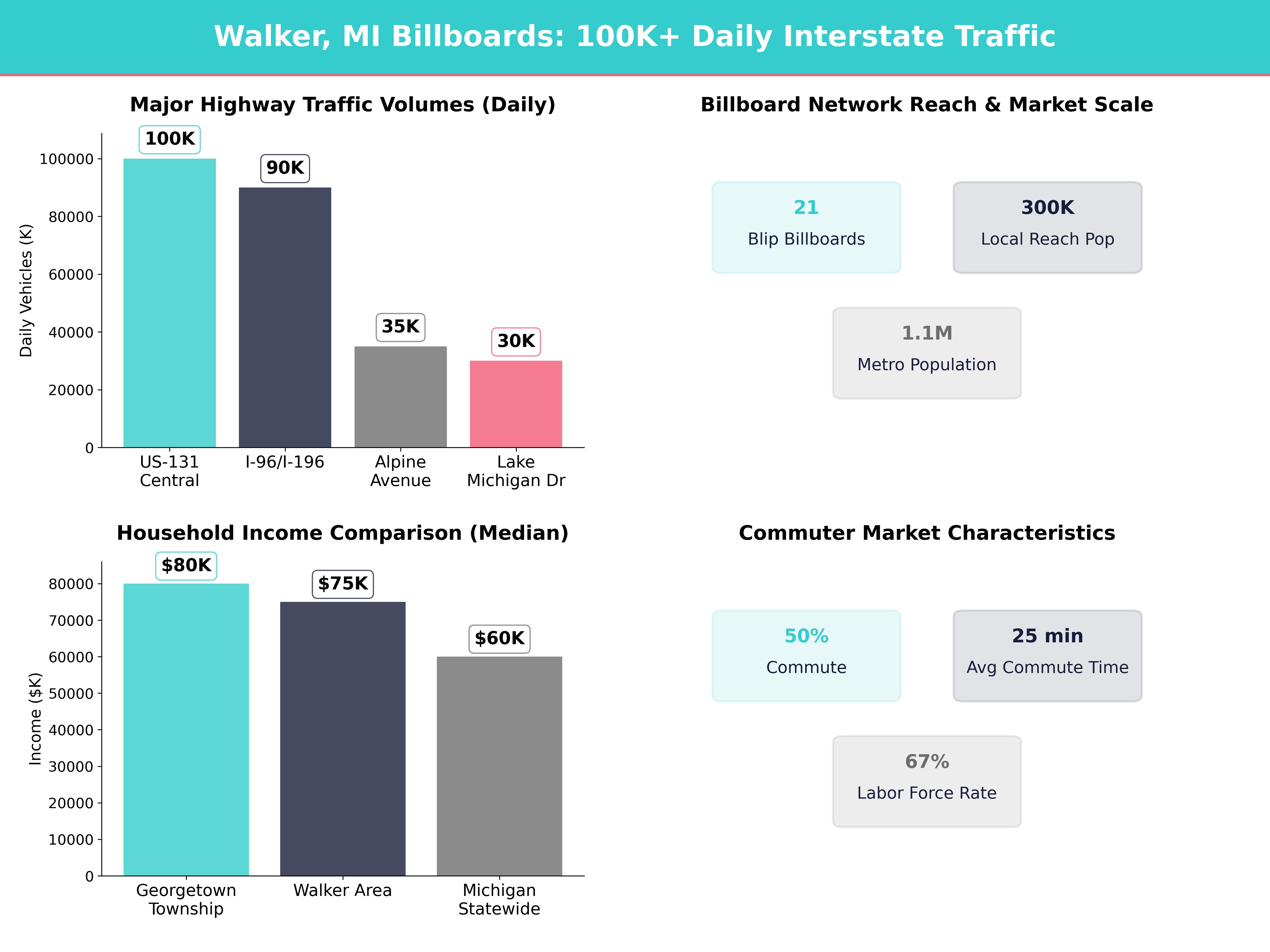
Walker, Michigan sits at the crossroads of suburban neighborhoods, industrial parks, and major regional highways, making the Walker area a powerful place to reach West Michigan consumers by digital billboard. With 21 Blip billboards located near Walker—primarily in Grand Rapids, Comstock Park, Wyoming, Georgetown Township, Plainfield Charter Township, and Byron Center—we can help you reach shoppers, commuters, and families who live, work, and play around Walker every day. These billboards near Walker give local businesses, regional brands, and recruiters a flexible way to stay visible across the whole northwest Grand Rapids corridor.
Understanding the Walker Area Market
Walker is a growing suburb on the northwest side of the Grand Rapids metro. According to 2020 data, the City of Walker has roughly 25,000–26,000 residents (about 25,100 in 2020, with modest growth since), while Kent County has more than 650,000 residents and the greater Grand Rapids metro exceeds 1.1 million people. More than 80% of Kent County residents live in suburban and urban communities that regularly travel through Walker-area corridors. That means campaigns near Walker naturally tap into a much larger regional audience than the city population alone suggests, and smart placement of Walker billboards can generate impact well beyond the city limits.
Key characteristics of the Walker area audience:
- Family-oriented suburbs:
Walker’s housing stock is dominated by single-family homes and townhomes; more than 60% of occupied housing units in the Walker–northwest Grand Rapids area are detached single-family homes. In Kent County, the median age is about 35–36 years, and roughly 1 in 3 households includes children under 18, indicating a relatively young, family-heavy population compared with Michigan overall. Owner-occupancy around Walker typically runs near 70%, reinforcing a stable, rooted community. - Middle to upper-middle income:
Median household income in Walker and surrounding suburbs generally falls in the $65,000–$75,000 range, compared with Michigan’s statewide median around the mid–$60,000s. Nearby communities such as Georgetown Township and Byron Center often see median incomes that climb into the $80,000+ range. This income profile supports robust demand for retail, dining, home improvement, healthcare, and recreation, and it positions Walker-area households as strong prospects for discretionary purchases. - Strong employment base:
Walker is home to major employers like Meijer’s corporate headquarters and distribution facilities, which employ several thousand people across corporate, logistics, and support roles in the immediate area. Industrial parks and logistics hubs along Wilson Avenue, Three Mile Road, and I-96 add a significant base of manufacturing, warehouse, and transportation jobs. The broader Grand Rapids region has consistently ranked among Michigan’s fastest-growing job markets, with pre-2020 unemployment rates often 1–2 percentage points below the national average and job growth in some years exceeding 2–3% annually. Major employment sectors include advanced manufacturing, healthcare, food processing, and professional services. - Regional identity:
Residents often identify with “Grand Rapids” as much as with Walker itself, consuming regional news from outlets like MLive Grand Rapids, WOOD TV8 FOX 17 West Michigan, and using resources like Experience Grand Rapids to find events and entertainment. Surveys and local economic development data suggest that well over half of workers in suburban communities like Walker commute across city borders daily, highlighting how interconnected the metro is in practice.
For advertisers, this means creative and offers that resonate with “West Michigan families” or “Grand Rapids area professionals” will feel natural and locally relevant to people in the Walker area and will reflect how they already think about where they live, work, and shop. When your message appears consistently on Walker billboards and adjacent corridors, it blends into the everyday patterns of this regional lifestyle.
How People Move Around the Walker Area
To design a high-impact campaign, we want to understand where and when people travel near Walker. The area is threaded by several high-traffic corridors that our nearby billboards can tap into, supported by Michigan Department of Transportation (MDOT)
- I-96 / I-196:
These interstates run just south and east of Walker, carrying regional traffic toward downtown Grand Rapids and out toward Lansing and the lakeshore. Segments near Grand Rapids often see 70,000–90,000+ vehicles per day (AADT), with some stretches exceeding 100,000 vehicles during peak travel seasons. These routes capture commuters from Walker, long-distance travelers, and freight traffic moving between West Michigan and the rest of the state. - US-131 through Grand Rapids and Wyoming:
This north–south spine handles some of the heaviest volume in West Michigan, with several central segments exceeding 100,000 vehicles per day and peak hours carrying 5,000–6,000 vehicles per hour in each direction. Commuters from Walker heading downtown or toward Wyoming and Byron Center frequently use this corridor, making it ideal for broad-reach campaigns looking to saturate the core of the metro. - Alpine Avenue (M-37):
Running just east of Walker, Alpine connects Walker-area neighborhoods to retail and employment centers in Comstock Park and Grand Rapids. Key segments carry an estimated 25,000–35,000 vehicles daily, with weekend volumes often matching or exceeding weekday peaks due to shopping traffic. The Alpine retail corridor pulls visitors from across northern Kent County, giving advertisers exposure beyond Walker’s immediate population. - Lake Michigan Drive (M-45) and Wilson Avenue:
These main arterials serve residential and commercial zones in Walker and Georgetown Township, channeling both local traffic and students/staff traveling to and from Grand Valley State University’s Allendale campus to the west. GVSU enrolls roughly 22,000–23,000 students, and Lake Michigan Drive is a primary route between campus and Grand Rapids, with daily traffic frequently in the 20,000–30,000 vehicles range near key intersections.
Typical daily patterns:
- Morning peak (6:30–9:00 a.m.):
Commuters from Walker head toward downtown Grand Rapids, industrial corridors, and the Medical Mile. In many segments, traffic volumes during this window are 30–40% higher than off-peak hours. Service businesses, coffee shops, and B2B advertisers benefit from heavier morning frequency and decision-making time in the car. - Midday (11:00 a.m.–2:00 p.m.):
Lunch runs and errands increase traffic near major retail hubs in Grand Rapids, Wyoming, and on Alpine Avenue. In suburban corridors, up to 20–25% of weekday daily traffic can fall in this midday band, ideal for food, retail, and healthcare reminders. - Evening peak (3:30–6:30 p.m.):
Workers return toward Walker and other suburbs; this is prime time for retail, dining, entertainment, and home services messaging. Evening peak volumes on some freeways rival morning peaks, and billboards benefit from increased dwell times when congestion builds near merges and exits. - Weekends:
Shopping destinations near Grand Rapids, Wyoming, and Byron Center attract families from the Walker area. In certain retail corridors, Saturday traffic can reach 110–130% of a typical weekday, particularly around big-box centers, malls, and entertainment venues. Weekend traffic along retail corridors can rival or exceed weekday commute peaks and is often more heavily skewed toward family decision-makers.
By deploying Blip campaigns on specific billboards near Walker that sit along these routes, we can match your impressions to the times and places where your best prospects are already on the road, focusing budgets on the dayparts and corridors that deliver the highest potential reach. This is the foundation of effective billboard advertising near Walker.
Where Our Billboards Are and Who You Reach
Our 21 digital billboards serving the Walker area are strategically positioned in nearby communities, all within about 10 miles of Walker. Within this radius, you can routinely reach a combined population of 300,000+ residents who live in or near the commuting shed. Taken together, these locations function as a tight network of Walker billboards that deliver metro-wide coverage:
- Grand Rapids (0.8 miles from Walker):
Ideal for reaching Walker residents commuting into the city, downtown employees, and regional visitors. The City of Grand Rapids itself has roughly 200,000 residents and hosts tens of thousands of workers and visitors daily. These locations are powerful for branding campaigns targeting “Greater Grand Rapids” audiences, including professionals working along the Medical Mile and downtown entertainment districts. - Comstock Park (5.4 miles):
Home of the West Michigan Whitecaps at LMCU Ballpark 300,000–400,000 fans per season, with individual home games often attracting 4,000–8,000 attendees depending on promotions and weather. Boards near Comstock Park capture game-day and shopping traffic, including many Walker-area families traveling in both directions on US-131 and Alpine. - Wyoming (5.7 miles):
A manufacturing and retail hub directly south of Walker, the City of Wyoming has a population of about 76,000–77,000 residents. Wyoming-area billboards reach a dense mix of blue-collar workers, warehouse employees, and shoppers traveling US-131 and 28th Street. 28th Street is one of West Michigan’s most commercially developed corridors, with segments drawing 30,000–40,000 vehicles per day. - Georgetown Township (6.9 miles):
A fast-growing community with more than 50,000 residents, suburban neighborhoods, and expanding commercial zones to the southwest. Traffic here includes many commuters and families who share a similar demographic profile to Walker: homeownership in the 75–80% range and household incomes often $80,000+. These boards efficiently extend your Walker audience deeper into the southwest suburbs. - Plainfield Charter Township (8.5 miles):
Rapidly growing residential areas north of Grand Rapids, with strong ties to Walker and Comstock Park via US-131 and local routes. Population growth in Plainfield has been among the faster in Kent County over the last decade, adding thousands of residents and supporting new retail, healthcare, and service businesses. - Byron Center (9.4 miles):
A fast-growing suburb in Byron Township that features large distribution centers, light industrial operations, and new housing developments. The Byron Center area has seen substantial residential growth since 2010, with some neighborhoods growing by 20–30% over the decade. These boards are excellent for targeting both workers in logistics/warehousing and upwardly mobile suburban families.
Using Blip, we can choose sets of boards near Walker that mirror your target:
- Walker-focused local businesses:
Prioritize Grand Rapids, Comstock Park, Georgetown Township, and Plainfield Charter Township to ring the Walker area and stay within the core 10–15 minute drive shed of many Walker households. This approach keeps your billboard rental near Walker tightly focused on the prospects most likely to convert. - Regional brands:
Add Wyoming and Byron Center to broaden your reach across the south and southwest suburbs, capturing the full West Michigan commuter shed where daily work trips commonly exceed 10–15 miles each way. - Employee recruitment:
Emphasize boards along commuter routes from residential areas into industrial and office zones, timed to peak commute hours. In a metro where labor force participation rates hover around 65–67%, recruitment messages that appear during drive times can repeatedly reach active and passive job seekers.
Seasonality and Local Events You Can Leverage
The Walker area follows the classic Midwest four-season cycle, and campaigns perform best when they sync with seasonal behavior and local events. Planning your billboard advertising near Walker around these patterns helps you get more results out of every dollar spent.
Winter (December–February)
- Snowy and icy conditions are common; the Grand Rapids area typically sees 70–80 inches of snowfall per year, with some winters surpassing 90 inches.
- Average high temperatures often sit in the low 30s°F, and sunset can occur as early as 5:05 p.m. in December, increasing the share of drive time in darkness.
- Consumers prioritize auto service (tires, brakes, batteries), home heating, indoor entertainment, and e-commerce, with many retailers reporting holiday-season sales accounting for 20–30% of annual revenue.
- Bright, high-contrast designs work well against gray skies and early sunsets.
- Use dayparting to increase evening impressions when it’s dark by 5:00 p.m., making digital billboards highly visible during after-work commutes.
Spring (March–May)
- Construction season ramps up, affecting commute routes across Kent County—an important moment for traffic/safety messaging, home improvement, garden centers, and outdoor recreation. MDOT and local agencies often launch dozens of lane and road projects in the metro during this window.
- Tax refunds arrive; many households receive refunds in the $2,000–3,000 range, fueling big-ticket purchases and home projects.
- Events and festivals in nearby Grand Rapids, promoted through Experience Grand Rapids, pull Walker residents downtown. Spring beer, food, and arts events can draw tens of thousands of attendees over a weekend, increasing traffic on downtown-bound routes.
Summer (June–August)
- Families head to Lake Michigan beaches, ballgames, and local attractions, aided by school breaks for roughly 10–12 weeks each summer.
- LMCU Ballpark in Comstock Park hosts 70+ home games and additional events each season, drawing thousands per game and generating concentrated surges on US-131 and West River Drive. Boards on routes to the park are perfect for food, beverage, and entertainment advertising.
- Tourism to the region surges as West Michigan’s lakeshore communities see summer visitation that can be 2–3 times typical off-season levels. Hotels, attractions, and restaurants benefit from flexible, higher-frequency campaigns during holiday weekends (Memorial Day, Fourth of July, Labor Day) and festival weeks.
- Outdoor lifestyle messaging (boats, RVs, camping, patio, landscaping) resonates strongly when daylight stretches to nearly 15 hours in late June.
Fall (September–November)
- Back-to-school, college sports, hunting season, and major retail holidays dominate. Local school districts typically bring tens of thousands of students back to campuses, driving morning and afternoon traffic near residential and school zones.
- Events like ArtPrize in downtown Grand Rapids can attract hundreds of thousands of visitors in peak years, significantly boosting traffic on central routes and filling downtown parking and entertainment districts for several weeks.
- Retailers and e-commerce brands should ramp up exposure from late October through Black Friday and early December, when national and local data show holiday spending per household in the hundreds to low thousands of dollars range.
With Blip, you can quickly adjust budgets and schedules around these peaks instead of committing to a static, all-season buy, ensuring your message is heaviest when consumer intent and traffic volumes are highest. This flexibility is one of the biggest advantages of digital billboard rental near Walker versus traditional fixed-term placements.
Crafting Effective Creative for the Walker Area
Walker-area audiences are practical, family-focused, and value-conscious. That should guide your billboard creative.
Messaging themes that work well:
- Family and community:
Emphasize safety, reliability, and value (e.g., “Trusted by West Michigan families since 1998”). In an area where over 60% of households are owner-occupied and many have children at home, stability and trust matter. - Local pride:
References to Walker, West Michigan, or Grand Rapids resonate strongly (e.g., “Serving the Walker–Grand Rapids area”). Local surveys consistently show high satisfaction with quality of life in Kent County, and businesses that present themselves as part of the community can earn stronger loyalty. - Convenience and proximity:
Highlight being “just off I-96,” “minutes from Alpine,” or “near Standale” to tie directly to local geography. For many Walker-area residents, the average one-way commute is about 20–25 minutes, so “on your way home” positioning can be powerful. - Job stability and benefits:
For hiring campaigns, focus on pay, benefits, and work-life balance, aligned with major local employers’ standards. Many logistics, manufacturing, and warehouse roles in the region target starting pay in the $17–$22 per hour range and promote health benefits and paid time off; matching or exceeding that in your creative can help your offer stand out.
Design tips for maximum impact:
-
Use big, bold type:
Aim for 6–8 words of main copy, legible at 60–70 mph. Walker-area highways and arterials often move quickly, so clarity beats cleverness. Studies of digital OOH readability suggest that messages with under 10 total words generally achieve higher recall. -
High contrast:
White or bright text on dark backgrounds, or vice versa, cuts through gray skies and heavy tree cover along many West Michigan roads. High-contrast palettes can improve legibility by 20–30% versus low-contrast designs in quick-glance environments. -
Local cues:
Simple visual nods to the Grand River, local sports teams, or lakeshore sunsets can create instant recognition without clutter. Even one recognizable local landmark or phrase (“just past the river,” “near Standale”) can significantly increase perceived relevance. -
Weather-aware creative:
- Winter: Use warm colors, “warm up,” “stay safe,” and highlight snow tires, furnace checks, or comfort foods.
- Summer: Use bright palettes, outdoor imagery, and short calls-to-action like “Exit 2 Miles – Tonight” for events or dining when spontaneous trips increase.
Because Blip lets you upload multiple creatives and rotate them automatically, we recommend:
- Running 2–4 variants at a time to avoid message fatigue while collecting performance data.
- Testing different calls-to-action (“Apply Today,” “Order Online,” “Visit This Weekend”) and measuring impact via unique URLs, promo codes, or landing pages. Even simple promo codes can show which creative drives higher response rates per thousand impressions.
- Iterating monthly or seasonally based on performance, which aligns with how often many local businesses update their promotions or service offers.
Timing Strategies Using Blip’s Flexibility
Dayparting and budget control are key tools for succeeding near Walker. Rather than a one-size-fits-all schedule, we can align your spending to when your target audience is most likely to be on the road. This is especially important when you’re concentrating your billboard advertising near Walker on a specific type of customer or business goal.
By business type:
-
Restaurants and coffee shops:
- Breakfast: 6:00–9:00 a.m. along commuter corridors into Grand Rapids and industrial areas. In some corridors, up to 25–30% of daily traffic passes during this morning block.
- Lunch: 11:00 a.m.–1:30 p.m. around office and industrial zones.
- Dinner: 4:00–7:00 p.m. on routes back toward Walker and suburbs like Georgetown Township and Plainfield Charter Township, when families are deciding where to eat.
-
Retail and services near Walker:
- Weekday evenings (4:00–8:00 p.m.) for after-work errands, when a significant portion of household spending decisions are made on the way home.
- Saturdays from 10:00 a.m.–6:00 p.m., focusing on boards near shopping centers in Grand Rapids, Wyoming, and Byron Center, when weekend retail traffic can exceed weekday baselines by 10–20%.
-
Recruitment and staffing:
- Weekday commute peaks (6:30–9:00 a.m. and 3:30–6:30 p.m.), catching both inbound and outbound workers.
- If hiring for night shifts, add 9:00–11:00 p.m. along industrial routes where shift changes are common. Many logistics and manufacturing employers operate 24/7 schedules, making off-peak exposure valuable.
-
Events and entertainment:
- Heavier schedule in the 7–10 days before the event, when awareness and ticket purchase intent are highest.
- Concentrated exposure on Thursday–Sunday and during afternoon and evening drive times, aligning with typical event start times and weekend leisure trips.
Because Blip allows you to set a maximum daily budget and adjust bids, we can:
-
Push bids higher for premium times (e.g., Friday evening game days near Comstock Park or festival weekends highlighted by Experience Grand Rapids).
- Ease off during low-impact windows (late-night hours for daytime-only businesses).
- Increase or pause campaigns quickly in response to local news or weather trends reported by outlets like WOOD TV8 FOX 17 West Michigan, for example when winter storms or heat waves change shopping patterns.
Targeting Walker Neighborhoods with Regional Boards
Even though the billboards serving the Walker area sit in nearby communities, we can still “map” them to the neighborhoods you care about most. Many Walker residents travel 5–15 miles daily for work, shopping, or school, which means strategic board placement can reliably capture specific household clusters. Thoughtful billboard rental near Walker and its neighboring suburbs can make your message feel hyper-local even when the boards themselves are technically just outside city limits.
Examples:
-
To reach northwest Walker and Standale:
- Prioritize locations in Grand Rapids to the east and Georgetown Township to the southwest that align with Lake Michigan Drive and Wilson Avenue traffic patterns. These corridors handle thousands of Walker-area trips daily between homes, GVSU, and downtown.
-
To reach Walker residents who shop on Alpine Avenue or in Comstock Park:
- Focus on boards in Grand Rapids and Comstock Park near Alpine and US-131, where Walker-area drivers converge. Alpine’s retail strip pulls shoppers from a catchment area of 100,000+ residents within a short drive.
-
To reach Walker commuters working in downtown Grand Rapids or the Medical Mile:
- Use central Grand Rapids boards along I-196, US-131, and major surface streets feeding into downtown. The downtown area supports tens of thousands of jobs, meaning repeated weekday exposure to the same commuters.
-
To reach workers in industrial and logistics jobs common around Walker and Wyoming:
- Combine Grand Rapids and Wyoming boards along US-131 and key surface routes at shift-change times. Industrial parks and warehouse districts in these zones employ thousands of workers on staggered shifts, so targeted dayparts can significantly increase message frequency among potential applicants.
For broader campaigns that cover the full Walker area plus surrounding suburbs, we can simply allocate impressions proportionally across Grand Rapids, Wyoming, Comstock Park, Georgetown Township, Plainfield Charter Township, and Byron Center, giving you both depth in Walker’s core audience and breadth across a metro area of more than 1.1 million people.
Measuring and Optimizing Your Campaign
To make the most of your investment near Walker, we recommend a simple measurement and optimization framework:
-
Define a clear, trackable goal:
- Store visits, online orders, phone calls, job applications, or event attendance.
- For many local businesses, even a 1–3% lift in weekly traffic can justify a sustained billboard presence when paired with strong margins.
-
Set geographic expectations:
- Watch metrics originating from Walker ZIP codes and adjacent Grand Rapids/Comstock Park areas as reported in your website analytics or POS system.
- Identify a reasonable drive-time trade area (often 5–15 miles) and compare performance inside vs. outside that radius.
-
Use trackable calls-to-action:
- Unique URLs (e.g.,
/walker-deal) or promo codes tied specifically to your billboard campaign. - Dedicated phone numbers or extension lines for billboard callers. Even capturing 10–20 incremental calls or form fills per week can make a measurable difference for service businesses.
- Unique URLs (e.g.,
-
Run controlled tests:
- Try one month with a heavier focus on weekday commuters, then one month emphasizing weekends, and compare results in web sessions, foot traffic, or sales.
- Test different creative messages on different boards serving the Walker area and pivot to the best performer. Simple A/B tests can reveal which message drives a higher conversion rate per thousand impressions.
-
Align with local news and events:
- Use coverage from MLive Grand Rapids and city resources like the City of Walker, Kent County, and City of Grand Rapids sites to time campaigns around civic events, infrastructure projects, or community initiatives that affect traffic and consumer behavior. For example, major road construction can reroute thousands of vehicles per day past specific billboards, temporarily increasing their value.
Putting It All Together for the Walker Area
The Walker area offers a rare combination of dense commuter traffic, strong household incomes, and a tight-knit, community-oriented culture. Within about 10 miles, you can reach a regional audience of hundreds of thousands of residents and workers whose daily routines naturally cross paths with our boards. By leveraging our 21 digital billboards in nearby Grand Rapids, Comstock Park, Wyoming, Georgetown Township, Plainfield Charter Township, and Byron Center, we can:
- Reach Walker-area commuters on their way to and from work across I-96, I-196, US-131, and key arterials.
- Connect with families during their shopping, school, and entertainment trips in retail corridors that see tens of thousands of vehicles per day.
- Support recruiting and B2B campaigns in one of Michigan’s strongest job markets, where employment growth and tight labor conditions make visibility critical.
- Adapt quickly to seasons, events, and real-time opportunities, aligning your heaviest spend with high-traffic periods and key local happenings.
With flexible budgeting, precise scheduling, data-informed targeting, and creative tailored to how people live and travel near Walker, digital billboard advertising through Blip can become a high-performing, measurable part of your marketing mix in West Michigan. Whether you’re focused on a handful of billboards near Walker for ultra-local reach or a broader network of Walker billboards for regional coverage, this approach gives you the control you need to grow efficiently.