Billboards in College Station, TX
No Minimum Spend. No Long-Term Contracts. Just Results.
Turn everyday drives into eye-catching moments with College Station billboards through Blip. Set your budget, choose your schedule, upload artwork, and watch your message pop on digital billboards in College Station, Texas—all with flexible control and real-time performance insights.
Trusted by Leading Brands


Billboard advertising
in College Station has
never been easier
HERE'S HOW IT WORKS
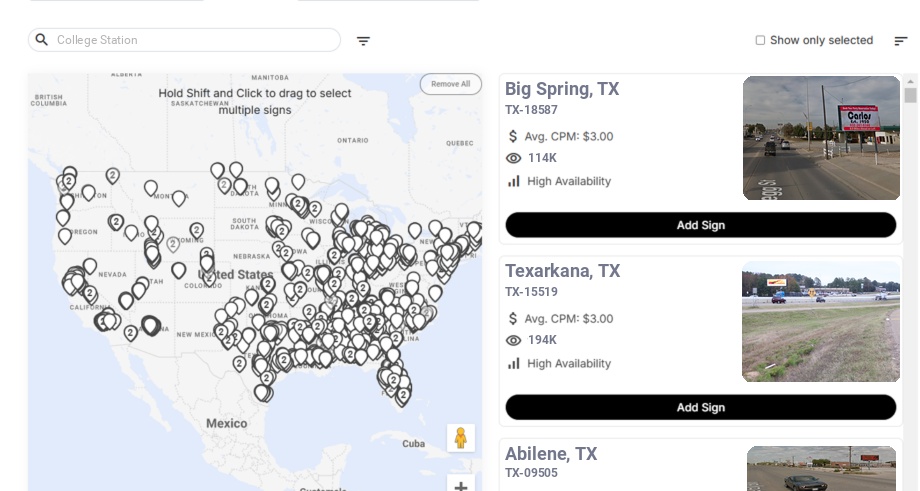
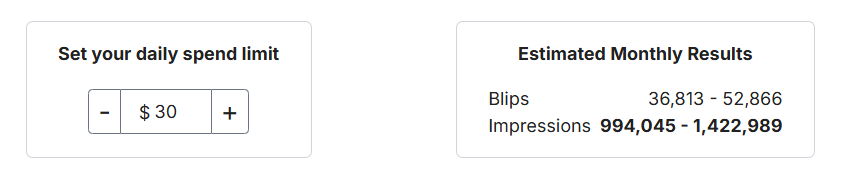
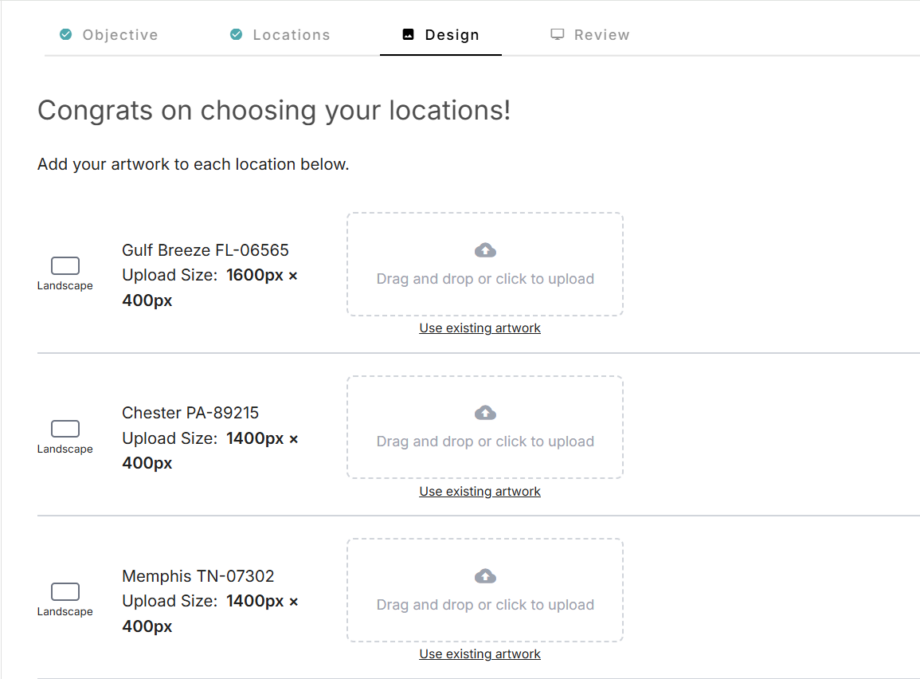
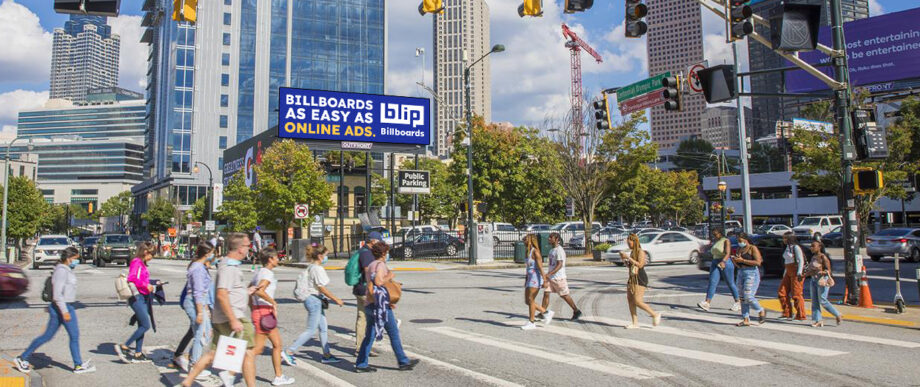
How much is a billboard in College Station?
Billboards in other Texas cities
College Station Billboard Advertising Guide
College Station, Texas, is a classic “small city, big impact” market. Anchored by Texas A&M University and surrounded by fast‑growing Central Texas communities, it combines a massive student population, loyal Aggie alumni traffic, and steady family and commuter audiences on its main corridors. When we use digital billboards strategically here, we can tap into game‑day surges, weekday commuter patterns, and highly localized neighborhood traffic—often with far more precision than in larger metros at a comparable cost. That combination makes College Station billboard advertising an efficient option for brands that want strong reach without big‑city rates.
Understanding the College Station Market
College Station is one of the youngest and fastest‑changing cities in Texas, which directly affects how we plan and design billboard campaigns and choose where to place College Station billboards.
Key market facts (latest publicly available data and local estimates):
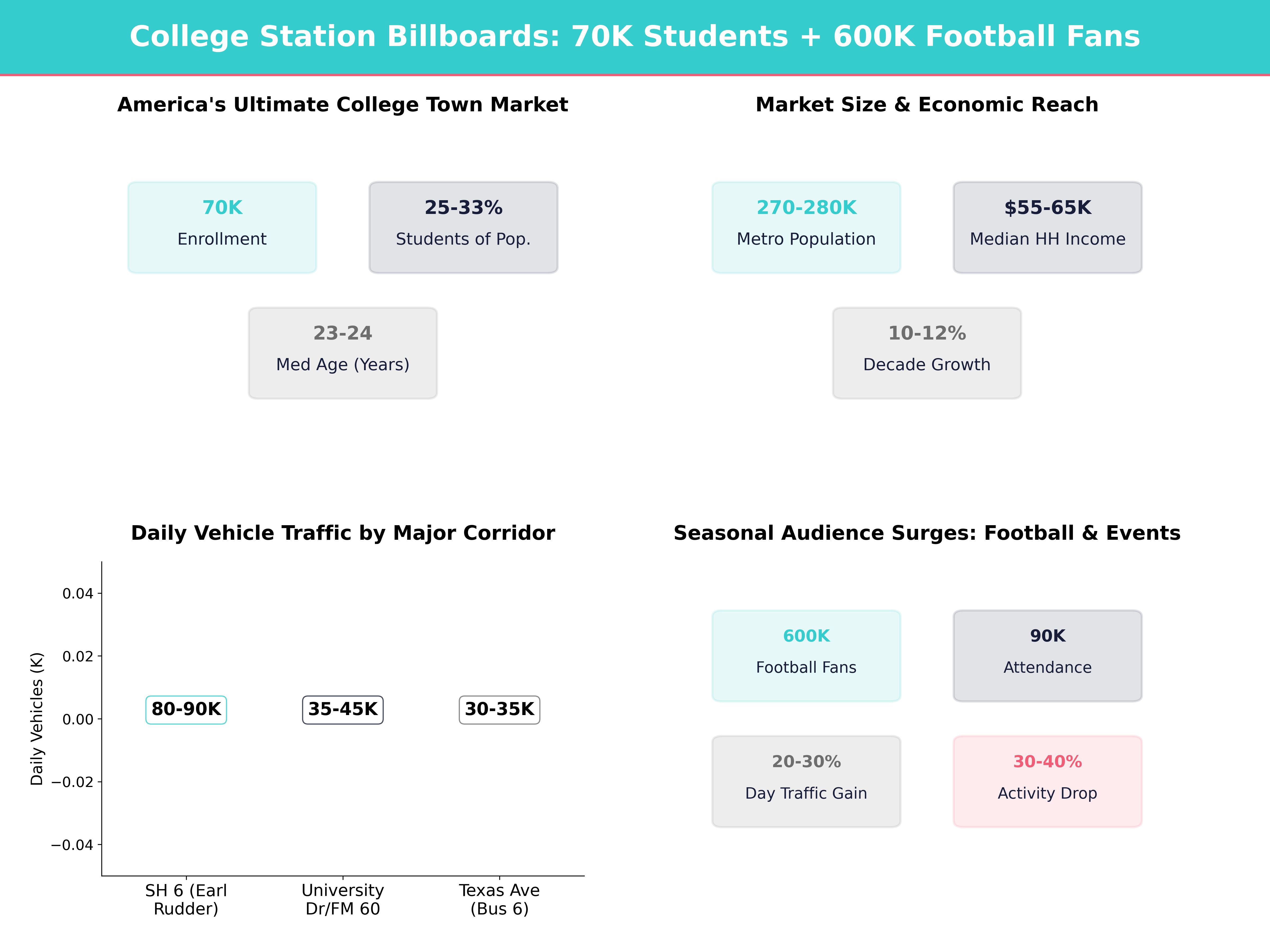
- Population: College Station’s city population is around 120,000–125,000 residents, while the Bryan–College Station metro (including Bryan and surrounding areas in Brazos County) sits near 270,000–280,000 residents.
- Texas A&M University: More than 77,000 students are enrolled system‑wide, with roughly 70,000+ on the College Station campus, plus over 13,000 faculty and staff at Texas A&M University. On busy weekdays, campus daytime population frequently exceeds 80,000 when you include contractors and visitors.
- Median age: Around 23–24 years old, compared with a Texas median in the mid‑30s. In some student‑heavy census tracts around campus, the median age dips below 21.
- Households: Roughly 45,000–47,000 households. About 55–60% of residents are renters, far above the U.S. average, reflecting the student market.
- Income and spending power: Median household income in the metro sits in the $55,000–$65,000 range, but non‑student households tend to be significantly higher. The combination of university payroll, healthcare, and government jobs injects hundreds of millions of dollars in annual local wages. Student discretionary spending (food, entertainment, retail, travel) is often estimated in the hundreds of millions of dollars per year.
- Metro growth: The Bryan–College Station metro has grown roughly 10–12% over the past decade, adding 25,000–30,000 residents. South and east College Station have seen some of the fastest housing growth in the region, with several large subdivisions and multifamily projects completed or underway according to City of College Station planning reports.
- Car usage: Like most Texas college towns, the market is heavily car‑dependent. In many neighborhoods, more than 90% of workers commute by car, and average one‑way commute times run about 18–22 minutes—enough time for repeated billboard exposure along the same corridors.
Implications for billboards:
- We are speaking to a very young, constantly renewing audience—tens of thousands of students turn over every 4–6 years. Roughly one‑quarter to one‑third of the city’s population may be enrolled students at any given time, so billboards in College Station need to refresh regularly to stay relevant.
- At the same time, we have a stable, higher‑income core of faculty, medical professionals, tech workers, and long‑time local families tied to institutions like Texas A&M, Baylor Scott & White Medical Center – College Station, CHI St. Joseph Health
- Seasonal swings are real: the population and traffic patterns look very different in summer, winter break, and football season than in mid‑semester. During winter and summer breaks, visible student activity on and around campus can drop by 30–40%, while hotel occupancy and restaurant traffic can spike 20–40% on football and graduation weekends.
Digital billboards let us pivot our message and schedule around those shifts in real time, instead of being locked into a single design for months. This flexibility is one of the main advantages of choosing digital College Station billboards instead of static placements alone.
Major Traffic Corridors and Where to Focus
To get the most from Blip, we want to align our campaign with the heaviest traveled routes and the specific audiences using them. Location is the core of effective College Station billboard advertising, so understanding how each corridor behaves is critical.
The City of College Station and TxDOT traffic counts show that these corridors are especially important:
-
SH 6 (Earl Rudder Freeway):
- Carries around 80,000–90,000 vehicles per day through the College Station–Bryan area, with higher volumes near major interchanges.
- Primary north–south spine, used by commuters, regional visitors, and game‑day traffic. On Texas A&M home football weekends, TxDOT has reported traffic volumes on key segments increasing by 20–30% compared to typical fall Saturdays.
- Best for: regional brands, medical, automotive, events, and any advertiser drawing from multiple neighborhoods or nearby towns (Navasota, Caldwell, Hearne, Madisonville).
-
University Drive / FM 60:
- Around 35,000–45,000 vehicles per day near Texas A&M and major retail nodes, with peak flows during class change and evening dining hours.
- Connects SH 6 to campus, Northgate, and major shopping/dining clusters at University/Harvey and around Post Oak Mall.
- Best for: student‑focused offers, nightlife and dining, quick‑serve restaurants, retail, entertainment, and any business targeting the 18–34 demographic.
-
Texas Avenue (Business 6):
- Approximately 30,000–35,000 vehicles per day along the College Station–Bryan axis.
- Heavy mix of local errands, older shopping centers, auto dealers, and service businesses; a high percentage of drivers here are local residents rather than out‑of‑town visitors.
- Best for: local services (insurance, dental, auto repair), political messages, community campaigns, and churches.
-
Rock Prairie Road & William D. Fitch Parkway (South College Station):
- Rapidly growing area with new neighborhoods, medical complexes, and retail, including major facilities for Baylor Scott & White and CHI St. Joseph.
- South College Station has seen some of the city’s fastest population growth, with several nearby tracts growing by 20%+ over the last decade.
- Best for: healthcare, childcare, fitness, family‑focused retail, professional services, home services, and higher‑income homeowner audiences.
-
Harvey Road (SH 30) and George Bush Drive:
- Together handle tens of thousands of vehicles per day connecting campus to SH 6 and eastern Brazos County.
- Important for sporting events at Reed Arena
- Best for: game‑day messaging, student housing, and businesses serving both students and long‑term residents.
When we set up a Blip campaign, we should:
-
Map audience to corridor:
- Students: prioritize University Dr, Texas Ave, George Bush Dr, and routes in/out of campus and the Northgate district.
- Families & higher‑income homeowners: focus more heavily on SH 6 and south College Station corridors like Rock Prairie and William D. Fitch.
- Regional visitors: use SH 6, SH 30, and key interchanges near major hotels and the Visit College Station “districts” (Northgate, Midtown, South College Station).
-
Use multiple boards across these corridors with tailored creatives, instead of a single “generic” board. With Blip’s flexible budgeting, even a modest daily budget (for example, $10–$30 per day) can be split across several strategically chosen faces to achieve thousands of targeted impressions. This approach turns billboard rental in College Station into a more precise, data‑driven channel rather than a one‑location gamble.
Key Audience Segments and How to Reach Them
College Station offers a few distinct, high‑value audiences. Blip’s flexibility lets us speak differently to each of them and customize how we use billboards in College Station for each group.
1. Students (Undergrad and Grad)
- Size: ~70,000+ on campus across undergraduate, graduate, and professional programs.
- Age: Largely 18–24, with a growing number of graduate students in their mid‑20s to early‑30s.
- Lifestyle: High smartphone and social media usage (national data for this age group shows 95%+ smartphone penetration). Frequent dining out, entertainment, rideshare usage, and online shopping; many live off‑campus along major corridors such as Southwest Parkway, Holleman, and Harvey.
Additional economic context:
- Students often spend $300–$600+ per month on discretionary categories like food away from home, entertainment, gas, and retail, depending on living situation.
- Thousands of international students add demand for specialized groceries, banking, and telecom services.
Strategy tips:
- Focus creatives on clear, direct offers: “$5 Student Lunch Special,” “Game Day Drink Deals,” “Student Discount – 20% with ID.”
- Use simple, bold visuals and very few words—4–7 words max. This respects the 2–4 seconds of realistic viewing time at typical speeds.
-
Schedule heavier impressions:
- Weeknights 5–10 p.m. for dining and nightlife when campus‑adjacent restaurants and bars see their highest check counts.
- Friday–Saturday for events and retail—foot traffic in areas like Northgate and Post Oak Mall often spikes by 20–40% vs weekdays.
- Beginning and end of semester for housing, banking, and moving services. Lease‑up and move‑in periods can drive weeks of elevated demand, especially in late July–September and December–January.
2. Faculty, Staff, and Local Professionals
- Thousands of higher‑income households tied to Texas A&M, the healthcare sector (Baylor Scott & White, CHI St. Joseph), City of College Station, City of Bryan, and local businesses.
- Average household incomes for this group are often 20–40% higher than the metro median, with strong demand for housing, vehicles, healthcare, financial services, and education for children.
- Many commute daily on SH 6, University Dr, Texas Ave, and Rock Prairie/Fitch, creating hundreds of weekly billboard impressions for frequent travelers.
Strategy tips:
-
Target commuter times on SH 6, University Dr, and Texas Ave:
- 7–9 a.m. and 4–6:30 p.m., when peak traffic counts can be 30–50% higher than mid‑day volumes.
- Messaging can be a bit more detailed (but still concise): “Expert Orthopedic Care in South College Station,” “Trusted CPA for Aggie Families.”
- Emphasize professionalism, trust, and convenience: parking, location, scheduling ease, and insurance acceptance—key decision drivers for time‑pressed professionals who repeatedly pass the same College Station billboards on their daily routes.
3. Local Families and Long‑Term Residents
- Represent a large share of the 275,000‑person metro outside the student base, including multigenerational households and long‑term Aggie alumni who have settled locally.
- Spread across Bryan ISD and College Station ISD attendance zones, central College Station, and the growing south and east neighborhoods.
- K–12 families typically have higher car ownership (often 2+ vehicles per household) and predictable travel patterns around schools, youth sports complexes, and churches.
Strategy tips:
- Emphasize value, reliability, and proximity: home services, schools, youth sports, churches, and family entertainment.
- Use family‑oriented imagery and friendly, community‑focused language, referencing local landmarks and districts when appropriate.
-
Schedule more impressions around:
- Afternoon school pickup (2:30–4:30 p.m.) on days when CSISD and BISD are in session.
- Saturday errand runs, when grocery and big‑box retail traffic typically peaks.
- Sunday mid‑day for churches and family dining; many local congregations report their primary services between 9 a.m. and noon, followed by restaurant surges.
4. Visitors, Aggie Alumni, and Sports Fans
According to Visit College Station, the city welcomes hundreds of thousands of visitors each year, driven largely by:
- Texas A&M football games: Kyle Field holds over 102,000 fans, making it one of the largest stadiums in the country. Several home games each season draw 90,000+ attendees, and total season attendance can exceed 600,000. Home games routinely push hotel occupancy toward sold‑out status across College Station and Bryan.
- Other Aggie sports (baseball at Blue Bell Park, basketball at Reed Arena), graduations, move‑in weekends, and conferences bring tens of thousands of additional visitors. Texas A&M typically holds multiple graduation ceremonies each December and May, filling local hotels and restaurants.
- Events like Chilifest, local rodeos, and major youth sports tournaments at area parks and school facilities. Large youth tournaments can draw 1,000–5,000+ participants and family members over a single weekend.
Strategy tips:
- Concentrate boards on SH 6, University Drive, and routes leading to Kyle Field and the campus core.
-
Turn up your Blip schedule on:
- Football home game weekends (Friday afternoon through Sunday). Many businesses see double‑digit percentage increases in sales those weekends.
- Graduation weekends (usually December and May).
- Move‑in weekends and Aggie events listed on the Texas A&M calendar
-
Focus messaging on short‑stay needs:
- Hotels, restaurants, nightlife, shopping, auto services, and attractions.
- Simple, directional calls to action: “Exit University – 2 Miles Ahead,” “Northgate Parking – Turn Right on College Main,” or “Game Day Breakfast – 0.5 Mile Ahead.”
Seasonality: Planning Around the Aggie Calendar
College Station’s calendar is defined by the academic year. We can dramatically increase campaign efficiency by aligning our Blip flights with these cycles and adjusting our College Station billboard advertising strategy as the audience mix shifts.
Academic Year Pattern
-
Late August – Early December (Fall Semester):
- City population and traffic are at their peak. Campus and surrounding roads see some of their highest vehicle counts of the year.
- Heavy demand from students, campus organizations, and Aggie football visitors. Friday and Saturday hotel occupancy can climb by 15–40 percentage points over summer baselines.
- Ideal for launching new businesses, promoting recurring events, and testing multiple offers when the greatest number of eyes are on your boards.
-
January – Early May (Spring Semester):
- Slightly less intense than fall but still strong; campus is near full occupancy, but there are fewer major football events.
- Great for big-ticket services: apartments (pre‑leasing for the next academic year often ramps up early in the spring), banking, auto, and healthcare.
- Spring break weeks will show brief dips in student traffic but increases in some leisure categories.
-
Mid‑May – Early August (Summer):
- Student presence drops; visible campus activity can fall by 30–40%. Some apartment complexes temporarily run occupancy discounts and short‑term leases.
- Traffic shifts to more local families, K‑12 school activities, youth camps, and summer visitors.
- Opportunity: cheaper impressions on some boards and a clearer path to reach permanent residents; competition for student‑focused billboard spots often eases, allowing value buys on Blip.
-
Winter Break (mid‑December – early January):
- Extended lower student presence of several weeks.
- Excellent time to focus on home services, medical procedures, financial planning, and brand building with long‑term residents. Many medical providers see increased demand for elective procedures during this period.
- Retail remains strong through late December, then shifts to returns and clearance traffic.
With Blip, we can:
- Increase bids and daily budgets when the city is full and demand is high (e.g., late August–November, major football and graduation weekends).
- Dial back or shift creatives to local‑resident messages during breaks.
- Run different creatives by date ranges—e.g., “Welcome Back, Aggies” in late August, “Graduation Specials” in early May, “Summer Tune‑Up” for auto/AC services in June and July.
Creative Best Practices for College Station
Digital billboards in College Station need to break through a landscape filled with Aggie branding, restaurant offers, and campus event promotions. A few localized approaches work especially well and can significantly improve the performance of billboard rental in College Station.
Keep Messages Ultra‑Simple
High speeds on SH 6 (posted limits often 65–75 mph) and busy intersections on University Dr mean we only have 2–4 seconds of real attention.
- Aim for 4–7 words plus logo/URL/short URL.
- One primary call to action: “Order Online,” “Book Today,” “Exit Rock Prairie.”
- Use large, high‑contrast fonts; white or yellow text on dark backgrounds stands out, especially for night‑time traffic.
- Avoid tiny details or multiple offers; drivers will not read them at highway speeds.
Tap into Aggie Culture—Carefully
Aggies are fiercely loyal to their traditions and symbols:
- References to “Gig ’em,” maroon and white color schemes, or Aggie traditions can create instant resonance with more than half the local population who are students, alumni, or employees.
- For example: “Gig ’em, Savings – 20% Off with Student ID.”
- Be respectful. Avoid implying official endorsement from Texas A&M unless you truly have it, and do not misuse trademarks or official logos. Texas A&M strictly manages its marks through its licensing office, and violations can lead to takedown demands or legal issues.
Tailor Visuals to the Corridor
-
Near campus (University Dr, Texas Ave, George Bush Dr):
- Youthful, energetic visuals and bold, playful colors.
- Food, drinks, student housing, entertainment, and campus‑life imagery.
- Think quick decisions: “Turn Now for Lunch,” “$2 Tacos Tonight.”
-
SH 6 and south College Station:
- More family, professional, and lifestyle cues: homes, families, healthcare, vehicles, and financial security.
- Messages like “New Homes from the $300s – Exit William D. Fitch” or “Pediatric Care Minutes from Home” align with the growth in master‑planned neighborhoods.
Use Multiple Creatives
With Blip, we can upload multiple creatives and rotate them:
- Version A: Student‑centric copy for boards closest to campus and for evenings/weekends.
- Version B: Professional/family messaging for commuting hours and south‑side boards.
- Version C: Event‑specific creative for game weekends or seasonal promotions (e.g., “Beat the Heat AC Tune‑Up,” “Tax Season Help for Aggies”).
Monitor which messages drive more web traffic, calls, or in‑store visits, then allocate more budget to the best performers. Even modest shifts—such as moving 20–30% of impressions from weaker to stronger creatives—can significantly improve return on ad spend and make College Station billboard advertising more cost‑effective over time.
Dayparting and Scheduling Strategies
Dayparting—choosing specific times of day for your blips—is critical in a city where behavior shifts quickly between student, commuter, and family cycles. Smart scheduling is what turns basic billboard rental in College Station into a highly targeted media buy.
Example Daypart Strategies
-
Restaurant & Quick‑Serve:
- Breakfast: 6–9 a.m. on SH 6 and Texas Ave; capture commuters and early classes.
- Lunch: 11 a.m.–2 p.m. near office corridors and campus; many restaurants see 40–50% of weekday traffic in this window.
- Late‑night (especially Thurs–Sat): 9 p.m.–2 a.m. near campus/Northgate, where the bar and late‑night food scene is concentrated.
-
Retail & E‑Commerce:
- Heavier on afternoon and early evening (3–8 p.m.) when people are thinking about shopping and online orders.
- Intensify Fridays and Saturdays for in‑store visits—big‑box and mall retailers often report weekend traffic 1.5–2x weekday levels.
- Use short, memorable URLs or QR codes for e‑commerce and pickup orders.
-
Healthcare & Professional Services:
- Commuter windows (7–9 a.m., 4–7 p.m.) on SH 6, Rock Prairie, and William D. Fitch to reach patients headed to or from work.
- Consider extended hours messaging like “Open Late Weeknights” or “Same‑Day Appointments.” Many urgent care facilities see peak walk‑in demand between 4–8 p.m..
- Layer in mid‑day (10 a.m.–2 p.m.) for retirees and stay‑at‑home parents.
-
Events & Entertainment:
- Ramp up impressions 7–14 days before the event for awareness.
- Peak frequency 48–72 hours ahead of the date, especially on routes that feed into the venue (e.g., SH 6 to University for Kyle Field).
-
For Aggie football or other big events, layer messaging by phase:
- Early season: “Season Tickets,” “Tailgate Supplies.”
- Week of game: “Game Day Specials,” “Parking Here.”
- Day‑of: “Open Early for Breakfast,” “Post‑Game Drinks.”
Blip lets us scale spend up or down by hour and date, so we only pay to show messages when they are most likely to matter.
Using Local Data and Media to Your Advantage
We can strengthen our strategy by aligning with local information sources and calendars and using them to guide which College Station billboards we prioritize:
-
City & Tourism Data:
- City of College Station posts information on development, special events, and long‑range plans. New road projects and retail developments (like improvements along SH 6, University Dr, and South College Station) can guide where we place boards.
- Visit College Station highlights major festivals, sports tournaments, and visitor trends. Tourism‑related spending in Brazos County runs into the hundreds of millions of dollars annually, supporting thousands of local jobs in hospitality and food service.
-
Local News & Weather:
- KBTX and The Eagle
- Tie creatives to high‑interest topics (e.g., new neighborhood openings, severe weather seasons, local economic developments) with timely, problem‑solving offers: hurricane‑season prep, hail‑damage roof repair, tax‑season financial help, etc.
- During severe weather or heat advisories, service categories like HVAC, roofing, and urgent care often see sharp short‑term demand spikes, making short‑run Blip flights highly effective.
-
School Districts & Youth Sports:
- College Station ISD and Bryan ISD calendars drive family routines—back‑to‑school, stadium events, UIL competitions, and tournaments.
- Youth sports and band competitions at local stadiums and complexes can draw hundreds to thousands of visiting families on weekends, ideal for hospitality and restaurant promotions.
- Back‑to‑school windows (late July–August) are prime time for promoting clothing, supplies, healthcare checkups, and tutoring.
By watching these sources, we can time our Blip campaigns around the actual rhythms of the city instead of just guessing and ensure our billboards in College Station are live when the right audiences are on the road.
Campaign Structures That Work Well in College Station
Below are a few proven campaign architectures that map well to the market and to Blip’s capabilities:
Always‑On Brand Layer + Seasonal Bursts
- Maintain a baseline presence year‑round on 1–2 key boards (e.g., SH 6 + University Dr) to build familiarity. Studies of out‑of‑home advertising commonly show lifts of 10–20% in brand awareness with consistent exposure.
-
Add short, high‑frequency bursts around:
- Football home games and other major Texas A&M events
- Back‑to‑school weeks
- Major holidays and tax season
- Ideal for: banks, healthcare, major service providers, large retailers, and any brand competing against bigger regional or national players that also invest in College Station billboard advertising.
Student‑Focused Flighting
-
Heavy flights:
- 2 weeks before classes start in August and January.
- First month of each semester for housing, banking, cell plans, gyms, and food, when new students are forming habits that can last months or years.
-
Reduced spend:
- Finals weeks (students are busy, less out‑of‑home in the evenings).
- Winter and summer breaks.
- Layer specific offers (e.g., “No‑Fee Student Checking,” “First Month Free Gym Membership”) and include clear student ID requirements where relevant.
- Ideal for: apartments, QSR, gyms, tutoring, student‑focused financial services, and college‑targeted brands.
Local‑Resident Reset During Breaks
-
Turn down student messaging during:
- Winter break (mid‑Dec–early Jan)
- Summer break (mid‑May–early Aug)
-
Shift creatives to:
- Home improvement, healthcare, family attractions, and services.
- “While Students Are Out” offers that appeal to locals enjoying shorter lines and less congestion.
- Use this time to build deeper connections with the permanent population that anchors the community—roughly two‑thirds to three‑quarters of the metro when students leave.
Measuring Success and Optimizing
To make the most of Blip’s flexibility, we should set up clear ways to measure performance and understand how individual College Station billboards contribute to results:
- Unique URLs or QR codes on creatives (e.g., “Visit mybrand.com/aggie”). Even a 1–3% scan or visit rate from exposed audiences can yield strong ROI at scale.
- Phone call tracking with dedicated numbers for billboard campaigns; measure call volume increases during active Blip periods vs. baselines.
- Offer codes tied to specific creatives (e.g., “Show this code: GIGEM10” or “Mention ‘Rock Prairie’ for 10% off”) to attribute in‑store redemptions.
- Web analytics: look for spikes in direct and branded search traffic for your business name from ZIP codes in and around College Station and Bryan when campaigns run.
Then, we can:
- Compare performance by location (SH 6 vs. University Dr vs. south College Station) to see where leads or sales per impression are highest and which billboard rental in College Station locations deserve more budget.
- Compare performance by time of day and day of week. For example, if late‑night Thursday–Saturday impressions around Northgate produce more restaurant redemptions than mid‑day, shift additional budget there.
- A/B test different headlines and visuals targeting students vs. families vs. visitors, and refine based on measured response.
- Use short test flights (e.g., 7–14 days) to validate concepts before committing larger budgets for key seasons.
Shift more of our Blip budget toward the combinations that generate the most leads, visits, or sales, and retire underperforming creatives quickly.
Local Compliance and Community Fit
While College Station is generally advertising‑friendly, we should:
- Ensure all messages respect community standards—avoid content that feels out of step with a largely family‑ and student‑oriented city, including sensitive topics or imagery that could provoke backlash on social media or in local news.
- Be cautious with humor or references to rival schools; playful is fine, but mean‑spirited rarely plays well in a proud Aggie town where Texas A&M is a major employer and identity anchor.
- For political or issue campaigns, verify timing and disclosure requirements based on local and state regulations. Local elections in Brazos County and the cities of College Station and Bryan can have strict windows for signage, disclaimers, and spending transparency.
- Respect any city ordinances regarding brightness, animation, and content on digital billboards, particularly near residential areas or schools.
Aligning our creative tone with the city’s identity—community‑minded, tradition‑rich, and education‑focused—helps our campaign feel like part of College Station, not just an ad dropped onto a board.
By combining College Station’s unique demographics, its Aggie‑anchored event calendar, and Blip’s precise control over timing, budget, and creative, we can build billboard campaigns that do far more than just “get seen.” They can speak to the right people, on the right roads, at the right times of year—turning fleeting highway impressions into measurable results for our business and making College Station billboard advertising a foundational part of a local media strategy.