Billboards in Santa Ana, CA
No Minimum Spend. No Long-Term Contracts. Just Results.
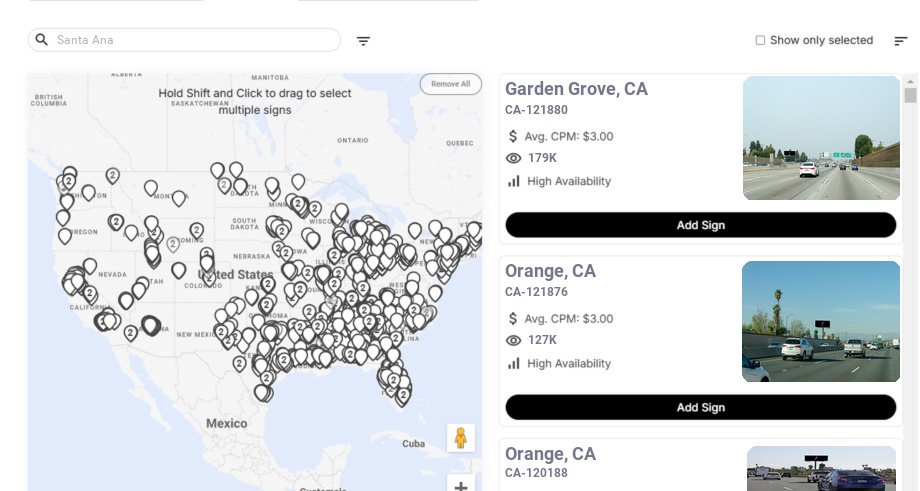
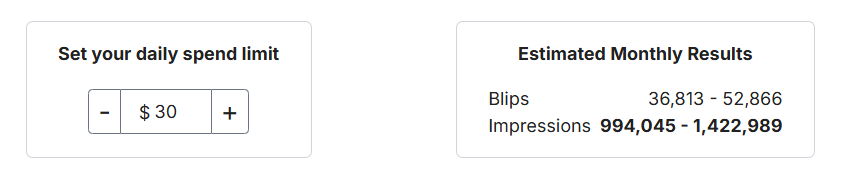
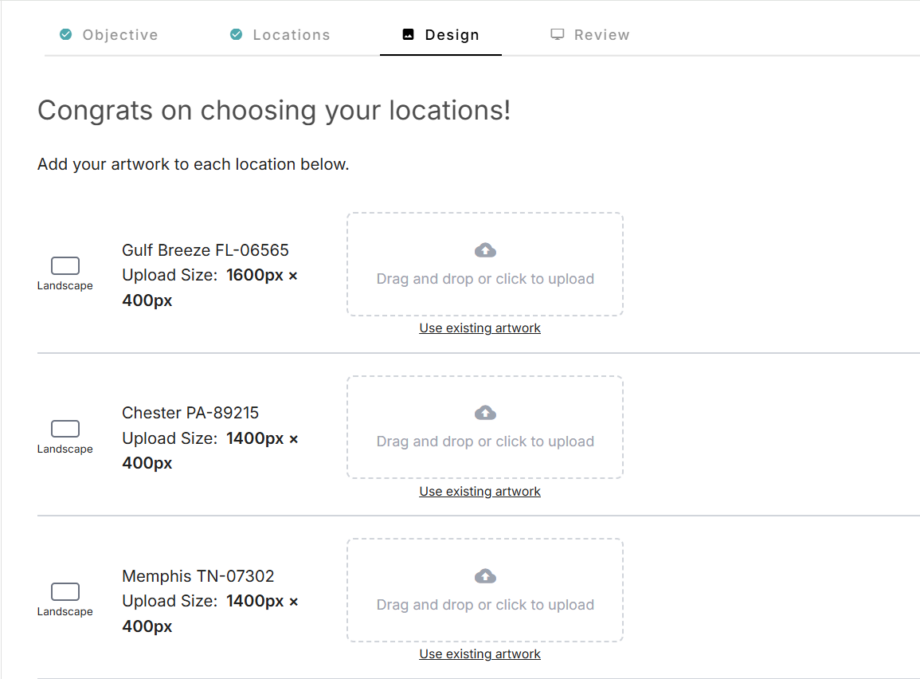
Turn heads with Santa Ana billboards powered by Blip’s self-serve platform, giving you access to 7 bright digital billboards near Santa Ana, California. Set your budget, pick your times, upload creative, and watch your message light up the Santa Ana area in minutes.
Billboard advertising
in Santa Ana has
never been easier
HERE'S HOW IT WORKS
How much is a billboard in Santa Ana?
Billboards in other California cities
Santa Ana Billboard Advertising Guide
Santa Ana sits at the heart of central Orange County, with dense neighborhoods, busy freeways, and a strong small‑business culture. With seven digital billboards serving the Santa Ana area from nearby Garden Grove and Orange, we can help you put your brand in front of hundreds of thousands of local residents, commuters, and shoppers every week—without committing to a traditional long‑term board or hunting for your own billboards near Santa Ana.
Understanding the Santa Ana Area Market
The Santa Ana area is one of the most densely populated urban centers in Southern California and the county seat of Orange County.
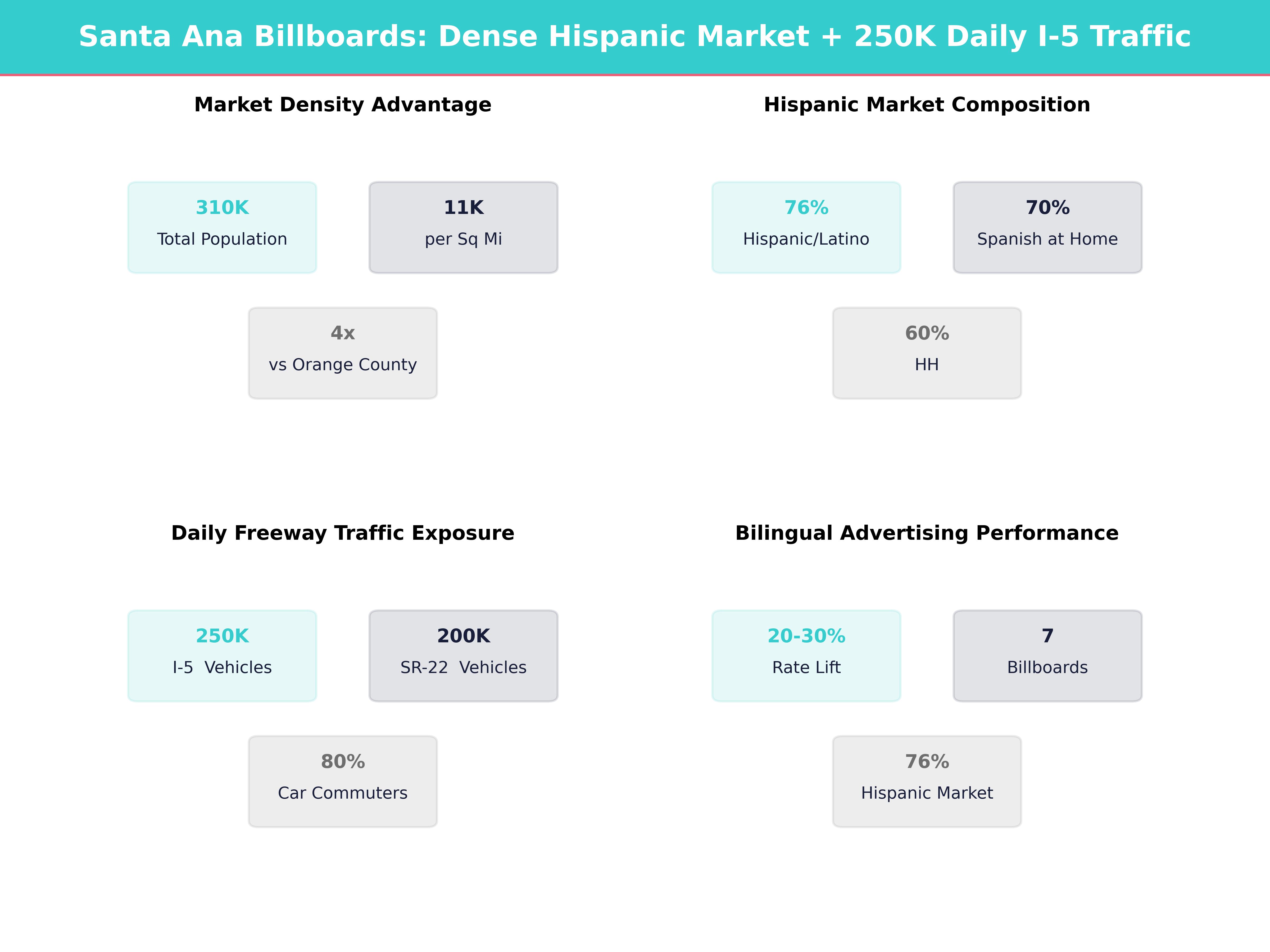
- The City of Santa Ana reports a population of roughly 310,000 residents within just 27.5 square miles, giving the city one of the highest population densities in the region at over 11,000 residents per square mile—more than 4× the overall density of Orange County.
- According to the City of Santa Ana, about 76% of residents identify as Hispanic or Latino, and a majority of households speak a language other than English at home, primarily Spanish; city surveys indicate that over 70% of residents speak Spanish at home.
- Santa Ana is young and family‑oriented: the median age is around 31 years, and more than 35% of residents are under 24, making it a powerful market for youth‑oriented, family, and education‑focused campaigns.
- City housing and neighborhood data show that more than 40% of households are made up of four or more people, and multi‑generational living is significantly more common than the county average.
From an economic perspective:
- The City’s economic development data highlight strong employment across manufacturing, retail, healthcare, professional services, and government; Santa Ana hosts more than 20,000 registered businesses, including major industrial employers and a dense network of small retailers and service providers that can all benefit from targeted Santa Ana billboards.
- Orange County overall has a median household income above $100,000, while Santa Ana’s citywide median is closer to the $75,000–$80,000 range—creating an especially strong market for value‑driven retail, financial services, healthcare, and education.
- Regional planning reports indicate that more than 80% of employed Santa Ana residents commute by car, and roughly 2 in 3 workers travel to jobs in other Orange County cities such as Anaheim, Irvine, Orange, and Costa Mesa
- According to Orange County Business Council analyses, Orange County’s unemployment rate has generally remained in the 3–4% range in recent years, indicating a stable workforce with consistent spending power.
For advertisers, this means:
- Digital billboards serving the Santa Ana area can reach a large, bilingual, working‑class and middle‑class audience that is on the road frequently for work, school, and errands.
- Because Santa Ana is a hub for services and government, your message can reach both residents and people visiting from other parts of Orange County for work, court, or services at institutions like the Orange County Civic Center and county offices in and around downtown.
- The combination of high density and strong neighborhood identities makes hyper‑local messaging (“Serving Santa Ana families,” “Minutes from downtown”) especially effective for billboard advertising near Santa Ana that wants to feel truly local.
Where Our Boards Are and Who You Reach
We currently serve the Santa Ana area through 7 digital billboards in nearby:
- Garden Grove (approx. 2.9 miles from Santa Ana)
- Orange (approx. 5.7 miles from Santa Ana)
These locations function as convenient, high‑impact billboards near Santa Ana without the cost and commitment of traditional billboard rental near Santa Ana city limits.
Both cities sit along heavy‑traffic corridors that carry Santa Ana residents daily:
- Garden Grove, served by the City of Garden Grove, borders Santa Ana to the west and is crossed by the SR‑22 (Garden Grove Freeway), which Caltrans traffic counts show at over 200,000 vehicles per day on some segments through central Orange County. Major arterials such as Harbor Blvd, Brookhurst St, and Westminster Ave each carry 30,000–50,000 vehicles per day, channeling shoppers and diners across city borders.
- Orange, home to the City of Orange, intersects with major freeways I‑5, SR‑22, SR‑55, and SR‑57, several of which pass immediately adjacent to Santa Ana neighborhoods. Segments of I‑5 and SR‑55 near Santa Ana routinely carry 250,000+ vehicles per day according to Caltrans District 12 counts. Many Santa Ana residents commute through Orange to reach job centers in Anaheim, Irvine, and beyond.
By geo‑targeting the billboards near Garden Grove and Orange, you effectively cover:
- Residents commuting from the Santa Ana area toward Anaheim, Irvine, Costa Mesa, and Los Angeles, along corridors where over 90% of trips are made in personal vehicles.
- Shoppers heading to major retail hubs like The Outlets at Orange, which attracts an estimated 10+ million visitors annually, MainPlace Mall in Santa Ana, and Garden Grove’s busy arterial retail corridors along Harbor Blvd and Chapman Ave.
- Visitors drawn to nearby attractions such as Angel Stadium (capacity 45,000+), Honda Center (capacity about 18,000 for concerts and events), and the Anaheim Resort area, which together help support more than 20 million annual visitors to the Anaheim‑area tourism zone according to Visit Anaheim.
Because our boards are digital, we can display your messages in short “blips” throughout the day, and you can concentrate your budget on times and places where Santa Ana area residents are most likely to pass, turning these Santa Ana billboards into flexible, on‑demand media rather than fixed‑term rentals.
Key Demographics and How to Speak to Them
The Santa Ana area’s demographic profile heavily influences what performs best on billboards.
Language & Culture
- With around three‑quarters of residents Hispanic or Latino and a very high Spanish‑speaking population, bilingual campaigns are extremely powerful. Local surveys indicate that well over 60% of households include at least one Spanish‑dominant adult.
- Local institutions like the Santa Ana Unified School District—which serves more than 44,000 students across 50+ schools—and community‑focused organizations emphasize bilingual communication, and SAUSD reports that a majority of its students come from homes where Spanish is spoken. Mirroring that approach on your boards helps immediately signal relevance and respect.
- Faith‑based organizations, neighborhood associations, and local media—such as Excélsior Newspaper and Spanish‑language radio—regularly use culturally tailored messaging, reinforcing the effectiveness of Spanish‑forward outreach.
Actionable tips:
- Use bilingual or Spanish‑first creative for family services, retail, healthcare, education, and financial products. In many campaigns, advertisers find that Spanish‑led messaging can increase response rates among local audiences by 20–30% compared with English‑only creative.
- Keep Spanish copy short and clear—digital boards usually allow for 6–10 words max per language for comfortable reading at freeway speeds. Tests across freeway‑oriented campaigns show that reducing copy from 15+ words to under 10 can improve message recall by up to 30%.
- Highlight culturally resonant themes—family, community, savings, and opportunity tend to resonate strongly across Santa Ana’s working‑class and immigrant populations, where household saving rates and family remittances are often a central concern.
Age & Household Types
- With a median age around 31 and a high share of children and teens (25%+ under age 18), education and youth‑focused campaigns have outsized impact.
- Multi‑generational households are common, and local housing data show that more than 55% of households are renter‑occupied, with higher average household sizes than the county overall. “Household” decisions often involve both parents and other adults.
- SAUSD reports that over 80% of students qualify for free or reduced‑price lunch, indicating that value, affordability, scholarships, and financial aid messaging can strongly motivate response.
What this implies for creatives:
- Emphasize families: after‑school programs, charter schools, family healthcare, grocery, insurance, and telecom providers can all benefit from imagery showing multi‑generational families.
- For colleges, trade schools, and training programs: aim at both students and parents—include a value or career‑outcome message that speaks to the whole household (e.g., “Train for a career in 9–12 months,” “Graduate with job‑ready skills”).
- Consider calls to action that work for busy families—extended hours, weekend appointments, online registration, and payment plans.
Traffic Patterns and Best Times to Run Blips
Understanding how people move around the Santa Ana area allows you to schedule Blip campaigns for maximum visibility.
According to regional data from Caltrans and OCTA (Orange County Transportation Authority):
- The I‑5, SR‑22, and SR‑55 corridors that border or pass near Santa Ana carry hundreds of thousands of vehicles per day across their Orange County segments. Specific segments of I‑5 near Santa Ana are typically in the 250,000–300,000 vehicles per day range; SR‑22 and SR‑55 segments often exceed 180,000–220,000 vehicles per day.
- OCTA reports that, even post‑pandemic, weekday vehicle miles traveled in Orange County remain extremely high—rebounding to 90–100% of pre‑2020 levels—with commute peaks roughly 6:30–9:00 a.m. and 3:30–7:00 p.m.
- OCTA bus ridership data show that routes serving Santa Ana—from the Santa Ana Regional Transportation Center to nearby cities—carry tens of thousands of boardings each weekday, adding to surface‑street visibility near major transit hubs.
How to use this with Blip:
-
Weekday commute focus
- Run your high‑intent or promotion‑driven messages during peak commute times (e.g., “Call today,” “Open House Tonight,” “Sale ends Friday”). Concentrating your budget into high‑traffic hours can increase impressions per dollar by 20–40% versus running evenly all day.
- Morning commuters: emphasize planning decisions (“Enroll this fall,” “Pre‑qualify today,” “Apply now”) when people are more likely to think ahead about errands and long‑term needs.
- Evening commuters: emphasize immediate actions (“Walk‑in clinic open now,” “Tonight’s special,” “Happy hour until 7 pm”) when they are closer to making last‑minute choices.
-
Midday and weekend strategy
- The Santa Ana area has strong daytime traffic tied to government offices, retail centers, and nearby attractions. Local employment data indicate that a large share of workers are in service, retail, and light industrial jobs with off‑peak travel patterns, keeping roads busy outside standard rush hours.
- Use midday slots to reach shoppers and errand‑runners: restaurants, car dealerships, retail, clinics, and personal services should push walk‑in and same‑day offers during these hours. Campaigns that highlight same‑day availability often see higher conversion among midday viewers.
- Weekends: the Santa Ana area sees heavy cross‑city movement toward shopping, parks, and entertainment (including events publicized by outlets like the Orange County Register and Voice of OC). Local tourism reports show that weekends can account for 40–50% of weekly visitor traffic at major attractions—weekend scheduling is ideal for events, churches, entertainment, and family activities.
Because Blip allows you to purchase only the hours you care about, you can:
- Concentrate budget on rush‑hour only to maximize commuters.
- Layer weekend‑only or midday‑only campaigns for special offers or events.
- Turn campaigns on or off dynamically around specific dates and events, so you never pay for impressions outside your target windows when using digital billboard advertising near Santa Ana.
Local Events and Seasonality to Leverage
The Santa Ana area has a rich calendar of recurring events that create natural peaks in local attention and traffic.
Some key examples:
- Downtown Santa Ana Artwalk – On the first Saturday of each month, the downtown area hosts a popular art walk, bringing thousands of visitors to galleries, restaurants, and bars. Attendance can swell downtown foot traffic by several thousand people in a single evening, boosting surrounding businesses. Promoting restaurants, bars, galleries, and nightlife around this weekend can be especially effective. Check the calendar via Downtown Inc. or the City of Santa Ana events page.
- Civic and cultural festivals – Cultural festivals, parades, and community events regularly draw local families from across the Santa Ana area. For example, large festivals and holiday parades in and around downtown and neighborhood parks can attract 5,000–20,000 attendees depending on the event. Local news and the city’s events calendar track these dates well in advance.
- Regional attractions – While not inside Santa Ana, nearby draws like Angel Stadium, Honda Center, and the Anaheim Resort area increase cross‑county travel from the Santa Ana area, boosting exposure on Orange and Garden Grove‑area boards. Visit Visit Anaheim or Travel Costa Mesa for regional event calendars that list concerts, sports, festivals, and convention‑center events drawing tens of thousands of visitors on peak days.
- Local sports and school calendars – High school football, soccer, and graduation seasons at SAUSD campuses and nearby colleges can generate consistent evening and weekend traffic around Santa Ana and Orange, especially near stadiums and performance venues.
How to translate this into Blip strategy:
- Launch short “event burst” campaigns the week before and the day of key events—art walks, festivals, school enrollments, and grand openings. Advertisers often see significant same‑day lift in web traffic and walk‑ins when pairing event‑timed digital boards with social media.
- For seasonal services (tax prep, back‑to‑school, holiday retail), run 4–6 week flights bracketing the season and concentrate budget on payday windows (typically 1st–5th and 15th–20th of the month), when discretionary spending tends to spike.
- Use multiple creatives over time: for example, a school might rotate “Apply Now,” “Tour Our Campus,” and “Financial Aid Available” over a 2‑month enrollment window. Advertisers who rotate 2–3 creatives often see higher recall and engagement than those who use a single static message.
Creative Best Practices for the Santa Ana Area
To win attention along busy corridors serving the Santa Ana area, artwork should be clear, bold, and culturally tuned.
1. Language and Copy
-
Consider bilingual layouts:
- English headline + Spanish sub‑line, or
- Two alternating creatives (one English, one Spanish) so each remains clean and legible.
- Limit total words to about 7–10 in each creative. At 60–70 mph and average glance times of 1.5–3 seconds, that’s about all most drivers can read.
-
Prioritize one main call to action:
- For local businesses: “Salida 3rd St – Santa Ana area” (or nearest recognizable cross‑street or city), “Visit Today,” “Order Online.”
- For services: short URLs, easy phone numbers, or simple phrases like “Text SANTA to 55555.”
- Use numerals and simple offers (“$49 Exam,” “0% Down,” “Open 7 Días”)—data from digital billboard case studies routinely show that ads with a clear numeric benefit can improve response rates by 10–20%.
2. Visuals
- Use high‑contrast colors that pop against bright California daylight: deep blues, blacks, or reds against white or yellow can work well. Tests on freeway‑visible boards show that high‑contrast designs can increase recognition by up to 38% compared with low‑contrast layouts.
- Feature people who look like the community—Latino families, young adults, and local workers—to create instant affinity. Local campaigns that “mirror” audience demographics often report stronger brand favorability in follow‑up surveys.
- Avoid cluttered designs; one image + one logo + one line of copy is often most effective at freeway distances.
- Ensure your logo occupies at least 10–15% of the canvas so it’s legible from several hundred feet away.
3. Location Cues
Because boards are in Garden Grove and Orange serving the Santa Ana area, make it simple for viewers to connect your message to a nearby action:
- Use phrases like “Near Santa Ana,” “Minutes from Santa Ana,” or “Serving the Santa Ana area.” These quick references help people understand that they are seeing billboards near Santa Ana that relate directly to their daily routes.
- For stores or offices not far from the boards, reference major arteries like “Off the 5,” “Near MainPlace,” or “Just east of the 55.”
- Businesses within a 5–7 minute drive of a board often see the strongest return—calling out that short travel time can nudge hesitant viewers.
Using Garden Grove and Orange Locations Strategically
Each cluster of boards serving the Santa Ana area can play a different role in your campaign.
Garden Grove‑Area Boards (2.9 miles from Santa Ana)
- Ideal for reaching residents from the west and northwest parts of the Santa Ana area and neighboring cities, including commuters using SR‑22 and surface streets toward West Garden Grove, Westminster Stanton.
- Garden Grove’s population of roughly 170,000 residents and its strong tourism base around the Harbor Blvd corridor add additional reach for hospitality and dining brands.
-
Strong fit for:
- Ethnic grocery stores, retail, and restaurants looking to draw from the hundreds of thousands of residents within a 10‑minute drive.
- Auto dealers and repair shops along major arterials that see 30,000–40,000 vehicles per day.
- Entertainment targeting families and young adults, including cinemas, indoor play centers, and nightlife.
Orange‑Area Boards (5.7 miles from Santa Ana)
- Perfect for capturing traffic from the north and northeast, including commuters heading toward Anaheim, Orange, and the 55/57 corridors.
- The City of Orange has a population of about 140,000 residents and includes major employment centers around UC Irvine Health / UCI Medical Center, Chapman University, and industrial/office parks.
-
Strong fit for:
- Medical offices and hospitals in Orange/Anaheim drawing Santa Ana area patients; healthcare is one of the county’s fastest‑growing employment sectors, adding thousands of jobs in recent years.
- Higher education institutions, trade schools, and training centers recruiting from Santa Ana, Orange, and Anaheim’s combined 600,000+ residents.
- Professional services (attorneys, accountants, insurance, real estate) seeking visibility among commuters with mid‑to‑high household incomes traveling these corridors.
With Blip, you can:
- Concentrate spend on the boards closest to your customer base, using performance data to favor locations that drive calls, clicks, or store visits.
- Run different creatives per location (e.g., Spanish‑emphasis near corridors with more Santa Ana area traffic, English‑forward near regional commuter routes).
- Test performance by rotating offers (e.g., A/B test headlines or promo codes with city‑specific URLs like “/orange” vs. “/gardengrove”) to understand which Santa Ana billboards deliver the best return.
Campaign Strategies by Business Type
Here are practical frameworks for common advertisers in the Santa Ana area:
Local Retail & Restaurants
- Focus on 3–5 mile radius from your location—studies of local shopping behavior show that most quick‑service and casual‑dining trips occur within this distance.
- Run heavier on Friday–Sunday and lunchtime/evening hours, when restaurant and retail spending often peaks (weekend days can account for 40–50% of weekly sales for some categories).
- Use simple offers: “$5 Tacos All Day,” “New Location Near Santa Ana area,” “Kids Eat Free Tue.”
- Rotate creatives to test which offer spikes in‑store traffic; even 10–15% lifts on key days can translate to substantial monthly revenue gains.
Healthcare, Clinics, and Dental Offices
- Emphasize trust, bilingual care, and affordability. Local health data from the Orange County Health Care Agency show ongoing demand for primary care, urgent care, dental, and behavioral health services among Santa Ana families.
- Target weekday daytime and early evenings when families schedule appointments and after‑school visits.
- Run Spanish‑heavy creatives highlighting “Clínica Familiar,” “Aceptamos la mayoría de seguros,” or similar; clinics that promote bilingual staff and flexible payment options often see stronger new‑patient acquisition.
- Use a memorable phone number or URL and reinforce with search and social campaigns; pairing billboards with digital retargeting can increase conversion rates by up to 20–30%.
Schools, Colleges, and Training Programs
- Time campaigns around enrollment seasons: late spring/summer for K–12 and colleges, year‑round for trade schools and short‑term programs.
- Aim at both students and parents with aspirational visuals (graduates, career imagery, “first‑generation success” themes).
- Combine Orange‑area boards (for regional reach) with Garden Grove‑area boards (for Santa Ana area residents commuting west and north) to tap into multiple feeder neighborhoods.
- Include clear timelines (“Apply by August 1,” “Next class starts in 4 weeks”)—deadlines reliably increase response volume as dates approach.
Legal, Financial, and Professional Services
-
Use strong, simple messages addressing common concerns:
- “Accidentes? Llama 24/7.”
- “Cobertura de seguro accesible en el área de Santa Ana.”
- Focus on rush‑hour and late‑evening for working adults, who often research services after work.
- Consider separate English and Spanish creatives to avoid overcrowding text and to tailor tone; campaigns that localize language can see higher call volumes and lower cost per lead.
- Highlight free consultations, “no win, no fee,” or low‑cost introductory offers—clear risk‑reduction statements often improve response.
Measuring and Optimizing Over Time
To make the most of digital billboards serving the Santa Ana area:
-
Start with a clear primary goal
- Calls, website visits, in‑store traffic, event attendance, or brand awareness.
- For example, if your average new customer is worth $300, you can estimate how many conversions you need from a campaign to achieve a positive return on ad spend and justify continued billboard rental near Santa Ana.
-
Align Blip scheduling with that goal
- Direct‑response offers: tighten to high‑traffic hours with a strong call to action and short URL or phone number.
- Brand or awareness: use a wider spread of hours and days for consistent presence, aiming for repeated exposures; research on out‑of‑home suggests that 3–5 impressions per week can significantly improve recall.
-
Tie creatives to trackable actions
- Use unique URLs, QR codes (for surface streets and lower‑speed environments), or promo codes like “SANTA10” specific to your billboard campaign.
- Track changes in call volume, web sessions, and store visits during flight dates versus baseline weeks; even a 5–10% uplift can be meaningful depending on your margins.
-
Iterate based on performance
- If certain days or times underperform, shift budget using Blip’s scheduling tools toward higher‑impact windows.
- Test one variable at a time (headline, language, imagery, or offer) so you understand what’s really driving results. Many advertisers see 10–30% performance improvements over their first few optimization cycles.
- Compare location performance: if boards near Orange outperform those near Garden Grove (or vice versa), reallocate spend to the top‑converting corridors for your billboard advertising near Santa Ana.
By combining an understanding of the Santa Ana area’s dense, bilingual, family‑oriented population with the flexibility of digital billboards in nearby Garden Grove and Orange, we can build highly efficient campaigns that reach exactly the people you care about—when they are most likely to see and act on your message—using convenient, cost‑controlled billboards near Santa Ana instead of inflexible long‑term leases.