Billboards near Inglewood, CA
No Minimum Spend. No Long-Term Contracts. Just Results.
Trusted by Leading Brands


Billboard advertising
near Inglewood has never been easier



How much is a billboard near Inglewood?
Why Choose Blip for Billboard Advertising near Inglewood
Blip lets you launch Inglewood billboards in minutes, perfect for 405/105 commuters and LAX traffic without a long setup.
Use flexible budgets in Inglewood to test event-day bursts near SoFi Stadium, the Forum, and Intuit Dome, then scale what works.
No contracts with Blip means you can target Inglewood's NFL season, concert weekends, or back-to-school traffic only when demand spikes.
Track Inglewood campaign results in real time and shift spend toward Century Blvd, Manchester Blvd, or LAX corridors as traffic patterns change.
Blip's creative tools make it easy to build bilingual ads for Inglewood's diverse residents and the fans, travelers, and workers passing through.
Frequently Asked Questions About Billboard Advertising near Inglewood
How much does a billboard cost near Inglewood, California with Blip?
With Blip, you control exactly what you spend on Inglewood billboards by setting a daily budget that can be adjusted at any time. Each “blip” is a brief 7.5 to 10-second ad display, and you only pay for the individual blips you receive, so even a modest budget can get you exposure on digital billboards near Inglewood, California. Your cost per blip changes based on when and where you choose to run your ads and current advertiser demand, giving you flexibility to target busier times or stretch your dollars further.
Where can I advertise with Blip near Inglewood, California?
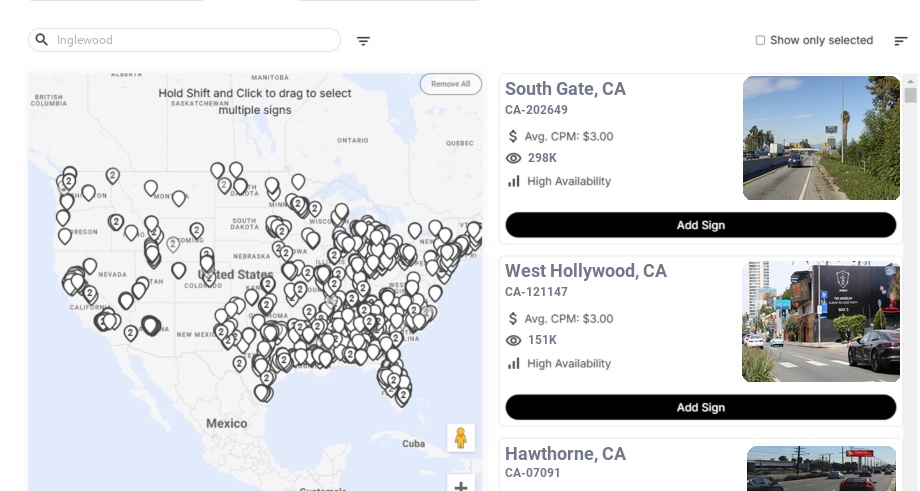
There are 24 digital billboards serving the Inglewood area, within about 10 miles, in Hawthorne, Los Angeles, Lynwood, Compton, and West Hollywood. These locations provide billboard advertising near Inglewood for brands that want to reach local residents as well as visitors attending games, concerts, and conventions. They also align with key movement corridors like the 405 Freeway, the 105 Freeway, and major arterials near SoFi Stadium and the Forum.
What kind of people will see Blip billboards in Inglewood, California?
Inglewood’s demographics heavily influence what kind of messages resonate, with a median age around 36 and roughly 26–28% of residents under 18. Around 50–52% of residents identify as Hispanic or Latino, and about 40–43% identify as Black or African American. The city also has a median household income in the mid-60,000s and a renter occupancy rate of about 65–70%, which makes family-oriented and household decision-maker messaging especially relevant.
When is the best time to run Blip ads on Inglewood billboards?
The Inglewood area has three major traffic drivers: daily commuting, event surges, and airport-related travel. Morning peak is roughly 6:30–9:30 a.m., midday shoulder is 11:00 a.m.–1:30 p.m., and evening peak is roughly 3:30–7:30 p.m. For events, the page recommends increasing bids 2–3 hours before events and 1–2 hours after to reach arriving crowds and people leaving parking structures and neighborhood streets.
Why is Inglewood, California a strong market for Blip billboard advertising?
Inglewood sits at the heart of one of Southern California’s busiest travel and entertainment corridors, with SoFi Stadium, the Kia Forum, Intuit Dome, and Los Angeles International Airport all shaping traffic patterns. Traffic counts on the 405 and 105 near Inglewood routinely exceed 250,000–300,000 vehicles per day, creating millions of weekly impressions for well-placed digital boards. The city also welcomes heavy event-driven and airport-related traffic, making it a scalable way to reach both locals and visitors.
Do I need a contract to advertise with Blip near Inglewood?
No, Blip has no long-term contracts or minimum commitments. You can start, pause, or stop your campaign at any time.
How fast can I launch a billboard campaign with Blip near Inglewood?
You can have your campaign live in minutes. Create a free account, select your locations, set your budget, upload your design, and start running once approved.
Where can I advertise with Blip near Inglewood?
Blip has digital billboards near Inglewood. You can browse available locations on a map, choose the ones that fit your audience, and start advertising right away.
Still have questions? Launch a campaign in minutes — no contracts, no commitments.
Start Your CampaignInglewood Billboard Advertising Guide
Inglewood sits at the heart of one of Southern California’s busiest travel and entertainment corridors. With SoFi Stadium, the Kia Forum Intuit Dome, and Los Angeles International Airport (LAX)
Understanding the Inglewood Area Market
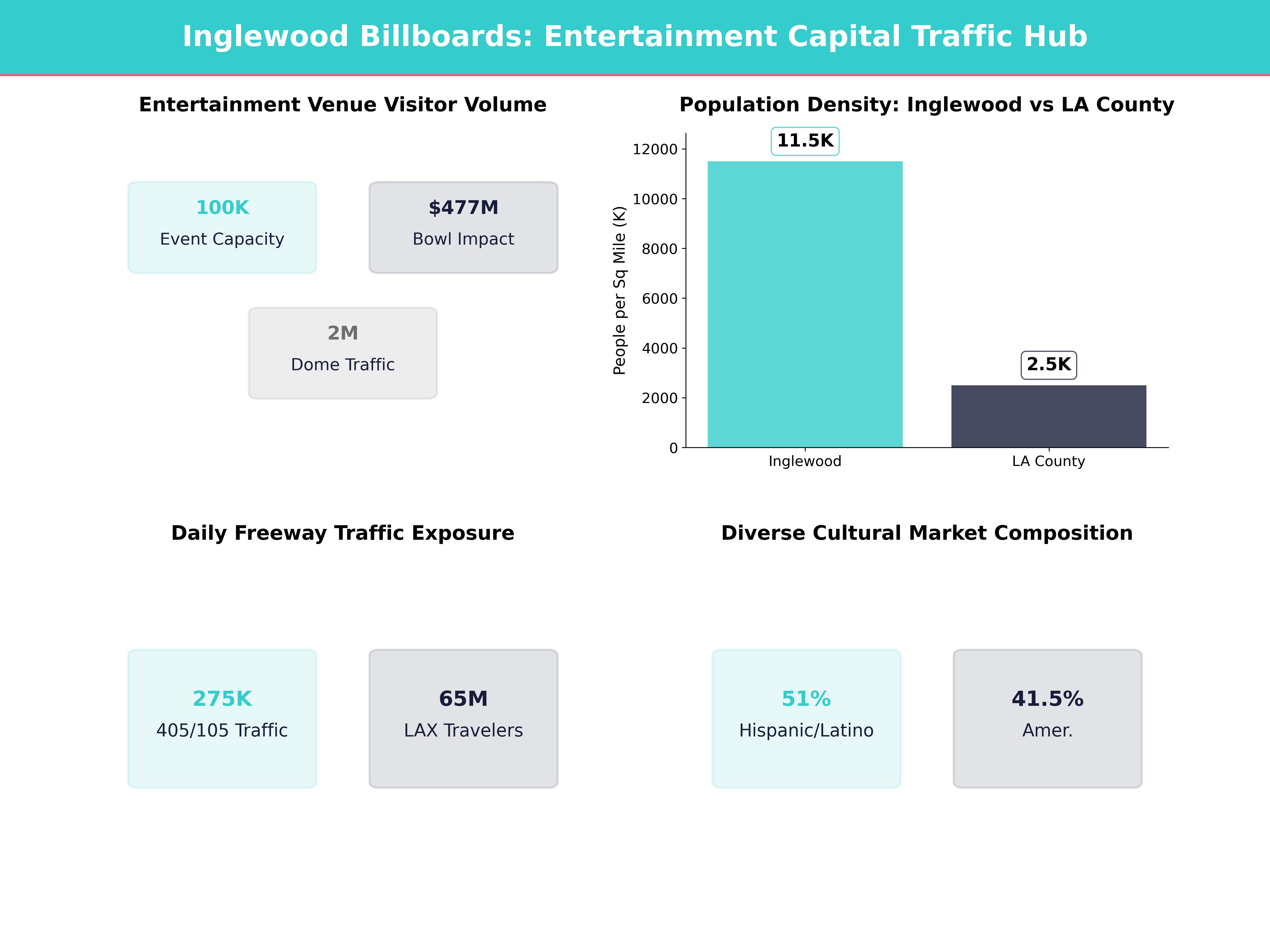
The City of Inglewood has transformed into a premier sports and entertainment hub while maintaining a strong residential core. According to 2020 data, the city has roughly 107,000–110,000 residents packed into just 9.1 square miles, yielding a population density of over 11,500 people per square mile—more than four times the overall density of Los Angeles County
A few key local anchors shape traffic and consumer behavior:
- SoFi Stadium – Home of the Los Angeles Rams and Chargers, SoFi Stadium seats about 70,000 for NFL games and can expand to over 100,000 for major events. Between two NFL teams, the venue typically hosts 20+ regular‑season home games per year, plus pre‑season games, college football, and special events. In Super Bowl LVI, the stadium welcomed a crowd of over 70,000 and generated an estimated $477 million in total economic impact for the Los Angeles region, according to regional tourism and economic development reports. Regular home games plus concerts and special events can bring tens of thousands of visitors 2–4 days per week during peak seasons, all passing prime billboard advertising near Inglewood.
- Kia Forum – The Kia Forum 17,500. Industry calendars typically show 75–100 ticketed events per year, and many major shows sell out, drawing regional visitors who travel through nearby corridors before and after events. On sold‑out nights, the Forum alone can generate 15,000+ trips in and out of Inglewood within a 3–4‑hour window.
- Intuit Dome – The future home of the LA Clippers, Intuit Dome is expected to open with capacity around 18,000. With 41 regular‑season Clippers home games plus pre‑season, playoffs, and non‑NBA events, the arena is expected to host 100+ event days annually once fully operational, adding hundreds of thousands of incremental visitors to Inglewood each year who can be reached by nearby Inglewood billboards.
- LAX – Los Angeles World Airports 88.1 million passengers in 2019 (pre‑pandemic), and rebounded to more than 65 million annual passengers by 2022, with traffic continuing to trend upward. LAX directly supports roughly 50,000–55,000 on‑airport jobs and well over 620,000 regional jobs when indirect impacts are included in economic studies. A sizable share of those travelers and workers pass on or near the corridors that serve the Inglewood area, especially the 405 and 105 freeways and Century Boulevard, where billboards near Inglewood capture frequent repeat impressions.
These anchors funnel heavy traffic along the I‑405, I‑105, Century Boulevard, Manchester Boulevard, and surrounding arterials—precisely where nearby digital billboards in Hawthorne Los Angeles, Lynwood Caltrans traffic counts for segments of the 405 and 105 near Inglewood routinely exceed 250,000–300,000 vehicles per day, creating millions of weekly impressions for well‑placed digital boards and making billboard advertising near Inglewood a scalable way to reach both locals and visitors.
For broader regional context, the Los Angeles Tourism & Convention Board has reported that Los Angeles County welcomed over 46 million domestic and international visitors in 2022, who spent more than $34 billion locally—much of that tied to sports, entertainment, and LAX‑related travel that touches Inglewood and the surrounding zones where our Inglewood billboards are visible.
Demographics and Audience Insights
Inglewood’s demographics heavily influence what kind of messages resonate:
-
Age profile
- Median age is around 36 years—slightly younger than the U.S. median of about 38.5 and close to the Los Angeles County median of 36–37.
- Roughly 26–28% of residents are under 18, indicating a strong presence of school‑age children and teens.
- About 60–62% fall between 18 and 64, a strong working‑age and consumer segment, with an estimated 10–12% aged 65 and over.
-
Ethnic and cultural mix
- Around 50–52% of residents identify as Hispanic or Latino.
- About 40–43% identify as Black or African American—one of the highest shares in Los Angeles County.
- Smaller but important communities include White (non‑Hispanic), Asian, and multiracial residents, each generally in the single‑digit percentage range.
This mix makes bilingual (English/Spanish) or culturally tailored messaging especially powerful. Local schools in the Inglewood Unified School District report that a majority of students come from Hispanic and Black households, reinforcing the value of inclusive creative for family‑focused campaigns that use billboards near Inglewood to speak directly to local households.
-
Income and housing
- Median household income is in the mid‑$60,000s (around $64,000–66,000), compared with Los Angeles County’s median closer to $75,000–80,000 in recent estimates.
- A significant majority of households are renters—various estimates put renter occupancy at about 65–70%, well above the national average of roughly 35%.
- Many households are multi‑generational or have more than one working adult, and average household size in Inglewood is about 2.9–3.1 persons, higher than the U.S. average of roughly 2.5. This raises the number of decision‑makers per household and broadens the reach of each impression.
-
Commuting patterns
- In much of the surrounding South Bay and South LA, over 70–75% of workers commute by car (alone or carpool), according to regional transportation surveys from agencies such as LA Metro
- Commute times of 30–44 minutes are common for Inglewood residents, with a notable share—around 20–25%—experiencing commutes of 45 minutes or more, meaning a lot of daily exposure to roadside media on the 405, 105, and arterial streets where Inglewood billboards are most visible.
For advertisers, this translates into:
- Strong potential for family‑oriented and household decision‑maker messaging.
- High effectiveness of commuter‑time campaigns that tap into daily routines and peak drive windows.
- Opportunity to connect authentically with Black and Hispanic communities using culturally aware visuals, bilingual copy, and references to local icons (SoFi, Forum, Clippers, Rams, Chargers) that residents see as part of neighborhood identity.
Where Our Billboards Reach the Inglewood Area
We have 24 digital billboards serving the Inglewood area, within about 10 miles, in:
- Hawthorne (about 3.3 miles from Inglewood, adjacent to LAX’s southern edge and home to major employers like aerospace and tech firms)
- Los Angeles (about 8.4 miles, including corridors that funnel traffic to Downtown LA and Hollywood)
- Lynwood (about 8.5 miles, capturing east‑west traffic between the 105 and 710)
- Compton (about 8.8 miles, a key node between the 91, 110, and 710 freeways)
- West Hollywood (about 9.5 miles, intersecting nightlife, tourism, and commuter flows from the Westside and Hollywood)
These locations provide billboard advertising near Inglewood for brands that want to reach local residents as well as visitors attending games, concerts, and conventions.
These locations align with key movement corridors:
- 405 Freeway (San Diego Fwy) – Major north–south artery connecting the South Bay, West LA, and the Valley. Caltrans counts show sections near LAX/Inglewood carrying 270,000–300,000 vehicles per weekday, and many Inglewood‑area commuters use the 405 daily.
- 105 Freeway (Century Fwy) – East–west freeway linking LAX/Hawthorne/Inglewood to Norwalk and beyond, with daily traffic volumes often above 200,000 vehicles on central segments.
- Arterials near SoFi Stadium and the Forum – Century Blvd, Prairie Ave, Manchester Blvd, and Crenshaw Blvd are used by local residents and event attendees. On major event days, traffic volumes on Century and Prairie can spike to several tens of thousands of additional vehicles over baseline within a few hours.
- Routes linking Inglewood to central LA and West Hollywood – Traffic between Inglewood and employment/entertainment centers in Downtown LA, Hollywood, and West Hollywood flows through nearby Los Angeles billboards along corridors such as La Brea Ave, La Cienega Blvd, and the 10 and 110 freeways.
By selectively targeting these displays, we can focus impressions on people who live in or regularly travel through the Inglewood area, even though the signs are physically placed in surrounding cities. For example, a commuter who lives in Inglewood and works in West Hollywood might pass 2–4 of our boards each workday, generating 40–80 weekly impressions for a well‑timed campaign. For advertisers comparing billboard rental near Inglewood versus strictly in‑city options, this approach can deliver similar audience quality at broader regional scale.
Traffic, Events, and Day‑Part Strategy
The Inglewood area has three major traffic drivers: daily commuting, event surges, and airport‑related travel. Using flexible Blip scheduling, we can match your ad spend to these patterns and maximize the impact of Inglewood billboards in each category.
Daily commuting
Regional traffic studies and LA Metro
- Morning peak: roughly 6:30–9:30 a.m.
- Midday shoulder: 11:00 a.m.–1:30 p.m. (especially for service, retail, and food runs)
- Evening peak: roughly 3:30–7:30 p.m.
On the busiest segments of the 405 and 105, more than 50–60% of daily vehicle trips occur within these combined windows.
Strategies:
- Use commute‑time dayparts on billboards along the 405, 105, and key arterials to reach workers heading to jobs in Downtown LA, the South Bay, and the Westside.
- For service businesses (auto repair, childcare, healthcare, quick‑service restaurants), emphasize proximity (“5 minutes from SoFi Stadium,” “Just off Century Blvd”) and speed (“Same‑day appointments,” “Walk‑ins in under 15 minutes”).
Event surges (SoFi Stadium, Forum, Intuit Dome)
Game and concert days create some of the highest traffic volumes in the Inglewood area:
- NFL games can bring 60,000–70,000+ attendees multiple Sundays and occasional Mondays/Thursdays from September through January. With two NFL teams, that’s typically 600,000–1,000,000 total game‑day attendees per season.
- Concerts at SoFi and the Forum can draw 15,000–70,000+ visitors per show. Major tours often occur Thursday–Sunday, with some weeks seeing 3–5 nights of high‑attendance events.
- Once Intuit Dome is fully operational, additional 40+ Clippers home games plus concerts and special events will further pack the calendar. Projections suggest annual attendance at the new arena could exceed 2 million visitors when including all events.
Strategies:
- Use date‑ and time‑specific scheduling to increase your bids 2–3 hours before events and 1–2 hours after. This puts your message in front of crowds arriving, rideshares staging, and attendees exiting parking structures and neighborhood streets.
- Rotate event‑themed creative on those days (e.g., “Game‑day specials,” “Show your ticket for 10% off,” “Walk from SoFi in 7 minutes”) while running broader branding messages on non‑event days.
- Focus on boards along inbound routes from South LA, the South Bay, Downtown LA, and Hollywood—where fans commonly travel from, according to ticket‑buyer origin data and regional surveys reported in outlets like the Los Angeles Times. This allows billboard advertising near Inglewood to capture audiences before they arrive and as they depart.
LAX and regional travel
With tens of millions of passengers annually at LAX, nearby freeways and surface streets serve:
- Air passengers and their friends/family, with 65+ million enplanements and deplanements in 2022.
- Airport workers—LAX itself supports around 50,000 on‑airport employees, many of whom live in Inglewood, Hawthorne, Lennox, and South LA.
- Rideshare and taxi drivers—studies in the late 2010s estimated 25,000–30,000 ride‑hail pick‑ups and drop‑offs at LAX on peak days.
Strategies:
- Promote hotels, parking, rideshare services, and attractions that appeal to airport travelers. A significant portion of LAX passengers are leisure travelers, and visitor research from Discover Los Angeles shows average overnight visitors spend several hundred dollars per day on lodging, dining, and entertainment.
- Use early morning (4:30–7:30 a.m.) and late‑night (9:00 p.m.–1:00 a.m.) dayparts to reach flight crews and travelers on red‑eye or early flights, when traffic to and from LAX stays notably strong compared with typical urban patterns.
Seasonal Timing in the Inglewood Area
Inglewood’s mild climate—average highs around 68–75°F most of the year and only about 12–15 inches of annual rainfall—and year‑round tourism mean there’s no true “off‑season,” but seasonal patterns matter:
- NFL season (Sept–Jan): Ideal for bars, restaurants, merchandise, sports betting apps (where legal), and transportation services. A full NFL season with two home teams can generate 800,000–1.2 million total stadium visits including pre‑season and playoffs.
- Concert peaks (spring and summer): Major tours often cluster March–June and August–October, with some weeks featuring 4–6 large shows across SoFi, the Forum, and nearby arenas in Los Angeles.
- Holiday shopping (Nov–Dec): Regional retail sales in Los Angeles County typically spike 20–30% over monthly averages during November and December. Use high‑frequency, short‑message campaigns to drive shoppers to local retailers, malls, and e‑commerce sites.
- Back‑to‑school (July–Sept): Inglewood Unified School District and surrounding districts return to class in August; the district serves thousands of students across elementary, middle, and high schools. Focus on school supplies, clothing, tutoring, and youth programs. You can reference district calendars via the Inglewood Unified School District site when planning.
- Tax season (Jan–Apr): Nationwide, more than 70% of tax refunds are issued by mid‑April, and average refunds often fall in the $2,000–3,000 range, giving local households extra spending power. Promote financial services, tax preparers, and credit unions to working‑age residents.
Because Blip allows flexible budgeting and scheduling, we can scale spending up in these peak windows and maintain a lower, always‑on baseline presence the rest of the year, ensuring that your brand stays visible to the 100,000+ local residents and millions of annual visitors passing through Inglewood’s sphere. For many advertisers, this flexible approach to billboard rental near Inglewood provides the right balance between cost control and continuous visibility.
Creative Best Practices for the Inglewood Area
To connect with Inglewood‑area audiences, billboard designs should be:
Bilingual and culturally aware
Given that around half of residents are Hispanic/Latino and a large share are Black:
- Use bilingual headlines where space allows, e.g., “Auto Repair You Can Trust / Reparación de Autos en la que Puedes Confiar.”
- When limited on space, consider English headline with a small Spanish call‑out, or vice versa, depending on your primary audience and neighborhood (for example, Spanish‑forward near corridors with higher Spanish‑speaking populations).
- Reflect local culture and diversity in imagery: families, young professionals, and multi‑generational households that mirror Inglewood neighborhoods, as seen in coverage from outlets like Inglewood Today.
- Be mindful of faith‑based and community‑oriented values: surveys of South LA communities often show high engagement with churches and local nonprofits, which can inspire partnership ideas and messaging tone.
Ultra‑simple and mobile‑friendly
Many viewers are driving 40–65 mph on freeways or moving quickly on arterials:
- Aim for 6–8 words or fewer per frame to stay within the typical 3–5 second viewing window at highway speeds.
- Use high‑contrast colors (light text on dark background or dark on light).
- Make logos large and legible at a glance; tests in outdoor advertising often show brand recall improving by 20–30% when logos occupy at least 10–15% of the creative.
- Use one clear call to action: “Exit at Century Blvd,” “Visit InglewoodLocation.com,” or “Text SOFI to 12345.” Simple, location‑based CTAs often outperform complex offers for highway audiences.
Event‑aware variations
Prepare multiple creatives that:
- Highlight game‑day or concert‑day offers (“Game‑Day Happy Hour 2–6 PM,” “Show Your Ticket, Get Free Appetizer”).
- Feature team colors or subtle references (without infringing trademarks) to appeal to Rams, Chargers, or Clippers fans and concertgoers.
- Switch to more general offers on non‑event days—e.g., weekly specials, membership programs, or evergreen branding.
With digital billboards, we can rotate these creatives throughout the day and week and track which date‑ and time‑combinations best correlate with website visits, map searches, and store traffic. This makes billboard advertising near Inglewood not just visible but also highly testable and optimizable.
Local Business and Vertical‑Specific Ideas
Restaurants, bars, and nightlife
The Inglewood area has a growing dining and nightlife scene, supported by visitors and residents. Local coverage from outlets like Inglewood Today and regional guides highlights an increasing number of sports bars, lounges, and independent restaurants clustered around Century Blvd, Market St, and the Hollywood Park development.
To capture this traffic:
- Target boards near routes from SoFi/Forum to neighborhood commercial areas used by the 60,000–70,000+ fans and concertgoers on big nights.
- Promote happy hour times, post‑game specials, or late‑night kitchens, especially Thursday–Sunday when event density is highest.
- Use short, appetite‑driven messages: “Wings & Drinks 1 Mile from SoFi,” “Open Late on Game Days,” “Kitchen Open Until 1 A.M.”
- Consider featuring average ticket or per‑person spend (“Dinner & Drinks Under $25”) in value‑sensitive areas.
Businesses that rely on these high‑energy nights often see strong returns from focused billboard rental near Inglewood during weeks packed with major events.
Automotive and transportation
With a car‑dominant commuting culture:
- Across South LA, 70–75% of workers drive to work, and vehicle ownership rates are high even in renter‑dominated neighborhoods.
-
Auto repair shops, dealerships, tire centers, and car washes can highlight:
- “Same‑Day Service”
- “No‑Credit Financing”
- “Near 105 & Crenshaw” or similar directional cues to instantly anchor location.
-
Rideshare, shuttle, and parking businesses can promote:
- “Game‑Day Parking – Reserve Online”
- “LAX Shuttle – Book Now”
- “Avoid $30+ Airport Parking” when competing with on‑airport rates.
Given that LAX handles 65+ million passengers annually, even capturing 0.05–0.1% of travelers with a shuttle, parking, or rideshare service could translate into 30,000–65,000 customer transactions per year. Strategically placed billboards near Inglewood along 405 and 105 access points can be central to that acquisition strategy.
Real estate and housing
Inglewood is in a transition phase, with new development around Hollywood Park and rising property values. Reports in the Los Angeles Times and other local outlets have documented home price increases in many Inglewood neighborhoods of 50% or more over the past decade.
-
Realtors and property managers can use billboards to feature:
- “New Apartments Near SoFi – Now Leasing”
- “Down Payment Assistance Available”
- “From the $600s in Inglewood”
- Emphasize commute advantages: “15 Minutes to Downtown LA” or “Close to 105 & 405 – Be at LAX in 10 Minutes.”
- Position properties as alternatives to higher‑priced Westside and South Bay markets, highlighting price differences of $100,000–200,000+ compared with neighboring coastal cities.
For lease‑ups or new communities, time‑bound billboard advertising near Inglewood during opening phases can rapidly build awareness among local renters and move‑up buyers.
Healthcare, education, and community services
Given the family‑heavy population and a median age in the mid‑30s:
- Clinics, urgent care centers, and dental offices can promote extended hours, walk‑ins welcome, same‑day appointments, and bilingual staff (“Se habla español”). Many families in the area have children under 18, so pediatric and family services are especially relevant.
- Local colleges, trade schools, and training programs can tie into commuter corridors to reach adults considering upskilling. In Los Angeles County, community colleges and trade schools collectively enroll hundreds of thousands of students annually, and many come from South LA and Inglewood.
- Nonprofits and community services can target awareness campaigns near neighborhoods with higher need, encouraging residents to connect to food assistance, youth programs, legal clinics, and housing support. Billboards can be timed to coincide with enrollment periods, grant cycles, or major outreach events highlighted on the City of Inglewood community calendar.
These sectors often benefit from always‑on, lower‑intensity billboard rental near Inglewood that keeps services top of mind year‑round.
Using Local Media and Government Insights
To refine strategy, we encourage checking:
- The official City of Inglewood site for development updates, event calendars, public meetings, and neighborhood initiatives. City planning and economic development pages often list major construction timelines and new business openings, which can signal future traffic shifts.
- Discover Los Angeles for tourism trends, hotel performance data, and major event listings across the LA region, including citywide conventions and sporting events that drive spikes in visitor volume.
- Local news outlets such as the Los Angeles Times (metro/LA County sections) and Inglewood Today for coverage of new businesses, community issues, and event schedules, along with periodic traffic, transit, and real estate reports that affect consumer patterns.
- Regional transit and transportation agencies like LA Metro
These sources help us identify when the Inglewood area will experience spikes in traffic or attention—such as playoff runs, major concert weekends, or large civic events—so we can time your campaigns accordingly and capture disproportionate share of voice during high‑impact periods using billboards near Inglewood and surrounding corridors.
Measuring and Optimizing Your Campaign
With digital billboards, we can actively refine performance over time:
-
Location testing – Start with a mix of Hawthorne, Los Angeles, Lynwood, Compton, and West Hollywood boards serving the Inglewood area. After 2–4 weeks, shift more of the budget to locations that align best with your website analytics, store traffic, or sales data. For example, if 60% of redemptions come from ZIP codes near the 105, weight more impressions to your east‑west corridors.
-
Daypart testing – Run different time windows (morning commute vs. afternoons vs. evenings) to see when you get the strongest response. Many advertisers find that 40–60% of digital billboard‑driven actions occur during commute windows; if your results confirm this, we reallocate spending accordingly.
-
Creative rotation – Test 2–4 versions of your artwork:
- English‑only vs. bilingual.
- Brand message vs. promotional offer.
- Event‑specific vs. evergreen.
Watch your metrics (site visits, coupon redemptions, inbound calls, map search views) to determine winners. It is common to see 20–50% performance differences between top‑ and bottom‑performing creatives, so disciplined testing can significantly improve ROI.
-
Short, intense flights vs. always‑on – For some advertisers (e.g., events, sales, product launches), 1–2‑week bursts with higher frequency perform best. For others (local services, healthcare, real estate), a steady, always‑on presence builds long‑term recognition; brand‑lift studies in out‑of‑home media often show recall increasing notably after 12–16 weeks of consistent exposure.
By combining these tactics, we can tailor a campaign that fully leverages the 24 digital billboards serving the Inglewood area—capturing commuters, residents, and visitors flowing through one of Southern California’s most dynamic and fast‑growing entertainment districts, and translating the region’s millions of annual trips and impressions into measurable business outcomes for your brand. Whether you are testing billboard advertising near Inglewood for the first time or scaling an existing presence, this framework helps ensure every impression moves you closer to your goals.