Billboards in Pittsburg, CA
No Minimum Spend. No Long-Term Contracts. Just Results.
Trusted by Leading Brands


Billboard advertising
in Pittsburg has never been easier



How much is a billboard in Pittsburg?
Why Choose Blip for Billboard Advertising in Pittsburg
Blip lets you launch Pittsburg billboard ads fast and self-serve, right along SR-4 commuter traffic without a long media buy.
Set a budget that fits Pittsburg, then Blip keeps spend in range while reaching East County families, commuters, and waterfront visitors.
Daypart Pittsburg ads for 6-9 a.m. and 3:30-7 p.m. to catch SR-4 rush-hour drivers when viewing time is highest.
No contracts means Pittsburg businesses can test marina, school, and industrial messages, then shift as traffic and seasons change.
Track Pittsburg campaign results in real time and adjust for weekday commutes, weekend recreation, or back-to-school demand.
Use Blip's creative tools to build bold Pittsburg billboards with bilingual, high-contrast copy that pops on fast-moving SR-4 traffic.
Frequently Asked Questions About Billboard Advertising in Pittsburg
How much does a billboard cost near Pittsburg, California with Blip?
With Blip, you control exactly what you spend on Pittsburg billboards by setting a daily budget that can be as small or as large as you like, and Blip automatically keeps your campaign in the Pittsburg area within that limit. Each “blip” is a 7.5 to 10-second ad on digital billboards near Pittsburg, California, and you only pay for the blips you receive, so your total cost is simply the sum of those brief ad plays. Cost per blip varies based on time, location, and demand, giving you a flexible, pay-per-blip way to advertise.
Where can I advertise with Blip in Pittsburg, California?
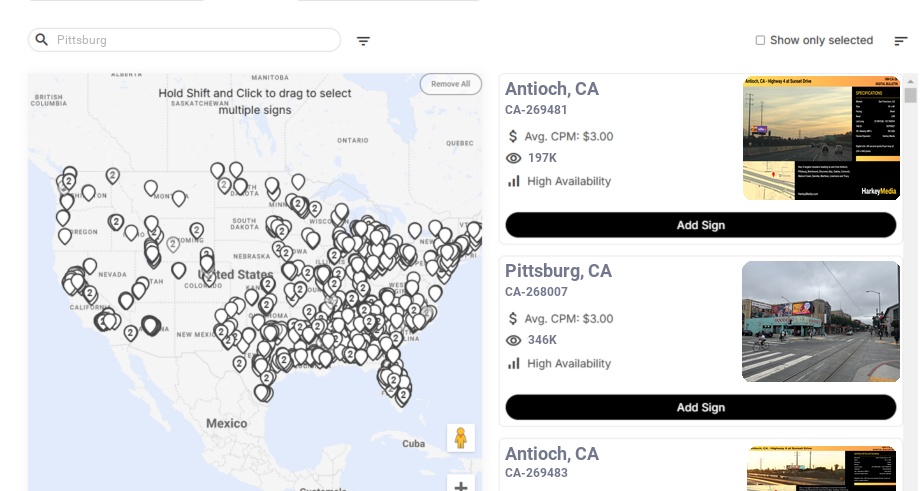
There are five digital billboards serving the Pittsburg area from nearby Antioch, about 4.7 miles away. These boards help you reach traffic flowing through East Contra Costa County, especially along State Route 4. For advertisers seeking billboards near Pittsburg, this cluster of digital faces offers a highly efficient way to reach local drivers.
Why is Pittsburg, California a good market for billboard advertising with Blip?
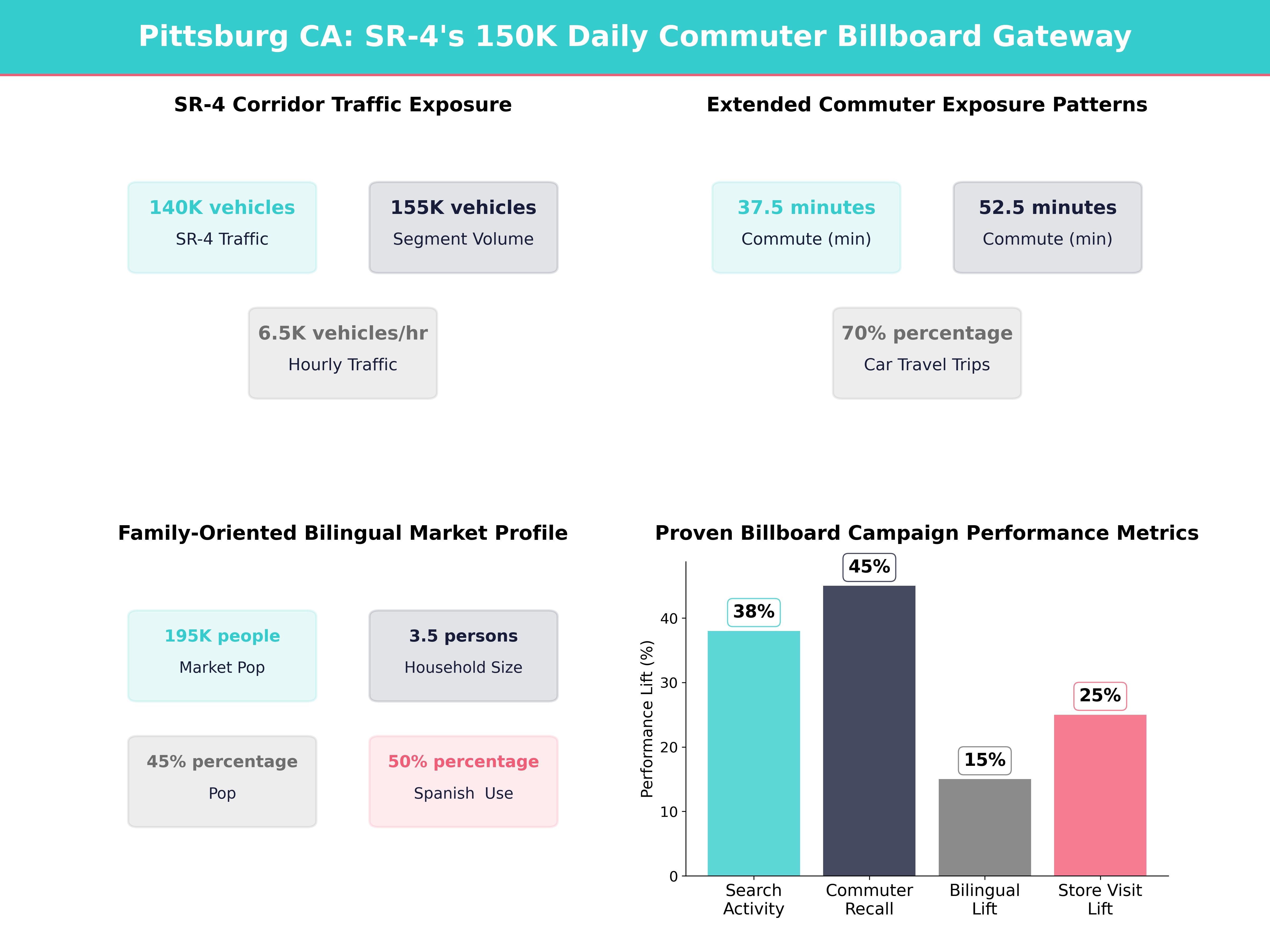
The Pittsburg area sits at a powerful crossroads of East Contra Costa County commuters, families, industrial employers, and waterfront recreation. The City of Pittsburg is in the mid-70,000s, Antioch adds about 115,000 residents, and the combined local market is around 190,000–200,000 people within just a few miles of the billboards. State Route 4 through the corridor also commonly sees average daily traffic in the 130,000–150,000 vehicles per day range.
What times should I run Blip ads near Pittsburg, California for commuters?
For commuter-focused ads, the page recommends morning hours from 6–9 a.m. and evening hours from 3:30–7 p.m. on weekdays. East County commute times often exceed 35–40 minutes each way, so repeated exposure during those windows can be especially effective. Late-night hours can also be useful if you want cheaper Blips and less ad clutter.
How should I target families and students in Pittsburg, California with billboard ads?
The page suggests using school-related times, especially 7–9 a.m. and 2–5 p.m. on weekdays, for after-school programs, tutoring, pediatric clinics, quick-service restaurants, and family entertainment. Pittsburg Unified School District serves more than 10,000 students, and nearby Los Medanos College enrolls approximately 8,000–9,000 students annually. The area also has many households with children, making it a strong market for family-oriented messaging.
Do I need a contract to advertise with Blip in Pittsburg?
No, Blip has no long-term contracts or minimum commitments. You can start, pause, or stop your campaign at any time.
How fast can I launch a billboard campaign with Blip in Pittsburg?
You can have your campaign live in minutes. Create a free account, select your locations, set your budget, upload your design, and start running once approved.
Where can I advertise with Blip in Pittsburg?
Blip has digital billboards in Pittsburg. You can browse available locations on a map, choose the ones that fit your audience, and start advertising right away.
Still have questions? Launch a campaign in minutes — no contracts, no commitments.
Start Your CampaignPittsburg Billboard Advertising Guide
The Pittsburg, California area sits at a powerful crossroads of East Contra Costa County commuters, families, industrial employers, and waterfront recreation. With five digital billboards serving the Pittsburg area from nearby Antioch (about 4.7 miles away), we can help you tap into this growing, high-traffic market with precise scheduling, flexible budgets, and creative tailored to local realities. For advertisers specifically seeking billboards near Pittsburg, this cluster of digital faces offers a highly efficient, data‑friendly way to reach local drivers.
Why the Pittsburg Area Is Strategically Valuable
The Pittsburg area provides access to a dense, diverse audience concentrated along one major mobility spine—State Route 4—plus growing residential neighborhoods and a strong industrial base. For Pittsburg billboards and campaigns focused on East County visibility, this combination of commuters and residents is especially powerful.
Key facts about the Pittsburg area:
- The City of Pittsburg mid‑70,000s as of recent estimates, making it one of the larger cities in eastern Contra Costa County and accounting for roughly 6–7% of the county’s total population.
- Nearby Antioch adds about 115,000 residents, creating a combined local market of around 190,000–200,000 people within just a few miles of our digital billboards.
- Contra Costa County overall has more than 1.16 million residents, according to county-level reports, with over 60% of employed residents commuting by car alone—meaning large daily flows through East County corridors.
- State Route 4 (SR‑4) is the backbone of mobility. Caltrans traffic counts for SR‑4 through the Pittsburg/Antioch corridor commonly show average daily traffic (ADT) in the 130,000–150,000 vehicles per day range on key segments, with peak segments in East County often exceeding 155,000 vehicles per weekday when combining both directions.
- The Contra Costa Transportation Authority (CCTA) estimates that East County (Antioch, Pittsburg, Brentwood, Oakley, and surrounding communities) has grown by more than 40% since 2000, intensifying east–west commute patterns and SR‑4 congestion.
- Household income levels in the Pittsburg–Antioch area sit in a “middle market” band: many neighborhoods have median household incomes in the $70,000–$90,000 range, supporting demand for everyday services, healthcare, and value‑driven retail.
Useful local sources:
- City of Pittsburg
- Contra Costa County
- Contra Costa Transportation Authority (CCTA)
For advertisers, this means a few things:
- Mass daily repetition: SR‑4 commuters see the same stretches of roadway 2x per day, 5 days a week—often spending 45–60 minutes on their daily one‑way commute during peak congestion. Smart Blip scheduling along this pattern can produce high‑frequency exposure even with modest budgets; national out‑of‑home studies have shown that high‑frequency OOH campaigns can drive up to 38% increases in search activity and 20–30% lifts in store visits when paired with digital channels. This makes billboard advertising near Pittsburg particularly effective for brands that need repeated exposure.
- Regional reach: People traveling between Brentwood, Oakley, Pittsburg, Antioch, and Concord pass through the Pittsburg area, giving your brand both local and regional visibility. East County alone accounts for 250,000+ residents, many of whom must use SR‑4 for work, school, and shopping.
- Diverse audience mix: The Pittsburg area includes blue‑collar industrial workers, white‑collar commuters to the inner Bay Area, students, and multi‑generational families—ideal for everything from trades and education to healthcare and consumer services. District and city data show that in many schools, 80–90% of students are students of color, and more than 60% qualify for free or reduced‑price meals, underlining the importance of value messaging and inclusive creative.
Key Audience Segments Around Pittsburg
We can use what we know about the Pittsburg area to tailor messaging and choose the right times and locations for your Blip campaign, whether you are testing billboard rental near Pittsburg for the first time or scaling a larger regional presence.
Commuters and Workers
- The SR‑4 corridor is one of the most heavily commuted routes in Contra Costa County, connecting the Pittsburg area with Concord, Walnut Creek, and I‑680. In East County, peak‑direction travel speeds on SR‑4 can drop below 25 mph during rush hour, increasing viewing time and billboard exposure.
- Thousands of residents commute west in the morning and return east in the evening. CCTA data shows that more than 70% of work trips in East County involve car travel, and a large share pass through the Pittsburg/Antioch segment, with several key interchanges handling 80,000–100,000+ vehicles per direction daily.
- Industrial and logistics employers near the waterfront and in business parks support multiple shifts; many industrial zones report 24/7 operations and employ several thousand workers in manufacturing, warehousing, and energy-related roles. This means potential exposure not only 8–5 but also late‑night and early‑morning traffic.
- Nearby job centers such as Concord, Walnut Creek, and the I‑680 corridor together support well over 150,000 jobs, drawing Pittsburg and Antioch residents into daily regional commute flows.
How to use this:
- Aim commute‑focused ads at morning (6–9 a.m.) and evening (3:30–7 p.m.) on weekdays for services that solve work‑life problems: auto repair, coffee, QSR, daycares, healthcare, and financial services. Commuter‑oriented campaigns often see higher recall rates (40–50% unaided recall) compared with generic daytime runs, thanks to repeated exposures to the same audience.
- For industrial recruitment or trade services (staffing agencies, safety training, equipment suppliers), emphasize shift‑friendly hours and job benefits during early morning (4–7 a.m.) and late evening (7–10 p.m.) windows, when industrial and logistics workers are commuting. Employers recruiting from East County can access a labor pool of tens of thousands of workers without paying inner‑Bay‑Area advertising rates.
Families and Local Residents
Pittsburg is known for its family orientation and relatively affordable housing within the Bay Area context. Many neighborhoods feature larger household sizes—often 3–4+ persons per household—and a high share of households with children.
- Pittsburg Unified School District (PUSD) serves more than 10,000 students across multiple elementary, middle, and high schools, plus alternative and adult education programs. In several schools, more than 30–40% of students come from households speaking a language other than English at home.
- Nearby Los Medanos College (LMC) enrolls approximately 8,000–9,000 students annually across its Pittsburg campus and centers, with programs ranging from transfer degrees to workforce certificates in healthcare, industrial technology, and business.
- Local housing remains more accessible than many core Bay Area markets. Typical home prices in Pittsburg and Antioch are often 30–40% lower than in central Contra Costa communities like Walnut Creek, attracting first‑time buyers and young families.
- Family‑ and youth‑oriented amenities—parks, sports leagues, and recreation programs—draw regular attendance. The City of Pittsburg Recreation Division 70–100% of available slots.
This generates a heavy flow of parents, students, and staff moving across the Pittsburg area daily—school drop‑offs, practices, games, and campus visits—creating multiple daily touchpoints for billboard viewing.
How to use this:
- Target school‑related times (7–9 a.m. and 2–5 p.m. on weekdays) for after‑school programs, tutoring, pediatric clinics, quick‑service restaurants, and family entertainment. OOH campaigns targeting school‑hour traffic have been shown to drive 15–25% higher response rates for youth and family services compared with untargeted day‑long schedules.
- Use youth‑ and parent‑friendly creative—clear headlines, warm imagery, and value‑based offers (“Kids eat free,” “After‑school specials,” “Same‑day appointments”).
- Consider creative that highlights short drive times (“5 minutes from LMC,” “2 exits from Pittsburg High”) to tap into residents’ desire to stay close to home and avoid long Bay Area trips.
Bilingual and Multicultural Audiences
The Pittsburg area is one of the more diverse communities in the county:
- City and school‑district data show that people of color make up a substantial majority of Pittsburg’s population. Many neighborhoods have Latino/Hispanic populations above 40–50%, along with sizable Asian and African American communities.
- In PUSD, it’s common for more than 30–40% of students to be designated as English Learners or fluent bilingual, with Spanish the most common home language after English.
- Community agencies and schools emphasize bilingual communications, indicating that a substantial portion of households are comfortable consuming mixed‑language media. Community surveys in East County often show 50%+ of residents reporting they see or use Spanish in daily life.
How to use this:
- Consider bilingual billboard creatives (English + Spanish) for broad consumer services. Research on bilingual OOH campaigns indicates they can produce 10–20% higher engagement among Spanish‑speaking audiences and improve brand favorability across all groups. Even a single Spanish phrase on your board can increase relevance and response.
- Use culturally inclusive imagery: families, multigenerational households, small local businesses, and community gatherings resonate strongly in the Pittsburg area.
- Highlight services such as bilingual staff, flexible payment options, and immigration‑friendly support where relevant—local service providers report that these cues significantly increase inquiry rates from diverse households.
Traffic Patterns and Optimal Blip Scheduling
Digital billboards serving the Pittsburg area from Antioch sit along major routes that mirror local habits. With Blip, you’re not locked into a static 4‑week buy—you can choose when your ads appear down to the hour and day. This flexibility allows you to fine‑tune billboard advertising near Pittsburg around the exact commute and shopping windows that matter most to your customers.
Daily Rhythms to Leverage
Based on typical SR‑4 corridor and suburban traffic patterns, plus local observations from East County:
-
Morning commute (6–9 a.m.)
- Heavy westbound flow toward Concord/Walnut Creek, with volumes on some SR‑4 segments exceeding 6,000–7,000 vehicles per hour in peak periods.
- Best for coffee, breakfast, transit connections, healthcare reminders, job recruitment, and B2B awareness.
-
Midday (11 a.m.–2 p.m.)
- Lunch runs, errands, mid‑shift workers, and students. In many suburban corridors, midday can represent 20–25% of daily traffic, with a higher share of decision‑makers and shoppers.
- Great for restaurants, retail, personal services, and appointment‑based businesses.
-
Evening commute (3:30–7 p.m.)
- Strong eastbound traffic returning to the Pittsburg area and neighboring cities. Evening peaks on SR‑4 often mirror the morning, with thousands of vehicles per hour passing key billboard locations.
- Effective for “tonight” messages: dinner, entertainment, gyms, grocery, and same‑day offers.
-
Late night (9 p.m.–1 a.m.)
- Lower volume (sometimes 30–50% fewer vehicles than daytime), but less ad clutter and cheaper Blips in many cases.
- Ideal for nightlife, convenience stores, 24‑hour services, and campaigns seeking high frequency at lower cost. Advertisers can often secure more impressions per dollar overnight because competition for inventory is lighter.
Weekday vs. Weekend Strategy
-
Weekdays:
- Focus on commuter and school patterns. Weekday traffic typically accounts for 65–70% of weekly vehicle trips on commuter corridors.
- Use weekday‑only scheduling if your offer is tied to workdays (B2B, transit, office services, job fairs).
-
Weekends:
- Traffic patterns shift toward shopping centers, churches, regional parks, and the waterfront. Weekends often see spikes around mid‑morning to early evening, when families travel for errands and recreation.
- Weekends often see more family and leisure travel along SR‑4 as people visit the Pittsburg Marina East Bay Regional Park District.
We can help you create custom daypart plans—for example, Monday–Thursday commuter‑only Blips for recruitment, plus Friday–Sunday family‑focused Blips to drive weekend sales. Data‑driven scheduling can increase effective reach by 20–40% versus running the same budget evenly across all hours.
Crafting Effective Creative for the Pittsburg Area
The Pittsburg area roadways encourage fast, high‑impact creative. Drivers on SR‑4 and major arterials typically have just 3–6 seconds to absorb your message. Effective artwork must be bold, simple, and locally relevant for commuters who encounter your Pittsburg billboards at highway speed.
Design Principles for High-Speed Corridors
- Limit text to 7–10 words total. Studies of OOH readability show that boards with fewer than 10 words are significantly more likely to be fully read at highway speeds. Aim for one dominant headline and a short sub‑line or call to action.
- Use large fonts (at least 12–18 inches on the actual board, which translates to big, clear type in your artwork file). Legibility tests show that each inch of letter height is readable at roughly 30–40 feet—critical when vehicles are traveling 55–65 mph.
- High‑contrast colors are essential. Dark backgrounds with light text – or vice versa – work best against bright California sun. In sunny regions, high‑contrast creatives can improve message recall by up to 25% compared with low‑contrast designs.
- One focal image. Avoid cluttered collages. A single compelling photo (a dish, a smiling family, a product close‑up, or a worker in uniform) is enough. Ads with one primary visual element consistently rank higher in unaided recall (40–50%) than busy, multi‑image layouts.
- Include a location cue (“2 exits ahead,” “5 min from Pittsburg Marina,” “Off Railroad Ave”) instead of a full street address. Drivers remember quick directional hints far better; location‑based cues have been shown to increase visit intent by 10–15% in OOH studies.
Local Messaging Angles
To connect with people in the Pittsburg area, incorporate:
- Commuter relief: “Beat traffic stress,” “5‑minute oil change,” “Fast coffee drive‑thru,” or “Same‑day urgent care.” With average East County commute times often exceeding 35–40 minutes each way for many workers, messages that save time and reduce hassle are especially powerful.
- Value and affordability: Given East County’s strong working‑class base, highlighting clear value—“$9.99 lunch,” “No hidden fees,” “Free estimates”—performs well. In communities where a significant share of households live near or below the county’s median income, price‑sensitive offers can make the difference between awareness and action.
- Community pride: References to the Pittsburg Marina higher repeat and referral rates compared with generic brand messaging.
- Bilingual hooks: Even a line like “Hablamos Español” can increase response from Spanish‑speaking residents. In districts where 30–40% of households speak a language other than English, bilingual cues are both inclusive and commercially effective.
Using Local Seasonality and Events
The Pittsburg area has a year‑round outdoor culture, but some times of year are especially important for advertisers.
Spring and Summer: Waterfront & Festivals
Pittsburg’s waterfront and marina area host events and seasonal activities that bring in visitors from across East County.
- The Pittsburg Marina thousands of visitors in a single day.
- The City of Pittsburg outdoor concerts, car shows, and cultural festivals that can attract thousands of attendees over a season. Signature events and summer series can cumulatively draw 10,000+ attendees across multiple dates. You can monitor upcoming dates via the city’s events calendar
- Regional attractions such as Black Diamond Mines Regional Preserve and Contra Loma Regional Park are within an easy drive, boosting weekend and holiday traffic past East County billboards.
Advertising near the Pittsburg area leading into these events is ideal for:
- Restaurants, bars, and dessert shops
- Event sponsors and booths
- Hotels and short‑term rentals in nearby cities
- Parks, recreation, and boat‑related services
Schedule Blips 2–3 weeks prior to major events to build awareness, then intensify frequency in the final week and on event weekends. Event‑linked OOH campaigns commonly see 20–40% spikes in web searches and social engagement during the days immediately surrounding promoted dates.
Back-to-School and College Cycles
For K–12 and Los Medanos College:
- Late July–September: Back‑to‑school rush—clothing, supplies, tutoring, healthcare check‑ups. Retailers often see double‑digit sales increases in August compared with June in school‑oriented categories.
- January: Spring semester start—college enrollment, financial aid services, textbook and technology promotions. Many community colleges, including LMC, enroll a substantial portion of students—often 20–30% of annual headcount—in the first few weeks of each term.
Use time‑bound messaging like:
- “Back‑to‑school checkups – Book today”
- “Enroll at LMC – Application deadline approaching”
- “Student discounts with ID”
Combine these with QR codes or short URLs to capture students and parents who see your message while commuting.
Holiday Shopping and End-of-Year
The Pittsburg and Antioch retail corridors become especially busy from mid‑November through December:
- Regional and national data show that many retailers earn 25–30% of their annual sales in the November–December period.
- Local shopping destinations—such as the Somersville and Slatten Ranch areas near Antioch and big‑box clusters along major arterials—see significant increases in weekend traffic and parking demand.
- Push retail, e‑commerce, and gift services with clear offers (“20% off this weekend,” “Order by Dec 20 for Christmas delivery”).
- If you operate locally, emphasize “Shop East County” messaging to tap into community preference for supporting nearby businesses. Local‑support campaigns in similar markets have shown 5–15% lifts in local sales when strongly promoted.
Geo-Targeting Around Pittsburg and Antioch
Our five digital billboards near Antioch serve the Pittsburg area by intercepting traffic flowing into and out of the city. Smart geo‑thinking can make a large difference, especially when you want your billboard rental near Pittsburg to focus on the highest‑value segments of local and regional traffic.
Capture Inbound and Outbound Pittsburg Area Traffic
-
Inbound to the Pittsburg area (heading toward residential neighborhoods, the marina, and local shopping) is ideal for:
- Restaurants, grocery stores, salons, gyms, and medical clinics serving local residents.
- Local services such as auto repair, dental clinics, and child care that draw largely from a 3–7 mile radius. In suburban areas, the majority of routine purchases happen within a 15‑minute drive of home.
-
Outbound from the Pittsburg area (heading toward Concord, Walnut Creek, or further west) is ideal for:
- Regional employers recruiting Pittsburg‑area workers
- Park‑and‑ride, BART connections, and commuter services
- Attractions and businesses nearer the I‑680 corridor that draw East County residents
We can help you choose boards and dayparts that align with these flows based on your customer catchment, using drive‑time mapping and ZIP‑code sales analysis to refine your targeting.
Complementing BART and Transit
While the Pittsburg/Bay Point and Antioch BART stations are technically outside the city center, many Pittsburg area residents rely on them.
- BART ridership data shows that the Antioch extension (Antioch and Pittsburg/Bay Point stations combined) typically handles several thousand weekday entries and exits, often in the 7,000–10,000 range on a typical weekday as ridership continues to recover, according to BART.
- Park‑and‑ride lots near SR‑4 and major arterials often reach 75–100% of capacity on busy weekdays, confirming strong transit‑linked driving patterns.
Consider board placements that drivers will see:
- On the way to park‑and‑ride lots
- As they leave the highway to reach BART‑connecting roads
This is effective for:
- BART‑connected services in Oakland, San Francisco, or Berkeley
- Commuter parking, shuttle services, and remote‑work hubs
- Higher education institutions and job training centers throughout the Bay Area
Combining OOH near Pittsburg with messaging at BART‑served destinations can create a “bookend” effect, giving commuters multiple daily exposures across their journey.
Budgeting, Flighting, and Measurement Tips
Blip’s flexibility is especially powerful in a market like the Pittsburg area, where traffic is highly patterned and advertisers want precise control over billboard advertising near Pittsburg without locking into rigid, long‑term buys.
Start with a Focused Test
For small and mid‑sized businesses:
- Start with a focused 2–4 week test around a single goal (e.g., “increase weekday lunch visits by 10%” or “boost web traffic from East County by 20%”). Many local advertisers see meaningful directional results with test budgets as low as a few hundred dollars when tightly targeted.
- Concentrate 70–80% of your budget on the highest‑impact periods for your audience (commute times, weekends, or school windows).
- Use the remaining 20–30% on exploratory times (late‑night, midday, or different days) to discover hidden value.
Even a modest daily budget can generate hundreds to thousands of impressions per day in a targeted window, because you only pay for the Blips you choose and can avoid low‑value time slots.
A/B Testing Creative
The Pittsburg area is ideal for creative testing because many commuters see the same boards repeatedly.
-
Run two creatives simultaneously:
- Version A: Strong offer (“$29.99 oil change”)
- Version B: Brand and trust message (“Family‑owned in East County since 1998”)
-
Track impact using:
- Website visits from local ZIP codes (e.g., 94565, 94509, 94531, 94513)
- Coupon codes unique to each creative
- “How did you hear about us?” prompts
After 2–3 weeks, shift spend toward the best performer and iterate. A/B optimization can improve campaign performance by 20–50% over time, especially in repeat‑view markets like SR‑4.
Measuring Local Impact
Link your billboard efforts to measurable actions:
- Unique landing pages for Pittsburg‑area campaigns (e.g.,
/pittsburgin your URL) - Phone numbers or SMS codes used only on the boards
- Time‑bound offers that align with your flight dates (“Show this ad through July 31”)
Pair this with local data from:
- Contra Costa County economic development reports, which track job growth, new business openings, and demographic trends in East County.
- Local business organizations like the Pittsburg Chamber of Commerce
- Local news coverage and trends, including the East Bay Times East County section and the Antioch Herald.
By comparing your KPIs (calls, web visits, foot traffic) with these local trend indicators, you can see whether your Pittsburg‑area spend is outperforming general market conditions.
Example Campaign Ideas for Pittsburg-Area Advertisers
To make the most of digital billboards serving the Pittsburg area, here are some specific campaign concepts tailored to local dynamics. Each can be executed with flexible billboard rental near Pittsburg using Blip’s on‑demand buying model.
Local Restaurant Near the Marina
- Goal: Increase weekday dinner traffic from commuters.
-
Strategy:
- Run Blips Monday–Friday from 4–7 p.m. on boards capturing eastbound traffic toward the Pittsburg area. Evening commute windows can deliver thousands of impressions per hour on SR‑4‑adjacent boards.
- Creative: mouth‑watering food image, “Pittsburg Marina • Happy Hour 4–6,” and “5 min ahead – Exit [X].”
- Measurement: Track Monday–Friday dinner reservations and walk‑ins vs. a pre‑campaign baseline. Aim for measurable improvements (e.g., 10–20% increase in weekday covers or check count) tied to your flight period.
Trade School or Training Program
- Goal: Recruit working adults and recent graduates from Pittsburg area.
-
Strategy:
- Bilingual creative highlighting “New Career in 9 Months” + “Hablamos Español.” Programs promising under‑one‑year completion often see higher inquiry rates from working adults.
- Dayparts: early morning (5–7 a.m.) and evening (5–9 p.m.) on weekdays to reach both current commuters and job‑seekers returning home.
- Measurement: Use a unique URL and ask leads which city they commute from. Track lead volume from Pittsburg/Antioch ZIP codes and target at least a 15–25% uplift compared with pre‑campaign periods.
Healthcare Clinic or Urgent Care
- Goal: Increase new patient visits from local families.
-
Strategy:
- Focus on clear benefits: “Walk‑In Urgent Care Near Pittsburg,” “Open 8 a.m.–8 p.m., 7 Days.” Clinics that promote extended hours prominently can capture a larger share of after‑work visits, when many families seek care.
- Heavy rotation on weekends and weekday evenings when families are most available.
- Measurement: New patient forms asking “Did you see our billboard near Pittsburg/Antioch?” Track the percentage of new patients citing the billboard and compare against visits from surrounding ZIP codes.
Local Retail or Service Franchise
- Goal: Grow brand share in East County.
-
Strategy:
- Always‑on presence at a modest daily budget, with higher frequency during seasonal pushes (tax season, back to school, holidays). Sustained OOH presence can improve brand awareness by 20–30% over several months.
- Creatives swapped quarterly to align with promotions and seasons.
- Measurement: Compare sales by ZIP code year‑over‑year for Pittsburg and Antioch. Look for above‑market growth (e.g., your East County sales growing faster than your company‑wide average) during periods when boards are active.
By combining what we know about the Pittsburg area’s population, traffic flows, and community character with the flexibility of Blip’s digital billboards serving the area, we can build campaigns that are not just visible—but locally meaningful and measurable. Whether you’re a small Pittsburg‑area business or a regional brand seeking East County growth, we can help you turn these five digital faces near Pittsburg into a precise, data‑informed marketing engine that reaches hundreds of thousands of monthly impressions along one of Contra Costa County’s most important corridors.