Billboards in Fontana, CA
No Minimum Spend. No Long-Term Contracts. Just Results.
Trusted by Leading Brands


Billboard advertising
in Fontana has never been easier



How much is a billboard in Fontana?
Why Choose Blip for Billboard Advertising in Fontana
Blip lets you launch on Fontana's I-10, I-15, or SR-210 in minutes—perfect for commuters, logistics workers, and travelers.
In Fontana, set flexible budgets and pay only when ads blip, so you can test freeway reach without long-term commitments.
Use dayparting in Fontana to hit rush hours, warehouse shifts, or Friday mountain-bound traffic on I-15.
Blip's real-time analytics help you tune Fontana campaigns as traffic spikes near Ontario Airport, Ontario Mills, and Route 66.
Create bilingual Fontana billboards fast with Blip's creative tools, ideal for a market that's about 72% Hispanic/Latino.
Frequently Asked Questions About Billboard Advertising in Fontana
How much does a billboard cost in Fontana with Blip?
With Blip, you set a daily budget, and you only pay when your ad actually appears. Each "blip" is a 7.5-to-10-second display, with pricing starting at just $0.01 per display. Because cost per blip changes based on time of day, location, and advertiser demand, Blip helps stretch your budget for the best possible reach.
Where can I advertise with Blip in Fontana?
Fontana gives us one of the Inland Empire’s strongest billboard environments because it combines a large resident base with nonstop regional traffic on I-10, I-15, and State Route 210 corridors. Fontana also benefits from its proximity to Ontario International Airport, major logistics campuses, shopping destinations, and mountain getaway traffic. That gives digital billboards both local frequency and regional scale.
What kind of audience can billboards reach in Fontana?
Fontana’s first billboard audience is the daily commuter, and roughly 9 in 10 workers use cars, trucks, or vans to get to work. Fontana is also a high-value family market, with Fontana Unified School District serving more than 35,000 students. The region also includes students and early-career adults through Chaffey College and California State University, San Bernardino.
What is the best time to run billboard ads in Fontana with Blip?
Fontana rewards time-based scheduling, so we can put more budget into weekday commute windows such as 6:00 to 9:00 a.m. and 3:00 to 7:00 p.m. We can also shift spend toward 9:00 p.m. to midnight or early morning windows when we want warehouse and shift-worker relevance. For mountain travel or event-driven campaigns, Friday afternoons and weekend mornings often deserve their own schedule.
Which Fontana billboard corridors are best for local reach and Blip campaigns?
State Route 210 helps us reach a different Fontana audience and is especially strong when we want to emphasize residential relevance rather than pure freeway scale. Beyond the freeway, Sierra Avenue and Foothill Boulevard matter because they convert freeway exposure into local action. Foothill Boulevard is part of historic Route 66, and it remains one of Fontana’s best local commercial spines.
Do I need a contract to advertise with Blip in Fontana?
No, Blip has no long-term contracts or minimum commitments. You can start, pause, or stop your campaign at any time.
How fast can I launch a billboard campaign with Blip in Fontana?
You can have your campaign live in minutes. Create a free account, select your locations, set your budget, upload your design, and start running once approved.
Where can I advertise with Blip in Fontana?
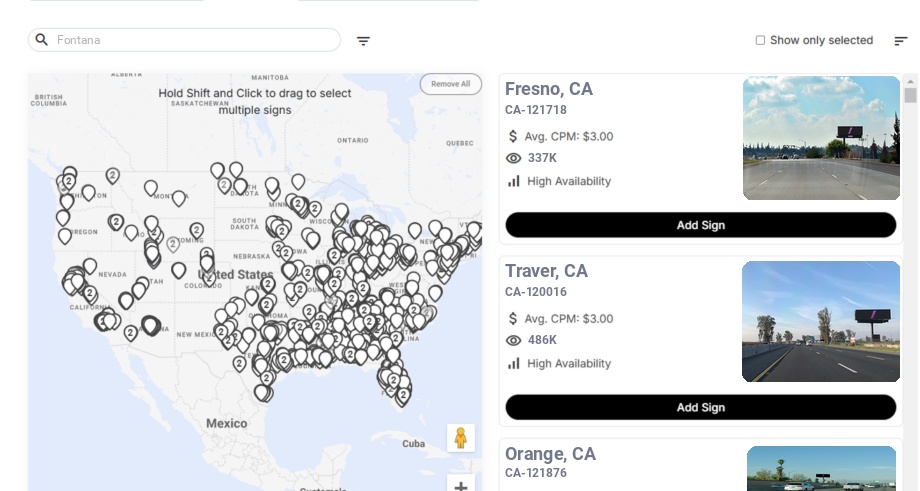
Blip has digital billboards in Fontana. You can browse available locations on a map, choose the ones that fit your audience, and start advertising right away.
Still have questions? Launch a campaign in minutes — no contracts, no commitments.
Start Your CampaignFontana Billboard Advertising Guide
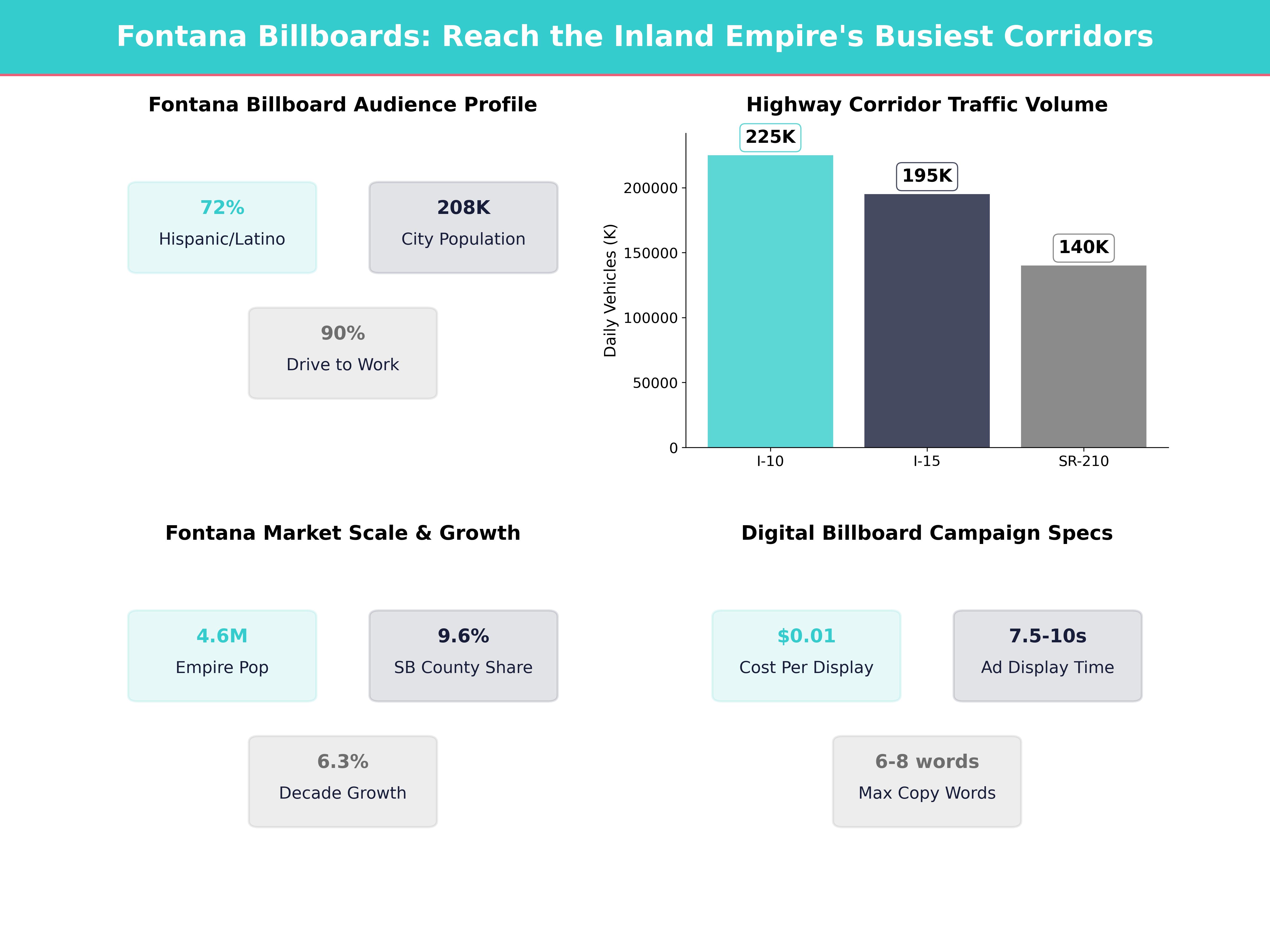
Fontana gives us one of the Inland Empire’s strongest billboard environments because it combines a large resident base with nonstop regional traffic on I-10, I-15, and State Route 210 corridors that routinely carry roughly 110,000 to 250,000 AADT on key segments. The city counted 208,393 residents in 2020, and it sits inside an Inland Empire market of 4,599,839 people across San Bernardino County and Riverside County. With Interstate 10, Interstate 15, and State Route 210 shaping daily movement, our messages reach drivers, shift workers, shoppers, and travelers in an area where commuting is overwhelmingly car-based, with roughly 9 in 10 employed residents using a car, truck, or van to get to work. Fontana also benefits from its proximity to Ontario International Airport
Fontana Market Overview
Fontana’s population, growth, and regional position
When we advertise in Fontana 196,069 residents in 2010 to 208,393 in 2020. That is a gain of 12,324 people, or 6.3% in one decade. Fontana alone represents about 9.6% of San Bernardino County’s 2,181,654 residents, and about 4.5% of the Inland Empire’s 4,599,839 residents across the two-county region. In practical terms, that means one Fontana campaign can influence both city-level buyers and a much larger commuter shed.
The city’s demographics also make billboard creative especially important. 2020 Census figures show that about 72% of Fontana residents identify as Hispanic or Latino, which gives bilingual and culturally fluent messaging real value. Fontana is also known as a family-oriented market, and that shows up in Fontana Unified School District’s 35,000-plus students, youth sports participation, neighborhood retail demand, and healthcare usage. For advertisers, this is a strong combination of scale, cultural clarity, and everyday spending categories.
What Fontana’s mobility and economy mean for billboard advertisers
Fontana functions as a classic Southern California driving market. Recent American Community Survey estimates indicate that roughly 9 in 10 employed residents commute by car, truck, or van, whether they drive alone or carpool. That level of auto dependence matters because billboard performance improves when audiences see the same message repeatedly on habitual routes.
The local economy broadens our reach beyond residents alone. Ontario International Airport 6,430,033 passengers in 2023, up from 5,581,378 in 2022, which was an increase of 15.2%. The nearby Ontario Convention Center offers more than 225,000 square feet of meeting and exhibit space, and Kaiser Permanente Fontana Medical Center is a 314-bed hospital campus. Along with the region’s logistics base, employers, event venues, schools, and shopping districts in Ontario, Rancho Cucamonga, Rialto San Bernardino
Key Traffic Corridors for Fontana Billboards
Interstate 10 in Fontana
According to Caltrans traffic census data, Fontana-area segments of Interstate 10 regularly fall in the 200,000 to 250,000 AADT range. That makes I-10 the broadest-reach east-west corridor in the market. It ties together Ontario, Rancho Cucamonga, Fontana Rialto San Bernardino
We typically like I-10 placements for advertisers that need scale more than hyperlocal precision.
- Retail, restaurants, and entertainment brands perform well on I-10 because the corridor reaches shoppers heading toward Ontario Mills Victoria Gardens, and other large destinations.
- Healthcare, legal, education, and financial services benefit from I-10 because commuters often see the same message multiple times per week and can act later.
- Recruiting and staffing campaigns work especially well on I-10 because the road serves large employment zones in south Fontana and the broader Inland Empire.
If our goal is regional awareness, I-10 should usually be in the first round of locations we evaluate.
Interstate 15 near Fontana
Interstate 15 is Fontana’s other essential billboard corridor. Caltrans counts near the Fontana area commonly run in the 170,000 to 220,000 AADT range, especially around the I-10 interchange and heavily traveled regional segments. I-15 carries north-south commuters, freight traffic, and long-distance leisure travelers moving between Corona, Jurupa Valley Fontana Rancho Cucamonga, Victorville, Hesperia
This corridor is especially strong when we want to catch people in travel mode or work mode.
- Quick-service restaurants, convenience stores, auto services, and fuel-related brands benefit because I-15 captures drivers who are actively making near-term travel stops.
- Hotels, attractions, event venues, and tourism brands gain value on I-15 because the highway serves weekend and holiday travelers moving toward mountain, desert, and Nevada destinations.
- Industrial suppliers, CDL recruiting, staffing agencies, and B2B services fit naturally here because the route is tightly connected to logistics movement.
If we are promoting something with urgency, utility, or travel relevance, I-15 often gives us some of Fontana’s best context.
State Route 210 and Fontana’s north-side access routes
State Route 210 helps us reach a different Fontana audience. Caltrans data generally place north Fontana segments of SR-210 in roughly the 110,000 to 170,000 AADT band. That is lower than I-10 and I-15, but the audience quality is excellent for suburban household decision-makers and daily commuters moving between Fontana Rancho Cucamonga, Upland, Rialto
We like SR-210 when we want to emphasize residential relevance rather than pure freeway scale.
- Home services, healthcare, childcare, schools, and family recreation benefit because north Fontana has strong neighborhood and household demand.
- Real estate, insurance, and financial services work well because commuters on SR-210 are often heading to or from established residential communities.
- Local retail and dining can perform well when the billboard is close enough to an exit or retail node to convert awareness into a visit.
Beyond the freeway, Sierra Avenue and Foothill Boulevard matter because they convert freeway exposure into local action. Foothill Boulevard is part of historic Route 66, and it remains one of Fontana’s best local commercial spines. Once drivers leave the freeway, those central corridors become valuable for clinics, restaurants, colleges, auto shops, and other businesses that need the audience to turn soon rather than remember later.
Audience Segments We Can Reach in Fontana
Commuters and logistics workers in Fontana
Fontana’s first billboard audience is the daily commuter. With roughly 90% of workers using cars, trucks, or vans to get to work, we can build frequency quickly on major routes. The city’s position along I-10 and I-15 also gives us access to logistics employees, warehouse supervisors, truck drivers, dispatch staff, and related service providers moving through south Fontana and the nearby airport-industrial belt.
This audience responds well to practical categories. Recruiting, banking, legal help, urgent care, quick dining, wireless plans, auto repair, and workwear all fit the rhythm of these trips. Shift-oriented messaging can be especially effective because workers often travel at predictable times outside the classic office commute.
Families and household decision-makers in Fontana
Fontana is also a high-value family market. Fontana Unified School District serves more than 35,000 students, which signals a large population of parents and caregivers making recurring decisions about food, healthcare, tutoring, sports, transportation, and home services. In a city where about 72% of residents are Hispanic or Latino, culturally familiar visuals and bilingual copy can improve resonance without making the ad feel overly complicated.
For this audience, we usually focus on usefulness and trust. Pediatric care, dental offices, grocery-oriented retail, family restaurants, after-school programs, youth activities, tax services, and neighborhood events all make sense. Billboards do particularly well when they simplify the next step, such as a nearby exit, a short URL, a recognizable intersection, or a strong value offer.
Students and early-career adults around Fontana
The student audience in and around Fontana is larger than many advertisers expect. Chaffey College serves more than 19,000 students, and California State University, San Bernardino enrolls more than 18,000 students. Combined, that gives the region a college audience of 37,000-plus students before we even count trade schools and adult education programs.
This segment matters for apartments, wireless service, career training, banking, retail, entertainment, food, and entry-level recruiting. Because students often travel between campuses, jobs, and home, freeway and arterial boards can reach them repeatedly without depending on one single neighborhood.
Travelers, shoppers, and event audiences near Fontana
Fontana also benefits from nearby visitor traffic. Ontario International Airport 6.43 million annual passengers create steady travel demand, while the Ontario Convention Center’s 225,000-plus square feet of event space brings business visitors year-round. Entertainment adds another audience layer through Toyota Arena, Ontario Mills Victoria Gardens, and Glen Helen Amphitheater, which has capacity for about 65,000 concertgoers.
When we want regional shoppers, event attendees, or out-of-town guests, Fontana boards can function as intercept media. They catch people before they choose where to eat, stay, shop, or stop.
Seasonal and Timing Opportunities in Fontana
Back-to-school timing in Fontana
Late July through September is one of the clearest seasonal windows in Fontana. Fontana Unified School District, Chaffey College, and California State University, San Bernardino all push families and students back into routine during this period. That makes it a strong time for healthcare, tutoring, orthodontics, kids’ activities, mobile plans, and school-adjacent retail.
A second education wave arrives in January when college schedules reset and many households revisit budgets, schedules, and goals. If we have a service that benefits from “fresh start” behavior, Fontana’s school calendar gives us two reliable launch windows every year.
Holiday retail and freight in the Fontana market
From October through December, Fontana’s freight-heavy geography becomes even more useful for billboard advertisers. Retail traffic rises near Ontario Mills Victoria Gardens, and airport access routes, while delivery and warehouse activity intensify along I-10 and I-15. That is a strong setup for staffing, shipping services, restaurants, seasonal entertainment, gift-oriented retail, and storage offers.
If we are advertising to shift workers, holiday staffing periods can justify heavier weekday and evening schedules. If we are advertising to shoppers, weekend runs near retail corridors often make more sense.
Summer travel, heat, and entertainment around Fontana
Summer in the Inland Empire brings sustained heat, school break, and more discretionary travel. That combination favors indoor entertainment, beverages, HVAC, auto maintenance, healthcare, and family attractions. It also aligns well with concert and event travel tied to Glen Helen Amphitheater, Toyota Arena, and regional road trips.
We also like summer for tourism-adjacent messaging. Drivers heading toward mountain communities, desert resorts, or weekend entertainment are more likely to respond to simple, immediate offers than to abstract brand lines.
Winter mountain traffic and new-year campaigns from Fontana
In winter, Fontana becomes a practical gateway for mountain-bound traffic heading toward Big Bear Mountain Resort, Snow Valley Mountain Resort Visit Big Bear. Snow weekends can create excellent conditions for coffee shops, tire and auto services, urgent care, sporting goods, and lodging campaigns. Friday afternoons and early Saturday mornings are often the most relevant windows for that travel behavior.
January also supports a different style of campaign. Fitness, tax preparation, career training, healthcare checkups, and financial services all benefit when households are resetting habits and budgets after the holidays.
Billboard Design Tips for the Fontana Market
Creative that feels local in Fontana
Fontana creative should look and sound like the Inland Empire, not like a generic national template. Because about 72% of residents are Hispanic or Latino, bilingual or Spanish-forward variants are often worth testing, especially for healthcare, retail, family dining, and community services. We do not need to over-translate every ad, but we should seriously consider whether the audience will connect faster in English, Spanish, or a blended approach.
Local cues also matter. Visuals that reference family life, movement, mountains, work, vehicles, or historic Route 66 usually feel more native than abstract branding. If we are targeting auto services or adjacent categories, Fontana’s motorsports identity around Auto Club Speedway
Message structure for Fontana’s fast roads
Fontana is a speed market. On I-10, I-15, and SR-210, drivers have only a few seconds to absorb the message, so 6 to 8 words of primary copy usually outperform a longer sentence. Clear action cues such as “Next Exit,” “2 Miles Ahead,” “Open Late,” or “Hiring All Shifts” work well because they match the audience’s actual decision moment.
We should also design for bright Inland Empire daylight. High-contrast color palettes, thick type, large logos, and a single offer line tend to hold up better than delicate layouts. Because each digital ad display lasts only 7.5 to 10 seconds, one idea per board is usually enough.
Offers and imagery that resonate in Fontana
The best Fontana creative usually emphasizes value, convenience, and proof. Family meal bundles, same-day appointments, bilingual service, nearby locations, and weekend hours all fit local behavior. Recruiting ads often do better when they mention the type of work, the shift, or the hiring urgency rather than relying on vague employer branding.
We should also tailor imagery by corridor. A recruiting ad on I-10 can show workers, equipment, or shift relevance. A family-focused ad on SR-210 can show parents and kids. A local service ad near Sierra Avenue should emphasize distance, exit, and immediacy.
Regional Strategies Across Fontana
North Fontana and the SR-210 growth corridor
North Fontana is where we often focus for commuter families, home services, healthcare, and neighborhood retail. The SR-210 corridor reaches residents moving between Fontana, Rancho Cucamonga, Upland, and Rialto
Central Fontana around Sierra Avenue and Foothill Boulevard
Central Fontana works best when we want local intent. Sierra Avenue, Foothill Boulevard, the Metrolink
South Fontana and the I-10 logistics belt
South Fontana is the workhorse strategy for industrial, recruiting, and utility-driven advertising. This submarket connects directly to warehouse campuses, freight routes, and the broader employment network stretching into Ontario, Bloomington, and Jurupa Valley
Westbound regional reach toward Ontario and Rancho Cucamonga
If we want Fontana awareness plus regional visitor overlap, we should think beyond city limits and include the westbound trade area. The I-10 and I-15 crossroads near Ontario and Rancho Cucamonga connect airport traffic, convention traffic, major shopping, and arena activity. That strategy is especially useful for hotels, events, attractions, healthcare systems, colleges, and brands that want reach across multiple Inland Empire cities at once.
Using Blip Tools and Capabilities in Fontana
Dayparting Fontana around real travel patterns
Fontana rewards time-based scheduling. We can put more budget into weekday commute windows such as 6:00 to 9:00 a.m. and 3:00 to 7:00 p.m. when our audience is commuter-heavy. We can also shift spend toward 9:00 p.m. to midnight or early morning windows when we want warehouse and shift-worker relevance. For mountain travel or event-driven campaigns, Friday afternoons and weekend mornings often deserve their own schedule.
This flexibility matters in Fontana because the audience changes by corridor and by hour. I-10 at rush hour does not behave the same way as I-15 on a holiday weekend.
Testing creative and geography without overcommitting
Fontana is a great market for experimentation because several distinct corridors sit close together. Instead of committing everything to one board, we can test 2 or 3 creative versions across 2 or 3 location types, such as I-10, I-15, and SR-210, and then watch which combination produces the best lift. We can also rotate English and Spanish variants, family and recruiting variants, or local-offer and brand-message variants.
Because Blip gives us map-based selection, flexible budget control, and real-time reporting, we can refine a Fontana campaign while it is live instead of waiting for a long fixed cycle to end. The built-in artwork tools also make it easier to create localized versions for retail openings, event dates, hiring pushes, or short seasonal runs.
Getting Started with Billboard Rental in Fontana
Start with a clear Fontana objective
Before we rent any billboard in Fontana, we should decide whether the goal is awareness, store traffic, recruiting, event attendance, or lead generation. That choice changes everything. A restaurant trying to drive nearby visits should not buy Fontana the same way a healthcare system, a staffing agency, or a regional college would.
If we are new to the market, starting with 3 to 5 boards across more than one corridor is often a smart way to learn. That structure lets us compare local-intent placements against broad-reach freeway placements without locking ourselves into a single assumption.
Evaluate Fontana billboard locations the practical way
When we compare locations, we should think like a local driver rather than like a media spreadsheet.
- We should check the direction of travel because westbound morning traffic and eastbound evening traffic often represent different decision moments.
- We should measure how close the board is to the destination, and a location within 1 to 3 miles of the exit or business is often better for immediate action than a farther-away face.
- We should match the corridor to the audience, because I-10, I-15, SR-210, and central arterials each carry different intent.
- We should note nearby anchors such as Ontario Mills Kaiser Permanente Fontana Medical Center, Chaffey College, Toyota Arena, or major warehouse zones, because those anchors help explain why traffic is there.
- We should give the campaign enough time to build repetition, because commuter markets usually respond after multiple exposures rather than one perfect impression.
How Blip simplifies billboard rental in Fontana
Traditional billboard buying in a market like Fontana can be slow, opaque, and difficult to fine-tune once the campaign starts. Blip simplifies that process by letting us choose boards on a map, control timing, adjust budget, and launch without a contract-heavy workflow. Since we pay only when the ad displays, and pricing can start at $0.01 per display, we can enter the market carefully, learn quickly, and scale what works.
That model is especially useful in Fontana because the city has several distinct advertising environments packed into one geography. We can run commuter-heavy freeway boards, family-oriented north Fontana boards, and local-intent central Fontana boards at the same time, then optimize based on what the market tells us. For advertisers who want reach in the Inland Empire without the rigidity of traditional outdoor buying, Fontana is one of the best places to start.