Billboards in San Bernardino, CA
No Minimum Spend. No Long-Term Contracts. Just Results.
Trusted by Leading Brands


Billboard advertising
in San Bernardino has never been easier
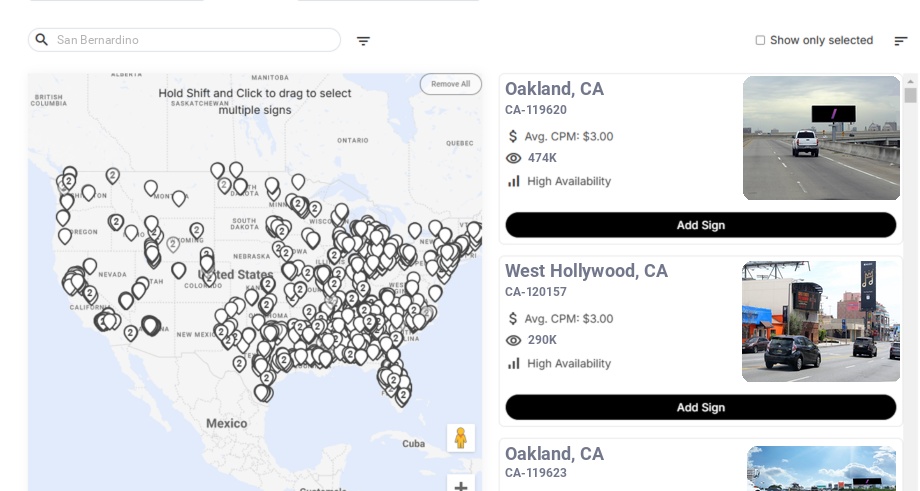



How much is a billboard in San Bernardino?
Why Choose Blip for Billboard Advertising in San Bernardino
Blip lets San Bernardino brands launch fast on I-10, I-215, and SR-210—perfect for daily commuter and freight traffic.
In San Bernardino, set a flexible budget with Blip and test value offers for cost-conscious families without long contracts.
Daypart your San Bernardino ads around early commutes, 3:30–7 p.m. peaks, or weekend Orange Show crowds for better relevance.
Blip's real-time analytics help San Bernardino advertisers track what works on freeway and Hospitality Lane traffic, then optimize fast.
Use Blip's creative tools to make bold bilingual San Bernardino billboards that connect with local Hispanic families and students.
Frequently Asked Questions About Billboard Advertising in San Bernardino
How much does a billboard cost in San Bernardino, California with Blip?
With Blip, you control exactly how much you spend on San Bernardino billboards by setting a daily budget that can be adjusted anytime, so you only pay for the 7.5–10 second “blips” your ad actually receives. Costs per blip change based on when and where your ad appears and current advertiser demand, making digital billboards in San Bernardino, California flexible for any budget. Over time, your total cost is simply the sum of those individual blips, giving you clear control over your spend.
Where should I advertise with Blip in San Bernardino for freeway traffic?
San Bernardino’s road network is dominated by three major freeways and a set of busy surface streets, and many segments carry 150,000–220,000 vehicles per day. I‑10 is one of California’s main east‑west arteries and has several segments through San Bernardino exceeding 200,000 vehicles per day. I‑215 cuts directly through downtown San Bernardino, while SR‑210 serves as a major east‑west bypass along the northern edge of the valley.
What kind of audience can I reach with San Bernardino billboards?
San Bernardino is the historic core of the Inland Empire and anchor of a vast logistics and commuter region, with the City of San Bernardino itself having just over 220,000 residents and San Bernardino County having more than 2.2 million residents. Around 65–70% of residents identify as Hispanic or Latino, and more than 50–60% of households speak a language other than English at home, predominantly Spanish. The city also has a young, family-heavy population, with a median age around 31–32 years.
When is the best time to run Blip ads in San Bernardino?
Morning peaks can start before 6:30 a.m. and extend past 9:00 a.m. along I‑10 and I‑215, while evening peaks generally run from 3:30 p.m. to 7:00 p.m., sometimes later on Fridays. Summer is a strong time for indoor, air-conditioned activities and cooling products, while outdoor recreation and travel toward the mountains, lakes, and desert spikes on weekends. Mild winters keep road volumes relatively steady year-round, so there is no major winter slowdown like in snow-belt cities.
What neighborhoods or routes in San Bernardino are good for local billboard advertising?
For local retail and restaurants, the page recommends focusing on boards near Hospitality Lane, downtown, and neighborhood arterials where repeated exposures build strong local frequency. Hospitality Lane / Waterman Avenue is dense with restaurants, hotels, and retail, while Baseline Street, Highland Avenue, and E Street are busy local connectors used heavily by residents for daily errands and school access. University Parkway / Kendall Drive is also important because it serves California State University, San Bernardino and nearby student traffic.
Do I need a contract to advertise with Blip in San Bernardino?
No, Blip has no long-term contracts or minimum commitments. You can start, pause, or stop your campaign at any time.
How fast can I launch a billboard campaign with Blip in San Bernardino?
You can have your campaign live in minutes. Create a free account, select your locations, set your budget, upload your design, and start running once approved.
Where can I advertise with Blip in San Bernardino?
Blip has digital billboards in San Bernardino. You can browse available locations on a map, choose the ones that fit your audience, and start advertising right away.
Still have questions? Launch a campaign in minutes — no contracts, no commitments.
Start Your CampaignSan Bernardino Billboard Advertising Guide
San Bernardino sits at the crossroads of Southern California freight, commuting, and culture. With more than 2.2 million people in the surrounding county and heavy daily traffic on I‑10, I‑215, and SR‑210, digital San Bernardino billboards in this market give us powerful reach into both local residents and pass‑through travelers. Below, we outline how to design, target, and time digital billboard campaigns in San Bernardino using Blip’s tools to capture this unique audience and get the most from San Bernardino billboard advertising.

Understanding the San Bernardino Market
San Bernardino is the historic core of the Inland Empire and anchor of a vast logistics and commuter region. The City of San Bernardino San Bernardino County reports more than 2.2 million residents across its 20,000+ square miles, making it the largest county in the U.S. by land area and one of California’s largest by population. The city covers about 62 square miles, with a population density near 3,500–3,700 residents per square mile, giving advertisers a dense, drive‑heavy audience that responds well to highly visible billboards in San Bernardino.
Key characteristics that matter for billboard advertisers:
-
Young, family‑heavy population
- Median age in the city is roughly 31–32 years, several years younger than the California median of about 37 years.
- In many neighborhoods, 35–40% of households include children under 18, and household sizes average 3.4–3.7 people, higher than the statewide average of about 2.9.
- Multi‑generational homes are common, with 10–15% of households including grandparents and grandchildren.
-
Predominantly Hispanic/Latino audience
- Around two‑thirds of residents (about 65–70%) identify as Hispanic or Latino, with some city tracts exceeding 80%.
- In several local elementary and high schools, Hispanic/Latino enrollment is over 80–90%, reflecting a deeply rooted culture across generations.
- Spanish‑language and bilingual messaging can dramatically increase relevance and response for San Bernardino billboard advertising campaigns.
-
Commuter and logistics hub
- The Inland Empire has grown by more than 30% in population since 2000, and a significant share of residents commute to jobs across the metro.
- Regional planning agencies report average one‑way commute times in the 32–35 minute range for many San Bernardino workers, with more than 25–30% commuting over 45 minutes.
- The Inland Empire is one of the nation’s leading warehousing and logistics centers, with over 700 million square feet of industrial space region‑wide, according to regional economic development organizations like the Inland Empire Economic Partnership
- The San Bernardino International Airport
- Thousands of workers travel daily along I‑10, I‑215, and SR‑210, giving billboards excellent weekday reach into working‑age adults.
-
Income and price sensitivity
- Median household income in the City of San Bernardino is in the $55,000–$60,000 range, compared with a California median closer to $90,000.
- In some neighborhoods, median incomes fall below $45,000, while countywide medians trend around $75,000–$80,000, highlighting strong intra‑regional differences.
- Poverty rates in the city are in the 23–27% range—roughly double the statewide rate—making price, promotions, and perceived value central to buying decisions.
- Renters make up 55–60% of households, and more than 45% of renters are “cost‑burdened” (spending over 30% of income on housing), reinforcing the need for value‑oriented offers.
When we use Blip to advertise in San Bernardino, we’re not just reaching one city; we’re tapping into the daily life of the larger Inland Empire—commuters driving to warehouse jobs, families running errands, students heading to campuses, and regional visitors attending events and attractions promoted by agencies like the City of San Bernardino tourism and recreation programs. That reach is what makes targeted San Bernardino billboards such a strong complement to other local media.
Key Traffic Corridors and Placement Strategy
San Bernardino’s road network is dominated by three major freeways and a set of busy surface streets. Understanding how each behaves helps us choose the right boards and dayparts for effective billboard rental in San Bernardino.
Regional transportation agencies such as the San Bernardino County Transportation Authority (SBCTA) and Caltrans District 8 report consistently heavy volumes across the city’s main corridors, with many segments carrying 150,000–220,000 vehicles per day. This translates into millions of weekly impressions for well‑placed digital billboards in San Bernardino.
1. I‑10 (San Bernardino Freeway)
- One of California’s main east‑west arteries, connecting Los Angeles to the Inland Empire and on to Arizona.
- Caltrans District 8 reports annual average daily traffic (AADT) on I‑10 through San Bernardino exceeding 200,000 vehicles per day in several segments (Caltrans District 8). Some nearby stretches in the Inland Empire surpass 230,000 vehicles per day, placing them among the busiest in Southern California outside Los Angeles.
- Peak travel directions shift by time of day: heavier westbound toward Los Angeles in the mornings and eastbound back into the Inland Empire in evenings.
- Best for: regional reach, long‑haul commuters, logistics workers, travelers headed to/from Palm Springs and the Coachella Valley, and visitors using I‑10 to reach local venues and shopping.
2. I‑215 (Escondido Freeway)
- Runs north‑south, cutting directly through downtown San Bernardino and connecting with Riverside and the High Desert.
- AADT commonly ranges from about 160,000–180,000 vehicles per day in city segments, with some bottleneck areas seeing peak‑hour speeds drop below 30 mph.
- SBCTA congestion studies show that certain I‑215 segments operate at or near capacity for 3–4 hours during weekday peak periods, creating long exposure times for drivers.
- Best for: downtown businesses, services near the civic core, events at the National Orange Show Event Center ( noscenter.com
3. SR‑210 (Foothill Freeway)
- A major east‑west bypass along the northern edge of the valley, connecting to Rancho Cucamonga, Upland, and beyond.
- Typical AADT is often in the 130,000–150,000 vehicles per day range, with sustained speeds but long travel distances that increase total impressions per driver.
- This corridor pulls in a higher share of commuters from foothill communities, where household incomes are typically 15–30% higher than in the city core.
- Best for: reaching higher‑income commuters from the foothill communities and those bypassing the more congested I‑10 corridor, plus regional visitors heading toward the San Bernardino Mountains and local recreation areas.
4. High‑impact arterial roads
Local arterials carry 20,000–40,000 vehicles per day on many segments, with slower speeds that favor digital billboard readability and QR‑code tests:
- Hospitality Lane / Waterman Avenue: Dense with restaurants, hotels, and retail; captures business travelers and lunch/dinner traffic. Hospitality Lane functions as a de facto restaurant row for the region, serving nearby office parks, hotels, and travelers exiting I‑10 and I‑215.
- Baseline Street, Highland Avenue, and E Street: Busy local connectors used heavily by residents for daily errands, bus routes, and access to schools. Many stretches see 1,000–2,000 vehicles per hour during weekday peaks.
- University Parkway / Kendall Drive: Primary routes for students and staff heading to California State University, San Bernardino (CSUSB), which enrolls about 19,000 students and employs thousands of faculty and staff. During the academic year, CSUSB reports that more than 80% of students commute, heavily loading nearby roads at class‑change times.
- Transit corridors: Omnitrans, the local transit agency, carries roughly 9–10 million annual trips system‑wide, much of it along these same arterials, reinforcing their role as everyday commercial corridors.
With Blip, we can selectively run on boards that align with these corridors:
- For region‑wide brands (auto dealers, insurance, large retailers), prioritize I‑10 and I‑215 boards to tap into the hundreds of thousands of daily freeway trips and maximize the impact of your San Bernardino billboard advertising.
- For local retail and restaurants, focus on boards near Hospitality Lane, downtown, and neighborhood arterials where repeated exposures build strong local frequency.
- For education or youth‑focused campaigns, weight impressions toward boards near CSUSB, San Bernardino Valley College, and major high schools, which together put tens of thousands of students on surrounding roads on a typical weekday.
Demographics and Cultural Insights for Better Messaging
San Bernardino’s social and cultural profile is distinct from nearby coastal cities, and our creative should reflect that to get the strongest response from San Bernardino billboards.
Ethnicity and language
- Approximately 65–70% of residents identify as Hispanic or Latino, with non‑Hispanic White residents making up roughly 10–15%, and smaller but growing Black, Asian, and multi‑racial communities.
- More than 50–60% of households speak a language other than English at home, predominantly Spanish; in some neighborhoods, Spanish‑speaking households exceed 70–75%.
- Around 25–30% of residents are foreign‑born, and a sizable share are first‑ or second‑generation Mexican‑American.
Implications for campaigns:
- Use bilingual or Spanish‑first creatives when targeting family services, local retail, healthcare, financial services, and community‑oriented offers.
- Even a simple dual‑language approach (“Big Sale Today / Gran Venta Hoy”) can significantly improve recognition and response, especially in corridors where Spanish‑dominant households exceed 60%.
- Consider culturally resonant imagery: family gatherings, youth sports, local neighborhoods, or subtle nods to Mexican‑American heritage without stereotypes. Campaigns that emphasize community, family pride, and opportunity often perform better than purely status‑driven messaging.
Age and life stage
- Median age around 31–32 years means a large share of young families, early‑career workers, and students, compared with coastal markets where median ages push toward the mid‑35s or higher.
- Roughly 30% of residents are under 18, and about 10–12% are college‑age (18–24), creating strong demand for education, entry‑level jobs, and family‑related services.
- Schools and colleges (CSUSB, San Bernardino Valley College, numerous high schools) add tens of thousands of students to the daily on‑road population, particularly during the August–May academic season.
Implications:
- Emphasize family value, career advancement, and education‑related offers.
- For younger audiences, keep messages bold, direct, and mobile‑friendly (e.g., easy URLs, short vanity domains, or QR‑coded follow‑ups where boards allow).
- Highlight quick, clear benefits: “Start a New Career in 9 Months,” “Free Kids’ Meals,” “Enroll Online in 5 Minutes.”
Income and household economics
- Median household income in many San Bernardino neighborhoods is significantly below the California median, with some tracts under $45,000 and others closer to $70,000, reflecting a patchwork of working‑class and emerging middle‑class areas.
- About 15–20% of residents lack health insurance, and many are under‑insured, creating strong interest in urgent care, low‑cost clinics, and discount dental.
- Cost of living pressures and long commutes shape buying behavior; discounts and practical benefits matter, and subscription or financing models need to be easy to understand and clearly affordable.
Implications:
- Highlight price, promotions, and financing options (“Payments from $199/mo,” “Kids eat free Tuesdays,” “No‑cost consultation”).
- Make calls‑to‑action simple and frictionless: “Exit Waterman – 0.5 miles,” “Apply today at [Brand].com,” “Text SBDEAL to [short code].”
- Use specific numbers where possible—“Save $50 Today,” “Up to 30% Off for Local Residents”—since concrete savings can convert cost‑conscious shoppers more effectively.
Timing and Seasonality in San Bernardino
San Bernardino’s climate, event calendar, and commuting patterns all influence the best times to run our Blip campaigns and structure billboard rental in San Bernardino for maximum return.
Climate considerations
- Summer daytime highs frequently reach 95–105°F, with heat waves above 110°F not uncommon in July–August. On average, San Bernardino experiences 60+ days per year above 90°F.
- Winters are mild, with average daytime highs in the 60s–70s°F and nighttime lows often in the 40s°F, and more than 270 sunny days per year, according to regional climate summaries from agencies like the National Weather Service’s local office.
- Minimal weather‑related freeway closures in the valley floor mean traffic volumes remain relatively stable year‑round, with only modest dips around major holidays.
How this affects billboard strategy:
- Summer: people are more likely to seek indoor, air‑conditioned activities and cooling products. Campaigns for HVAC, ice cream/coffee chains, malls, and indoor entertainment can perform well, especially when paired with heat‑relief messaging (“Beat 105° Heat – Visit Us Today”).
- Outdoor recreation and travel toward the mountains, lakes, and desert spikes on weekends, making Friday–Sunday billboards attractive for tourism‑oriented brands.
- Mild winters keep road volumes relatively steady year‑round, so there’s no major winter slowdown like in snow‑belt cities—advertisers can sustain campaigns through Q1 and Q4 without losing reach.
Commuting and dayparting
- Inland Empire workers often commute early and late to avoid traffic. Morning peaks can start before 6:30 a.m. and extend past 9:00 a.m. along I‑10 and I‑215.
- Evening peaks generally run from 3:30 p.m. to 7:00 p.m., sometimes later on Fridays, with certain corridors seeing heavy volumes until 7:30–8:00 p.m.
- SBCTA data indicate that over half of workers commute outside their home city, and roughly one‑third leave the county, which makes freeway billboards particularly effective for cross‑city and regional brands.
With Blip’s dayparting tools, we can:
- Focus commuter‑oriented offers (auto service, coffee, quick breakfast, traffic apps, radio stations) on early morning and late afternoon blips along freeways.
- Emphasize family dining, retail, and entertainment in the late afternoon and evening along Hospitality Lane and neighborhood arterials, when families are returning from work and school.
- Use midday rotations to reach shift workers, stay‑at‑home parents, and seniors running errands, especially along arterials and near shopping centers.
- Consider late‑night (9 p.m.–midnight) bursts for quick‑service restaurants, convenience stores, and entertainment venues that see strong post‑9 p.m. traffic, particularly on Fridays and Saturdays.
Events and local rhythms
San Bernardino hosts regular events that spike traffic and local enthusiasm:
- National Orange Show Fair & events at the National Orange Show Event Center 10,000–30,000 attendees over multi‑day periods.
- Inland Empire 66ers baseball at San Manuel Stadium April–September season, with annual home attendance typically reaching into the six‑figure range ( Inland Empire 66ers
- Car culture and Route 66‑themed activities still resonate, drawing classic‑car enthusiasts on weekends along historic corridors like Foothill Boulevard.
- Regional shopping peaks around back‑to‑school (late July–August), Black Friday, and December holidays; retail sales data for San Bernardino County routinely show double‑digit percentage spikes in these periods compared with off‑season months.
- Tax refund season (February–April) often brings heightened spending on cars, furniture, major home purchases, and local travel, with national and regional studies indicating that 20–30% of refunds are used for big‑ticket or deferred purchases.
We can use Blip’s flexible budgeting to ramp up impressions:
- 2–3 weeks before major events, to build anticipation and brand association along main access routes and near venues.
- During key retail windows (back‑to‑school, Black Friday, tax season) with strong offer‑driven creatives, aiming to ride the natural 10–40% lift in consumer spending seen in these periods.
- Immediately around local news moments picked up by outlets like the San Bernardino Sun or The Press-Enterprise—for example, new store openings, citywide initiatives promoted by the City of San Bernardino
Creative Best Practices for San Bernardino Billboards
The right message and design can make the difference between a forgettable impression and a measurable response. For San Bernardino, we recommend:
1. Simple, bold, and bilingual where relevant
- Use 7 words or fewer in your main headline; at 60–65 mph, drivers typically have 5–8 seconds to process a message.
-
If you include Spanish, keep both English and Spanish short and direct; prioritize legibility over clever wordplay.
- Example: “Low‑Cost Braces / Brackets a Bajo Costo”
- Example: “Rent Today / Renta Hoy – Exit Waterman”
- Use high‑contrast color combinations (e.g., white or yellow text on dark backgrounds) to maintain readability during bright, sunny days, which account for three‑quarters or more of the year.
2. Value‑forward messaging
Given local income levels and cost‑consciousness:
- Lead with specific offers: “Oil Change $39.99,” “Enroll from $99,” “$0 Down, Bad Credit OK.”
- Reinforce savings with numbers: “Save Up to 40%,” “2‑for‑1 Tuesdays,” “First Month Free.”
- Highlight limited‑time promotions (“This Week Only,” “Ends Sunday”) around paydays—many local workers are paid biweekly or on the 1st/15th, when discretionary spending temporarily increases.
3. Community‑oriented visuals
- Highlight families, students, workers in realistic local settings (streetscapes similar to downtown, foothill neighborhoods, or warehouse districts).
- Avoid overly “luxury coastal” imagery that may feel disconnected from local reality; emphasize authenticity, community, and practicality instead.
- Incorporate local landmarks subtly—mountain skylines, Route 66 references, or nods to the San Bernardino Mountains and nearby recreation areas promoted by regional tourism sites
- For campaigns aligned with civic or nonprofit initiatives, consider visual alignment with city branding used by the City of San Bernardino
4. Clear directions and proximity cues
Many San Bernardino billboard viewers are in their cars heading to the next errand or outing.
- Use exit‑based CTAs: “Exit Tippecanoe – 0.7 Miles,” “Next Right on Hospitality.”
- Include approximate drive times where helpful: “5 Minutes from This Exit,” “2 Miles Ahead on E Street.”
- For local businesses, mention neighborhood names: “Near Downtown,” “By CSUSB,” “Across from Inland Center Mall.” Linking to well‑known hubs like Inland Center Mall or downtown landmarks helps anchor your message.
5. Mobile‑friendly follow‑up
People can’t click a billboard, but they can act later:
- Use short, memorable URLs or branded domains: “Visit SBLoans.com.”
- Utilize concise, easy‑to‑remember codes: “Text ‘SBDEAL’ to 12345.”
- If a board location allows, a well‑sized QR code can work at low speeds (surface streets and near parking areas), but avoid it on high‑speed freeways where vehicles travel 55–70 mph and scan times are too short.
- Pair billboard campaigns with geo‑targeted mobile ads in the same ZIP codes (e.g., 92401, 92404, 92407) to reinforce recall and drive multi‑touch conversions.
Using Blip’s Tools Strategically in San Bernardino
Blip’s pay‑per‑blip model lets us treat San Bernardino like a set of overlapping micro‑markets rather than a single, monolithic city, and it simplifies digital billboard rental in San Bernardino for businesses of all sizes.
Location targeting
-
Select only the boards that align with your audience:
- Freeway boards for regional reach and commuters traveling between Los Angeles, Riverside, San Bernardino, and the High Desert.
- Surface‑street boards near specific ZIP codes, schools, or shopping corridors for tighter neighborhood targeting.
- For example: a dental office serving families around north San Bernardino might concentrate on SR‑210 and University Parkway boards, whereas a hospitality brand might invest more heavily along I‑10 near Hospitality Lane and the National Orange Show.
- If you serve tourists or weekend visitors heading to nearby mountain or desert destinations, focus on Friday–Sunday impressions on I‑10, I‑215, and SR‑210, especially near interchanges that connect to mountain routes.
Dayparting
-
Schedule blips by hour of day and day of week:
- Weekday AM/PM commute blocks for B2B services, logistics staffing, construction supplies, or radio stations.
- Midday weekdays for healthcare, errands, and quick‑service restaurants, when stay‑at‑home parents, retirees, and shift workers are on the road.
- Weekend afternoons/evenings for entertainment, restaurants, churches, and events.
- Late night (where appropriate) for fast food, convenience stores, and gaming or hospitality destinations.
- Use different creatives by daypart: value‑driven breakfast offers in the morning, family bundles in the evening, and nightlife or entertainment messaging after 9 p.m.
Budget flexibility
- Start with a modest daily budget to test multiple creatives across a mix of boards—for example, $10–$50 per day spread across a handful of locations.
- Increase spend on the top‑performing routes and times once you see patterns in response (e.g., more calls, walk‑ins, or site traffic from the targeted ZIPs).
- Use short, intense bursts (3–7 days) around specific promotions or events to create a “mini‑takeover” effect without a large traditional billboard contract.
- Consider ramping up budgets around payday cycles (1st/15th or biweekly Fridays) when consumers are more likely to make discretionary purchases.
A/B testing creatives
-
Run two or three variations side‑by‑side:
- English‑only vs. bilingual.
- Price‑focused vs. benefit‑focused.
- Different images or color schemes (e.g., family‑centric vs. product‑centric).
- Track responses using unique URLs, phone extensions, or promo codes tied to each creative to see what resonates best.
- Evaluate early results over at least 2–4 weeks, since many buyers in this market are planning around paycheck timing and may respond with a slight delay after first exposure.
Vertical-Specific Tips for San Bernardino Advertisers
Different industries can lean into particular local dynamics when planning billboards in San Bernardino.
Local retail and restaurants
- Concentrate budgets around Hospitality Lane, Inland Center Mall, downtown, and major arterials where daily traffic reaches 20,000–40,000 vehicles on many segments.
- Run creatives with weekday lunch specials 10 a.m.–2 p.m., and family dinner offers 4–8 p.m., aligning with local work schedules and school dismissal times (often 2–4 p.m.).
- Use both English and Spanish if your customer base is mixed, especially in areas where Spanish‑speaking households exceed 60%.
- Tie in with local events—game nights at San Manuel Stadium, fairs at the National Orange Show, or downtown festivals listed on the City of San Bernardino events calendar
Automotive (sales, service, tires, detail)
- Leverage I‑10 and I‑215 boards with exit‑based directions and strong monthly payment or discount messaging; auto loans and leases often hinge on payment amounts under key thresholds (e.g., “Under $300/mo”).
- Inland Empire vehicle ownership rates are high—often 2+ vehicles per household—and many commuters drive long distances daily, creating demand for routine maintenance, tires, and fuel‑efficient vehicles.
- Consider weather‑linked creative (“Beat the Heat – A/C Check $79”) in summer and pre‑holiday road‑trip themes later in the year.
- Emphasize quick service for commuters: “Oil Change in 20 Minutes – Exit Waterman,” “No Appointment Needed – Open Until 8 p.m.”
Education and training
- Target SR‑210, I‑215, and routes close to CSUSB and San Bernardino Valley College for colleges, trade schools, and certification programs. Combined, these institutions serve tens of thousands of students each term.
- Highlight job outcomes and affordability: “Nursing Assistant in 9 Months,” “Financial Aid Available,” “Job Placement Support.”
- Given local income levels, emphasize flexible schedules (evening/weekend classes) and commuting convenience; many students work while studying.
- Coordinate messaging timing with application and enrollment windows (e.g., April–August for fall starts, October–January for spring) and reference local success stories when possible.
Healthcare, dental, and urgent care
- Focus on convenience and affordability: “Walk‑In Urgent Care,” “Open 7 Days,” “$0 Copay for Many Plans,” “Braces from $99/Month.”
- With 15–20% of residents uninsured and many more under‑insured, clear low‑cost packages and payment options resonate strongly.
- Use trust‑building visuals (providers, families, clean clinics) and bilingual messaging.
- Target residential corridors and boards close to medical clusters; coordinate with campaigns in local media and on sites like the City of San Bernardino
Events, venues, and attractions
- For venues like the National Orange Show, San Manuel Stadium, or local festivals, intensify campaigns in the 10–21 days leading up to the event, when ticket searches and social buzz typically spike.
- Use clear dates, ticket URLs, and simple benefits (“Live Music • Food • Family Fun,” “Fireworks Night – Friday 7 p.m.”).
- Focus on freeway boards leading into the city and arterials near the venue; adjust dayparts to emphasize evenings and weekends when most events occur.
- Promote nearby attractions—such as mountain recreation, local parks highlighted by San Bernardino County Regional Parks, or downtown cultural events—to capture both residents and out‑of‑town visitors.
Measuring and Optimizing Campaign Performance
To get the most from San Bernardino billboard campaigns with Blip, we should plan from the beginning to measure and iterate.
Set clear KPIs
- For local businesses: foot traffic, phone calls, appointments, coupon redemptions, and average ticket size. Even a 5–10% lift in weekly sales from targeted ZIP codes can signal success.
- For digital funnels: direct‑URL visits, branded search volume, landing page conversions, and call tracking data. Track changes in traffic from local ZIP codes (e.g., 92401–92415, 92423–92427).
- For awareness: survey lifts, social engagement from the targeted geography, and correlated sales increases during periods of heavy Blip activity.
Use trackable elements
- Unique phone numbers or call‑tracking extensions for billboard‑only ads. Businesses commonly see 10–30% of total calls shift to these numbers when billboards are performing well.
- Distinct promo codes like “SB10” for San Bernardino boards and “IE20” for wider Inland Empire campaigns.
- Special short URLs (e.g., Brand.com/SB) used only in billboard creative; monitor direct visits and QR‑driven sessions where applicable.
Correlate with geography and timing
- Watch for traffic spikes from ZIP codes around key routes like I‑10 near Waterman, I‑215 through downtown, or SR‑210 near University Parkway. Use basic analytics to compare these ZIPs with non‑advertised areas.
- Compare periods with heavy Blip schedules to “off” weeks to see whether there is a lift in inquiries or sales; even a 3–5% sustained increase can justify scaling up spend.
- Align reporting with local event calendars (e.g., National Orange Show dates, baseball homestands, holiday weekends) using information from sites like the City of San Bernardino San Bernardino Sun to understand which spikes are billboard‑driven versus event‑driven.
By combining San Bernardino’s unique demographic and traffic patterns with Blip’s granular control over locations, times, and budgets, we can build billboard campaigns that are both highly efficient and deeply relevant to the people who live and work here. With data‑driven planning, locally tuned creative, and continuous testing, digital billboards become one of the most powerful tools for reaching the Inland Empire audience at scale and making the most of billboard rental in San Bernardino.