Billboards in Upland, CA
No Minimum Spend. No Long-Term Contracts. Just Results.
Trusted by Leading Brands


Billboard advertising
in Upland has never been easier



How much is a billboard in Upland?
Why Choose Blip for Billboard Advertising in Upland
Blip lets you launch on Upland's I-10 and SR-210 corridors in minutes, reaching commuters moving between LA, the Inland Empire, and Ontario.
Set flexible budgets in Upland and only pay for the blips you need—ideal for testing Foothill Blvd and Downtown Upland traffic without overcommitting.
Use dayparting in Upland to hit school drop-off, commute peaks, or weekend shoppers near Euclid and Foothill when traffic is highest.
No contracts means Upland businesses can scale up for farmers markets, holiday events, or summer heat waves, then pause anytime.
Track Upland campaign results in real time and shift spend fast when I-10, SR-210, or local retail corridors start outperforming.
Blip's creative tools help Upland ads stand out with quick swaps for bilingual messaging, Route 66 references, and mountain-bound weekend traffic.
Frequently Asked Questions About Billboard Advertising in Upland
How much does a billboard cost in Upland, California with Blip?
With Blip, you can advertise on digital Upland billboards on any budget, because you choose a daily spend that Blip will automatically keep your campaign within and you can adjust it at any time. Each “blip” is a brief 7.5 to 10-second ad display, and you only pay for the blips you receive, similar to pay-per-click ads online. The price of individual blips on billboards in Upland, California varies based on when and where your ads run and current advertiser demand, so you stay in control of how much you invest.
Where are the best places to advertise with Blip in Upland, California?
Regional transportation agencies consistently rank I-10 and SR-210 among the Inland Empire’s heaviest-traveled freeways, making them prime inventory for awareness and response. Placing billboards in Upland along these routes lets brands tap into both local and regional traffic. Euclid Avenue and key intersections around Downtown Upland also see strong local traffic, with many residents passing the same billboard locations 10–20 times per week.
What kind of people do Upland, California billboards reach?
Upland is a mid-sized city with about 79,000 residents, within a daytime trade area that swells well above 100,000 when you factor in commuters, students, and visitors. The median household income is in the high-$80,000s, and the age profile is well balanced across families, young professionals, and older homeowners. A substantial share of residents are bilingual, with Spanish commonly spoken at home.
When is the best time to run billboards in Upland, California with Blip?
Timing depends on the audience you want to reach. Morning commuter campaigns work well from 5–10 a.m., while families and workers are a strong fit for 3–8 p.m., and late-night entertainment messaging can run from 8 p.m.–midnight. The page also notes that weekends, holidays, and event lead-up periods can create stronger spikes in attention and traffic.
Can Blip help target commuters and shoppers on Upland, California freeways?
Yes, Upland’s borders touch major commuter and shopping flows between Ontario, Rancho Cucamonga, Claremont, and other Inland Empire cities. Boards positioned along connecting routes like Base Line Road, Foothill Boulevard, and Mountain Avenue can reach thousands of daily cross-city commuters. Weekend retailer traffic can jump 30–50% compared with weekdays, making these corridors valuable for shopper-focused campaigns.
Do I need a contract to advertise with Blip in Upland?
No, Blip has no long-term contracts or minimum commitments. You can start, pause, or stop your campaign at any time.
How fast can I launch a billboard campaign with Blip in Upland?
You can have your campaign live in minutes. Create a free account, select your locations, set your budget, upload your design, and start running once approved.
Where can I advertise with Blip in Upland?
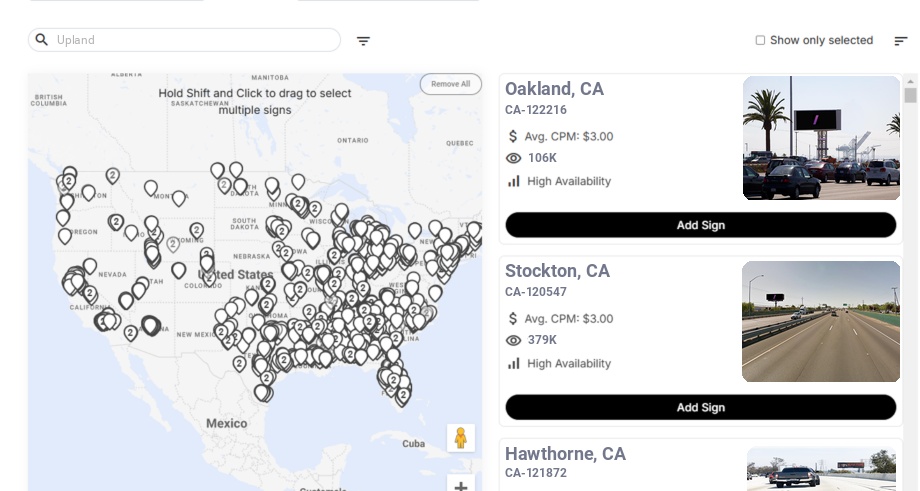
Blip has digital billboards in Upland. You can browse available locations on a map, choose the ones that fit your audience, and start advertising right away.
Still have questions? Launch a campaign in minutes — no contracts, no commitments.
Start Your CampaignUpland Billboard Advertising Guide
Upland sits at the western edge of San Bernardino County, right where the Inland Empire San Gabriel Valley Los Angeles, the mountains, and desert destinations. When we plan digital billboard campaigns in Upland with Blip, we can capitalize on these overlapping audiences with highly targeted timing, locations, and messages. Upland billboards are especially effective for brands that want to stay visible to drivers moving between these sub‑regions every day.
Understanding the Upland Market
Upland is a mid‑sized city with big‑city connectivity:
- Population: about 79,000 residents based on recent estimates, within a daytime trade area that swells well above 100,000 when you factor in commuters, students, and visitors.
- The broader San Bernardino County region has roughly 2.2–2.3 million people, giving Upland advertisers reach far beyond city limits and tapping into one of the fastest‑growing large counties in California.
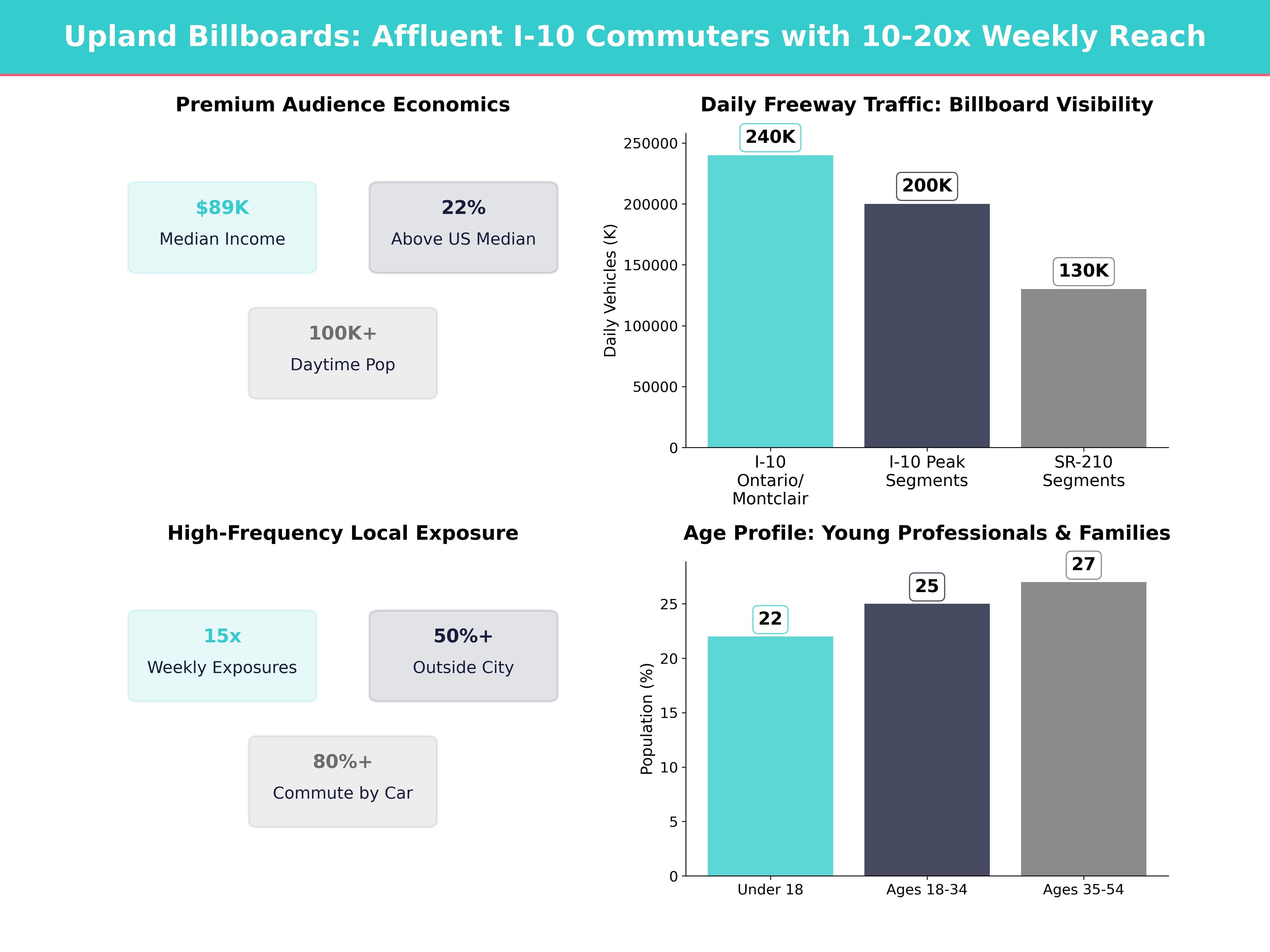
- Median household income in Upland is in the high‑$80,000s (around $88,000–$90,000), roughly 20–25% higher than the U.S. median, signaling strong discretionary spending for retail, dining, and home services.
- Age profile is well balanced: about 22% under 18, roughly 25% ages 18–34, about 27% ages 35–54, and the rest 55+. This mix lets us tailor creatives for families, young professionals, and older homeowners at different times of day and on different corridors.
- Linguistically and culturally, a substantial share of residents are bilingual, with Spanish commonly spoken at home—relevant for dual‑language or Spanish‑first creatives that can boost response among local households.
Upland is also deeply connected to nearby economic hubs:
- The city is immediately north of Ontario and its logistics and retail engines, including Ontario International Airport
- It borders Claremont and its higher‑education cluster ( The Claremont Colleges
- It’s within commuting distance of Los Angeles (about 35–45 miles west), Pasadena Riverside, which pushes substantial weekday traffic across the I‑10 and SR‑210 corridors. Regional planning agencies such as SCAG highlight this west–east “Inland Empire–LA County” flow as one of Southern California’s busiest commuter pipelines.
Local government and business resources such as the City of Upland, the Upland Chamber of Commerce, and San Bernardino County economic development emphasize logistics, healthcare, education, and retail as major sectors. Healthcare and social assistance together employ tens of thousands of workers county‑wide, logistics and warehousing occupy more than 100 million square feet of industrial space in nearby cities, and retail trade accounts for a double‑digit share of local employment. For billboard advertisers, that means a base of steady workers, commuters, and shoppers who are exposed to digital out‑of‑home multiple times a day, making Upland billboard advertising a practical channel for staying top‑of‑mind.
Key Traffic Corridors and Placement Strategy
Billboard success in Upland starts with understanding how people move through the city and its neighbors. Regional transportation agencies like the San Bernardino County Transportation Authority and Caltrans District 8 consistently rank I‑10 and SR‑210 among the Inland Empire’s heaviest‑traveled freeways, making them prime inventory for awareness and response. Placing billboards in Upland along these routes lets brands tap into both local and regional traffic.
1. Interstate 10 (I‑10) Corridor
Running directly along Upland’s southern edge, I‑10 is one of Southern California’s busiest freeways:
- Average daily traffic volumes on I‑10 through the west Inland Empire often exceed 200,000 vehicles per day on peak segments, with some nearby Ontario and Montclair sections approaching 220,000–240,000 vehicles daily.
- Morning eastbound traffic carries tens of thousands of commuters from eastern Los Angeles County into the Inland Empire; evening westbound traffic reverses the flow as workers return toward LA, Pasadena, and the San Gabriel Valley.
- Truck traffic is significant: heavy trucks can represent 10–15% of total vehicles on some I‑10 segments, important for B2B, logistics, and employment campaigns.
Campaign implications:
- Use morning‑commuter creatives eastbound (e.g., coffee shops, breakfast spots, auto services, healthcare reminders).
- Use evening‑commuter creatives westbound (e.g., restaurants, entertainment, e‑commerce promos, real estate).
- With Blip’s location and time targeting, we can schedule heavier spending during weekday rush hours and scale back in late nights or mid‑day to keep CPMs efficient while still capturing 60–70% of daily impressions in peak windows.
2. State Route 210 (SR‑210) / Foothill Corridor
SR‑210 and Foothill Boulevard run closer to Upland’s foothill neighborhoods:
- SR‑210 carries on the order of 100,000–130,000 vehicles per day across many Inland Empire segments, connecting Pasadena, Rancho Cucamonga, Upland, and San Bernardino.
- Foothill Boulevard (Historic Route 66) is a major commercial strip with local retail, restaurants, auto dealerships, and service businesses; daily traffic at key Upland segments frequently reaches 25,000–35,000 vehicles.
- The northern half of Upland near SR‑210 is characterized by higher homeownership and above‑average home values relative to the county, strengthening the case for home improvement, medical, and professional‑service campaigns.
Campaign implications:
- Perfect for mid‑to‑upper‑income households and established homeowners.
- Promote home services (HVAC, roofing, landscaping), healthcare practices, and higher‑ticket retail.
- Use midday and early‑evening dayparts to capture errands and family outings, when local trip volumes spike on surface streets by 20–30% over off‑peak periods.
3. Euclid Avenue and Central City Arteries
Euclid Avenue (running north–south) and key intersections around Downtown Upland see strong local traffic:
- The Downtown Upland district
- City and county traffic counts on Euclid and nearby arterials (such as Mountain Avenue and San Antonio Avenue) often reach 15,000–30,000 vehicles per day, mostly locals making frequent, repeat trips within a 3–5‑mile radius.
- Because these corridors feed into neighborhood streets and schools, the same residents can pass the same billboard locations 10–20 times per week, strengthening frequency and recall.
Campaign implications:
- Ideal for hyperlocal businesses: restaurants, gyms, salons, medical offices, and local events.
- With Blip, we can concentrate impressions to tight radii near stores, then spike delivery on weekends or event days to match expected attendance lift.
- Because speeds are lower than on freeways, there is a bit more dwell time, increasing QR‑code scan rates and direct‑response potential.
4. Regional Flow: Ontario, Rancho Cucamonga, and Claremont
Upland’s borders touch high‑value markets:
- Ontario’s retail and industrial districts, including large shopping areas like Ontario Mills
- Rancho Cucamonga's affluent neighborhoods and shopping (Victoria Gardens and surrounding centers), served by major arterials and SR‑210.
- Claremont’s college community and historic downtown, a key cultural and dining hub for tens of thousands of area residents and students.
By targeting Blip boards positioned along connecting routes (like Base Line Road, Foothill Boulevard, and Mountain Avenue), we reach:
- Thousands of daily cross‑city commuters traveling between these cities; regional data indicate that well over 50% of employed residents in this sub‑region work outside their home city.
- Students and faculty traveling to and from campuses in Claremont, Rancho Cucamonga, and Pomona
- Shoppers moving between Upland, Ontario, and Rancho Cucamonga retail centers, where weekend retailer traffic can jump 30–50% compared to weekdays.
Audience Segments and How to Reach Them
Upland’s demographics and geography give us several distinct audience clusters. Matching creative and timing to each cluster is where digital billboards excel, and where focused Upland billboard advertising can outperform more generic regional campaigns.
Suburban Families and Homeowners
Indicators:
- Around 60% of housing units are owner‑occupied, notably above nearby renter‑heavy markets, which typically sit closer to 40–50% ownership.
- Many neighborhoods north of Foothill and along Euclid skew toward family households, with average household sizes around 3 people and a strong presence of married‑with‑children households.
- Local public schools in the Upland Unified School District enroll thousands of K‑12 students, creating intense morning and afternoon traffic around campuses.
How to reach them:
- Best locations: SR‑210, Foothill Blvd, Euclid Avenue, and corridors leading to schools and parks (such as San Antonio Heights access points and routes to Memorial Park Upland Recreation
- Best times: 7–9 a.m. school drop‑off; 3–7 p.m. school pick‑up, after‑work errands, and evening outings—time windows when traffic volumes near schools and shopping centers can be 40–60% higher than mid‑day lows.
-
Message ideas:
- “Need a new roof before the next storm? Call today, inspections in 24 hours.”
- “Pediatric appointments this week – Accepting new patients in Upland.”
- “Weeknight family dinners under $40—3 miles ahead on Foothill.”
Use short, family‑oriented language and quick value propositions (price, convenience, safety). Because families in this income band often spend thousands of dollars per year on home improvement and youth activities, clear scheduling and price cues can significantly lift response.
Commuters and Logistics Workers
Indicators:
- A large share of Upland residents commute to jobs in Ontario, Rancho Cucamonga, eastern LA County, and the broader Inland Empire. In many Inland Empire cities, 80%+ of workers commute by car, with average one‑way commute times around 30 minutes.
- Proximity to warehouses, airport operations, and regional offices means a sizable portion of the workforce is employed in transportation, warehousing, manufacturing, and logistics support.
- Truck and commercial trip counts on I‑10 and SR‑210 reflect heavy goods‑movement activity to and from major logistics hubs around Ontario International Airport
How to reach them:
- Best locations: I‑10 and SR‑210 facing peak‑direction traffic; boards near industrial zones and employment centers in Ontario and Rancho Cucamonga for recruitment messaging.
- Best times: 5–9 a.m. and 3–7 p.m. weekdays, when commute volumes often reach 1.5–2x mid‑day levels.
-
Message ideas:
- “Skip traffic stress—listen to [your station/app] on the way home.”
- “Hiring forklift drivers – $X/hour + benefits – Apply this week.”
- “Oil change in 20 minutes, open until 8 p.m. – next exit.”
We can rotate recruitment, service, and lifestyle creatives based on season and hiring cycles—for example, pushing hiring creatives more heavily during peak logistics seasons (late summer and Q4) when local employers typically ramp up staffing.
Students and Young Adults
Indicators:
- Several colleges are within a 5–10 mile radius: the Claremont Colleges, Chaffey College in Rancho Cucamonga, and additional campuses in Pomona and Ontario. Combined, these institutions serve well over 30,000 students.
- A solid share of Upland’s population is between 18–34, including renters and early‑career workers; this group is highly mobile, tech‑savvy, and responsive to event‑driven and discount‑oriented messaging.
- Young adults in the region tend to over‑index on dining‑out, nightlife, and entertainment spending relative to older cohorts.
How to reach them:
- Best locations: Routes between Upland and Claremont/Rancho Cucamonga; Foothill Blvd; I‑10 near major retail centers; surface‑street boards near popular hangouts and transit stops.
- Best times: Late mornings, afternoons, and evening entertainment hours (6–11 p.m.), when social and shopping trips rise.
-
Message ideas:
- “Student discount tonight—show ID for 20% off.”
- “Local coworking space – 24/7 access, from $X/month.”
- “Live music in Downtown Upland this Friday – Free entry.”
Keep visuals bold, modern, and mobile‑friendly (short URLs or QR codes they can capture at a red light). For nightlife and events, consider frequency bursts 48–72 hours before showtime, when intent is highest.
Visitors and Regional Shoppers
Indicators:
- Upland sits along paths to the mountains and desert, and near major visitor draws in Ontario and Rancho Cucamonga. Regional tourism agencies such as Discover Inland Empire Visit California’s Inland Empire pages highlight the corridor as a gateway to the San Gabriel Mountains, Route 66 attractions, and desert destinations.
- The City of Upland promotes local recreation, trailheads, and historic downtown as visitor assets—trail systems, regional parks, and events that collectively attract tens of thousands of visits annually.
- Nearby shopping destinations like Ontario Mills, Victoria Gardens, and local centers in Upland and Montclair draw regional consumers who often spend 20–30 minutes or more on I‑10 and SR‑210 to reach these hubs.
How to reach them:
- Best locations: I‑10, SR‑210, and Foothill Blvd as people arrive from LA County or other Inland Empire cities; boards near exits serving Downtown Upland and key shopping areas.
- Best times: Weekends, holidays, and evenings, when leisure and shopping trips spike; for some centers, Saturday traffic can exceed weekday averages by 40–60%.
-
Message ideas:
- “Vintage shops and craft beer – Downtown Upland next 2 exits.”
- “Stay the night near the mountains – Book your room in minutes.”
- “Outlet‑style savings just 5 minutes off the freeway – Exit now.”
Pair strong directional cues (“Next Exit,” “2 Miles Ahead”) with compelling offers to prompt detours and capture incremental visitor spending.
Seasonal and Event‑Driven Strategy
Upland’s calendar and climate create predictable peaks of attention that we can leverage with Blip’s flexible scheduling.
Weather and Outdoor Seasonality
- Upland enjoys a Mediterranean climate: warm, dry summers and mild winters. Average summer highs frequently reach the low to mid‑90s °F, with heat waves above 100°F several days each year; winter daytime highs typically run in the low‑60s to upper‑60s °F.
- The area receives around 15 inches of rain annually, heavily concentrated between November and March, with some years experiencing heavier storm events tied to atmospheric rivers.
- Because of its proximity to the San Gabriel Mountains, Upland is also a staging point for snow and hiking trips; nearby mountain resorts can receive dozens of snow days each year, drawing significant weekend traffic through the corridor.
Campaign implications:
- Spring (March–May): Home improvement, landscaping, HVAC tune‑ups, outdoor recreation, spring sports, and allergy/health campaigns. Many households make large‑ticket purchases in this window as temperatures rise.
- Summer (June–September): Cooling services, summer camps, water parks and pools, beverage and quick‑serve restaurant promotions, and weekend travel offers. Energy demand and A/C usage peak, making efficiency and comfort messages timely.
- Fall (October–November): Back‑to‑school offers, flu shots and health screenings, home maintenance, and holiday shopping. Retailers often see sales increases of 20–40% in Q4 versus off‑season months.
- Winter (December–February): Retail promotions, tax prep, fitness memberships, and mountain travel (ski/board trips in nearby ranges). Snow‑day traffic to mountain communities can surge dramatically on Saturday mornings, with long lines of vehicles visible along I‑210 and mountain access roads.
With Blip, we can swap creatives in response to weather swings—e.g., push A/C repair creatives on hotter‑than‑average weeks, promote roofing/plumbing during rain events, or feature “snow day” offers tied to mountain conditions.
School and University Calendars
- Public schools in the Upland Unified School District influence traffic around start/end times and the August–June academic calendar. Enrollment in UUSD numbers in the high thousands, and early‑release or back‑to‑school days noticeably alter local driving patterns.
- Nearby colleges such as the Claremont Colleges and Chaffey College operate on semester or quarter systems, with surges at move‑in, midterms, and graduation. These events bring additional visitors, family members, and spending into the area.
- Adult education and career training programs also enroll new cohorts several times per year, creating repeated opportunities to target new students.
Campaign implications:
- Time campaigns for tutoring centers, daycare, family services, and extracurricular programs around late summer and early January, when parents are researching options; these months typically see spikes in search and enrollment activity.
- For student‑focused brands, push heavy visibility in the 2–3 weeks before fall and spring terms and during major campus events (orientation, homecoming, graduation).
- Use dayparting to narrow delivery to school‑related peaks—such as 7–9 a.m. and 2–4 p.m. near school corridors—to boost relevance and reduce wasted impressions.
Local Events and Community Life
Upland hosts community festivals, farmers markets, and downtown gatherings, which are often promoted by the city and local organizations via city news and events pages Inland Valley Daily Bulletin and the San Bernardino Sun, which highlight marquee events, high school sports, and regional attractions.
- Recurring events such as holiday parades, summer concerts, and community fairs can draw several hundred to several thousand attendees each, depending on scale.
- Farmers markets and food‑truck nights bring concentrated foot traffic into Downtown Upland on specific weekdays, with parking areas and approach routes seeing short‑term traffic spikes.
Campaign implications:
-
Promote event attendance with 7–14 day lead‑up campaigns featuring:
- Date and start time in large text.
- Simple value proposition (e.g., “Live music + food trucks,” “Free kids’ activities”).
- “This weekend in Upland” messaging for regional boards.
- For sponsors, run follow‑up creatives (“Thank you, Upland!”) to build brand goodwill and recall.
- Consider pulsing higher impression volumes in the 72 hours before an event, when last‑minute planning drives a disproportionate share of attendance decisions.
Creative Best Practices for Upland Billboards
Digital billboards in Upland compete with heavy traffic, mountain views to the north, and dense signage along commercial corridors. We should design for instant readability and local resonance so that Upland billboards cut through the noise and remain memorable.
1. Keep It Simple and Hyper‑Legible
- Aim for 6–10 words total; studies of out‑of‑home effectiveness repeatedly show that recall drops sharply past 10–12 words at freeway speeds.
- Use high‑contrast color combinations—e.g., white or yellow text on dark blue or black backgrounds—to ensure readability from 500–800 feet away.
- Make one element dominant: either your offer (“2‑for‑1 Lunch”) or your brand name/logo, not both. Over‑cluttered creatives can cut recall rates by 30–40% versus clean designs.
2. Localize Your Message
Inject a sense of place to connect faster:
- Reference known landmarks: “Exit now for Euclid Ave,” “Just off Foothill,” or “Near Downtown Upland.”
- Speak to local habits: “Beat I‑10 traffic—dine in Upland instead.”
- Highlight “Upland‑owned,” “Serving the Upland community since [year],” or “Proud sponsor of Upland schools” for community‑driven brands; local focus can increase trust and preference, especially among long‑term residents.
3. Design for Fast‑Moving Freeway Traffic
On I‑10 and SR‑210:
- Prioritize logo, 3–5 word headline, and a clear call‑to‑action.
- Use large, bold fonts and avoid fine detail; typical freeway exposure at 60–70 mph is only a few seconds.
- Use directional phrasing: “Next Exit,” “2 Miles Ahead,” “Off Euclid, North of I‑10.”
On surface streets like Foothill and Euclid:
-
You can include a bit more information, but still stay concise:
- One offer + one benefit + logo.
- Short URLs or QR codes are more viable here because vehicles slow or stop at lights, raising the chance of interaction.
4. Align Visuals with Upland’s Character
- For outdoor, family, and lifestyle brands, use backdrop visuals of foothills, trails, or neighborhood scenes to align with the city’s proximity to the San Gabriel Mountains and its local park system (see Upland Parks & Recreation
- For professional services (law, finance, healthcare), emphasize clarity and trust—clean layouts, professional photography, and credentials rather than busy imagery. Testimonials or rating callouts (“4.9★ locally rated”) can boost credibility.
Using Blip’s Tools to Optimize in Upland
Blip’s flexibility is especially valuable in a market like Upland where audiences change dramatically by time of day and direction of travel. If you’re exploring billboard rental in Upland for the first time, these tools make it easier to start efficiently and scale what works.
1. Dayparting
- Morning (5–10 a.m.): Commuter‑focused (coffee, auto services, radio apps, recruitment), school‑related (breakfast spots, tutoring reminders). Many boards can see 30–40% of daily traffic in this window.
- Midday (10 a.m.–3 p.m.): Stay‑at‑home parents, retirees, service calls—home services, medical appointments, lunch specials, B2B.
- Evening (3–8 p.m.): Families and workers running errands—retail, dining, fitness, kids’ activities.
- Late night (8 p.m.–midnight): Entertainment, delivery food, streaming services, nightlife in Upland or nearby cities.
We can schedule creatives by daypart and test which time blocks drive the best responses (using unique URLs, promo codes, or call‑tracking numbers), then shift more budget into top‑performing windows.
2. Location Targeting Across the Corridor
Instead of one generic creative on every board, we can strategically differentiate:
- Freeway boards (I‑10, SR‑210): Directional and regional awareness—“Next exit,” travel‑time claims (“5 minutes north”), brand‑building, and big events.
- Surface‑street boards in Upland: Action‑oriented, local offers (“Tonight only,” “This weekend”), driving immediate visits and calls.
- Boards closer to Ontario/Rancho Cucamonga: “Destination” messaging to pull shoppers and diners into Upland instead of competing markets, emphasizing reasons to choose Upland (parking ease, unique stores, local‑only offers).
3. A/B Testing Creatives
Because Blip lets us rotate multiple creatives, we can run structured tests:
- Offer A vs. Offer B (“$20 off” vs. “Free consultation”).
- Brand‑heavy vs. offer‑heavy creative.
- Family‑centric imagery vs. product‑centric imagery.
- English‑only vs. bilingual messaging in corridors with high Spanish‑speaking traffic.
Measure results using:
- Unique phone numbers.
- Different landing URLs (e.g., /upland‑210 vs. /upland‑10).
- QR codes for surface‑street boards.
- Simple in‑store or online prompts (“Show this code: UPLAND10”) to attribute redemptions.
Then shift budget toward the higher‑performing creative and dayparts. Over several weeks, this test‑and‑learn approach can significantly lift conversion rates without increasing total spend.
Vertical‑Specific Tips for Upland Advertisers
Local Retail and Restaurants
- Promote lunch specials along major work and shopping corridors (I‑10, Foothill) from 10 a.m.–2 p.m., when foodservice visits typically peak.
- Use “X minutes from this exit” for freeway travelers and “Just past Euclid & Foothill” for local drivers. Even a “3–5 minute” time claim can reduce perceived friction and increase visit intent.
- For chains competing with nearby Ontario and Rancho Cucamonga locations, highlight Upland‑specific offers (“Upland location only,” “Free dessert at our Upland store”) to keep spending in‑city.
- Pair promotions with major shopping days—back‑to‑school, Black Friday, and pre‑holiday weekends, when consumer spending in the region can jump 50–100% versus typical weeks.
Home Services and Contractors
- Focus on SR‑210, Foothill, and northern neighborhoods where ownership rates and home values are higher. These areas often see greater investment in remodeling, landscaping, and solar.
- Align messages to seasonal needs: A/C in late spring and summer, roofing and gutters during rainy periods, solar and energy‑efficiency messages when utility rates spike or during summer heat waves.
- Use credibility markers: “Serving Upland since 2005,” “Rated 4.8 stars on Google,” or “Licensed, bonded, and insured.” Upland homeowners often make decisions on projects worth $5,000–$20,000+, so trust is crucial.
- For emergency services (plumbing, HVAC breakdowns), run always‑on branding creatives plus heavier impression bursts during extreme weather events.
Healthcare, Dental, and Wellness
- Target commuting corridors and school routes for family‑oriented practices; parents frequently cluster medical appointments around work and school schedules.
-
Promote:
- New patient specials.
- Evening or weekend hours (many clinics see significant demand on Saturdays).
- Bilingual services if applicable, which can broaden your reach among local households.
- Consider multiple creatives: one for families, one for adults or seniors, and schedule them by time segment—family messages in school windows, senior‑focused creatives during late morning/early afternoon when older adults are more likely to be on the road.
- For larger medical centers or hospital systems, use freeway boards for reputation and specialty‑care awareness, and surface streets for urgent care and same‑day services.
Education and Training
- For K–12 and tutoring: emphasize proximity to schools and after‑school hours. Many families spend hundreds to thousands of dollars annually on tutoring, test prep, and enrichment; clear “near your school” messaging drives visits.
- For colleges, trade schools, and certification programs: run campaigns at semester changeovers and around graduation periods, when prospective students reassess their options.
- Use career‑oriented outcomes in copy: “Become a medical assistant in 9 months—Campuses near Upland” or “Train for logistics careers in as little as 6 months,” aligning with strong regional job markets.
- Coordinate with local news coverage and job‑market headlines from outlets like the Inland Valley Daily Bulletin to keep messaging timely and relevant.
Hiring and Workforce
With so many logistics and service‑sector jobs nearby:
- Use I‑10 and SR‑210 to recruit workers commuting through Upland; focus on boards near major industrial parks and the airport corridor.
- Highlight pay ranges, sign‑on bonuses, and benefits in big text—“Up to $22/hr + benefits”—since clear, visible pay information can substantially increase application rates.
- Run heavier rotations in the mornings and evenings when workers are thinking about their commute and job satisfaction. Seasonal hiring pushes (e.g., pre‑holiday, back‑to‑school) should be front‑loaded 4–6 weeks before demand peaks.
- Consider bilingual hiring creatives to tap into a broader labor pool in the local area.
Measuring and Refining Campaign Success
To make the most of Upland’s dynamic market, we should plan from the outset to track performance:
- Assign unique URLs or QR codes per creative or corridor (for example, /upland‑210 vs. /upland‑10) and monitor traffic, bounce rates, and conversions.
- Use phone call tracking numbers to compare leads from different messages, boards, and dayparts.
- Watch traffic and sales patterns in relation to billboard flight dates—especially around events or season changes. Compare average daily revenue or leads during campaign weeks vs. baseline weeks to quantify lift.
- For multi‑location businesses (with stores in Upland, Ontario, and Rancho Cucamonga), track store‑level sales and footfall to see if Upland‑targeted campaigns shift share toward your Upland location.
Then, using Blip’s ability to:
- Swap creatives in minutes.
- Reallocate budget between boards and dayparts.
- Pause or surge campaigns around new promotions or events.
we can treat Upland as a test‑and‑learn environment, steadily increasing our return on ad spend over time. By combining a data‑driven understanding of Upland’s corridors, commuters, and neighborhoods with the flexibility of digital billboards in Upland and surrounding cities, we put ourselves in a strong position to capture attention, drive action, and build lasting brand presence throughout the city and its surrounding region.