Billboards near Mountain View, CA
No Minimum Spend. No Long-Term Contracts. Just Results.
Trusted by Leading Brands


Billboard advertising
near Mountain View has never been easier



How much is a billboard near Mountain View?
Why Choose Blip for Billboard Advertising near Mountain View
Blip lets you launch Mountain View billboards in minutes, reaching US-101 and SR-237 commuters without sales calls or delays.
Set a flexible daily budget for Mountain View and pay only for the blips you run—ideal for tech firms and startups on the move.
Daypart your Mountain View ads for 7–10 a.m. and 3:30–7:30 p.m. to catch Silicon Valley commuters when traffic peaks.
No contracts means you can test Mountain View on weekday office traffic, then shift fast for Shoreline or Levi’s Stadium spikes.
Use Blip’s real-time analytics to see what works in Mountain View, from Santa Clara cross-city traffic to Milpitas corridor reach.
Blip’s creative tools help you tailor Mountain View messages for tech-savvy audiences, high-income households, and event crowds.
Frequently Asked Questions About Billboard Advertising near Mountain View
How much does a billboard cost near Mountain View, California with Blip?
With Blip, you control exactly what you spend by setting a daily budget for Mountain View billboards, and your ads play in short 7.5 to 10-second “blips” on digital displays serving the Mountain View area. You only pay for the blips you receive, and each one is priced based on when and where it runs and on current advertiser demand. That means the total cost of your campaign is simply the sum of all those individual blips over time.
Where can I advertise near Mountain View, California with Blip?
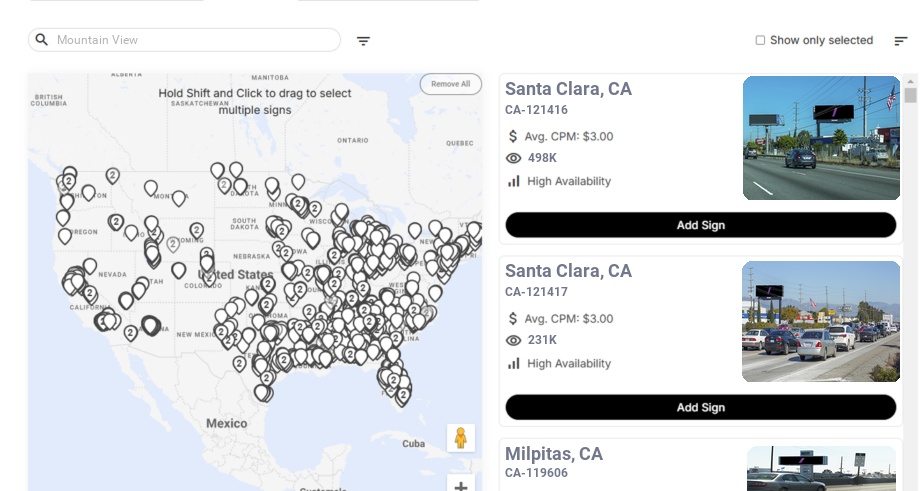
Blip’s inventory is located on digital billboards in Santa Clara and Milpitas, serving the Mountain View area. Santa Clara is about 7.2 miles from Mountain View, and Milpitas is about 9.2 miles away. These nearby placements function as an always-on presence along the primary travel corridors your audiences use every day.
Why is Mountain View, California a strong market for billboard advertising with Blip?
Mountain View sits at the heart of Silicon Valley, where some of the most valuable audiences in the world live, work, and commute. With roughly 82,000 residents in the city itself and hundreds of thousands more flowing through the Mountain View area daily, digital billboards near Mountain View offer advertisers powerful reach into tech workers, high-income households, startup founders, students, and visitors. For brands comparing different out-of-home options, billboards near Mountain View deliver a rare mix of affluent residents and commuting professionals who see the same locations again and again.
When is the best time to run Blip ads in Mountain View, California?
Traffic in the Mountain View area is highly time-sensitive and tied to the tech workday and events calendar, so timing is crucial for any billboard advertising near Mountain View. The morning peak is 7:00–10:00 a.m. on US-101, SR-85, and SR-237, and the evening peak is 3:30–7:30 p.m., often with heavier outbound traffic from tech campuses. Monday–Thursday rush hours and midday business travel are especially strong for B2B and tech-focused campaigns.
What kind of people will see my Mountain View, California billboard ads with Blip?
Mountain View’s population is about 82,000, but the city supports roughly 75,000–80,000 jobs, meaning the daytime population can swell well above 100,000 as workers commute to major employers such as Google, Intuit, and LinkedIn. More than 40% of jobs in the city are in professional, scientific, and technical services, and information sectors, reflecting a highly skilled workforce. In and around Mountain View, well over 60% of adults 25+ hold a bachelor’s degree or higher, and more than 30% hold a graduate or professional degree.
Do I need a contract to advertise with Blip near Mountain View?
No, Blip has no long-term contracts or minimum commitments. You can start, pause, or stop your campaign at any time.
How fast can I launch a billboard campaign with Blip near Mountain View?
You can have your campaign live in minutes. Create a free account, select your locations, set your budget, upload your design, and start running once approved.
Where can I advertise with Blip near Mountain View?
Blip has digital billboards near Mountain View. You can browse available locations on a map, choose the ones that fit your audience, and start advertising right away.
Still have questions? Launch a campaign in minutes — no contracts, no commitments.
Start Your CampaignMountain View Billboard Advertising Guide
Mountain View sits at the heart of Silicon Valley, where some of the most valuable audiences in the world live, work, and commute. With roughly 82,000 residents in the city itself and hundreds of thousands more flowing through the Mountain View area daily, digital billboards near Mountain View offer advertisers powerful reach into tech workers, high-income households, startup founders, students, and visitors. For brands comparing different out-of-home options, billboards near Mountain View deliver a rare mix of affluent residents and commuting professionals who see the same locations again and again. With Blip’s flexible buying model and five digital billboards in nearby Santa Clara and Milpitas serving the Mountain View area, we can help you turn this unique billboard advertising near Mountain View into real results for your brand.
Why the Mountain View Area Is a High-Value Billboard Market
Mountain View is far more than a bedroom community—it is an employment and innovation hub, which makes it a high-impact environment for Mountain View billboards:
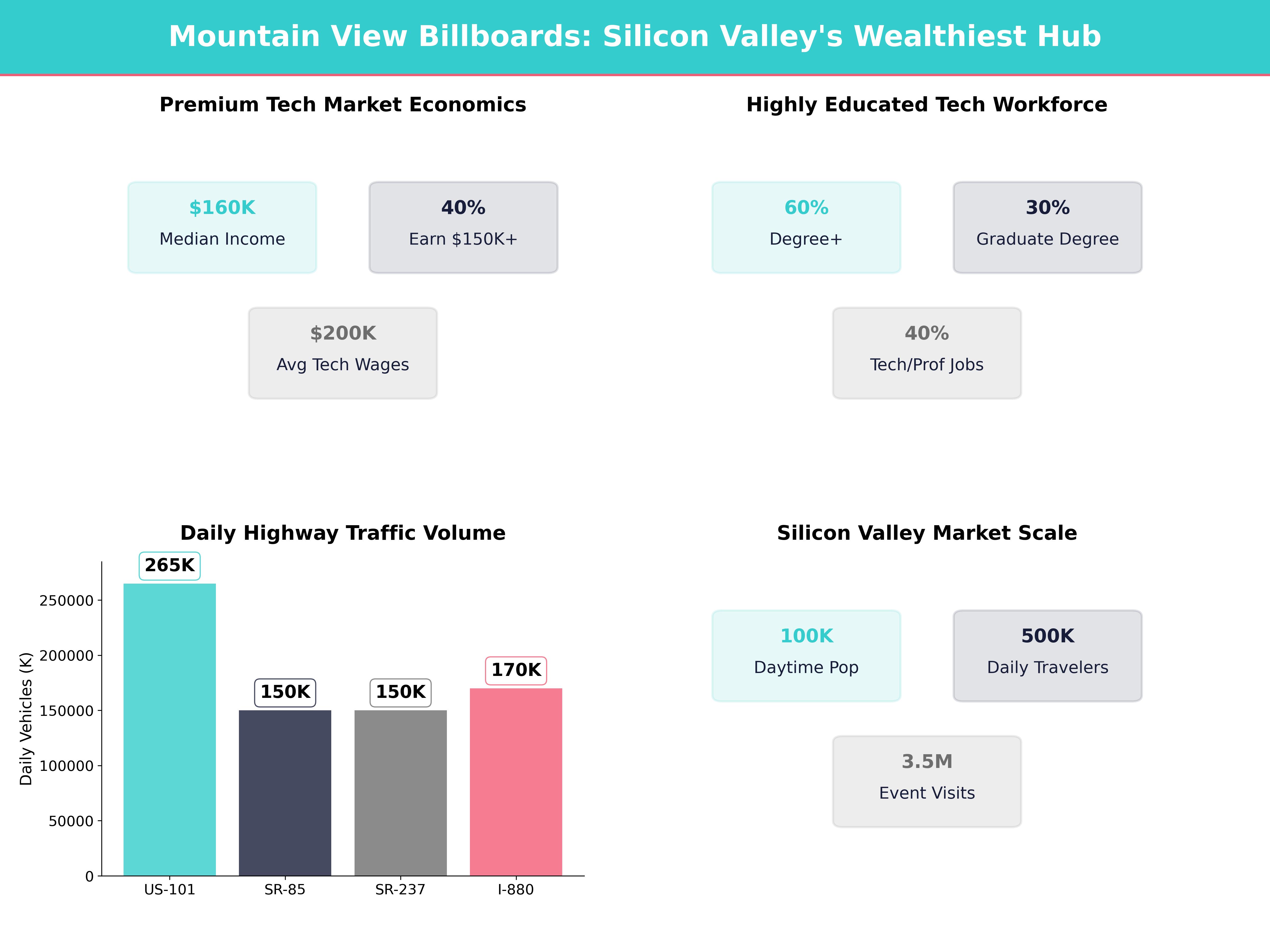
- Mountain View’s population is about 82,000, but the city supports roughly 75,000–80,000 jobs, meaning the daytime population can swell well above 100,000 as workers commute to major employers such as Google, Intuit, and LinkedIn. According to the City of Mountain View
- According to the City of Mountain View’s economic development information, more than 40% of jobs in the city are in professional, scientific, and technical services, and information sectors, reflecting a highly skilled workforce. Across Santa Clara County, more than 300,000 people work in information and professional/technical services, giving you dense concentration of knowledge workers within a short radius of your billboards.
- Santa Clara County, of which Mountain View is a part, has over 1.9 million residents and a median household income above $140,000, one of the highest in the U.S., indicating significant disposable income and B2B purchasing power. In many Mountain View and north-county ZIP codes, median household income exceeds $160,000, with more than 40% of households earning $150,000 or more annually. You can explore county economic data via Santa Clara County City of Mountain View
- The area’s educational attainment is also exceptionally high: in and around Mountain View, well over 60% of adults 25+ hold a bachelor’s degree or higher, and more than 30% hold a graduate or professional degree, according to local planning and economic reports from the City of Mountain View
For advertisers, this translates into:
-
Premium consumer targets:
- Tech workers whose average annual wages in Santa Clara County often exceed $200,000 in the information sector.
- A regional per capita personal income above $90,000, supporting higher average spend on dining, travel, and consumer technology.
- B2B decision-makers: engineers, product managers, executives, and founders who influence software, hardware, and enterprise purchasing; Santa Clara County routinely reports more than 70,000 employer establishments, including thousands of tech and professional services firms clustered within 15–20 minutes of the Mountain View area.
-
Dynamic visitor traffic:
- Nearby attractions like Shoreline Amphitheatre, Levi’s Stadium, and California’s Great America together attract well over 3–4 million visits per year.
- The broader Silicon Valley region reports tens of millions of visitor-nights annually, according to regional tourism sources such as Visit San Jose Visit Silicon Valley
Because Blip’s inventory is located on digital billboards in Santa Clara (about 7.2 miles from Mountain View) and Milpitas (about 9.2 miles away), your campaign can consistently reach people who live, work, shop, and commute through the broader Mountain View area, including the roughly 500,000+ people who travel daily within the US‑101/SR‑237/I‑880/I‑680 loop. When you think of Mountain View billboards, these nearby placements function as an always-on presence along the primary travel corridors your audiences use every day.
Understanding Local Audiences and Travel Patterns
The Mountain View area is defined by dense commuting and cross-city travel patterns, which is exactly what you want when planning billboard advertising near Mountain View:
-
Major freeways:
- US‑101 runs along the bay side of Mountain View and carries roughly 250,000–280,000 vehicles per day through the Silicon Valley corridor, according to recent Caltrans District 4 traffic volume reports. Over the course of a month, that translates to 7.5–8.5 million vehicle trips past key segments.
- State Route 85 to the south carries around 140,000–160,000 vehicles per day between Mountain View, Sunnyvale, and San Jose, or approximately 4–5 million trips per month.
- State Route 237, connecting Mountain View and Milpitas, typically sees 150,000+ vehicles per day during the workweek, meaning more than 3 million weekday impressions per month are available on this corridor alone.
- Tech corridor commutes: Workers regularly travel between Mountain View, Sunnyvale, Santa Clara, Milpitas, Cupertino, and San Jose, creating repeated exposure opportunities on our nearby boards. Regional commute analyses from agencies like the Metropolitan Transportation Commission and local planning departments show that in Silicon Valley, more than 70% of employed residents commute to a different city than where they live, and average one-way commute times in Santa Clara County are in the 28–32 minute range.
-
Transit and multimodal travel:
- Caltrain’s nearby stations (Mountain View, Sunnyvale, and San Jose Diridon) support tens of thousands of weekday riders; annual ridership has been reported in the 10–15 million trip range in recent years. More details are available at Caltrain.
- VTA bus and light rail lines connect Santa Clara, Mountain View, and Milpitas, with VTA reporting tens of millions of annual boardings systemwide.
- The Mountain View Transit Center alone handles thousands of riders per weekday across Caltrain, VTA, shuttles, and bike/pedestrian connections, according to the City of Mountain View
What this means for your billboard strategy:
- Expect repeated impressions: Many commuters use the same routes five days a week; a driver making 2 trips per day on US‑101 or SR‑237 can see your message 20–40 times per month, giving you frequency and brand-building power.
- Cross-city influence: A billboard seen near Santa Clara or Milpitas can still be highly relevant to people who live, work, shop, or attend events in the Mountain View area, since more than half of Santa Clara County workers cross at least one city boundary on their way to work.
- Peak weekday value: Monday–Thursday rush hours and midday business travel are especially strong for B2B and tech-focused campaigns; local traffic and employer data suggest these are the highest in-office and meeting days for hybrid tech workers.
Choosing the Right Locations Near Mountain View
Our five digital billboards serving the Mountain View area are located in Santa Clara and Milpitas, both critical nodes in the Silicon Valley travel network. If you’re comparing billboard rental near Mountain View, these locations effectively act as extensions of the city’s own commuter network.
Santa Clara (approx. 7.2 miles from Mountain View)
Santa Clara is home to:
- Major employers like Intel and NVIDIA, which together employ tens of thousands of workers in the city and surrounding region. The City of Santa Clara
- Levi’s Stadium, which seats about 68,500 for San Francisco 49ers games and up to 75,000+ for concerts and special events. A full NFL season can bring in 650,000–700,000 fans just for regular-season home games, not counting playoffs or special events.
- California’s Great America, drawing hundreds of thousands of visitors annually; in strong seasons, attendance can reach into the 1–2 million visitor range, depending on events and operating days.
- Large retail and entertainment destinations like Santa Clara Square and nearby shopping centers, where each major center can see tens of thousands of weekly visits, according to local economic development summaries from the City of Santa Clara
Boards placed in the Santa Clara area allow you to:
- Reach Mountain View residents and workers on their way to major events and shopping; 49ers game days, for example, routinely trigger traffic advisories from Santa Clara Police
- Capture visitors who stay in Santa Clara hotels (the city has thousands of hotel rooms) but explore the broader Silicon Valley, including the Mountain View area and nearby attractions like Shoreline Amphitheatre.
- Build brand familiarity among tech employees who commute across US‑101, SR‑237, and city arterials such as Great America Parkway and Tasman Drive, each of which can carry tens of thousands of vehicles per day according to Caltrans and local traffic counts.
Learn more about local context at the City of Santa Clara Visit Santa Clara Visit San Jose / Silicon Valley
Milpitas (approx. 9.2 miles from Mountain View)
Milpitas sits at a critical junction where:
- I‑880 and I‑680 converge, carrying a combined daily traffic volume well over 300,000 vehicles in the South Bay. Segments of I‑880 in the area often carry 160,000–180,000 vehicles per day, and I‑680 segments can carry 140,000–160,000 per day, based on Caltrans counts.
- SR‑237 connects directly back toward Mountain View’s office and industrial zones, with traffic volumes above 150,000 vehicles per weekday during peak months.
- The Milpitas Transit Center/BART station
Placing your ads on Milpitas-area boards is ideal when you want to:
- Reach commuters traveling between the East Bay, Milpitas, and the Mountain View area; regional commute data shows that tens of thousands of workers travel daily between Alameda County, southern East Bay cities, and Santa Clara County via I‑880/I‑680/SR‑237.
- Influence tech manufacturing and supply chain workers who move goods and services across the valley; Milpitas’ industrial and business parks host hundreds of firms in hardware, semiconductor, logistics, and advanced manufacturing, according to the City of Milpitas.
- Extend a Mountain View-focused campaign to capture additional drive-time impressions among similar demographics, including high-income East Bay commuters whose median household incomes are frequently in the $120,000–$150,000+ range.
Local context is available via the City of Milpitas and the Milpitas economic development resources linked from the city website.
Timing Your Campaign with Local Traffic Peaks
Traffic in the Mountain View area is highly time-sensitive and tied to the tech workday and events calendar, so timing is crucial for any billboard advertising near Mountain View.
Weekday commute patterns
Based on typical Silicon Valley traffic reports from sources like Caltrans and regional news outlets such as the San Francisco Chronicle The Mercury News:
- Morning peak: 7:00–10:00 a.m. on US‑101, SR‑85, and SR‑237, with speeds on some segments dropping below 25–30 mph during the heaviest congestion and travel times increasing by 20–40% compared to free-flow conditions.
- Evening peak: 3:30–7:30 p.m., often with heavier outbound traffic from tech campuses; traffic analytics frequently rank Silicon Valley among the most congested regions in California, especially on Tuesdays through Thursdays.
- Lunch and meetings: 11:30 a.m.–2:00 p.m., as workers move between campuses, client meetings, and restaurants; local economic reports indicate that weekday lunch and early evening periods are prime revenue windows for food, retail, and coffee concepts in the Mountain View–Santa Clara corridor.
With Blip’s flexible scheduling, we can:
- Daypart your buys to appear most frequently in rush hours for maximum impressions per dollar, concentrating spending in windows where freeway traffic is at or near peak volumes.
- Run separate creatives for morning vs. evening (e.g., “On your way to the office?” vs. “Ready to unwind after work?”) to align with mindset and likely calls to action.
- Increase bids on Tuesday–Thursday, which tend to be heavier in-office days for hybrid work schedules in the tech sector; surveys reported in outlets like the San Francisco Chronicle San José Spotlight
Event-driven spikes
Several venues close to the Mountain View area drive major traffic spikes:
- Shoreline Amphitheatre in Mountain View hosts concerts and festivals with capacities of ~22,500 visitors per event. A busy concert season can bring in several hundred thousand attendees; on major show nights, local traffic alerts from the City of Mountain View Shoreline Amphitheatre
-
Levi’s Stadium in Santa Clara hosts:
- 10 regular-season San Francisco 49ers home games, each drawing around 65,000–70,000 fans.
- Major concerts, college football, international soccer matches, and special events that can add another 10–20 large-scale events per year.
Collectively, Levi’s Stadium can attract well over 1 million event attendees annually, creating repeated chances to reach the same high-value audiences.
- Nearby conventions at venues like the Santa Clara Convention Center San Jose McEnery Convention Center
We recommend:
- Creating event-specific flights: run heavier schedules on concert or game days and the day before, especially during pre-event drive times 3–7 p.m.
- Using countdown-style creatives (“49ers kickoff tonight – watch with us in Mountain View area!”) to tap into urgency and excitement.
- Running post-event offers targeted at fans heading back through the corridor (e.g., late-night food, rideshare, or hospitality offers), particularly between 9:30 p.m. and midnight on event nights.
Creative Strategies for Tech-Savvy Viewers
Mountain View-area audiences are highly digital, analytical, and visually sophisticated. Your billboard creative needs to respect their time and attention so your Mountain View billboards stand out even during busy commutes.
Keep it clean and focused
- Aim for 7 words or fewer in your main headline; outdoor advertising best-practice studies consistently show that shorter headlines can increase recall by 20–30% compared to longer ones.
- Use high-contrast color combinations (e.g., dark background with light text) to stand out against the often-bright California sky; outdoor design guidelines suggest minimum font heights of 18–24 inches on freeway boards for readability at 55–65 mph.
- Make your logo prominent and legible from a distance; avoid thin fonts that can disappear at 400–600 feet, especially on digital boards with short display intervals (e.g., 6–10 seconds per rotation).
Speak their language without overdoing jargon
-
Tech professionals respond well to clear value propositions:
- “Ship software faster with managed dev teams.”
- “Switch to fiber internet in the Mountain View area.”
- “AI-ready infrastructure for your next launch.”
- Avoid cluttered buzzwords. Focus on one clear audience and one clear benefit; campaigns that speak to a single, well-defined use case often see higher conversion rates when measured via landing pages or promo codes.
Localize your message to the Mountain View area
Even if your blip is served on a board in Santa Clara or Milpitas, you’re still speaking to people who connect with Mountain View and who are likely to notice billboards near Mountain View on their daily routes:
-
Reference the Mountain View area or local landmarks:
- “Lunch near Shoreline? Order ahead.”
- “Coworking near Castro Street – tours today.”
- Mention transit hubs and commute paths (“5 minutes from US‑101,” “Near Mountain View Caltrain”) that thousands of locals recognize immediately.
- Use simple maps or arrows only if they remain readable at highway speeds (otherwise use short text directions: “10 min from Mountain View Caltrain”).
Optimize for mobile follow-through
Mountain View-area viewers are heavy smartphone users:
- In high-income, tech-centric areas like Mountain View and Santa Clara, smartphone ownership rates are typically above 90%, and mobile web traffic can account for 60–70% of sessions for many consumer-facing brands, according to industry benchmarks frequently cited by local agencies and outlets such as The Mercury News.
- Incorporate short, memorable URLs and brand names.
- Use simple QR codes on slower city-facing boards where drivers or pedestrians may pause at lights; avoid relying on QR codes for high-speed freeway boards, where scan rates tend to be much lower.
- Consider app installs, booking pages, or demo sign-up pages as landing pages optimized for mobile; track billboard-driven results via unique URLs or UTMs.
Using Blip Tools to Test, Learn, and Scale
Because Blip lets you buy digital billboard time one blip at a time with custom budgets and scheduling, you can treat the Mountain View area like you would any high-performance digital channel and continuously refine your billboard rental near Mountain View.
Start small and test multiple creatives
-
Launch with 3–5 creative variations:
- Different headlines.
- Different value propositions (price, speed, quality, local convenience).
- Different calls to action (download, visit, reserve, apply).
- Distribute impressions evenly for the first 7–14 days, then use your own metrics (web traffic, promo code usage, lead forms) to identify winners. Many advertisers see 20–50% performance differences between top- and bottom-performing creatives, making ongoing testing valuable.
- Consider aligning tests with specific micro-audiences (e.g., “engineers commuting on SR‑237” vs. “families heading to Shoreline concerts”) and map those to the boards and time slots most likely to reach them.
Use geographic and time-based segmentation
- Create one campaign focused on weekday rush hours targeting commuters associated with Mountain View-area offices.
- Run a second campaign with evening and weekend blips aimed at leisure, dining, and entertainment in and near Mountain View.
- If you serve different customer segments (e.g., B2B vs. B2C), assign each a creative set and scheduling profile; for example, B2B campaigns might focus on 7 a.m.–7 p.m. Monday–Friday, while consumer offers might lean into 5–11 p.m. and weekends.
- Over time, compare performance across these segments to see which combinations of location + daypart deliver the best cost per lead, booking, or store visit.
Scale into peak periods
Once you know what’s working:
-
Increase bids and daily budgets on:
- Product launch weeks, especially when coordinating with PR or coverage from local outlets like The Mercury News or San José Spotlight
- Key conference dates in nearby San Jose or Santa Clara (e.g., large tech conferences at the San Jose McEnery Convention Center
- Quarter-end or holiday seasons, when both B2B and consumer spending often spike; many B2B teams close 25–40% of annual revenue in Q4, while retail and hospitality see strong lifts from November through early January.
Campaign Ideas for Key Mountain View Industries
The Mountain View area is uniquely concentrated in specific sectors. Tailored billboard concepts can significantly improve relevance and response, whether you’re running traditional Mountain View billboards or flexible digital inventory.
B2B software, SaaS, and cloud infrastructure
Audience: engineers, PMs, startup founders, and IT decision-makers.
- Mountain View and surrounding cities host thousands of software and internet companies; the broader Silicon Valley area is home to a startup density several times higher than the national average, as highlighted in regional reports from organizations like Joint Venture Silicon Valley.
- Average deal sizes and contract values are often high, so even a small number of billboard-driven leads can justify spend.
Ideas:
- “Deploy 10x faster – scale your infra without new hires.”
- “Mountain View–area teams: cut your cloud bill by 30%.”
- “Your SOC‑2 ready partner – demo this week.”
- Run heavier during weekday daylight hours, aligned with office commutes and meeting times, and tie messaging to common B2B cycles (end of quarter, budget planning seasons).
Consumer tech, fintech, and apps
Audience: early adopters and high-income consumers.
- In affluent, tech-heavy corridors like Mountain View–Santa Clara–Cupertino, adoption rates for digital banking, investment apps, and subscription services are often 10–20 percentage points higher than national averages, according to industry studies often cited by local business media like The Mercury News.
- Many households own multiple connected devices, making this a prime market for cross-device engagement after billboard exposure.
Ideas:
- “Invest from your phone in 3 minutes – zero account fees.”
- “Track your health, not your data. Download [Brand] today.”
- “Designed in Silicon Valley. Built for your wallet.”
- Tie into local themes: “Built for Silicon Valley, available everywhere.”
Dining, nightlife, and experiences near Mountain View
Audience: after-work crowds, Shoreline concertgoers, and Levi’s Stadium attendees passing through.
- Mountain View’s Castro Street and surrounding downtown host dozens of restaurants and bars; city economic profiles from the City of Mountain View
- Shoreline Amphitheatre events can bring 20,000+ visitors to the area on a single evening, while Levi’s Stadium events draw up to 70,000; many of these attendees travel along the same freeway and arterial routes your boards face.
Ideas:
- “Headed to Shoreline? Dinner just 5 minutes from Amphitheatre.”
- “Post-game drinks near the Mountain View area – open late tonight.”
- “Skip the traffic – happy hour on Castro now.”
- Use event-day bursts around big shows and games, with creatives that reference “tonight,” “after the show,” or “before kickoff.”
Recruiting and employer branding
With Mountain View’s concentration of talent, employer branding is powerful:
- Santa Clara County reports some of the lowest unemployment rates in California, and tech unemployment nationally is often well below overall averages. That means standing out as an employer in front of tens of thousands of commuters can be a strategic advantage.
- According to local business groups such as the Mountain View Chamber of Commerce and Silicon Valley Leadership Group
Ideas:
- “Your next big move is one exit away – we’re hiring engineers.”
- “Build what’s next. Join our team in the Mountain View area.”
- “Tired of the commute? Work closer to home.”
- Schedule more blips during commute hours and just before major local job fairs or tech meetups (check calendars from Mountain View Chamber of Commerce, City of Mountain View local news).
Education, training, and bootcamps
Audience: career switchers, new graduates from nearby institutions like Stanford and local community colleges.
- The region includes major higher-ed institutions such as Stanford University, San Jose State University, Foothill–De Anza colleges, and others, representing tens of thousands of students and recent grads within a 20–30 minute radius, as listed by local education and workforce development agencies like Work2Future.
- Tech bootcamps and continuing education programs have strong demand in Silicon Valley, where many professionals look to upskill or pivot every few years.
Ideas:
- “Become a software engineer in 9 months – no CS degree required.”
- “Upskill after work – evening programs near the Mountain View area.”
- “Data science certificate – classes start next month.”
- Emphasize evening and weekend scheduling for those researching education options off-hours, and align with academic cycles (e.g., late summer and early winter enrollment periods).
Measuring Success and Optimizing Over Time
To get the most from digital billboards serving the Mountain View area, tie your campaign closely to measurable outcomes and treat your Mountain View billboards like a performance channel rather than a static awareness buy.
Set clear metrics from day one
Depending on your business model, track:
- Direct traffic lifts to your website or key landing pages when your campaign is live; many advertisers see 10–30% increases in direct and branded search traffic during active billboard flights.
- Promo codes or vanity URLs unique to the billboard campaign; assign different codes to Santa Clara vs. Milpitas boards if you want to compare performance by submarket.
- Store visits or bookings from zip codes around Mountain View, Santa Clara, and Milpitas. For physical locations, watch for a lift in foot traffic of 5–15% during strong campaigns, compared to baseline periods.
Correlate schedule with performance
- Compare days and times when your blips ran to spikes in web or store activity. Short campaigns of 2–4 weeks often provide enough data to identify which time windows outperform.
-
Use A/B testing:
- Week 1–2: mostly morning commuters.
- Week 3–4: mostly evening commuters.
- Evaluate which window drives more conversions, longer session durations, or higher average order value.
- If you have multiple locations (e.g., a Mountain View storefront and a Santa Clara office), compare location-level metrics against where your boards are most visible to understand which billboards near Mountain View move the needle most.
Iterate creative locally
Use local insights from sources such as:
- The City of Mountain View
- Regional news outlets like The Mercury News, San José Spotlight Mountain View Voice.
- Local tourism and business resources like Visit Mountain View / Chamber of Commerce, Visit San Jose Visit Silicon Valley
Adjust your messaging to align with:
- Seasonal patterns (summer concerts at Shoreline, football season at Levi’s Stadium, holiday shopping, back-to-school periods).
- Economic cycles (end-of-quarter sales pushes, fiscal year-end for B2B buyers, local hiring waves).
- Local headlines that may create opportunities or sensitivities—for example, a surge in AI-focused conferences, transit changes reported by VTA, or new development projects highlighted by San José Spotlight
By combining rich local context about the Mountain View area with Blip’s flexible, data-driven approach to digital billboard buying, we can help you reach some of the most valuable audiences in the world—on their daily routes, on their way to major events, and as they explore Silicon Valley. With strategic timing, tailored creative, and continuous optimization, your message can become a familiar part of the Mountain View-area landscape and a reliable driver of measurable results for your brand whenever you invest in billboard advertising near Mountain View.