Billboards near Fairview, CA
No Minimum Spend. No Long-Term Contracts. Just Results.
Trusted by Leading Brands


Billboard advertising
near Fairview has never been easier




How much is a billboard near Fairview?
Why Choose Blip for Billboard Advertising near Fairview
Blip lets you launch Fairview billboards in minutes, reaching I-880 and I-580 commuters without buying a long-term package.
Use Fairview’s high-income East Bay audience on your budget, then scale up as results come in from nearby Hayward and Dublin corridors.
Daypart your ads for Fairview rush hours on I-880, CA-92, and Mission Blvd, so commuters see your message when traffic is heaviest.
No contracts mean you can test Blip in Fairview during back-to-school, holiday shopping, or Tri-Valley weekends and adjust anytime.
Track performance in real time across Fairview and nearby San Lorenzo, Hayward, and Dublin, then shift spend to the creatives that work.
Blip’s creative tools make it easy to build bold Fairview ads for diverse East Bay drivers, including bilingual messages for local households.
Frequently Asked Questions About Billboard Advertising near Fairview
How much does a billboard cost near Fairview, California with Blip?
With Blip’s flexible, pay-per-blip pricing, you control exactly how much you spend on Fairview billboards by setting a daily budget that can be adjusted anytime. Each “blip” is a short, 7.5–10 second ad on digital billboards near Fairview, California, and you only pay for the blips you receive. Costs vary based on when and where your ads run, plus real-time advertiser demand, so you can start small, test different times of day, and scale up when you see what works.
Where can I advertise with Blip near Fairview, California?
With 11 digital billboards serving the Fairview area from nearby San Lorenzo, Hayward, and Dublin, Blip can precisely target local residents, commuters, and shoppers as they move between home, work, and regional destinations. Our 11 digital billboards serving the Fairview area are located in nearby San Lorenzo, Hayward, and Dublin, all within about 10 miles of Fairview. This placement gives us coverage on some of the most heavily traveled roads in the East Bay, where annual average daily traffic frequently reaches six-figure vehicle counts.
What kind of people can Blip reach near Fairview, California?
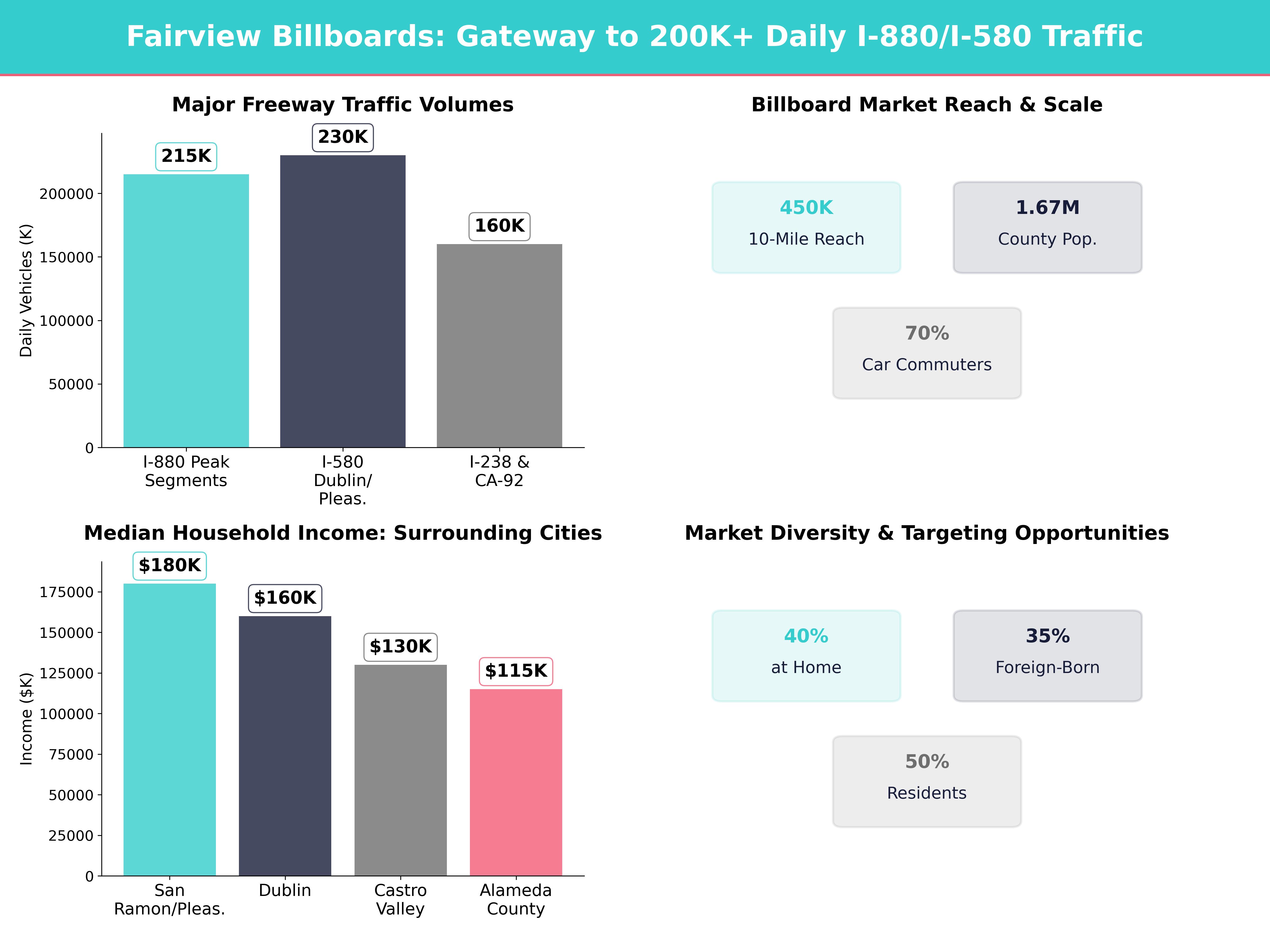
Because of its location, campaigns serving the Fairview area naturally reach several distinct audience segments, including suburban commuters, families and homeowners, Tri-Valley professionals, multicultural audiences, and students and education workers. Within a roughly 10-mile radius of Fairview, we realistically reach 400,000–500,000 people when we include the broader Eden Area, Hayward, Castro Valley, San Leandro, and the Tri-Valley. Alameda County median household income is over $115,000 per year, and nearby communities run considerably higher.
When is the best time to run billboards near Fairview, California with Blip?
Traffic serving the Fairview area follows typical East Bay commuter patterns, with weekday morning commute from 6:30–9:30 a.m. and weekday evening commute from 3:30–7:30 p.m. Midday from 10 a.m.–3 p.m. can represent 25–35% of daily traffic on major arterials, and weekends shift toward shopping centers, outdoor recreation, and regional attractions. With Blip’s flexible scheduling and budgeting, we can concentrate spend only on rush hours, emphasize weekend afternoons, or increase frequency during limited campaign windows.
Why is billboard advertising in Fairview, California a good fit for local businesses?
Billboard advertising near Fairview, California lets us tap into a dense, high-income East Bay community that sits at the crossroads of several key commuter and retail corridors. With 11 digital billboards serving the Fairview area from nearby San Lorenzo, Hayward, and Dublin, we can precisely target local residents, commuters, and shoppers as they move between home, work, and regional destinations. This cluster of locations offers flexible coverage without sacrificing local relevance.
Do I need a contract to advertise with Blip near Fairview?
No, Blip has no long-term contracts or minimum commitments. You can start, pause, or stop your campaign at any time.
How fast can I launch a billboard campaign with Blip near Fairview?
You can have your campaign live in minutes. Create a free account, select your locations, set your budget, upload your design, and start running once approved.
Where can I advertise with Blip near Fairview?
Blip has digital billboards near Fairview. You can browse available locations on a map, choose the ones that fit your audience, and start advertising right away.
Still have questions? Launch a campaign in minutes — no contracts, no commitments.
Start Your CampaignFairview Billboard Advertising Guide
Billboard advertising near Fairview, California lets us tap into a dense, high-income East Bay community that sits at the crossroads of several key commuter and retail corridors. With 11 digital billboards serving the Fairview area from nearby San Lorenzo Hayward, and Dublin
Understanding the Fairview Area Market
Fairview is an unincorporated community in Alameda County perched between Hayward and Castro Valley 11,300 residents, while Alameda County as a whole has about 1.67 million residents and is one of the most affluent and diverse counties in California. The Eden Area 120,000 residents, creating a tightly connected, suburban trade area that Fairview billboards can reach efficiently.
Key demographic characteristics in the Fairview area:
-
Population base
- Fairview: ~11,300 residents
- Hayward: ~162,000 residents
- Dublin: ~76,000 residents
- Castro Valley (unincorporated): ~66,000 residents
- San Leandro: ~91,000 residents
- Within a roughly 10‑mile radius of Fairview, we realistically reach 400,000–500,000 people when we include the broader Eden Area, Hayward, Castro Valley, San Leandro, and the Tri‑Valley.
- Hayward alone issues thousands of new business licenses and building permits annually, reflecting continuous economic activity and new services flowing into the market (City of Hayward).
-
Income and spending power
-
Alameda County median household income is over $115,000 per year, and nearby communities run considerably higher:
- Dublin: median household income frequently cited above $160,000.
- Castro Valley: roughly $120,000–$130,000.
- San Ramon and Pleasanton in the wider Tri‑Valley: often in the $150,000–$180,000 range.
- In Dublin and Pleasanton, more than 50% of households have incomes above $150,000, supporting strong discretionary spending in categories like dining, fitness, elective healthcare, travel, home improvement, and premium retail.
- Auto ownership rates exceed 1.8 vehicles per household in many nearby ZIP codes, which reinforces heavy reliance on driving and high exposure to outdoor advertising.
-
Alameda County median household income is over $115,000 per year, and nearby communities run considerably higher:
-
Housing and stability
- Homeownership in many East Bay suburbs near Fairview (Castro Valley, Dublin, San Ramon) ranges from about 55–70% of occupied units.
- In several of these communities, 35–45% of households have lived in the same home for 10+ years, creating a stable base for long‑term, brand‑building billboard campaigns (home services, medical, education, financial).
-
Diversity
- Hayward and nearby communities are among the most diverse in the Bay Area, with no single ethnic group forming a majority.
- In Hayward, major population groups include Latino, Asian, Black, and White communities, each representing significant multi‑tens‑of‑percent shares of residents.
- More than 40% of residents in many East Bay corridors speak a language other than English at home, and Spanish is the most common non‑English language.
- This makes messaging that is inclusive, culturally aware, and sometimes bilingual (especially English–Spanish) particularly effective.
Useful local context and data resources:
- Alameda County information: https://www.acgov.org
- City of Hayward (economic & community data): https://www.hayward-ca.gov
- City of Dublin (business & demographics): https://dublin.ca.gov
- Eden Area (which includes Fairview) overview: https://www.acgov.org/edenarea
- Castro Valley community and chamber information: https://castrovalleychamber.com
- Alameda County economic development & business resources: https://www.acgov.org/cda/ceda
When we design campaigns serving the Fairview area, we should think in terms of this wider, affluent East Bay corridor rather than Fairview alone, and select billboards near Fairview that intersect with these broader travel and shopping patterns.
Where Our Billboards Reach: Key Corridors and Traffic Patterns
Our 11 digital billboards serving the Fairview area are located in nearby San Lorenzo, Hayward, and Dublin, all within about 10 miles of Fairview. This placement gives us coverage on some of the most heavily traveled roads in the East Bay, where annual average daily traffic (AADT) frequently reaches six‑figure vehicle counts. For businesses looking for billboard advertising near Fairview, this configuration delivers both freeway and surface‑street visibility.
Relevant highways and corridors (with approximate daily traffic volumes from the Caltrans Traffic Census Program):
-
I‑880 (Hayward/San Lorenzo corridor)
- Often exceeds 200,000 vehicles per day near Hayward, with some segments topping 215,000.
- Roughly 60–65% of traffic is weekday commuter and work‑related travel, supporting frequency‑driven campaigns.
- Heavy commuter traffic connecting Oakland, the South Bay, and the San Mateo–Hayward Bridge (CA‑92).
- Ideal for commuter-focused, workday and B2B messaging.
-
I‑580 (Castro Valley / Dublin corridor)
- Commonly in the 180,000–220,000 vehicles per day range through key East Bay segments; in Dublin and Pleasanton, peak locations can approach 230,000 vehicles daily.
- Carries commuters between the Tri‑Valley (Dublin, Pleasanton, Livermore) and Oakland/SF, as well as long-distance I‑5 and Central Valley traffic.
- Average commute times for Tri‑Valley workers often exceed 30–35 minutes, allowing multiple daily impressions per traveler.
- Great for reaching higher-income suburban commuters and long-distance travelers.
-
I‑238 and CA‑92 near Hayward
- I‑238 and the CA‑92 approach to the San Mateo–Hayward Bridge each see on the order of 130,000–160,000 vehicles per day.
- The San Mateo–Hayward Bridge itself carries well over 80,000–90,000 vehicles daily, much of it tech and professional workers commuting between the East Bay and the Peninsula.
- Concentrated cross‑bay commute traffic toward Silicon Valley and the Peninsula.
-
Major arterials near Fairview
- Mission Boulevard, Hesperian Boulevard, Foothill Boulevard, and Redwood Road each carry tens of thousands of vehicles daily; several segments are in the 25,000–45,000 vehicles per day range.
- These routes gather Fairview, Castro Valley, and Hayward residents as they head to retail, school, and local services.
- The City of Hayward estimates more than 1 million vehicle trips per week on its busiest arterials, creating consistent reach for neighborhood‑focused campaigns ( City of Hayward transportation
By placing creative on boards in San Lorenzo and Hayward, we capture Fairview residents on their daily errands and commutes. Boards in Dublin let us reach Tri‑Valley commuters who live, shop, or visit near Fairview, especially those moving along the I‑580 corridor and visiting major regional centers like Hacienda Crossings and Stoneridge Mall. Together, these Fairview billboards function as a connected network for East Bay coverage.
Who You Can Reach in the Fairview Area
Because of its location, campaigns serving the Fairview area naturally reach several distinct audience segments:
-
Suburban Commuters
- In Alameda County, more than 70% of workers commute by car, truck, or van, and in some suburban ZIP codes around Fairview that share can exceed 80%.
- Many Fairview and Castro Valley residents commute to jobs in Oakland, San Francisco, or Silicon Valley; cross‑county commuting rates above 35–40% are common in the Tri‑Valley.
- Average one‑way commute times for many East Bay workers are 30–40 minutes, meaning 10–20 miles of daily freeway exposure.
- Long stretches on I‑580, I‑880, and CA‑92 mean multiple daily impressions per commuter.
- Strong fit for service businesses (auto repair, healthcare, legal, financial services), subscription products, employer branding, and recruitment.
-
Families and Homeowners
- The area skews toward single‑family homes and long‑term residents; in some nearby communities, over 60% of housing units are single‑family detached homes.
- Household sizes often average 3.0–3.2 people, with a significant share of households containing children under 18.
- High relevance for home services (roofing, landscaping, HVAC, solar, remodeling), local schools and tutoring, children’s activities, and healthcare providers.
- Many East Bay utilities and local governments report residential energy‑efficiency and solar adoption programs serving thousands of households annually, indicating strong interest in home upgrades and sustainable living.
-
Tri‑Valley Professionals (via Dublin boards)
- Dublin and the greater Tri‑Valley have some of the highest incomes in the Bay Area and a large professional and tech workforce; professional, scientific, tech, and finance jobs can account for 25–35% of all employment in some Tri‑Valley cities.
- Educational attainment is high: in nearby employment centers, more than 50% of adults hold a bachelor’s degree or higher.
- Ideal for higher‑ticket offers: real estate, automotive, medical specialists, financial advisors, and premium retail.
- Regional visitor data show millions of annual visits to Tri‑Valley shopping, dining, and winery destinations (Visit Tri‑Valley), many of which flow along I‑580 near our Dublin boards.
-
Multicultural Audiences
- Hayward and neighboring communities have large Latino, Asian, and Pacific Islander populations, along with meaningful African American and Middle Eastern communities.
- In many nearby ZIP codes, more than 50% of residents are non‑white, and 30–40% were born outside the U.S., underscoring the importance of inclusive, culturally smart messaging.
- Bilingual or culturally nuanced campaigns can tap into loyal, word‑of‑mouth driven communities, especially for healthcare, education, and local retail.
-
Students and Education Workers
- Institutions like California State University, East Bay in Hayward serve roughly 13,000–14,000 students across undergraduate and graduate programs, plus thousands of faculty and staff.
- Nearby community colleges such as Chabot College in Hayward enroll around 13,000–15,000 students annually.
- Local school districts, including Hayward Unified School District and Castro Valley Unified School District, collectively serve tens of thousands of K–12 students.
- Great match for student housing, quick‑service restaurants, wireless plans, test prep, and recruiting.
Clarifying which of these segments matters most to your business helps us choose when and where your ads (“blips”) should appear on billboards near Fairview.
Crafting Effective Creative for the Fairview Area
Digital billboards give us only a few seconds of attention, and East Bay drivers are often in dense, fast‑moving traffic. On segments of I‑580 and I‑880, posted speeds of 55–65 mph combined with high volumes mean viewers often have no more than 3–5 seconds to absorb a message. Artwork serving the Fairview area should be designed accordingly:
-
Ultra‑simple messaging
- Aim for 6–8 words or fewer of main text; legibility studies of roadside signs show comprehension drops sharply beyond 7–10 words when vehicles are traveling above 45 mph.
- Use one central idea per ad: “New Patient Special – Fairview Dental,” not a full list of services.
- Use large font sizes; major outdoor standards recommend at least 18–24 inches of letter height for freeway viewing distances.
-
High‑contrast, Bay‑Area‑friendly color palettes
- Strong contrast (light text on dark background or vice versa) is critical in bright sun on I‑580 and I‑880, where clear‑day sunshine can exceed 250–300 high‑brightness days per year.
- Avoid large white fields at night that can feel harsh; deep blues, greens, and dark neutrals with bold accent colors often work well.
- Limit yourself to 2–3 main colors and 1–2 typefaces to make the message immediately scannable.
-
Location cues that feel local
- Use references such as “Minutes from Fairview,” “Off Mission Blvd in Hayward,” or “Near Castro Valley BART.”
- The Bay Area Rapid Transit (BART) network carries hundreds of thousands of riders weekly, and references to nearby BART stations (Hayward, Castro Valley, Bay Fair) help anchor your location.
- This reassures nearby audiences that you are “their” local option and can lift response rates versus generic, non‑localized creative.
-
Language and inclusivity
- Consider bilingual English–Spanish versions for certain boards or dayparts, especially on routes heavily used by Hayward and San Lorenzo residents, where Spanish‑speaking households can make up 20–35% of the population.
- Use inclusive imagery that reflects the ethnic and age diversity of the East Bay: multigenerational families, diverse professionals, and youth all appear heavily in local demographics.
-
Call‑to‑action formats that work while driving
- Focus on short, memorable CTAs: “Search: Fairview Orthodontics,” “Exit Hesperian – Turn Right,” or a short URL/brand name that’s easy to recall.
- Phone numbers should be used sparingly and only if truly memorable (e.g., repeating digits or vanity numbers of 7 or fewer characters).
- For time‑sensitive offers, phrases like “This Week Only” or “Ends Sunday” can create urgency without requiring detailed fine print.
Because Blip makes it easy to upload multiple designs, we can A/B test different headlines, colors, or language combinations across the same boards and quickly learn what resonates for billboard advertising near Fairview.
Timing Your Campaign: When to Run Your Blips
Traffic serving the Fairview area follows typical East Bay commuter patterns, with some nuances tied to local schools, ports, and cross‑bay travel:
-
Weekday morning commute (6:30–9:30 a.m.)
- Heavy westbound and southbound flows on I‑580, I‑880, and CA‑92. On these corridors, traffic volumes during peak hours can reach 2–3 times off‑peak levels.
-
Best for:
- Coffee shops, breakfast/QSR, transit‑adjacent retail.
- B2B services (IT, HR, staffing) targeting office workers.
- Messages like “Today Only,” “Before Work,” or “Open at 7 a.m.”
-
Weekday evening commute (3:30–7:30 p.m.)
- Strong eastbound and northbound volume returning toward Fairview, Castro Valley, and Dublin.
- In many East Bay locations, evening commute windows account for 30–40% of total weekday vehicle miles traveled.
-
Best for:
- Restaurants, gyms, family activities, grocery stores.
- Home services (“Call on your drive home, we’ll be there tomorrow”).
-
Midday (10 a.m.–3 p.m.)
- More local errands and flexible workers, including parents and retirees; this period can represent 25–35% of daily traffic on major arterials.
-
Best for:
- Healthcare, auto repair, retail centers, government and community messaging.
- Appointment‑driven businesses that operate during business hours.
- Local agencies like the Alameda-Contra Costa Transit District (AC Transit) report strong midday ridership on routes serving Hayward and San Leandro, reflecting robust daytime activity.
-
Weekends
- Traffic shifts toward shopping centers, outdoor recreation, and regional attractions.
- Regional tourism organizations note millions of annual visitors to East Bay destinations—parks, waterfronts, wineries, and downtowns—much of it concentrated on Fridays, Saturdays, and Sundays (Visit Oakland, Visit Tri‑Valley).
-
Good fit for:
- Malls and power centers in Hayward, San Leandro, and Dublin.
- Entertainment, events, religious institutions, and tourism.
- Promotions tied to nearby destinations like Oakland, the Tri‑Valley wineries, or regional festivals.
With Blip’s flexible scheduling and budgeting, we can:
- Concentrate spend only on rush hours for maximum commuter reach.
- Emphasize weekend afternoons for retail and entertainment.
- Increase frequency during limited campaign windows (e.g., a 2‑week grand opening) and scale back afterward.
- Adjust quickly in response to observed traffic changes, such as school‑year vs. summer patterns or major construction projects reported by Caltrans District 4 and local cities.
Geographic Strategy: Matching Boards to Your Customers
Because our 11 digital billboards serving the Fairview area are spread across San Lorenzo, Hayward, and Dublin, we can build a geographic strategy that reflects where your customers actually travel:
-
Fairview‑centric services (e.g., local medical practice, preschool, home services)
- Prioritize boards in San Lorenzo and Hayward, especially those closest to Mission Boulevard, Hesperian Boulevard, and Foothill Boulevard corridors.
- Many households in Fairview and surrounding unincorporated areas rely on these arterials daily; local trip‑generation studies often show 5–10 vehicle trips per household per day for errands, school, and work.
- Focus on commute and midday slots when local residents are on the road.
- This approach effectively turns nearby inventory into Fairview billboards for hyperlocal awareness.
-
Regional retail destinations and chains
- Use a mix of Hayward and Dublin boards to capture both Eden Area and Tri‑Valley shoppers.
- Major regional centers such as Southland Mall in Hayward and Hacienda Crossings in Dublin draw from trade areas of 150,000+ people, often spanning multiple cities.
- Highlight the closest store location in your creative: “Hayward – Winton Ave” or “Dublin – Hacienda Dr.”
- For brands with multiple nearby locations, consider rotating creative that spotlights different stores by daypart or day of week.
-
Professional and tech‑focused businesses
- Emphasize Dublin and I‑580 boards to tap the higher‑income Tri‑Valley demographic while still reaching Fairview‑area commuters who travel that corridor.
- The Tri‑Valley is home to thousands of tech, biotech, and professional services jobs in business parks around Dublin, Pleasanton, and Livermore.
- Position services like coworking spaces, enterprise software, consulting, or executive health offerings during weekday commute hours.
-
Event‑driven campaigns
- For events in or near the Fairview area, run high‑frequency, short‑burst campaigns 7–10 days before the event, focusing on boards nearest major routes leading to your venue.
- Consider directional copy: “This Saturday – 2 Miles Ahead, Exit X.”
- Local venues—from downtown Hayward cultural events (Hayward city events calendar) to Tri‑Valley festivals (Visit Tri‑Valley events)—often draw thousands of attendees, making pre‑event billboard exposure especially valuable.
Leveraging the Local Calendar and News Cycle
Aligning your campaign with what’s happening locally can multiply its impact:
-
School year cycles
-
Back‑to‑school periods (August–September, January) are ideal for:
- Tutoring centers, after‑school programs, childcare, pediatric care, and clothing retailers.
- Hayward Unified School District serves roughly 20,000+ students across dozens of schools, and Castro Valley Unified adds thousands more; each school year transition prompts large waves of purchases and schedule changes.
- Coordinate with local school calendars from entities like Hayward Unified School District, Castro Valley Unified School District, and San Lorenzo Unified School District.
-
Back‑to‑school periods (August–September, January) are ideal for:
-
Holiday shopping and tax season
- November–December: Emphasize retail, gifts, auto sales, and dining. Regional retail centers in the East Bay can see 20–40% higher foot traffic vs. typical months during this period.
- January–April: Promote tax preparation, financial advising, and debt‑relief services; many tax preparers report 60–70% of annual volume concentrated in these months.
- Tie messages to local promotions, holiday markets, and city‑sponsored downtown events promoted by organizations like Downtown Hayward
-
Local events and festivals
- Monitor local outlets such as the East Bay Times, The Mercury News East Bay section, and the Hayward city events calendar for major happenings you can tie into.
- County‑wide and regional events—parades, cultural festivals, sports tournaments, and university events—can each attract thousands to tens of thousands of attendees.
- Quick‑turn creative swaps through Blip let us update messaging around specific weekends or events.
-
Tourism and leisure
- Regional tourism resources like Visit Tri‑Valley and Visit Oakland highlight seasonal draws from wine tourism and outdoor recreation to arts and food festivals.
- These organizations report millions of annual visitor days to their regions, much of which passes through East Bay freeway corridors.
- Hospitality, attractions, and recreation businesses can time heavier weekend and holiday campaigns to coincide with spikes in regional visitors who pass through Dublin and Hayward.
- Local parks and open spaces managed by the East Bay Regional Park District attract millions of visits each year, offering another seasonal hook for outdoor, family, and recreation‑oriented campaigns.
Measuring and Optimizing Your Campaign
While billboard impressions are based on traffic counts and share of voice, we can still build a data‑driven loop around your Blip campaigns serving the Fairview area:
-
Impression estimates
- Use Caltrans traffic data and the number of times your creative appears to approximate total exposures per day or per week.
- For example, a digital billboard on a stretch of freeway with 200,000 vehicles per day where your ad shows 1,000 times daily in a loop of 8–10 advertisers might conservatively deliver 100,000–150,000 gross impressions per day.
- Compare this to web traffic, calls, or store visits during the same period.
-
Trackable calls‑to‑action
-
Use:
- Unique URLs or landing pages.
- Billboard‑specific promo codes (“FAIRVIEW10”).
- Distinct phone numbers or extensions.
- Watch for changes in these metrics when your campaign is active vs. paused; even a 5–10% lift in calls or site visits can be meaningful at local‑business scale.
-
Use:
-
Creative rotation testing
- Run at least 2–3 variations of your key message in parallel.
- Allow each creative to accumulate a statistically useful volume of impressions—often tens of thousands of impressions per version—before deciding on a winner.
- After 1–2 weeks, evaluate which version lines up with better performance signals (calls, form fills, walk‑ins) and shift budget toward the winners.
-
Daypart experiments
-
Start with a broad schedule, then narrow:
- If you see more conversions during evening commute hours, reallocate more of your Blip budget there.
- If weekend‑focused businesses notice strong Saturday results, add more impressions on those days.
- Over time, many advertisers find that concentrating spend into their top‑performing 20–30 hours per week produces better ROI than spreading the same budget thinly across all hours.
-
Start with a broad schedule, then narrow:
Over time, this process helps us identify the most efficient mix of boards, creative, and timing for reaching your ideal customers near Fairview and getting the most from your billboard rental near Fairview.
Putting It All Together for the Fairview Area
Advertising on digital billboards serving the Fairview area gives us a unique combination of:
- Access to high‑income, diverse suburban households, many with household incomes above $115,000 and significant discretionary spending.
- Coverage of major East Bay and Tri‑Valley corridors with six‑figure daily traffic counts, including I‑580, I‑880, CA‑92, and key arterials.
- Flexibility to adjust budget, timing, and creative quickly around your business needs.
By pairing the local realities of Fairview, San Lorenzo, Hayward, and Dublin with Blip’s on‑demand buying model, we can:
- Define the audiences you most want to reach (Fairview locals, Tri‑Valley commuters, families, students).
- Match those audiences to specific corridors and boards.
- Craft clear, localized, and visually impactful creative.
- Time your campaign around commute patterns, weekends, and the local calendar.
- Measure, test, and refine continuously.
When we approach the Fairview area with this level of focus and flexibility, digital billboards become a powerful, cost‑controlled channel for building awareness and driving real‑world results across one of the Bay Area’s most dynamic suburban markets, whether you need always‑on visibility or short‑term billboard rental near Fairview for key promotions.