Billboards near Montclair, CA
No Minimum Spend. No Long-Term Contracts. Just Results.
Trusted by Leading Brands


Billboard advertising
near Montclair has never been easier



How much is a billboard near Montclair?
Why Choose Blip for Billboard Advertising near Montclair
Blip's self-serve setup lets you launch Montclair ads fast on I-10 and SR-210, reaching daily commuters in the Inland Empire and San Gabriel Valley.
Use flexible budgets in Montclair to test Montclair Place weekend traffic or weekday Central Ave shoppers, then scale what works.
No contracts means you can run Montclair blips around back-to-school, Fairplex events, or holiday retail surges without long commitments.
Real-time analytics show which Montclair dayparts hit commuters best, so you can shift spend between 6-9 a.m. and 4-7 p.m. instantly.
Blip's creative tools make it easy to build bilingual Montclair billboards for a market where most residents are Hispanic or Latino.
Frequently Asked Questions About Billboard Advertising near Montclair
How much does a billboard cost near Montclair, California with Blip?
With Blip, you control exactly how much you spend on Montclair billboards by setting a daily budget that can be adjusted anytime. Each ad is a short “blip” on rotating digital billboards, and you only pay per blip, so your total cost is simply the sum of the individual displays you receive. This flexible, pay-per-blip model makes it easy to start advertising in the Montclair area with any budget, whether you want to test a small campaign or scale up.
Where can I advertise near Montclair, California with Blip?
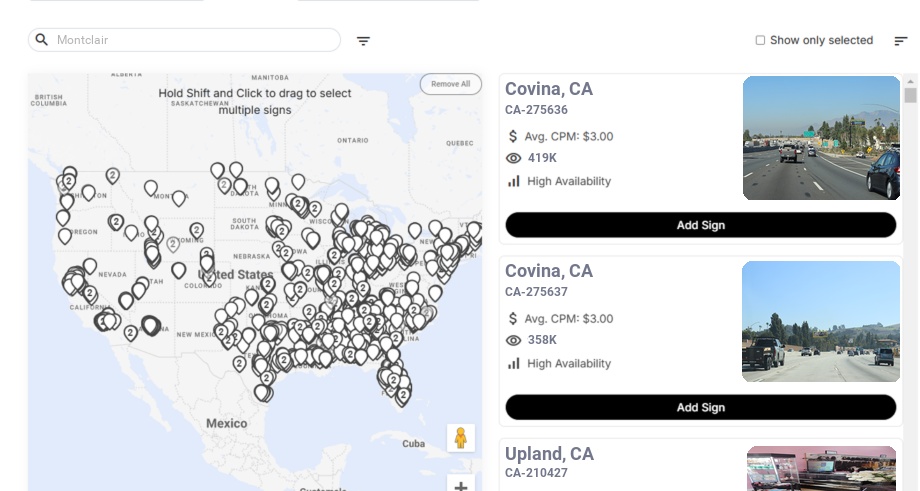
Blip’s nearby digital billboards are located in Upland, about 4 miles from Montclair, and in Covina, about 9.5 miles away. These placements can reach both daily commuters and regional shoppers traveling to and from the Montclair area. The page also notes that Upland boards capture traffic along SR-210 and other local corridors, while Covina boards tap into San Gabriel Valley markets.
What kind of audience can Blip reach in Montclair, California?
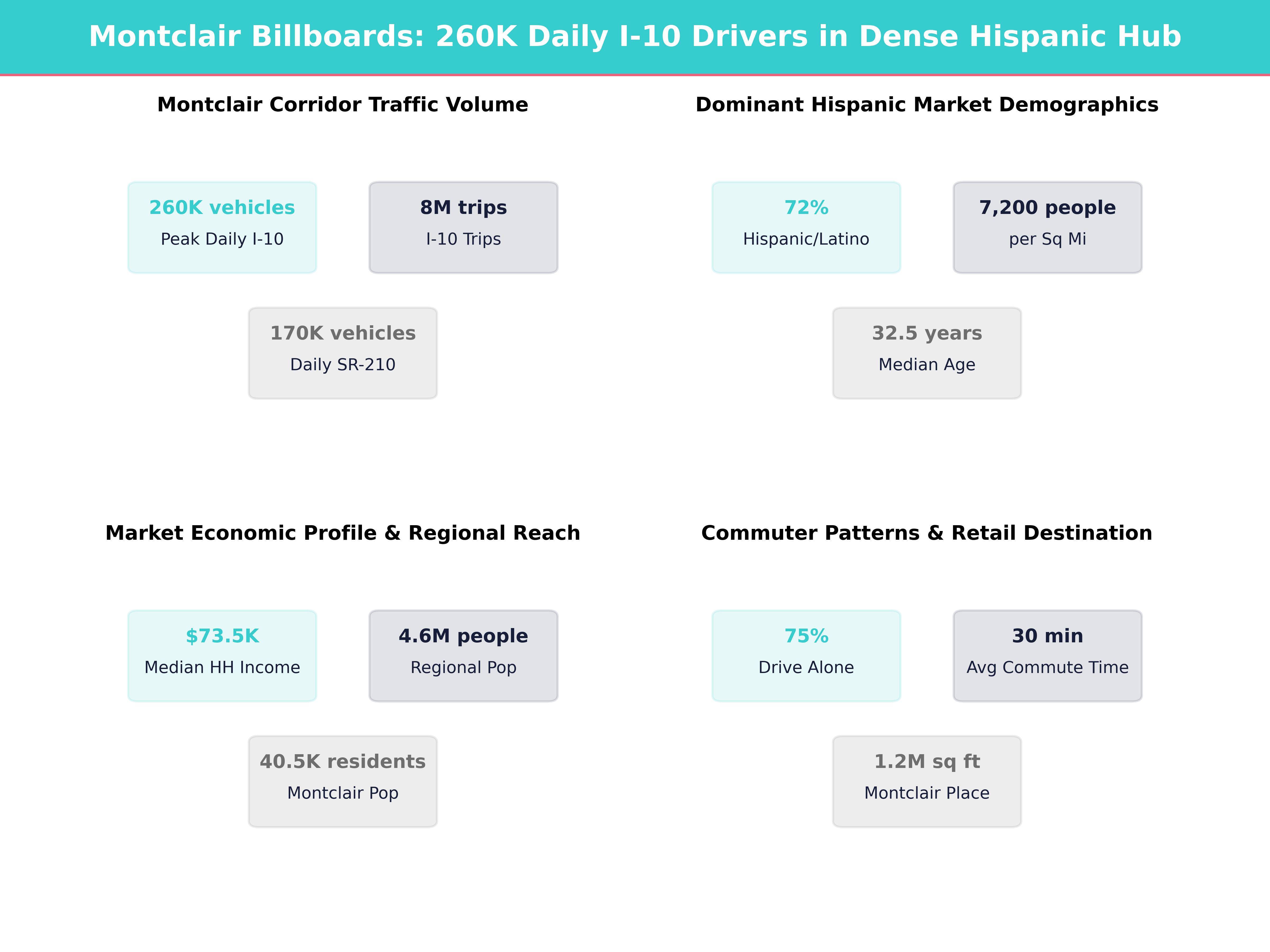
Montclair is a compact but busy city with a population a little above 40,000 and a median age around 32–33 years. About 71–72% of residents identify as Hispanic or Latino, creating a strong bilingual English/Spanish advertising environment. The area also has a large share of family households and many commuters driving daily through the region.
When is the best time to run Blip billboards in Montclair, California?
Weekday commute hours are especially valuable in Montclair, with morning traffic from 6–9 a.m. and evening traffic from 4–7 p.m. being the heaviest periods on I-10 and SR-210. Midday is also strong around Montclair Place and Ontario Mills, and weekends stay busy with shopping, family outings, and events. Blip lets you schedule heavier impression volume during these high-value dayparts while keeping a continuous presence the rest of the week.
What roads in Montclair, California get the most billboard traffic?
The Montclair area sits at the junction of several high-volume corridors, including Interstate 10, State Route 210, and major surface streets like Central Avenue, Monte Vista Avenue, Holt Boulevard, and Mission Boulevard. I-10 segments between San Bernardino County and eastern Los Angeles County carry roughly 200,000–260,000 vehicles per day, and many local streets run in the 20,000–40,000 vehicles-per-day range. These routes make billboard advertising near Montclair especially effective for reaching commuters and shoppers.
Do I need a contract to advertise with Blip near Montclair?
No, Blip has no long-term contracts or minimum commitments. You can start, pause, or stop your campaign at any time.
How fast can I launch a billboard campaign with Blip near Montclair?
You can have your campaign live in minutes. Create a free account, select your locations, set your budget, upload your design, and start running once approved.
Where can I advertise with Blip near Montclair?
Blip has digital billboards near Montclair. You can browse available locations on a map, choose the ones that fit your audience, and start advertising right away.
Still have questions? Launch a campaign in minutes — no contracts, no commitments.
Start Your CampaignMontclair Billboard Advertising Guide
Located at the western edge of San Bernardino County, Montclair sits at the crossroads of the Inland Empire and the San Gabriel Valley. With roughly 40,000–41,000 residents in Montclair itself packed into just over 5.5 square miles, and more than 4.6 million people across San Bernardino, Riverside County Los Angeles County Upland and Covina
Understanding the Montclair Area Market
Montclair is a compact but busy city—only about 5.5 square miles—with a population a little above 40,000 and a median age around 32–33 years. The city reports that about 71–72% of residents identify as Hispanic or Latino, creating a strong bilingual (English/Spanish) advertising environment. A significant share of households speak Spanish at home, and many are multigenerational. You can explore local demographics and community data directly from the City of Montclair and San Bernardino County. These demographics help explain why Montclair billboards and nearby placements are especially valuable for brands targeting bilingual, family-focused audiences.
Key economic and lifestyle indicators that matter for billboard advertisers:
- Population density: More than 7,200 residents per square mile in Montclair, compared with a national average of roughly 94 per square mile and a California average of about 252 per square mile. This extreme density around major corridors like Central Avenue, Monte Vista Avenue, and the I‑10 corridor significantly amplifies the value of every impression and supports efficient billboard advertising near Montclair that reaches a large audience with each play.
- Household income: Median household income in Montclair is in the low- to mid‑$70,000s (roughly $72,000–$75,000), while neighboring cities like Upland often fall in the low‑$80,000s, Ontario in the mid‑$70,000s, and Claremont frequently tops $110,000. This mix supports both value-focused campaigns (discount retail, quick service restaurants, buy-here-pay-here auto) and higher-ticket offerings (healthcare, financial services, higher education, and specialty retail).
- Housing and families: Around 60–65% of Montclair households are family households, and roughly 35–40% include children under 18. The homeownership rate is typically in the 50–55% range, with a substantial renter population—ideal for campaigns promoting apartments, mobile services, and local amenities.
- Commuter behavior: Regional transportation analyses for the Inland Empire indicate that 75–80% of workers commute by driving alone, another 10–12% carpool, and only a small share use transit, biking, or walking. Average one-way commute times commonly exceed 30 minutes, with many Inland Empire residents spending 60–90 minutes per day on the road. Many Montclair residents work in Los Angeles County or western San Bernardino County, driving daily past our Upland and Covina locations. You can review broader commute and growth patterns through the Southern California Association of Governments.
- Retail gravity: The Montclair Place mall, a regional center with roughly 1.2 million square feet of retail space and more than 100–120 stores and eateries, anchors a high-traffic commercial zone. Combined with adjoining big-box corridors along Central Avenue, Monte Vista Avenue, and Holt Boulevard, the area draws shoppers from Upland, Ontario, Pomona, and Claremont. Local economic reports often cite tens of thousands of visits per week and strong weekend and holiday surges. Explore mall details and events via Montclair Place.
Because our four digital billboards are located in Upland (about 4 miles away) and Covina (about 9.5 miles away), campaigns can reach both daily commuters and regional shoppers traveling to and from the Montclair area, including traffic feeding into hubs like Ontario Mills Pomona Fairplex Claremont Colleges
Key High-Traffic Corridors Serving Montclair
Efficient billboard advertising in the Montclair area starts with understanding regional traffic. The area sits at the junction of multiple high-volume freeways and arterials:
-
Interstate 10 (San Bernardino Freeway)
- Runs east–west directly along Montclair’s southern edge, linking the Inland Empire with the San Gabriel Valley and downtown Los Angeles.
- Caltrans traffic counts show segments of I‑10 between San Bernardino County and eastern Los Angeles County carrying roughly 200,000–260,000 vehicles per day, with peak volumes during weekday morning and evening rush hours.
- This translates to 6–8 million vehicle trips per month on key segments where commuters from Montclair, Ontario, Pomona, and Upland funnel into Los Angeles County.
- Our nearby boards in Upland and Covina can position your message along I‑10 or close parallel routes that capture this flow, especially for travelers moving between the Inland Empire and job centers in the San Gabriel Valley. If you are comparing different options for billboard rental near Montclair, boards along this corridor consistently deliver some of the heaviest daily reach.
-
State Route 210 (Foothill Freeway)
- Passes just north of Montclair through Upland and Rancho Cucamonga.
- Many segments of SR‑210 in western San Bernardino County handle around 140,000–170,000 vehicles per day, according to Caltrans traffic data.
- That’s more than 4 million monthly vehicle trips across key commuter stretches.
- Upland-based digital billboards give you access to this commuter stream, including Montclair residents heading to job centers in Pasadena, Glendale, or the San Fernando Valley.
-
Metrolink and transit corridors
- The Montclair Transcenter Metrolink thousands of boardings per day, making rail and bus riders another touchpoint for brands that appear repeatedly along their driving and transfer routes.
- Local and regional bus routes from agencies like Foothill Transit and Omnitrans
-
Key surface streets
- Central Avenue, Monte Vista Avenue, Holt Boulevard, and Mission Boulevard are all heavily traveled arterials connecting Montclair with Upland, Pomona, Claremont, and Ontario.
- On many segments, local street volumes run in the 20,000–40,000 vehicles-per-day range, with some intersections at or near Montclair Place and freeway on/off-ramps exceeding 45,000 vehicles per day on peak days.
- These streets are ideal for messages targeted to hyper-local shoppers and service users, including “last-mile” directional creative.
By using Blip’s location targeting and scheduling tools, we can emphasize blips on boards and dayparts that line up with these specific commuting patterns and shopping trips, leveraging data from sources like Caltrans District 8 and local traffic studies commissioned by nearby cities. This makes it easy to fine-tune billboard advertising near Montclair so your messages appear when the right drivers are actually on the road.
Who You Can Reach in the Montclair Area
To shape effective messaging, it helps to think about the key audience segments moving through the Montclair area and the nearby Upland and Covina corridors:
-
Young families and multigenerational households
- With a relatively young median age (early 30s) and a high share of households with children, Montclair and adjacent cities support strong demand for family services. Nearby districts like the Ontario-Montclair School District report enrollment in the 20,000–21,000 student range across dozens of campuses, indicating a large base of school-age children and engaged parents.
- Multigenerational living is common in the Inland Empire, with regional estimates often showing 15–20% of households including three or more generations—supporting campaigns for healthcare, grocery, financial services, and home improvement.
-
Latino and bilingual consumers
- More than 70% of Montclair residents identify as Hispanic or Latino, and nearby cities like Ontario and Pomona show similarly high shares. In many neighborhoods, a majority of households use Spanish at home.
- Businesses that incorporate bilingual or Spanish-first creative frequently see higher engagement among local audiences, particularly for banks, credit unions, auto dealerships, healthcare providers, and supermarkets.
- Major local and regional media, such as Spanish-language radio and community news, reinforce this environment—your billboard presence can extend that reach into key travel corridors.
-
Commuters into Los Angeles County and western Inland Empire
- Regional data show that roughly 60–65% of Inland Empire workers commute to jobs within the same county, while a sizeable minority travel into Los Angeles County and Orange County. For Montclair, that means thousands of daily trips west along I‑10 or north along SR‑210.
- Many travelers pass near our Covina billboards on their way into employment centers in the San Gabriel Valley and central Los Angeles, while Upland boards capture east–west and north–south flows to Rancho Cucamonga, Ontario, and beyond.
- Average annual vehicle miles traveled per household in the Inland Empire commonly exceed 20,000 miles per year, creating repeated exposure opportunities for well-placed billboards.
-
Retail and entertainment visitors
- Regional draws like Montclair Place, Claremont Village Ontario Mills Pomona Fairplex 10–20 mile radius or more. Ontario Mills alone is known as one of California’s busiest outlet centers, attracting millions of shoppers per year.
- The Fairplex, home to the LA County Fair tens of thousands of visitors per major event weekend, spiking freeway and arterial volumes.
- Events at venues such as the Fairplex and local college campuses (including the Claremont Colleges Inland Valley Daily Bulletin and Discover Claremont to align your bursts.
Designing your campaign with these segments in mind lets you use creative rotations and dayparting to talk to very different audiences throughout the day and week, whether you’re focused on in-city Montclair billboards or nearby placements that still reach the same consumers.
When to Run Your Blips Near Montclair
With Blip, you control not only budget but also timing, so you can lean into the Montclair area’s daily and weekly rhythms rather than paying for wasted impressions.
Weekday commute focus
-
Morning (6–9 a.m.)
- Regional traffic studies consistently identify 6–9 a.m. as the heaviest inbound period on I‑10 and SR‑210, with peak hour volumes often exceeding 10,000–12,000 vehicles per lane per day on busy segments.
- Target Montclair-area commuters heading west toward Los Angeles County or east toward job centers like Ontario and Rancho Cucamonga.
- Highlight time-sensitive offers: breakfast, coffee, car care, mobile apps, transit alternatives, or same-day services.
- Use clear, benefit-first lines: “Oil Change in 15 Minutes – Exit [X]” or “Coffee & Breakfast Burritos 5 Minutes Ahead.”
-
Evening (4–7 p.m.)
- Evening peak periods often last longer than morning peaks in Southern California, with heavy volumes well past 6 p.m. as commuters return home and run errands.
- Capture weary commuters thinking about dinner, errands, and family activities.
- Restaurants, grocery, gyms, childcare, healthcare clinics, and entertainment venues should prioritize these hours.
- Pair with limited-time messaging: “Kids Eat Free Tonight” or “Walk-In Clinic Open Until 8 PM.”
Midday and retail peaks
- Midday (11 a.m.–3 p.m.) sees strong local circulation as residents run errands, shop, or take lunch breaks. Around regional shopping centers like Montclair Place and Ontario Mills, weekday mid-day traffic can approach 70–80% of peak weekend levels.
- Retailers around Montclair Place, service providers, and QSR/fast-casual restaurants can run value-focused creative during these windows to influence spur-of-the-moment decisions.
Weekends
- Weekend freeway and arterial traffic near Montclair typically remains strong, driven by shopping, family outings, and events. In many Southern California corridors, Saturday volumes are within 5–15% of weekday peaks, with Sunday often only slightly lower.
-
Use Saturday and Sunday dayparts to promote:
- Car dealers and auto services
- Furniture and home improvement
- Entertainment, church services, and community events
- Education (open houses, enrollment deadlines)
With Blip, we can schedule heavier impression volume on these high-value dayparts while maintaining a continuous low-level presence the rest of the week, adjusting in real time around local happenings highlighted by outlets like the City of Montclair and City of Ontario. This flexible control is especially helpful if you’re testing multiple approaches to billboard advertising near Montclair and want to learn which time frames drive the best response.
Creative Strategies for the Montclair Area
Billboard creative must communicate in under 6 seconds at freeway speeds. In the Montclair area’s busy corridors—where typical flow speeds can be 55–65 mph on freeways and 30–40 mph on arterials—clarity is even more crucial. We recommend:
1. Bilingual and culturally tuned messaging
- Use simple bilingual headlines where appropriate: for example, English main line with a Spanish sub-line, or vice versa.
- Avoid cramming two full ads into one layout; instead, keep the headline and CTA universally clear and supplement with one bilingual support line.
- Focus on community themes that resonate locally: family, savings, education, and neighborhood pride. This aligns with a market where more than 7 in 10 residents identify as Hispanic or Latino and where many local events, from school programs to church festivals, are bilingual.
2. High-contrast visuals for bright Inland Empire skies
- Montclair, Upland, and Covina see over 270–280 sunny days per year, based on regional climate normals reported for the Inland Empire and San Gabriel Valley. Bright conditions wash out low-contrast designs.
-
Use bold color combinations:
- Dark backgrounds (navy, deep purple, black) with white or neon text
- Solid blocks of color instead of gradients or busy patterns
- Test legibility at small sizes on a phone screen; if you can’t read it in a 2–3 second glance, drivers won’t either.
3. Localized calls-to-action
-
Reference nearby landmarks or exits travelers actually use:
- “Just off Central Ave”
- “Next to Montclair Place”
- “10 Minutes from Here in Upland”
- Include distance-based cues (“2 exits ahead”) when you’re promoting a destination accessible from the freeway or major arterial serving the Montclair area. This is especially effective near interchanges like I‑10 at Central Avenue or Monte Vista, where daily counts are well into the six figures.
4. Lean copy and big type
- Aim for 6–8 words max, plus a short URL or simple logo.
- Use large, sans-serif fonts; avoid script or thin typefaces.
- If you must include a phone number, keep it local and simple; vanity numbers or very short local URLs get better recall. In a market where average commute times exceed 30 minutes, drivers see your creatives repeatedly across multiple days, so memorability matters more than detail.
5. Creative rotation for different segments
Since digital billboards can swap creatives in seconds, use multiple designs to speak to different audiences at different times:
- Morning creative: commuter or coffee offers
- Midday creative: lunch or shopping
- Evening creative: dinner, entertainment, or healthcare
- Weekend creative: auto, furniture, events, real estate
Blip makes it easy to upload several creatives and schedule them by daypart and day of week, letting you match creative to specific traffic flows documented in Caltrans and local planning reports.
Using Upland and Covina Boards to Reach the Montclair Area
Our four digital billboards near Upland and Covina extend your reach across two high-value submarkets that funnel traffic through the Montclair area. If you’re searching for billboards near Montclair that can hit both Inland Empire and San Gabriel Valley travelers, this cluster of boards is designed to do exactly that.
Upland boards (about 4 miles from Montclair)
- Capture traffic along the northern Inland Empire corridor, including SR‑210, Foothill Boulevard (Historic Route 66), and north–south connectors like Euclid and Mountain Avenues. Many of these arterials carry 25,000–35,000 vehicles per day through commercial stretches.
-
Ideal for reaching Montclair residents and visitors heading to or from:
- The Claremont Colleges Claremont Village
- Rancho Cucamonga business parks and shopping areas like Victoria Gardens
- Outdoor recreation in the San Gabriel Mountains foothills via trailheads in Upland and Claremont
- Helpful for brands wanting a “foothill cities” presence that still impacts Montclair shoppers and commuters using SR‑210 and Foothill Boulevard.
Covina boards (about 9.5 miles from Montclair)
- Plug directly into San Gabriel Valley markets while staying close enough to influence Montclair-bound and Montclair-origin commuters. Covina and neighboring cities like West Covina and Azusa account for a combined population well over 250,000, adding a substantial audience to your reach.
-
Great for regional brands with multiple locations spanning the Inland Empire and Los Angeles County:
- Healthcare networks and hospitals (urgent care, specialty clinics, regional systems)
- Higher education institutions (community colleges, universities, trade schools)
- Franchised restaurant chains and coffee brands
- Auto dealerships with broader service areas extending from the SGV to the Inland Empire
- Visibility in both Upland and Covina allows you to reach drivers across two major freeway corridors (I‑10 and SR‑210) and multiple east–west arterials, increasing frequency for commuters who travel across county lines.
By splitting your budget across Upland and Covina boards with Blip, you can build a two-sided funnel: one set of impressions as people leave the Montclair area and another as they come back, maximizing exposure over the 200,000+ daily vehicle trips that move along these combined corridors. For advertisers evaluating billboard rental near Montclair, this strategy often provides more flexible coverage and better regional reach than relying on a single static board.
Aligning with Local News, Events, and Seasonality
The Montclair area responds strongly to timely, community-centered messages. Some ways to use Blip’s flexibility:
-
School-year cycles
- Back-to-school periods in August/September and January are crucial for education, tutoring, retail, and healthcare campaigns. Districts like Ontario-Montclair School District, Upland Unified Claremont Unified, and Pomona Unified collectively serve tens of thousands of students, creating concentrated windows when families are highly responsive to school-related messaging.
- Check district calendars to time your flights around registration, open houses, and testing periods.
-
Local events and regional draws
- Major events at the Pomona Fairplex—including the LA County Fair, auto shows, and cultural festivals—can draw 50,000+ visitors per day during big weekends, along with heavy traffic on I‑10, SR‑57, and surface streets like Holt Boulevard.
- Community events in Montclair, Upland, Ontario, and Claremont (street fairs, concerts, athletic tournaments) also generate noticeable upticks in local traffic and footfall.
- Monitor regional calendars via outlets like Inland Valley Daily Bulletin, San Gabriel Valley Tribune, and city event pages such as City of Ontario events and City of Covina events
-
Holiday retail seasons
- Montclair Place and surrounding centers see heavy traffic from early November through late December. Regional mall reports often show November–December accounting for 20–30% of annual retail sales.
- Spring promotion periods (March–April), back-to-school (July–August), and tax refund season (February–April) are also high-opportunity windows for categories like apparel, electronics, home goods, and auto.
- Use Blip’s date controls to ramp up showings during these weeks without committing to a long fixed-term contract.
-
Weather and air quality days
- Summer highs in the Inland Empire frequently reach the 90s and 100s (°F), with several weeks per year above 95°F.
- Air quality alerts, especially for ozone and particulate matter, occur multiple times per year throughout the region.
- On extreme heat or poor air quality days, quick-turn messaging for HVAC services, healthcare, car maintenance, or delivery services can stand out. Because digital creatives can be swapped rapidly, you can test “weather-reactive” messages—such as “Stay Cool – AC Tune-Up Today” or “Free Delivery – Stay Indoors”—without redesigning an entire campaign.
Practical Campaign Structures for Montclair-Area Advertisers
Here are a few proven structures we often recommend for campaigns serving the Montclair area:
1. Local service business (dentist, clinic, auto repair) – Always-on with peaks
- Baseline daily budget to maintain presence on Upland and/or Covina boards during commute hours, generating steady weekly reach among the roughly 200,000+ daily freeway drivers in the broader corridor.
-
Heavier short bursts for:
- New location opening
- Special promotion (e.g., “Free Exam This Month”)
- Seasonal demand spikes (back-to-school checkups, pre-trip car inspections before major holiday weekends)
- Rotate 2–3 creatives: one brand-focused, one offer-focused, one directional (“Exit [X], 5 Minutes South”).
2. Regional retail or restaurant chain – Daypart and weekend emphasis
- Focus majority of impressions Thursday–Sunday and 11 a.m.–9 p.m., when mall and dining traffic are strongest. For many chains, these four days can account for 50% or more of weekly sales.
- Use distinct creatives for lunch and dinner, plus family- or group-oriented messages for weekends.
- Highlight location clusters: “3 Locations Near Montclair – Upland • Ontario • Pomona,” making it easy for shoppers from across San Bernardino and Los Angeles counties to see themselves in your message.
3. Education or workforce program – Deadline-driven flights
- Run 4–6 week bursts around application or enrollment deadlines, capturing both awareness and last-minute decision makers.
- Begin with awareness creative (“New Career in 9 Months”), then swap to urgency creative in the last 10–14 days (“Classes Start Aug 15 – Enroll Now”).
- Target both commute and evening periods to capture adult learners and parents, and consider directional or campus-specific messages near Upland and Covina to tap into students traveling between colleges, workplaces, and home.
4. Real estate and home services – Zip-code focused reach
- Heavy weekend coverage when homebuyers and renters are touring properties, often visiting 5–10 homes or apartments per day.
- Emphasize Montclair-area zip codes and nearby communities: “Homes in Montclair, Upland & Ontario from the $500s.”
- For home services (HVAC, solar, landscaping), reference the climate and local home stock: “Cut Your Summer AC Bill” or “Drought-Friendly Landscaping Near Montclair.” The Inland Empire’s hot, dry summers and increasing interest in water-wise landscaping make these messages especially relevant.
Blip’s pay-per-blip model lets you test these structures with modest budgets—often starting with just a few dollars per day—then scale into what performs best based on your response and analytics. This flexibility is particularly useful for smaller businesses trying billboard rental near Montclair for the first time and wanting to validate results before committing more spend.
Measuring and Optimizing Your Campaign
A well-run digital billboard campaign near the Montclair area doesn’t stop at launch. Use data and local feedback to refine:
- Impression and spend data from your Blip dashboard show which boards, times, and days deliver the best cost per thousand impressions (CPM). Comparing weekday vs. weekend and commute vs. mid-day can quickly reveal where your most efficient reach lies.
- Web analytics: Watch for traffic spikes from the Montclair area and neighboring cities like Upland, Ontario, Pomona, Claremont, and Covina during your campaign window. Monitor metrics such as new users, direct traffic, and branded search volume; a sustained campaign along corridors carrying hundreds of thousands of daily vehicles should produce measurable lifts.
- Unique URLs or promo codes: Use short, location-specific URLs (e.g., “/montclair”) or codes (“MONT10”) to track engagement by region. Comparing redemption rates between Inland Empire and Los Angeles County codes can show how well your Upland and Covina boards are working together.
- Customer feedback: Ask new customers how they heard about you; consistent mentions of “billboards on the 10” or “saw your sign near Upland” are strong validation. Many local businesses in the Inland Empire report that 15–30% of new walk-ins first noticed them via roadside signage.
We also recommend staying tuned into local developments—new shopping centers, roadway projects, or policy changes—through sources such as the City of Montclair, San Bernardino County, and nearby cities like Upland, Ontario, and Covina
By understanding who moves through the Montclair area, when they travel, and which routes they take, we can use our four digital billboards in nearby Upland and Covina to deliver focused, flexible, and measurable campaigns. With precise scheduling, localized creative, and data-driven optimization anchored in real traffic and demographic statistics, advertisers can turn the busy corridors serving Montclair into a powerful engine for brand awareness and response, and get the most out of any billboard advertising near Montclair they choose to deploy.