Billboards near Mill Valley, CA
No Minimum Spend. No Long-Term Contracts. Just Results.
Trusted by Leading Brands


Billboard advertising
near Mill Valley has never been easier



How much is a billboard near Mill Valley?
Why Choose Blip for Billboard Advertising near Mill Valley
Blip lets you launch fast in Mill Valley and hit US-101/Golden Gate commuters with self-serve control—no media-buyer required.
Set any budget in Mill Valley and test premium ads on Marin-to-SF traffic, from high-income families to weekday professionals.
Daypart your Mill Valley campaign for 7-10 a.m. and 4-7 p.m. to catch bridge commuters when dwell time is highest.
No contracts means Mill Valley brands can flight around the Film Festival, Muir Woods weekends, and holiday shopping surges.
Track Mill Valley results in real time and shift spend when weekend trail or downtown visitor traffic spikes.
Use Blip's creative tools to swap Mill Valley messaging for outdoor season, redwoods, or affluent family audiences in seconds.
Frequently Asked Questions About Billboard Advertising near Mill Valley
How much does a billboard cost near Mill Valley, California with Blip?
With Blip, you set your own daily budget and only pay for the digital ad displays, called “blips,” that you receive on Mill Valley billboards serving the Mill Valley area. Each blip is a brief 7.5–10 second spot, and the price of every blip depends on when you choose to run your ad, where it appears on billboards near Mill Valley, California, and overall advertiser demand. Your total cost over time is simply the sum of those individual blips, and you can adjust your budget whenever you like.
Where can I advertise near Mill Valley, California with Blip?
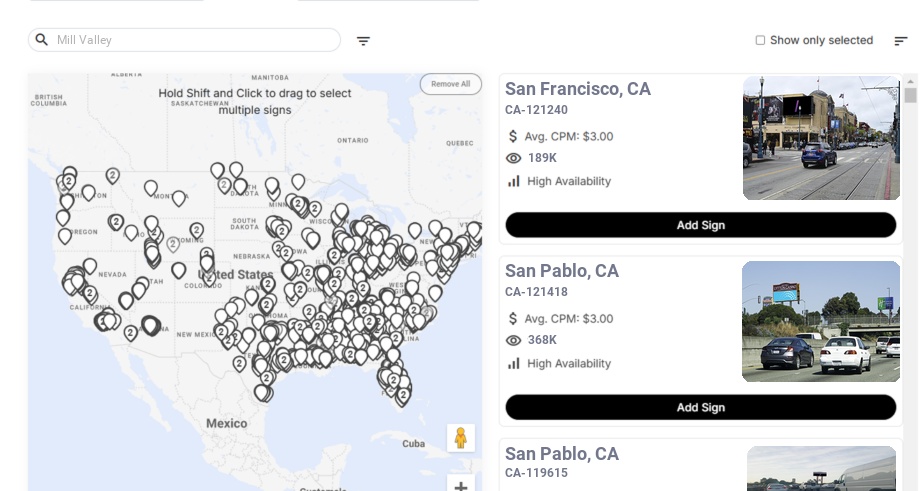
With two nearby digital billboards serving the Mill Valley area from San Francisco, Blip can reach a tightly defined, high-value audience as they move between Marin County and the city. These placements function as a high-impact gateway to both local residents and visitors. The page also explains that because the billboards are in San Francisco, they still effectively reach people traveling to and from Mill Valley.
Who can I reach with Mill Valley, California billboards from Blip?
Mill Valley sits at the intersection of affluence, outdoor lifestyle, and daily cross-bay commuting, so the audience is compact but economically powerful. Median household income is commonly reported in the $160,000–$170,000 range, and many residents are professionals, executives, creatives, and tech workers commuting into San Francisco. The area also has high educational attainment and strong digital engagement, making it a good fit for premium, lifestyle-aligned campaigns.
When is the best time to run Blip ads near Mill Valley, California?
Weekday commute peaks typically cluster around 7:00–9:30 a.m. and 4:00–7:00 p.m. for Marin–SF commuter traffic. Weekend traffic builds later in the morning, often 10:00 a.m.–2:00 p.m., as visitors and locals head to trails, the waterfront, and downtown areas, then again 4:00–8:00 p.m. as they return. The page also suggests higher bids for Thursday–Saturday when leisure and discretionary spending often peak.
What kinds of billboard messages work best in Mill Valley, California with Blip?
The Mill Valley area demographic is visually sophisticated and values-driven, so the creative approach should reflect quality and experience rather than discounts. The page recommends keeping copy minimal, using high-contrast colors, and choosing imagery like trails, cycling, redwoods, and Golden Gate views. It also suggests time-sensitive hooks and local references such as “This Weekend in Marin” or “Headed to Muir Woods?” to make the message feel relevant.
Do I need a contract to advertise with Blip near Mill Valley?
No, Blip has no long-term contracts or minimum commitments. You can start, pause, or stop your campaign at any time.
How fast can I launch a billboard campaign with Blip near Mill Valley?
You can have your campaign live in minutes. Create a free account, select your locations, set your budget, upload your design, and start running once approved.
Where can I advertise with Blip near Mill Valley?
Blip has digital billboards near Mill Valley. You can browse available locations on a map, choose the ones that fit your audience, and start advertising right away.
Still have questions? Launch a campaign in minutes — no contracts, no commitments.
Start Your CampaignMill Valley Billboard Advertising Guide
Mill Valley sits at the intersection of affluence, outdoor lifestyle, and daily cross‑bay commuting. With two nearby digital billboards serving the Mill Valley area from San Francisco, we can reach a tightly defined, high‑value audience as they move between Marin County and the city. For advertisers searching for billboards near Mill Valley or flexible billboard rental near Mill Valley, these placements function as a high‑impact gateway to both local residents and visitors. Below, we outline how to design, time, and target your Blip campaigns to make the most of this unique market.
Understanding the Mill Valley Area Audience
Mill Valley is a compact but economically powerful community in southern Marin County.
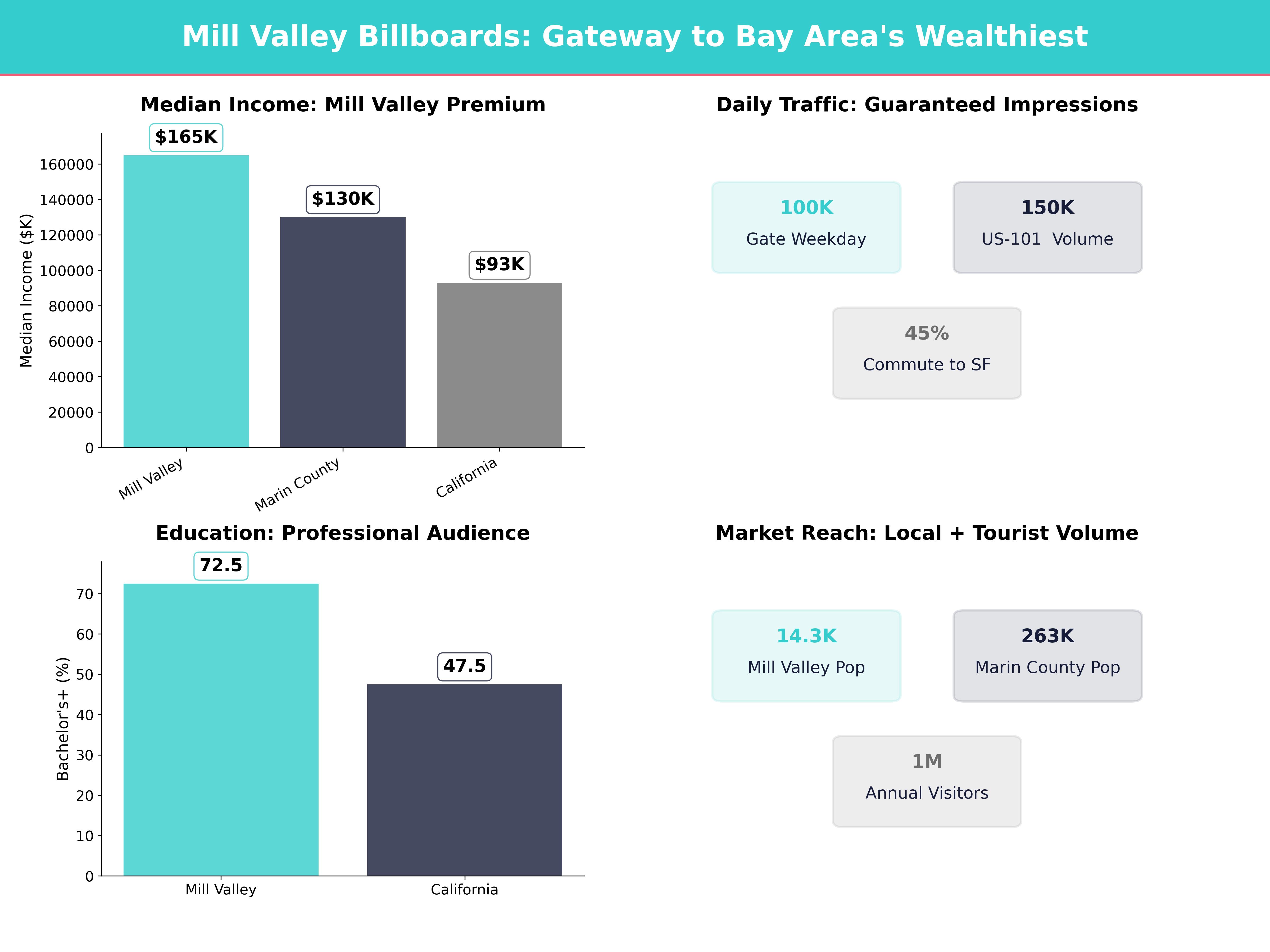
- The City of Mill Valley reports a population of roughly 14,000–14,500 residents, while Marin County 260,000–265,000 people, making it one of the smallest counties in the Bay Area by population but one of the richest by income.
- Mill Valley households are among the wealthiest in the Bay Area. Median household income is commonly reported in the $160,000–$170,000 range, and Marin County overall posts a median household income above $130,000, compared with around $90,000–$95,000 for California statewide.
- Home prices reflect this spending power. Real estate data regularly show Mill Valley’s median home value exceeding $1.7–$1.8 million, with many neighborhoods averaging $2.0M+ for single‑family homes. Marin County consistently ranks among the top 10 most expensive counties in the U.S., with countywide median prices often in the $1.3–$1.5 million range.
- Educational attainment is high: estimates routinely place Mill Valley’s share of adults with a bachelor’s degree or higher at 70–75%, compared with roughly 45–50% for California overall. In Marin County, about 1 in 3 adults hold a graduate or professional degree.
- Age and household structure skew toward families and established professionals. In many Mill Valley neighborhoods, 30–40% of households include children under 18, and the median age typically falls in the mid‑40s, several years older than the California average.
- Digital engagement is strong: surveys for affluent Bay Area communities frequently show 90%+ broadband adoption and smartphone ownership near 95%, making cross‑channel campaigns (billboard + digital retargeting) especially effective.
These numbers translate into an audience that:
- Has substantial discretionary income for premium products, services, and experiences; a large share of households fall into the top 10–15% of U.S. incomes.
- Is highly responsive to quality, design, brand values, and sustainability messaging, with Marin County often posting above‑average green purchasing and EV ownership rates (in some ZIP codes, 20–25% of new vehicle registrations are electric or plug‑in hybrid).
- Skews toward professionals, executives, creatives, and tech workers commuting into San Francisco, many of whom work in fields such as technology, finance, consulting, biotech, and creative industries.
When we build campaigns for the Mill Valley area, we should think in terms of value, lifestyle, and identity rather than simple price or mass‑market messaging. This is where thoughtfully placed Mill Valley billboards and digital displays along their daily routes can reinforce a premium, lifestyle‑aligned brand story.
Key Traffic Flows Near Mill Valley
Even though our digital billboards are located in San Francisco, they are positioned to capture heavy flows of Marin–San Francisco traffic that include Mill Valley–area residents.
Golden Gate Bridge & US‑101 Corridor
- US‑101 connects Mill Valley to San Francisco via the Golden Gate Bridge. The Golden Gate Bridge Highway and Transportation District has reported typical average weekday traffic around 100,000 vehicle crossings per day in recent years, with peak years exceeding 112,000–115,000 daily crossings and weekend surges during tourism season.
- Caltrans data for District 4 (which includes Marin and San Francisco) show US‑101 as one of the busiest regional corridors, often exceeding 150,000 vehicles per day at key points approaching and leaving the city.
- Golden Gate Transit Golden Gate Ferry 20,000 trips, reinforcing the strength of this commute corridor.
- Travel time studies regularly show that during peak periods, the Sausalito–Mill Valley to San Francisco drive can stretch from a typical 20–25 minutes off‑peak to 40–60 minutes or more in heavy traffic, increasing dwell time with your billboard.
Commute Patterns
- Pre‑pandemic, regional data indicated that 40–50% of employed Mill Valley residents commuted to jobs in San Francisco or elsewhere in the urban core, with Marin as a whole sending tens of thousands of workers across the bridge each weekday.
- Even with more hybrid work, regional transportation updates suggest that Golden Gate Bridge weekday volumes have rebounded to 80–90% of pre‑COVID levels, with many high‑earning professionals still traveling 2–4 days per week during standard commute windows.
- A high share of commuters drive: in comparable Marin communities, 65–75% of workers commute by car (solo or carpool), with a smaller but notable share using buses or ferries.
Our nearby San Francisco billboards allow us to:
- Reach Mill Valley–area drivers heading into San Francisco in the morning, when tens of thousands of southbound vehicles funnel toward the city between 7:00 and 10:00 a.m.
- Reinforce your message as they return north to Marin in the late afternoon and evening, when northbound volumes on US‑101 and the Golden Gate routinely spike by 30–40% over mid‑day levels.
- Intercept tourists and visitors who drive across the Golden Gate Bridge and then explore Marin, Sausalito, and Mill Valley’s downtown, trails, and redwood areas. During peak tourism months, visitor vehicles can account for 25–35% of weekend crossings.
When you design a campaign, plan creatives and schedules that align with these flows rather than thinking only about static “local” placements. In practice, this means treating these San Francisco‑side locations as functional billboards near Mill Valley that consistently reach your target audience on their real‑world journeys.
Tourism, Recreation, and Visitor Traffic
Mill Valley is a gateway to some of the Bay Area’s most iconic outdoor destinations.
- Visit Mill Valley highlights attractions like downtown boutiques and restaurants, the Mill Valley Depot Plaza, and events at venues such as the Sweetwater Music Hall weekend foot traffic in downtown Mill Valley can double compared with weekdays during peak seasons.
- Mill Valley borders the Muir Woods National Monument and sits at the base of Mount Tamalpais, which collectively attract well over 1 million visitors annually when combining trail use, park visits, and nearby recreation. Muir Woods alone has recorded annual visitation in the 900,000–1.1 million range in strong tourism years.
- Visit Marin notes that Marin County as a whole welcomes millions of visitors per year, with county tourism generating hundreds of millions of dollars in direct visitor spending and supporting several thousand local jobs in hospitality, dining, and outdoor recreation.
- San Francisco itself hosted an estimated 20+ million visitors in 2023, according to San Francisco Travel $8–10 billion per year. A meaningful share of those visitors cross the Golden Gate to explore Marin and Mill Valley; travel surveys have found that 20–30% of overnight San Francisco visitors take at least one side trip to the North Bay.
- Iconic outdoor assets such as Stinson Beach Marin Headlands, and Mount Tamalpais State Park draw large day‑trip crowds; on sunny summer weekends, some trailhead and beach parking areas fill to capacity by 10:00–11:00 a.m., indicating heavy morning flows northbound out of the city.
Our billboards in San Francisco can influence these visitors before they head north:
- Visitors often rent cars or use rideshare to cross the Golden Gate. In major tourism surveys, 60–70% of U.S. leisure travelers report renting a car or using personal vehicles when visiting California, and rideshare usage in the Bay Area is among the highest in the country.
- Positioning your message on their approach gives you early mindshare when they are choosing where to eat, shop, and explore north of the bridge.
- Many itineraries include “Golden Gate Bridge + Marin + Muir Woods + Mill Valley” in a single day; reaching them at the start of that journey increases the chance they choose your restaurant, activity, or retail option later that same day.
- Studies of out‑of‑home effectiveness regularly show 20–30% lifts in brand awareness when travelers are exposed to billboard messaging along primary access routes, with digital formats driving faster recall for time‑sensitive offers.
Brands in hospitality, dining, adventure tourism, outdoor gear, wellness, and local attractions can all benefit from this cross‑bay visitor flow. For these businesses, digital billboard advertising near Mill Valley’s primary access routes can become a core pillar in capturing spur‑of‑the‑moment decisions from high‑spending tourists.
Seasonal and Weekly Timing Strategies
The Mill Valley area has relatively mild, consistent weather, but traffic patterns change predictably by season and day of week.
Seasonal Patterns
- Peak tourism and recreation season runs roughly from April through October, with summer weekends especially busy on the Golden Gate and in Marin’s recreation zones. In high summer, weekend traffic volumes on the bridge can run 10–20% higher than typical weekdays.
- The City of Mill Valley also hosts seasonal events and the long‑running Mill Valley Film Festival California Film Institute 40,000–50,000 attendees over its run each fall, including industry professionals and high‑income filmgoers from across the Bay Area.
- Local events such as the Mill Valley Fall Arts Festival, concerts at Sweetwater Music Hall, and community celebrations in the Depot Plaza can each attract hundreds to several thousand attendees, often concentrated on weekends.
- Holiday shopping and travel spikes in November and December increase cross‑bay trips to regional malls, downtown San Francisco, and Marin retail hubs like Corte Madera. Retail sales data for the Bay Area consistently show 20–30% higher revenues in November–December compared with average months, aligning with heavier travel and shopping patterns.
- Rainy season (roughly November–March) can slightly dampen beach and trail traffic but often shifts activity toward indoor dining, wellness, entertainment, and home‑improvement spending.
How to use Blip:
- Increase your blip frequency leading into key seasonal windows (e.g., late March for outdoor season, late September for film festival–related traffic, late October for holiday planning), when visitor volumes and spending intentions rise.
- Run “flighted” bursts around specific event dates published by the city or local venues. For a multi‑day festival or race, consider 7–10 days of lead‑in creative plus a weekend‑heavy push while the event is live.
- Align message content with the season: outdoor imagery and adventure themes in spring/summer; cozy dining, wellness, and gifting themes in fall/winter.
Day‑of‑Week and Time‑of‑Day
- Weekday commute peaks typically cluster around 7:00–9:30 a.m. and 4:00–7:00 p.m. for Marin–SF commuter traffic, with some studies showing as much as 35–40% of daily bridge crossings occurring in these windows.
- Midday on weekdays (roughly 11:00 a.m.–2:00 p.m.) remains important for flexible workers, retirees, and service trips; for many service businesses, these hours can account for 30–50% of weekday in‑person visits.
- Weekend traffic builds later in the morning, often 10:00 a.m.–2:00 p.m., as visitors and locals head to trails, the waterfront, and downtown areas, then again 4:00–8:00 p.m. as they return. During peak summer Saturdays, outbound northbound traffic from San Francisco toward Marin can be 15–25% higher than on typical weekdays.
- Evening entertainment patterns matter: in nearby Bay Area dining districts, 60–70% of restaurant covers on Fridays and Saturdays occur after 6:00 p.m., with prime time between 6:30–8:30 p.m..
With Blip, we can:
- Use dayparting to concentrate impressions in commute windows if we’re targeting professionals who live in the Mill Valley area but work in San Francisco.
- Shift to midday and weekend afternoon emphasis for tourism, recreation, and family‑activity campaigns, when visitor flows to Marin and Mill Valley are strongest.
- Run evening‑heavy campaigns for restaurants, live music, and entertainment venues drawing patrons from Mill Valley and broader southern Marin, especially Thursday through Sunday.
- Allocate higher bids for Thursday–Saturday, when leisure and discretionary spending often peaks, and experiment with slightly lower bids for lower‑traffic nights like Monday and Tuesday.
Crafting Creative That Resonates in the Mill Valley Area
The Mill Valley area demographic is visually sophisticated and values‑driven. Our creative approach should reflect that.
Design Essentials
- Keep copy minimal: 6–8 words or fewer. At freeway speeds, legibility is crucial; transportation safety research suggests drivers have 3–6 seconds to absorb a billboard message.
- Use high contrast colors. Think bold text on a simple background. Avoid clutter that competes with the natural scenery commuters are viewing.
- Choose imagery that matches local aesthetics: trails, cycling, redwoods, Golden Gate views, and clean, modern design all resonate with residents who identify with outdoor and design‑focused lifestyles.
- Use large, sans‑serif fonts and avoid putting critical text in the top or bottom 10% of the screen, where it can be harder to read at distance or partially obstructed by infrastructure.
Message Angles That Work
Given the high income and education levels:
- Emphasize quality and experience over discounts: “Exceptional Dental Care for Marin Families” or “Elevated Home Design, Minutes from Mill Valley.” In high‑income markets, experience‑led messaging often outperforms price‑led messaging by 15–25% in ad recall studies.
- Highlight sustainability and localism: Many Mill Valley area residents strongly support eco‑friendly and community‑oriented businesses; Marin has historically been among the top counties in California for recycling rates and climate initiatives.
- Use time‑sensitive hooks: “This Weekend Only in Sausalito,” “Tonight at Sweetwater,” or “New Exhibit 15 Minutes from the Golden Gate.” Time‑bound offers commonly drive higher short‑term response, particularly for entertainment, dining, and events.
- Where appropriate, integrate QR codes or simple URLs; out‑of‑home studies show that 1 in 4 viewers report using their phone to look up a brand they just saw on a billboard.
Local References
Consider tasteful nods to known local touchpoints:
- “From the redwoods to your living room — premium home furnishings, just over the bridge.”
- “Headed to Muir Woods? Fuel up with organic brunch on the way.”
- “Before you hit Mount Tam, upgrade your gear in Mill Valley.”
Local references can increase relevance, but keep them brief to maintain readability and ensure your billboard advertising near Mill Valley remains clear at a glance.
Aligning Location Strategy with Mill Valley Area Behaviors
Because our two digital billboards serving the Mill Valley area are located in San Francisco, we should think strategically about where in the journey we’re influencing people.
Inbound to San Francisco (Southbound 101 and City Approaches)
Use these directions to:
- Reach Mill Valley–area residents on their way into work in downtown San Francisco, SoMa, or the Financial District. Many white‑collar workers in Marin report 30–60 minute one‑way commutes, making these daily touchpoints powerful.
- Promote B2B services, professional services, coworking spaces, healthcare providers, and high‑consideration purchases (financial advisors, private schools, remodeling, automotive).
- Introduce brands that will be encountered later in the day in the city (e.g., cultural institutions, medical centers, or retail destinations).
Example strategies:
- Morning‑heavy schedules focused on 7:00–10:00 a.m., when a significant share of Mill Valley professionals are in motion.
- Messages like “When You Get Home to Mill Valley…” to connect a city‑based message to their Marin lifestyle.
- For service businesses that operate during business hours, layer in a lighter mid‑day presence to capture flexible workers, freelancers, and parents commuting for errands or appointments.
Outbound to Marin (Northbound Toward the Golden Gate)
Use these directions to:
- Catch audiences heading back toward Mill Valley, Sausalito, and Tiburon at the end of the day, when shoppers and diners are deciding whether to stop on the way home.
- Promote dining, grocery, fitness, childcare, home services, and events happening that evening or upcoming weekend.
- Influence visitors departing San Francisco for overnight stays or dinners in Marin; hotel and restaurant booking data often show same‑day decision rates above 40–50% for leisure travelers.
Example strategies:
- Heavier weighting 4:00–8:00 p.m., especially Thursday–Sunday, when leisure spending climbs and many Bay Area residents extend their day in Marin.
- Calls‑to‑action like “Tonight in Mill Valley Area,” “This Weekend in Marin,” or “Exit Before the Bridge for…” to encourage spontaneous stops.
- For tourist‑oriented offerings, consider late morning/early afternoon northbound exposure as well, hitting visitors as they leave San Francisco for day trips.
In both directions, these placements effectively function as Mill Valley billboards in the eyes of commuters and visitors, because they shape decisions immediately before and after time spent in the Mill Valley area.
Targeting Affluent Niches in the Mill Valley Area
Because Mill Valley and southern Marin are relatively small but affluent, precision matters more than scale. We can align creative with specific niches:
Families and Education‑Focused Households
- The Mill Valley School District and Tamalpais Union High School District serve high‑performing schools that draw education‑oriented families. Local schools frequently post test scores and college‑going rates well above state averages, with some high schools sending 80–90% of graduates to 2‑ or 4‑year colleges.
- The presence of multiple preschools, enrichment centers, and youth sports organizations reflects strong demand for child‑focused services; in many Marin communities, 30–40% of household spending beyond essentials goes toward education, activities, and experiences for children.
- Campaign ideas: private tutoring, enrichment programs, summer camps, independent schools, healthcare providers, and family‑friendly activities such as museums, indoor play spaces, or outdoor adventure programs.
- Use time slots around school commute hours (roughly 7:30–9:00 a.m. and 2:30–4:30 p.m.) and late afternoons when parents plan after‑school activities and weekend outings.
Outdoor and Wellness Enthusiasts
- Southern Marin’s trail systems, bike routes, and waterfront parks attract heavy use from health‑conscious residents. Participation rates in outdoor activities such as hiking, cycling, and running are significantly higher than national averages; surveys in similar Bay Area communities often find 60–70% of adults engage in vigorous outdoor exercise at least weekly.
- The proximity of Mount Tamalpais, Muir Woods, Tennessee Valley, and the Marin Headlands means that on good‑weather weekends, thousands of hikers and cyclists pass through or near Mill Valley’s corridor.
- Campaign ideas: fitness studios, outdoor gear, wellness clinics, organic food brands, yoga retreats, sports medicine, physical therapy, and spa or recovery services.
- Target weekends plus early mornings and post‑work hours, when fitness and trail usage peak. Many gyms and studios report 40–50% of check‑ins before 9:00 a.m. and after 5:00 p.m., making those windows ideal for wellness messaging.
High‑Net‑Worth and Professional Services
- With high home values and incomes, demand is strong for financial advisors, estate planning, luxury real estate, and high‑end home services. In affluent Marin ZIP codes, the share of households with investable assets over $1 million is well above national averages, and second‑home ownership is common.
- High‑end contractors, architects, and landscape designers benefit from the region’s older but well‑maintained housing stock; in some Marin cities, annual residential remodeling spending approaches $5,000–$7,000 per household on average.
- Campaign ideas: wealth management, boutique law firms, luxury remodelers, architects, landscape designers, EV or luxury auto dealers, and concierge healthcare.
- Use a clean, understated aesthetic and focus on trust, discretion, and expertise. Professional‑services research shows that credibility cues (years in practice, local offices, testimonials) can increase inquiry rates by 20–30%.
- Prioritize weekday commute and early evening slots, when professionals are most likely to notice and mentally schedule follow‑up tasks.
For all of these niches, flexible billboard rental near Mill Valley via Blip lets you increase or decrease exposures quickly as you learn which segments respond best.
Using Data and Local Media to Refine Your Campaign
We can sharpen our Blip strategy by pairing billboard performance data with local information sources:
- Monitor regional news through outlets like the Marin Independent Journal and the San Francisco Chronicle temporary spikes or dips in specific corridors.
- Track transportation updates via Caltrans District 4 and the Golden Gate Bridge district to understand construction, lane closures, or toll changes that could alter commute behavior. Toll or lane configuration changes have historically shifted crossing volumes by 5–10% in the short term.
- Sync campaigns with cultural calendars posted by Visit Mill Valley, Visit Marin, and the City of Mill Valley to capitalize on visitor surges. A well‑timed digital billboard push in the 7–14 days before a major event can significantly increase awareness among both locals and visiting attendees.
- Reference school and community information from the Mill Valley School District and Tamalpais Union High School District for timing around back‑to‑school periods, graduations, sports seasons, and breaks.
On the Blip side, we can then:
- Adjust budgets dynamically based on which days and hours yield the best engagement or correlated business activity. For example, if you see that 60% of new leads arrive after exposures during evening commutes, you can reallocate spend to those hours.
- Test multiple creative variations — for example, one emphasizing sustainability vs. one emphasizing convenience — and allocate more budget to the versions that align best with Mill Valley area response patterns. A/B tests in out‑of‑home campaigns often show 10–30% performance gaps between top‑ and bottom‑performing creatives.
- Align your billboard schedule with digital analytics: if you see website traffic from Marin County spike at particular times, mirror or slightly precede those windows with your Blip placements to reinforce behavior.
This data‑driven approach turns Mill Valley billboards and nearby digital units into continually improving assets rather than static, set‑and‑forget media buys.
Practical Tips for Launching a Blip Campaign for the Mill Valley Area
To turn all of this into action:
-
Define your primary audience segment.
Are you targeting commuting professionals, local families, visitors heading to Muir Woods, or high‑net‑worth homeowners? This drives your schedule and creative tone. For example, a single Blip board can easily deliver tens of thousands of impressions per day, but the value comes from which subset of those viewers you design for. -
Choose time windows that match real behavior.
- Commuter‑focused: morning and evening weekdays, especially 7:00–9:30 a.m. and 4:00–7:00 p.m.
- Tourism and outdoor: late morning to afternoon, especially weekends (10:00 a.m.–4:00 p.m.).
- Dining and entertainment: late afternoon through evening, Thursday–Sunday (4:00–9:00 p.m.).
-
Develop 2–4 creative variations.
Test different headlines or imagery tailored to:- Commute vs. leisure travel.
- Locals vs. visitors.
- Value‑driven vs. experience‑driven messaging.
Out‑of‑home case studies often show that campaigns running 3+ creative variants achieve higher recall and longer engagement than single‑message campaigns.
-
Use concise, location‑aware CTAs.
“Just across the bridge,” “On your way back to Mill Valley area,” or “This weekend in southern Marin” creates a mental map without overloading the design. Clear directional cues (“Exit before the bridge,” “10 minutes past the tunnel”) can increase response by making next steps obvious and reinforce that your message is tied to billboards near Mill Valley rather than a generic regional placement. -
Monitor and refine.
Watch your own business metrics (web traffic by region, calls, reservations, store visits) as you adjust Blip schedules and creatives. Over a few weeks, patterns will emerge that help you narrow in on the most effective times and messages. Many advertisers see measurable lift — such as 10–20% increases in branded search or direct traffic from target ZIP codes — within the first 4–8 weeks of a well‑structured digital billboard campaign.
By combining Blip’s flexible scheduling and budget controls with a grounded understanding of Mill Valley area demographics, traffic flows, and lifestyle, we can build campaigns that reach fewer people more meaningfully — prioritizing the right travelers on the right trips at the right moments as they move between San Francisco and the Mill Valley area. For any brand considering billboard advertising near Mill Valley, this approach turns proximity, timing, and relevance into a measurable competitive advantage.