Billboards in French Camp, CA
No Minimum Spend. No Long-Term Contracts. Just Results.
Trusted by Leading Brands


Billboard advertising
in French Camp has never been easier
How much is a billboard in French Camp?
Why Choose Blip for Billboard Advertising in French Camp
Blip lets you launch fast in French Camp and target SR 99 commuters without contracts or minimums.
Use Blip's auto-select to match French Camp goals with I-5 freight traffic and south Stockton reach.
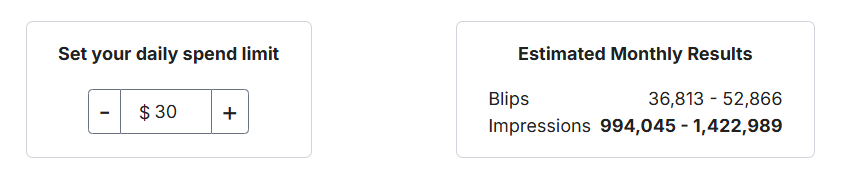
Set a flexible budget in French Camp and pay only when your ad blips near county hospital and Port traffic.
Daypart your French Camp campaign for AM/PM rushes on SR 99 and I-205, when car commuters are heaviest.
Track French Camp results in real time, then shift spend toward Manteca, Tracy, or Stockton as you see what works.
Frequently Asked Questions About Billboard Advertising in French Camp
How much does a billboard cost in French Camp with Blip?
Billboard advertising in French Camp with Blip is designed to be affordable and flexible. Instead of paying a fixed upfront rate, you set a daily budget and only pay when your ad actually appears as a 7.5-to-10-second “blip” on a rotating digital billboard, starting at just $0.01 per display. The cost per blip can change based on time of day, location, and advertiser demand, helping maximize your reach without overspending.
Where can I advertise with Blip in French Camp to reach commuters?
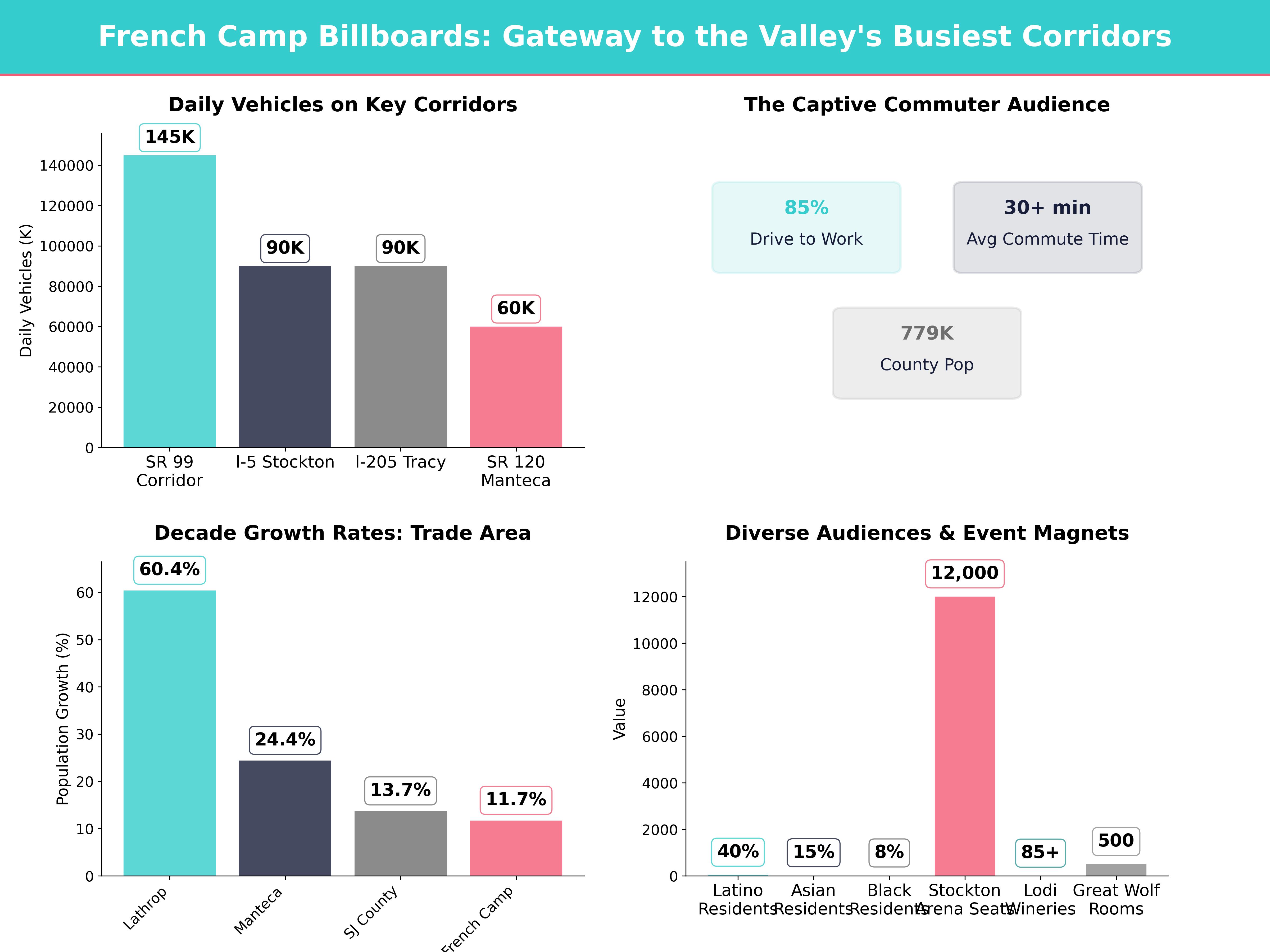
State Route 99 through south Stockton and the French Camp area carries well into six figures on many segments, with typical counts in the roughly 130,000 to 160,000 AADT range near the core south Stockton travel shed. Interstate 5 west of French Camp also serves a valuable audience, with key segments commonly landing in the 80,000 to 100,000-plus AADT range. Interstate 205 near Tracy generally carries 90,000-plus vehicles per day, and State Route 120 between I-5 and Manteca often exceeds 60,000 AADT on major segments.
What kind of audience does French Camp give Blip advertisers?
French Camp is effective because the audience mix is unusually broad for a small community. We can reach daily commuters, healthcare workers, industrial labor, students, families, and visitors without leaving the same general travel shed. More than 85% of county workers commute by car, truck, or van, and the average commute is more than 30 minutes.
Why is French Camp a good Blip market for local businesses?
French Camp sits in the middle of a highly practical economy, with San Joaquin General Hospital as a major local anchor and the Port of Stockton as a major regional freight asset. That combination of healthcare, government, logistics, warehousing, and agriculture creates strong demand for billboard categories such as healthcare and urgent care, hiring and workforce recruitment, and consumer services. This is a car-first market, which matters because French Camp sits close to corridors that move commuters, freight, students, families, and visitors all day long.
When is the best time to run a French Camp billboard campaign with Blip?
Spring is one of the best windows for billboard campaigns in this market, and late summer and early fall are also prime periods. Spring brings more college and high school activity, baseball and outdoor events, and household shopping before summer vacations, while late summer and early fall restart school routines and harvest-related movement. Winter is also useful for healthcare, tax services, gyms, legal services, furniture, home improvement financing, and recruitment pushes that need weekday commuter repetition.
Do I need a contract to advertise with Blip in French Camp?
No, Blip has no long-term contracts or minimum commitments. You can start, pause, or stop your campaign at any time.
How fast can I launch a billboard campaign with Blip in French Camp?
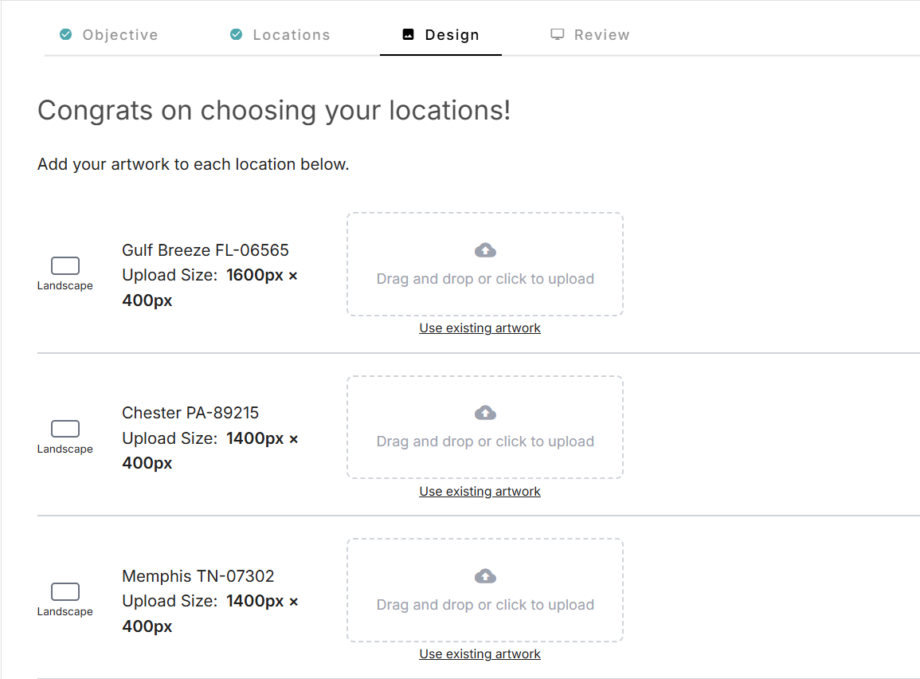
You can have your campaign live in minutes. Create a free account, select your locations, set your budget, upload your design, and start running once approved.
Where can I advertise with Blip in French Camp?
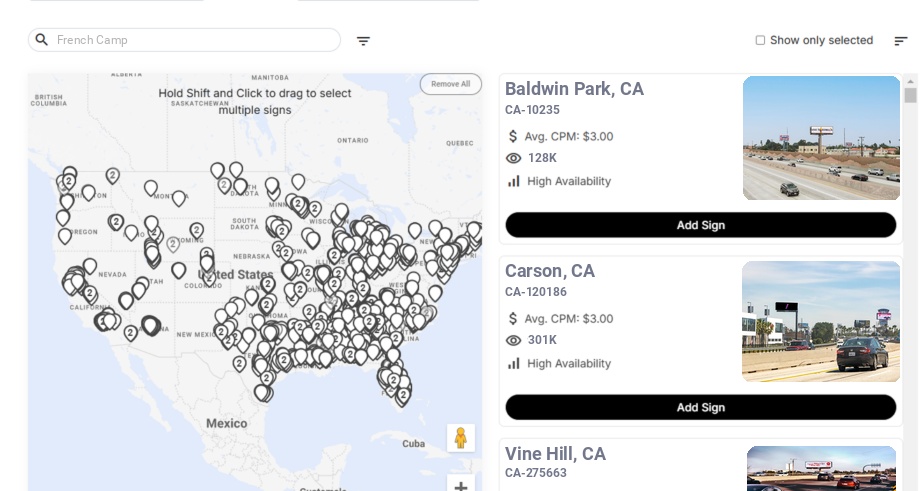
Blip has digital billboards in French Camp. You can browse available locations on a map, choose the ones that fit your audience, and start advertising right away.
Still have questions? Launch a campaign in minutes — no contracts, no commitments.
Start Your CampaignFrench Camp Billboard Advertising Guide
French Camp is a small community with outsized billboard value because it sits inside one of the Central Valley’s most important travel zones. The community itself counted 3,770 residents in 2020, but it is embedded in San Joaquin County, which had 779,233 residents at the same count and is anchored by nearby Stockton, Manteca Lathrop Tracy. This is a car-first market, with more than 85% of county workers commuting by car, truck, or van, and that matters because French Camp sits close to Caltrans corridors that move commuters, freight, students, families, and visitors all day long. We can use billboard advertising here to reach not just local residents, but also the much larger regional audience flowing through south Stockton and the broader San Joaquin Valley.
French Camp Market Overview
French Camp works best when we think beyond the census-designated place and treat it as part of a larger south San Joaquin County trade area. That broader market combines steady population growth, heavy driving dependence, major healthcare and logistics employment, and strong family-oriented suburban expansion.
Population scale and growth around French Camp
French Camp’s 3,770 residents make it a small place on paper, but its geography is what gives it advertising power. It sits beside Stockton, which had 320,804 residents in 2020, up from 291,707 in 2010, Manteca 83,498, Lathrop 28,918, and Tracy, which was at roughly 93,000 residents in 2020.
Growth has been meaningful across the area. San Joaquin County grew from 685,306 residents in 2010 to 779,233 in 2020, which was an increase of 13.7%. French Camp itself grew by nearly 11.7% from 3,376 residents in 2010 to 3,770 in 2020. Manteca 24.4% during the decade, and Lathrop 60.4%, which tells us that the southern and western parts of the county are still gaining households.
For advertisers, that growth means two things. First, we are not advertising into a static market. Second, we can use French Camp-area boards to reach both established Stockton households and newer suburban consumers in fast-growing cities nearby.
Economy, workforce, and what they mean for advertisers
French Camp sits in the middle of a highly practical economy. San Joaquin General Hospital is a major local anchor with 196 beds, and the surrounding county campus brings in healthcare workers, public employees, patients, and visitors throughout the day.
Industry is equally important. The Port of Stockton spans about 4,200 acres and operates 15 berths, making it a major regional freight asset. Agriculture also matters across the county, and San Joaquin County’s annual crop value has exceeded $3 billion in recent reports. That combination of healthcare, government, logistics, warehousing, and agriculture creates strong demand for billboard categories such as:
- Healthcare and urgent care, because people regularly travel to appointments and medical campuses.
- Hiring and workforce recruitment, because logistics, healthcare, and trades employers need recurring visibility.
- Consumer services, because daily vehicle traffic supports auto repair, insurance, legal, dental, banking, and home services.
- Retail and food, because commuters and families make frequent route-based decisions.
Demographics and commuting behavior in French Camp’s trade area
San Joaquin County is one of California’s most diverse counties, and that shapes how we build creative. Latino residents make up a little over 40% of the county population, Asian residents are around 15%, and Black residents are near 8%. No single racial or ethnic group dominates the market, which generally rewards inclusive, broadly understandable messaging.
Driving is still the dominant transportation mode. Recent commuting profiles show that more than 85% of workers in the county get to work by car, truck, or van, and the average commute is more than 30 minutes. That long-drive pattern is especially important in south and west county, where many households travel toward Stockton, Tracy, and the Bay Area commute shed.
For billboard advertisers, that means frequency matters. A French Camp placement is not just a one-time exposure. It is often part of a repeated weekday routine.
Key Traffic Corridors Around French Camp
The strongest French Camp billboard strategy starts with the roads. This is a corridor-led market, and our best-performing plans usually follow the highways people already depend on.
State Route 99 through French Camp and south Stockton
Caltrans traffic counts consistently show that State Route 99 through south Stockton and the French Camp area carries well into six figures on many segments, with typical counts in the roughly 130,000 to 160,000 AADT range near the core south Stockton travel shed. That makes SR 99 the signature billboard corridor for French Camp.
SR 99 is especially strong for advertisers that need repetition and broad household reach. We usually like this corridor for:
- Hospitals, clinics, and dental groups, because the route serves local residents and referral traffic.
- Community colleges, trade schools, and universities, because students and working adults travel this corridor often.
- Retail, grocery, and quick-service restaurants, because it captures routine daily traffic.
- Attorneys, insurance agencies, and tax services, because repeated commuter exposure helps memory.
Because SR 99 connects the area to Manteca Modesto Sacramento-bound travel farther north, it also works well for regional brands that want coverage beyond just French Camp.
Interstate 5 west of French Camp
Interstate 5 west of French Camp serves a different but equally valuable audience. In the Stockton, Lathrop, and south county zone, Caltrans counts commonly land in the 80,000 to 100,000-plus AADT range on key segments, and the corridor carries a strong blend of commuters, truck traffic, airport-related movement, and destination travel.
This is where we usually focus when the goal is industrial, regional, or destination-oriented advertising. I-5 is especially useful for:
- Logistics and warehouse hiring, because the route reaches drivers already moving through freight territory.
- Truck services, fuel, and fleet businesses, because the corridor has strong commercial relevance.
- Hotels, attractions, and event venues, because travelers often make last-minute stop decisions on I-5.
- B2B suppliers and industrial services, because decision-makers and crews are on the road here.
French Camp also benefits from its proximity to Stockton Metropolitan Airport, which adds another layer of traveler and employee movement to the western side of the market.
Interstate 205 and State Route 120 as French Camp feeders
French Camp advertisers should not ignore the feeder corridors. Interstate 205 near Tracy generally carries 90,000-plus vehicles per day, and State Route 120 between I-5 and Manteca 60,000 AADT on major segments. Those roads are essential because they pull Bay Area commuters, family travelers, and weekend leisure traffic into the south San Joaquin County system.
We typically like these corridors for:
- Family entertainment, because parents heading to Great Wolf Lodge Northern California
- Home services, because fast-growing suburban areas generate steady demand for roofing, HVAC, plumbing, landscaping, and solar.
- Auto dealers and service centers, because vehicle ownership is central to local life.
- New housing and apartment communities, because these routes reach active movers and cross-shoppers.
Local connectors that matter in French Camp
The freeway network gets most of the attention, but local roads such as French Camp Road, Arch Road, and nearby access routes matter for context. These roads help funnel traffic to San Joaquin General Hospital, county offices, industrial properties, and west-side destinations.
For advertisers with a narrower conversion goal, local access can be just as important as freeway volume. If we are promoting a medical office, urgent care, staffing firm, or industrial supplier, proximity to those final approach roads can outperform a broader but less relevant location.
French Camp Audience Segments We Can Reach
French Camp is effective because the audience mix is unusually broad for a small community. We can reach daily commuters, healthcare workers, industrial labor, students, families, and visitors without leaving the same general travel shed.
Commuters and super-commuters near French Camp
The first and largest audience is commuters. As noted earlier, more than 85% of county workers commute by car, truck, or van, and average travel times exceed 30 minutes. Many households in this region also commute beyond their home city, which creates repeated weekday patterns on SR 99, I-5, I-205, and SR 120.
This audience responds well to messages built around convenience, time savings, location cues, and direct offers. We usually see strong relevance for categories such as banking, healthcare, insurance, legal services, quick-service food, fuel, and mobile apps.
Healthcare, government, logistics, and industrial workers
French Camp has a particularly strong employment audience because of the county and healthcare campus. San Joaquin General Hospital brings in doctors, nurses, staff, vendors, patients, and visitors, while nearby public offices generate steady daytime circulation.
The broader regional workforce matters too. The Port of Stockton has its 4,200-acre footprint and 15-berth marine complex, and San Joaquin County’s agriculture sector regularly produces more than $3 billion in annual crop value. Together, those numbers tell us that the regional economy is still grounded in movement, production, and practical services.
For this segment, billboard campaigns often work best when they are highly functional. Hiring campaigns, CDL recruitment, healthcare recruitment, workers’ compensation law, occupational medicine, truck parts, industrial safety, and vocational education all fit naturally here.
Students, families, and lifelong learners in the French Camp region
Education is another meaningful segment. San Joaquin Delta College serves more than 18,000 students, and University of the Pacific enrolls more than 6,000 students across its campuses. Even when those institutions are not inside French Camp itself, their students and staff travel through the wider Stockton-area road network.
Families are just as important. Fast-growing Manteca Lathrop Tracy are packed with school-age households, youth sports traffic, and parents making purchase decisions for healthcare, tutoring, food, recreation, and home services. We can also use school calendar timing from districts such as Stockton Unified School District, Manteca Unified School District, Lodi Unified School District, and Tracy Unified School District to tighten campaign windows.
Visitors, event-goers, and weekend traffic
French Camp is not a pure tourism market, but it benefits from strong visitor spillover. Great Wolf Lodge Northern California 500-room resort with a 95,000-square-foot indoor water park. Visit Lodi promotes 85-plus wineries in the Lodi area. Visit Stockton supports a year-round event calendar anchored by venues such as Stockton Arena 12,000, Bob Hope Theatre 2,042, and Banner Island Ballpark, which seats about 5,200.
That mix means we can reach:
- Weekend family travelers headed to resorts, water attractions, and tournaments.
- Entertainment audiences going to concerts, games, and live events.
- Wine and dining visitors moving through the county.
- Short-stay travelers making route-based food, hotel, and retail decisions.
Seasonal Opportunities in French Camp and San Joaquin County
Timing matters in French Camp because travel patterns shift by school calendars, harvest cycles, summer heat, and the regional event schedule. We usually get the best results when we align campaigns with those real local rhythms.
Spring and early summer in French Camp
Spring is one of the best windows for billboard campaigns in this market. College and high school activity rises, baseball and outdoor events return, and household shopping picks up before summer vacations. Banner Island Ballpark and downtown Stockton event traffic begin to matter more, and June brings the San Joaquin County Fair, which helps pull regional visitors.
This is a strong season for:
- Education and enrollment campaigns tied to graduation and registration.
- Healthcare outreach, especially primary care, urgent care, dental, and specialty practices.
- Home improvement and landscaping, because homeowners act before the hottest stretch of summer.
- Family entertainment, because parents start planning warm-weather outings.
Summer travel and heat-driven behavior around French Camp
Summer in the northern San Joaquin Valley is hot, and daily highs regularly push above 90°F. That climate makes air-conditioned destinations, water attractions, cold drinks, and convenience offers especially compelling.
This is where nearby attractions matter. Great Wolf Lodge Northern California Stockton Metropolitan Airport, Visit Stockton destinations, and regional shopping nodes can support hospitality, restaurants, quick-serve, and entertainment campaigns.
For French Camp advertisers, summer is also a good time to raise share of voice during long daylight hours when drivers are on the road later in the evening.
Back-to-school and fall harvest opportunities in French Camp
Late summer and early fall are prime periods for this region. School calendars restart in August, commuter routines become more predictable, and harvest-related movement builds across the county. Wine-country promotion also becomes more relevant as Visit Lodi and surrounding businesses benefit from late-summer and fall visitor interest.
This is an ideal window for:
- Tutoring, childcare, and youth activity campaigns.
- Medical, dental, and vision campaigns tied to family scheduling.
- Recruitment campaigns for logistics, warehousing, healthcare, and seasonal production.
- Retail and restaurant campaigns aimed at reestablished weekday routines.
Holiday and winter timing in French Camp
Winter is not the heaviest tourist season, but it is still useful for billboard advertisers. Holiday shopping, indoor entertainment, healthcare enrollment cycles, and New Year habit changes all create strong demand. Family destinations remain relevant because Great Wolf Lodge Northern California
We often like winter campaigns in French Camp for healthcare, tax services, gyms, legal services, furniture, home improvement financing, and recruitment pushes that need weekday commuter repetition.
Billboard Design Tips for French Camp Campaigns
French Camp does not reward abstract creative. The market responds best when we build for freeway speed, practical decision-making, diverse households, and a strong work-and-family mindset.
Creative choices that fit French Camp traffic behavior
Because the core corridors near French Camp carry fast-moving traffic and long-distance commuters, our creative should communicate instantly. A simple headline, one clear offer, and one memorable brand cue usually outperform clever but slower concepts.
In this market, we generally like:
- Location-forward language, such as “Next Exit,” “Near SR 99,” or “Minutes from Stockton.”
- Value-forward messages, because commuters and families respond to price, convenience, and utility.
- Time-saving language, because long-drive households pay attention to ease and speed.
- Recruiting headlines, because “Now Hiring,” pay ranges, and benefit cues are highly relevant in logistics and healthcare corridors.
Tiny QR codes and dense copy are usually a poor fit for French Camp freeway boards. Drivers often have only a few seconds to process the message.
Visual styles that feel local in French Camp
Local relevance matters here. We do not need to over-romanticize the market, but we should acknowledge what people actually recognize around them. That means medical imagery near the hospital campus, family-friendly visuals for Manteca and Lathrop travel, and practical service imagery for commuter routes.
We also like creative that reflects the county’s diversity. Since Latino residents account for a little over 40% of the county population, bilingual English-Spanish creative or Spanish-language variants can expand relevance quickly. We can also test separate creative versions for different corridors rather than forcing one message across every audience.
Color choice should account for Central Valley brightness. High-contrast combinations, bold typography, and strong visual separation tend to read better in intense daytime sun.
Message framing that works in the French Camp region
French Camp sits in a market where many people are balancing commute time, family logistics, and price sensitivity. That means our best billboard messages usually center on one of four ideas:
- Save time.
- Save money.
- Get care or help fast.
- Do something fun nearby.
For example, a healthcare advertiser can emphasize same-day appointments near French Camp. A home services advertiser can stress free estimates in Stockton, Manteca, and Tracy. A family attraction can use urgency around weekends, school breaks, or holiday dates.
Regional Strategies Beyond French Camp
The smartest campaigns in this market rarely rely on one billboard or one city. We usually get the best lift when we treat French Camp as the center of a multi-submarket strategy.
French Camp and south Stockton strategy
This sub-area is best for practical categories. The audience includes hospital traffic, county workers, service providers, industrial employees, and SR 99 commuters. We typically prioritize healthcare, legal services, hiring, staffing, trade schools, and route-based retail here.
If our goal is conversions rather than broad branding, this is often the first geography we test.
Manteca and Lathrop strategy from French Camp outward
Manteca Lathrop 83,498 in 2020, and Lathrop grew to 28,918 after a decade of roughly 60% growth. These cities are especially strong for family-focused advertisers.
We usually like this zone for:
- Pediatric, dental, and orthodontic services.
- Home services and remodeling.
- Family dining and entertainment.
- Auto retail and maintenance.
- Real estate and apartment marketing.
Tracy and westbound commuter strategy near French Camp
Tracy sits at the gateway between San Joaquin County and the Bay Area commute pattern. The city’s population is around 93,000, and the I-205 and I-5 system gives advertisers access to one of the region’s most commute-heavy audiences.
This is often the right strategy for employers, fuel and travel services, logistics brands, regional healthcare systems, and advertisers that need to catch people before or after a long drive.
Stockton core and north county extension strategy
Stockton gives us scale, with 320,804 residents and a much deeper concentration of civic, entertainment, education, and healthcare activity. If our campaign needs broader awareness, we often pair French Camp-area inventory with Stockton boards.
For countywide or destination campaigns, we can extend north toward Lodi
Blip Tools for French Camp Billboard Advertising
Blip is especially useful in French Camp because this market has clear corridor differences. The audience on SR 99 is not exactly the same as the audience on I-5, and neither is identical to the suburban family audience around Manteca or the commuter audience around Tracy.
Using manual selection in French Camp
When we already know our best audience, manual selection works well. We can choose specific digital billboards near French Camp, south Stockton, Manteca, Lathrop, or Tracy, and build a campaign around the corridors that matter most.
That approach is useful when:
- We only want healthcare-adjacent traffic near French Camp.
- We want recruitment visibility on I-5 and freight corridors.
- We want suburban family reach near SR 120 and Manteca.
- We want to support a store, clinic, or event with tight geographic relevance.
Using Blip-optimized campaigns for French Camp reach
When we want broad regional awareness, Blip-optimized campaigns are often the better fit. We can give the platform our audience and budget goals, and let it distribute spend across the right mix of French Camp, Stockton, Manteca, Lathrop, and Tracy inventory.
That is especially helpful in a market like this because travel patterns overlap. A healthcare system, college, entertainment brand, or legal advertiser may benefit from being present across multiple commute paths rather than betting everything on one board.
Timing, testing, and analytics in the French Camp market
Dayparting is powerful here. Morning and late-afternoon commute windows often matter most for service brands, while evenings and weekends can be stronger for attractions, restaurants, and retail. We can also rotate creative by season, by corridor, or by audience segment.
Real-time analytics help us compare what is actually working. If French Camp and south Stockton boards drive stronger weekday consistency, we can shift there. If weekend family traffic performs better near Manteca, we can lean into that pattern without waiting through a long traditional contract cycle.
Getting Started with Billboard Rental in French Camp
Renting a billboard in French Camp is easier when we start with traffic behavior, not just map pins. The right location depends on who we want to reach, what action we want them to take, and when they are most likely to be on the road.
Define the goal before choosing French Camp inventory
We should first decide whether the campaign is about broad awareness, local foot traffic, event attendance, or hiring. A clinic near French Camp needs a different board strategy than a resort in Manteca or a warehouse employer on I-5.
A simple planning sequence usually works best:
- We define the primary audience.
- We identify the corridor that audience actually uses.
- We match creative to the speed and purpose of that trip.
- We test, review results, and expand from there.
Evaluate French Camp boards by travel context
Not every board in the same ZIP area will do the same job. We should evaluate each option by:
- Direction of travel, because morning and evening audiences can differ.
- Distance from the decision point, because “next exit” campaigns need close placement.
- Nearby land use, because hospital traffic, warehouse traffic, and family retail traffic behave differently.
- Regional role, because some boards are local converters and others are broad frequency builders.
A French Camp board can be excellent if we need healthcare, county, industrial, or commuter reach. If we need family weekend traffic, a Manteca or SR 120 placement may add more value.
Why the Blip approach fits French Camp advertisers
Traditional billboard buying often forces advertisers into long commitments before they know which corridor will actually perform. In a market like French Camp, where the difference between SR 99, I-5, and SR 120 really matters, flexibility is a major advantage.
With Blip, we can start smaller, learn faster, and scale the boards that match our goals. We can adjust artwork, change timing, test multiple submarkets, and build a practical regional plan without getting locked into one assumption. For advertisers in French Camp, that usually leads to smarter placement decisions and a better fit between local travel behavior and billboard spend.