Billboards near Culver City, CA
No Minimum Spend. No Long-Term Contracts. Just Results.
Trusted by Leading Brands


Billboard advertising
near Culver City has never been easier



How much is a billboard near Culver City?
Why Choose Blip for Billboard Advertising near Culver City
Blip lets you launch Culver City campaigns fast, reaching 405 and 10 commuters with self-serve control and no traditional barriers.
Set flexible budgets for Culver City and tap West Hollywood and Hawthorne rush traffic without locking into long contracts.
Use dayparting in Culver City to hit studio workers at 6–10 a.m. and nightlife crowds in West Hollywood after 8 p.m.
Blip's real-time analytics help you optimize around Culver City's weekday commuter surges and LAX-driven visitor flow.
Create and test bold Culver City creative in minutes, then swap messages for arts events, awards season, or summer travel spikes.
Frequently Asked Questions About Billboard Advertising near Culver City
How much does a billboard cost near Culver City, California with Blip?
With Blip, you choose a daily budget that works for you, and your ad appears on Culver City billboards for short 7.5–10 second “blips,” so you only pay for the displays you receive. Pricing for billboards near Culver City, California is flexible and depends on when and where your ads run, along with real-time advertiser demand. You’re always in control, since you can adjust your budget anytime and let Blip automatically keep your campaign within that amount.
Where can I advertise with Blip near Culver City, California?
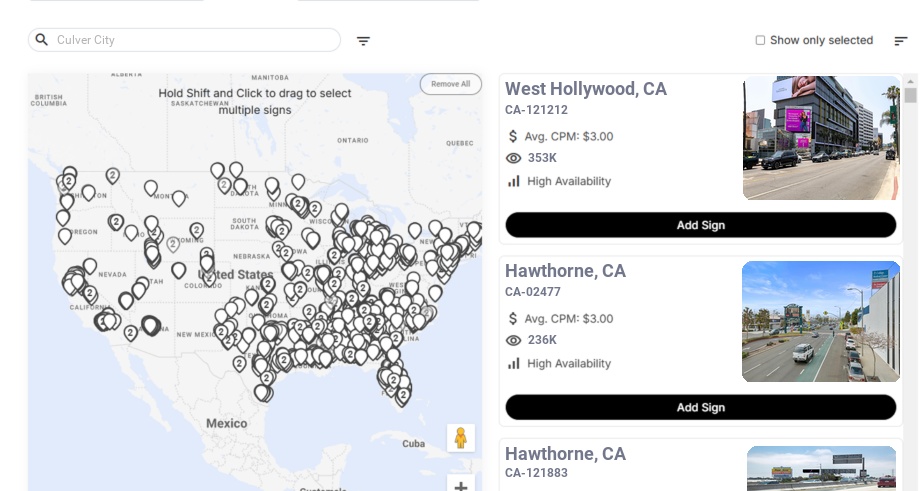
Blip offers 12 digital billboards serving the Culver City area, strategically positioned in nearby cities within roughly 10 miles. These include West Hollywood, CA, approximately 6.1 miles from Culver City, and Hawthorne, CA, approximately 7.2 miles from Culver City. These locations sit along major commuter and entertainment corridors used heavily by people who live, work, or socialize in the Culver City area.
Who do Culver City billboards with Blip reach?
The Culver City area offers advertisers an unusually concentrated, high-value audience, with more than 8,000 residents per square mile and a population footprint that grows far beyond the city limits. It is surrounded by Los Angeles neighborhoods and nearby cities, and within a 5-mile radius of downtown Culver City the total population easily exceeds 400,000 people. This density makes well-placed Culver City billboards and nearby units effective for repeated, high-frequency exposure.
When is the best time to run Blip billboards near Culver City, California?
Traffic in the Culver City area is shaped by commuter flows on I-405 and I-10, so morning drive, midday, and evening rush all offer different opportunities to reach audiences. Morning drive from 6–10 a.m. captures inbound commuters, while evening rush from 3–7 p.m. targets outbound commuters leaving the Culver City area. West Hollywood-located boards can also be especially valuable late at night for nightlife and entertainment audiences.
Why is Culver City, California a strong market for billboard advertising with Blip?
Culver City is widely recognized as a creative and media powerhouse, with major employers like Sony Pictures Entertainment, Amazon Studios, Apple TV+, and TikTok’s U.S. operations nearby. The area also has high household incomes, a strong concentration of working-age adults, and substantial commuter traffic from surrounding neighborhoods. That combination makes the Culver City area particularly attractive for B2B, media, and lifestyle brands.
Do I need a contract to advertise with Blip near Culver City?
No, Blip has no long-term contracts or minimum commitments. You can start, pause, or stop your campaign at any time.
How fast can I launch a billboard campaign with Blip near Culver City?
You can have your campaign live in minutes. Create a free account, select your locations, set your budget, upload your design, and start running once approved.
Where can I advertise with Blip near Culver City?
Blip has digital billboards near Culver City. You can browse available locations on a map, choose the ones that fit your audience, and start advertising right away.
Still have questions? Launch a campaign in minutes — no contracts, no commitments.
Start Your CampaignCulver City Billboard Advertising Guide
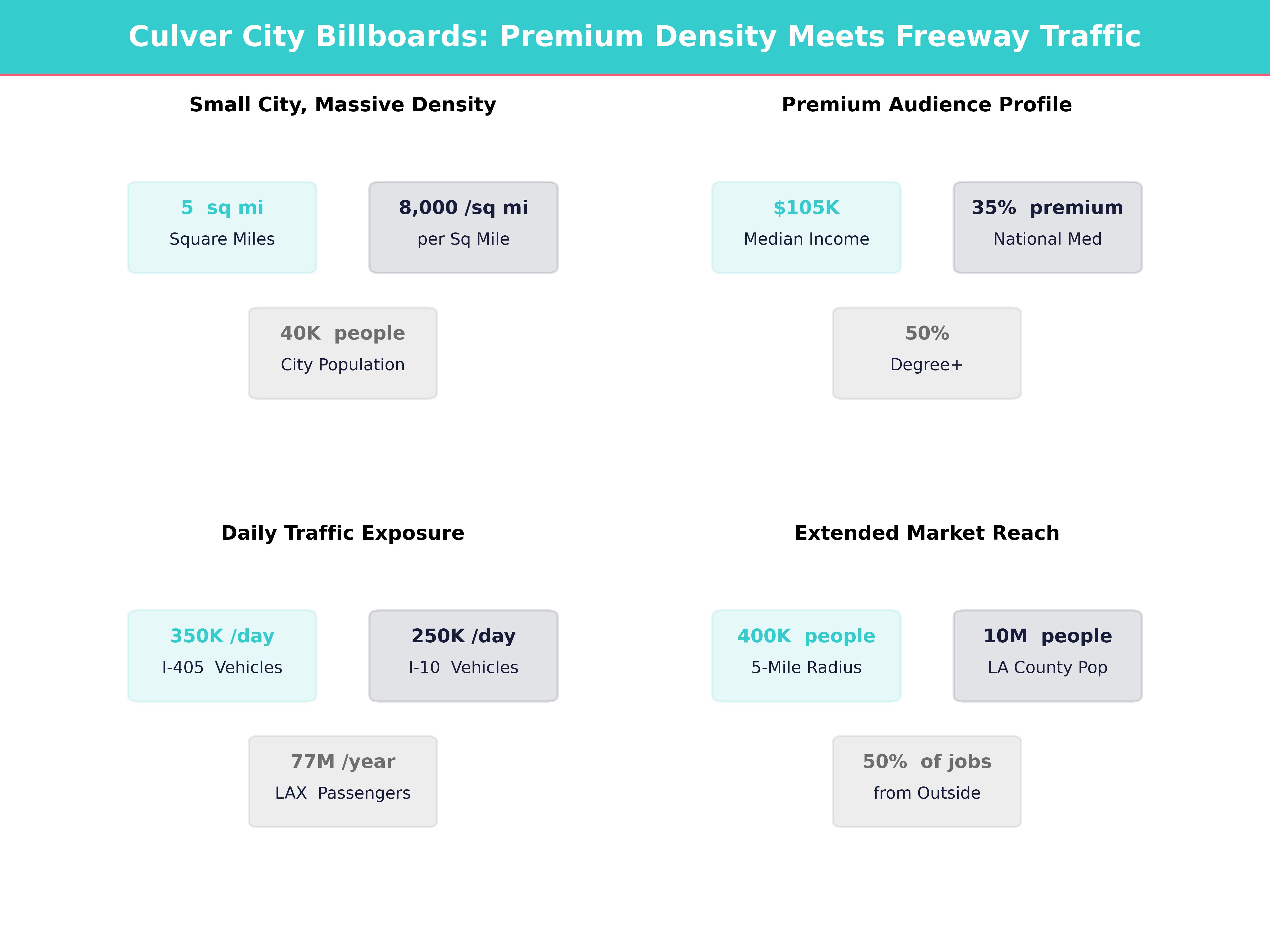
The Culver City area sits at the crossroads of entertainment, technology, and everyday Los Angeles life. With major studios, rapidly growing creative offices, bustling retail districts, and dense residential neighborhoods all packed into just over 5 square miles, the Culver City area offers advertisers an unusually concentrated, high-value audience. Within those 5 square miles, there are more than 8,000 residents per square mile—more than triple the overall density of Los Angeles County West Hollywood Hawthorne
Understanding the Culver City Market
Culver City itself has an estimated population of around 40,000 residents, but its true advertising footprint is far larger. The city is surrounded by Los Angeles neighborhoods like Palms, Mar Vista, West Adams, and Playa Vista, plus nearby cities such as Inglewood and West Hollywood. Within a 5‑mile radius of Culver City’s downtown, the total population easily exceeds 400,000 people when we include adjacent Los Angeles communities and cities along the I‑405 and I‑10 corridors, and daytime population can swell significantly as workers and visitors come into the area. This density is what makes well‑placed Culver City billboards and nearby units so effective for repeated, high-frequency exposure.
Key demographic and economic highlights for the Culver City area (rounded from recent regional data sources):
-
Population:
- ~40,000–41,000 in Culver City proper.
- 3.8+ million in the City of Los Angeles as a whole.
- 10+ million in Los Angeles County, a large share of whom regularly move through Westside job centers like Culver City, making consistent billboard advertising near Culver City a strong way to reach regional audiences.
-
Age:
- A balanced mix, with a strong concentration of working-age adults.
- In Culver City, roughly 65–70% of residents are between 18 and 64, and the median age sits in the mid‑30s to late‑30s—older than many college‑town areas but younger than many suburban communities.
- This translates into a core audience of earners and decision‑makers in prime consumption years.
-
Income:
- Median household income in Culver City is in the $100,000–$110,000+ range, placing it roughly 30–40% above typical national medians and notably higher than many other LA neighborhoods.
- A sizeable share of households earn well above that: in many Westside and adjacent zip codes, 25–35% of households report incomes of $150,000 or more.
- High disposable income supports premium spending on dining, travel, health and wellness, and entertainment.
-
Education:
- More than 50% of residents hold a bachelor’s degree or higher, and in several nearby tracts that share commuting corridors with Culver City, that percentage exceeds 60%.
- This makes the Culver City area one of the more highly educated pockets of greater Los Angeles, ideal for sophisticated and specialist messaging.
-
Housing mix:
- A blend of long‑term homeowners and renters; in many Culver City‑area zip codes, renters account for 55–65% of occupied units.
- Significant multifamily development—new apartments, condos, and mixed‑use projects—has added thousands of units over the last decade along corridors such as Washington Boulevard, Venice Boulevard, and Jefferson Boulevard.
- Higher-density housing increases the frequency with which residents encounter nearby billboards on daily errands and commutes.
Culver City is widely recognized as a creative and media powerhouse. It hosts or is adjacent to major employers like Sony Pictures Entertainment, Amazon Studios, Apple TV+, TikTok’s U.S. operations, and many production, post‑production, and gaming companies in and around the Hayden Tract and the surrounding Westside. Employment in “information” and “arts, entertainment, and recreation” categories across the central and Westside Los Angeles region runs into the tens of thousands; major studio facilities alone can house several thousand on‑lot workers and contractors on busy production days. That concentration of creative professionals, tech workers, and entertainment decision‑makers makes the Culver City area particularly attractive for B2B, media, and lifestyle brands, and it amplifies the value of having Culver City billboards or nearby placements along their commute paths.
For local context and planning, we recommend exploring:
- City of Culver City
- Culver City Economic Development
- Culver City tourism and visitors information
- Local news sources such as Culver City News Los Angeles Times
- Regional information from the City of Los Angeles and visitor insights via Discover Los Angeles.
These resources help us align billboard messaging with local priorities, events, and economic trends, including business openings, infrastructure projects, and seasonal tourism surges.
Where Our Billboards Reach the Culver City Area
Blip offers 12 digital billboards serving the Culver City area, strategically positioned in nearby cities within roughly 10 miles:
- West Hollywood, CA – approximately 6.1 miles from Culver City
- Hawthorne, CA – approximately 7.2 miles from Culver City
These two cities sit along major commuter and entertainment corridors used heavily by people who live, work, or socialize in the Culver City area:
- West Hollywood connects the Culver City area to Hollywood, Beverly Hills, and the Sunset Strip. West Hollywood’s residential population is around 35,000, but the city attracts millions of visitors per year for nightlife, dining, and events. People traveling between Culver City-area studios/offices and nightlife, events, or residences in central LA regularly pass through this zone. The city’s compact 1.9‑square‑mile footprint concentrates bars, clubs, hotels, and offices along key arterials where billboards excel, making it a prime place to run billboard advertising near Culver City.
- Hawthorne is just southeast of Culver City near the I‑105 and I‑405 interchange—a major funnel for Culver City commuters coming from the South Bay, Inglewood, and LAX. Hawthorne itself has roughly 85,000–90,000 residents, with a strong base of aerospace, logistics, and tech employment (including major regional employers nearby). Many of these workers use the same freeway corridors as Culver City commuters, so well‑timed billboard rental near Culver City in this area can capture both workday and leisure‑time travel.
By placing messages on digital billboards near Culver City in these locations, we can intercept:
- Daily commuters heading to studios and offices in the Culver City area. Regional labor data indicates that more than half of Culver City’s jobs are filled by workers who live outside the city limits, yielding tens of thousands of inbound trips on a typical weekday.
- Residents from other parts of LA traveling to dine, shop, or attend events in the Culver City area. Downtown Culver City, the Culver Steps, and the Helms Bakery District collectively draw thousands of patrons on busy weekend days and evenings, and nearby Culver City billboards help keep these destinations top of mind.
- Visitors and tourists passing between LAX, the beach cities, Hollywood, and West Hollywood who will naturally route near the Culver City area along the 405 and surface streets. LAX serves tens of millions of passengers annually, and a meaningful share stays in or passes through Westside and central LA neighborhoods accessible via our boards.
For additional geographic insight:
- City of West Hollywood
- Visit West Hollywood
- City of Hawthorne
- Los Angeles County Metro
- Regional mapping and services via Los Angeles County
These sites often publish corridor plans, mobility projects, and development updates that can inform which boards to prioritize and when, especially for advertisers comparing different options for billboard advertising near Culver City.
Traffic Patterns and Commuter Flows to Target
Traffic in the Culver City area is shaped by two major freeways (I‑405 and I‑10), key arterials (Venice Boulevard, Washington Boulevard, Sepulveda Boulevard), and its proximity to LAX. In the broader Westside and South Bay region, several freeway segments rank among the busiest in California.
Relevant transportation and traffic context (rounded from recent transportation reports):
- I‑405 (San Diego Freeway) carries well over 300,000 vehicles per day on some central LA segments. Certain stretches between the South Bay and the Westside have average daily traffic (ADT) counts approaching or exceeding 350,000 vehicles, placing the 405 among the most heavily used freeways in the United States.
- I‑10 (Santa Monica Freeway) typically sees over 250,000 vehicles per day on the Westside between downtown and the coast, with peak-hour congestion that can slow average speeds into the 20–30 mph range during rush periods—ideal for longer viewing times for nearby digital boards.
- LAX—only about 6–7 miles from the Culver City area—handled roughly 75–80 million passengers in the most recent full year of available data, rebounding strongly from the pandemic downturn. During peak pre‑pandemic years, annual totals approached 88 million passengers. Daily passenger throughput often exceeds 200,000 people on busy travel days, many of whom travel through or near Hawthorne and the Culver City area on their way to hotels, studios, and meetings. Additional data and traveler information are available via Los Angeles World Airports.
- Regional studies indicate that more than 50% of workers in the Culver City area commute from outside the immediate city, often via the I‑405/I‑10 interchanges or through adjacent neighborhoods like Palms, Mar Vista, and Inglewood. In practice, this means that on weekdays, the travel “shed” of people exposed to Culver City‑oriented messages is much larger than the residential base alone.
We can use this data to inform scheduling and content:
- Morning drive (6–10 a.m.): Capture inbound commuters to the Culver City area from the South Bay and central LA, especially with Hawthorne-located boards near the 105/405 corridors, where weekday traffic counts routinely surpass 200,000 vehicles per day.
- Midday (11 a.m.–3 p.m.): Reach freelancers, remote workers, and tourists heading to lunches, shopping, or studio meetings in the Culver City area. Weekday non‑peak traffic still often runs at 50–70% of peak volumes on key arterials, giving meaningful reach for lifestyle and errand‑oriented messages.
- Evening rush (3–7 p.m.): Target outbound commuters leaving the Culver City area for the South Bay, Hollywood, or central LA. Many freeway segments show their highest hourly volumes in this window, making it prime time for service businesses, entertainment, restaurants, and e‑commerce brands.
- Late-night (8 p.m.–2 a.m.): West Hollywood-located boards can speak to nightlife and entertainment audiences, many of whom work in or around the Culver City area during the day. West Hollywood’s hospitality sector sees especially strong spikes Thursday through Saturday evenings, with thousands of pedestrians and rideshare trips concentrated along major corridors.
For more detailed corridor data, advertisers can reference traffic and mobility information from:
- Caltrans District 7
- Los Angeles Department of Transportation (LADOT)
- Culver City Transportation Department
These agencies publish traffic counts, mobility plans, and transit ridership figures that can refine targeting around specific interchanges and arterials and help determine which billboards near Culver City will capture the heaviest flows.
Key Audience Segments in the Culver City Area
Because the Culver City area sits at the intersection of multiple industries and lifestyles, we can target a variety of high‑value audience segments. Across central and Westside Los Angeles, hundreds of thousands of workers are employed in entertainment, information, professional services, tech, and education—many of whom pass within a few miles of Culver City daily.
-
Entertainment and Media Professionals
With Sony Pictures, Amazon Studios, Apple TV+, and many production companies operating near Culver City, thousands of producers, writers, editors, marketers, and executives commute through the area daily. A single major studio lot can employ several thousand workers, and the broader “creative economy” around Culver City and neighboring Westside communities supports tens of thousands of jobs in film, TV, advertising, and digital media. B2B services, software, professional training, and high‑end consumer brands can all benefit from visibility along their commute paths via West Hollywood and Hawthorne boards, especially when campaigns are planned as premium billboard advertising near Culver City rather than generic citywide buys. -
Tech and Startup Employees
The Culver City area and nearby Playa Vista (“Silicon Beach”) collectively host technology companies, startups, and creative agencies employing many thousands of workers across software, gaming, social media, and e‑commerce. In Silicon Beach‑adjacent neighborhoods (Playa Vista, Marina del Rey, Venice, and Culver City), office absorption over the last decade has been substantial, with multiple large campuses filling several million square feet of space. Many of these workers live in central LA (Hollywood, West Hollywood, Downtown) or the South Bay, passing near our billboard locations daily—often logging 30–60 minutes each way in the car, increasing billboard exposure time. -
Affluent Urban Households
Median incomes in the Culver City area and neighboring Westside communities are significantly higher than national averages. In several Culver City and adjacent Westside zip codes, median household incomes exceed $100,000–$120,000, and housing costs reflect that: typical rents for newer one‑bedroom units often run $2,500–$3,000+ per month, and median home values are frequently well above $1 million. This translates into substantial discretionary spending on dining, entertainment, travel, personal care, and premium consumer goods. Billboards should emphasize quality, lifestyle benefits, and brand identity rather than pure discount messaging. -
Students and Young Professionals
Nearby institutions such as UCLA (to the north) and Loyola Marymount University (to the southwest) contribute a large population of younger, trend‑sensitive residents and commuters. UCLA alone enrolls more than 45,000 students, while Loyola Marymount University adds several thousand more. Many students and recent graduates live or work in the Culver City area, the Westside, or central LA and are especially likely to travel through West Hollywood and Hawthorne corridors for work, internships, and nightlife. This group is highly engaged with digital media, streaming, and app‑based services, making billboard‑driven online calls‑to‑action particularly effective. -
Tourists and Visitors
Greater Los Angeles attracts tens of millions of visitors annually, with the Westside and central LA capturing a large share of hotel nights and day visits for dining and entertainment. Tourists staying in West Hollywood, Hollywood, Beverly Hills, or near LAX frequently move through the Culver City area to reach the beach, downtown, or major attractions. Visitor bureaus report billions of dollars in annual tourism spending across LA County, with per‑visitor daily spending often in the $150–$250 range for lodging, food, shopping, and entertainment. This is ideal for:- Local attractions and museums
- Restaurants and nightlife in the Culver City area
- Hotels, tours, and transportation services
- Streaming, gaming, and entertainment products seeking mainstream exposure in a media‑savvy market
For tourism and visitor insights, advertisers can reference:
- Culver City tourism and visitors information
- Visit West Hollywood
- County‑wide visitor information from Discover Los Angeles
Seasonal and Event-Based Opportunities
The Culver City area experiences relatively stable weather year‑round, with more than 280–290 sunny or partly sunny days per year across coastal and near‑coastal LA, which keeps outdoor advertising highly visible across all seasons. Average annual rainfall is under 15 inches, and extreme weather closures are rare, ensuring consistent visibility for campaigns. However, certain times of year and major events intensify traffic and spending:
- Pilot season, awards season, and major entertainment releases (roughly January–March and late summer): More industry professionals, events, and screenings near Culver City studios and in West Hollywood. LA’s broader entertainment awards corridor (Golden Globes, SAG Awards, Oscars, and various guild events) clusters many premieres and screenings in a 60–90‑day window. This is great for entertainment marketing, B2B services targeting production companies, and hospitality.
- Summer travel (June–August): Higher tourist volumes to LA, more leisure trips, and heavier use of corridors between LAX, the beach communities, and central LA. Visitor statistics show that summer months can account for 30% or more of yearly leisure travel to the region. This period is ideal for attractions, events, and consumer brands targeting families, international tourists, and staycationers.
- Back‑to‑school and fall (August–October): Increased commuting patterns as schools and universities are in full session. UCLA, LMU, and multiple community colleges and high schools in the Westside/South Bay corridor all resume around this window, bringing tens of thousands of students and staff back into regular travel routines. Useful for education, retail, and subscription services.
- Holiday season (November–December): Elevated retail and entertainment spending, plus family travel in and out of LAX. Holiday travel peaks around Thanksgiving, late December, and early January, with air travel surging significantly over off‑season averages. Perfect for promotions, seasonal offers, and experience‑driven campaigns.
We can also time creative around:
- Local festivals, art walks, and film-related events promoted by the City of Culver City’s events calendar.
- Pride, Halloween, and other major cultural events in West Hollywood
- Sporting events at nearby venues like SoFi Stadium and the Kia Forum in Inglewood (easily accessible via the same freeway corridors serving the Culver City area). SoFi Stadium hosts NFL games, concerts, and special events that can each draw 60,000–70,000 attendees, while the Kia Forum
Aligning billboard schedules with these spikes in traffic and spending can substantially increase impressions and conversion potential, and makes flexible billboard rental near Culver City especially valuable for time‑sensitive promotions.
Crafting Effective Creative for the Culver City Area
Given the media-savvy, visually literate nature of the Culver City audience, billboard creative near the city should be polished and conceptually strong. Many local viewers work directly in visual storytelling, design, or advertising, so standards are high.
Here are practical guidelines based on local behavior and viewing conditions:
-
Embrace “studio-quality” visuals.
Many viewers work in film, TV, or design. High‑contrast images, cinematic composition, and bold typography resonate strongly. Avoid clutter and amateurish layouts—this audience will notice. In a market where local creatives routinely produce content for national and global brands, billboards that feel “off‑brand” can stand out for the wrong reasons. -
Keep copy extremely concise.
With fast‑moving traffic and complex intersections, we recommend:- 6–10 words maximum on most creatives
- One clear call to action (URL, short code, or simple search phrase)
- Large fonts; primary text at least 1/6 the height of the creative canvas
- High color contrast to ensure readability from 500–800 feet away
Studies of out‑of‑home effectiveness consistently show that reducing word count and visual complexity improves recall—especially along high‑speed corridors like I‑405 and I‑10.
-
Leverage location-based storytelling.
Phrases like “Minutes from Culver City’s [landmark/area]” or “On your way to the Culver City area?” connect the viewer’s route to their destination. Mention known local points such as:- Downtown Culver City
- The Culver Steps
- The Arts District / Hayden Tract
- Helms Bakery District
This reinforces relevance even when the billboard itself is technically in West Hollywood or Hawthorne. Reference travel times (“5 minutes from downtown Culver City off [exit]”) during off‑peak hours when those claims match real‑world conditions. This approach helps billboards near Culver City feel hyperlocal and immediately useful.
-
Match tone to corridor and timing.
- On Hawthorne‑area boards during morning rush, emphasize productivity, convenience, and time savings (e.g., coffee, transit, productivity tools), speaking to commuters making 20–40‑minute drives into the Culver City area.
- On West Hollywood boards evenings and late nights, lean into entertainment, dining, nightlife, and fashion messaging tied back to the Culver City area. Late‑night impressions here are particularly valuable for brands tied to music, streaming, nightlife, and rideshare.
-
Design for frequent rotation.
Because Blip runs short “blips” (individual ad plays) that can appear many times per day, we can:- Rotate multiple versions of a message (e.g., three different headline angles).
- Test image‑only vs. text‑heavy creatives to see what drives more engagement (measured via website traffic, search volume, or promo codes).
- Day‑part creative (e.g., business messaging during commute hours, lifestyle messaging on weekends and evenings).
For example, a campaign running several hundred to several thousand blips per day can easily support A/B tests where each creative receives 30–50% of total plays, generating statistically meaningful performance comparisons over a 2–4‑week period.
Using Blip’s Flexibility to Target the Culver City Area
Our platform allows fine‑tuned control over when and where messages appear on the digital billboards serving the Culver City area. Advertisers can take advantage of:
-
Geographic targeting at the screen level.
Choose specific boards in West Hollywood and Hawthorne depending on where your Culver City-area audience is likely to be traveling from:- South Bay or LAX to Culver City area: prioritize Hawthorne, focusing on routes that carry well over 150,000–200,000 vehicles per day.
- Central LA and Hollywood to Culver City area: prioritize West Hollywood, where entertainment workers and nightlife visitors overlap heavily.
- Citywide or countywide awareness: use both sets of boards for broader coverage, capturing flows from the Valley, Downtown LA, the Westside, and the South Bay.
This level of control makes it easy to tailor billboard advertising near Culver City to your most valuable origin and destination pairs.
-
Day‑part and weekday customization.
Use traffic patterns and customer behavior to schedule:- Weekday morning and evening commute-heavy schedules for professional services, B2B, fitness, and childcare in the Culver City area, aligning with the busiest traffic windows (often 7–9 a.m. and 4–7 p.m.).
- Weekend-heavy schedules for dining, activities, and events, especially Friday evenings through Sunday nights when discretionary outings peak.
- Late‑night slots for entertainment, streaming services, rideshare, and hospitality—particularly beneficial on West Hollywood boards where late‑night foot and vehicle traffic is high Thursday–Sunday.
-
Budget control and optimization.
Because we operate on a pay‑per‑blip model, advertisers can:- Start with small daily budgets (even under $10/day) to test messaging to the Culver City audience, potentially generating dozens to hundreds of plays per day depending on bid levels and demand.
- Increase bids during peak times (e.g., Friday evenings, major event days) when impressions are more valuable and traffic volumes or event attendance spike.
- Pause or redirect spending quickly if a promotion sells out or a campaign objective is met, or to shift focus from Hawthorne to West Hollywood (or vice versa) based on real‑time business needs.
This flexible approach to billboard rental near Culver City helps both small and enterprise advertisers maximize impact without overcommitting budget.
-
Real-time adjustments around local events.
With digital scheduling, we can:- Push special creatives during film festivals, award seasons, or local arts events promoted by Culver City’s Arts & Culture programs.
- Highlight limited-time offers timed with big concert nights at West Hollywood or Inglewood venues when Culver City-area residents are on the move.
- Adapt to weather (e.g., heatwaves, rare rain events) to promote relevant products like indoor experiences, cooling services, or seasonal menu items.
This flexibility is especially useful in a market like greater Los Angeles, where traffic conditions, event calendars, and even local news cycles can shift quickly and drive sudden changes in consumer demand.
Strategy Examples for Common Advertiser Types
To make the most of the 12 billboards serving the Culver City area, we can tailor approaches by category. The strategies below combine local travel behavior with typical impression patterns across digital boards in high‑traffic corridors.
Local Restaurants and Bars in the Culver City Area
- Target: Residents and workers commuting into and out of Culver City, plus visitors headed between LAX and central LA.
-
Tactics:
- Run lunchtime creatives 11 a.m.–2 p.m. weekdays: “Lunch in the Culver City area? Exit [landmark/major street].” Focus on quick‑serve, fast‑casual, and business‑lunch offerings popular among the area’s sizable office worker base.
- Run evening creatives 4–8 p.m. with strong imagery of dishes and drinks and a short URL or “Search: [Restaurant Name] Culver City.” Local dining data shows that evening check averages and party sizes typically increase after 6 p.m., making this window especially valuable.
- Concentrate spend on West Hollywood boards Thursday–Saturday nights and Hawthorne boards late afternoons and evenings for airport-bound traffic, which includes both departing locals and higher‑spend visitors.
Studios, Production Services, and Creative Agencies
- Target: Entertainment and media professionals commuting to Culver City-area studios and clients.
-
Tactics:
- Use clean, professional visuals with minimal copy: “Finishing on deadline? [Brand Name] post-production solutions. Culver City area.”
- Focus on weekday commute windows, especially mornings (7–10 a.m.), when thousands of production workers, editors, and executives move toward Culver City, Hollywood, and nearby studio zones.
- Rotate 2–3 variations of industry-specific messaging and observe which correlates with more contact form submissions or inbound calls. For example, track unique URLs for “editing,” “VFX,” and “sound” variants to see which resonates most with local decision‑makers.
Education and Training (Film Schools, Bootcamps, Universities)
- Target: Aspiring creatives, tech workers, and career switchers in the broader Culver City area.
-
Tactics:
- Run enrollment push campaigns 6–8 weeks before each term, aligning with typical application windows and orientation periods.
- Use strong calls to action like “Apply by June 30” with an easy URL. Short, memorable domains or QR codes can significantly improve follow‑through, especially among on‑the‑go commuters.
- Use both West Hollywood and Hawthorne boards to tap into a wide commuter catchment—including students traveling between campuses, internships, and part‑time jobs across the Westside and central LA.
E‑Commerce and Apps
- Target: Affluent, tech‑savvy consumers and industry tastemakers passing near the Culver City area.
-
Tactics:
- Emphasize brand name, core value, and a very simple call to action (e.g., “Try it free. [BrandName].com”). In a market where smartphone penetration and broadband adoption are extremely high, frictionless calls‑to‑action perform best.
- Align creative with national campaigns but add subtle local relevance (“Trusted across LA’s creative community.” or “Built in LA for LA.”).
- Use frequency: many short blips spread throughout the day to build broad awareness. For example, 200–500 plays per day across a week can yield thousands of total impressions, especially on high‑ADT corridors like the 405.
Measuring and Refining Campaign Performance
While billboards are an upper‑funnel medium, we can still track and optimize performance for campaigns serving the Culver City area.
Recommended measurement tactics:
- Unique URLs or landing pages: e.g.,
yourbrand.com/culvercityto see traffic driven by the campaign. Monitor sessions, time on site, and conversion actions from users in Culver City, West Hollywood, Hawthorne, and adjacent zip codes. - Promo codes or offer phrases: “Mention ‘Culver City’ for 10% off” for phone or in‑person conversions. Track how many in‑store visits or calls reference the code during the campaign window versus a baseline period.
- Search volume monitoring: Track branded search volume in the Culver City area during and after the campaign. Sudden increases in direct brand searches or “brand + Culver City” queries often correlate with strong out‑of‑home visibility.
- Geo‑fenced digital ads: Run mobile or social ads geo‑fenced to the Culver City area and adjust flights to complement billboard timing; watch for lift in engagement when both run simultaneously. Studies of integrated campaigns often show higher recall and response when out‑of‑home and mobile or social media are combined.
By reviewing performance weekly or monthly, we can:
- Shift spend to specific boards (West Hollywood vs. Hawthorne) performing better for your goals, using web analytics, store traffic, or call volume by neighborhood as proxies.
- Adjust day‑parts to focus on the highest‑impact hours, such as when website traffic or store visits from Culver City‑area IPs or addresses spike.
- Swap out underperforming creatives while keeping strong ones in rotation longer, continuously improving the return on each advertising dollar. Over time, this process helps identify which types of billboard advertising near Culver City deliver the most efficient results for your brand.
Putting It All Together
The Culver City area offers a rare combination of affluent residents, high‑value professionals, dense creative industries, and heavy commuter and tourist traffic. With 12 digital billboards serving the Culver City area from nearby West Hollywood and Hawthorne, we can build strategic, flexible campaigns that:
- Intercept key audiences along their daily routes, including commuters on freeways with hundreds of thousands of daily vehicles and visitors moving between LAX, the beach, and central LA.
- Align with local events, seasons, and industry cycles, such as awards season, major concerts, and sports events that draw tens of thousands of attendees at a time.
- Test and refine messaging quickly using Blip’s pay‑per‑blip model and scheduling tools, starting with modest budgets and scaling up based on performance.
By combining local knowledge of Culver City’s economic and cultural landscape with smart creative and data‑driven scheduling, advertisers can turn digital billboards near Culver City—and broader billboard rental near Culver City corridors—into a powerful, measurable driver of awareness, consideration, and action.