Billboards near Beverly Hills, CA
No Minimum Spend. No Long-Term Contracts. Just Results.
Trusted by Leading Brands


Billboard advertising
near Beverly Hills has never been easier

How much is a billboard near Beverly Hills?
Why Choose Blip for Billboard Advertising near Beverly Hills
Blip lets you launch Beverly Hills billboards fast, reaching Sunset Strip and Santa Monica Blvd traffic without traditional buying delays.
Set flexible budgets in Beverly Hills and reach daytime workers, tourists, and Rodeo Drive shoppers on your terms.
Daypart Beverly Hills campaigns for weekday commutes or Thursday-Saturday nightlife flows between West Hollywood and Beverly Hills.
No contracts needed—test Beverly Hills ads near La Cienega and Doheny, then scale what drives results.
Track Beverly Hills performance in real time and shift spend as visitor spikes rise around hotels, events, and luxury retail.
Use Blip creative tools to build polished Beverly Hills ads that fit the city’s luxury tone and high-end audience.
Frequently Asked Questions About Billboard Advertising near Beverly Hills
How much does a billboard cost near Beverly Hills, California with Blip?
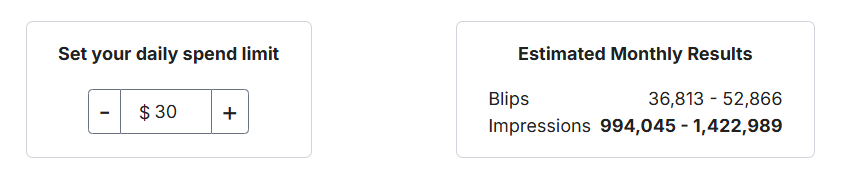
With Blip, you control exactly what you spend by setting a daily budget for Beverly Hills billboards, and our pay-per-blip model means you only pay each time your ad appears for 7.5 to 10 seconds on digital billboards near Beverly Hills, California. Costs vary based on the times you choose, the locations serving the Beverly Hills area, and overall advertiser demand, so your total spend is simply the sum of each individual blip your campaign receives. It can work with almost any budget, and you can adjust that budget at any time to match your goals.
Where can I advertise with Blip in Beverly Hills, California?
We currently have 4 digital billboards serving the Beverly Hills area, all located in nearby West Hollywood, about 1.8 miles from Beverly Hills. This is critical: West Hollywood is one of the primary pass-through zones for people going to and from Beverly Hills, so these are among the most visible billboards near Beverly Hills for both residents and visitors. By strategically placing creative across our 4 nearby digital billboards, we can capture inbound and outbound traffic moving through the area.
What kind of audience can Blip reach near Beverly Hills, California?
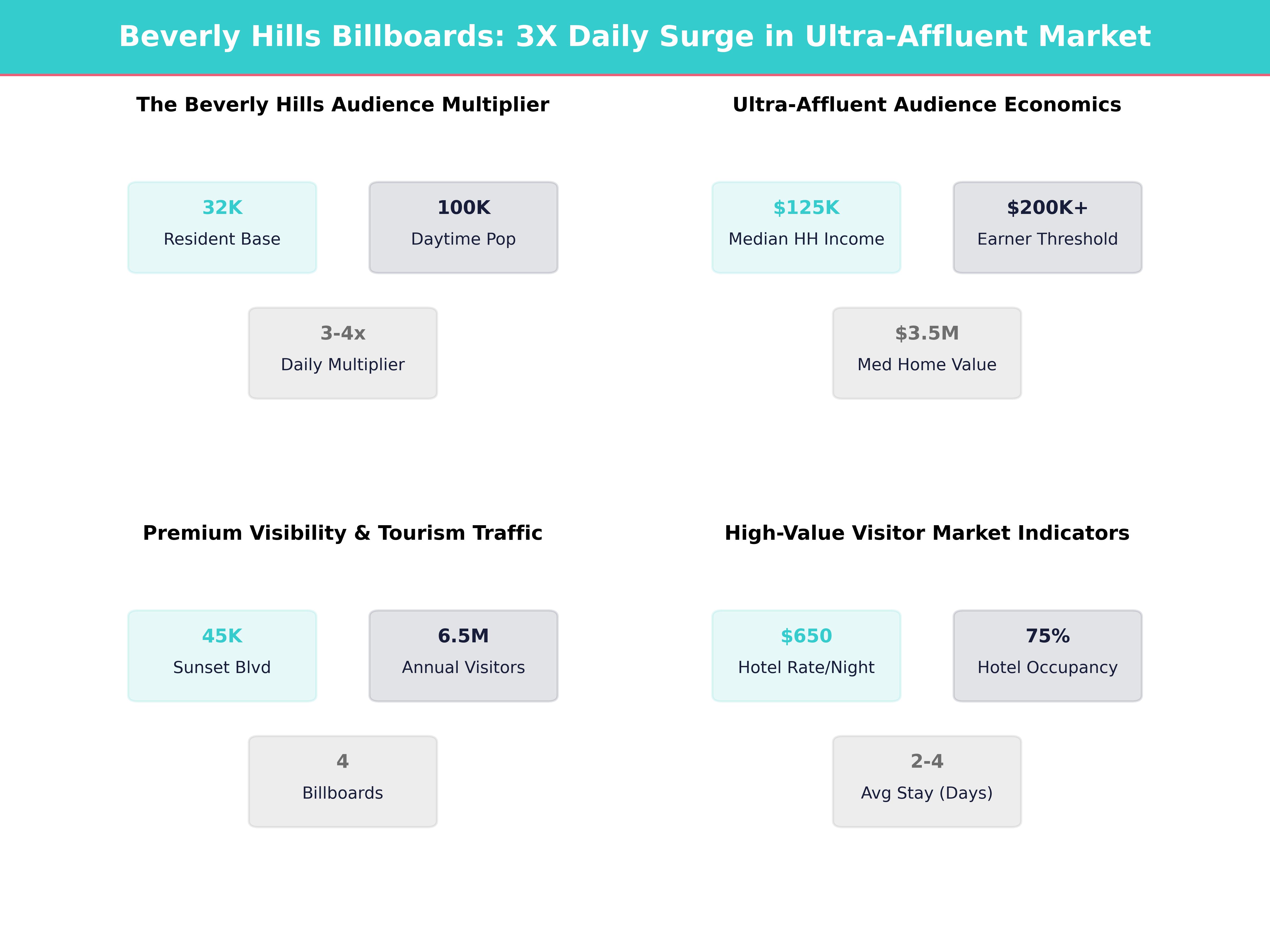
The Beverly Hills area is one of the most concentrated pockets of wealth, influence, and tourism in the country. With a resident population of roughly 32,000–33,000 people, but a daily influx that pushes the daytime population to well over 100,000, it punches far above its size in terms of marketing impact. Recent city and regional economic profiles put Beverly Hills’ median household income in the $120,000–$130,000 range, with a large share of households well above $200,000.
When is the best time to run billboards in Beverly Hills, California with Blip?
The Beverly Hills area follows distinct patterns around work, tourism, and nightlife, and Blip’s flexible scheduling lets us adjust campaigns by time of day, day of week, and even specific dates. Weekend occupancy and ADR typically peak Thursday–Sunday, while weekday patterns are driven by business travel, production schedules, and medical, legal, and financial appointments. Traffic counts on corridors like Sunset Boulevard and Santa Monica Boulevard similarly show strong a.m. and p.m. peaks on weekdays and heightened late-night activity on weekends.
Why are billboards near Beverly Hills, California effective for tourists and locals?
Tourists and residents behave very differently in the Beverly Hills area, and the location attracts millions of visitors annually. Many visitors stay in Beverly Hills or nearby West Hollywood hotels, and international travelers often have limited time of 2–4 days and high budgets for premium experiences. Local professionals and workers in the Beverly Hills area see area signage frequently, making them ideal targets for ongoing services and repeat exposure.
Do I need a contract to advertise with Blip near Beverly Hills?
No, Blip has no long-term contracts or minimum commitments. You can start, pause, or stop your campaign at any time.
How fast can I launch a billboard campaign with Blip near Beverly Hills?
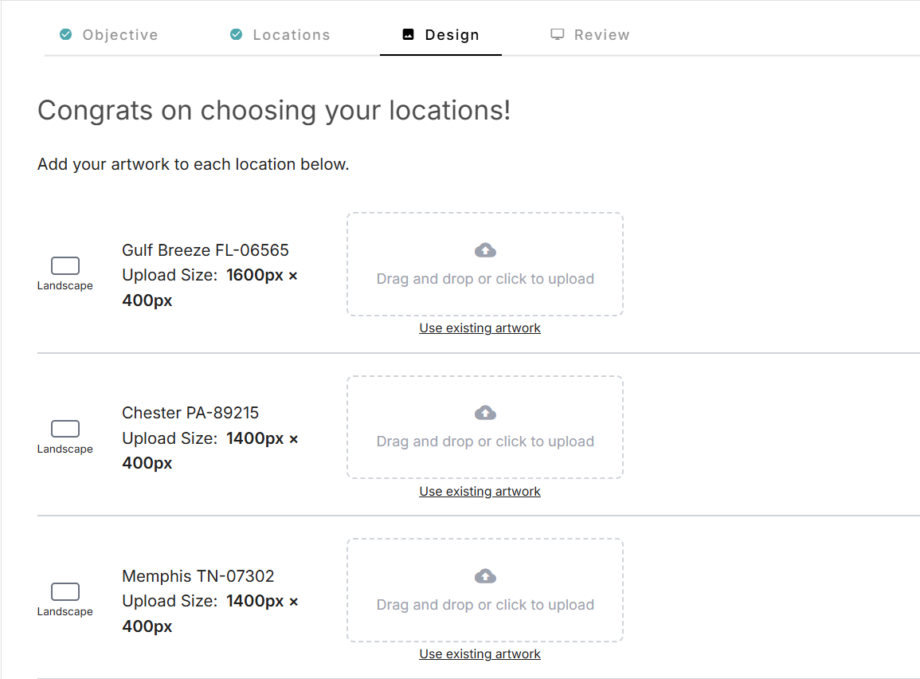
You can have your campaign live in minutes. Create a free account, select your locations, set your budget, upload your design, and start running once approved.
Where can I advertise with Blip near Beverly Hills?
Blip has digital billboards near Beverly Hills. You can browse available locations on a map, choose the ones that fit your audience, and start advertising right away.
Still have questions? Launch a campaign in minutes — no contracts, no commitments.
Start Your CampaignBeverly Hills Billboard Advertising Guide
The Beverly Hills area is one of the most concentrated pockets of wealth, influence, and tourism in the country, and we treat it as a high-impact zone for billboard advertising. With a resident population of roughly 32,000–33,000 people, but a daily influx that pushes the daytime population to well over 100,000, it punches far above its size in terms of marketing impact. Local economic reports note that Beverly Hills supports tens of thousands of jobs in hospitality, retail, and professional services, drawing workers and visitors from across Greater Los Angeles every weekday. By placing digital billboard campaigns on nearby West Hollywood boards serving the Beverly Hills area, we can connect brands with both the local community and high-intent visitors moving between Beverly Hills, West Hollywood, and greater Los Angeles, creating a powerful alternative to traditional Beverly Hills billboards for many advertisers.
Understanding the Beverly Hills Area Audience
The Beverly Hills area sits at the intersection of luxury, entertainment, and global tourism. A few core data points help define the market:
- Affluent residents: Recent city and regional economic profiles put Beverly Hills’ median household income in the $120,000–$130,000 range, with a large share of households well above $200,000. In some census tracts near the Golden Triangle and north of Sunset, median home values exceed $3–4 million, and single-family homes routinely list above $5 million. Luxury retail, premium services, real estate, medical, legal, and financial services all perform well here.
- High density of decision makers: Beverly Hills and adjacent West Hollywood together host thousands of entertainment, media, and professional services firms, including major talent agencies, production companies, and boutique financial and legal practices. This leads to a high concentration of executives, entertainment professionals, investors, and influential creatives, making the area a strong fit for B2B marketing (private banking, production services, corporate events, high-end tech) that can benefit from strategic billboard advertising near Beverly Hills.
- Visitor-heavy economy: According to the city’s tourism organization, Love Beverly Hills, Beverly Hills attracts millions of visitors annually, with pre‑pandemic benchmarks often cited in the 6–7 million visitors per year range and visitor spending estimated in the multi‑billion‑dollar range. The city’s luxury hotels regularly achieve occupancy rates in the 70–80% range and some of the highest average daily room rates in Greater Los Angeles. It’s common to see international travelers from Asia, the Middle East, Europe, and Latin America.
- Daytime worker population: City business and economic development materials indicate that Beverly Hills supports tens of thousands of jobs, particularly in hospitality, professional services, medical/dental, and high-end retail. As a result, the daytime population can be 3–4x the resident base, especially on weekdays when commuters and service providers flow into the city.
- Cultural diversity: The broader Westside and Hollywood corridor includes significant Persian, Israeli, Russian, Latin American, and East Asian communities. West Hollywood itself has a population of roughly 35,000–36,000 residents, and is known for its LGBTQ+ community, creative professionals, and hospitality workforce. Messaging that is culturally aware (and occasionally multilingual) can resonate in the Beverly Hills area.
Because we serve the Beverly Hills area from nearby West Hollywood, we are tapping into an audience that is frequently on the move between Beverly Hills, the Sunset Strip, Hollywood, and the rest of Los Angeles. Many of these viewers are in rideshares, luxury vehicles, or service vehicles—ideal moments for awareness and consideration campaigns, especially given that corridor traffic volumes often reach tens of thousands of vehicles per day on each major arterial. For many brands, this makes billboards near Beverly Hills in West Hollywood an efficient way to capture both local and visitor traffic without paying premium core-zone rates.
For additional demographic and business context, advertisers can review resources from the City of Beverly Hills and the Beverly Hills Chamber of Commerce, as well as business and visitor data from Visit West Hollywood West Hollywood Chamber of Commerce
Where Our Billboards Fit: Key Corridors Serving Beverly Hills
We currently have 4 digital billboards serving the Beverly Hills area, all located in nearby West Hollywood, about 1.8 miles from Beverly Hills. This is critical: West Hollywood is one of the primary pass-through zones for people going to and from Beverly Hills, so these are among the most visible billboards near Beverly Hills for both residents and visitors.
Traffic counts from the City of West Hollywood 30,000–50,000+ vehicles per day, with peak-hour volumes heavily skewed toward commute and entertainment travel. For advertisers evaluating Beverly Hills billboards versus adjacent options, these corridors offer comparable exposure with more flexible buying structures.
A few important traffic and movement patterns to understand:
-
Sunset Boulevard / Sunset Strip (West Hollywood):
- The Sunset Strip is one of LA’s most iconic advertising corridors. City traffic data and corridor studies commonly show roughly 40,000–50,000 vehicles per day along busy segments of Sunset in West Hollywood, with weekend evening peaks fueled by nightlife and entertainment traffic.
- Visitors headed to Beverly Hills hotels, restaurants, and Rodeo Drive often traverse the Strip from Hollywood and the 101. Many tours, rideshares, and hotel shuttles follow this route, leading to repeated exposures among high‑spending visitors.
-
Santa Monica Boulevard / Route 2:
- Santa Monica Boulevard passes just north of Beverly Hills and runs through West Hollywood and into Century City and Santa Monica. In West Hollywood, several stretches record average daily traffic (ADT) in the high‑30,000s to mid‑40,000s.
- It carries heavy commuter and rideshare traffic, with many vehicles bound for offices in Beverly Hills, Century City, and the Westside. This corridor is also a key spine for local transit, cyclists, and micromobility users, broadening the mix of impressions.
-
La Cienega, Doheny, and adjacent arterials:
- La Cienega Boulevard, connecting the Beverly Center area, West Hollywood, and points south, often records 30,000–40,000 vehicles per day, while Doheny Drive and nearby collectors add another tens of thousands of daily trips combined.
- These streets connect the Beverly Hills area to West Hollywood nightlife, Melrose retail, and central LA. They serve residents heading to dinner, events, and shopping, as well as service providers (contractors, designers, stylists, medical reps).
By strategically placing creative across our 4 nearby digital billboards, we can:
- Capture inbound traffic headed toward the Beverly Hills area for shopping, meetings, and hotel stays, particularly during morning and afternoon commute periods when corridor volumes peak.
- Reach outbound traffic leaving Beverly Hills events, luxury shopping, and restaurants—when visitors are primed to act on reminders (dining, nightlife, rideshare codes, follow-up appointments). Evening traffic on the Sunset Strip and Santa Monica Boulevard is especially strong Thursday–Saturday.
- Align with specific journeys, such as from Hollywood to Beverly Hills hotels, or from West Hollywood nightlife to Beverly Hills brunch spots, where one trip might generate multiple billboard exposures over the course of a stay.
For an overview of the area’s road network and city boundaries, advertisers can reference the official City of Beverly Hills website and maps from the City of West Hollywood Average Daily Traffic (ADT) summaries that are useful when planning impression-based billboard advertising near Beverly Hills.
Crafting Creative That Resonates in the Beverly Hills Area
Advertising near Beverly Hills demands a polished, elevated approach. The audience is highly brand-aware and regularly exposed to top-tier creative from global luxury brands. Local tourism and media data underscore this: Beverly Hills and West Hollywood collectively support dozens of 4‑ and 5‑star hotels, hundreds of fine‑dining and upscale casual restaurants, and some of the highest retail sales per square foot in Southern California. When you use Beverly Hills billboards or digital boards just outside the city, your creative needs to meet these expectations.
1. Lead with premium visuals.
- Use high-resolution, cinematic imagery. Think glossy magazine cover, not local flyer. Beverly Hills hotel markets often report average daily room rates above $600–$700, so your creative should feel at home in that environment.
- Showcase aspirational settings: rooftop views, luxury interiors, sleek vehicles, couture-level fashion, or refined product photography.
- Avoid clutter; use 5–7 words max on most creatives. At 35–45 mph average corridor speeds, a driver typically has 2–4 seconds to absorb your message.
2. Match the area’s tone and expectations.
- Beverly Hills–adjacent viewers expect sophistication. Fonts, colors, and compositions should feel consistent with brands seen on Rodeo Drive or in high-end publications like the Los Angeles Times
- For luxury or professional services, emphasize discretion, exclusivity, and trust (e.g., “Private Wealth Management for Multi‑Generational Families” vs. “Financial Help Available.”). The area’s high‑net‑worth households and family offices are accustomed to working with firms that emphasize service quality and track record.
3. Use location cues for relevance.
- Phrases like “Minutes from Rodeo Drive,” “Serving the Beverly Hills area,” or “Next Door in West Hollywood” help people place you geographically. Surveys from local tourism boards consistently show that proximity and ease of access are among the top decision factors for visitors choosing restaurants and experiences.
- If you are physically located in Beverly Hills or nearby, show neighborhood names (Rodeo Drive, Golden Triangle, Wilshire Corridor, Beverly Grove).
4. Highlight concrete proof points.
For this highly discerning audience, numbers matter:
- “Rated 4.9★ by 2,500+ clients”
- “Over 30 years serving the Beverly Hills area”
- “Trusted by 300+ entertainment professionals annually”
- “Top‑10 Beverly Hills med spa by online reviews”
These specifics appeal to professionals and affluent buyers who use data and reputation to justify decisions. Local reviews in outlets like Beverly Hills Courier and coverage in publications such as the Los Angeles Times
Timing and Dayparting Strategies for Maximum Impact
The Beverly Hills area follows distinct patterns around work, tourism, and nightlife. Blip’s flexible scheduling lets us adjust campaigns by time of day, day of week, and even specific dates, making billboard rental near Beverly Hills more efficient and targeted than traditional fixed buys.
Hotel and tourism data for Beverly Hills and West Hollywood show that weekend occupancy and ADR typically peak Thursday–Sunday, while weekday patterns are driven by business travel, production schedules, and medical, legal, and financial appointments. Traffic counts on corridors like Sunset Boulevard and Santa Monica Boulevard similarly show strong a.m. and p.m. peaks on weekdays and heightened late‑night activity on weekends.
Morning (6–10 a.m.)
- Audience: Commuters, professionals driving to offices, hotel guests heading to meetings or breakfast. Many medical and legal offices in Beverly Hills start client appointments between 8–10 a.m., making this window prime for professional services.
-
Best for:
- Professional services (law, finance, medical, real estate)
- Fitness, wellness, and medical aesthetics
- Breakfast spots and coffee shops
-
Strategy: Use concise, benefit-led messaging:
- “Need a Beverly Hills business attorney? Call before 10 a.m. for a same-day consult.”
- “Start your Beverly Hills morning with 5-star coffee – 5 minutes ahead.”
Midday (10 a.m.–3 p.m.)
- Audience: Shoppers, tourists, hospitality workers, freelancers, local parents. Tourism organizations note that midday and early afternoon are peak shopping and sightseeing hours, especially for visitors on short 2–4 day stays.
-
Best for:
- Retail, luxury goods, designer boutiques
- Lunch restaurants, cafes, and dessert spots
- Attractions, galleries, and beauty services
- Strategy: Rotate multiple creatives showing product variety or lunch specials. Emphasize walkable distance or short drives (“3 minutes from Rodeo Drive,” “On Santa Monica Blvd in Beverly Hills”).
Afternoon Rush (3–7 p.m.)
- Audience: Workers leaving the Beverly Hills area, school pickups, early evening shoppers. Evening peak traffic on Santa Monica Boulevard and Sunset Boulevard can reach several thousand vehicles per hour in this window.
-
Best for:
- Commuter-focused messages (auto, insurance, healthcare, real estate)
- After-work dining, happy hour, or wellness services
-
Strategy: Use urgency or “tonight” framing:
- “Happy hour near Beverly Hills until 7 p.m.”
- “Book same-day luxury car service for tonight’s event.”
Evening & Late Night (7 p.m.–1 a.m.)
- Audience: Nightlife-goers, hotel guests, visitors moving between West Hollywood and Beverly Hills restaurants, lounges, and events. West Hollywood alone welcomes millions of visitors annually, and tourism reports regularly cite nightlife as one of the top activities, fueling high nighttime traffic volumes Thursday–Saturday.
-
Best for:
- Nightlife, bars, live music, experiences
- Late-night delivery, rideshare promotions, event marketing, streaming/entertainment
-
Strategy: Use bold colors and simple calls to action:
- “Late-night sushi near Beverly Hills – open till 1 a.m.”
- “Headed to the Strip? Pre-book your ride now.”
Because our billboards are in West Hollywood, dayparting is particularly powerful for campaigns tied to West Hollywood nightlife that still want to reach Beverly Hills hotel guests and visitors flowing between the two cities via billboards near Beverly Hills that they pass multiple times per trip.
For broader transportation context and transit connections that influence travel patterns, advertisers can also reference regional information from Metro City of West Hollywood
Reaching Tourists vs. Locals in the Beverly Hills Area
Tourists and residents behave very differently in the Beverly Hills area—and your creative and scheduling strategy should reflect that.
Tourists
- Many visitors stay in Beverly Hills or nearby West Hollywood hotels. Pre‑pandemic tourism benchmarks show West Hollywood welcoming around 3–4 million visitors per year, with total visitor spending exceeding $1 billion annually, while Beverly Hills attracts millions more focused heavily on luxury retail and fine dining.
- International travelers often have limited time (2–4 days) and high budgets for premium experiences. Luxury visitors commonly spend more per day on shopping and dining than typical leisure travelers elsewhere in Los Angeles.
Tourist-focused tips:
-
Focus on simple, location-centric calls to action:
- “Only 5 minutes from Rodeo Drive”
- “Best rooftop view near Beverly Hills – Tonight.”
- Use imagery of recognizable landmarks: palm-lined streets, Rodeo Drive signage, Beverly Hills city hall, or the iconic “Beverly Hills” shield (while respecting trademark and image rights).
- Promote reservation links or scannable short URLs for restaurants, tours, and attractions. Hotel and tourism data show that a large share of high‑spend bookings are made same‑day or within 24 hours, especially for dining and nightlife.
The official tourism site Love Beverly Hills
Locals and workers
- Local professionals and workers in the Beverly Hills area see area signage frequently; they notice changes and fresh creative. With tens of thousands of people employed in the Beverly Hills–West Hollywood–Beverly Grove cluster, weekday commuter patterns are highly consistent.
- They are ideal targets for ongoing services: medical, legal, financial, automotive, education, and home services.
Local-focused tips:
- Rotate offers and messages over weeks: new procedure highlights, seasonal promos, event invitations. Research on out-of-home (OOH) campaigns suggests that rotating creatives can increase ad recall by 10–20% compared with a single static design.
-
Demonstrate local expertise:
- “Serving Beverly Hills area families for 20+ years.”
- “Preferred dentist for Beverly Hills professionals.”
- Run heavier frequency on weekdays during commute windows, when local audiences are consistent, and maintain lighter but persistent presence on weekends for residents staying in town.
With Blip, we can run two parallel campaigns: a weekday-heavy service campaign targeting workers and residents, and a weekend-boosted hospitality/experience campaign focused on tourists—each on the same 4 digital billboards serving the Beverly Hills area, but with different budgets and schedules. This flexible approach to billboard rental near Beverly Hills lets advertisers fine-tune frequency and spend without long-term commitments.
Using Blip’s Flexibility to Test and Optimize
Digital billboards serving the Beverly Hills area are premium ad space, but Blip allows us to buy it in small increments (“blips”) and optimize based on performance indicators. For brands comparing traditional Beverly Hills billboards with more flexible options, this model offers test-and-learn agility and entry at lower budget thresholds.
Local tourism and business districts often track foot traffic, hotel occupancy, and event calendars—all of which can be aligned with Blip data to see which time windows and creative themes correlate with spikes in inquiries, reservations, or sales.
Practical testing strategies:
-
A/B test creative styles.
- Version A: Clean, minimal luxury look.
- Version B: Bolder color with more explicit offer.
Track which version drives more direct actions (promo code use, web visits, call volume) during your flight. For example, run each version for at least 7–14 days with comparable budgets to collect a statistically useful sample of impressions.
-
Test dayparts and days of week.
- Run a two-week test: Weekdays only vs. Weekends only on the same West Hollywood screens serving the Beverly Hills area.
- Compare Google Analytics traffic or booking patterns by day and time. Hospitality businesses commonly see 20–40% higher conversion rates from impressions served within 3 hours of the visit or booking time.
-
Geo-aligned messaging.
- One creative focusing on “Near Beverly Hills Hotels”
- Another focusing on “Minutes from the Sunset Strip”
See which resonates more with your target audience based on the response data. This is especially useful if your location sits roughly between Beverly Hills and West Hollywood, and you are using billboards near Beverly Hills to pull from both markets.
-
Short flight, high intensity experiments.
- For product launches or event promotions, concentrate budget for 3–5 days with higher frequency instead of stretching thin over a month.
- Measure uplift in direct traffic or last-minute sales; event marketers often report that “last 72 hours” campaigns can contribute 20–30% of final ticket sales, especially for local nightlife and experiences.
Because we can adjust budgets daily, we can shift more impressions to the best-performing dayparts and creatives within a single campaign, maximizing return on ad spend in this high-value market.
Example Campaign Ideas for the Beverly Hills Area
To spark ideas, here are a few campaign concepts that align with typical Beverly Hills–adjacent audiences:
1. Luxury Clinic or Med Spa
- Target: Residents, professionals, and visitors seeking premium cosmetic or wellness services. Beverly Hills and the nearby “medical triangle” along Wilshire and Camden host hundreds of cosmetic, dermatology, and dental practices, making differentiation critical.
-
Strategy:
- Daypart: Heaviest spend 7–10 a.m. and 4–8 p.m. weekdays.
-
Creative:
- “World-class aesthetics near Beverly Hills – Complimentary consultation this week.”
- Include a subtle before/after concept or a close-up of flawless skin, plus your location and website.
- Use a vanity URL like “/bh” or a dedicated phone line to track billboard response and quantify the impact of billboard advertising near Beverly Hills on new patient inquiries.
2. High-End Restaurant or Rooftop Lounge
- Target: Hotel guests, tourists, locals celebrating special occasions. Tourism data for Beverly Hills and West Hollywood show that dining and nightlife are among the top two or three spending categories for visitors.
-
Strategy:
- Daypart: 4 p.m.–12 a.m., Thursday–Sunday, with higher weekend budgets.
-
Creative variations:
- “Dinner near Beverly Hills – Book tonight.”
- “Sunset cocktails minutes from Rodeo Drive.”
- Include photography of signature dishes, cocktails, or skyline views and consider adding a “Reserve on our site” call-to-action linked to an online booking tool.
3. Real Estate Brokerage or Luxury Property Launch
- Target: Affluent buyers, investors, and high-earning professionals working or staying in the Beverly Hills area. Ultra‑luxury sales above $10 million are common in Beverly Hills, Holmby Hills, and the Bird Streets, and the area attracts both local and international buyers.
-
Strategy:
- Daypart: Commuter windows and midday.
-
Creative:
- “New luxury residences near Beverly Hills – From $X million”
- “Private showings this week – Call [phone number].”
- Rotate creative every few weeks to feature different listings or neighborhoods (Beverly Hills area, Beverly Grove, West Hollywood, Holmby Hills), and reference statistics like “Over $500M in closed sales” or “Top 1% producer” if accurate.
4. Boutique Fitness or Wellness Studio
- Target: Health-conscious residents and visitors who prioritize wellness. West Hollywood and Beverly Hills together support dozens of boutique studios, from Pilates and yoga to boxing and recovery, and many rely on memberships and class packs.
-
Strategy:
- Daypart: 6–10 a.m. and 4–8 p.m.
-
Creative:
- “First class free – Boutique fitness near Beverly Hills.”
- “Wellness, redefined – 5 minutes from your Beverly Hills office.”
- Offer a trackable code like “BILLBOARD” for intro packages and measure redemption rates over 4–6 weeks.
5. Entertainment or Live Experience
- Target: Tourists and locals seeking memorable nights out. West Hollywood’s tourism board regularly highlights live music, comedy, and immersive experiences among the most‑searched activities.
-
Strategy:
- Daypart: Evenings and weekends with increasing frequency close to event dates.
-
Creative:
- “Live music tonight – Minutes from Beverly Hills area hotels.”
- “Immersive art experience near the Sunset Strip.”
- Use countdown messages: “3 nights left” to drive urgency, and track uplift in online sales or RSVP volume during the countdown period.
Local Context, Regulations, and Best Practices
While our digital billboards are located in West Hollywood, they primarily serve the Beverly Hills area’s lifestyle and economic ecosystem. Advertisers should be mindful of the broader local environment and regulations when planning billboard rental near Beverly Hills:
-
City information:
- City of Beverly Hills – for information about local events, business resources, planning, and community priorities. The city’s economic development and community development pages often share data on business licenses, investment zones, and major projects.
- City of West Hollywood
-
Local news and culture:
- Beverly Hills Courier and WeHo Times / WEHOville
- Scanning these sources can inspire context-sensitive campaigns or sponsorship tie-ins with events and initiatives, from Beverly Hills galas and charity events to West Hollywood Pride and cultural festivals that attract tens of thousands of attendees.
-
Tourism and business organizations:
- Love Beverly Hills
- The Beverly Hills Chamber of Commerce and West Hollywood Chamber of Commerce
-
Content considerations:
- Avoid messaging that conflicts with local ordinances or community standards; West Hollywood and Beverly Hills both pay close attention to public-facing content and have sign codes regulating certain product categories and explicit imagery.
- When referencing “Beverly Hills,” keep claims accurate—especially around endorsements, partnerships, or “official” designations. When in doubt, consult city guidelines or legal counsel to ensure compliance.
By aligning creative and scheduling with local sensibilities and movement patterns, advertisers can leverage our 4 digital billboards serving the Beverly Hills area to reach a uniquely valuable, high-spending audience—without committing to the traditional long-term, fixed-cost structure of classic outdoor buys. With data-driven testing and flexible budgeting, we can continuously refine campaigns to match the sophistication and dynamism of the Beverly Hills market, using local traffic data, tourism patterns, and business indicators as ongoing guides, and making the most of billboards near Beverly Hills as a core part of a broader omnichannel strategy.