Billboards in Desert Hot Springs, CA
No Minimum Spend. No Long-Term Contracts. Just Results.
Trusted by Leading Brands


Billboard advertising
in Desert Hot Springs has never been easier



How much is a billboard in Desert Hot Springs?
Why Choose Blip for Billboard Advertising in Desert Hot Springs
Blip lets you launch Desert Hot Springs ads fast and self-serve, reaching I-10, Palm Drive, and Gene Autry Trail commuters in minutes.
Set flexible budgets for Desert Hot Springs and lean into snowbird season, Coachella, and Stagecoach traffic without overspending.
No contracts with Blip means you can test Desert Hot Springs billboards for weekend spa visitors, then pause or scale anytime.
Use real-time analytics to see what works in Desert Hot Springs, from I-10 travelers to Joshua Tree-bound weekend drivers.
Daypart your Desert Hot Springs campaign for 6:30-9 a.m. rush or 3:30-7 p.m. return trips, when local traffic peaks.
Blip's creative tools help you tailor Desert Hot Springs ads with mineral pools, cooling offers, and clear 3-second highway copy.
Frequently Asked Questions About Billboard Advertising in Desert Hot Springs
How much does a billboard cost near Desert Hot Springs, California with Blip?
With Blip, you control exactly how much you spend on Desert Hot Springs billboards by setting a daily budget that can be as small or as flexible as you’d like. Each 7.5 to 10-second blip on digital billboards near Desert Hot Springs, California is priced individually based on when and where you choose to appear and current advertiser demand, so you only pay for the exposure you receive. The total cost of your campaign in the Desert Hot Springs area is simply the sum of your blips over time.
Where can I advertise with Blip near Desert Hot Springs, California?
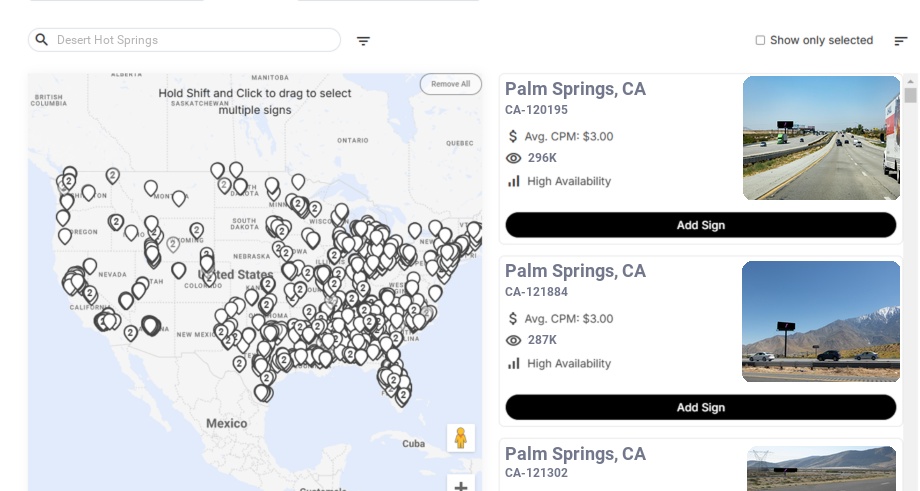
Our 4 digital billboards serving the Desert Hot Springs area are positioned in nearby Palm Springs, giving you exposure along primary routes used by Desert Hot Springs residents and visitors. Because our boards are near Palm Springs, they capture commuters from Desert Hot Springs heading south to jobs, shopping, and the Palm Springs International Airport. They also reach tourists driving between Palm Springs resorts and I-10, who may choose Desert Hot Springs for more affordable lodging, spa experiences, or cannabis tourism.
What kind of people see Desert Hot Springs, California billboards?
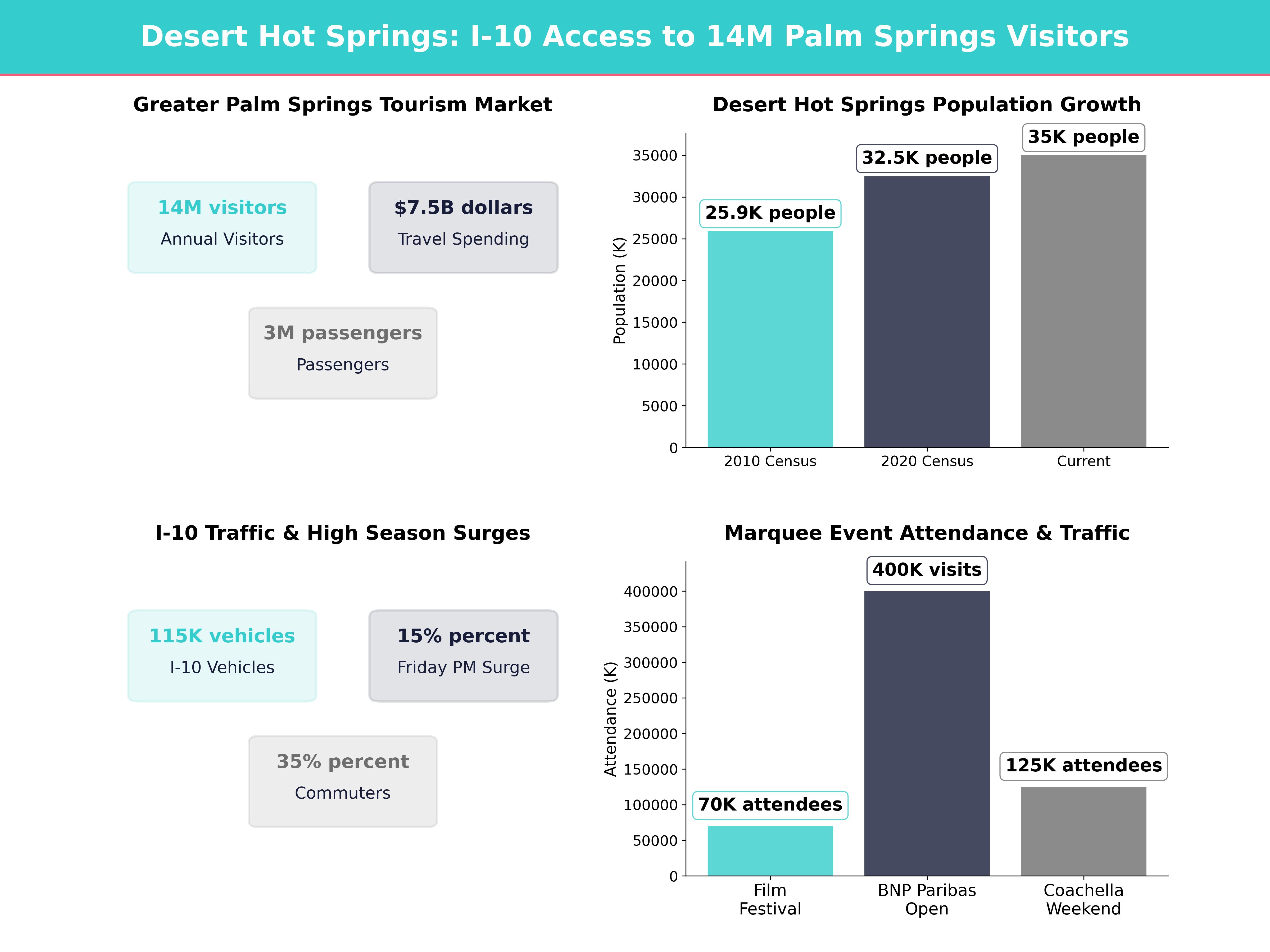
The Desert Hot Springs area combines a stable residential base with a powerful tourism and snowbird economy that makes Desert Hot Springs billboards a natural fit for both local and visitor-focused brands. Desert Hot Springs had 32,512 residents in the 2020 Census, up from 25,938 in 2010, and the broader Coachella Valley attracts more than 14 million visitors annually. This mix creates dual opportunities: daytime reach to older leisure visitors and commuters, and family-oriented messaging for school-age households.
When is the best time to run Blip billboards in Desert Hot Springs, California?
A strong strategy is to align your Blip scheduling with known traffic peaks. Morning rush runs from 6:30–9:00 a.m., afternoon and evening runs from 3:30–7:00 p.m., and weekend late mornings from 10:00 a.m.–1:00 p.m. High season from November to April brings more visitors, more part-time residents, and more outdoor events, so increasing bids during those periods can be especially effective.
Do I need a contract to advertise with Blip in Desert Hot Springs?
No, Blip has no long-term contracts or minimum commitments. You can start, pause, or stop your campaign at any time.
How fast can I launch a billboard campaign with Blip in Desert Hot Springs?
You can have your campaign live in minutes. Create a free account, select your locations, set your budget, upload your design, and start running once approved.
Where can I advertise with Blip in Desert Hot Springs?
Blip has digital billboards in Desert Hot Springs. You can browse available locations on a map, choose the ones that fit your audience, and start advertising right away.
Still have questions? Launch a campaign in minutes — no contracts, no commitments.
Start Your CampaignDesert Hot Springs Billboard Advertising Guide
Desert Hot Springs sits at the northern gateway to the Coachella Valley, where year‑round tourism, regional commuting, and strong local pride intersect. With digital billboards serving the Desert Hot Springs area from nearby Palm Springs Riverside County
Understanding the Desert Hot Springs Area Audience
The Desert Hot Springs area combines a stable residential base with a powerful tourism and “snowbird” economy that makes Desert Hot Springs billboards a natural fit for both local and visitor‑focused brands.
- Local population: Desert Hot Springs had 32,512 residents in the 2020 Census, up from 25,938 in 2010, a growth of more than 25%. Recent state estimates put the city in the low‑to‑mid 30,000s, reflecting continued infill and new housing permits highlighted by the City of Desert Hot Springs.
- Age profile: The broader Coachella Valley has a large retiree base, with some valley communities reporting median ages in the mid‑50s, while Desert Hot Springs itself trends younger, with a strong share of residents in the 25–54 working‑age range and a sizable population under 18. This mix creates dual opportunities: daytime reach to older leisure visitors and commuters, and family‑oriented messaging for school‑age households.
- Households & income: Household incomes in Desert Hot Springs tend to be lower than in neighboring resort cities such as Palm Springs and Rancho Mirage—median household income in Desert Hot Springs is tens of thousands of dollars below that of Palm Springs and substantially below affluent enclaves like Rancho Mirage. That gap makes value‑driven offerings, essential services, and everyday retail particularly compelling for locals, while still allowing you to reach higher‑spending visitors and commuters along the same corridors with billboard advertising near Desert Hot Springs.
- Housing & growth dynamics: The Coachella Valley as a whole has added tens of thousands of residents since 2010, with Desert Hot Springs one of the faster‑growing cities in Riverside County. Local planning reports and building activity shared by Riverside County City of Desert Hot Springs underscore ongoing single‑family and multifamily development, which in turn drives recurring demand for home services, furnishings, and neighborhood retail.
Layered on top of the resident base is one of California’s signature tourism engines:
- Coachella Valley visitors: The Greater Palm Springs region, which includes Palm Springs, Desert Hot Springs, and surrounding cities, attracts more than 14 million visitors annually, generating roughly $7–$8 billion in direct travel spending and supporting tens of thousands of local jobs, according to regional tourism sources such as Visit Greater Palm Springs.
- Lodging performance: In high season (roughly November–April), valley‑wide hotel occupancy frequently ranges from the mid‑60% to low‑80% levels on weekends, with average daily rates commonly exceeding $250–$300 at many Palm Springs resorts during peak holidays and major events. This pushes some value‑seeking visitors to look north toward Desert Hot Springs for more affordable spa hotels and short‑term rentals, creating extra value for billboard advertising near Desert Hot Springs that highlights deals and packages.
- Air travel: Palm Springs International Airport
-
Events & seasonal demand:
- January: The Palm Springs International Film Festival
- March: The BNP Paribas Open in Indian Wells
- April: Coachella and Stagecoach Festivals in Indio
- November–April: Peak “snowbird” season, when part‑time residents from colder states and Canada significantly swell local populations. Local tourism officials routinely report that winter visitation can be 20–30% higher than shoulder seasons, with some weekends effectively selling out regional lodging.
For advertisers, this means digital billboards serving the Desert Hot Springs area can reach:
- Year‑round residents commuting to jobs across the valley.
- Seasonal residents and retirees staying weeks or months at a time.
- Short‑stay leisure travelers and festivalgoers passing through the corridor between I‑10, Desert Hot Springs, and Palm Springs.
- Day‑trippers heading between the valley and outdoor destinations like Joshua Tree National Park via regional highways.
Understanding which of these segments you want to reach should drive your creative message and your campaign schedule. Data from tourism agencies, the Greater Coachella Valley Chamber of Commerce, and local news outlets such as the Desert Sun can help you benchmark visitor volumes, peak weeks, and spending levels for your category and fine‑tune your use of Desert Hot Springs billboards.
Key Corridors and Traffic Patterns Near Desert Hot Springs
Our 4 digital billboards serving the Desert Hot Springs area are positioned in nearby Palm Springs, giving you exposure along primary routes used by Desert Hot Springs residents and visitors. If you’re evaluating billboard rental near Desert Hot Springs, understanding these corridors will help you estimate your potential reach.
When you design campaigns, consider how people move through the area:
- Interstate 10 (I‑10): The major east–west artery connecting Los Angeles to the Coachella Valley. Many visitors exit I‑10 to head south to Palm Springs or north toward Desert Hot Springs. Traffic counts on I‑10 in this region typically exceed 100,000–130,000 vehicles per day, according to regional transportation data from agencies such as Caltrans District 8 and the Riverside County Transportation Commission.
- Palm Drive / Gene Autry Trail corridor: Palm Drive connects Desert Hot Springs directly to I‑10 and continues as Gene Autry Trail toward the Palm Springs airport and downtown. This is a primary commuter and service corridor for Desert Hot Springs residents, with daily volumes in the tens of thousands of vehicles and consistent rush‑hour congestion reported by local travelers and highlighted in outlets like KESQ News Channel 3.
- State Route 62 (Twentynine Palms Highway): Just north of the city, SR‑62 carries traffic to and from Joshua Tree and the Morongo Basin. Daily traffic near the SR‑62/I‑10 junction routinely reaches tens of thousands of vehicles, including a high share of weekend leisure travelers heading to Joshua Tree National Park and back through the Coachella Valley.
Because our boards are near Palm Springs, they capture:
- Commuters from Desert Hot Springs heading south to jobs, shopping, and the Palm Springs International Airport.
- Tourists driving between Palm Springs resorts and I‑10, who may choose Desert Hot Springs for more affordable lodging, spa experiences, or cannabis tourism.
- Regional traffic moving east–west along I‑10, especially during peak event weekends and holiday travel when agencies like the Coachella Valley Association of Governments and Visit Greater Palm Springs often warn of heavy congestion.
These patterns make billboard advertising near Desert Hot Springs especially effective for brands that depend on drive‑time decisions, such as attractions, quick‑serve dining, and lodging.
A strong strategy is to align your Blip scheduling with known traffic peaks:
- Morning rush: 6:30–9:00 a.m. (northbound and southbound commuter flows). Commuter share can easily account for 30–40% of weekday traffic volumes on key arterials.
- Afternoon/evening: 3:30–7:00 p.m. for workers heading home and visitors driving to dinner or entertainment. On Fridays in high season, p.m. peak volumes on I‑10 and key arterials can run 10–20% above typical weekday levels.
- Weekend late mornings: 10:00 a.m.–1:00 p.m., when tourists head out for spa appointments, brunch, or outdoor activities, and families run errands. Local tourism data indicate that late morning and early afternoon are prime travel windows for leisure visitors, especially Saturday and Sunday.
Using Blip, we can selectively bid for impressions during these high‑value windows instead of spreading budget thin across low‑impact hours. Combining Blip impression logs with traffic count information published by agencies like Caltrans District 8 or the Riverside County Transportation Commission can help you approximate potential daily reach and frequency for billboards near Desert Hot Springs.
Seasonal Strategy: Heat, Snowbirds, and Festival Crowds
Local climate and seasonality should shape your creative and your schedule.
-
Extreme heat: Summer temperatures often exceed 105°F, and triple‑digit days can stretch from June through September. In the hottest months, the Palm Springs airport weather station typically records 60–80 days per year over 100°F and a number of days reaching 110°F+. Heat affects travel behavior:
- Midday outdoor activity declines; early mornings and evenings become more important as drivers shift errands and recreation into cooler hours.
- Messaging that references “cool,” “refreshing,” or “indoor comfort” resonates strongly in the hottest months and is a recurring theme in local coverage from outlets like KESQ and the Desert Sun.
-
High season (November–April):
- More visitors, more part‑time residents, and more outdoor events. Tourism officials in the Greater Palm Springs area report that winter visitor volumes can be 20–40% higher than summer on a monthly basis.
- Hotel occupancy and short‑term rental stays spike across the valley, boosting drive‑time and leisure traffic. During marquee weekends, some resorts near Palm Springs report near‑sellout conditions, with occupancy climbing into the 80–90% range.
-
Event surges:
- Coachella & Stagecoach: Even though they’re held in Indio, festival attendees commonly fly into Palm Springs International Airport and travel along the I‑10 and Palm Springs corridors. Combined, the April festivals inject hundreds of millions of dollars in local spending and create multi‑hour traffic backups that your billboards can capitalize on.
- BNP Paribas Open & golf tournaments: These events attract affluent visitors; the BNP Paribas Open alone has reported economic impacts approaching or exceeding $400 million regionally in recent years. Many attendees seek spa, wellness, and dining experiences across the valley, including quieter alternatives like Desert Hot Springs.
- Local news outlets like the Desert Sun regularly highlight how these events increase regional traffic and spending, with reports of daily event attendance surges adding tens of thousands of extra vehicles to valley roads.
How to adapt your billboard strategy:
-
Summer (value & necessity focus):
- Target locals and budget‑conscious travelers with offers on essentials: AC services, auto repair, groceries, indoor entertainment, and quick‑serve dining—categories that often see steady or even increased demand during heat waves.
- Run heavier schedules early morning and evening; reduce mid‑day spend if your budget is tight, mirroring the shift in local travel patterns documented in public safety updates and traffic advisories.
-
High season (experience focus):
- Emphasize destination‑style messaging for spas, boutique hotels, restaurants, tours, and cannabis lounges. Visitor spending per trip in Greater Palm Springs often averages hundreds of dollars per day, making experience‑driven offers particularly lucrative.
- Increase bids during Thursday–Sunday, when leisure traffic spikes. High‑season weekend hotel and short‑term rental occupancies commonly run 10–20 percentage points higher than midweek.
- Align campaign bursts with marquee events—launch a 2–3 week flight around big festivals or sports events, using event calendars from Visit Greater Palm Springs and the City of Desert Hot Springs to time your pushes.
A thoughtful seasonal approach helps ensure your Desert Hot Springs billboards are always aligned with what people are actually doing and feeling on the road.
Reaching Specific Verticals in the Desert Hot Springs Area
Different industries can leverage unique local dynamics. Some examples:
Spas, Hotels, and Wellness Brands
Desert Hot Springs is famous for its natural hot mineral water spas, which the city promotes through its official tourism information. The valley is home to dozens of boutique spa and wellness properties, and wellness‑motivated travelers are often willing to spend 20–30% more per trip on treatments, classes, and specialized amenities compared with general leisure visitors, according to regional tourism and wellness‑industry surveys.
Wellness‑oriented visitors often compare stays in Palm Springs vs. Desert Hot Springs based on price and atmosphere. With hotel and resort rates in central Palm Springs frequently topping $300–$400 per night during peak weekends, Desert Hot Springs properties that market nightly rates under that threshold can appeal strongly to value‑seeking guests.
Billboard tips:
- Use phrases that differentiate: “Natural mineral hot springs,” “Mountain‑view pools,” or “Quiet, uncrowded escapes.” These respond directly to the top decision factors reported by spa visitors—ambiance, scenery, and access to natural features. Desert Hot Springs billboards that highlight these features can stand out from more generic Coachella Valley messaging.
- Highlight quick travel times: “Just 10 minutes north of Palm Springs.” Actual drive times from downtown Palm Springs to much of Desert Hot Springs commonly range from 10–20 minutes, depending on traffic.
- Promote last‑minute decisions: spa day passes, weekday discounts, or couples packages to catch visitors already in the valley—day‑of and next‑day bookings can make up a significant share of spa revenue during busy periods.
- Consider referencing local accolades: If your property has been featured in the Desert Sun, on KESQ, or in regional lifestyle outlets, echo that on your creative with concise phrases like “Locals’ favorite since 20XX.”
Cannabis Dispensaries and Related Services
Desert Hot Springs was an early adopter of commercial cannabis cultivation and retail in the region, and continues to attract “cannabis tourism.” The city has approved a notable number of cultivation and retail facilities compared with neighboring jurisdictions, which has helped position it as a production and shopping hub within the valley.
- Focus on simple, compliant messaging: brand name, “licensed dispensary,” location, and value proposition (e.g., “daily deals,” “rewards program”). Local regulations and state advertising guidelines emphasize clear, non‑misleading information—billboards give you large‑format visibility without needing long copy.
- Drive “destination” behavior: “Make us your first stop after landing at PSP” or “On your way back to L.A.? Stop for …” With millions of vehicle trips annually along I‑10 and major arterials, even capturing a small fraction of through‑traffic can translate into meaningful visit volumes.
- Daypart around arrival and departure peaks at Palm Springs International Airport
- Use geo‑contextual cues: Phrases like “Minutes from I‑10 & Palm Drive” or “North of Palm Springs off Palm Drive” help visitors unfamiliar with the area quickly map your location while driving and recognize they are seeing billboards near Desert Hot Springs rather than generic highway ads.
Home Services, Auto, and Local Retail
With more than 32,000 residents and ongoing housing development, Desert Hot Springs is an attractive market for recurring‑need services. Across the Coachella Valley, owner‑occupied housing and new subdivisions continue to expand, boosting long‑term demand for HVAC, landscaping, pool care, roofing, and remodeling.
- Position your business as “local’s choice” for Desert Hot Springs area residents. Hyper‑local framing is especially effective in communities where a significant share of workers commute but still prefer to spend service dollars close to home.
- Use billboards to reinforce search and social campaigns: “Search: [Brand] Desert Hot Springs.” Studies of local search behavior show that a large majority of consumers—often 70% or more—will look up a business online before visiting; billboards can plant the exact search terms you want them to use.
-
Time campaigns around:
- Extreme weather prep: AC tune‑ups before summer, roofing and insulation promotions in late fall. In hot desert climates, cooling can account for a large portion of home energy use during summer months, making pre‑season service offers highly appealing.
- Tax refund season (Feb–April): Encourage big‑ticket purchases (appliances, vehicles, home upgrades). National and regional retail studies frequently show March and April as strong months for auto, home improvement, and electronics purchases as refunds arrive.
- Back‑to‑school and holiday periods: Local families often consolidate large shopping trips around late summer and November–December; front‑loading visibility during these windows can increase store visits and calls.
For these verticals, flexible billboard rental near Desert Hot Springs through Blip makes it easier to match spending to your busiest seasons and service windows.
Crafting Artwork That Works in the Desert Hot Springs Area
Digital billboards near Palm Springs serving the Desert Hot Springs area are viewed primarily by drivers traveling at 35–70 mph. Effective designs must communicate in 3–5 seconds, which corresponds to the typical view time for drivers passing a standard‑sized digital face at highway speeds, according to industry best practices.
Key principles:
- Font & size: Use large, bold sans‑serif fonts. Limit text to 7 words or fewer whenever possible. Research from outdoor advertising associations consistently shows that shorter copy improves recall and comprehension, especially at freeway speeds.
- Color & contrast: The valley’s sun is intense, with more than 260–300 sunny days per year in the Palm Springs/Desert Hot Springs area. Use high‑contrast combinations (e.g., dark text on bright background or vice versa) so copy remains legible even in midday glare. Avoid thin light fonts or low‑contrast color pairings, which can wash out under desert light.
- Single focus: One main idea per creative—“Exit here,” “Tonight only,” “From $99,” etc. Avoid cramming multiple offers. Campaigns that focus on one clear call to action tend to generate higher response rates in brand lift and traffic studies.
-
Local cues:
- Visuals of surrounding mountains, palm trees, or mineral pools reinforce place‑based identity and resonate strongly with both locals and visitors looking for “authentically desert” experiences, as highlighted on sites like Visit Greater Palm Springs and Visit Palm Springs.
- Phrases like “near Desert Hot Springs,” “minutes from Desert Hot Springs,” or “serving the Desert Hot Springs area” strengthen relevance while staying geographically accurate.
- Heat‑aware visuals: In summer, imagery of shaded patios, cool interiors, cold beverages, or water features subconsciously appeals to overheated drivers. During cooler months, you can pivot to cozy, nighttime, or festive imagery aligned with local events and holidays.
With Blip, you can upload multiple creative versions and run A/B tests:
- Rotate two or three versions with different headlines, price points, or imagery. Even small changes—such as shifting from a generic headline to one naming “Desert Hot Springs” directly—can move recall and response.
- After 2–4 weeks, compare which version drives more web traffic, calls, or store visits (based on your own analytics and sales data). Look at metrics such as direct type‑in traffic, branded search volume, or coupon redemptions.
- Shift impression share toward the best‑performing designs and consider refreshing artwork every 8–12 weeks to avoid creative fatigue for daily commuters who regularly see billboards near Desert Hot Springs.
Smart Scheduling and Budgeting With Blip
Because Blip lets you set bids per “blip” (a single ad display) and control your schedule by hour and day, we can tailor campaigns around the unique rhythms of the Desert Hot Springs area.
Consider these strategies:
-
Commuter focus for local services:
- Run heavier 6:30–9:00 a.m. and 3:30–7:00 p.m. on weekdays, mirroring peak volumes measured on key corridors by agencies like Caltrans District 8.
- Target your headline to commuters: “Need AC fixed after work?” or “Family dinner tonight? Exit for [Restaurant].” Commuter‑focused offers with clear time references (“tonight,” “before work,” “this weekend”) often see higher immediate response.
-
Weekend spikes for hospitality & attractions:
- Allocate 60–70% of your budget to Friday–Sunday during high season if you’re in hospitality, entertainment, or attractions. Local hotel and short‑term rental performance data show weekends as the highest‑yield days for room rates and ancillary spending.
- Add late‑evening impressions (8:00–11:00 p.m.) for nightlife or late‑dining offers. In Palm Springs and nearby areas, restaurant and bar districts remain active into late evening, especially Thursday–Saturday.
-
Event‑based bursts:
- During Coachella/Stagecoach weeks, increase bids so your ads win more slots when event traffic is highest—often Thursday afternoon through Monday midday for each festival weekend.
- For local festivals or city events highlighted on the City of Desert Hot Springs events calendar or promoted by the Greater Coachella Valley Chamber of Commerce, run short, intense campaigns leading into and during the event. Even a 7–10 day burst can deliver strong awareness if concentrated around peak travel times.
Because our digital billboards are near Palm Springs, costs to reach people in the Desert Hot Springs area can be more efficient than major metro markets closer to Los Angeles, where CPMs (cost per thousand impressions) are often significantly higher. You can start small—sometimes with daily minimums in the tens of dollars—analyze results, and then scale your budget as you see traction. This makes billboard rental near Desert Hot Springs accessible for both small local businesses and larger regional brands.
Integrating Billboards With Your Other Marketing
Digital billboards serving the Desert Hot Springs area work best when they reinforce what people see online, in print, or on local TV and radio.
Tactics to consider:
- Branded search alignment: If your board says “Spa Day Pass – [Brand Name],” make sure a search for “[Brand Name] Desert Hot Springs” leads to a clear landing page with the same messaging. Studies of consumer behavior often show that 80–90% of buyers research online before visiting physical locations, so continuity between billboard and web content is critical.
- Offer codes & trackable URLs: Use short URLs or easy promo codes such as “DHS20” so you can attribute redemptions to your billboard campaign. Track number of uses, average order value, and new vs. returning customers tied to each code.
- Local news synergy: If your business appears in coverage from outlets like the Desert Sun or KESQ News Channel 3, run billboard creative that echoes the headline or award: “As seen on KESQ” or “Voted Best Spa by Desert Sun readers.” Local media endorsements can significantly lift trust and click‑through rates when mirrored in outdoor creative.
- Social media echoes: Share photos or mock‑ups of your billboard on Instagram, Facebook, and TikTok, targeting hashtags such as #DesertHotSprings, #PalmSprings, or #CoachellaValley to amplify awareness among locals and visitors. Regional tourism handles like Visit Greater Palm Springs and Visit Palm Springs often feature or reshare compelling local content, providing another potential exposure channel.
- Partnerships and co‑op campaigns: Coordinate with neighboring businesses—such as a hotel and nearby restaurant or spa—to share billboard costs and feature joint offers. Multi‑partner deals can increase perceived value (e.g., “Stay, Soak & Dine” packages) while effectively splitting media spend.
By tying your Desert Hot Springs billboards into these broader efforts, you turn them into a powerful anchor for your overall marketing mix.
Measuring Success in the Desert Hot Springs Area
Even though billboards are an offline medium, we can still analyze performance in a data‑driven way:
-
Traffic & timing correlations:
- Compare your store traffic or website visits during periods when your Blip campaign is on vs. off. Look for percentage‑change patterns (e.g., a 10–25% lift in foot traffic during flight weeks).
- Look for surges around commute hours or weekends that match your scheduled blips. Many advertisers see noticeable bumps in call volume or walk‑ins immediately after starting or intensifying campaigns.
-
Geo‑based analytics:
- Track whether web sessions and calls from ZIP codes tied to Desert Hot Springs and Palm Springs grow after campaign launch. Even a 5–10% increase in visits from these areas can indicate strong billboard contribution.
- If you see increased map searches or navigation requests from mapping apps, that’s a strong signal of billboard impact, especially for businesses positioned along primary corridors used by Desert Hot Springs residents.
-
Offer‑based tracking:
- Use unique promo codes tied to specific flights (e.g., DHSJAN, DHSSPRING). Evaluate redemption rates (e.g., redemptions as a percentage of total transactions) by creative, time of day, and day of week.
- Assess redemption patterns and adjust creative or scheduling accordingly—if evening codes outperform morning codes by 2–3x, shift more impressions to later dayparts.
-
Brand lift indicators:
- Monitor branded search volume for your name plus “Desert Hot Springs” in tools like Google Ads or your analytics platform. A sustained upward trend during and after campaigns can signal improved awareness.
- Ask “How did you hear about us?” at the point of sale or in online forms and track how often customers mention “billboard,” “sign near Palm Springs,” or “on the freeway.”
Over time, advertisers near Desert Hot Springs often find that digital billboards become a “baseline presence” channel: always on at a modest level, then ramped up during prime seasons, events, or product launches. Blip’s reporting, combined with your own POS and analytics data, allows you to calibrate spend to the periods and messages that deliver the strongest return from billboard advertising near Desert Hot Springs.
Putting It All Together
The Desert Hot Springs area offers a blend of growing residential neighborhoods, destination wellness tourism, cannabis‑related travel, and major event spillover from the broader Coachella Valley. With 4 digital billboards serving the Desert Hot Springs area from strategic locations near Palm Springs, we can help you:
- Reach commuters and locals on their daily routes along corridors like I‑10, Palm Drive, and Gene Autry Trail.
- Capture high‑spending visitors during peak travel and event seasons, when the Greater Palm Springs region hosts millions of visitor‑days and generates billions of dollars in spending each year.
- Tailor creative and scheduling around extreme heat, seasonal patterns, and major festivals, aligning your flights with the real‑world rhythms documented by local tourism, transportation, and news sources.
- Test and refine your message quickly and affordably, using Blip’s flexible bidding and scheduling tools to focus on the highest‑value hours and days.
By combining hyper‑local insights, flexible Blip scheduling, and strong creative, advertisers can build billboard campaigns near Desert Hot Springs that not only get noticed, but also drive measurable results for their businesses in one of Southern California’s most dynamic desert markets. Whether you’re new to billboard rental near Desert Hot Springs or scaling an existing presence, these strategies provide a roadmap for making every impression count.