Billboards near Country Club, CA
No Minimum Spend. No Long-Term Contracts. Just Results.
Trusted by Leading Brands


Billboard advertising
near Country Club has never been easier
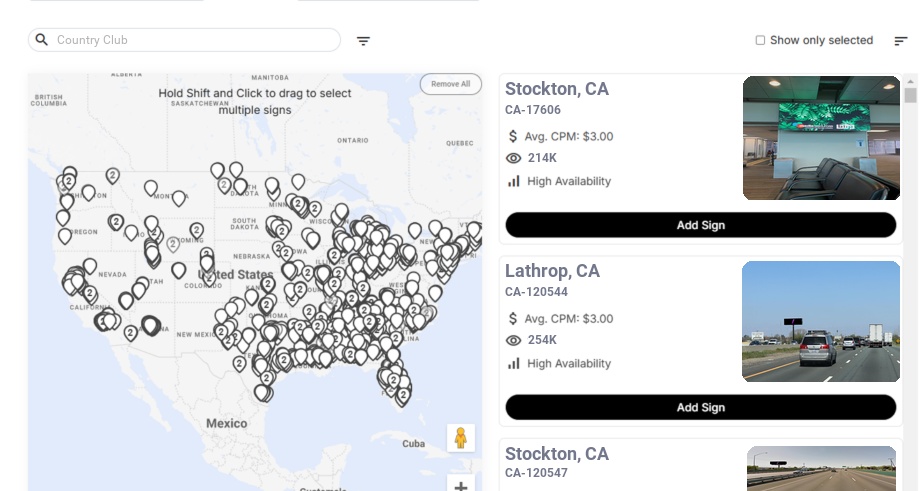



How much is a billboard near Country Club?
Why Choose Blip for Billboard Advertising near Country Club
Blip lets you launch Country Club billboards fast and self-serve, reaching I-5 and CA-4 commuters without waiting on traditional buys.
Set flexible budgets on Blip for Country Club and target peak 7-9 a.m. and 3-6 p.m. traffic on the Crosstown Freeway.
No contracts means you can test Country Club against Stockton, Morada, and Lathrop routes, then scale what works.
Use Blip's real-time analytics to track Country Club campaigns as logistics, retail, and family traffic shifts near the Port of Stockton and CA-99.
Blip creative tools make it easy to swap bold, bilingual ads for Country Club shoppers and Delta College students on weekday and weekend runs.
Frequently Asked Questions About Billboard Advertising near Country Club
How much does a billboard cost near Country Club, California with Blip?
With Blip, you can run eye-catching digital ads on Country Club billboards on any budget, because you choose your own daily spend and only pay for each 7.5–10 second “blip” your ad receives. Costs vary based on when and where your ad runs and on advertiser demand, but Blip automatically keeps your campaign within the daily limit you set, and you can adjust that budget anytime to match your goals. Blip makes the answer flexible and accessible, giving you complete control over your spend while your message appears on billboards near Country Club, California.
Where can I advertise near Country Club, California with Blip?
There are 11 nearby digital billboards in Stockton, Morada, and Lathrop—each within about 10 miles—so you can tap into a dense mix of commuters, families, shoppers, and logistics workers moving through the Country Club area every day. Boards near Stockton help you reach dense local traffic, Morada can reach north-Stockton and suburban audiences, and Lathrop can capture commuter and logistics traffic. This network gives you flexible coverage without sacrificing local relevance.
Who do Country Club, California billboards reach?
The broader Stockton–Country Club market is diverse, family-oriented, and solidly working- and middle-class. Median age in the Country Club area sits in the mid-30s, and many households include children under 18, while local language diversity means Spanish and Tagalog can be especially effective. San Joaquin County is also a logistics and transportation hub, so recruitment campaigns can perform very effectively on commute-heavy routes near the Country Club area.
When is the best time to run Blip ads near Country Club, California?
Weekday commute peaks are especially important, with morning traffic from 6:30–9:00 a.m. and evening traffic from 3:30–7:00 p.m. Those windows correspond with the highest congestion levels on I‑5, CA‑99, and CA‑4, when traffic volumes can reach 2–3 times off-peak levels. Friday evenings and Saturdays also see significant traffic toward shopping areas, grocery stores, and entertainment venues.
What kind of creative works best on billboards near Country Club, California?
Digital billboards near the Country Club area benefit from fast-moving freeway traffic and relatively short viewing windows, so clarity and contrast are non-negotiable. The page recommends big, bold, simple headlines, high-contrast colors, and price or value callouts because the area is price sensitive. It also suggests using local cues like “Delta,” “Stockton area,” or “San Joaquin” to create an instant sense of relevance.
Do I need a contract to advertise with Blip near Country Club?
No, Blip has no long-term contracts or minimum commitments. You can start, pause, or stop your campaign at any time.
How fast can I launch a billboard campaign with Blip near Country Club?
You can have your campaign live in minutes. Create a free account, select your locations, set your budget, upload your design, and start running once approved.
Where can I advertise with Blip near Country Club?
Blip has digital billboards near Country Club. You can browse available locations on a map, choose the ones that fit your audience, and start advertising right away.
Still have questions? Launch a campaign in minutes — no contracts, no commitments.
Start Your CampaignCountry Club Billboard Advertising Guide
The Country Club, California area sits at the heart of San Joaquin County’s daily traffic flow, wedged between Interstate 5, the Calaveras River, and the west side of Stockton. With 11 nearby digital billboards in Stockton, Morada, and Lathrop—each within about 10 miles—we can help you tap into a dense mix of commuters, families, shoppers, and logistics workers moving through the Country Club area every day. For brands looking specifically for billboards near Country Club that still capture regional traffic, this cluster of locations offers flexible coverage without sacrificing local relevance.
Understanding the Country Club Market
Country Club is a compact, heavily traveled residential and commercial pocket just west of downtown Stockton. It’s technically an unincorporated community, but functionally it operates as a busy west-Stockton corridor under San Joaquin County’s jurisdiction through agencies like San Joaquin County and San Joaquin County Public Works. This makes Country Club billboards especially useful for reaching both Stockton residents and countywide commuters.
Key market facts (latest available public data and local estimates):
- Population of the Country Club CDP: approximately 9,300–9,500 people, packed into roughly 2.1 square miles, giving the area a density of over 4,400 residents per square mile.
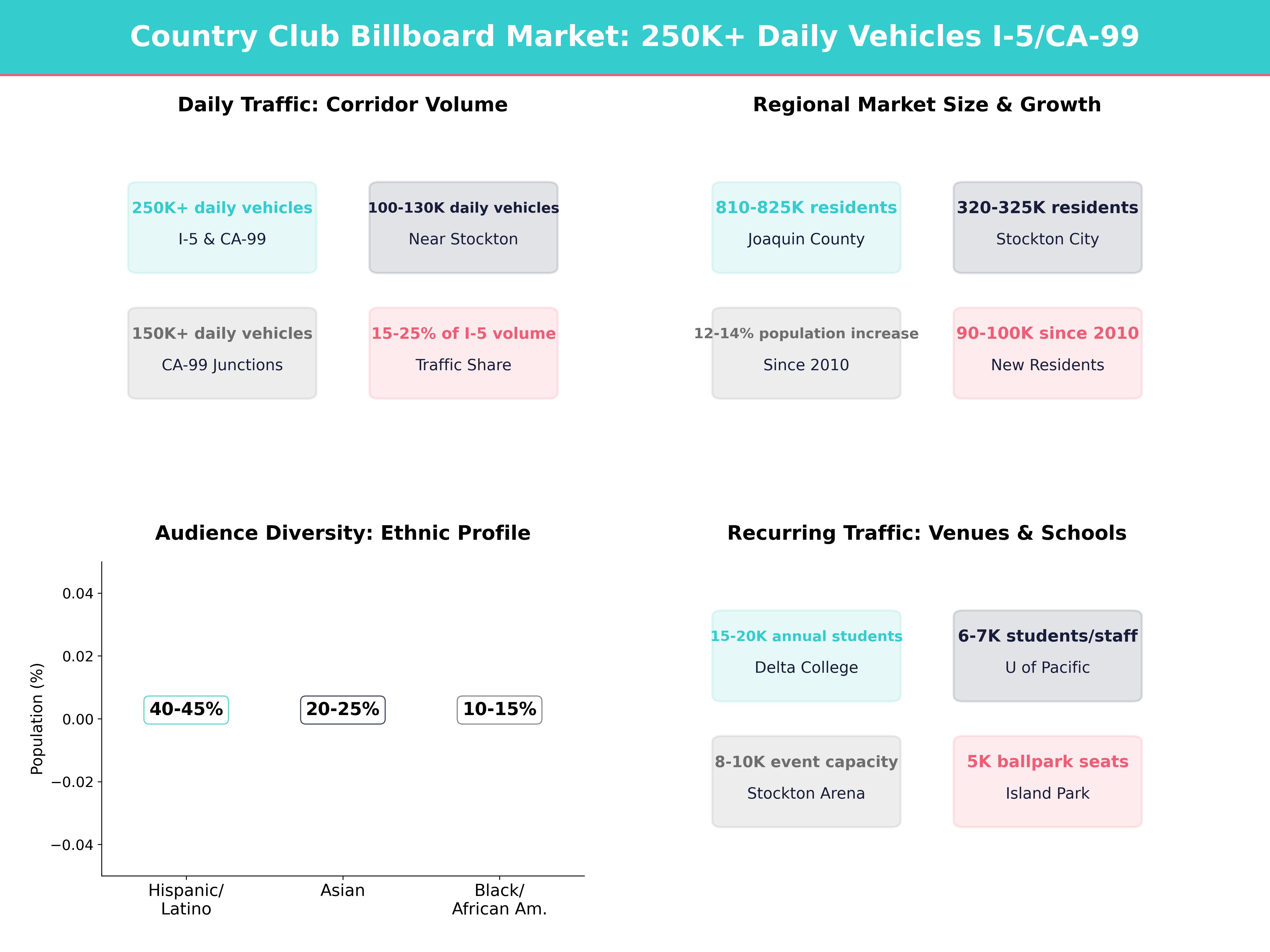
- The nearby City of Stockton, administered by the City of Stockton, has a population of about 320,000–325,000 residents, making it one of the 15 largest cities in California.
- San Joaquin County totals about 810,000–825,000 residents, with county reports showing an increase of roughly 90,000–100,000 people since 2010—growth of around 12–14%.
- Median household income in the Country Club area is roughly $50,000–$55,000, about 10–15% lower than the Stockton citywide median (around $60,000–$65,000), which itself trails the California median. This makes value-focused and budget-conscious messaging particularly effective.
- Local home values in west Stockton and the Country Club area generally run 25–35% lower than statewide medians, and rents are often $300–600 per month cheaper than major Bay Area suburbs—supporting a strong commuter and first-time homebuyer base.
- According to regional planning and economic development agencies such as the San Joaquin Council of Governments Greater Stockton Chamber of Commerce, the Stockton–San Joaquin region continues to attract residents priced out of the Bay Area, contributing to sustained housing, retail, and commuter growth.
Nearby billboards in Stockton, Morada, and Lathrop allow you to capture:
- West–east traffic between I‑5 and downtown Stockton via corridors like March Lane and the Crosstown Freeway (CA‑4), each carrying tens of thousands of vehicles daily.
- North–south flows along I‑5 and CA‑99 between Sacramento and the Central Valley, where combined daily flows through the Stockton area can exceed 250,000 vehicles.
- Regional traffic tied to distribution centers, agriculture, the Port of Stockton, and nearby suburbs like Lathrop Manteca Tracy
Because many residents and workers travel through multiple nearby cities in a single day—living in Stockton, working in Lathrop or Tracy, and shopping along I‑5 and CA‑99—a well-planned Blip campaign can surround people who live, shop, and work in and around the Country Club area. If you’re exploring billboard advertising near Country Club, leveraging this broader commuter web is key to turning local impressions into real results.
Where Traffic Flows Near Country Club (and Why It Matters)
The Country Club area sits directly against some of the most important roadways in San Joaquin County. Our digital billboards near Stockton, Morada, and Lathrop help you intercept high-intent drivers at key choke points identified by Caltrans District 10 and San Joaquin County Public Works. This is the same traffic that billboards near Country Club are designed to capture every day.
Important traffic corridors:
-
Interstate 5 (I‑5)
- One of the West Coast’s main north–south arteries; Caltrans traffic counts show sections of I‑5 near Stockton often see 100,000–130,000 vehicles per day, with truck traffic frequently accounting for 15–25% of that volume.
- Connects Country Club area residents to Sacramento (about 50 miles north), the Bay Area (via I‑205/I‑580, about 60–70 miles west to key employment centers), and the rest of the Central Valley.
- Strong for regional branding and higher-ticket purchases (autos, home services, financial services) because average trip lengths and dwell times on I‑5 are longer and drivers are often in “planning mode” for big purchases.
-
State Route 4 / Crosstown Freeway (CA‑4)
- Connects west Stockton and the Country Club area to I‑5 and CA‑99, forming a major east–west commuter spine.
- Caltrans data indicate key segments of CA‑4 in Stockton typically carry 70,000–90,000 vehicles per day, with sharp peaks during the 7–9 a.m. and 3–6 p.m. commute windows.
- Heavy commuter volumes heading to and from downtown Stockton, the Port of Stockton, industrial zones, and government facilities like the San Joaquin County Administration Building
- Ideal for everyday services: quick-serve restaurants, healthcare, retail, and local events that benefit from repeated daily exposures.
-
CA‑99 & I‑205/CA‑120 junctions (near Lathrop & Manteca)
- These junctions serve as funnels for commuters traveling between the Stockton–Lathrop area and Tracy, the Tri-Valley, and the broader Bay Area.
- Daily traffic volumes at some of these junctions regularly exceed 150,000 vehicles per day, with a particularly high concentration of long-distance commuters and freight movement.
- The nearby City of Lathrop 30,000–32,000, up more than 40% since 2010), driven by logistics and e‑commerce warehousing, which adds steady commercial and worker traffic.
Because our 11 digital billboards are spread across Stockton, Morada, and Lathrop, you can:
- Use boards near Stockton for dense local reach into the Country Club area, tapping into tens of thousands of residents and workers who cross major arterials like March Lane, Hammer Lane, and Pershing Avenue multiple times per week. This cluster effectively functions as a network of Country Club billboards for both neighborhood and through traffic.
- Use Morada boards for north-Stockton and upscale suburban audiences, including households with median incomes that often run 15–25% higher than the Stockton citywide median.
- Use Lathrop boards to tap into commuter and logistics traffic tied to warehouses and e‑commerce fulfillment centers, where large employers draw in thousands of workers daily from across San Joaquin and neighboring counties.
Who You’ll Reach in the Country Club Area
The broader Stockton–Country Club market is diverse, family-oriented, and solidly working- and middle-class. That mix strongly shapes which messages perform best and aligns with demographic trends documented by local agencies such as the City of Stockton, San Joaquin County, and regional school districts. Understanding this audience helps you design billboard advertising near Country Club that feels tailored, not generic.
High-level audience characteristics:
-
Age
- Median age in the Country Club area sits in the mid‑30s, similar to Stockton overall.
-
Roughly 25–30% of Stockton residents are under age 18, and about 25–30% fall between 25–44, creating:
- Strong opportunity for family services, childcare, education, youth sports, and youth activities.
- Significant audience for young adult services such as entry-level careers, trade schools, banking, and first-time homebuyer services.
- Local colleges—San Joaquin Delta College and University of the Pacific—add thousands of 18–24-year-olds to the daily traffic mix.
-
Household & family structure
- Average household sizes around 3.0–3.2 people are common in the Country Club and broader Stockton area, noticeably above the national average near 2.5–2.6.
- In many west Stockton and Country Club neighborhoods, 40–50% of households include children under 18, and multi-generational living is common.
- These households respond well to “family value”, “bundle”, “group discount”, and “kids included” messaging—particularly for grocery, wireless, insurance, medical, and dining offers.
-
Ethnic and cultural diversity
- Stockton is regularly cited by regional organizations like Visit Stockton and the City of Stockton as one of the most diverse cities in the nation.
-
Local estimates suggest:
- Roughly 40–45% of residents identify as Hispanic/Latino.
- Around 20–25% identify as Asian, with particularly strong Filipino and Southeast Asian communities.
- Approximately 10–15% identify as Black or African American.
- Significant Pacific Islander and multiracial populations add to the cultural mix.
- In many Country Club and west Stockton neighborhoods, households where a language other than English is spoken at home can exceed 50%, with Spanish and Tagalog among the most common.
-
Multilingual or culturally resonant messaging (especially in Spanish and Tagalog, but also bilingual English/Spanish) can significantly increase response, particularly for:
- Healthcare and insurance.
- Food and grocery.
- Community events and faith-based outreach.
- Adult education and workforce-training programs.
-
Income & price sensitivity
- Local median incomes in the Country Club area trend 10–20% below California’s statewide median.
- A notable share of households in Stockton and west Stockton earn less than $50,000 per year, and housing cost burdens (share of income spent on rent or mortgage) can easily reach 30–40%.
- Offers with clear value propositions, discounts, payment plans, “no credit needed,” and “$0 down” language tend to significantly outperform generic branding in similar markets.
-
Workers & industries
-
San Joaquin County is a logistics and transportation hub for Central and Northern California. Local economic reports point to:
- Tens of thousands of jobs in warehousing, trucking, and distribution centered along I‑5, CA‑99, and near the Port of Stockton.
- Strong employment in agriculture and food processing, especially in surrounding rural communities.
- Significant health-care employment anchored by hospitals such as St. Joseph’s Medical Center
- Education-sector jobs at San Joaquin Delta College, University of the Pacific, and school districts such as Stockton Unified School District and Lincoln Unified School District.
- Blue-collar, healthcare, and service-sector recruitment campaigns can perform very effectively on commute-heavy routes near the Country Club area, especially when wage rates, signing bonuses, and benefits are clearly displayed.
-
San Joaquin County is a logistics and transportation hub for Central and Northern California. Local economic reports point to:
When crafting creative, think “bilingual-friendly, family-centered, value-focused,” tailored for a high-share working-class commuter audience that spends 20–35 minutes per day in the car, often on the same corridors that your billboards near Country Club will be targeting.
Local Lifestyles, Destinations, and Events to Leverage
Daily life in the Country Club area revolves around a mix of residential neighborhoods, neighborhood retail, and quick connections to Stockton’s larger commercial and entertainment zones. Data from local tourism and transportation agencies confirm that shopping, education, and entertainment create strong, recurring traffic patterns.
Key destinations that influence traffic patterns and campaign timing:
-
Shopping & errands
- Major shopping corridors in west and north Stockton—including March Lane, Pacific Avenue, and Hammer Lane—host big-box stores, grocery chains, and regional centers that attract thousands of trips per day from Country Club area residents.
- Retail hubs such as the Pacific Avenue/ Weberstown Mall Friday evenings and weekend afternoons, aligning with stronger discretionary spending.
- Many residents make evening and weekend shopping runs, especially Friday after 3 p.m. and Saturdays midday, making these periods ideal for retail and grocery promotions.
-
Education hubs
- San Joaquin Delta College enrolls roughly 15,000–20,000 students annually, plus faculty and staff, feeding traffic onto nearby I‑5 access points and adjacent arterials.
- University of the Pacific serves around 6,000–7,000 students, faculty, and staff, with additional visitors drawn for athletics, arts, and community programs.
- Combined, these institutions add tens of thousands of weekly trips through nearby corridors, especially during the academic year (late August–May).
- Education- and youth-focused campaigns (tutoring, financial aid help, student housing, nightlife, quick-serve dining) can benefit from targeted weekday and early-evening rotations.
-
Sports and entertainment
- Stockton Arena Stockton Kings 8,000–10,000 attendees.
- Banner Island Ballpark Stockton Ports, seats over 5,000 fans, with seasonal schedules that create regular evening and weekend surges in nearby traffic.
- Local school sports, community events, and youth leagues at fields and gyms across Stockton further amplify evening and Saturday traffic patterns.
- Event-driven campaigns—restaurants, parking, rideshare, late-night retail—should weight impressions 2–4 hours before events, especially Thursdays–Saturdays and during minor-league baseball and basketball seasons.
-
Tourism and recreation
- The nearby Delta waterways and marinas attract boaters and outdoor enthusiasts, especially on warm weekends from late spring through early fall.
- Visit Stockton reports that visitor spending in the Stockton area reaches hundreds of millions of dollars annually, supporting lodging, dining, entertainment, and fuel purchases.
- Popular regional events—festivals, car shows, cultural celebrations—often draw 5,000–20,000 visitors over a weekend, many of whom pass through I‑5, CA‑4, and key arterials near the Country Club area.
- Hospitality and tourism businesses can emphasize weekend and holiday Blip schedules near primary highway routes, especially around three-day weekends and summer travel peaks.
Aligning your Blip schedule with these rhythms helps ensure your message hits people on the way to shop, work, and play in the Country Club area, increasing the odds of repeated exposure to the same households across multiple trip purposes. This is especially important if you’re using billboard rental near Country Club to promote limited-time offers or seasonal events.
Creative Strategies That Work Near Country Club
Digital billboards near the Country Club area benefit from fast-moving freeway traffic and relatively short viewing windows. Speed limits on I‑5 and CA‑99 commonly sit around 65–70 mph, and even on busy surface streets, average travel speeds often hover near 30–40 mph. That makes clarity and contrast non-negotiable for any billboard advertising near Country Club.
We typically recommend:
-
Big, bold, simple headlines
- Aim for 6–10 words max so drivers can process your message in about 3–5 seconds.
-
Example for a local HVAC company:
- “AC OUT? SAME-DAY REPAIR IN STOCKTON AREA”
- Keep one key message per creative; use multiple Blip creatives to rotate different offers instead of cramming details into one.
-
High-contrast color choices
- Dark background + bright text (or vice versa) is crucial for legibility in full sun.
- Country Club and Stockton see roughly 260–270 sunny days per year, according to regional climate summaries shared by local agencies and utilities, so treat glare as a design factor.
- Avoid thin fonts and script fonts; use bold, sans-serif typefaces sized to occupy at least one-third of the board height for main copy.
-
Price and value callouts
-
Given the area’s price sensitivity, including a clear, bold offer often beats generic branding:
- “$0 DOWN AUTO LOANS”
- “KIDS EAT FREE TUESDAYS”
- “$49 NEW PATIENT SPECIAL”
- Use large numerals and minimize small print—ideally no more than 2–3 lines of text plus logo.
-
Given the area’s price sensitivity, including a clear, bold offer often beats generic branding:
-
Local cues and landmarks
- References to “Delta”, “Stockton area”, “San Joaquin”, or local teams (Stockton Ports, Stockton Kings) can create an instant sense of relevance.
- Example: “DELTA FAMILIES SAVE 30% ON INTERNET” or “STOCKTON AREA’S #1 WALK-IN CLINIC”.
- Incorporating known corridors (“Off I‑5 at March Lane”) or institutions (near “Delta College” or “UOP”) helps drivers quickly place your location, which is vital when your Country Club billboards are targeting on-the-go decision making.
-
Cultural resonance and language choice
- In west Stockton and Country Club neighborhoods where non-English home language rates can exceed 50%, consider Spanish versions of your strongest creative for boards heavy with neighborhood and commuter traffic.
- For audiences with strong Filipino and Southeast Asian representation, Tagalog or culturally tailored visuals can make a noticeable difference in recognition and response.
- Don’t overcrowd the board by trying to be multilingual in a single design—rotate language-specific creatives through Blip instead.
-
Strong, short calls to action (CTAs)
-
Best CTAs near the Country Club area are phone, short URL, or location-based:
- “EXIT I‑5 AT MARCH LANE”
- “CALL 209‑XXX‑XXXX”
- “VISIT ACMEAUTO.COM”
- QR codes can work on slower surface streets but are less effective on high-speed freeway units where drivers have under 2 seconds of clear viewing time.
- If you must use a URL, keep it to 15 characters or less where possible, using memorable words rather than complex strings.
-
Best CTAs near the Country Club area are phone, short URL, or location-based:
Because Blip lets you upload multiple creatives and control when they appear, we encourage building a small creative set (3–6 variations) to test different offers, languages, and CTAs on your billboards near Country Club. Even small adjustments (e.g., “$49 Exam” vs. “FREE X‑RAYS”) can yield measurable differences in call volume and web traffic.
Timing and Dayparting: When to Run Your Blips
The Stockton–Country Club area features classic commuter peaks plus strong midday and weekend retail traffic. Data from agencies like San Joaquin Regional Transit District and San Joaquin Council of Governments
You can use Blip’s scheduling tools to buy only the times that align with your objectives and maximize the value of your billboard rental near Country Club.
Consider structuring schedules around:
-
Weekday commute peaks
- Morning: 6:30–9:00 a.m.
- Evening: 3:30–7:00 p.m.
- These windows correspond with the highest congestion levels on I‑5, CA‑99, and CA‑4, when traffic volumes can reach 2–3 times off-peak levels.
-
Best for:
- Commuter services (auto repair, gas, coffee, fast food).
- Recruitment campaigns (logistics, healthcare, construction, warehousing).
- Brand awareness for financial, insurance, or education—particularly when commuters repeatedly encounter your message 5+ times per week on the same route.
-
Midday and school-related traffic
- 11:00 a.m.–2:00 p.m. and 2:30–4:30 p.m.
- Heavy mix of parents running errands, shift workers, and students from local K‑12 districts and colleges.
- School release times at districts like Stockton Unified School District and Lincoln Unified School District create pronounced spikes in neighborhood and arterial traffic.
- Strong for QSR, grocery, personal services (cafes, salons, clinics, dental), and after-school programs.
-
Evenings and weekends
- Friday evenings and Saturdays see significant traffic toward shopping areas, grocery stores, and entertainment venues.
- Weekend freeway volumes remain high in the Stockton–Lathrop–Manteca corridor, driven by recreation, regional shopping, and visits to friends and family.
-
Best for:
- Restaurants and nightlife.
- Retail promotions and limited-time sales.
- Local events, concerts, faith services, and sports activities.
-
Event-based boosts
- When Stockton Arena or local stadiums host events, or when major community festivals and cultural celebrations are scheduled through Visit Stockton, consider temporary event-window schedules (e.g., 3–7 p.m. on event days).
- For events expecting 5,000–10,000+ attendees, a short, intense burst of impressions on nearby corridors can materially increase awareness and turnout.
- This is where Blip’s flexibility is especially valuable—you can increase your budget for specific days only without committing to long-term fixed schedules.
By combining these time windows with specific boards around Stockton, Lathrop, and Morada, you can build micro-campaigns that reach the right segments in the Country Club area with minimal waste and ensure your billboard advertising near Country Club is working hardest when people are actually on the road.
Strategic Use Cases for Advertisers Near Country Club
Because of how people move through the Country Club area and greater Stockton—often crossing multiple jurisdictions in a single day—several campaign types tend to perform especially well:
-
Local businesses drawing from a 3–10 mile radius
- Examples: family restaurants, auto shops, dentists, urgent care, gyms, car washes, and neighborhood retailers.
- Many of these businesses rely on repeat visits from a base of 5,000–20,000 local households who pass nearby corridors multiple times per week.
-
Strategy:
- Use near-Stockton boards at commuter times with distance-based CTAs (“5 MINS AHEAD ON PERSHING AVE” or “NEXT EXIT: MARCH LANE”).
- Emphasize offers, convenience (“OPEN TIL 10 PM”), and local identity (“STOCKTON FAMILY OWNED SINCE 1995”).
- Treat these placements as your “always-on” Country Club billboards that keep your brand in front of nearby residents.
-
Recruiting for logistics, agriculture, and trades
- Large logistics centers in and around Lathrop, Stockton, and Tracy employ tens of thousands of workers across warehouses, trucking, and distribution—many commuting along I‑5, CA‑99, and CA‑120.
- Seasonal agriculture and construction sectors also hire heavily from nearby communities.
-
Strategy:
- Target boards along I‑5 and CA‑99 during weekday peaks when work commuters are most concentrated.
- Use pay rates or bonuses in large type: “WAREHOUSE JOBS $21/HR + BENEFITS” or “CDL DRIVERS: $2,500 SIGN-ON BONUS”.
- Direct to phone or short URL; avoid complex application instructions on the board. Encourage mobile-friendly landing pages.
-
Healthcare and education outreach
- With healthcare and colleges acting as regional anchors, the area is rich for patient and student recruitment.
- Hospitals like St. Joseph’s Medical Center
-
Strategy:
- Run campaigns near major commuter routes with messages like “WALK‑IN CLINIC – SAME DAY APPTS” or “CAREER TRAINING IN STOCKTON AREA”.
- Adjust creative by season: back-to-school checkups, open enrollment (typically Oct–Jan), flu season (fall/winter), and graduation/registration periods for San Joaquin Delta College and University of the Pacific.
-
Real estate and financial services
- Stockton’s more affordable housing draws Bay Area commuters and local upgraders; home prices can be 30–50% lower than many parts of the Bay Area, and commute connections to job centers are under 60–75 minutes for many residents.
-
Strategy:
- Position branding boards on I‑5 and CA‑99 to influence both locals and incoming commuters considering a move.
- Use concise messages: “ZERO-DOWN FHA LOANS – STOCKTON AREA” or “BUY A HOME FOR LESS THAN RENT”.
- Consider bilingual English/Spanish or English/Tagalog creatives in high-diversity corridors.
-
Community events, churches, and nonprofits
- The Country Club area’s strong community ties, supported by local organizations, churches, and civic groups, mean local causes can gain traction quickly.
- Many community events see noticeable attendance lifts when promoted consistently 2–4 weeks in advance across billboards and local media.
-
Strategy:
- Front-load impressions in the 2–3 weeks before an event, especially Thurs–Sun and during midday/evening peaks.
- Emphasize date, location, and one key benefit (e.g., “FREE BACKPACKS FOR KIDS” or “FREE HEALTH SCREENINGS”).
- Coordinate messaging with community calendars hosted by Visit Stockton and local media.
Practical Tips for Launching a Blip Campaign Near Country Club
To get the most from your digital billboard investment serving the Country Club area, we recommend:
-
Define your “drive-time” radius
- Most everyday services should prioritize audiences living or working within 5–10 miles of the Country Club area—a zone that easily includes much of west and central Stockton and parts of north Stockton.
- Commuters traveling between Stockton and Lathrop, Manteca, or Tracy may drive 15–40 miles each way, offering ample exposure opportunities along I‑5, CA‑99, CA‑120, and I‑205.
- Select boards in Stockton, Morada, and Lathrop that your ideal customer is most likely to pass at least 3–5 times per week, based on where they live, work, and shop. Think of this selection as your personalized mix of billboards near Country Club tailored to your customer journeys.
-
Start with a focused test budget
- Launch with a tightly targeted time window (e.g., weekday commutes only) and a small set of creatives focused on one or two core offers.
- A 2–4 week initial run provides enough data points to see patterns in calls, web visits, or store traffic tied to your flights.
- After the test period, review your KPIs (calls, web traffic spikes, coupon redemptions, “how did you hear about us” mentions) and shift spend toward the best-performing times and boards.
-
Align with your other local marketing
- Coordinate billboard messaging with promotions seen on local outlets like the Stockton Record, ABC10 Sacramento, KCRA 3, and other Central Valley stations that reach Stockton.
- Reinforce offers and visuals on social media, local print, radio, and sponsorships of community events listed on Visit Stockton.
- Consistency in offers and branding across billboards and local media builds faster recall and can lift response by 20–30% compared with uncoordinated efforts, based on common multi-channel marketing benchmarks.
-
Update creative seasonally
-
Use new artwork for:
- Back-to-school (Aug–Sep), when traffic related to schools and colleges increases.
- Holiday retail and services (Nov–Dec), when consumer spending typically peaks.
- Tax season (Jan–Apr), when demand for financial, automotive, and home-improvement services rises.
- Summer events and recreation (May–Aug), when tourism and local travel intensify.
- Blip makes swapping creatives quick and low-cost compared to traditional print billboards, allowing you to respond to local conditions (heat waves, storm seasons, festival announcements) within days instead of weeks.
-
Use new artwork for:
-
Measure what you can
-
Track:
- “How did you hear about us?” responses in stores, on calls, and in online forms.
- Unique URLs or promo codes shown only on billboards.
- Call volume and store visits during the specific times your campaign runs.
- Changes in website traffic from IPs and devices geolocated to the Stockton–Lathrop–Morada area.
- Even simple tracking can highlight 20–50% performance differences between time slots, offers, or creatives, enabling smarter reallocations over time.
- Use these insights to refine both your creative and your dayparting strategy, gradually concentrating spend where results are strongest. Over time, this turns your billboard rental near Country Club into a consistently optimized, data-informed channel.
-
Track:
By pairing strong local knowledge of the Country Club and Stockton area with Blip’s flexible scheduling and creative tools, we can help you build a digital billboard campaign that’s both highly targeted and cost-effective. With 11 nearby digital billboards across Stockton, Morada, and Lathrop, you’ll be able to consistently reach the people who live, work, commute, and shop in the Country Club area—on the roads they use every day—with billboard advertising near Country Club that’s tuned to how this community really moves.