Billboards near Temple City, CA
No Minimum Spend. No Long-Term Contracts. Just Results.
Trusted by Leading Brands


Billboard advertising
near Temple City has never been easier
How much is a billboard near Temple City?
Why Choose Blip for Billboard Advertising near Temple City
Blip lets you launch Temple City billboards in minutes and target I-10, I-210, and Rosemead Blvd commuters without contracts.
Set flexible daily budgets for Temple City and scale up for Camellia Festival, back-to-school, or holiday traffic when demand spikes.
Use Blip dayparting to reach Temple City families on school-run hours and midday seniors near Pasadena medical trips.
Track Temple City campaigns in real time, then shift spend toward El Monte, Baldwin Park, or Pasadena routes that perform best.
Create bilingual Temple City ads fast with Blip tools—ideal for Asian, Spanish, and family-focused audiences along Las Tunas and Valley Blvd.
Frequently Asked Questions About Billboard Advertising near Temple City
How much does a billboard cost near Temple City, California with Blip?
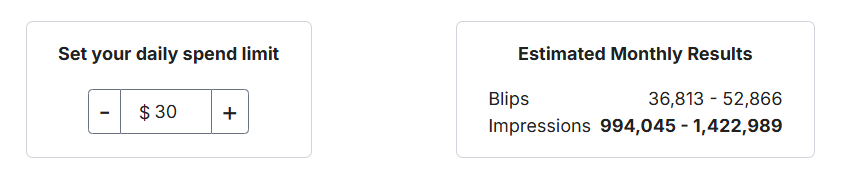
With Blip, you can advertise on Temple City billboards on any budget, because you only pay per “blip”—a 7.5 to 10-second ad display on digital billboards serving the Temple City area. You set a daily budget during campaign creation, and Blip automatically keeps your advertising within that limit, so you stay in control. The price of each blip on billboards near Temple City, California depends on when and where you choose to advertise and on local advertiser demand, and your total cost is simply the sum of the blips you receive.
Where can I advertise with Blip near Temple City, California?
There are 25 digital billboards serving the Temple City area from nearby cities within roughly 10 miles. These include El Monte, Irwindale, Baldwin Park, Pasadena, La Puente, and Montebello. Together, they create a regional reach that can easily exceed 400,000 people within a 10-mile radius.
What kind of people do Temple City billboards reach in Temple City, California?
Temple City is a compact, affluent, and highly diverse community in the western San Gabriel Valley, surrounded by major commuter corridors and neighboring job centers like Pasadena, El Monte, and Irwindale. Within a 5-mile radius of Temple City, you tap into a broader trade area of well over 300,000 residents when you include adjacent communities. More than 70% of residents speak a language other than English at home, with Chinese dialects among the most common.
When is the best time to run Blip billboards in Temple City, California for local families and students?
Boards serving the Temple City area near El Monte, Pasadena, and Baldwin Park can promote family and education offerings heavily during back-to-school season, report card periods and exam seasons, and summer enrichment and camp enrollment windows. Back-to-school season runs from late July–September, exam seasons are commonly late fall and spring semesters, and summer enrichment windows are March–June. This is a strong fit for after-school programs, tutoring, test prep, and family restaurants.
Which roads are best for Temple City billboard advertising in Temple City, California?
Key roadways and corridors that matter for billboard visibility include I-10, I-210 near Pasadena and Irwindale, State Route 19 and Las Tunas Drive, and State Route 60 near Montebello and La Puente. By choosing boards along these routes, advertisers can reach tens of thousands of impressions per day from Temple City area residents, workers, and through-traffic. A single digital face on a freeway with 200,000 AADT, running your ad in a 1-in-8 rotation, can routinely deliver 20,000–30,000 impressions per day for your creative alone, depending on scheduling.
Do I need a contract to advertise with Blip near Temple City?
No, Blip has no long-term contracts or minimum commitments. You can start, pause, or stop your campaign at any time.
How fast can I launch a billboard campaign with Blip near Temple City?
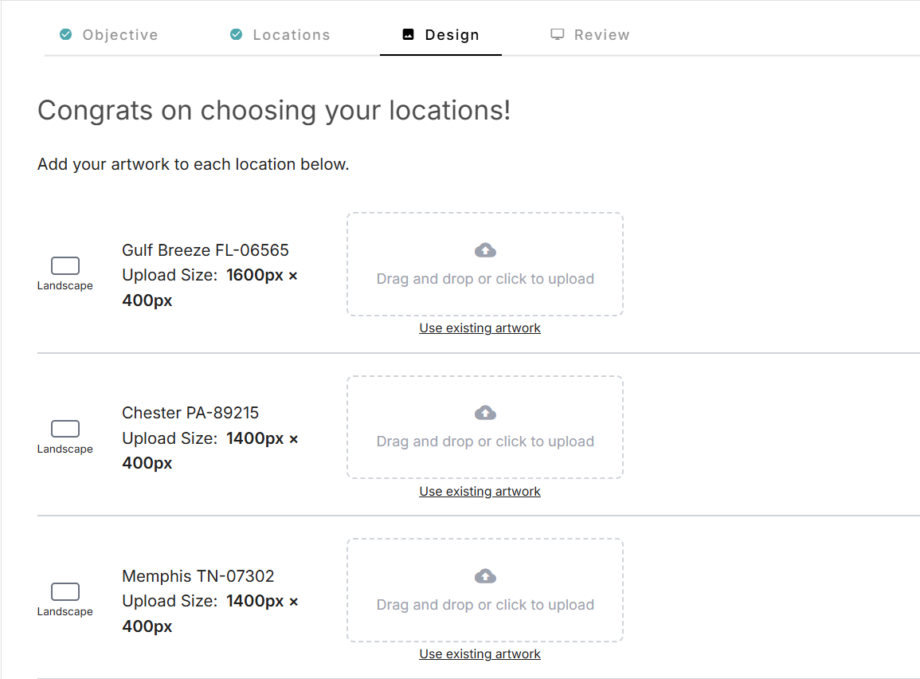
You can have your campaign live in minutes. Create a free account, select your locations, set your budget, upload your design, and start running once approved.
Where can I advertise with Blip near Temple City?
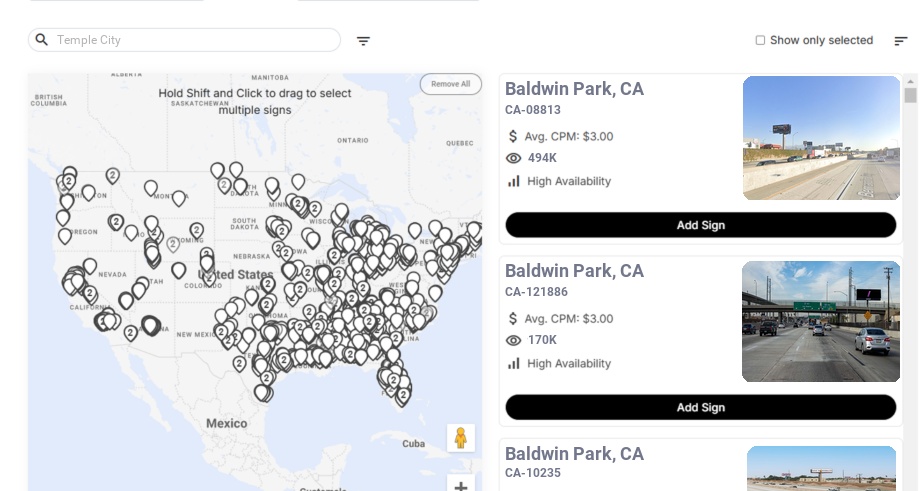
Blip has digital billboards near Temple City. You can browse available locations on a map, choose the ones that fit your audience, and start advertising right away.
Still have questions? Launch a campaign in minutes — no contracts, no commitments.
Start Your CampaignTemple City Billboard Advertising Guide
Temple City is a compact, affluent, and highly diverse community in the western San Gabriel Valley, surrounded by major commuter corridors and neighboring job centers like Pasadena, El Monte, and Irwindale. With 25 digital billboards serving the Temple City area from nearby cities within roughly 10 miles, we can reach residents, commuters, and visitors as they move between work, school, and regional attractions. For advertisers exploring billboards near Temple City, this cluster of locations offers a powerful combination of neighborhood frequency and regional reach.
Understanding the Temple City Area Market
Temple City itself has a population of roughly 35,000 residents, packed into just 4 square miles, creating a dense, neighborhood-focused market. Recent estimates put the city’s population in the mid–30,000s to just over 36,000 residents, meaning even small shifts in awareness through Temple City billboards can reach thousands of households. Key characteristics that matter for billboard advertisers:
-
Population & density
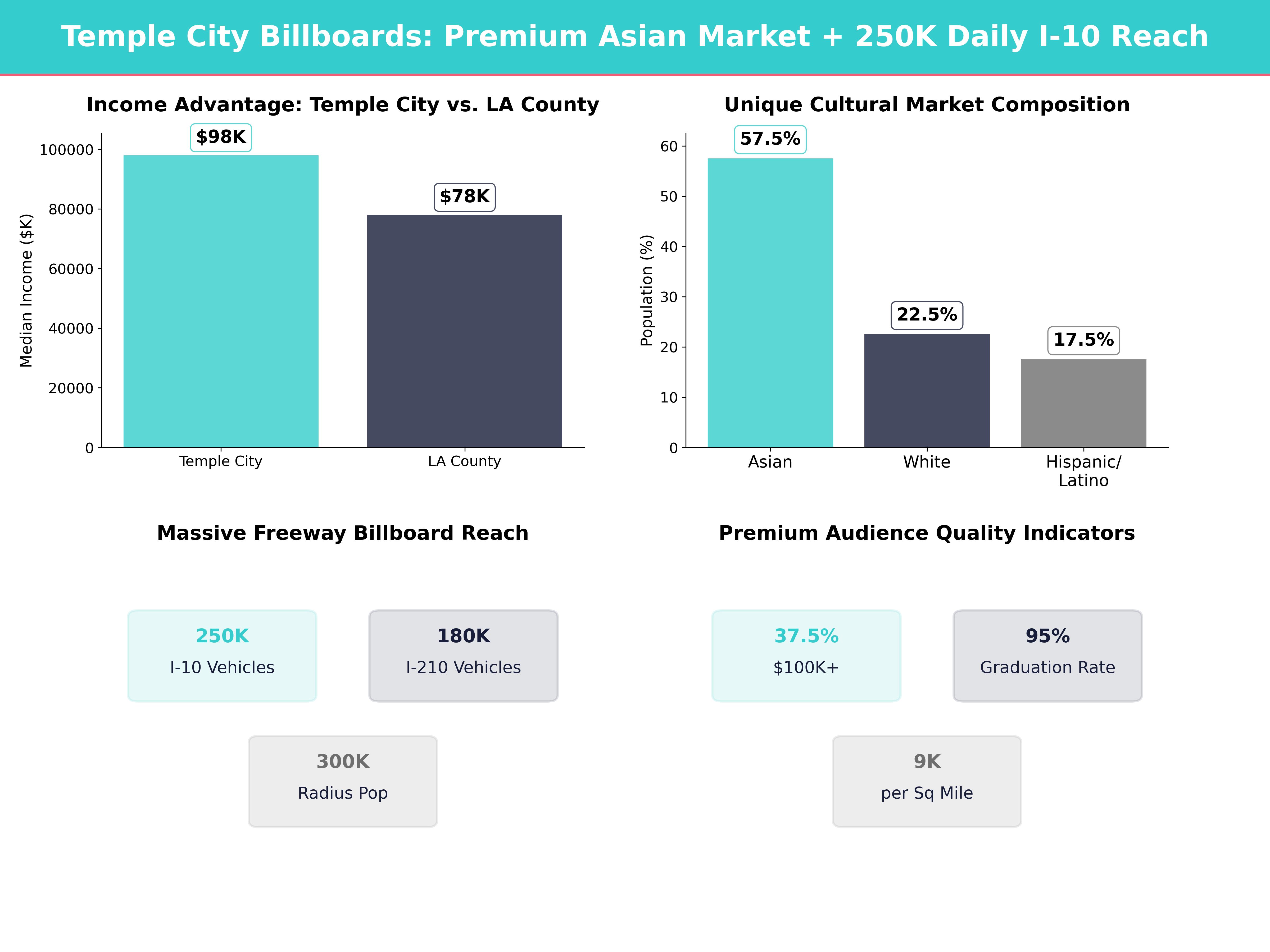
- Temple City’s population density is around 9,000 people per square mile, significantly above the U.S. average of about 94 people per square mile and more than double the overall Los Angeles County density (roughly 2,400–2,500 people per square mile). This means a relatively small geographic footprint covers a substantial audience with high potential frequency.
- Within a 5-mile radius of Temple City, you tap into a broader trade area of well over 300,000 residents when you include adjacent communities like El Monte, Arcadia, Rosemead, and parts of Pasadena, all of which are touched by billboard advertising near Temple City when you use regionally placed boards.
-
Income & spending power
- Median household income in Temple City is estimated in the low–$90,000s to low–$100,000s per year (roughly $92,000–$105,000 in recent community estimates), significantly higher than the Los Angeles County median (about $76,000–$80,000). In some adjacent census tracts in Arcadia and San Marino, median incomes exceed $120,000.
- Roughly 35–40% of Temple City households are estimated to earn $100,000 or more annually, and about 15–20% exceed $150,000. This suggests strong spending power for categories like home improvement, dining, personal services, education, elective healthcare, and financial services.
- Homeownership runs near 60–65% in Temple City, versus roughly 45–50% countywide, which supports demand for home services, remodeling, landscaping, solar, and insurance products that can be effectively promoted through billboard advertising near Temple City.
-
Age distribution
- Roughly 20–22% of residents are under 18, about 58–60% are working-age adults (18–64), and close to 18–20% are 65+, a larger senior share than many U.S. cities (the national 65+ share is closer to 17%).
- About 30% of households include children under 18, and multigenerational living is common in the San Gabriel Valley. Advertisers can effectively speak to family decision-makers and caregivers across generations.
-
Diversity
-
Temple City is one of the most ethnically diverse communities in the San Gabriel Valley. Recent estimates show:
- About 55–60% Asian (with large Chinese, Taiwanese, and Vietnamese communities)
- Roughly 20–25% White
- Roughly 15–20% Hispanic or Latino
- More than 70% of residents speak a language other than English at home, with Chinese dialects (Mandarin and Cantonese) among the most common.
- This creates strong opportunities for bilingual or culturally tailored creative (e.g., English + Chinese, or English + Spanish depending on your audience) when planning Temple City billboards.
-
Temple City is one of the most ethnically diverse communities in the San Gabriel Valley. Recent estimates show:
Useful local resources for understanding the community and events include the City of Temple City website and the San Gabriel Valley Tribune for regional news. For a broader visitor and lifestyle perspective, advertisers can also reference Discover San Gabriel Valley and the Visit California – Los Angeles County tourism pages for seasonal travel patterns that affect local traffic and inform when to increase billboard rental near Temple City.
Where Our Billboards Reach the Temple City Area
Our 25 digital billboards serving the Temple City area are strategically located in nearby cities that Temple City residents frequently travel through, giving advertisers practical options for billboards near Temple City without needing a board on every local street:
- El Monte (about 2.6 miles from Temple City)
- Irwindale (about 4.3 miles)
- Baldwin Park (about 4.9 miles)
- Pasadena (about 5.4 miles)
- La Puente (about 9.2 miles)
- Montebello (about 9.3 miles)
These communities collectively add access to hundreds of thousands of additional residents and workers. For example, El Monte has a population of around 106,000, Baldwin Park about 72,000, Pasadena roughly 135,000, and Montebello around 63,000, giving Temple City–focused campaigns a regional reach that can easily exceed 400,000 people within a 10–mile radius when you use Temple City billboards as part of a wider San Gabriel Valley strategy.
These placements let us intercept:
- Commuters heading toward job centers in Pasadena, Downtown Los Angeles, and the broader San Gabriel Valley
- Shoppers traveling to regional retail centers and big-box clusters in El Monte, Baldwin Park, La Puente, and Montebello
- Visitors and locals attending events and attractions in Pasadena and surrounding cities
Key roadways and corridors that matter for billboard visibility include:
- I-10 (San Bernardino Freeway) – A primary east–west artery with daily traffic counts often exceeding 250,000 vehicles near El Monte and Baldwin Park, according to Caltrans District 7. Annual average daily traffic (AADT) at some segments between El Monte and Baldwin Park commonly ranges from 220,000 to over 260,000 vehicles.
- I-210 (Foothill Freeway) near Pasadena and Irwindale – Serving commuters and higher-income households in the foothill communities with daily volumes commonly over 180,000 vehicles, and certain stretches near Pasadena exceeding 190,000 AADT.
- State Route 19 (Rosemead Boulevard) and Las Tunas Drive corridors – Core surface streets that Temple City residents use to access freeways, shopping, and schools. Local traffic counts on Rosemead Boulevard in the Temple City–Rosemead corridor often surpass 35,000–45,000 vehicles per day.
- State Route 60 near Montebello and La Puente – Another major east–west trade corridor with heavy commuter and truck traffic, with many segments carrying 200,000+ vehicles per day.
By choosing boards along these routes, we can reach tens of thousands of impressions per day from Temple City area residents, workers, and through-traffic. A single digital face on a freeway with 200,000 AADT, running your ad in a 1-in-8 rotation, can routinely deliver 20,000–30,000 impressions per day for your creative alone, depending on scheduling. This makes billboard rental near Temple City an efficient way to build frequency with both local households and regional visitors.
For additional corridor-specific data, advertisers can review traffic and project updates from Metro (Los Angeles County Metropolitan Transportation Authority) and corridor plans from the Southern California Association of Governments, which help forecast growth along I-10, I-210, and SR-60.
Temple City Area Audience Segments to Target
Digital billboards near Temple City work best when we build campaigns around specific groups and behaviors.
1. Commuters & Workers
Los Angeles County commute data show that roughly 72–75% of workers drive alone to work, around 9–11% carpool, about 5–7% use public transportation, and 3–4% work from home on a regular basis. Average one-way commute times in the Temple City–San Gabriel Valley area are typically 30–33 minutes, several minutes longer than the U.S. average of about 26–27 minutes. Longer commutes mean more minutes spent on the road with repeated exposure to your message, which is ideal for billboard advertising near Temple City.
Many Temple City residents commute to:
- Pasadena (engineering, education, healthcare, and tech)
- El Monte and Baldwin Park (logistics, manufacturing, public agencies)
- Downtown Los Angeles and surrounding business districts via I-10, I-5, and Metro services
Boards near I-10, I-210, and major arterials like Rosemead Boulevard and Valley Boulevard are ideal for:
- Auto dealers
- Financial services
- Colleges and training programs
- Professional services (attorneys, accountants, insurance, real estate)
We can daypart commuting hours (roughly 6–9 a.m. and 3–7 p.m.) to match heavy traffic periods, when peak-hour volumes on I-10 and I-210 can account for 35–40% of total daily traffic in just a few hours.
2. Families & Education-Focused Households
Temple City is known for strong schools. The Temple City Unified School District serves about 3,000–4,000 students across multiple campuses, with high graduation rates that often exceed 95% and college-going rates for graduates commonly reported in the 80–90% range. Temple City High School consistently ranks well among Los Angeles County public high schools, helping drive family demand for housing in the area and supporting continued value in Temple City billboards for youth- and education-focused advertisers.
Within a 5–mile radius of Temple City, the total K–12 public and private student population (including districts in Arcadia, El Monte, and Pasadena) easily exceeds 30,000 students, creating a large market for youth and family-focused offerings.
This creates high demand for:
- After-school programs and tutoring
- Test prep and language schools
- Extracurriculars like music, dance, and sports
- Family restaurants and quick-service dining
Boards serving the Temple City area near El Monte, Pasadena, and Baldwin Park can promote these offerings heavily during:
- Back-to-school season (late July–September), when many schools in Los Angeles County resume classes and families are actively scheduling activities
- Report card periods and exam seasons (commonly late fall and spring semesters), when interest in tutoring and enrichment spikes
- Summer enrichment and camp enrollment windows (March–June), when parents plan for 8–10 weeks of summer break
3. Asian and Multilingual Audiences
With a majority Asian population and a significant portion of residents speaking a language other than English at home, multilingual and culturally specific messaging can substantially increase response. In many San Gabriel Valley communities, 50–60% of residents report speaking Asian or Pacific Islander languages at home, and in some Temple City–adjacent tracts the figure is even higher.
Practical tactics:
- Use short bilingual headlines: English plus Chinese (simplified or traditional, depending on your target audience). In many local Chinese-language campaigns, advertisers have successfully kept combined bilingual headlines to 8–10 total words.
- Feature visuals and cultural references familiar to Asian American families in the San Gabriel Valley, such as family dining, education success imagery, or traditional holiday themes around Lunar New Year and Mid-Autumn Festival.
- Highlight trust, family, education, and value – themes that consistently resonate across local communities. For example, “family-owned since 1995,” “top-rated by local parents,” or “trusted by Temple City families” are strong proof points for billboard advertising near Temple City aimed at this audience.
Local media such as World Journal’s Los Angeles edition and coverage in the San Gabriel Valley section of the Los Angeles Daily News can help inform your cultural tone and promotions. Chinese-language and bilingual coverage in outlets like KAZN AM 1300 (a local Chinese radio station) can also provide insight into popular topics and consumer interests.
4. Seniors & Healthcare Consumers
With nearly 1 in 5 residents in or approaching retirement age (about 18–20% 65+), healthcare and senior services are a major local need. Across the San Gabriel Valley, older adults are a growing segment; regional health agencies report steady increases in demand for primary care, specialty care, and in-home support services.
Key categories include:
- Primary care and specialty clinics
- Senior living communities
- Home health and in-home support
- Medicare advisors and insurance brokers
Boards that serve the Temple City area near medical clusters in Pasadena (including large providers such as Huntington Hospital) and along I-10 in El Monte and Baldwin Park can focus on:
- Appointment reminders and new patient promotions
- Screening campaigns (vision, hearing, diabetes, heart health)
- Easy contact methods (large phone numbers, short URLs, QR codes)
Midday and weekday dayparts (10 a.m.–3 p.m.) can be especially effective for reaching older adults and caregivers traveling for appointments, as medical visits for seniors disproportionately occur during these off-peak hours.
Timing Your Campaign Around Local Events and Seasons
The Temple City area has a steady calendar of events and seasonal patterns that advertisers can use to time campaigns. Los Angeles County typically hosts tens of thousands of permitted events annually, and the San Gabriel Valley’s share includes community festivals, parades, sports tournaments, and cultural celebrations that significantly increase weekend and evening traffic on local corridors. Aligning billboard rental near Temple City with these spikes in activity can amplify your return on ad spend.
City & Community Events
The City of Temple City parks and recreation and community services departments host regular:
- Camellia Festival – A signature annual event drawing thousands of attendees, including families from across the San Gabriel Valley. Over a typical festival weekend, local officials and news outlets often estimate total attendance in the 10,000–20,000 range, with parade day generating heavy mid-morning and afternoon congestion around Las Tunas Drive.
- Summer concerts, movies in the park, and holiday events that can each attract hundreds to a few thousand attendees per night, depending on programming.
- Youth sports and recreation programs that enroll hundreds of local children per season across multiple leagues and age groups.
We can ramp up impressions near Temple City area boards in the weeks leading up to:
- Festival weekends
- Registration deadlines for youth programs
- Holiday celebrations (Lunar New Year, Mid-Autumn Festival, Christmas, and New Year)
Promoting offers like “Festival weekend specials,” “Show this ad on your phone,” or event tie-ins can drive foot traffic. Local event calendars on the Temple City Parks & Recreation page and regional listings in the Pasadena Star-News are useful for planning your campaign calendar and deciding when to increase spend on Temple City billboards.
Regional Attractions & Tourism
Nearby destinations create additional traffic near our billboard locations:
- Pasadena – Home to Old Pasadena, the Rose Bowl, and large events like the Rose Parade and UCLA games. Major events at the Rose Bowl Stadium can draw 40,000–90,000 attendees per event, while the Rose Parade routinely attracts several hundred thousand spectators along the route. The Visit Pasadena site lists year-round happenings that contribute to heavy weekend traffic.
- Shopping centers in El Monte, Baldwin Park, La Puente, and Montebello generate regular weekend traffic spikes. Regional malls and power centers typically see 20–40% higher foot traffic on Saturdays and Sundays compared with weekdays.
- Dining corridors throughout the San Gabriel Valley, including Valley Boulevard, Garvey Avenue, and Main Street segments in nearby cities, are popular late-night and weekend destinations.
Retailers, restaurants, and entertainment venues can time heavier ad flights for:
- Weekends and evenings near Pasadena and Montebello boards
- Major event dates when traffic spikes (e.g., Rose Bowl concerts, holiday parades, sports tournaments)
- Holiday shopping periods (Black Friday through late December, plus Lunar New Year promotions, which can generate a sizable uptick in spending among Asian households)
Creative Best Practices for Digital Billboards Near Temple City
To maximize impact on digital billboards serving the Temple City area, we should design creative around high-traffic, multi-ethnic, commuter-heavy conditions.
Keep Messages Ultra-Short
Drivers often have 6–8 seconds to see and process a message. In freeway conditions at 55–65 mph, this can shrink to 3–5 seconds of clear viewing. Aim for:
- 6–8 words maximum in your main headline
- One clear call to action (e.g., “Exit Rosemead,” “Call Today,” “Enroll Now”)
- A large phone number or short URL
For example, instead of:
“High-Quality After-School Tutoring for Temple City Students”
Try:
“Temple City Tutoring – After School, All Subjects”
Campaigns that keep to 7 words or fewer often see significantly higher recall in industry studies compared with more text-heavy boards.
Use High-Contrast, Simple Design
Common conditions near the Temple City area include bright sun, smoggy haze, and nighttime glare from lights. Design for readability under all conditions:
- Use high contrast (e.g., dark background with light text or vice versa)
- Large fonts (at least ~18–24 inches tall in the final art, which typically translates to 10–15% of the total board height)
- Avoid script and overly thin typefaces
- Limit to 2–3 colors plus your logo
Out-of-home studies frequently show that legibility scores drop by 20–30% when more than three colors are used or when text falls below recommended size, so simplifying your palette can directly improve performance.
Localize Your Message
People respond when they feel the ad is “for them.” Good localization tactics:
- Reference key roads and landmarks (“Near Rosemead & Las Tunas,” “Just off I-10 Rosemead exit”).
- Mention the Temple City area or San Gabriel Valley in copy if space allows.
- For multilingual audiences, use a bilingual headline and keep it simple.
Example:
- “San Gabriel Valley Dental – New Patients Welcome”
- Secondary line in Chinese or Spanish for clarity.
Localized messages have been shown in various OOH campaigns to increase recall and intent-to-visit by 10–20% versus generic regional messaging, and this is especially true when you tailor billboard advertising near Temple City to local roads and neighborhoods residents recognize.
Rotate Creative by Time and Audience
Because digital billboards let us serve different messages at different times, we can align creative with:
- Morning: Coffee shops, breakfast spots, financial services, traffic updates, school-related offers.
- Midday: Healthcare, senior services, home improvement, business-to-business offers.
- Afternoon school run: Tutoring, after-school programs, quick-service dining, local retail.
- Evening/weekend: Restaurants, entertainment, local events, ecommerce and app-based services.
Advertisers who use dayparting often report more efficient campaigns—shifting 20–30% of impressions out of low-response windows and into peak-response hours can meaningfully lower cost per lead or visit.
Example Strategies by Industry
Local Retail and Restaurants
Objective: Drive in-store visits from Temple City area residents.
Approach:
- Run heavier impressions Thursdays–Sundays, when many retailers see 40–50% of their weekly sales.
- Use boards near El Monte, Baldwin Park, and Montebello where many Temple City shoppers pass through and where weekend freeway volumes regularly spike 10–15% above weekday averages.
- Feature limited-time offers (“Weekend Family Specials,” “Happy Hour 3–6 p.m.”).
- Use dayparting to show dinner deals from 3–8 p.m. and lunch specials 11 a.m.–2 p.m. Industry data show that restaurant response rates to out-of-home can improve by 15–25% when creative is aligned to mealtimes.
Education & Tutoring Services
Objective: Grow enrollment from Temple City students.
Approach:
- Concentrate impressions near the start of school (late July–September), mid-semester, and exam seasons (March–May), when many test prep providers report their highest inquiry volumes.
- Use simple, trust-building messages: “Top Scores, Local Teachers, Flexible Hours.”
- Promote free assessments or first-session discounts, as “free trial” offers consistently rank among the highest-performing triggers in education marketing.
- Consider bilingual creative for families who prefer Chinese or another language at home, especially on boards closest to heavily Asian corridors like Valley Boulevard and Rosemead Boulevard.
- Emphasize that your billboard advertising near Temple City is designed for local families (“Close to Temple City Schools,” “Minutes from Las Tunas & Rosemead”).
Healthcare Providers
Objective: Attract new patients from the Temple City area.
Approach:
- Focus on boards near Pasadena, El Monte, and I-10 where patients may travel to clinics and hospitals. Health systems in these corridors serve combined catchment areas of several hundred thousand residents across the San Gabriel Valley.
- Daypart your campaign to run heavier 7 a.m.–7 p.m. on weekdays, when most appointments and urgent-care visits occur.
- Use reassuring language and clear contact info: “Same-Week Appointments,” “Accepting New Patients,” “24/7 Urgent Care.”
- Highlight specialties that match local demographics: pediatrics, family medicine, geriatrics, and dental. Dental and vision care in particular show strong response to out-of-home, with some providers attributing 10–20% of new-patient calls to billboard visibility in local case studies, especially when they take advantage of accessible billboards near Temple City.
Home Services (Contractors, Solar, Landscaping)
Objective: Capture high-value residential customers.
Approach:
- Use neighborhood-focused language: “Serving Temple City Area Homes.”
- Highlight quick response and social proof: “Over 500 Local Jobs Completed,” “Rated 4.8 Stars by SGV Homeowners.”
-
Run campaigns heavily during:
- Spring and early summer for landscaping and renovations, when home-improvement spending often rises 20–30% versus winter months.
- Late summer and fall for roofing and HVAC maintenance, aligning with heat waves and pre-rainy-season checks.
- Use phone numbers and short URLs, plus phrases like “Call Now for a Free Estimate.” Many home service businesses report that out-of-home leads tend to have higher average ticket sizes, especially in higher-income areas like Temple City and adjacent foothill communities, making billboard rental near Temple City a strong fit for these categories.
Using Blip’s Tools to Optimize Campaigns Near Temple City
Digital billboards give us flexible control over how, when, and where your ads run. With 25 boards serving the Temple City area, we can fine-tune your strategy using:
Location Selection
- Choose boards in El Monte and Baldwin Park for high I-10 visibility; segments here commonly exceed 220,000 AADT, maximizing impressions.
- Use Pasadena boards when targeting higher-income audiences, professionals, and event-goers; the median household income in some Pasadena neighborhoods can exceed $110,000, and major events can double or triple normal weekend traffic.
- Include Montebello and La Puente to reach east–west commuters and shoppers traveling along the SR-60 corridor, where volumes above 200,000 AADT are common.
We can start broad, see where impressions and results are strongest, then shift more budget to the most effective locations. Many advertisers see meaningful improvements—often 10–30%—in response rates after the first round of optimization, especially when they focus on boards that function as Temple City billboards for nearby neighborhoods.
Dayparting and Scheduling
- Match your ad schedule to your customer behavior—commuter hours, lunchtime, after-school, evenings, and weekends. For instance, if 60–70% of your sales occur after 3 p.m., we can bias 60–70% of your impressions into that window.
- Promote time-sensitive offers (happy hour, same-day service, event dates) during relevant windows only, avoiding wasted impressions outside your core business hours.
Budget Flexibility
- Start with a modest daily budget, then increase during key periods like festivals, holidays, sales events, or enrollment deadlines. It’s common for advertisers to double or triple their daily spend for 7–14 days around a major promotion, then return to a “maintenance” level.
- Use “pulse” cycles: higher intensity for 1–2 weeks around a promotion, then a lighter “always-on” presence to maintain awareness. This approach helps maintain share of voice without requiring a constant high spend and pairs well with the on-demand nature of billboard rental near Temple City.
Measuring and Refining Your Campaign
To keep improving performance, we should measure results and adapt:
- Website traffic: Track changes in direct and branded search traffic from the Temple City area when your campaign runs. Many local businesses see 10–30% lifts in branded search during well-timed billboard flights.
- Offer codes & URLs: Use unique promo codes or short URLs on your billboard creative to attribute responses. Even if only a portion of customers use them, they provide a directional measure of impact.
- Phone tracking: Use a trackable phone number that forwards to your main line so you can quantify how many calls are generated by your boards.
- Customer surveys: Ask new customers, “Where did you hear about us?” and watch for trends from the Temple City area and surrounding cities.
Local business resources, such as the Temple City Chamber of Commerce and regional insights in outlets like the Pasadena Star-News, can also help you benchmark your marketing performance and refine targeting. Chambers and business journals frequently publish data on consumer confidence, sales trends, and development projects that signal where future demand and traffic growth will be strongest and where to focus billboard advertising near Temple City.
By leveraging data about Temple City’s demographics, commuting patterns, and cultural landscape—combined with the flexibility of 25 digital billboards serving the Temple City area—we can build campaigns that reach the right people, at the right time, with messages that truly resonate and deliver measurable results for local advertisers who rely on billboards near Temple City.