Billboards near Palo Alto, CA
No Minimum Spend. No Long-Term Contracts. Just Results.
Trusted by Leading Brands


Billboard advertising
near Palo Alto has never been easier



How much is a billboard near Palo Alto?
Why Choose Blip for Billboard Advertising near Palo Alto
Blip lets you launch fast in Palo Alto, reaching U.S. 101 and Caltrain commuters without long-term contracts.
Set a flexible budget for Palo Alto and only pay for blips that run during peak tech-commute hours.
Use Palo Alto dayparting to hit Stanford, Sand Hill Road, and downtown traffic at morning and evening rush.
Track Palo Alto campaign results in real time, then shift spend as Stanford events and weekend shopping traffic change.
Blip’s creative tools make it easy to tailor Palo Alto billboards for tech workers, investors, and affluent families.
Frequently Asked Questions About Billboard Advertising near Palo Alto
How much does a billboard cost near Palo Alto, California with Blip?
With Blip, you can advertise on digital Palo Alto billboards on any budget, making it easy for businesses in the Palo Alto area to get noticed. You simply set a daily budget, and Blip automatically keeps your campaign within that amount, displaying your ad as short “blips” of 7.5 to 10 seconds on rotating digital billboards near Palo Alto, California. Each blip is individually priced based on when and where it runs and current advertiser demand, so you only pay for the impressions you receive.
Where can I advertise with Blip near Palo Alto, California?
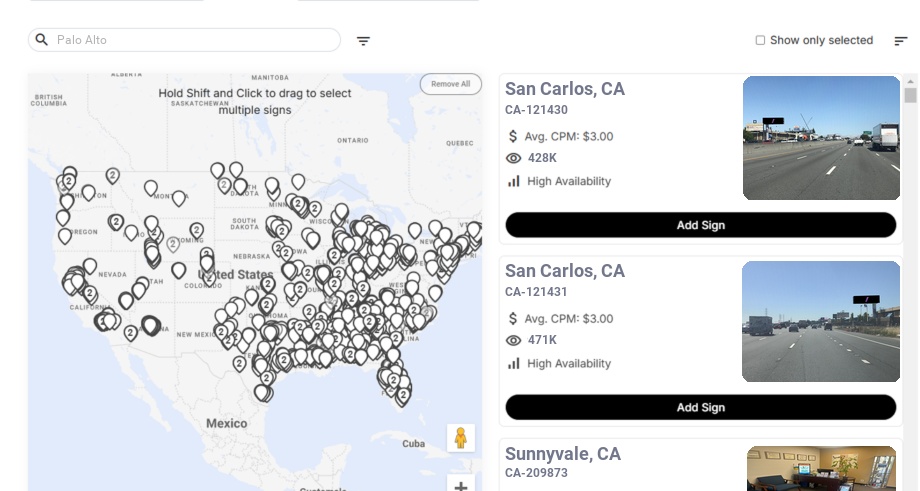
Our three digital billboards in San Carlos sit roughly 9.5 miles from Palo Alto, along the crucial north–south spine that connects the Peninsula and links key employment centers from San Francisco down to San Jose. For marketers comparing different billboard rental near Palo Alto options, this stretch of U.S. 101 offers a powerful balance of volume, commuter quality, and proximity to core Palo Alto destinations. Digital billboards near Palo Alto on this corridor are ideal for reaching affluent commuters, tech audiences, and cross-market campaigns across Silicon Valley.
What kind of audience do Palo Alto, California billboards reach?
Palo Alto sits at the heart of Silicon Valley’s innovation corridor, with U.S. 101, Caltrain, and major arterial streets funneling a high-income, highly educated audience through and around the city every day. The area is highly international, with nearly 40–45% of residents speaking a language other than English at home and more than 30% foreign-born. For advertisers, this translates into a compact geographic area with outsized purchasing power, influence, and innovation adoption.
When is the best time to run billboards near Palo Alto, California with Blip?
Weekday peak periods are especially strong, including the morning commute from 6:30–9:30 a.m. and the evening commute from 3:30–7:00 p.m. Weekend counts along U.S. 101 and arterial streets typically reach 70–80% of weekday averages, driven by family and leisure trips. Event-driven spikes at Stanford University and nearby venues can add 10,000–50,000 attendees on specific days, depending on the event size.
Do I need a contract to advertise with Blip near Palo Alto?
No, Blip has no long-term contracts or minimum commitments. You can start, pause, or stop your campaign at any time.
How fast can I launch a billboard campaign with Blip near Palo Alto?
You can have your campaign live in minutes. Create a free account, select your locations, set your budget, upload your design, and start running once approved.
Where can I advertise with Blip near Palo Alto?
Blip has digital billboards near Palo Alto. You can browse available locations on a map, choose the ones that fit your audience, and start advertising right away.
Still have questions? Launch a campaign in minutes — no contracts, no commitments.
Start Your CampaignPalo Alto Billboard Advertising Guide
Palo Alto sits at the heart of Silicon Valley’s innovation corridor, with U.S. 101, Caltrain, and major arterial streets funneling a high-income, highly educated audience through and around the city every day. With our digital billboards in nearby San Carlos serving the Palo Alto area, we can help brands tap into this concentration of tech workers, investors, students, and affluent residents using flexible, data-driven campaigns. For advertisers specifically looking for billboards near Palo Alto, this corridor offers the reach and audience quality of an in-city placement with more flexible pricing and availability.
Understanding the Palo Alto Area Market
Palo Alto may be relatively small in population, but its economic impact and audience quality are enormous, making it an ideal environment for high-impact Palo Alto billboards focused on premium and B2B brands.
-
Population and households
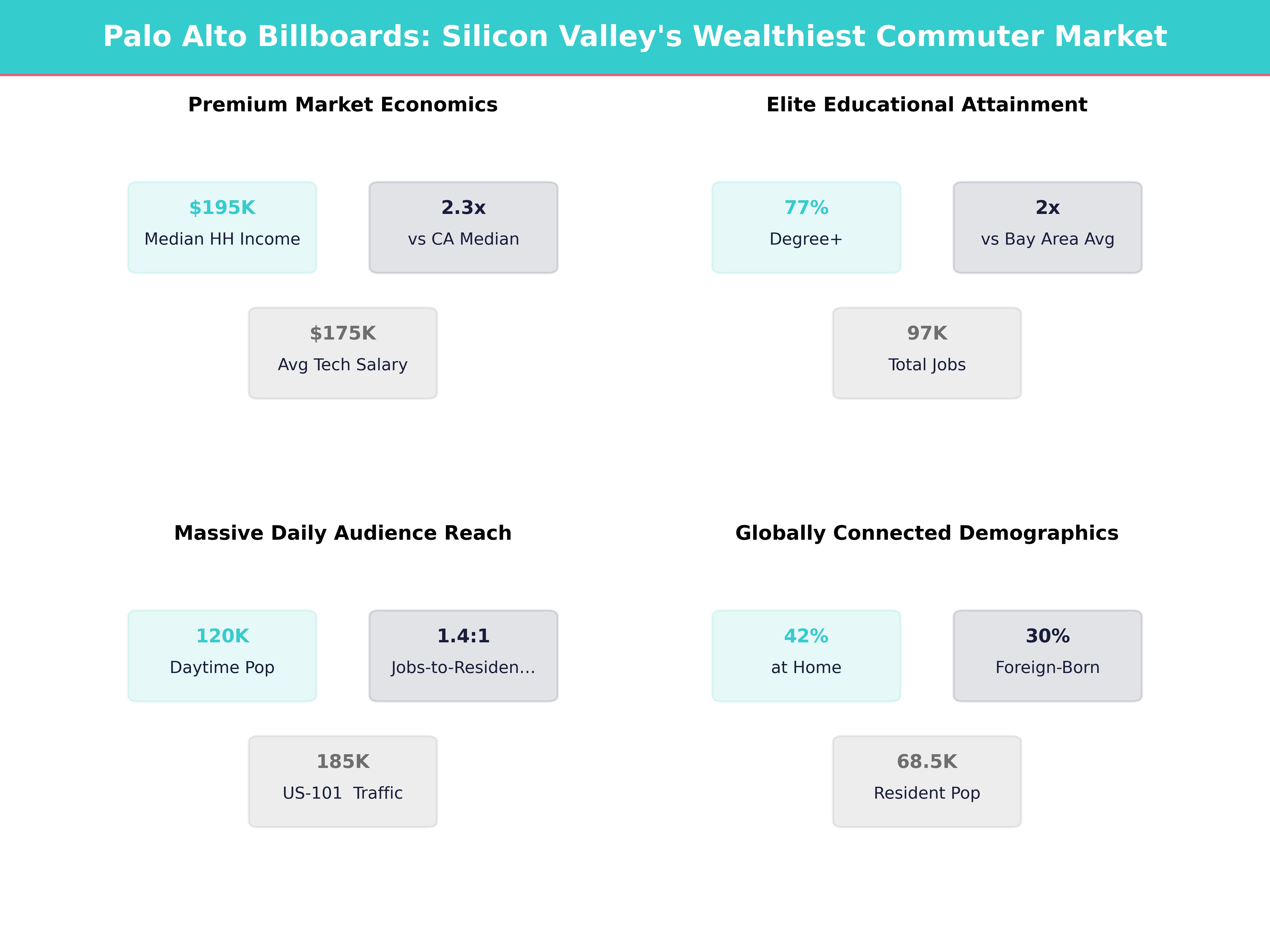
- The City of Palo Alto reports a population of roughly 68,000–69,000 residents, with city estimates clustering around 68,500 residents and about 26,000 households, giving an average household size of about 2.6 people.
- Local and regional economic reports place median household income near $190,000–$200,000, more than 2.2–2.4 times the California statewide median, ranking Palo Alto among the top-earning communities in Santa Clara County ( County of Santa Clara
- Educational attainment is exceptionally high: city and regional planning documents indicate that over 75–80% of adults hold a bachelor’s degree or higher, roughly double the rate for the broader Bay Area.
-
Jobs and daytime population
- According to local planning reports, Palo Alto supports roughly 95,000–100,000 jobs across tech, healthcare, education, professional services, and retail, compared with under 70,000 residents—a jobs-to-residents ratio of roughly 1.4:1. This means the daytime population can swell past 120,000 people when commuters and visitors are included.
- Stanford University alone has about 17,000 students and over 15,000 faculty and staff (Stanford University), for a campus population of 32,000+. Many of these students and employees commute from across San Mateo and Santa Clara counties, feeding daily flows through U.S. 101, El Camino Real, and Caltrain (Caltrain) corridors served by our inventory near the Palo Alto area.
- The broader Santa Clara County labor market includes more than 1 million jobs, while neighboring San Mateo County—home to our San Carlos boards—adds another 400,000+ jobs (San Mateo County), reinforcing cross-corridor commuter traffic that sees frequent exposure to Palo Alto billboards and nearby inventory.
-
Affluent, global, and tech-centric
- Regional business data and local news coverage show that a large share of Palo Alto workers are in technology, venture capital, professional and technical services, and healthcare, with many in senior or decision-making roles. Average salaries in software and related tech roles frequently exceed $150,000–200,000, with total compensation (including equity) often higher.
- Palo Alto is highly international: city and county data indicate that nearly 40–45% of residents speak a language other than English at home, and more than 30% are foreign-born. Significant language communities include Mandarin and other Chinese dialects, Hindi, and Spanish, supported by cultural institutions and coverage in local outlets such as Palo Alto Online and The Mercury News.
- Homeownership and asset levels are correspondingly high. In many neighborhoods, ownership rates hover near 55–60%, and a substantial share of owner households report home equity above $1 million.
For advertisers, this translates into a compact geographic area with outsized purchasing power, influence, and innovation adoption, ideal for product launches, B2B messaging, recruitment, and premium consumer brands that want their billboard advertising near Palo Alto to reach decision-makers and early adopters.
How Our San Carlos Billboards Serve the Palo Alto Area
Our three digital billboards in San Carlos sit roughly 9.5 miles from Palo Alto, along the crucial north–south spine that connects the Peninsula and links key employment centers from San Francisco down to San Jose. For marketers comparing different billboard rental near Palo Alto options, this stretch of U.S. 101 offers a powerful balance of volume, commuter quality, and proximity to core Palo Alto destinations.
-
U.S. 101 corridor
- According to Caltrans District 4 traffic counts, typical Annual Average Daily Traffic (AADT) on U.S. 101 through central San Mateo County ranges from about 160,000 to over 200,000 vehicles per day, with some segments near San Carlos recorded around 180,000–190,000 vehicles per day (Caltrans District 4).
- The City of San Carlos and county transportation agencies note that U.S. 101 carries a mix of long-distance commuters, local Peninsula trips, and airport traffic to and from San Francisco International Airport (SFO) (San Francisco International Airport), which itself handles more than 50 million passengers annually.
-
Rail and parallel corridors
- Caltrain operates along a nearly parallel alignment to U.S. 101, with pre-pandemic weekday ridership near 65,000 daily boardings system-wide and more recent recovery figures in the 30,000–40,000 weekday boardings range (Caltrain). Stations at San Carlos, Redwood City, Menlo Park, Palo Alto, and Mountain View channel a dense flow of tech commuters and Stanford riders.
- Local transit agencies like SamTrans (SamTrans) and VTA (VTA) add thousands more daily riders along El Camino Real and major arterials, creating additional exposure to drivers, bus passengers, and rail users who move through the same visual corridors as our boards.
Because technology workers frequently commute between Peninsula cities, our San Carlos locations effectively reach:
- Palo Alto residents heading to employers in San Francisco, San Mateo, San Carlos, Redwood City, and South San Francisco, including major campuses clustered along U.S. 101.
- Tech workers and executives who live north or south but commute to Palo Alto, Stanford University, Stanford Research Park, or Sand Hill Road venture capital firms, a corridor that houses dozens of VC and private equity offices managing tens of billions of dollars in assets.
- High-income shoppers and families traveling to key destinations near the Palo Alto area like Stanford Shopping Center ( Stanford Shopping Center downtown Palo Alto ( Downtown Palo Alto Stanford Stadium (Stanford Athletics) for games and events.
Digital billboards near Palo Alto on this corridor are ideal for:
- Brand lift and awareness among affluent commuters who often spend 45–60 minutes or more per weekday in traffic, according to regional commute surveys by Metropolitan Transportation Commission.
- Targeting tech and venture audiences traveling between offices, meetings, and events, many of whom work at firms with $10M+ in annual recurring revenue or manage portfolios of $100M+.
- Cross-market campaigns that naturally cover multiple Silicon Valley hubs—Palo Alto, Menlo Park, Redwood City, Mountain View, and San Jose—with one flight, making it easy to extend billboard advertising near Palo Alto into the broader Bay Area.
Key Commuter and Traffic Patterns to Target
To make the most of Blip’s flexible scheduling, we should align flight times with how people move around the Palo Alto area and when they are most likely to notice Palo Alto billboards on their daily routes:
Weekday peak periods
-
Morning commute (6:30–9:30 a.m.)
- Regional traffic monitoring by Caltrans and San Mateo County shows that peak speeds on U.S. 101 can drop below 30 mph in this window, significantly increasing billboard dwell time.
- Southbound volumes are especially heavy as professionals head to jobs in Palo Alto, Menlo Park, Mountain View, Sunnyvale, and San Jose.
-
Evening commute (3:30–7:00 p.m.)
- Return flows see both northbound and southbound congestion, with many workers leaving Palo Alto and Stanford Research Park toward housing in San Francisco, Daly City, San Mateo, Redwood City, and southern Santa Clara County suburbs.
- In many segments, p.m. peak volumes can reach 110–130% of a.m. peak volumes as measured by local corridor studies.
-
Midday (11:00 a.m.–2:00 p.m.)
- Midday traffic includes professionals on the move for client meetings, lunches, and errands, plus service, healthcare, and education workers with non-traditional hours. While speeds are faster, volumes still remain high—often 60–70% of peak-period volumes.
Weekend patterns
-
Saturday mid-morning to afternoon (10:00 a.m.–4:00 p.m.)
- Weekend counts along U.S. 101 and arterial streets typically reach 70–80% of weekday averages, driven by family and leisure trips toward shopping areas like Stanford Shopping Center and downtown Palo Alto, plus regional attractions promoted by tourism groups such as Discover San Mateo County.
-
Event-driven spikes
- Football games, graduations, and large events at Stanford University and nearby venues can add 10,000–50,000 attendees on specific days, depending on the event size (Stanford Athletics).
- During major games at Stanford Stadium (capacity ~50,000), local cities and Santa Clara County often activate special traffic control plans, which slow traffic and boost impressions.
With Blip’s tools, we can:
- Concentrate impressions during commuter peaks for B2B, recruiting, and SaaS messaging when the highest concentrations of engineers, founders, and investors are on the road.
- Shift budgets to weekends for retail, hospitality, real estate, and entertainment when households and visitors are heading to shopping, dining, and regional attractions.
- Increase frequency during major Stanford events or product launch weeks, then scale back afterward, using event calendars from Stanford University and local outlets like Palo Alto Online and The Mercury News for planning.
Audience Segments We Can Reach Near Palo Alto
Because of the unique composition of the Palo Alto area, it helps to think in terms of distinct segments that can all be reached efficiently through billboard advertising near Palo Alto:
-
Tech professionals and founders
- Employed by companies across software, hardware, AI, and biotech in hubs such as Stanford Research Park, which alone hosts more than 150+ companies across 700+ acres, and nearby campuses in Mountain View and Sunnyvale.
- Average tech salaries locally often exceed $150,000+, with many senior and specialized roles in the $200,000–300,000+ range when equity and bonuses are included.
- Ideal for: B2B software, developer tools, cybersecurity, cloud platforms, fintech, coworking spaces, and productivity products targeting decision-makers who control six- to seven-figure annual budgets.
-
Investors and executives
- The Sand Hill Road and downtown Palo Alto corridor host dozens of VC and private equity firms, from early-stage funds managing $100M–$500M to large firms with multi-billion-dollar portfolios. Executive offices for public tech companies and unicorn startups add further concentration of C-level decision-makers.
- These audiences influence not just local, but global technology trends and procurement decisions.
- Ideal for: High-end B2B services, enterprise SaaS, wealth management, corporate legal and advisory services, and executive education.
-
Affluent families
- Median home prices often exceed $3 million in many Palo Alto neighborhoods, according to local real estate reporting by Palo Alto Online, with some areas frequently seeing sales above $4–5 million.
- Home listings above $2.5 million routinely make up more than 60–70% of for-sale inventory, signaling a large base of high-net-worth households.
- Spending patterns skew toward education (private school tuition often $30,000–60,000 per year), international travel, premium healthcare, and luxury vehicles.
- Ideal for: Private schools, tutoring and test prep, travel and luxury goods, family healthcare, financial planning, and premium automotive.
-
Students, faculty, and staff
- Stanford’s population of 30,000+ students and employees moves through the broader corridor, with many living in Palo Alto, Menlo Park and relying on U.S. 101, El Camino Real, and Caltrain for daily travel.
- This group is highly educated, digitally savvy, and influential in tech, science, and policy conversations. A significant share fall into the 18–34 age bracket, a sweet spot for app adoption and early technology use.
- Ideal for: Apps, consumer tech, mobility and micromobility, housing and coliving, local dining, nightlife, and events promoted via local guides and tourism sites, such as San Mateo County tourism.
By tailoring creative and flight strategies to these segments, we can deliver campaigns that feel highly relevant to people who live and work near Palo Alto and maximize every impression from billboards near Palo Alto.
Creative Strategies That Work for the Palo Alto Area
The Palo Alto area audience is saturated with information and accustomed to polished experiences. That means:
1. Lead with clarity, not complexity
- Use short, punchy copy: aim for 5–8 words maximum for the main message. Studies of roadside readability show comprehension drops sharply when copy exceeds 10–12 words on freeway-speed boards.
- Assume drivers are moving at 55–65 mph; prioritize a single benefit or call to action.
-
Examples:
- “AI Security for Growing Startups”
- “Hire Senior Engineers in 30 Days”
- “Wealth Management for Tech Founders”
2. Speak the audience’s language
-
Incorporate tech and startup context where appropriate:
- “Ship Faster with Automated Testing”
- “Scale Your AI Infra Without Headaches”
- Reference outcomes (e.g., “Cut Cloud Spend 30%”) rather than vague buzzwords; Palo Alto area professionals follow product reviews and business news via outlets such as Palo Alto Online and The Mercury News and are quick to tune out generic hype.
3. Visual hierarchy and branding
- Strong logo presence is essential given 2–4 second typical viewing windows at highway speeds.
- Use high-contrast color palettes that stand out against the often bright, clear Peninsula sky; avoid low-contrast combinations that disappear in sun or fog.
- Keep visuals bold and simple—one product image, icon, or character is usually enough to lift brand recall by 20–30% versus cluttered designs, based on industry OOH effectiveness studies.
4. Consider multilingual or culturally aware creative
-
If your target includes specific international communities (e.g., Mandarin-speaking founders, global student population), consider:
- Simple bilingual lines (e.g., English plus Mandarin or Spanish), keeping total copy length under 12–14 words.
- Icons and imagery that communicate across language barriers, especially for categories like finance, mobility, and education.
5. Connect OOH with digital
-
Add easy-to-remember URLs or vanity domains, especially for B2B or recruiting:
- “Brand.com/PaloAlto”
- “Brand.com/Founders”
- Use location-based or time-based landing pages that mirror the billboard message, improving attribution and recall. Many advertisers see 10–30% higher conversion rates when landing page copy matches their OOH headlines.
- Track performance through web analytics, capturing direct type-ins and short-link visits that happen during and immediately after peak commuter windows.
Timing and Seasonality Near Palo Alto
Seasonal rhythms in the Palo Alto area should guide campaign planning and help determine when billboard advertising near Palo Alto can have the most impact:
Stanford academic calendar
-
September–June: Campus is in full swing, with thousands of daily trips between campus, downtown Palo Alto, and broader Peninsula job centers. Ideal for:
- Recruiting campaigns (internships, new grads).
- Brand awareness among students and faculty in engineering, business, and medicine.
- Event promotions and product launches aligned with major conferences, hackathons, or lecture series posted on Stanford University event calendars.
- June graduation and major sports seasons generate traffic surges, especially on weekends and evenings. Commencement and reunion events can draw tens of thousands of visitors over a single weekend.
Tech and conference cycles
-
Many product launches, conferences, and funding announcements cluster in:
- Q1 (January–March) and Q4 (October–December), when technology companies align with fiscal years and major industry events in the San Francisco Bay Area.
-
We can:
- Run burst campaigns (e.g., 2–4 weeks) around launch announcements or funding milestones.
- Use billboards as a “stage” for milestone moments (Series A/B funding, new product lines, or major partnerships) timed to press coverage across outlets like Palo Alto Online and The Mercury News.
Holidays and travel
- Thanksgiving, winter holidays, and summer travel see elevated movements between the Peninsula, San Francisco, and airports, with SFO and San Jose Mineta International Airport (San José Mineta International Airport) jointly handling 70M+ passengers annually.
-
These are strong windows for:
- Travel and hospitality offers (hotels, vacation rentals, premium credit cards).
- Retail promotions and end-of-year gift campaigns.
- End-of-year financial and tax planning services when households revisit portfolios and charitable giving.
With Blip, we can quickly adjust spend and flight schedules around these peaks—no need to commit to long, fixed campaigns that don’t align with your most important dates or miss the best windows for billboard rental near Palo Alto.
Campaign Ideas by Vertical
Here are practical ways we can use billboards near the Palo Alto area for different industries:
Tech & SaaS
- Goal: Credibility, awareness, and lead generation among founders, engineers, and IT leadership.
-
Tactics:
- Run weekday commuter campaigns targeting 7–10 a.m. and 4–7 p.m., when U.S. 101 volumes are highest.
- Highlight one sharp value prop and a clear URL or QR-friendly short link.
- Change creative every 2–4 weeks to highlight different product features (“Security,” “Scale,” “Speed”) and measure which messages correlate with higher demo requests or trial signups.
Hiring and Talent Branding
- Goal: Attract engineers, PMs, designers, and data scientists in one of the most competitive labor markets in the world.
-
Tactics:
- Speak directly to the candidate: “Senior Engineers, Work From Anywhere. Apply at…”
- Time creatives around graduation, internship, and hiring cycles (spring and fall) when Stanford and other local universities release thousands of new grads and interns into the market.
- Use different creatives for “Engineering,” “Sales,” “Design,” swapping via Blip’s flexible upload and scheduling to A/B test which roles get the highest application rates.
Healthcare & Wellness
- Goal: Reach affluent families and professionals who prioritize quality care and convenience.
-
Tactics:
- Promote specialty services (cardiology, pediatrics, fertility, mental health, orthopedics) and emphasize access metrics such as “Same-Week Appointments” or “24/7 Virtual Care.”
- Daypart towards morning and early evening when families are planning appointments and commuting past the boards.
- Tie messages to local health news or seasons (e.g., flu season, mental health awareness), which are often covered by Palo Alto Online and other regional outlets.
Education & EdTech
- Goal: Reach parents, students, and academic professionals.
-
Tactics:
- Promote test prep, after-school programs, private schools, and EdTech tools around back-to-school (August–September) and exam seasons (March–May).
- Use simple score or outcome-driven messaging: “Raise SAT Scores 150+ Points” or “Coding Skills in 12 Weeks.”
- Highlight hard numbers like “95% College Acceptance Rate” or “10,000+ Students Trained” to resonate with data-driven parents.
Real Estate & Financial Services
- Goal: Acquire high-net-worth clients and investors who live or work in one of the world’s most valuable housing markets.
-
Tactics:
- Emphasize trust, expertise, and local knowledge: “1,000+ Peninsula Homes Sold” or “$2B+ Assets Under Management.”
- Use neighborhood cues (e.g., “Serving Palo Alto, Menlo Park, Atherton”) that signal familiarity with ultra-high-value submarkets where median home prices often exceed $4–5 million, including Atherton.
- Concentrate budget in Q4 and early Q1 when financial planning, tax strategy, and relocation decisions peak.
Using Blip’s Flexibility to Optimize Near Palo Alto
The strength of digital billboards serving the Palo Alto area is that we can treat them more like a high-impact, location-based digital channel:
- Dayparting: Only pay for impressions at specific times (rush hours, lunch, weekends). For example, allocate 70–80% of impressions to peak commuting windows for B2B and hiring campaigns.
- Budget control: Set daily or campaign budgets so you can test creative and timing without overcommitting. Many advertisers start with modest daily spends and scale up once they see cost-per-visit or cost-per-lead metrics stabilize.
-
A/B testing: Run multiple creatives:
- Test different taglines (“Cut Cloud Costs 30%” vs. “Scale Without Downtime”).
- Test different calls to action (“Book a Demo” vs. “Start Free Trial”) and monitor which versions correlate with higher click-through rates on matching landing pages.
-
Rapid iteration: Swap creative within days to respond to:
- News cycles and local developments covered by Palo Alto Online and The Mercury News.
- Product updates or new features.
- Local events or weather (e.g., heat waves for HVAC or energy-efficiency offers).
For example, a startup raising a Series B could:
- Announce funding for 7–10 days with a bold milestone creative (“Series B Raised. Now Hiring in Palo Alto.”).
- Shift the next 1–2 weeks to recruiting-focused creative targeting engineers and sales talent.
- Follow with a 4–6 week wave of customer-focused messaging, all on the same screens serving the Palo Alto area, effectively turning billboards near Palo Alto into an always-on storytelling channel.
Measuring Success and Connecting the Dots
To make campaigns near Palo Alto accountable and data-driven, we should plan measurement in advance:
-
Traffic and impressions
- Use estimated impressions from traffic volumes (e.g., 160,000–200,000 vehicles per day on U.S. 101 segments in San Mateo County) and standard vehicle-occupancy assumptions (often 1.2–1.5 people per vehicle) to size potential reach.
- Over a 4-week campaign with steady presence, this can translate into millions of gross impressions among tech workers, executives, and affluent households.
-
Web analytics
-
Track:
- Direct traffic spikes during campaign periods and by time of day (e.g., increases in direct visits during 7–10 a.m. and 4–7 p.m. windows).
- Increases in branded search (e.g., brand name + Palo Alto or San Carlos).
- Landing page visits from short URLs or vanity domains used on creatives.
- Compare conversion rates from Palo Alto and surrounding ZIP codes to non-exposed regions to understand how well your billboard advertising near Palo Alto is driving real business outcomes.
-
Track:
-
Lead quality and sales cycles
- For B2B, compare pipeline volume, deal size, and close rates from the Palo Alto area during and after campaigns. Many advertisers see 10–20% lifts in branded pipeline volume when OOH is layered with digital.
- For consumer brands, monitor store foot traffic, local online orders, and appointment bookings from Palo Alto and nearby cities such as Menlo Park, Redwood City, and Mountain View.
By combining location-aware strategy, sharp creative, and the flexibility of Blip’s digital inventory near Palo Alto, we can access one of the world’s most valuable and influential audiences—with the precision and agility needed to keep up with Silicon Valley’s pace, and with billboard rental near Palo Alto that scales to your goals and budget.