Billboards near Arcadia, CA
No Minimum Spend. No Long-Term Contracts. Just Results.
Trusted by Leading Brands


Billboard advertising
near Arcadia has never been easier



How much is a billboard near Arcadia?
Why Choose Blip for Billboard Advertising near Arcadia
Blip’s self-serve billboards near Arcadia launch fast on I-210 and I-605 commuter corridors—no media-buying hassles.
Set a flexible daily budget in Arcadia and scale up for Santa Anita Park race days or holiday shopping rushes.
No contracts mean Arcadia businesses can test ads on Huntington Drive, Rosemead Blvd, and Baldwin Ave, then pivot anytime.
Use Blip’s real-time analytics to see how Arcadia campaigns perform during morning and evening commute peaks.
Blip’s creative tools make it easy to tailor Arcadia billboards for bilingual families and Westfield Santa Anita shoppers.
Frequently Asked Questions About Billboard Advertising near Arcadia
How much does a billboard cost near Arcadia, California with Blip?
With Blip, you control exactly how much you spend on Arcadia billboards by setting your own daily budget and adjusting it whenever you like. Each ad is a brief “blip” on a rotating digital display, and you only pay for the blips you receive. The price of each blip on billboards near Arcadia, California depends on the specific times you choose to advertise, the locations serving the Arcadia area, and overall advertiser demand.
Where can I advertise with Blip near Arcadia, California?
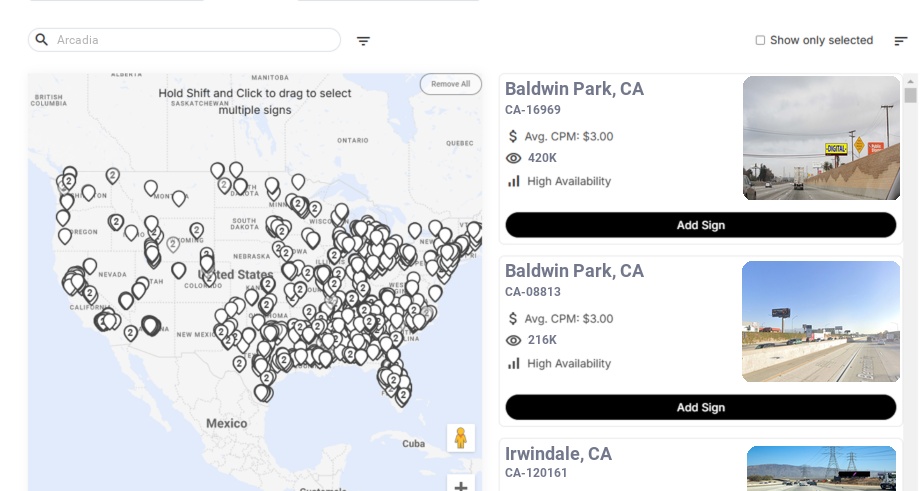
Our 21 digital billboards serving the Arcadia area are strategically located in nearby cities within roughly 10 miles, including Irwindale, El Monte, Pasadena, and Baldwin Park. These locations give advertisers reach along major travel corridors in the western San Gabriel Valley, including I-210, I-605, I-10, and major surface streets like Huntington Drive, Rosemead Boulevard, and Baldwin Avenue. This cluster of locations provides broad yet efficient coverage for billboards near Arcadia.
What kind of people do Arcadia billboards with Blip reach?
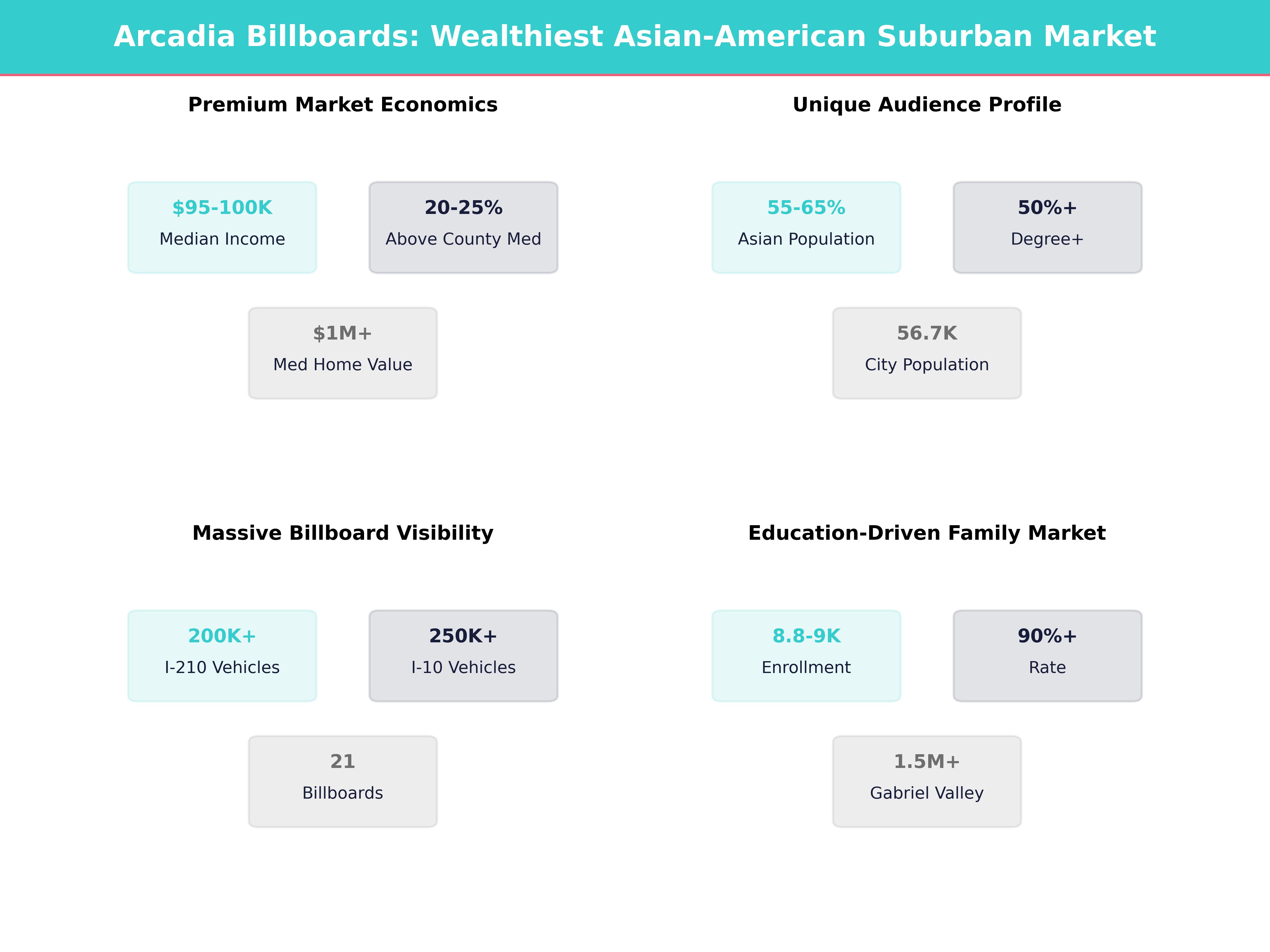
Arcadia is a prosperous suburban city of about 56,000–57,000 residents, with the broader San Gabriel Valley home to well over 1.5 million people who regularly travel through Arcadia and its neighboring cities. The area has a median household income commonly reported around $95,000–$100,000, and more than 50% of adults hold a bachelor’s degree or higher. A majority Asian population, often reported at 55–65%, also makes bilingual messaging especially relevant.
When is the best time to run Blip billboards in Arcadia?
Morning commute boards near Pasadena and El Monte are ideal for westbound messaging to Arcadia-area residents heading toward job centers, while eastbound-facing boards in Irwindale, Baldwin Park, and El Monte can reinforce offers as people head home in the late afternoon and evening. Weekends often account for 35–40% of weekly shopping and dining visits in regional retail centers, so mid-day and afternoon slots on Fridays, Saturdays, and Sundays can maximize visibility. On major race days or holiday weekends at Santa Anita Park, you can increase your budget and frequency to capture high-value visitor traffic.
Why does Arcadia make a strong market for billboard advertising with Blip?
Arcadia sits at a powerful intersection of affluence, culture, and commuter traffic in the western San Gabriel Valley. Higher-than-average incomes support premium retail, dining, financial services, healthcare, and education offerings, and local per-capita retail sales exceed $20,000 per year. The area also draws major traffic from Santa Anita Park, Westfield Santa Anita, and nearby cultural hubs like Old Pasadena.
Do I need a contract to advertise with Blip near Arcadia?
No, Blip has no long-term contracts or minimum commitments. You can start, pause, or stop your campaign at any time.
How fast can I launch a billboard campaign with Blip near Arcadia?
You can have your campaign live in minutes. Create a free account, select your locations, set your budget, upload your design, and start running once approved.
Where can I advertise with Blip near Arcadia?
Blip has digital billboards near Arcadia. You can browse available locations on a map, choose the ones that fit your audience, and start advertising right away.
Still have questions? Launch a campaign in minutes — no contracts, no commitments.
Start Your CampaignArcadia Billboard Advertising Guide
Arcadia sits at a powerful intersection of affluence, culture, and commuter traffic in the western San Gabriel Valley. With 21 digital billboards serving the Arcadia area from nearby Irwindale El Monte Baldwin Park
Understanding the Arcadia Area Market
Arcadia is a prosperous suburban city of about 56,000–57,000 residents, located roughly 13 miles northeast of downtown Los Angeles. Recent demographic and economic indicators show:
- Population: About 56,700 residents in the City of Arcadia, with the broader San Gabriel Valley home to well over 1.5 million people who regularly travel through Arcadia and its neighboring cities.
- Median household income: Commonly reported around $95,000–$100,000, roughly 20–25% higher than the Los Angeles County median, indicating above-average discretionary spending on retail, dining, financial products, and healthcare.
- Education: More than 50% of adults hold a bachelor’s degree or higher, with a substantial share in professional, technical, and managerial occupations.
- Age profile: A balanced mix of young families, middle‑aged professionals, and older adults; many local estimates place nearly 25–30% of residents under 20, and roughly 20% over 60, supporting both family-focused and senior-focused services.
- Ethnic composition: A majority Asian population, often reported at 55–65%, with strong Chinese‑American and other East Asian communities, alongside White, Hispanic/Latino, and other groups. In some Arcadia neighborhoods, Asian residents account for more than 70% of the population.
These data points combine to create an attractive advertising market:
- Strong spending power: Higher-than-average incomes support premium retail, dining, financial services, healthcare, and education offerings. In many Arcadia neighborhoods, consumer spending on retail and dining per household is 10–20% above the county average, and local per‑capita retail sales exceed $20,000 per year.
- Family focus: The Arcadia Unified School District (AUSD) serves roughly 8,800–9,000 students across its schools and consistently ranks among the top districts in California on standardized test scores and college readiness indicators. AUSD’s high graduation and college‑going rates fuel strong demand for tutoring, test prep, music lessons, sports leagues, and STEM enrichment.
- Cultural diversity: In many Arcadia-area ZIP codes, more than 50% of households speak a language other than English at home, with Chinese dialects especially prominent. Multilingual messaging (particularly English plus Chinese) can resonate with a large share of households and differentiate your brand.
Local institutions and attractions further amplify the Arcadia area’s draw:
- City of Arcadia government facilities and civic events, including summer concerts, holiday celebrations, and community fairs that collectively attract tens of thousands of attendees each year.
- Santa Anita Park, one of the premier horse racing venues in the U.S., which can draw 20,000–30,000 visitors on major race days and has hosted season meets with cumulative attendance in the hundreds of thousands.
- Westfield Santa Anita 10–15 million visitor trips per year, especially concentrated on weekends and holidays.
- Nearby cultural and tourist hubs like Old Pasadena, which the local tourism office reports attracts millions of visitors annually to its restaurants, shopping, and events.
When we design campaigns serving the Arcadia area, we can leverage these characteristics to tailor our messaging, language, and timing to match how people actually live and move around the San Gabriel Valley. For many brands, this means building Arcadia billboards into a broader local strategy that also includes search, social media, and community sponsorships.
Where Our Digital Billboards Reach People Near Arcadia
Our 21 digital billboards serving the Arcadia area are strategically located in nearby cities within roughly 10 miles:
- Irwindale 3.8 miles from Arcadia)
- El Monte 4.4 miles)
- Pasadena 5.2 miles)
- Baldwin Park 5.5 miles)
These locations give advertisers reach along some of the busiest travel corridors in the western San Gabriel Valley, including:
- I‑210 (Foothill Freeway): A major east‑west route for Arcadia commuters, connecting to Pasadena and the Inland Empire. Caltrans traffic data often show 200,000+ vehicles per day on the busiest I‑210 segments through the San Gabriel Valley. See Caltrans District 7 for regional freeway information and updates.
- I‑605 (San Gabriel River Freeway): North‑south traffic linking the Arcadia area to the rest of LA County, with many segments carrying 150,000–200,000 vehicles daily.
- I‑10 (San Bernardino Freeway): One of Southern California’s heaviest commuter and freight corridors, with volumes that can exceed 250,000 vehicles per day near El Monte and Baldwin Park.
- Major surface streets like Huntington Drive, Rosemead Boulevard, and Baldwin Avenue, which carry significant local traffic between Arcadia and neighboring cities and can see 30,000–50,000 vehicles per day on key segments.
According to Caltrans traffic counts in the greater San Gabriel Valley, average daily traffic on segments of I‑210 and I‑10 near the Arcadia area regularly surpasses 200,000 vehicles per day. This means our digital boards in Irwindale, El Monte, Pasadena, and Baldwin Park can deliver repeated exposures to Arcadia-area residents on their daily commutes to work, school, shopping, and entertainment. For advertisers specifically looking for billboards near Arcadia that can capture both local and regional travelers, this cluster of locations provides broad yet efficient coverage.
In practical terms, this lets a single Blip campaign:
- Greet Arcadia residents heading west toward Pasadena and Los Angeles in the morning
- Remind them of your brand as they return east in the evening
- Capture shoppers and diners traveling between Arcadia and nearby retail and employment centers throughout the day
Commuter Patterns and Optimal Placement Strategy
To refine placement and scheduling, it helps to understand how people move around the Arcadia area:
- Workflows: A substantial share of Arcadia residents commute to jobs in Pasadena, downtown Los Angeles, and other hubs. In many San Gabriel Valley cities, 70–80% of workers commute by car, and typical one‑way commute times fall in the 30–35 minute range. This creates multiple daily touchpoints on freeways and arterials where our boards are located.
- Regional shopping: Westfield Santa Anita, Old Pasadena, Monrovia West Covina 40–50% of visits come from outside the host city, meaning a large portion of their traffic passes through El Monte, Baldwin Park, and Pasadena corridors where our billboards sit.
- Transit usage: The LA Metro A Line 150,000–250,000 average weekday boardings range in recent years, according to LA Metro
- Events: Santa Anita Park race days, city events, and regional festivals drive surges of visitors arriving by car on I‑210 and local roads. On major race or festival days, traffic volumes on access routes can spike by 10–20% over typical weekends.
From this, we can draw several tactical conclusions:
-
Morning vs. evening:
- Westbound-facing boards near Pasadena and El Monte are ideal for morning commuter messaging to Arcadia-area residents and San Gabriel Valley workers heading toward job centers.
- Eastbound-facing boards in Irwindale, Baldwin Park, and El Monte can reinforce offers as people head home in the late afternoon and evening, catching two daily impressions from the same commuter.
-
Weekend emphasis:
- Weekends often account for 35–40% of weekly shopping and dining visits in regional retail centers. Targeting mid‑day and afternoon slots on Fridays, Saturdays, and Sundays can maximize visibility for retail, dining, and entertainment promotions.
-
Event‑linked scheduling:
- On major race days or holiday weekends at Santa Anita Park, you can increase your budget and frequency on boards along I‑210 and I‑605 corridors and nearby surface streets, capturing high‑value visitor traffic when local hotel occupancy, restaurant waits, and rideshare activity all climb.
Blip’s flexible, pay‑per‑blip model allows you to increase bids during these high‑impact periods and taper back during slower times, rather than committing to a static 4‑week schedule. This flexibility is especially useful for advertisers testing billboard advertising near Arcadia for the first time and wanting to prove results before scaling up.
Demographic Insights to Shape Your Creative
The Arcadia area’s demographics strongly influence what works on a billboard. Based on recent data and local observation:
- High‑income, value‑conscious shoppers: With median household income near $100,000 and many dual‑income families, residents are open to premium brands, but they are also research‑driven and responsive to clear value propositions, savings, and proof of quality (ratings, awards, years in business).
- Family and education focus: In high-performing districts like Arcadia Unified School District, it’s common for 90%+ of graduates to pursue college, and participation in after‑school activities can reach 60–70% of students in some schools. This underpins strong interest in tutoring, enrichment programs, test prep, private schools, and family services.
- Asian-majority community: With a high proportion of residents with Chinese, Taiwanese, and other Asian backgrounds, many households are bilingual or multilingual. In some local tracts, 40–50% of residents are foreign‑born, making bilingual communication especially impactful.
Practical creative takeaways:
-
Lead with clarity and quality
-
Use concise headlines (7 words or fewer) that highlight premium quality or clear benefits:
- “Top‑Rated Dental Care Near Arcadia Area”
- “Luxury Living Minutes from Santa Anita Park”
- Feature high‑quality photography: clean interiors, professional staff, and recognizable local landmarks. Local surveys consistently show that over 70% of consumers are more likely to visit a business that looks “professional and trustworthy” in its advertising.
-
Use concise headlines (7 words or fewer) that highlight premium quality or clear benefits:
-
Consider bilingual or culturally aware messaging
- English-only designs will still perform, but in neighborhoods where 50%+ of households speak Asian languages at home, bilingual English–Chinese billboards can stand out and feel particularly relevant.
- Keep translations short, with large fonts and high contrast; avoid cramming too much text in either language.
- Use culturally neutral but aspirational imagery: families, education success, financial stability, and health, which consistently test well in affluent suburban markets.
-
Highlight convenience and proximity
- The Arcadia area is highly car‑oriented; in many nearby cities, 90% or more of households have at least one vehicle. Phrases like “5 minutes from Westfield Santa Anita” or “Just off I‑210” help drivers immediately understand where you are.
- Use well-known geographic references: “near Santa Anita Park,” “by the 210 & 605,” or “minutes from Old Pasadena” to anchor your location in the driver’s mental map. This reinforces that your business is close to the Arcadia billboards they pass every day.
-
Design for fast-moving traffic
- Use one main visual, one short headline, and one clear call to action. Transportation research suggests drivers typically have 5–8 seconds to absorb a billboard message at freeway speeds.
- Phone numbers should be short and easy to remember; URLs should be simple, or use a memorable vanity domain.
- If you include QR codes, restrict them to boards on slower surface streets, where typical speeds (25–35 mph) give drivers more time to safely scan.
Key Audience Segments in the Arcadia Area
We can segment likely viewers into several high-value groups and tailor campaigns accordingly:
-
Affluent families and homeowners
- Likely to spend on home improvement, insurance, financial services, healthcare, and premium education.
- Median home values in Arcadia are widely reported to be above $1 million, compared with many LA County communities in the $700,000–$800,000 range, reflecting strong property ownership and equity.
- Homeownership rates in similar suburban cities often range from 55–65%, creating demand for mortgage refinancing, remodeling, landscaping, solar, and security services.
- Effective messaging: “Protect Your Arcadia‑Area Home,” “College Planning for San Gabriel Valley Families,” or “Renovate Before You Sell.”
-
Students and education-focused households
- The area feeds into highly ranked public schools and is close to institutions like Pasadena City College and the California Institute of Technology (Caltech), whose combined enrollments exceed 25,000 students.
- Households with school‑age children can easily represent 30–40% of local households in family‑oriented suburbs like Arcadia and neighboring cities.
- Effective messaging: test prep, tutoring centers, private academies, after‑school programs, and summer camps, especially during key enrollment windows (spring and late summer), when education services often see 20–30% spikes in inquiries.
-
Tourists and regional visitors
- Santa Anita Park, Westfield Santa Anita, and Old Pasadena draw visitors from across Southern California. On peak weekends, local hotel occupancy and short‑term stays can climb into the 80–90% range in nearby Pasadena and Arcadia.
- The Angeles National Forest and San Gabriel Mountains attract hikers and outdoor enthusiasts who often pass through Arcadia-area corridors to reach trailheads. Popular gateway cities in the foothills regularly report hundreds of thousands of annual recreation visits.
- Effective messaging: hotels, restaurants, attractions, and services that benefit from out-of-town traffic (auto repair, urgent care, retail).
-
Local workers and commuters
- Many people commute through the Arcadia area between residential neighborhoods and job centers in Pasadena, downtown Los Angeles, and the Inland Empire. In San Gabriel Valley communities, it is common for 40–50% of employed residents to work outside their home city.
- Effective messaging: quick-service restaurants, coffee shops, gas stations, fitness centers, and convenience services timed to morning and evening drive.
Blip’s scheduling tools let us set different daypart and day‑of‑week strategies for each audience, optimizing spend for when each segment is most likely to see your message. This makes it easier to turn Arcadia billboards into a reliable awareness channel for each of these groups.
Timing Your Campaign: Seasonality and Dayparting
Advertising near Arcadia works best when aligned with local rhythms. Use Blip’s controls to adjust your campaign for:
Seasonal patterns
-
Back‑to‑school (late July–September)
- Prime time for education, youth sports, clothing, and technology retailers. In many school districts, over 70% of families report making major school‑related purchases in this window.
- Emphasize boards serving routes to schools and shopping areas, particularly in the two weeks before and after the first day of school reported on Arcadia Unified School District calendars.
-
Holiday shopping (November–December)
- Westfield Santa Anita and area retail corridors see heavy traffic; national mall benchmarks show holiday season foot traffic can be 30–40% higher than the annual monthly average.
- Increase frequency on Fridays–Sundays and late afternoons; promote gifts, dining, events, and services like shipping or storage.
-
Lunar New Year and other cultural holidays
- The large Asian population means Lunar New Year (often late January or February) is a key retail and dining period, with many local businesses reporting double‑digit sales increases compared to typical winter weeks.
- Bilingual or culturally aware creative can capture heightened spending on dining, gifting, banking, and travel.
-
Racing seasons and special events at Santa Anita Park
- During major meets and race days, visitor traffic rises sharply, and local restaurants and hotels frequently report 10–25% higher sales relative to non‑event weekends.
- Use time‑limited promotions targeted to those weekends or days, aligning with race schedules on Santa Anita Park.
Check local calendars from sources like the City of Arcadia and Santa Anita Park to line up bursts of activity with real events.
Daypart strategies
-
Morning commute (6–10 a.m.)
- Ideal for coffee shops, breakfast options, radio/podcasts, financial news, and productivity tools. In many commuter surveys, 30–40% of daily trips occur in the morning peak.
- Messages: “Stop for Coffee on Your Way Through the Arcadia Area,” “Beat Traffic—Try Our App.”
-
Midday (10 a.m.–3 p.m.)
- Reaches stay‑at‑home parents, retirees, and flexible workers. Healthcare providers frequently see 40–50% of daily appointments in this window.
- Great for medical appointments, retail, and lunchtime restaurants.
-
Evening commute (3–7 p.m.)
- Best for dining, entertainment, grocery stores, and fitness centers. Retail and restaurant sales data often show 50% or more of weekday revenue occurring after 3 p.m.
- Messages: “Dinner Near Santa Anita Park Tonight,” “Join Our Gym on Your Way Home.”
-
Late evening (after 7 p.m.)
- Lower traffic but still useful for nightlife, streaming services, and special offers, often at a lower cost per blip. Late‑evening impressions can be budget‑efficient for awareness campaigns.
By allocating more budget to the highest-yield dayparts and trimming spend in off‑peak hours, we can stretch your campaign to deliver more relevant impressions without increasing overall cost. This is a smart way to approach billboard rental near Arcadia when you want maximum impact from a defined budget.
Crafting High-Impact Creative for the Arcadia Area
Because our digital billboards serving the Arcadia area are seen at high speeds and multiple times per week by regular commuters, your artwork should be built for quick recognition and repetition.
Key design principles:
-
Single focus per creative
- One main product or offer per design. If you have multiple offerings, rotate several creatives rather than squeezing everything into one.
-
Example sequence:
- Creative A: “New Patients: $99 Exam & Cleaning” (dental)
- Creative B: “Invisalign Special – Near Arcadia Area”
- Creative C: “Emergency Dental – Call 24/7”
- Campaigns that rotate 2–3 focused creatives often see 10–20% higher response rates than those with a single, cluttered design.
-
Large, legible typography
- Use bold fonts at sizes that remain readable from 400–600 feet. Industry guidelines recommend lettering heights of 18–24 inches for highway billboards to ensure legibility.
- Avoid script fonts or thin type against busy backgrounds.
- Limit total words to roughly 7–10; studies of driver attention consistently show recall drops sharply beyond 10–12 words.
-
High contrast and bold color
- Dark text on a light background or vice versa.
- Avoid colors that blend with the sky (light blue) or surrounding environment; use accent colors like yellow, orange, or red for calls to action.
- High‑contrast designs have been shown to improve message recall by up to 20–30% versus low‑contrast layouts.
-
Local relevance
-
Include a clear nod to the geography:
- “Serving the Arcadia Area Since 1995”
- “Minutes from Westfield Santa Anita”
- Feature recognizable landmarks subtly in the background, like Santa Anita Park or the San Gabriel Mountains skyline, which helps drivers immediately associate your brand with the local area.
-
Include a clear nod to the geography:
-
Data and offer-driven messaging
-
Arcadia-area residents respond well to clear, specific offers:
- “Save 20% This Weekend Only”
- “0.99% Intro APR – Local Credit Union”
- Make the offer time‑bound and consider coordinating with short, targeted Blip flights. Limited‑time offers frequently produce higher click‑through and response rates than evergreen messages for the same ad spend.
-
Arcadia-area residents respond well to clear, specific offers:
Using Blip’s Flexibility to Test and Optimize
Digital billboards serving the Arcadia area offer the same dynamic advantages as online ads—without long-term contracts. We can leverage Blip’s tools in several ways:
-
A/B test creative and messaging
- Run two or three variations simultaneously on selected boards in Pasadena or El Monte and compare performance using web analytics (direct traffic, promo codes, or QR scans).
-
Example:
- Version 1: English-only
- Version 2: English + Chinese
- In many campaigns, A/B testing has revealed 15–30% performance differences between creative versions, allowing you to shift budget to the highest‑performing option.
-
Board-level targeting
- Emphasize boards closest to your location or to the areas where your best customers live, based on your own customer data and ZIP‑code analysis.
- For example, if your business is near Westfield Santa Anita, you may prioritize boards on routes from Pasadena and Baldwin Park to capture inbound shoppers. If your best customers live east in Irwindale and Baldwin Park, weight spend on east‑west corridors that those residents use daily.
-
On-demand campaign bursts
- Increase your budget for 3–7 days around special events: grand openings, sales, or sponsored activities with local partners like schools or community organizations listed on the City of Arcadia events page.
- Many advertisers see 2–3x increases in calls, site traffic, or walk‑ins during these focused bursts compared with baseline weeks.
- Dial back to a low-maintenance “always-on” presence the rest of the month to maintain awareness at a modest cost.
-
Day-of-week tactics
- Restaurants: heavier spend Thursday–Sunday, when dining out rates are typically 30–50% higher than early‑week days.
- Professional services and B2B: Monday–Friday, business hours, aligned with office schedules.
- Healthcare or clinics: align with appointment availability (e.g., evenings and weekends if you offer extended hours), which can boost appointment utilization by 10–15%.
These optimization tools allow you to treat billboard advertising near Arcadia much like a digital campaign—constantly learning, adjusting, and improving results over time.
Example Campaign Concepts for the Arcadia Area
To illustrate how all of this can come together, here are a few sample approaches:
Local Restaurant Near Westfield Santa Anita
- Goal: Drive dinner traffic from commuters and shoppers.
- Target boards: Along I‑210 and major arterials in Pasadena, El Monte, and Baldwin Park serving the Arcadia area.
-
Schedule:
- Heavier spend Thursday–Sunday, 3–9 p.m., when restaurant traffic is typically highest and check averages are larger.
- Extra budget on major shopping days (Black Friday, weekends in December), when mall visits can spike 30–40%.
-
Creative:
- “Dinner Near Santa Anita Park – Exit [Your Street]”
- Strong food photography, short URL, possibly a QR code for online reservations on slower-street boards.
- Consider a limited‑time offer like “Free Appetizer with Dinner This Weekend” to drive measurable redemptions.
Tutoring Center Serving Arcadia Students
- Goal: Increase enrollment before school and mid-year exams.
- Target boards: Routes that families drive to and from schools and shopping areas (Pasadena and El Monte boards facing east/west on I‑210 and I‑10).
-
Schedule:
- August–September and January–March, 7–9 a.m. and 3–7 p.m., aligning with school start and dismissal times.
- During these periods, many tutoring centers report enrollment increases of 25–40% compared with other months.
-
Creative:
- “Top Scores for Arcadia‑Area Students”
- “Math & SAT Prep – Enroll This Week”
- Optionally bilingual to appeal to Chinese‑speaking parents and guardians.
Healthcare Provider or Clinic
- Goal: Build awareness and drive appointments from nearby residents.
- Target boards: Irwindale, Pasadena, and El Monte boards that commuters see traveling toward and away from the Arcadia area.
-
Schedule:
- Steady presence Monday–Friday, 9 a.m.–6 p.m., with slightly higher bids during open appointment windows or flu season, when demand can rise 20–30%.
-
Creative:
- “Same‑Day Urgent Care – Serving the Arcadia Area”
- “Walk‑In Clinic – Most Insurance Accepted”
- Include a short URL or easy phone number; consider a simple metric like “Average wait under 20 minutes” if your operations support it.
Leveraging Local Media and Community Context
To deepen your understanding of the Arcadia area and align campaigns with local sentiment and events, consider regularly checking:
- City of Arcadia – city news, permits, community events, and recreation programs that can draw thousands of residents each season
- Arcadia Unified School District – academic calendars and major school activities, including back‑to‑school nights, graduations, and sports seasons
- Local news outlets such as:
-
Regional tourism and information sources:
- Visit Pasadena for events and tourism trends that impact traffic through the Arcadia–Pasadena corridor
- LA Metro’s site at LA Metro
- Caltrans District 7 for construction alerts, lane closures, and traffic projects that can temporarily shift traffic volumes around your chosen boards
These sources help us time campaigns around community milestones—school calendars, city festivals, construction projects, and major stories that influence how residents move around and what they care about. Used alongside flexible billboard rental near Arcadia, they allow you to sync your out-of-home presence with the moments when local attention and foot traffic are highest.
By combining the Arcadia area’s strong demographics, heavy commuter flows, and vibrant retail and entertainment hubs with Blip’s flexible, data‑driven digital billboards, we can create campaigns that punch far above their weight. Strategic placement on our 21 boards in Irwindale, El Monte, Pasadena, and Baldwin Park—paired with tailored creative, smart scheduling, and ongoing testing—gives your brand a powerful, cost‑efficient way to stay visible to Arcadia‑area residents day after day.