Billboards near Monterey Park, CA
No Minimum Spend. No Long-Term Contracts. Just Results.
Trusted by Leading Brands


Billboard advertising
near Monterey Park has never been easier




How much is a billboard near Monterey Park?
Why Choose Blip for Billboard Advertising near Monterey Park
Blip lets you launch Monterey Park billboards fast, reaching I-10 and SR-60 commuters without contracts or long leases.
Set flexible budgets in Monterey Park and pay only for 7.5–10 second blips, perfect for testing multilingual creative in this Asian-Latino market.
Use dayparting on Blip to catch Monterey Park rush hour, weekend shopping, and Lunar New Year traffic near Pasadena and Montebello.
Track Monterey Park campaign results in real time and shift spend toward the corridors driving the most commuter and retail response.
Blip's creative tools make it easy to build bold, bilingual ads for Monterey Park families, seniors, and nearby San Gabriel Valley shoppers.
Frequently Asked Questions About Billboard Advertising near Monterey Park
How much does a billboard cost near Monterey Park, California with Blip?
With Blip, you control exactly what you spend on Monterey Park billboards by setting a daily budget that works for you, whether that’s just a few dollars a day or more robust coverage in the Monterey Park area. Each “blip” is a 7.5–10 second ad display, and you only pay for the blips you receive, so your total cost is simply the sum of those brief, targeted exposures. The price of billboards near Monterey Park, California varies based on when and where your ads run and current advertiser demand, but you can adjust your budget anytime.
Where can I advertise with Blip near Monterey Park, California?
Tap into 38 digital billboards near Monterey Park, California, serving the Monterey Park area with flexible budgets, playful designs, and real-time controls. While Monterey Park itself is largely built out and restrictive for new sign structures, our 38 digital billboards are strategically placed in nearby cities that drivers from the Monterey Park area frequently pass through. This network of billboards near Monterey Park ensures strong coverage across the routes residents rely on every day.
What kind of audience do Monterey Park, California billboards reach?
Monterey Park sits at the heart of the western San Gabriel Valley, with dense neighborhoods, busy commuting corridors, and a uniquely multicultural community—especially Asian American and Latino families. According to recent estimates summarized by the City of Monterey Park, the city has roughly 60,000–62,000 residents, with around 65–70% of residents Asian and roughly 25–30% Hispanic or Latino. The median household income is in the low–mid $70,000s, and nearly 1 in 5 residents is 65+, indicating a sizable senior and caregiver market.
What are the busiest driving routes for Monterey Park, California billboard ads with Blip?
The Monterey Park area sits between I‑10 to the north and SR‑60 to the south, both of which are among the busiest freeways in Southern California. Recent counts show I‑10 through the San Gabriel Valley carries well over 250,000 vehicles per day in many segments, and SR‑60 in nearby Montebello and East Los Angeles carries upward of 220,000 vehicles per day. By placing digital billboard impressions on these and connecting corridors via our screens in Montebello, El Monte, Pasadena, and Los Angeles, we can reach a huge share of daily Monterey Park area drivers.
When should I run billboard ads in Monterey Park, California with Blip?
Morning commute is roughly 6:30–9:30 a.m. westbound on I‑10 and SR‑60, when freeway speeds regularly drop below 30 mph during peak congestion, increasing dwell time with your creatives. Evening commute is 4:00–7:30 p.m. eastbound returning through Montebello and East LA, with similar stop-and-go patterns on most weekdays. Weekends see elevated traffic volumes, particularly Saturday 11:00 a.m.–8:00 p.m. and Sunday mid-day, which can be especially effective for promotions and grand openings.
Do I need a contract to advertise with Blip near Monterey Park?
No, Blip has no long-term contracts or minimum commitments. You can start, pause, or stop your campaign at any time.
How fast can I launch a billboard campaign with Blip near Monterey Park?
You can have your campaign live in minutes. Create a free account, select your locations, set your budget, upload your design, and start running once approved.
Where can I advertise with Blip near Monterey Park?
Blip has digital billboards near Monterey Park. You can browse available locations on a map, choose the ones that fit your audience, and start advertising right away.
Still have questions? Launch a campaign in minutes — no contracts, no commitments.
Start Your CampaignMonterey Park Billboard Advertising Guide
Monterey Park sits at the heart of the western San Gabriel Valley, with dense neighborhoods, busy commuting corridors, and a uniquely multicultural community—especially Asian American and Latino families. With 38 digital billboards serving the Monterey Park area from nearby cities like Montebello, El Monte, Pasadena, and Los Angeles, we can reach residents and commuters who live, shop, and work around Monterey Park with highly targeted, flexible campaigns. For advertisers looking specifically for billboards near Monterey Park, this regional footprint delivers consistent visibility without needing structures inside the city limits.
Understanding the Monterey Park Area Audience
Monterey Park is a compact, fully built‑out city of just over 7.7 square miles, but it punches far above its size in economic and cultural influence. That makes Monterey Park billboards, even when placed just outside city boundaries, a strong tool for brands that want to stay visible in this concentrated market.
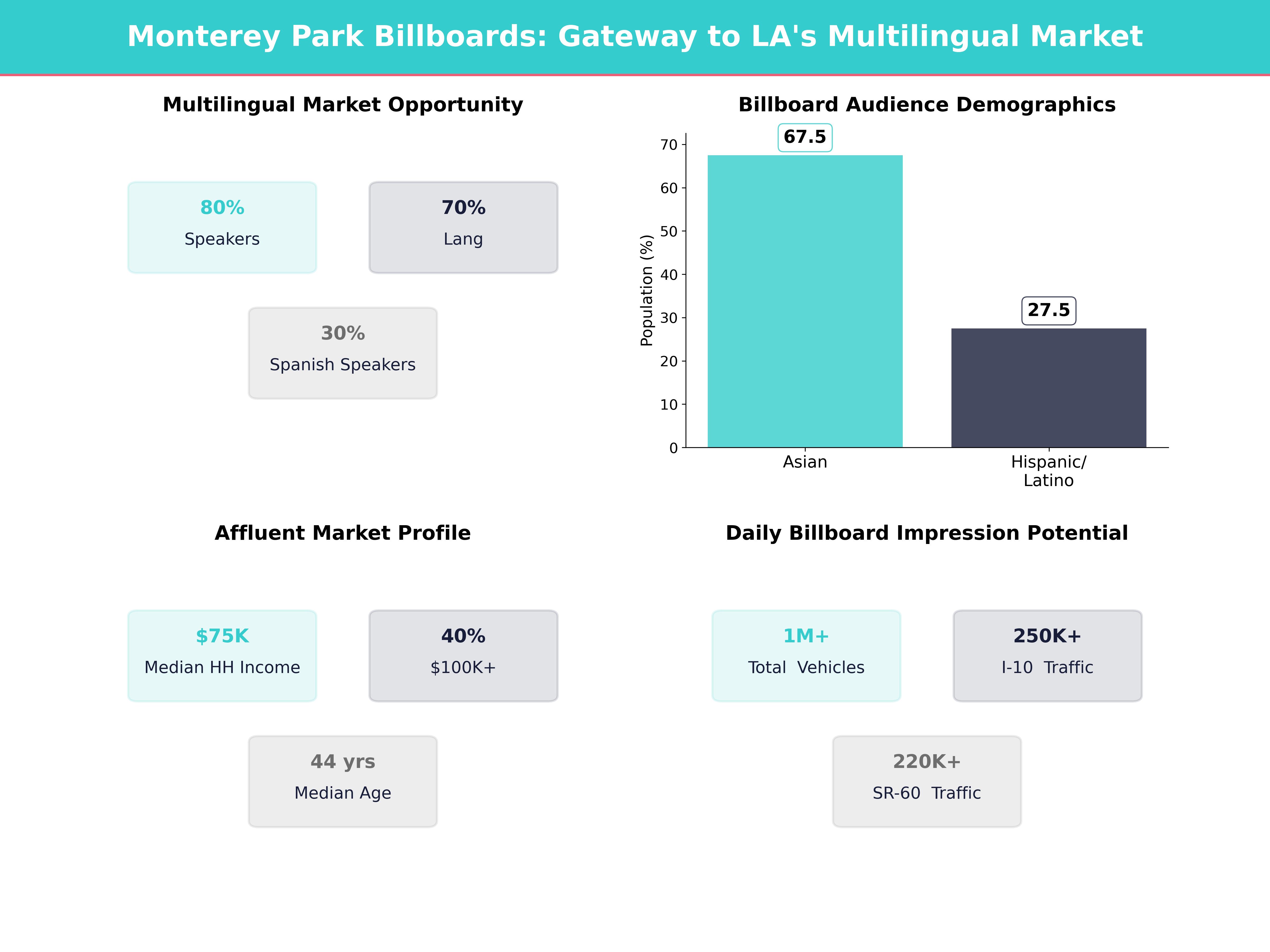
According to recent estimates summarized by the City of Monterey Park, the city has roughly 60,000–62,000 residents (about 60,000 based on the most recent decennial count, with modest growth in subsequent estimates). What makes the Monterey Park area particularly powerful for billboard advertisers is its distinctive demographic mix:
- Around 65–70% of residents are Asian, with Chinese and Taiwanese communities making up the largest share, alongside notable Vietnamese, Filipino, and other East and Southeast Asian groups.
- Roughly 25–30% are Hispanic or Latino, primarily of Mexican and Central American origin, concentrated in multi‑generational households and long‑established neighborhoods.
- The median household income is in the low–mid $70,000s (roughly $73,000–$78,000 in recent multi‑year estimates), with close to 40% of households above $100,000 in income, signaling strong purchasing power for family essentials and discretionary categories.
- The median age is around 44 years, significantly older than the Los Angeles County median (about 37), and nearly 1 in 5 residents is 65+, indicating a sizable senior and caregiver market in addition to families with school‑aged children.
- Homeownership hovers near 50%, higher than many nearby core Los Angeles neighborhoods, and average household size is about 3.0–3.2 people, underscoring the prevalence of family and extended‑family living arrangements.
- In many recent surveys and planning documents, well over 80% of residents report speaking a language other than English at home, with Chinese dialects (Mandarin and Cantonese) and Spanish the most common.
This profile suggests:
- Family‑oriented messaging (education, home services, financial products, health care, groceries, and dining) resonates strongly with a base where a large share of households are middle income or above, with children or elders in the home.
- Bilingual or multilingual creatives can perform exceptionally well. In some Monterey Park and West San Gabriel Valley ZIP codes, over 70% of households speak an Asian or Pacific Island language, and over 30% speak Spanish at home, alongside English.
- Trust and reputation matter: local surveys and business reporting consistently show that immigrant and multi‑generational households rely heavily on word‑of‑mouth and visible, long‑standing brands. Long‑term, consistent billboard presence near Monterey Park helps establish credibility among residents who tend to stay in the area for many years.
For background on city priorities and projects that affect traffic and commerce, it’s worth reviewing updates on the official Monterey Park News & Announcements page, as well as city planning and economic development information on the Monterey Park Economic Development
Where Our Billboards Reach Monterey Park Area Drivers
While Monterey Park itself is largely built out and restrictive for new sign structures, our 38 digital billboards are strategically placed in nearby cities that drivers from the Monterey Park area frequently pass through. This network of billboards near Monterey Park ensures strong coverage across the routes residents rely on every day:
- Montebello (about 4.6 miles away) – Key corridors include the I‑5, I‑60, and major arterials serving shoppers heading to The Shops at Montebello and big‑box retail. The City of Montebello 8–10 million visits per year.
- El Monte (5.9 miles) and Baldwin Park (8.7 miles) – Heavy commuter traffic on the I‑10 and I‑605 as residents travel east–west between the San Gabriel Valley and Downtown Los Angeles. El Monte is a major employment and transit hub, with the City of El Monte noting tens of thousands of daily trips through its freeway and arterial network and the El Monte Station City of Baldwin Park corridors also carry strong commuter volumes.
- Bell Gardens (6.3 miles), South Gate (7.4 miles), and Lynwood (9.3 miles) – Access to I‑710 and I‑105, driving traffic between the ports, South LA, and inland communities. The City of South Gate, City of Bell Gardens City of Lynwood, and neighboring gateway cities sit along major goods‑movement corridors connecting the Port of Los Angeles and Port of Long Beach 17 million TEUs (twenty‑foot equivalent units) of cargo annually, contributing to robust truck and commuter flows.
- Pasadena (7.5 miles) – Strong retail and event‑based traffic around Old Pasadena and the Rose Bowl, pulling visitors from the entire San Gabriel Valley. The Visit Pasadena tourism bureau highlights that the city welcomes millions of visitors annually, with key attractions and events regularly driving daily traffic into the hundreds of thousands on peak days.
- Los Angeles (about 9.7 miles) – Billboards near Downtown LA, the Arts District, and major freeways capture Monterey Park area commuters heading into the central city. The City of Los Angeles remains the primary employment center for the county, with Downtown alone supporting well over 500,000 daily workers and visitors in recent economic assessments.
The Monterey Park area sits between I‑10 to the north and SR‑60 to the south, both of which are among the busiest freeways in Southern California. According to Caltrans, recent counts show:
- I‑10 through the San Gabriel Valley carries well over 250,000 vehicles per day in many segments, with some stretches approaching 280,000 average daily vehicles.
- SR‑60 in nearby Montebello and East Los Angeles carries upward of 220,000 vehicles per day, with truck traffic composing a notable share due to east‑west freight movement.
By placing digital billboard impressions on these and connecting corridors via our screens in Montebello, El Monte, Pasadena, and Los Angeles, we can reach a huge share of daily Monterey Park area drivers—especially commuters and shoppers. Between I‑10, SR‑60, I‑710, and I‑605, total daily volumes in the broader Monterey Park catchment easily exceed 1 million vehicle trips per day, providing substantial reach even with tightly targeted campaigns. For businesses comparing different options for billboard advertising near Monterey Park, this cross‑freeway coverage is often more impactful than a single in‑city board.
Key Travel Patterns to Target
To get the most from campaigns serving the Monterey Park area, it helps to align your schedule and locations with how residents actually move. Understanding these travel patterns makes it easier to choose Monterey Park billboards and nearby placements that line up with your customers’ daily routines:
-
Commutes to Downtown LA and Central LA
- Many Monterey Park area residents work in Downtown LA, the Arts District, and surrounding neighborhoods. Across Los Angeles County, roughly 3 in 4 workers commute by car, and in many San Gabriel Valley communities, auto mode share is even higher.
- Morning commute: roughly 6:30–9:30 a.m. westbound on I‑10 and SR‑60, when freeway speeds regularly drop below 30 mph during peak congestion, increasing dwell time with your creatives.
- Evening commute: 4:00–7:30 p.m. eastbound returning through Montebello and East LA, with similar stop‑and‑go patterns on most weekdays.
- Our Los Angeles and Montebello boards along these routes are ideal for brand awareness, job recruitment, financial services, and higher‑ticket home services, as they can reach the same commuters 5 days per week and deliver very high effective frequency over a 4–8‑week flight.
-
San Gabriel Valley Cross‑Traffic
- Residents drive east–west between City of Alhambra, City of San Gabriel, City of Rosemead, El Monte, and Baldwin Park for shopping, schools, and family visits. The City of Alhambra and nearby cities document consistently high commercial activity along major boulevards that feed directly into Monterey Park.
- Local arterials like Valley Blvd, Garvey Ave, and Atlantic Blvd feed onto I‑10 and SR‑60, amplifying exposure to our nearby boards. Many of these corridors carry 30,000–50,000 vehicles per day, blending local and regional trips.
- Daytime traffic is strong from 10:00 a.m.–3:00 p.m., when school, medical, and shopping trips are most common. This window is optimal for retail, restaurants, health clinics, and education providers that benefit from same‑day or near‑term response.
-
Retail and Dining Trips
- The Monterey Park area is a well‑known destination for Asian dining and specialty grocers, and residents also frequent nearby malls in Montebello, Alhambra, and Pasadena. Popular centers such as Atlantic Times Square tens of millions of visits annually, according to local economic and tourism reports.
- Weekends see elevated traffic volumes, particularly Saturday 11:00 a.m.–8:00 p.m. and Sunday mid‑day, when major regional malls and restaurant clusters often experience 20–40% higher foot traffic compared to weekdays.
- Running weekend‑heavy flights near shopping corridors can be especially effective for promotions and grand openings, with digital creative updates enabling day‑specific offers or limited‑time deals.
-
Transit and Multimodal Access
- The area is crossed by multiple LA Metro 900,000–1 million weekday boardings in recent years, a substantial share of which touch the Eastside and San Gabriel Valley.
- While billboards target drivers and passengers, their routes mirror dense transit corridors—another indicator of where population and commerce concentrate. Many Monterey Park‑adjacent bus stops and park‑and‑ride facilities are within 1–2 miles of our digital boards, reinforcing repeated exposure as people switch between driving and transit.
When building a schedule in Blip, we can leverage dayparting tools to emphasize these high‑value patterns around Monterey Park area traffic flows and fine‑tune billboard advertising near Monterey Park so it lines up with specific times and corridors.
Cultural Insights: Speaking to Monterey Park Area Communities
Monterey Park is often cited as one of the first “suburban Chinatowns” in the United States and remains a leading center of Chinese and broader Asian American life in Southern California. It also has a significant Latino community and a long history of immigrant entrepreneurship. Local coverage from outlets such as LAist, the San Gabriel Valley Tribune, and regional organizations like the San Gabriel Valley Economic Partnership frequently highlights the area’s role as a hub for small businesses, cross‑border commerce, and cultural festivals.
These cultural dynamics shape what works on billboards serving the area:
-
Language Strategy
- Consider bilingual English–Chinese (Simplified or Traditional depending on audience) for citywide campaigns. In many Monterey Park tracts, over half of residents have limited English proficiency, making Chinese‑language support a real differentiator.
- For neighborhood‑level services used heavily by Latino families, English–Spanish creatives may outperform English‑only, especially in adjacent communities where Spanish‑speaking households exceed 40–45%.
- Keep Chinese or Spanish text brief and bold; use English for brand names or URLs where possible to aid search and app discovery.
-
Values and Imagery
- Family, education, and upward mobility are powerful themes. In several San Gabriel Valley school districts, graduation and college‑going rates exceed 90% and 60% respectively, and participation in after‑school and enrichment programs is significantly above national averages—conditions that favor messaging around tutoring, test prep, and youth services.
- Financial products (banks, credit unions, mortgage brokers, and insurance) that emphasize stability, trust, and multi‑generational planning tend to resonate. Asian and Latino households in the region have higher rates of multi‑generational living and homeownership than many urban LA neighborhoods, making wealth‑building and protection messages especially relevant.
- Use respectful, culturally aware imagery—avoid stereotypes and over‑generalization. Real families, local landmarks, or food and festival imagery from the region can build connection and recall.
-
Community‑Oriented Messaging
-
Reference local institutions and events when appropriate. For example:
- The city’s annual Lunar New Year Festival, highlighted on the Monterey Park Special Events page, which typically features hundreds of vendors and performers.
- Cultural programming and markets across the San Gabriel Valley promoted by outlets like LAist and the regional tourism board Discover Los Angeles.
- Local community colleges and universities such as East Los Angeles College Cal State LA, which enroll tens of thousands of largely commuter students from Monterey Park and neighboring cities.
- Campaigns linked to community support, safety, or education—especially following major local news events—can build significant goodwill and align your brand with community resilience.
-
Reference local institutions and events when appropriate. For example:
Timing Campaigns Around Local Events
Events generate surges in traffic and give us hooks for timely creatives. In the Monterey Park area, some of the most impactful include:
-
Lunar New Year in Monterey Park
- Typically draws tens of thousands of visitors over a weekend from across Southern California, with many years seeing total attendance estimated in the 40,000–50,000+ range according to local media and city recaps.
-
Ideal for:
- Food and beverage brands
- Banks and financial services targeting Asian American families
- Telecom, travel, and e‑commerce platforms with Asia‑US connections
- Run event‑linked creatives 2–3 weeks before the festival on boards in Pasadena, Montebello, El Monte, and Los Angeles to capture both local residents and inbound visitors who may be traveling from 20–40 miles away.
-
Pasadena’s Major Events (Rose Parade, Rose Bowl Games, Concerts)
- Pasadena is a regional anchor that draws hundreds of thousands of visitors each year, as covered frequently in the Pasadena Star‑News. The Rose Parade alone typically draws roughly 700,000 spectators in person, and the Rose Bowl Game can host over 90,000 attendees in the stadium.
- Monterey Park area residents often travel through Pasadena for shopping, dining, and events, and regional visitors frequently pass near or through the San Gabriel Valley on freeways.
- Campaigns timed for late December–early January and specific concert or sports dates can capture heightened traffic on I‑210 and connecting roads, as well as increased hotel and restaurant activity highlighted by Visit Pasadena.
-
Back‑to‑School and Graduation Seasons
- The Alhambra Unified School District and nearby districts such as Montebello Unified and San Gabriel Unified serve many Monterey Park families. Combined, these districts educate tens of thousands of students across elementary, middle, and high schools.
- Back‑to‑school (late July–August) and graduation (May–June) are perfect for after‑school programs, tutoring, apparel, and tech products. Households typically increase spending on school‑related categories by 20–30% in these months compared to off‑season averages, according to retail industry analyses.
Because Blip lets us start and stop campaigns at any time, we can spin up short, event‑centric flights serving the Monterey Park area around these key seasonal peaks and quickly adjust if dates or attendance expectations shift.
Creative Best Practices for Monterey Park Area Billboards
With digital roadside inventory, we have only a few seconds to communicate. For campaigns reaching the Monterey Park area, we recommend:
-
Ultra‑Clear Hierarchy
- One main idea, one main visual. Research on roadside advertising suggests that messages with 10 words or fewer significantly outperform more text‑heavy designs in recall and comprehension.
- 7–10 words of text maximum, plus logo/URL/QR code.
- High contrast colors for visibility in bright Southern California light, where clear‑day sun is common 260+ days per year in the LA region.
-
Strategic Use of Language
- Use English headlines with secondary Chinese or Spanish text for a call‑to‑action, depending on your target segment.
- Avoid dense translations; focus on a key benefit or offer in the secondary language. Side‑by‑side bilingual layouts that keep total text short perform better than trying to fully duplicate long English copy.
-
Community‑Specific Visuals
- Visuals that reflect Asian and Latino families, local food culture, or recognizable regional backdrops (San Gabriel Mountains skyline, Pasadena City Hall, Downtown LA in the distance) build familiarity and improve brand favorability in surveys of multicultural audiences.
- Be careful with religious or political symbolism—Monterey Park is diverse in beliefs and viewpoints, and polarizing imagery can reduce appeal across key segments.
-
Mobile‑Friendly Calls to Action
- Many drivers will follow up on their phones. In Los Angeles County, smartphone adoption is near‑universal among adults, with mobile search and map usage dominating local discovery. Simple URLs, recognizable app icons, or “Search: [Brand + Keyword]” CTAs work well.
- For hyper‑local businesses, pair a short message like “2 Exits Ahead in Montebello” or “Just off Atlantic Blvd” when directing traffic to a nearby location; distance‑based cues have been shown to increase visit intent for drivers within 3–5 miles. This kind of localized CTA is particularly effective when used on billboard rental near Monterey Park that sits just off key exits.
-
Versioning for Different Corridors
- Use commuter‑focused messaging on boards along I‑10 and SR‑60 (e.g., professional services, banking, education, healthcare), where average trip lengths and incomes tend to be higher.
- Use shopping/dining‑focused messaging on boards closer to retail centers in Montebello, Pasadena, and South Gate, where a larger share of trips are discretionary and weekend‑oriented.
With digital boards, we can easily swap variations and test what works best for the Monterey Park area audience, iterating quickly based on performance metrics such as web traffic, coupon redemptions, or store visit patterns.
Using Blip’s Tools to Maximize Impact Near Monterey Park
Blip’s flexibility is a strong fit for the fragmented but high‑value geography around Monterey Park. We recommend using our tools in these ways to get more from billboard advertising near Monterey Park:
-
Geographic Clustering Around Key Routes
-
Cluster impressions on boards:
- East–west commuters: El Monte, Baldwin Park, Los Angeles (I‑10 and SR‑60 corridors).
- Retail and dining: Montebello, Pasadena, South Gate, and nearby commercial hubs such as Alhambra and San Gabriel.
- This builds a surround‑sound effect for Monterey Park area residents as they move through their normal routines. Given that many local workers commute 10–20 miles each way, repeat exposure on multiple corridors substantially boosts reach and frequency.
-
Cluster impressions on boards:
-
Dayparting by Objective
- Morning/Evening Rush Hours: Great for brand awareness and upper‑funnel campaigns targeting commuters who travel the same routes 200+ days per year.
- Midday and Early Evening (10 a.m.–7 p.m.): Ideal for promotions that require same‑day action (meals, retail offers, events), particularly among part‑time workers, seniors, and caregivers who run errands during off‑peak times.
- Late Evening (after 8 p.m.): Often lower cost per impression; useful for budget‑sensitive campaigns needing broad frequency or targeting nightlife, streaming, gaming, and delivery services.
-
Budget and Bid Adjustments
- Start with moderate bids to secure visibility across several locations, then increase bids on the best‑performing corridors (often I‑10/I‑60 commuters) once early performance data is in.
- Use short test flights—3–7 days—around Monterey Park area traffic corridors to learn where your creative resonates most, then reinvest in boards that correlate with higher click‑through rates, search lift, or store traffic in surrounding ZIP codes.
-
Creative Rotation and Testing
-
Rotate multiple creatives:
- One English‑dominant
- One English–Chinese
- One English–Spanish
- Compare performance indicators (web traffic from local ZIP codes, store visits, search volume) during each rotation. For many brands, even a 10–20% uplift in response from bilingual creatives can justify maintaining those language variants long‑term.
-
Rotate multiple creatives:
By combining these tools with carefully chosen billboards near Monterey Park, advertisers can cover both everyday commuters and occasional visitors in a cost‑efficient way.
Who Can Win with Billboards Serving the Monterey Park Area?
Because of its density, demographics, and location, campaigns serving the Monterey Park area can work especially well for:
-
Restaurants and Food Brands
- Asian cuisines, bubble tea, bakeries, and quick‑service concepts can tap into a population known for dining out and exploring new options. Local and regional news outlets routinely profile thriving food clusters in Monterey Park, Alhambra, and San Gabriel that draw diners from across Los Angeles County’s 10‑million‑plus residents.
-
Education and Tutoring Services
- After‑school enrichment, test prep, language schools, and colleges that speak to academic achievement and future success. In many San Gabriel Valley high schools, college enrollment rates exceed 60–70% of graduates, reflecting strong demand for academic support services.
-
Financial Institutions & Real Estate
- Banks, credit unions, investment advisors, and real estate agents highlighting multilingual service and community roots. Home prices in the San Gabriel Valley have risen significantly over the past decade, and many households are focused on wealth preservation, refinancing, and intergenerational transfers.
-
Healthcare Providers
- Clinics, dental practices, optometrists, and specialty care that provide language‑concordant services. With nearly 20% of Monterey Park residents aged 65+ and many more acting as caregivers, senior care, chronic disease management, and preventive services are high‑priority categories.
-
Local and Regional Retailers
- Grocers, electronics, furniture, and automotive dealers that draw shoppers from across the San Gabriel Valley. Car ownership is near‑universal among local households, and auto‑related spending (purchase, lease, service) remains a major expenditure category.
Local news coverage from outlets like the Los Angeles Times LA Daily News, and the San Gabriel Valley Tribune often highlights how the San Gabriel Valley’s immigrant and family‑oriented communities drive small‑business growth; billboard campaigns that mirror this focus can gain traction quickly. For many of these sectors, flexible billboard rental near Monterey Park provides an accessible way to test out‑of‑home without committing to long‑term static leases.
Putting It All Together
To effectively reach audiences in the Monterey Park area using our 38 digital billboards:
- Focus on high‑traffic commuter and retail corridors in nearby cities like Montebello, El Monte, Pasadena, South Gate, and Los Angeles, where combined daily traffic exceeds 1 million vehicle trips across freeways and key arterials.
- Align your schedule with rush hours, weekend shopping patterns, and major cultural events such as Lunar New Year and Pasadena’s Rose Parade/Rose Bowl festivities.
- Craft bilingual, family‑oriented, and trust‑building creatives that reflect the area’s Asian and Latino communities and acknowledge the city’s role as a long‑standing immigrant gateway.
- Use Blip’s dayparting, geographic targeting, and creative rotation to test, learn, and scale what works, reallocating budget toward corridors and languages that deliver measurable lifts in inquiries, visits, or sales.
By understanding how Monterey Park area residents live, commute, and shop—and by leaning into the flexibility of digital out‑of‑home—we can build campaigns that not only generate impressions on Monterey Park billboards and nearby locations, but also earn lasting visibility and loyalty in one of Southern California’s most dynamic and culturally influential communities.