Billboards near Commerce, CA
No Minimum Spend. No Long-Term Contracts. Just Results.
Trusted by Leading Brands


Billboard advertising
near Commerce has never been easier
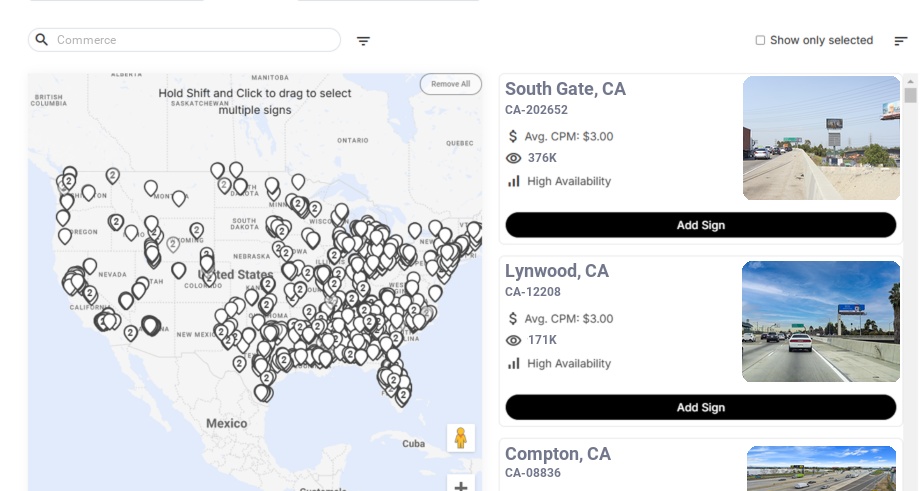



How much is a billboard near Commerce?
Why Choose Blip for Billboard Advertising near Commerce
Blip lets you launch Commerce billboards fast, reaching I-5 shoppers near Citadel Outlets without a long-term contract.
Set a daily budget for Commerce and scale with demand—ideal for weekday workers on I-710 and weekend retail traffic.
Daypart your Blip ads in Commerce for 4–7 a.m. shift changes or Fri–Sun outlet crowds to match real traffic peaks.
No contracts mean you can test Commerce corridors serving logistics hubs, then shift spend based on what performs.
Track Commerce campaign results in real time and adjust creative for commuters on I-5, SR-60, and I-710.
Use Blip’s creative tools to run bilingual Commerce ads that stand out for Southeast LA shoppers, workers, and drivers.
Frequently Asked Questions About Billboard Advertising near Commerce
How much does a billboard cost near Commerce, California with Blip?
With Blip, you control exactly what you spend on Commerce billboards by setting your own daily budget, so you can start with just a few dollars a day and scale up whenever you’re ready. Each blip is a brief 7.5–10 second display on digital billboards near Commerce, California, and you only pay for the blips you actually receive. Pricing for each blip depends on when and where you choose to run your ad, along with overall advertiser demand.
Where can I advertise with Blip near Commerce, California?
There are 42 digital billboards serving the Commerce area from nearby cities like Montebello, Bell Gardens, South Gate, Lynwood, Los Angeles, El Monte, Norwalk, Artesia, Compton, and Santa Fe Springs. For brands specifically looking for billboards near Commerce, this cluster of locations gives you flexible options to reach the right audiences without needing a sign inside city limits. These boards are strategically positioned along major routes like I-5, I-710, SR-60, and nearby connectors.
What kind of audience do Commerce, California billboards reach?
The Commerce area functions less as a bedroom community and more as an industrial, commercial, and retail center for the greater Southeast Los Angeles region. More than 70% of land in and around Commerce is devoted to industrial and commercial uses, and the city’s daytime population swells far beyond its resident base due to inbound workers and shoppers. Nearby cities and the surrounding freeway network put well over 500,000 residents within a short drive of Commerce.
When is the best time to run Commerce, California billboards with Blip?
Traffic near Commerce is influenced by commuters, industrial shifts, and shopping patterns, so timing matters. Typical peak periods are morning from 6–9 a.m. and evening from 3–7 p.m., with weekend traffic surges near Citadel Outlets and nearby retail corridors. For shoppers, the page recommends focusing blips from Friday afternoon through Sunday evening, especially during midday blocks from 10 a.m.–6 p.m.
Why are Commerce, California billboards effective for reaching shoppers and workers?
Commerce is encircled by some of Southern California’s most congested, high-exposure corridors, including I-5, SR-60, and I-710. Those roads carry heavy daily traffic and create long dwell times, especially where speeds drop below 25 mph or traffic stays congested for hours. The area also draws workers heading to warehouses, rail yards, industrial parks, and shoppers visiting Citadel Outlets, making it a strong market for repeated exposure.
Do I need a contract to advertise with Blip near Commerce?
No, Blip has no long-term contracts or minimum commitments. You can start, pause, or stop your campaign at any time.
How fast can I launch a billboard campaign with Blip near Commerce?
You can have your campaign live in minutes. Create a free account, select your locations, set your budget, upload your design, and start running once approved.
Where can I advertise with Blip near Commerce?
Blip has digital billboards near Commerce. You can browse available locations on a map, choose the ones that fit your audience, and start advertising right away.
Still have questions? Launch a campaign in minutes — no contracts, no commitments.
Start Your CampaignCommerce Billboard Advertising Guide
The Commerce, California area sits at the crossroads of Los Angeles County Citadel Outlets. With 42 digital billboards serving the Commerce area from nearby cities like Montebello Bell Gardens South Gate, Lynwood, Los Angeles, El Monte, Norwalk, Artesia, Compton Santa Fe Springs, we can help advertisers tap into a dense mix of commuters, shoppers, and workers moving through this highly trafficked logistics and retail hub. For brands specifically looking for billboards near Commerce, this cluster of locations gives you flexible options to reach the right audiences without needing a sign inside city limits.

Understanding the Commerce Area Market
The City of Commerce 12,500–13,000 residents in an area of just 6.5 square miles, it functions less as a bedroom community and more as an industrial, commercial, and retail center for the greater Southeast Los Angeles region. More than 70% of land in and around Commerce is devoted to industrial and commercial uses, and the city’s daytime population swells far beyond its resident base due to inbound workers and shoppers. This imbalance between residents and workers is exactly why strategically placed Commerce billboards in nearby cities can outperform many purely residential markets.
Key market characteristics:
- Industrial & logistics hub: Commerce is heavily zoned for industrial and commercial use, with hundreds of warehouses, distribution centers, rail‑served facilities, and manufacturing plants clustered along the I‑5, I‑710, and rail corridors. The Ports of Los Angeles and Long Beach together processed roughly 16–17 million TEUs in 2023 (about 8.6 million at the Port of Los Angeles and 8.0 million at the Port of Long Beach
- Regional retail draw: Citadel Outlets along I‑5 is a regional and tourist magnet. Publicly cited figures from local tourism and retail sources often estimate 10–14 million visits annually, with peak shopping periods (Black Friday weekend, December holidays, back‑to‑school) drawing traffic spikes that can push weekend parking occupancy toward 90–100%. The center’s visibility from I‑5—where daily traffic counts exceed 250,000 vehicles on some segments—gives brands sustained exposure to both planned shoppers and impulse visitors.
- Dense surrounding population: While Commerce itself is small, it is surrounded by heavily populated cities. Los Angeles County has just under 10 million residents, making it the most populous county in the United States. Nearby cities such as Los Angeles (nearly 4 million residents), Downey 110,000), Norwalk (around 100,000), Montebello 60,000), South Gate (around 90,000), and Bell Gardens 40,000) put well over 500,000 residents within a short drive of Commerce. Regional planners like the Southern California Association of Governments forecast that the Gateway Cities subregion (which includes Commerce, South Gate, and neighboring communities) will continue to add tens of thousands of residents over the next decade, sustaining long‑term audience growth.
- Bilingual, multicultural audience: In Southeast Los Angeles communities like Commerce, Montebello, Bell Gardens, and South Gate, Spanish is spoken at home by roughly 60–85% of households in many census tracts, according to regional planning profiles. In several adjacent neighborhoods, Latino/Hispanic residents account for 70–95% of the local population. Effective campaigns near Commerce therefore perform best when they incorporate bilingual or culturally aware messaging, with many advertisers reporting higher response rates when at least 50% of their creatives are in Spanish or bilingual formats.
For local context, advertisers can review demographic and economic information through the City of Commerce, business and permitting resources from Los Angeles County Los Angeles Economic Development Corporation Gateway Cities Council of Governments.
Why Billboards Serving the Commerce Area Are So Powerful
Commerce is encircled by some of Southern California’s most congested, high-exposure corridors, all documented by Caltrans District 7 and regional mobility partners like LA Metro
- I-5 (Santa Ana Freeway): Runs north–south along Commerce’s western edge, connecting Orange County, downtown Los Angeles, and the Central Valley. Segments of I‑5 in the Commerce/Montebello/LA corridor routinely carry 220,000–260,000 vehicles per day, with truck percentages in the 10–15% range. Average peak‑hour speeds can drop below 25 mph, increasing dwell time and impressions for freeway-visible digital billboards.
- SR-60 (Pomona Freeway): Just north of Commerce, SR‑60 carries 200,000+ vehicles per day in the East LA and Monterey Park area, including a heavy mix of commuter traffic and freight bound for the San Gabriel Valley and Inland Empire. In some segments, trucks represent 12–18% of all vehicles, elevating the value of campaigns aimed at logistics and industrial buyers.
- I-710 (Long Beach Freeway): A core freight and commuter corridor from the Ports of LA/Long Beach up toward Commerce and beyond. Caltrans counts show 150,000–180,000 vehicles per day on many I‑710 segments, with one of the highest heavy‑duty truck shares in the region (often 20%+ of all traffic). Safety and environmental studies regularly identify I‑710 as a top corridor for goods movement, making it ideal for B2B, hiring, and fleet‑focused messaging.
- I-105 / I-605 influence: While slightly farther, these freeways feed traffic toward the Commerce area and our boards in Norwalk, Artesia, Lynwood, and nearby locations. I‑605 segments near Norwalk and Santa Fe Springs typically carry 160,000–190,000 vehicles per day, much of it from workers traveling between inland suburbs and the I‑5/I‑710 industrial belt.
Our 42 digital billboards in Montebello, Bell Gardens, South Gate, Lynwood, Los Angeles, El Monte, Norwalk, Artesia, Compton, and Santa Fe Springs are strategically positioned along these routes. That allows you to:
- Capture daily commuters traveling between Southeast LA, downtown LA, and Orange County. In LA County overall, more than 75% of workers commute by car, and average one‑way commute times exceed 30 minutes, giving you multiple daily exposure opportunities with Commerce billboards and nearby freeway units.
- Reach workers heading to and from warehouses, rail yards, and industrial parks in and near Commerce, where thousands of jobs concentrate along Washington Blvd, Atlantic Blvd, Garfield Ave, and Telegraph Rd.
- Influence shoppers and tourists on their way to Citadel Outlets and surrounding retail corridors. Weekend traffic volumes near major retail nodes can rise 10–20% above weekday baselines during key holiday shopping periods, amplifying retail campaigns.
- Reinforce brand presence across multiple touchpoints as drivers travel through adjacent cities. By placing creatives on several boards along the same commute path, brands commonly see effective frequencies of 15–30 impressions per commuter per month, even at modest budgets.
For deeper traffic planning, advertisers often pair Caltrans count data with regional studies from Metro’s Highway Program Gateway Cities Council of Governments
Key Audience Segments in the Commerce Area
Because the Commerce area is more of a work-and-shop destination than a pure residential market, thinking in terms of audience segments rather than just residents is critical. Choosing billboards near Commerce that align with these segments will help you prioritize the best locations and time frames.
1. Industrial & Logistics Workforce
- The Southeast LA and Gateway Cities region supports tens of thousands of jobs in warehousing, trucking, rail, and manufacturing. Industrial job density in Commerce and neighboring Vernon ranks among the highest in Los Angeles County.
- Nearby employment centers include large distribution hubs, rail yards, and manufacturing clusters in Commerce, Santa Fe Springs, South Gate, and Compton. Many of these facilities employ hundreds to several thousand workers each across multiple shifts.
- Workers originate from nearby cities such as Los Angeles, El Monte, Norwalk, Compton, Lynwood, and Santa Fe Springs. Regional commuting profiles show that in many Gateway Cities communities, 40–60% of workers commute to job sites more than 10 miles from home, often crossing through the Commerce area.
-
Schedules skew toward:
- Early morning shifts (arrivals starting 4–6 a.m.), when many facilities launch loading and receiving operations.
- Afternoon and swing shifts (departures 2–4 p.m., arrivals 3–5 p.m.), when congestion spikes on local arterials such as Atlantic Blvd, Washington Blvd, and Telegraph Rd.
- Overnight truck movements, as drayage and long‑haul carriers use off‑peak hours to avoid daytime congestion and port gate queues.
Ideal use cases:
- Recruiting campaigns (CDL drivers, warehouse workers, maintenance staff, forklift operators) for employers competing in a tight labor market where local logistics and warehousing wages have risen 15–25% over the last several years.
- B2B services: logistics software, insurance, fleet services, equipment leasing, and compliance services for carriers impacted by evolving environmental and safety regulations.
- Financial services: payday alternatives, local credit unions, tax prep, and banking products aimed at shift workers and contractors.
2. Value-Oriented Shoppers & Tourists
Citadel Outlets and nearby shopping centers attract:
- Budget-conscious local families from Southeast LA, where household incomes in several nearby cities fall below the county median, heightening price sensitivity and interest in outlet and discount retail.
- Tourists staying in downtown LA, Hollywood, or Anaheim seeking outlet deals; local tourism reports indicate that Los Angeles County welcomes over 50 million visitors per year, and outlet centers capture a meaningful share of spending from international visitors.
- International visitors who often arrive via tour buses or rental cars along I‑5; on peak weekends, dozens of charter buses may cycle through Commerce, delivering groups that can number 40–60 shoppers per bus.
Ideal use cases:
- Retail promotions: limited-time sales, new store openings, loyalty programs, and “doorbuster” offers timed to high‑traffic retail weekends when outlet traffic can jump 30–40% above non‑peak weekends.
- Hospitality: nearby hotels, dining options, attractions, and entertainment venues looking to capture pre‑ or post‑shopping spend. In LA County, visitor spending on food and beverage alone totals several billion dollars annually, creating strong cross‑sell opportunities that are well-suited to commerce-focused billboard advertising near Commerce.
- Payments and fintech: buy-now-pay-later, cash-back apps, and international money transfers, particularly for cross‑border shoppers and families who regularly send remittances abroad.
For tourism and visitor behavior insights, advertisers can reference regional tourism organizations such as Discover Los Angeles and county information via LA County’s tourism and economic pages
3. Local Small Businesses & Service Providers
Surrounding communities have dense residential neighborhoods, many with multi-generational households:
- In nearby Southeast LA cities, average household sizes often range from 3.5 to 4.5 persons per household, compared with roughly 3.0 for the county overall. This drives strong demand for auto repair, healthcare clinics, neighborhood grocery, quick-service restaurants, and household services.
- A significant share of residents work non-traditional hours in logistics, hospitality, and manufacturing. In several Gateway Cities communities, 15–25% of workers report evening, night, or rotating shifts, making off‑peak and extended‑hours services particularly attractive.
- Local purchasing power is amplified by population density: parts of Southeast LA reach residential densities above 15,000 residents per square mile, versus about 2,500 per square mile countywide.
Ideal use cases:
- “Near you” awareness campaigns for clinics, auto shops, grocery, restaurants, and local chains, emphasizing short travel times and easy freeway or arterial access.
- Bilingual campaigns emphasizing convenience, trust, and community—such as highlighting decades in business, locally owned status, or partnerships with community organizations tracked by cities like South Gate, Montebello Bell Gardens
4. Commuters into Downtown Los Angeles and Beyond
Our boards serving the Commerce area catch commuters:
- Traveling from Norwalk, El Monte, and the San Gabriel Valley toward central LA job centers. In some of these communities, more than 70% of outbound commuters travel west or northwest toward job clusters in Downtown LA, Commerce, Vernon, and the Westside.
- Moving between the Long Beach/Harbor Area and downtown through I‑710 and I‑5. The Harbor area hosts tens of thousands of port, logistics, and industrial jobs, many of which are linked directly to inland warehouses and offices accessed through Commerce.
Ideal use cases:
- Brand-building for regional and national brands that benefit from repeated daily exposure to the same commuting base.
- Streaming, telecom, and app-based services, which often see measurable lifts in web traffic or app installs in zip codes along targeted corridors when out-of-home campaigns run at sufficient frequency.
- Higher education and workforce training programs, including community colleges and trade schools in the greater LA area such as East Los Angeles College Rio Hondo College
Local media like the Los Angeles Times Whittier Daily News, and Los Angeles Daily News can be useful references to track local economic and commuting trends that shape these segments, including coverage of major employer expansions, port conditions, and transportation projects.
Crafting Effective Creative for the Commerce Area
The Commerce area’s visual environment is fast-paced, industrial, and freeway-dominated. That has direct implications for creative design and for how you use Commerce billboards to stand out amid heavy traffic and dense signage.
1. Prioritize Simplicity and Distance Legibility
Most impressions near Commerce occur at 40–65 mph on freeways or major arterials, with typical view times of only 6–10 seconds as drivers approach and pass a billboard. We recommend:
- 6–8 words max of primary text to ensure full comprehension at speed.
- Large, bold fonts (sans-serif) with strong contrast (e.g., white on dark blue, yellow on black). Industry research on digital out-of-home (DOOH) shows that high-contrast creatives can improve ad recall by 20–30% compared with low‑contrast designs.
- A single, high-impact image or icon rather than cluttered collages. Studies commonly find that simple creatives can boost message comprehension by up to 40% in fast‑moving traffic environments.
2. Bilingual and Culturally Relevant Messaging
Given high Spanish usage in nearby communities:
- Consider bilingual boards (English + Spanish) or alternating English- and Spanish-only creatives via different “blips.” Advertisers targeting heavily Latino corridors in LA County frequently allocate 50–75% of impressions to Spanish or bilingual assets when the offer is mass‑market.
- Use familiar cultural references carefully and respectfully: food, family, local sports, and community events. Local sports references tied to the Lakers, Dodgers, or Rams can resonate strongly, especially during playoff or opening-day periods.
- Highlight benefits like “ahorra,” “cerca de ti,” and “sin compromiso” for value-driven offers. For finance and telecom, Spanish-language campaigns in LA have often driven higher click‑through or call volumes per impression than English‑only equivalents when targeted to majority‑Latino zip codes.
3. Emphasize Location and Convenience
Commerce is about access and convenience:
- Use directional cues: “5 minutes from this exit,” “Next to Citadel Outlets,” or “Off I-5 at Washington Blvd.” Studies of driver behavior indicate that including a clear exit name or distance marker can increase navigation follow‑through by 10–20%.
-
Include a simple call-to-action:
- “Exit Atlantic Blvd”
- “Order now – delivery today”
- “Apply on your phone in 2 minutes”
- Short URLs, QR codes (on slower arterials), and clear icons (phone, app store badges) help convert brief attention into action. On high-speed freeways, QR codes are less effective, while on surface streets with speeds under 35 mph, scan rates can be meaningfully higher.
4. Make Offers Time-Sensitive When Possible
Because Blip allows flexible scheduling, you can align:
- “This weekend only” sales with Friday–Sunday blips, when retail centers near Commerce often see 20–30% higher traffic than midweek days.
- Lunch specials (11 a.m.–2 p.m.) or late-night offers (9 p.m.–1 a.m.), capturing workers on meal breaks and after shifts. Quick-service restaurants near industrial corridors often report double-digit percentage lifts in peak-period transactions during well-timed out-of-home campaigns.
- Weekly promos around paydays (1st and 15th of the month, or typical Friday pay cycles), when spending on discretionary items like dining, apparel, and entertainment tends to spike.
Smart Timing & Dayparting Strategies
Traffic near Commerce is influenced by commuters, industrial shifts, and shopping patterns. We can use Blip’s scheduling tools to align with these rhythms and make billboard advertising near Commerce feel timely and relevant.
1. Weekday Commuter Peaks
Typical peak periods:
- Morning: 6–9 a.m. on I-5, I-710, and SR-60, when travel times on major segments can be 40–70% longer than free‑flow conditions.
- Evening: 3–7 p.m., with extended congestion common in LA. Evening peaks often last 4+ hours, creating long windows for exposure.
Best for:
- Brand awareness for regional and national brands seeking broad reach among workers and students.
- Professional services (education, legal, financial) that benefit from repeated daily impressions.
- App, streaming, and telecom products that can be searched or downloaded on mobile devices once commuters reach home or work.
2. Warehouse & Manufacturing Shifts
To reach logistics workers:
- Early shift windows: 4–7 a.m. and 2–4 p.m. to catch arrivals and departures at large distribution centers.
- Swing/night: 9 p.m.–1 a.m. where night visibility of digital boards is particularly striking, and traffic is less congested but more truck‑heavy.
Best for:
- Hiring campaigns in a tight labor market, where even a 1–2% improvement in application volume can significantly reduce recruiting costs.
- Quick-service restaurants near industrial corridors (breakfast, late dinner) looking to lift visits during non‑traditional meal periods.
- Financial services used by shift workers (check cashing alternatives, remittances, short-term savings products).
3. Weekend Shopping & Entertainment
Weekend traffic surges near:
- Citadel Outlets along I-5.
- Retail corridors in Montebello, South Gate, Norwalk, and nearby cities highlighted on local city and business pages such as Norwalk’s economic development resources and City of Montebello business services
Focus your blips:
- Friday afternoon through Sunday evening.
- Midday blocks (10 a.m.–6 p.m.) when families and tourists are most active and parking demand at major centers is highest.
Best for:
- Retail and outlet stores rolling out high‑margin promotions.
- Entertainment, events, and attractions in greater LA, including concerts, theme parks, and family venues that draw from Southeast LA.
- Dining and quick-service brands aiming to increase check averages with limited‑time offers and combos.
4. Long-Haul and Regional Trucking
Freight patterns are less “9-to-5”:
- Night and early morning traffic on I-5 and I-710 includes regional and long-haul trucking. On some overnight periods, trucks can represent 25–30% of vehicles on key freight segments.
-
These impressions are valuable for:
- Fuel stations and truck stops positioned along key corridors.
- Fleet services and trucking schools that need to reach drivers and aspiring drivers directly.
- Safety messages and compliance-related products responding to evolving rules tracked by agencies like the California Air Resources Board and local port authorities.
Using Blip’s Capabilities to Target the Commerce Area
With 42 digital billboards in nearby cities serving the Commerce area, we can build highly customized, cost-efficient campaigns. Whether you are testing billboard rental near Commerce for the first time or scaling an existing out-of-home strategy, Blip’s platform lets you refine placements and budgets at a granular level.
1. Board-Level Targeting Around Commerce
Use different clusters based on your objectives:
-
Commerce shopping and retail focus:
- Prioritize boards in Montebello, Los Angeles (near I-5), and South Gate that intercept traffic approaching Citadel Outlets. These corridors collectively reach hundreds of thousands of daily drivers, including the 10–14 million annual visitors estimated for Citadel.
-
Industrial workforce focus:
- Combine boards in Bell Gardens, South Gate, Lynwood, Compton, and Santa Fe Springs along I-710 and key arterials where truck percentages often exceed 20% and shift workers move in predictable waves.
-
Regional commuter focus:
- Add El Monte and Norwalk boards that hit commuters traveling SR-60, I-605, and I-5 from the San Gabriel Valley and southeast suburbs into central job hubs.
You can mix these locations to create reach (many boards, fewer blips each) or frequency (fewer boards, more blips) depending on your budget and goals. For example, a reach strategy may aim for 10–20 boards with moderate bidding to touch a broad audience, while a frequency strategy may focus on 5–8 boards along a specific route to achieve repeated exposures.
2. Budget Control Through Bid Pricing
Blip’s model lets you:
- Set a maximum bid per blip (each display turn), allowing you to manage cost per impression closely.
- Increase bids during peak times (e.g., Friday evening shopping traffic, weekend afternoons) and lower them during off-peak (late-night or midday weekdays) when competition tends to drop and CPMs can fall by 20–40%.
- Test different bid levels on specific boards to discover where you can get the lowest cost per thousand impressions (CPM). On some corridors, advertisers find that shifting just 20–30% of spend to lower‑cost time blocks yields significantly higher total impressions without increasing budget.
In high-demand corridors near Commerce, it’s often smart to:
- Start with a moderate bid.
- Monitor delivery volume and adjust weekly based on impression reports and downstream metrics (web traffic, calls, store visits).
- Shift budget toward boards delivering better performance or better-aligned audiences, gradually pruning underperforming locations.
3. Creative Rotation and Testing
Because you can upload multiple creatives, you can:
- Run English-only, Spanish-only, and bilingual versions simultaneously, then favor what resonates best (measured through site traffic, coupon redemptions, QR scans, or store visits). Many marketers aim for at least 3–4 creative variations during a test period to capture meaningful differences in performance.
-
Test different value propositions:
- “Lowest price” vs. “fastest service” vs. “most trusted.”
- For services, framing around “same-day,” “no credit check,” or “walk‑in welcome” can materially impact response rates.
-
Seasonally rotate:
- Back-to-school, holiday shopping, tax season, or summer travel campaigns aligned with local calendars and retail cycles highlighted by outlets like Citadel Outlets and regional tourism sources.
Examples of Commerce Area Campaign Approaches
Below are conceptual examples of how advertisers can use boards serving the Commerce area effectively. These illustrate how strategic billboard rental near Commerce can be tailored to different verticals and goals.
1. Outlet Retailer Near Citadel
Goal: Drive weekend store traffic.
Approach:
- Boards targeted along I-5 and key approaches in Montebello, South Gate, and Los Angeles, all serving the Commerce area. These corridors can collectively reach hundreds of thousands of vehicles daily, including a large share of the 10–14 million yearly Citadel visitors.
- Dayparting: heavy Friday–Sunday from 10 a.m.–7 p.m., covering the window when many families spend 2–4 hours at outlet centers.
- Creative: “Extra 30% Off – This Weekend Only – Exit at Citadel Outlets.” Simple visual of the product category and clear exit cue.
- Bilingual rotations to capture local and visiting Spanish-speaking shoppers, who may represent 60–80% of households in surrounding neighborhoods.
2. Regional Logistics Employer
Goal: Hire warehouse associates and CDL drivers.
Approach:
- Focus on boards in Bell Gardens, Lynwood, Compton, and Santa Fe Springs, all serving the Commerce area logistics cluster where industrial job centers employ thousands of workers per square mile.
- Dayparting: 4–7 a.m., 2–4 p.m., and 9–11 p.m. to align with shift changes and overnight trucking operations.
- Creative: “CDL Drivers: Up to $X/hr + Benefits. Apply at [short URL].” Alternate with Spanish creative highlighting pay and stability (“hasta $X/hora + beneficios”). Include simple icons (steering wheel, truck) that can be recognized in under 2 seconds at freeway speeds.
3. Quick-Service Restaurant Near Industrial Park
Goal: Increase breakfast and lunch traffic.
Approach:
- Use nearby boards in South Gate, Montebello, and Norwalk that commuters pass on their way to Commerce-area jobs. In these corridors, 60–70% of traffic during peak periods is work‑related.
- Dayparting: 5–10 a.m. (breakfast) and 11 a.m.–2 p.m. (lunch), when fast-casual and QSR outlets often generate 50–60% of daily transactions.
- Creative: “Breakfast Combo $4.99 – 5 Minutes Ahead on [Street].” Rotating Spanish/English versions emphasizing value (“desayuno desde $4.99”) and speed (“rápido, para llevar”).
4. Local Healthcare Clinic
Goal: Brand awareness and appointment volume among families and workers in Southeast LA.
Approach:
- Broad mix of boards in Montebello, Bell Gardens, South Gate, Lynwood, and Norwalk serving the Commerce area, collectively touching a population base of hundreds of thousands within a short driving radius.
- All-day presence, with slightly higher bids during commute hours to reach insured workers and caregivers.
- Creative: “Walk-In Clinic – Open Late – Most Insurance Accepted.” Spanish version emphasizes “clínica sin cita – abierto hasta tarde – aceptamos la mayoría de seguros.” Clinics in similar corridors often see single- to low double-digit percentage increases in calls and web visits during sustained OOH campaigns.
Aligning with Local Events and News
The Commerce area sits near many regional events and news cycles that you can leverage:
- Sales and campaigns synced with major shopping holidays (Black Friday, back-to-school, Labor Day) and regional events promoted by outlets like Discover Los Angeles.
- Sports-related creative timed around LA’s pro sports seasons (Lakers, Dodgers, Rams), referenced by local outlets like the Los Angeles Times and local TV stations such as ABC7 Los Angeles and NBC4 Los Angeles.
- Community-oriented messages tied to city initiatives, which you can follow through the City of Commerce, surrounding city websites such as City of Lynwood, City of Compton City of Norwalk, and regional news platforms.
Using Blip, you can quickly upload new creatives or adjust schedules to react to:
- Flash sales and inventory surpluses triggered by shifting consumer demand.
- News events that affect demand (e.g., port congestion, fuel price spikes, new regulations impacting trucking) covered regularly by local media and port authorities.
- Local events or festivals in surrounding cities—such as cultural festivals, parades, or city-sponsored summer concert series—that draw thousands of visitors and create short-term spikes in corridor traffic.
Putting It All Together
The Commerce, California area combines:
- Intense freeway and freight traffic, with nearby corridors routinely carrying 150,000–260,000 vehicles per day.
- A powerful retail destination in Citadel Outlets, drawing an estimated 10–14 million visits annually.
- Dense, multicultural neighborhoods in surrounding cities, where Spanish is spoken at home by 60–85% of households in many areas.
- A massive industrial workforce that moves on predictable patterns across multiple shifts.
By leveraging our 42 digital billboards serving the Commerce area and the flexibility of Blip’s scheduling and budgeting tools, advertisers can:
- Precisely target the most relevant corridors and times of day, optimizing CPMs by shifting spend to the best-performing boards and dayparts.
- Tune messaging for bilingual, value-conscious, and commuter-heavy audiences shaped by Southeast LA’s unique demographic and economic profile.
- Rapidly test and optimize creatives to lower acquisition costs and increase response, using data from web analytics, POS systems, and call tracking to refine strategy.
When we align geography, timing, and creative with how people actually move through the Commerce area, digital billboards become one of the most cost-effective ways to build real-world visibility in one of Southern California’s busiest commercial corridors. For organizations comparing different forms of local advertising, well-placed Commerce billboards offer a scalable way to reach industrial workers, shoppers, and commuters with measurable, high-frequency exposure.