Billboards near Loma Linda, CA
No Minimum Spend. No Long-Term Contracts. Just Results.
Trusted by Leading Brands


Billboard advertising
near Loma Linda has never been easier



How much is a billboard near Loma Linda?
Why Choose Blip for Billboard Advertising near Loma Linda
Blip lets you launch Loma Linda billboards on I-10, I-215, and SR-60 in minutes—perfect for reaching commuters, patients, and students.
Set a daily budget for Loma Linda and scale up or down anytime; no contracts, just flexible pay-per-blip control.
Daypart your Loma Linda ads for 6–9 a.m. hospital shifts or 3–8 p.m. return traffic, matching the corridor’s busiest hours.
Track Loma Linda performance in real time and shift spend fast as traffic changes around LLU, Moreno Valley, and Riverside.
Use Blip's creative tools to build clean, health-focused Loma Linda ads that fit the city’s Blue Zone, family-first audience.
Frequently Asked Questions About Billboard Advertising near Loma Linda
How much does a billboard cost near Loma Linda, California with Blip?
With Blip, you control exactly what you spend on Loma Linda billboards by setting a daily budget that can be adjusted at any time. Each “blip” is a brief, 7.5–10 second display on digital billboards near Loma Linda, California, and you only pay for the blips you receive. Pricing for each blip changes based on the time of day, location, and advertiser demand, so you can tailor your campaign to match your goals and budget in the Loma Linda area.
Where can I advertise with Blip near Loma Linda, California?
Our 9 digital billboards serving the Loma Linda area are located in Moreno Valley, San Bernardino, and Riverside. These nearby cities sit on the same traffic arteries that Loma Linda residents, employees, and visitors use every day. By placing digital billboards near Loma Linda along commuter paths just outside the city limits, we can capture commuters, patients, visitors, and residents moving through this busy medical and education hub.
What kind of people do Loma Linda, California billboards reach with Blip?
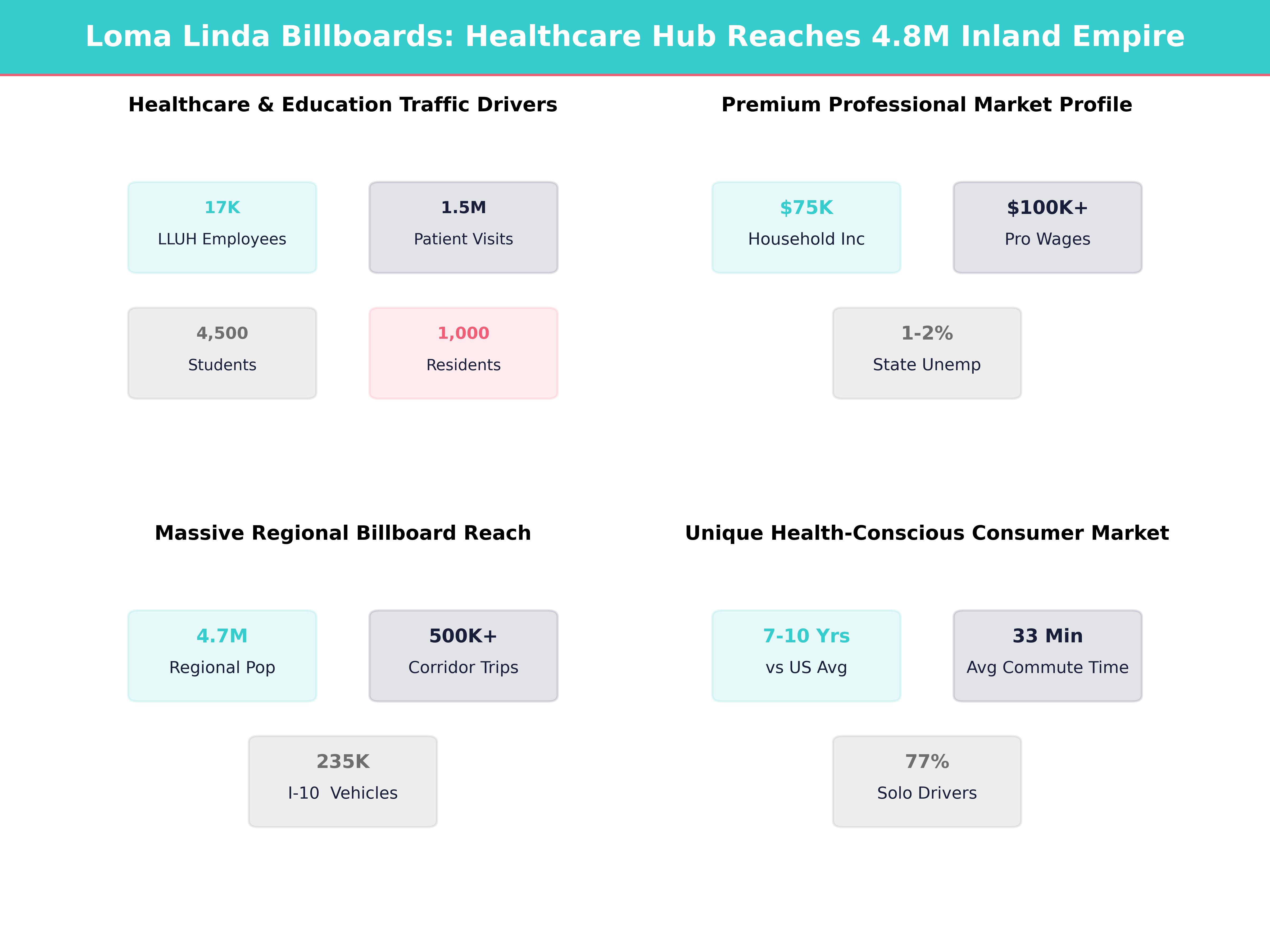
The Loma Linda area sits at the intersection of several overlapping audiences shaped by healthcare, higher education, and suburban family growth across the Inland Empire. Loma Linda University Health alone, with its 17,000+ employees, is one of the largest employers in the region, and the broader community includes 4,500–5,000 students plus 1,000+ residents and fellows. These groups are time-poor, highly educated, and often responsive to solutions that save time, improve well-being, or support families.
When is the best time to run a billboard campaign in Loma Linda, California with Blip?
Because our billboards are digital, you can use Blip to schedule ads down to specific hours and days. For the Loma Linda area, timing is crucial because traffic volumes and audience mix shift predictably throughout the week. Morning, afternoon, and evening dayparts can each reach different audiences, from healthcare workers and students to return commuters and families.
What roads around Loma Linda, California get the most billboard traffic?
Interstate 10 is the primary east–west spine through the Loma Linda area, carrying roughly 220,000–250,000 vehicles per day on busy segments between Redlands, Loma Linda, and San Bernardino. Interstate 215 has many segments posting 150,000–190,000 vehicles per day, and State Route 60 frequently exceeds 140,000–160,000 vehicles per day through central Moreno Valley and westward. Across a typical weekday, this means well over half a million combined daily vehicle trips moving through the I‑10, I‑215, and SR‑60 corridors that link Riverside, Moreno Valley, San Bernardino, and the Loma Linda area.
Do I need a contract to advertise with Blip near Loma Linda?
No, Blip has no long-term contracts or minimum commitments. You can start, pause, or stop your campaign at any time.
How fast can I launch a billboard campaign with Blip near Loma Linda?
You can have your campaign live in minutes. Create a free account, select your locations, set your budget, upload your design, and start running once approved.
Where can I advertise with Blip near Loma Linda?
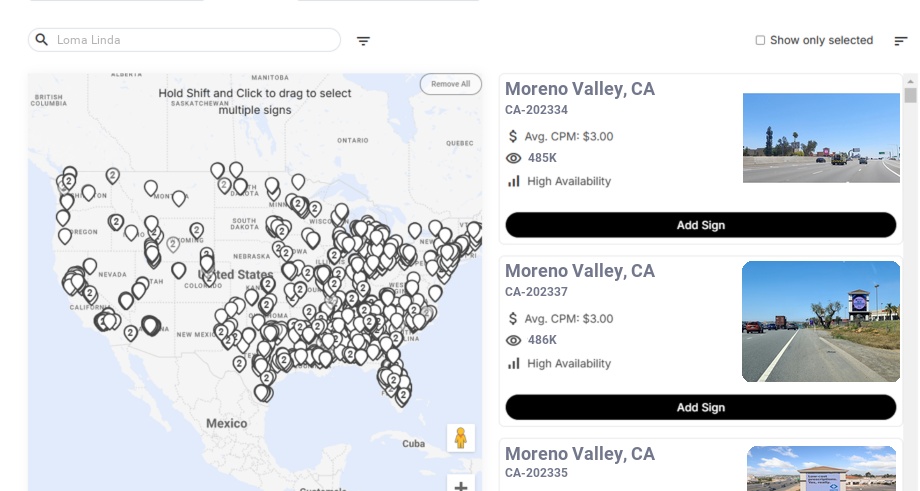
Blip has digital billboards near Loma Linda. You can browse available locations on a map, choose the ones that fit your audience, and start advertising right away.
Still have questions? Launch a campaign in minutes — no contracts, no commitments.
Start Your CampaignLoma Linda Billboard Advertising Guide
Nestled along the I‑10 corridor in the Inland Empire, the Loma Linda area offers advertisers a rare combination of high freeway visibility, affluent healthcare workers, university students, and family-oriented neighborhoods. With 9 Blip digital billboards serving the Loma Linda area from nearby Moreno Valley, San Bernardino, and Riverside, we can help you tap into tens of thousands of daily impressions from commuters, patients, visitors, and residents moving through this busy medical and education hub. For brands actively looking for billboards near Loma Linda, this cluster of signs puts your message directly into the daily routines of the region’s core audiences.
Understanding the Loma Linda Area Market
Loma Linda is small in land area—about 7.5 square miles—but large in influence. The city’s population is a bit over 25,000 people (recent state estimates place it around 25,000–26,000), but its daytime population swells significantly with workers, patients, and students drawn to its major institutions:
- Loma Linda University Health (LLUH) employs more than 17,000 people across its hospitals, clinics, and university operations and reports over 1.5 million outpatient visits annually, plus tens of thousands of inpatient discharges and emergency visits each year. You can explore system-wide facts and community benefit reports at lluh.org.
- Loma Linda University enrolls roughly 4,500–5,000 students across eight schools (medicine, dentistry, nursing, pharmacy, public health, religion, behavioral health, and allied health professions). More than 1,000 medical residents and fellows train on and around the campus, creating a dense cluster of young professionals. Learn more about the university community at llu.edu.
- The broader San Bernardino County population has surpassed 2.2 million residents, while neighboring Riverside County is over 2.5 million, creating a regional catchment of nearly 4.7–4.8 million residents within an approximate 30–40‑mile radius of the Loma Linda area, according to county planning and economic development summaries at sbcounty.gov and riversideca.gov.
Within Loma Linda itself, local and state data show:
- Median household income is in the mid‑$70,000s to low‑$80,000s range, above many nearby neighborhoods.
- A high share of residents hold college and graduate degrees, with healthcare, education, and professional services among the largest employment categories.
- The city’s unemployment rate tends to track 1–2 percentage points below the state average, reflecting strong institutional employers.
Loma Linda is known globally for its longevity; it is recognized as a “Blue Zone,” with residents often living 7–10 years longer than the U.S. average, and local research has documented higher life expectancy for Adventist populations compared with national norms. This culture of health, wellness, and community has clear implications for billboard messaging and for how you approach billboard advertising near Loma Linda:
- Wellness, family, and community-focused themes resonate strongly with a population where plant-based diets, low smoking rates, and active lifestyles are common.
- Healthcare, healthy food, fitness, and outdoor lifestyle brands can align naturally with local values and the roughly 1.5+ million annual patient touchpoints through LLUH.
- Financial services, education, and home services benefit from an audience that tends to be stable, educated, and planning for the long term, with a high proportion of dual‑income professional households.
For background and city context, advertisers can explore the City of Loma Linda at lomalinda-ca.gov Visit Inland Empire at visitinlandempire.com
Where Our Billboards Are and How They Serve the Loma Linda Area
Our 9 digital billboards serving the Loma Linda area are located in:
- Moreno Valley (about 7.1 miles from Loma Linda; city population roughly 210,000–215,000), see moval.org
- San Bernardino (about 7.7 miles from Loma Linda; city population around 220,000–225,000), see sbcity.org
- Riverside (about 9.9 miles from Loma Linda; city population around 315,000–320,000), see riversideca.gov
These nearby cities sit on the same traffic arteries that Loma Linda residents, employees, and visitors use every day. Caltrans District 8 traffic counts show some of the heaviest volumes in the Inland Empire on these routes, making them prime locations for Loma Linda billboards that still comply with local sign ordinances inside city limits:
- Interstate 10 (I‑10): The primary east–west spine through the Loma Linda area, carrying roughly 220,000–250,000 vehicles per day on busy segments between Redlands, Loma Linda, and San Bernardino.
- Interstate 215 (I‑215): Connecting San Bernardino and Riverside, with many segments posting 150,000–190,000 vehicles per day; major ramps and connectors feed directly into Loma Linda via I‑10 and arterials like Tippecanoe Avenue and Anderson Street.
- State Route 60 (SR‑60): A heavily traveled commuter route between Moreno Valley and Riverside, where volumes frequently exceed 140,000–160,000 vehicles per day through central Moreno Valley and westward.
Across a typical weekday, this means well over half a million combined daily vehicle trips moving through the I‑10, I‑215, and SR‑60 corridors that link Riverside, Moreno Valley, San Bernardino, and the Loma Linda area. By placing digital billboards near Loma Linda along commuter paths just outside the city limits, we can capture:
- Loma Linda employees commuting from Riverside, Moreno Valley, San Bernardino, Redlands, Yucaipa, Beaumont, and other Inland Empire communities—regional surveys show average commute times in the Inland Empire at about 30–35 minutes, with over 75–80% of workers driving alone to work.
- Patients and visitors driving to Loma Linda University Medical Center, Children’s Hospital, and other medical facilities—major regional hospitals routinely draw from a 25–50‑mile radius, adding thousands of additional daily trips.
- Students traveling between housing, campus, and retail centers in nearby cities, with class schedules creating peaks beyond standard 9–5 work patterns.
- Residents heading to regional shopping, entertainment, and service destinations such as downtown Riverside, Moreno Valley Mall, and major retail corridors in San Bernardino and Redlands.
To better understand commuter dynamics and road projects that might affect traffic flows—and therefore impact the performance of billboard advertising near Loma Linda—we recommend reviewing updates from San Bernardino County Transportation Authority at gosbcta.com and Caltrans District 8 updates linked from dot.ca.gov, which publish average daily traffic (ADT) counts and major construction timelines.
Who You’re Reaching: Demographics and Lifestyles
The Loma Linda area sits at the intersection of several overlapping audiences shaped by healthcare, higher education, and suburban family growth across the Inland Empire.
1. Healthcare Professionals and Staff
- Between Loma Linda University Health, nearby hospitals in Redlands and San Bernardino, and clinics across the corridor, tens of thousands of healthcare workers travel through the area weekly. LLUH alone, with its 17,000+ employees, is one of the largest employers in the region.
- In surrounding Inland Empire communities, median household incomes in many professional commuter neighborhoods commonly range from the high‑$70,000s to over $90,000, with dual‑income healthcare and public sector households frequently exceeding $100,000.
- Healthcare practitioners and technical occupations are also among the highest‑paid occupational groups in California, with average annual wages regularly $100,000+ for many physician, advanced practice, and specialty nursing roles.
- This group is time-poor, highly educated, and often responsive to solutions that save time, improve well-being, or support families (e.g., childcare, financial planning, home services, quick dining options). Ads on Loma Linda billboards that emphasize “same‑day,” “online check‑in,” “open late,” or “near the hospital” align with their schedules.
2. Health-Conscious Residents
- Loma Linda’s culture emphasizes plant-based diets, non-smoking lifestyles, and community involvement through its Seventh-day Adventist roots—local surveys and research have documented lower rates of smoking and higher consumption of fruits, vegetables, and whole grains compared with state averages.
- The share of residents participating in regular religious or community activities is high, with multiple Adventist congregations and community groups anchoring local life.
- Wellness brands, gyms, healthy restaurants, medical practices, and mental health services are especially well-aligned with this identity. In the broader Inland Empire, health and wellness spending has been growing faster than general retail, with fitness and health club revenues increasing by double‑digit percentages over several recent years.
- Messaging around preventive care, nutrition, and family wellness often has more resonance here than aggressive, hard-sell tactics or “quick fix” promises, making billboard advertising near Loma Linda particularly effective for mission-driven health and lifestyle campaigns.
3. University Students and Trainees
- The Loma Linda University community includes 4,500–5,000 enrolled students plus 1,000+ residents and fellows in their 20s and 30s. Many live within a 5–10‑mile radius, in Loma Linda, Redlands, San Bernardino, and Riverside.
- National student surveys consistently show that over 95% of college and graduate students own smartphones, and social media usage rates in this age group exceed 90%. In a commuter-heavy region like the Inland Empire, students also rely heavily on personal vehicles; many drive 10–25 miles between housing, campus, and work.
- They are heavy users of mobile devices and social media, making billboards a powerful top-of-funnel channel to support digital retargeting.
- They respond well to offers for housing, banking, affordable dining, fitness, study spaces, and entertainment in nearby Riverside, San Bernardino, and Moreno Valley, especially when paired with student discounts or “show your ID” promotions.
4. Inland Empire Commuter Families
- The Inland Empire has been one of Southern California’s fastest-growing regions in the past decade, adding hundreds of thousands of residents as households seek more attainable housing compared to Los Angeles and Orange counties.
- Daily commuting flows link cities like Riverside (population over 310,000), Moreno Valley (over 210,000), and San Bernardino (over 220,000) through the Loma Linda area corridors. In several of these cities, more than 60–70% of households are families, and a substantial share—often more than 35–40%—have children under 18 at home.
- Average commute times commonly fall in the 30–40‑minute range, meaning drivers are exposed to roadside media for extended periods across multiple jurisdictions.
- These families are ideal targets for K–12 schools, after-school programs, pediatric healthcare, auto dealers, big-box retail, and home improvement services, especially when campaigns use multiple boards for consistent billboard rental near Loma Linda across their full commute.
Local context and detailed reporting on growth and lifestyle trends can be found at outlets such as The Press-Enterprise (pe.com) and The San Bernardino Sun (sbsun.com), which frequently cover Inland Empire population growth, housing trends, and major employer expansions.
Timing Your Blip Campaign Around Local Rhythms
Because our billboards are digital, you can use Blip to schedule ads down to specific hours and days. For the Loma Linda area, timing is crucial because traffic volumes and audience mix shift predictably throughout the week.
Weekday Commuter Peaks
Caltrans and regional transportation reports show that peak freeway volumes in the Inland Empire typically occur during:
- Morning (6–9 a.m.): Capture healthcare workers starting early shifts (many hospital shifts begin at 7 a.m.), university students heading to 8 a.m. classes, and commuters heading toward the Loma Linda campus and neighboring employment centers in Riverside and San Bernardino. Traffic counts often rise sharply between 6 and 7 a.m., with some I‑10 segments reaching over 10,000 vehicles per hour.
- Afternoon (3–5 p.m.): Reach shift changes at hospitals, university class transitions, and early commuters, including school pickup traffic and part‑time workers.
- Evening (5–8 p.m.): Target return commuters heading back to Riverside, Moreno Valley, and other suburbs, along with families going to shopping centers and dining. In many corridors, outbound volumes between 4 and 7 p.m. match or exceed morning peaks.
Consider using morning dayparts for professional services (financial advisors, B2B, continuing education) and evening dayparts for consumer-facing offers (restaurants, fitness, retail promotions, after‑school activities). This kind of time-of-day targeting is one of the major advantages of digital billboard advertising near Loma Linda versus static print.
Weekend Patterns
- Saturdays often see strong traffic toward shopping centers in Moreno Valley and Riverside, as well as leisure travel along I‑10 and SR‑60. Regional mall and big‑box shopping centers can draw tens of thousands of visitors per weekend day, particularly during back‑to‑school and holiday seasons.
- Sundays in Loma Linda can be more subdued—reflecting the local religious culture—but there is still movement to regional malls, parks, and visiting family, plus traffic to recreational destinations in the mountains or desert via I‑10 and I‑215.
Use weekend scheduling to push:
- Limited-time retail promotions
- Open houses for real estate
- Special events at restaurants, churches, or entertainment venues
- Healthcare screenings, fairs, or community wellness events
Seasonal Opportunities
- Academic Calendar: New student cohorts typically arrive late summer to early fall. Run welcome campaigns and student offers in August–October and again in January for spring entrants. LLU’s academic calendar, which you can review at llu.edu, provides specific semester start dates.
- Holiday Season (November–December): Retail spending in the U.S. often jumps 20–40% above typical monthly levels during the November–December period, and freeway traffic around shopping destinations in Riverside and Moreno Valley increases accordingly. Focus on gift shopping, year-end healthcare and dental benefits, elective procedures, and financial planning.
- Health Awareness Months: Tie campaigns to national observances (e.g., Heart Month in February, Breast Cancer Awareness in October) to reach both professionals and consumers attuned to health messaging. LLUH and local hospitals typically host community events and seminars that you can support with billboard visibility.
Monitor local event calendars from Loma Linda University Health (lluh.org), City of Riverside (riversideca.gov), and City of Moreno Valley (moval.org) to sync campaigns with major conferences, marathons, health fairs, concerts, and festivals that can temporarily boost traffic by thousands of extra visitors.
Creative Strategy: Designing Artwork for the Loma Linda Area
To stand out on busy Inland Empire freeways and arterials, billboard creative must be both bold and culturally tuned to Loma Linda’s values.
Keep It Simple and Legible
- Target 6–8 words of primary copy; at freeway speeds of 55–65 mph, drivers generally have 5–8 seconds or less to absorb your message.
- Use high-contrast color combinations (e.g., dark blue/white, yellow/black, deep green/white) to cut through sun glare and haze common in the Inland Empire, particularly during summer months when ozone and particulate levels are higher.
- Prefer sans-serif fonts at large point sizes; avoid thin or script fonts that break up at a distance.
- Use logos and URLs sparingly—aim for one primary call to action that a driver can recall after passing at 200+ feet per second.
Align With Health and Community Values
Given Loma Linda’s identity:
- Emphasize well-being, family, and community service.
- For healthcare or wellness products, highlight benefits like “better rest,” “more energy,” “stress relief,” or “healthy family meals” instead of purely discount-focused messaging.
- Show diverse, multigenerational families and professional imagery that reflects the region’s ethnic diversity; in many Inland Empire cities, Latino residents make up 50–60% or more of the population, with significant Asian, Black, and White communities as well.
- Consider bilingual or Spanish‑forward elements where appropriate, especially if your location serves high‑Spanish‑speaking ZIP codes in San Bernardino and Riverside.
Localize Your Message
- Reference nearby landmarks and corridors: “Just off I‑10,” “Minutes from Loma Linda University,” or “Near Riverside & San Bernardino.”
- For businesses in Riverside, Moreno Valley, or San Bernardino, clarify proximity: “10 minutes from Loma Linda area” or “Next exit after the hospital.”
- If you serve healthcare workers, say it explicitly: “Healthcare staff discount,” “Nurses & residents welcome,” or “Open late for hospital shifts.” Messages like these perform especially well on billboards near Loma Linda that are passed repeatedly by the same professionals each week.
Use Digital’s Flexibility
Blip allows you to upload multiple creatives and rotate them. Strategies that work well near the Loma Linda area include:
- A/B Testing Headlines: Run two variations (e.g., “Healthy Meals in 10 Minutes” vs. “Plant-Based Meals for Busy Families”) to see which drives more web or in-store engagement. Even a 10–20% difference in response can significantly improve return on ad spend across thousands of daily impressions.
- Dynamic Promotion Cycles: Swap creatives weekly to highlight different services (e.g., urgent care, primary care, dental, optical) or different product categories. This is effective in a corridor where many drivers commute 5 days a week and may see your message dozens of times per month.
- Daypart-Specific Creative: Breakfast-focused ads in the morning, family dinner messaging in the evening, and weekend-only specials for Saturdays and Sundays help match the offer to the context of the drive.
Choosing Locations: Matching Boards to Audience Flows
Our 9 digital billboards serving the Loma Linda area from Moreno Valley, San Bernardino, and Riverside offer different strengths depending on whom you’re targeting and how far you want to pull customers. This flexibility essentially gives you a menu of Loma Linda billboards to choose from, even though the structures sit just outside the city boundary.
Moreno Valley-Facing Boards
- Ideal for reaching younger families and commuters traveling along SR‑60 and I‑215, many of whom work in healthcare, logistics, retail, manufacturing, and public sector jobs. Moreno Valley has seen strong population growth over the past decade and a high share of households with children.
- Commute flows from Moreno Valley to Loma Linda commonly run 15–30 minutes via SR‑60 and I‑215, giving repeated exposure to digital billboards along the route.
- Strong fits: family healthcare practices, K–12 schools, quick-service restaurants, big-box retail, auto dealers, and home improvement services that serve fast‑growing master‑planned communities.
- For more on housing and development trends that shape this audience, review Moreno Valley’s economic development data at moval.org.
San Bernardino-Facing Boards
- Capture traffic along I‑10 and I‑215 heading to and from the Loma Linda and San Bernardino medical and government complexes. The City of San Bernardino hosts county offices, courts, and other public agencies that bring thousands of employees and visitors into the downtown area daily; see sbcity.org for civic and development updates.
- Many commuters from high‑growth communities to the north and east (Highland, Rialto, Colton, Yucaipa) pass through these corridors to reach Loma Linda and Riverside.
- Strong fits: professional services (attorneys, accountants), healthcare systems, higher education, and B2B advertisers aiming at public agencies and regional employers.
Riverside-Facing Boards
- Reach a larger, more urban population base and major regional shopping centers and entertainment venues. Riverside is the county seat and home to a large student population via local universities and colleges, adding tens of thousands of young adults to the daytime population.
- Riverside’s economic development reports highlight strong sectors in education, healthcare, logistics, and professional services, with median household incomes in many neighborhoods in the $80,000+ range.
- Strong fits: universities, banks and credit unions, lifestyle brands, regional entertainment, and high-ticket retail.
When you set up your Blip campaign, you can select or exclude individual boards, allowing you to:
- Concentrate your budget on corridors with the highest likelihood of Loma Linda employee or patient traffic—such as I‑10 segments that connect directly to Anderson Street, Barton Road, and Tippecanoe Avenue.
- Add boards near Riverside or Moreno Valley for brand expansion while keeping Loma Linda commuters as a core audience.
- Test different board combinations for 2–4 weeks at a time to see where incremental impressions generate the most response, using metrics like web traffic by ZIP code, call volume, or coupon redemption.
City economic and planning documents from San Bernardino County (sbcounty.gov) and City of Riverside (riversideca.gov) are good references for understanding growth areas, logistics hubs, and new developments when choosing locations and deciding where billboard rental near Loma Linda will have the greatest impact.
Budgeting and Bidding Strategy With Blip
Blip’s pay-per-“blip” model lets you set bids and budgets that reflect your priorities in the Loma Linda area and adjust quickly based on results. This flexibility makes it easy to scale billboard advertising near Loma Linda up or down as seasons and business needs change.
Start With Clear Goals
Examples:
- “Generate awareness for a new clinic within a 10-mile radius of Loma Linda University Medical Center.”
- “Drive weekend foot traffic to a Moreno Valley restaurant that draws Loma Linda families.”
- “Introduce a financial services brand to healthcare workers commuting between Riverside and the Loma Linda area.”
- “Promote a health fair expecting 500–1,000 attendees at a Loma Linda or Riverside community venue.”
Pair these goals with measurable indicators, such as a target number of website sessions, phone calls, or event RSVPs over a 4–8‑week period.
Set Daily Budgets and Adjust Over Time
- Begin with a modest daily budget to gather baseline impressions—enough to achieve several hundred to several thousand daily plays (blips), depending on your bid and board selection.
- Allocate more budget to high-value dayparts (e.g., 6–9 a.m., 4–7 p.m.) and reduce spend during lower-priority hours. If you notice that web traffic or inbound calls peak after evening commutes, consider shifting 60–70% of your budget into those hours.
- Monitor performance indicators such as web traffic by hour/day, promo code redemptions, call tracking data, or direct surveys asking “Where did you hear about us?” over at least a few weeks to account for repeated exposure effects.
- Adjust location mix quarterly or seasonally to reflect changes in road construction, school calendars, or new development openings.
Use Bidding to Prioritize Key Moments
- Increase bids during known peaks (weekday rush hours, pre-holiday weekends, back-to-school season). For example, in late November and early December, you might temporarily increase bids by 20–30% on Riverside- and Moreno Valley-facing boards serving major retail centers.
- Lower bids or pause certain boards during road construction or detours that might temporarily reduce traffic on a corridor, using data from gosbcta.com and local news alerts from outlets like pe.com and sbsun.com.
- Use short, intensive “bursts”—higher bids for 7–14 days—to support grand openings, time‑sensitive enrollment periods, or limited‑time health screenings, then return to baseline levels.
Over time, this approach turns your billboard rental near Loma Linda into a flexible, always-on channel that can be dialed up for major events and scaled back when you only need steady background awareness.
Integrating Billboards With Your Other Marketing
Billboard advertising near the Loma Linda area becomes more powerful when integrated with your digital and offline channels, especially given how frequently Inland Empire residents use smartphones while on the go.
Pair With Search and Social
- Use billboard taglines or keywords in your Google Ads or social campaigns to boost recall; when drivers later search similar terms, consistent language can increase click‑through rates.
- Encourage simple, memorable URLs or search phrases: e.g., “Search ‘Loma Linda Wellness Center’.” Short domains or vanity URLs are easier to remember at 60 mph.
- Time your social media posting schedule to coincide with your billboard dayparts, so users seeing you on the road also see you online within the same 2–3‑hour window.
Use Location-Based Offers
- Create promo codes like “LL10” or “I10HEALTH” unique to billboard campaigns and promote them in a large, easy-to-read font.
- Ask at point of sale or in online forms, “Did you see our billboard near the Loma Linda area?” with options listing nearby freeways or specific cities (Riverside, San Bernardino, Moreno Valley).
- Track redemptions geographically (e.g., ZIP codes around Loma Linda, Riverside, Moreno Valley, and San Bernardino) to refine target boards and confirm that you’re pulling customers from desired trade areas.
Reinforce Community Presence
- If you sponsor events or health fairs at Loma Linda University Health or in Riverside/San Bernardino, run supporting billboard campaigns in the 2–4 weeks leading up to them. Community events hosted by LLUH and local cities often draw 300–2,000+ attendees, depending on the type of event.
- Highlight community actions: blood drives, scholarship funds, family wellness days, food drives, and other initiatives, which resonate strongly in this service- and mission-driven region and can improve brand favorability even among non‑customers.
- Coordinate PR and billboard schedules so that when stories appear in local news outlets, your brand is also visible on major commuter corridors.
Local outlets like Redlands Daily Facts (redlandsdailyfacts.com) and broadcast stations covering the Inland Empire often report on community events; align campaigns with that coverage for extra lift and greater visibility for your Loma Linda billboards.
Industry-Specific Tips for the Loma Linda Area
Healthcare and Wellness
- Focus on convenience (extended hours, same-day appointments, walk‑in clinics) and preventive care, which align with Loma Linda’s health culture and LLUH’s emphasis on whole‑person care.
- Showcase proximity: “5 minutes from Loma Linda area hospitals,” “Across from LLU campus,” or “Exit [X] off I‑10.” In a region where average commutes exceed 30 minutes, saving 5–10 minutes is a clear value proposition.
- Use calm, reassuring visuals and emphasize trust, quality, and outcomes—such as years in practice, number of patients served, or local awards.
- Consider messaging for specific awareness months (heart, cancer, diabetes, mental health), supported by LLUH and other hospital campaigns.
Education and Training
- Target students and professionals with continuing education, certification, and graduate programs. Healthcare workers in particular have ongoing CE requirements, generating consistent demand.
- Run heavier rotations in August–October and January–February to coincide with new enrollment cycles and clinical residency start dates.
- Highlight flexible formats (evening, weekend, online) that fit healthcare and commuter schedules, noting options such as “finish in 12 months” or “100% online” where applicable.
- Feature outcomes data—job placement rates, average salary increases, or number of graduates—if available.
Restaurants and Retail
- Promote healthy menu options, vegetarian/vegan offerings, and family-friendly environments—important in a community where a significant share of residents follow or respect plant-based dietary practices.
- Use time-specific creatives: breakfast grab-and-go for morning commuters, “quick dinner near Loma Linda area” for evening traffic, and “weekend family specials” Friday–Sunday.
- Emphasize fast access from major routes: “Just off I‑10,” “Next to [well-known shopping center],” or “Free parking off [street name].”
- Consider showing approximate drive times from major landmarks, e.g., “8 minutes from Loma Linda University.”
Financial Services and Real Estate
- Speak to long-term planning: retirement, home ownership, education savings, especially for healthcare professionals and young families whose incomes often rise steadily with experience.
- Use credibility cues (years in the community, local branches, bilingual staff) to build trust in a diverse and values-driven market; note that many Inland Empire cities have 30–50% of households speaking a language other than English at home.
- Promote first-time homebuyer seminars, physician mortgage programs, or credit union membership tied to regional employers. Homeownership rates in many Inland Empire communities are higher than coastal counties, making mortgage and refinancing offers particularly relevant.
- Highlight data points where possible: “Serving 10,000+ Inland Empire members,” “Helping local families finance over 500 homes annually,” etc.
Making the Most of Blip in the Loma Linda Area
The Loma Linda area is a unique blend of small-city community and large regional influence. By combining:
- Strategic placement on high-traffic corridors in Moreno Valley, San Bernardino, and Riverside
- Smart scheduling around commuter flows, health-system rhythms, and academic calendars
- Creatives that reflect the area’s strong culture of health, education, and family
- And Blip’s flexible budgeting, dayparting, and creative rotation tools
we can help you build efficient, data-informed campaigns that reach the right people at the right moments, across hundreds of thousands of daily vehicle trips. Whether you need a short-term push or ongoing billboard rental near Loma Linda, the same platform can adapt to your goals.
As you plan your next campaign serving the Loma Linda area, consider where your best customers are driving, when they’re on the road, and how your message can support the lifestyle and values that make this community stand out—and then use targeted Loma Linda billboards to keep your brand in front of them day after day.