Billboards near Ontario, CA
No Minimum Spend. No Long-Term Contracts. Just Results.
Trusted by Leading Brands


Billboard advertising
near Ontario has never been easier
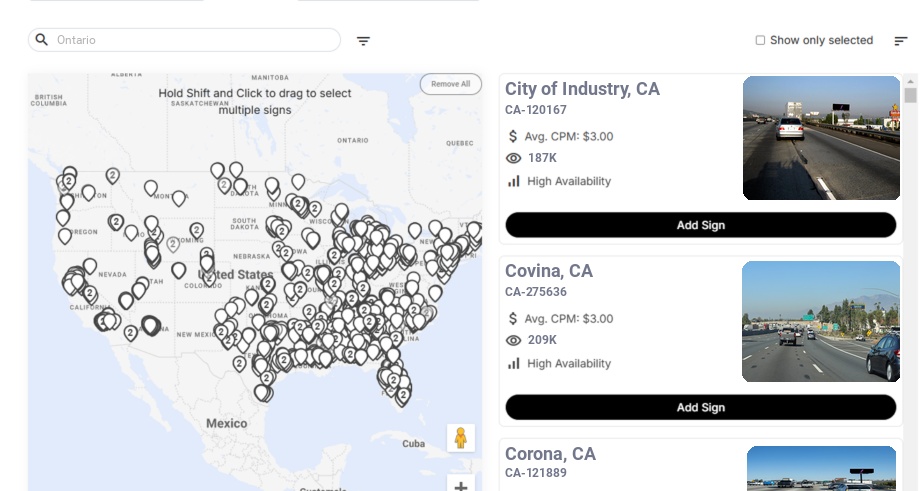



How much is a billboard near Ontario?
Why Choose Blip for Billboard Advertising near Ontario
Blip’s self-serve platform lets you launch Ontario billboards fast and aim at I-10, I-15, and Route 210 commuters in minutes.
Set a flexible daily budget for Ontario and shift spend around Ontario Mills weekends or Toyota Arena event nights as traffic changes.
No contracts means you can test Ontario-area ads near ONT and the logistics corridors, then scale what works.
Use Blip’s real-time analytics to track Ontario impressions and adjust for peak 4–7 p.m. commute flow from Upland and Rancho Cucamonga.
Blip creative tools make bilingual, high-contrast ads easy for Ontario’s Spanish-speaking families and busy car commuters.
Frequently Asked Questions About Billboard Advertising near Ontario
How much does a billboard cost near Ontario, California with Blip?
With Blip, you control exactly what you spend on Ontario billboards by setting a daily budget that can be adjusted anytime, so your campaign always stays within your comfort zone. Each “blip” is a brief 7.5 to 10-second ad on rotating digital billboards near Ontario, California, and you only pay for the individual blips you receive. Pricing is flexible because each blip’s cost depends on when and where you choose to advertise and on advertiser demand.
Where can I advertise with Blip near Ontario, California?
Blip sells exposure one “blip” at a time, and the page highlights digital billboards in nearby Upland, about 5 miles from central Ontario. These boards sit within the same day-to-day travel patterns that define life in the Ontario area, giving you coverage comparable to many in-city Ontario billboards. The nearby corridors include I-10, Route 210, and local arterials used by commuters, shoppers, and travelers.
Why are Ontario, California billboards effective for reaching commuters with Blip?
Roughly 75–80% of workers in the area commute by car, with about 10–12% carpooling. Average one-way commute times typically fall between 30 and 35 minutes, with a sizable share spending 45 minutes or more. A large portion of those trips use I-10, I-15, Route 210, and major arterials, making Ontario billboards and nearby freeway placements especially valuable for reaching daily drivers.
What kind of audience does Ontario, California have for billboard advertising?
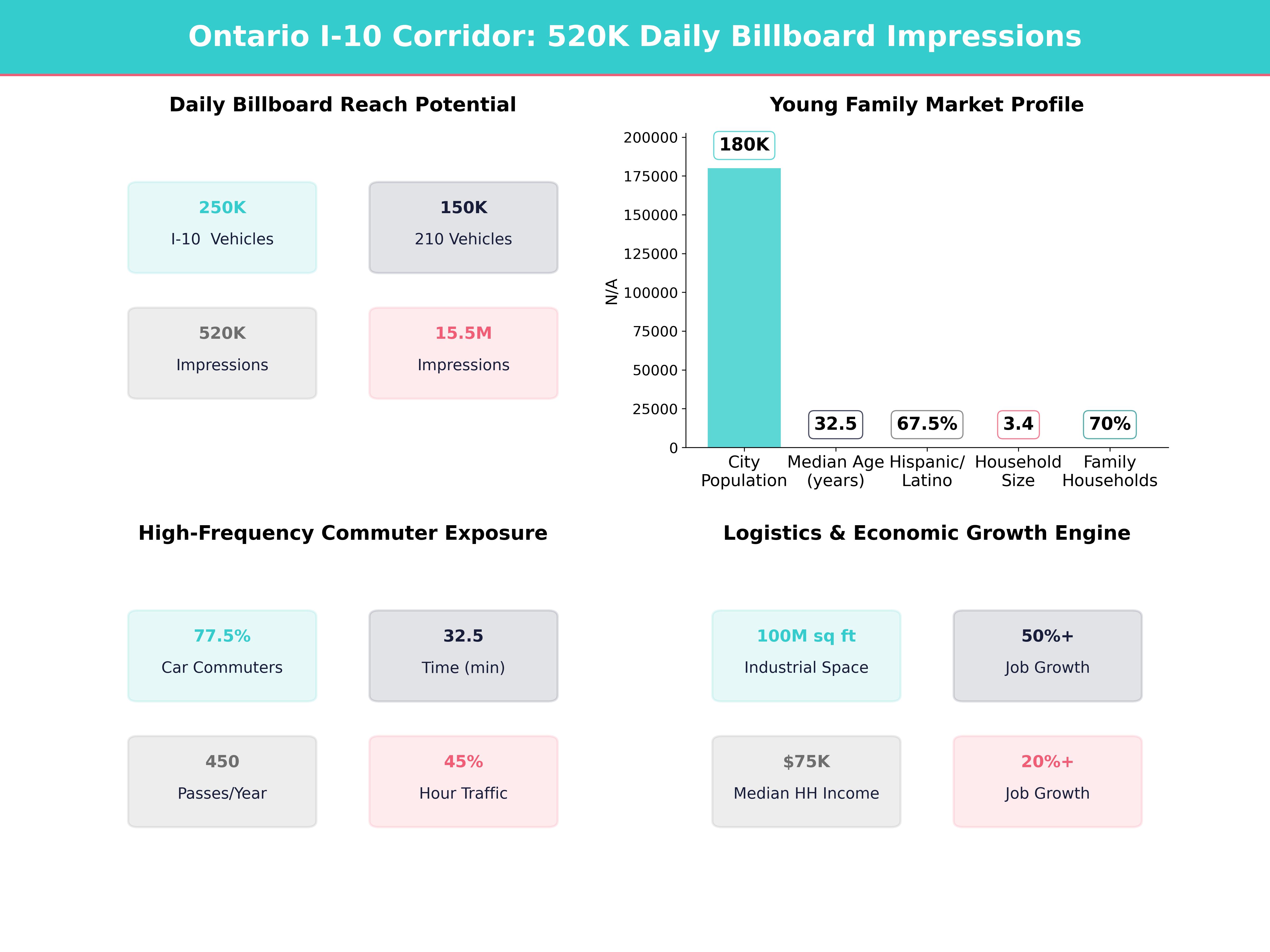
Ontario is one of Southern California’s key transportation and commercial hubs, with a population around 180,000 and a broader Inland Empire region that has been one of California’s fastest-growing areas. The median age in Ontario is roughly 32–33 years, and about 70% of occupied housing units are family households. The area is also highly diverse, with a strong Hispanic majority and Spanish widely spoken at home.
When is the best time to run Blip billboard ads near Ontario, California?
Using Blip’s scheduling controls, you can make the most of Ontario-area traffic patterns by day of week and time of day. Early morning, evening commute, and weekend peak windows are called out as especially strong, with some freeway segments seeing volumes 50–70% higher in peak hours than overnight lows. The page also notes that focusing on the top 3–4 peak hours on weekdays can deliver a disproportionate share of total daily traffic.
Do I need a contract to advertise with Blip near Ontario?
No, Blip has no long-term contracts or minimum commitments. You can start, pause, or stop your campaign at any time.
How fast can I launch a billboard campaign with Blip near Ontario?
You can have your campaign live in minutes. Create a free account, select your locations, set your budget, upload your design, and start running once approved.
Where can I advertise with Blip near Ontario?
Blip has digital billboards near Ontario. You can browse available locations on a map, choose the ones that fit your audience, and start advertising right away.
Still have questions? Launch a campaign in minutes — no contracts, no commitments.
Start Your CampaignOntario Billboard Advertising Guide
Ontario, California Inland Empire
Understanding the Ontario Area Market
Ontario is one of Southern California’s key transportation and commercial hubs. According to recent local estimates, the city’s population is around 180,000, within a San Bernardino County population of more than 2.2 million. The broader Inland Empire region has been one of California’s fastest-growing areas over the past decade, at times adding more than 30,000 residents per year across Riverside County
A few high-impact characteristics of the Ontario area:
- Young, working-age population: The median age in Ontario is roughly 32–33 years, several years younger than the California average of about 37. That means well over half of residents are in the 18–54 working-age band, with a particularly strong share in the 25–44 range—prime years for household formation, home buying, and peak discretionary spending.
- Family households: About 70% of occupied housing units in the Ontario area are family households, and more than one-third include children under 18. In many nearby Inland Empire communities, the share of households with children is closer to 30%, so Ontario skews even more family-focused, which boosts demand for after-school programs, quick-service dining, healthcare, and financial planning.
- Commuter-heavy: Roughly 75–80% of workers in the area commute by car, with about 10–12% carpooling. Average one-way commute times typically fall between 30 and 35 minutes, with a sizable share spending 45 minutes or more. A large portion of those trips use I‑10, I‑15, Route 210, and major arterials that lead toward Upland and neighboring cities like Rancho Cucamonga and Montclair, making Ontario billboards and nearby freeway placements especially valuable for reaching daily drivers.
- Diverse community: Ontario and surrounding cities have a highly diverse population, with a strong Hispanic majority—often cited around 65–70% of residents—alongside Asian, Black, and non-Hispanic White communities. In many Ontario-area neighborhoods, over 50% of households speak Spanish at home. Bilingual (English/Spanish) creative can significantly expand reach and increase ad recall.
The City of Ontario’s own economic development materials highlight its role as a logistics and retail powerhouse, with approximately 100 million square feet of industrial and warehousing space and major employers in distribution, retail, and services. Local reports indicate that logistics, transportation, and warehousing together account for tens of thousands of jobs in and around the city, with industrial vacancy rates often in the low single digits. You can explore more local economic context through the City of Ontario Ontario Economic Development, and regional resources like Discover Inland Empire
Nearby Upland adds another 79,000+ residents and a strong base of professional, healthcare, and retail workers. For additional community demographics and business data, you can reference City of Upland and the regional planning information available through San Bernardino County, which is useful when planning billboard advertising near Ontario that also reaches adjacent communities.
Why Digital Billboards Near Upland Work for the Ontario Area
Our two digital billboards in nearby Upland (about 5 miles from central Ontario) sit within the same day-to-day travel patterns that define life in the Ontario area, giving you coverage comparable to many in-city Ontario billboards:
- Ontario residents routinely drive into Upland and neighboring cities for shopping, services, dining, and work.
- Upland and Ontario share high-traffic corridors funneling vehicles between I‑10, Route 210, and local arterials.
- Many regional visitors to Ontario Mills Toyota Arena, and Ontario International Airport
According to Caltrans traffic count summaries and regional transportation reports, segments of I‑10 near Ontario routinely carry more than 250,000 vehicles per day, and Route 210 through Upland and adjacent cities often exceeds 150,000 vehicles per day. Nearby segments of I‑15 to the east carry another 200,000+ vehicles daily. Even at a conservative average vehicle occupancy of 1.2–1.4 people per car, this translates to an estimated 480,000–560,000 potential daily impressions across these corridors alone. Over a 30‑day flight, those same patterns can represent 14–17 million total impression opportunities, even before accounting for local arterials like Mountain Avenue, Euclid Avenue, and Foothill Boulevard.
Local agencies such as Caltrans District 8, the San Bernardino County Transportation Authority, and transit provider Omnitrans
Because Blip sells exposure one “blip” at a time, you can concentrate your budget on the precise times and boards that align with commuting patterns between Ontario and Upland, capturing residents as they move between home, work, and major retail destinations. This makes it easy to treat our inventory as flexible billboard advertising near Ontario, without the long-term contracts or fixed schedules of traditional placements. For example, focusing on the top 3–4 peak hours on weekdays can deliver a disproportionate share of total daily traffic, often 40–50% of volume, while using lower bids to maintain a lighter presence at off-peak times.
Key Audience Hubs in the Ontario Area
To design effective campaigns, it helps to anchor your strategy in the major activity centers that drive traffic patterns:
- Ontario International Airport (ONT):
ONT handled over 6 million passengers in 2023 and has been among the fastest-growing airports in the U.S. for several years, with year-over-year passenger growth in some recent years exceeding 10–15%. The airport supports thousands of on-site jobs in airlines, security, concessions, and ground transportation, and broader airport-related employment in the region is often estimated in the tens of thousands. Many passengers and employees travel from across the Inland Empire, with a high proportion coming from Ontario, Upland, Rancho Cucamonga, and surrounding areas. See current traffic statistics at FlyOntario.com Ontario International Airport Authority - Ontario Mills:
One of California’s largest outlet and value-retail shopping centers, Ontario Mills reports tens of millions of visitors annually (commonly cited figures are around 20–24 million visits per year). During peak holiday periods, weekend traffic and sales regularly rank among the highest in the region’s retail centers. With more than 200 stores and restaurants, plus nearby hotels, the Mills functions as a full‑day destination. Visitors arrive from the Inland Empire, the Los Angeles basin, and even international markets, and many use connector roads that overlap with primary commuting paths through Upland and Rancho Cucamonga. Visitor and tourism context is available through sites like Visit Ontario Visit California’s Inland Empire section. - Toyota Arena and Events:
Toyota Arena, with a capacity of about 11,000 for concerts and over 9,000 for sporting events, regularly hosts hockey, basketball, concerts, and family shows. A busy event calendar can mean 150–200+ event days per year. Event nights concentrate thousands of higher-intent consumers on nearby roads in a tight 2–3 hour window, boosting localized traffic volumes by thousands of vehicles beyond the daily average and generating strong short-term demand for dining, parking, hotels, and rideshare. - Industrial and Logistics Corridors:
The Ontario area’s vast warehouse and logistics sector—supported by roughly 100 million square feet of industrial space—employs tens of thousands of workers, from entry-level warehouse associates to distribution managers and truck drivers. Warehousing and transportation employment in the broader Inland Empire has grown by well over 50% since 2010, outpacing statewide averages. These facilities cluster near the airport, along I‑10 and I‑15, and in business parks stretching toward Upland and Rancho Cucamonga. Work shifts typically start very early (5–7 a.m.) and end mid‑afternoon to evening (2–6 p.m.), creating distinct rush periods beyond standard office hours and providing prime windows to reach blue-collar and hourly workers.
Understanding how each of these hubs feeds traffic toward our boards near Upland helps you choose the right time windows and creative messages. For local event calendars and development news, you can also follow Inland Valley Daily Bulletin and community updates via OntarioCA.gov
Demographics and Messaging Strategy for the Ontario Area
The Ontario area’s demographic profile leads to several practical creative recommendations:
-
Income and price sensitivity:
Median household income in Ontario is roughly in the mid‑$70,000s, compared with a California median closer to the mid‑$80,000s and a San Bernardino County median in the low‑$70,000s. About 40–45% of households fall into the $50,000–$100,000 range, with a meaningful share under $50,000 and a growing segment above $100,000, reflecting both value-conscious and aspirational consumers.That suggests:
- Value-oriented offers (discounts, bundles, promotions) perform well.
- Clear price points (“$49”, “Under $20”, “0% APR for 12 months”) catch attention.
- Financing and payment-plan messaging can help for higher-ticket items (autos, furniture, home improvement).
-
Family-first messaging:
With roughly one-third of households including children under 18 and average household sizes around 3.3–3.5 people (higher than the U.S. average of about 2.6), family and multigenerational living are common.- Feature family imagery and benefits for kids (education, safety, fun).
- Highlight timing (“After-school programs”, “Weekend family fun”, “Summer camps”).
- Promote convenience for busy parents (“5 minutes from Ontario Mills”, “On your way home from work”).
-
Bilingual and culturally relevant content:
A majority of residents in the Ontario area identify as Hispanic or Latino, and Spanish is widely spoken at home; in some neighborhoods, over 60% of residents speak Spanish. Studies of bilingual advertising in similar markets show double-digit lifts in brand recall and message comprehension when Spanish is incorporated thoughtfully.- Consider bilingual copy: English headline with Spanish subline, or two alternating creatives (one in each language).
- Use culturally resonant visuals without leaning on stereotypes—focus on universal themes like family, celebration, and community.
- Include simple Spanish CTAs (“Llámanos hoy”, “Visítanos ahora”) that are easy to digest in a few seconds.
-
Mobile and local search synergy:
With such a commuting population, many impressions will be to drivers who will search your brand later on their phone. National and regional data often show that 40–60% of consumers who notice out-of-home advertising end up searching for the advertiser online.- Use short, unique brand names and URLs that are easy to remember.
- Encourage search: “Google: ‘ABC Plumbing Ontario’” or “Search ‘Fresh Tacos Ontario’”.
- Align billboard messaging with concurrent local search or social campaigns targeting ZIP codes in the Ontario area (such as 91761, 91762, 91764, 91786).
For more community context that can shape your messaging, explore local insights from the Ontario Chamber of Commerce and regional health and wellness data via San Bernardino County.
Crafting Effective Creative for an Auto-Oriented Market
In the Ontario area, drivers typically have only 6–8 seconds to absorb a message, in line with industry research for freeway-speed environments. Our boards near Upland will give you repeated, quick impressions, so clarity wins.
We recommend:
-
5–7 words of primary text, maximum.
Example: “Fast HVAC Repair – Ontario Area” plus a phone number or URL. Creative audits of high-performing digital OOH campaigns commonly show 7 words or fewer and no more than 2 distinct information elements. -
High-contrast colors and simple layouts.
Use dark backgrounds with light text (or vice versa). Avoid thin fonts and long paragraphs. High-contrast designs can improve legibility distances by 20–30% compared with low-contrast designs, especially at night or in glare conditions. -
One clear call to action (CTA):
- “Exit at Vineyard Ave”
- “Call Now”
- “Book Online Today”
-
Location hooks:
Because the boards are near Upland but serving the Ontario area, mention landmarks that orient drivers:- “Near Ontario Mills”
- “5 Minutes from Ontario Airport”
- “Serving the Ontario Area Since 1998”
-
Time-sensitive messages:
Digital makes it easy to swap or rotate:- “Today Only – Free Appetizer”
- “This Weekend: Grand Opening Ontario Area”
- “Sign Up by Friday for 20% Off”
We can help you test multiple versions—promotional vs. brand-focused, English vs. bilingual, price-led vs. benefit-led—and optimize based on performance. Campaigns that A/B test creatives often see 10–30% performance differences between top and bottom variations, underscoring the value of iteration.
Timing Your Campaign: When Impressions Matter Most
Using Blip’s scheduling controls, you can make the most of Ontario-area traffic patterns by day of week and time of day. Local transportation counts typically show clearly defined AM and PM peaks, with some corridors seeing volumes 50–70% higher in peak hours than overnight lows.
Weekday patterns
-
Early morning (5 a.m.–9 a.m.):
Captures warehouse and logistics workers heading to early shifts, plus airport employees and early flights. ONT’s departure schedules and logistics shift patterns mean thousands of workers and travelers are on the roads before 7 a.m.-
Good for:
- Quick-service restaurants and coffee
- Automotive repair and fuel
- Employment and staffing ads
-
Good for:
-
Midday (10 a.m.–3 p.m.):
Reaches stay-at-home parents, retirees, flexible workers, and service providers moving between appointments. Many retail and healthcare visits in suburban markets occur during this window, making it ideal for:- Healthcare, retail, personal services, and B2B marketing.
- “Same-day” or “walk-in” calls to action.
-
Evening commute (3 p.m.–7 p.m.):
High volumes of workers returning home through the Ontario–Upland corridor. For some freeway segments, the 4–6 p.m. window can represent the single highest hour of daily traffic.- Great for restaurants, entertainment, fitness, and urgent services (“Same-Day Dental”, “Walk-In Clinic”).
Weekend patterns
-
Saturday peaks (10 a.m.–8 p.m.):
Ontario Mills, local shopping centers, and entertainment venues draw heavy traffic. Weekend leisure trips to and from the San Gabriel Mountains also push more vehicles through Upland via Route 210 and local arterials. Retail studies frequently show that Saturdays can account for 20–25% of a week’s in-store visits.- Emphasize restaurants, retail, events, auto sales, and recreational activities.
-
Sunday (10 a.m.–6 p.m.):
More family outings, church traffic, and day trips. Many households use Sundays for home improvement and major-purchase research.- Focus on family attractions, home improvement, real estate, and financial services.
With Blip, you can bid more aggressively for peak times (e.g., Friday 4–7 p.m., Saturday midday) and maintain lower but consistent presence in off-peak windows to stretch your budget. Many advertisers find that allocating 60–70% of spend to peak windows and 30–40% to off-peak coverage balances frequency with efficiency.
Local Industries and How to Speak to Them
The Ontario area economy centers on a few major sectors. Tailoring your message to workers and decision-makers in these industries can dramatically improve relevance.
-
Logistics and Warehousing:
With tens of millions of square feet of distribution centers and thousands of daily truck movements, this sector drives much of the region’s daytime road use. Inland Empire logistics employment has grown at several times the national average over the last decade, reflecting strong demand for labor and services.- Target: forklift operators, warehouse staff, drivers, supervisors, and logistics managers.
- Message themes: time savings, reliability, equipment uptime, safety, and benefits.
- Examples: “Need CDL Drivers in the Ontario Area – $30/Hour + Benefits” or “Fast Truck Repair – 24/7 Roadside Near Ontario.”
- For workforce-related messaging and industry snapshots, you can consult Ontario Thinks Business and countywide resources from San Bernardino County.
-
Retail and Hospitality:
Ontario Mills, nearby shopping centers, and hotel clusters around ONT support a large workforce and heavy visitor flow. The Ontario–Upland hotel market taps into millions of ONT passengers plus Ontario Mills’ 20–24 million annual visitors and frequent arena event attendees.- Target: shoppers, tourists, event attendees.
- Message themes: convenience, limited-time deals, proximity (“Just off I‑10”), and experience (“Family fun”, “Date night”).
- Example: “Stay Tonight Near Ontario Airport – Free Parking & Shuttle.”
- Explore visitor trends and hotel information through Visit Ontario Discover IE
-
Professional Services and Healthcare:
As Ontario grows, so does demand for legal, financial, educational, and healthcare services. Inland Empire healthcare employment has expanded significantly in recent years as providers respond to population growth, with some local systems adding hundreds of new positions annually.- Target: families, small business owners, and commuters.
- Message themes: trust, local expertise, outcomes (e.g., “Same-Day Appointments”, “$0 Down Bankruptcy”).
- Example: “Ontario Area Urgent Care – Walk In, No Appointment.”
- Local business networks like the Ontario Chamber of Commerce and city business directories on OntarioCA.gov
Connecting to Local News, Events, and Community Trends
Tying your campaign to what people are already talking about in the Ontario area can significantly raise response. Surveys of out-of-home advertisers often show 10–20% lifts in engagement when creative references timely local events or seasonal needs.
- Follow local outlets like the Inland Valley Daily Bulletin, Spectrum News 1 Inland Empire Inland Empire Community News for headlines, major events, and seasonal stories.
-
Use seasonal hooks:
- Back-to-school (August–September), when local districts serving tens of thousands of students return to class.
- Holiday shopping (November–December, especially around Ontario Mills), when foot traffic and sales volumes can spike 30–50% above typical months.
- Summer travel spikes through Ontario International Airport (June–August), when passenger volumes often climb 10–20% vs. off‑season months.
- Sports and concert calendars at Toyota Arena and community festivals listed on Ontario’s events calendar
Examples of context-aware campaigns:
- “Beat the Ontario Heat – A/C Tune-Up Special This Week Only”
- “Holiday Shopping Near Ontario Mills? Don’t Forget Dinner at [Your Restaurant]”
- “Flying out of ONT? Park with Us & Save 20% – Ontario Area Parking.”
Location Strategy: How to Use the Upland Boards to Reach Ontario
Because our billboards are located in nearby Upland, we encourage thinking in terms of corridors rather than city limits. Regional studies of trip patterns show that many daily journeys cross multiple city boundaries within a 10–15 mile radius, especially along I‑10 and Route 210. For advertisers comparing options for billboard rental near Ontario, this corridor-based approach can often deliver better reach and frequency than focusing on a single ZIP code alone.
-
Home-to-work corridor:
Many Ontario residents commute west or northwest through Upland toward the San Gabriel Valley or eastward through the same corridors in reverse. These workers may pass the same point 400–500 times per year, creating very high frequency potential.- Position your messaging as part of their daily route: “On Your Drive Home to Ontario? Stop for Groceries at [Brand]”.
-
Shopping and entertainment corridor:
Shoppers visiting Ontario Mills or local plazas may connect via Route 210, Mountain Avenue, Euclid Avenue, or other arterials that pass near Upland.- Use destination-based messages with distance markers: “Just 10 Minutes South – Ontario Area Dealership.”
- Reference recognizable cross-streets or interchanges (e.g., “Off Mountain Ave Exit”).
-
Airport and hotel corridor:
Travelers combining trips to ONT with visits across the Inland Empire frequently pass through interconnected routes around Upland and Rancho Cucamonga. Many ONT passengers originate within a 15–20 mile radius that includes Upland.- For hotels, parking, and travel services, emphasize airport proximity and easy freeway access.
- Example: “Fly from ONT Tomorrow? Stay Tonight – Free Shuttle, 5 Minutes Away.”
Because Blip allows you to choose which boards you appear on and at what times, you can design campaigns like:
- Board A: heavy weekday commuter coverage (6–9 a.m., 3–7 p.m.).
- Board B: weekend retail and entertainment focus (10 a.m.–8 p.m. Sat–Sun).
This kind of structure helps ensure you are present across multiple stages of a consumer’s weekly routine while controlling for cost per thousand impressions based on time-of-day bid differences.
Sample Campaign Blueprints for the Ontario Area
To make this more concrete, here are a few sample approaches tailored to the Ontario area:
1. Local Restaurant Near Ontario Mills
-
Target times:
- Weekdays 11 a.m.–2 p.m. (lunch) and 4–7 p.m. (dinner).
- Weekends 11 a.m.–8 p.m.
-
Creative:
- “Hungry After Ontario Mills? Kids Eat Free Today.”
- Mouth-watering food photography, large “Kids Eat Free” text, small logo/URL.
-
Strategy:
- Increase bid during weekends and holiday shopping peaks (late November–December), when Ontario Mills traffic can surge 30–40% above typical volumes.
- Run bilingual creative on alternating slots to connect with the area’s majority Hispanic audience.
- Add a simple code like “Show ‘MILLS10’ for 10% Off” to track redemptions.
2. Logistics Staffing Agency Serving the Ontario Area
-
Target times:
- Weekdays 4–7 a.m. and 2–6 p.m. (shift changes), when thousands of workers are entering or leaving industrial parks near ONT and along I‑10/I‑15.
-
Creative:
- “Hiring Ontario Area Warehouse Workers – $20/hr to Start”
- Short URL or textable number.
-
Strategy:
- Emphasize pay rate and benefits; in competitive markets, a $1–$2/hour wage difference can significantly increase response.
- Test two creatives: one focused on pay, another on steady hours and location.
- Include Spanish-language variation (“Empleos de Almacén – Desde $20/hora”) to reach bilingual job seekers.
3. Ontario Area Real Estate Team
-
Target times:
- Weekdays 6–9 a.m. and 4–7 p.m.
- Weekends 10 a.m.–4 p.m., when open houses and showings peak.
-
Creative:
- “Buy in the Ontario Area with 3% Down – Call [Agent Name].”
- Alternate: “Thinking of Selling? Free Home Valuation.”
-
Strategy:
- Align creative with seasonal transaction peaks (spring and early summer), when home sales volumes often run 20–30% above winter levels.
- Feature local imagery—Ontario neighborhoods, parks, or recognizable skyline elements.
- Use an Ontario-specific landing page (e.g., “/OntarioHomes”) and track leads originating from billboard-influenced ZIP codes.
For more real estate and development context, monitor city planning and housing news via OntarioCA.gov Inland Valley Daily Bulletin.
Measuring and Optimizing Your Ontario-Area Campaign
While digital billboards are a top-of-funnel channel, there are concrete ways to measure and improve impact in the Ontario area. Advertisers who actively test and optimize creative and scheduling often see 15–30% improvements in response metrics over the course of a campaign.
-
Directional URLs and phone numbers:
Use Ontario-specific landing pages or tracking numbers:- “/OntarioOffers” or “CALL 555‑ONTARIO”
- Unique QR codes can also help, especially for pedestrians or slow-moving traffic near surface streets.
-
Time-window analysis:
Align impression windows with website analytics:- If you run most blips 4–7 p.m., look for lifts in direct visits and branded searches from Ontario-area ZIP codes during those times.
- Compare days with higher impression counts against baseline days to estimate incremental impact.
-
Creative rotation tests:
Run at least two creatives simultaneously:- English vs. bilingual
- Price-focused vs. benefit-focused
- With vs. without geographic references (“Near Ontario Mills” vs. generic)
- Track which version correlates with higher call volume, form fills, or coupon redemptions.
-
Promotional codes:
Use simple, location-based codes:- “Show this code ‘ONT10’ for 10% off.”
- “Mention ‘Upland Board’ for a Free Upgrade.”
Local analytics and news coverage from sources like the Daily Bulletin, Spectrum News 1 Inland Empire OntarioCA.gov
Putting It All Together
The Ontario area combines a younger, family-oriented population with intense commuter traffic, a booming logistics sector, and regionally significant retail and entertainment venues. Our digital billboards in nearby Upland sit directly on the paths that residents, workers, shoppers, and travelers use every day, along corridors that carry hundreds of thousands of vehicles and millions of monthly trips. For businesses seeking flexible billboard rental near Ontario without committing to a single static unit, these placements offer a powerful, scalable way to stay visible.
By:
- Targeting the right time windows around commutes, shifts, and shopping,
- Crafting short, high-contrast, bilingual-friendly creative,
- Anchoring your message to familiar Ontario-area landmarks and needs, and
- Iterating using Blip’s flexible budget and scheduling tools,
we can help you build a digital billboard presence that reliably reaches your ideal audience in the Ontario area and turns those impressions into measurable results.