Billboards near Newark, CA
No Minimum Spend. No Long-Term Contracts. Just Results.
Trusted by Leading Brands


Billboard advertising
near Newark has never been easier



How much is a billboard near Newark?
Why Choose Blip for Billboard Advertising near Newark
Blip lets Newark brands launch fast and cap daily spend while reaching I-880 and SR-84 commuters without long leases.
Use dayparting in Newark to hit the 6:30–9:30 a.m. and 3:30–7 p.m. rush when Dumbarton Bridge and I-880 traffic peaks.
No contracts means Newark advertisers can test NewPark Mall shoppers, then shift budget toward weekends or holiday retail surges.
Track Newark campaign results in real time and reallocate spend as traffic shifts between Hayward and Milpitas corridors.
Blip creative tools make it easy to run bold, simple ads for Newark families, tech workers, and bilingual audiences on the go.
Frequently Asked Questions About Billboard Advertising near Newark
How much does a billboard cost near Newark, California with Blip?
With Blip, Newark billboards are accessible on virtually any budget, because you choose a daily spend that Blip will never exceed, and you can change it whenever you like. Each “blip” is a short 7.5–10 second ad on rotating digital billboards near Newark, California, and you only pay for the blips you receive. Pricing varies based on when your ad runs, where it appears, and real-time advertiser demand, so you stay in full control of your costs.
Where can I advertise near Newark, California with Blip billboards?
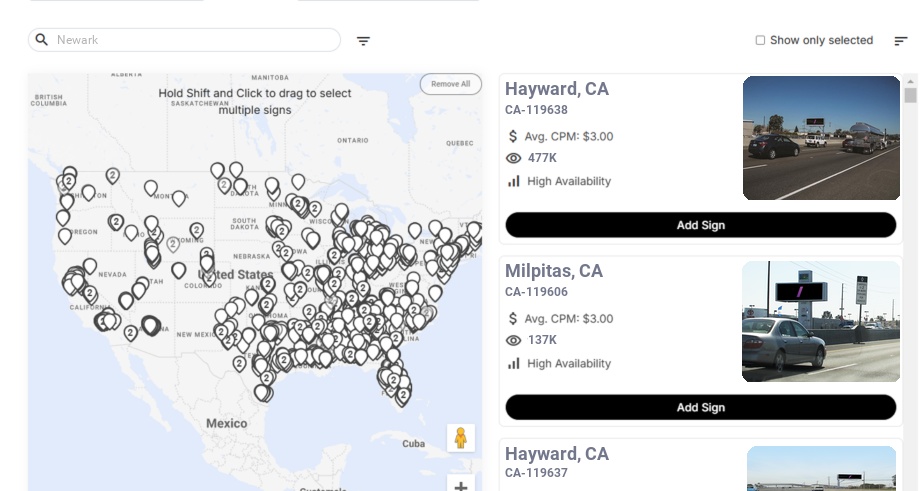
Blip’s digital billboards serving the Newark area are physically located in Hayward and Milpitas, but they are strategically placed along corridors that a large share of Newark-area drivers use daily. By placing digital campaigns on Blip’s boards near Hayward and Milpitas, we can intercept commuters traveling between the Tri-City area and South Bay/Silicon Valley, shoppers heading to regional retail hubs like NewPark Mall, and logistics and industrial workers moving along the I‑880 and I‑680 corridors.
Why is Newark, California a good market for billboard advertising?
Newark is compact but economically powerful, making Newark billboards an efficient way to reach a dense, high-value audience. The Newark area has a population of roughly 49,000 in the city itself, within a larger Tri-City cluster of over 365,000–370,000 people combined. Median household income is around $140,000–$145,000 in Newark, which is about 30–35% higher than the California average.
When is the best time to run Newark, California billboard ads with Blip?
Morning peak traffic in the Newark area is typically 6:30–9:30 a.m., and evening peak traffic is roughly 3:30–7:00 p.m. Weekdays, especially Monday through Thursday, tend to show the heaviest commute traffic. For performance-focused campaigns, the page recommends peak-only schedules to focus impressions when commuters are most captive.
What kinds of businesses work best for Newark, California billboards?
The page says Newark-area billboards are especially effective for retailers at NewPark Mall, recruiters and employers, and service providers such as legal, medical, and automotive businesses. It also notes that B2B tech, SaaS, co-working spaces, education and training programs, and healthcare and wellness advertisers can perform well because the area has high-income, tech-savvy, family-oriented audiences. Promotions tied to shopping, dining, events, and commuting also fit the local market well.
Do I need a contract to advertise with Blip near Newark?
No, Blip has no long-term contracts or minimum commitments. You can start, pause, or stop your campaign at any time.
How fast can I launch a billboard campaign with Blip near Newark?
You can have your campaign live in minutes. Create a free account, select your locations, set your budget, upload your design, and start running once approved.
Where can I advertise with Blip near Newark?
Blip has digital billboards near Newark. You can browse available locations on a map, choose the ones that fit your audience, and start advertising right away.
Still have questions? Launch a campaign in minutes — no contracts, no commitments.
Start Your CampaignNewark Billboard Advertising Guide
The Newark, California Hayward and Milpitas
Why the Newark Area Is a High-Value Billboard Market
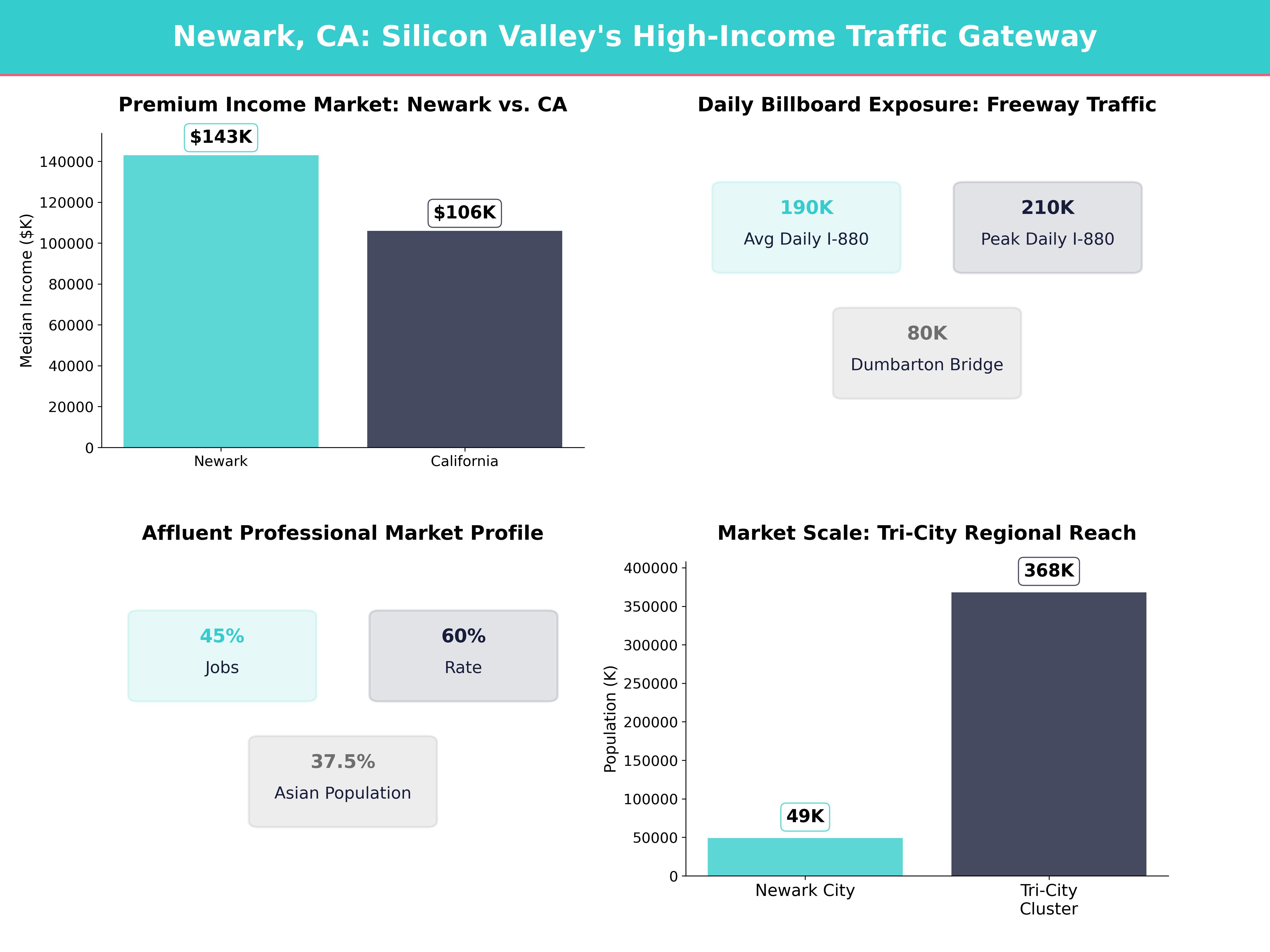
Newark is compact but economically powerful, making Newark billboards an efficient way to reach a dense, high-value audience. According to recent estimates, the Newark area has:
- A population of roughly 49,000 residents in the city itself, within a larger Tri-City cluster ( Newark Fremont Union City) of over 365,000–370,000 people combined.
- A median household income around $140,000–$145,000 in Newark, compared with roughly $106,000 for California overall, putting local incomes about 30–35% higher than the state average and more than 70% higher than national medians.
- Homeownership rates in much of the Tri-City area in the 55–65% range, supporting stable, repeat local spending in home services, healthcare, and education.
- A labor force in which 40–50% of workers are employed in management, business, science, and arts occupations, and a significant share working in information, professional/technical services, manufacturing, logistics, and healthcare tied to both the East Bay and Silicon Valley.
The city’s official site, newark.org NewPark Mall district, new residential developments, and business parks that directly feed daily traffic along I‑880, Thornton Avenue, and the Dumbarton Bridge approach. The City of Newark
Retail is a core engine of the local economy. Within a 10‑minute drive of Newark’s center, NewPark Mall and surrounding centers encompass more than 1 million square feet of retail space, with area retail sales measured in the hundreds of millions of dollars annually according to city economic development data. Nearby Fremont, profiled on Fremont’s Economic Development industrial vacancy rates under 5% in key submarkets, indicating strong business demand that further boosts worker and truck traffic through Newark’s trade area.
By placing digital campaigns on Blip’s boards near Hayward (about 9.1 miles from Newark) and Milpitas (about 9.5 miles from Newark), we can intercept:
- Commuters traveling between the Tri-City area and South Bay/Silicon Valley
- Shoppers and families heading to regional retail hubs like NewPark Mall and nearby Fremont centers
- Logistics and industrial workers moving along the I‑880 and I‑680 corridors
This network effectively functions as a ring of billboards near Newark, giving brands Newark billboard coverage without needing a physical structure inside city limits.
The broader East Bay economic region, highlighted by Alameda County’s Economic & Civic Development Newark Chamber of Commerce, supports more than 850,000 jobs, ensuring a constant base of daily commuters, goods movement, and discretionary spenders who can be reached via high‑visibility digital billboards.
Understanding Newark-Area Audiences
To make billboard campaigns effective near the Newark area, it helps to understand who we’re talking to and how they move through the region. This local insight is essential when planning billboard advertising near Newark through Blip’s platform.
Demographics & Lifestyle
- Newark and adjacent Fremont/Union City skew family-oriented, with many households of 3–4+ people. In several neighborhoods, more than 35% of households include children under 18, and multi-generational homes are common. Family-focused offers (education, healthcare, groceries, activities) tend to perform especially well.
- The broader Fremont–Newark–Union City area includes a significant Asian and Pacific Islander population. In Fremont, for example, Asian residents account for roughly 60% of the population, while in Newark the Asian share is around 35–40%, alongside strong Latino (around 30–35%) and White populations. Bilingual or culturally aware creative (especially English plus Chinese, Tagalog, Hindi, or Spanish, depending on your audience) can increase resonance and improve recall.
- Median home values in nearby Fremont and Newark commonly exceed $1.1–$1.2 million, and average monthly rents are often in the $2,700–3,200 range, reinforcing the high‑income, high‑cost-of-living profile of the area. These consumers tend to be selective and research‑oriented but also willing to pay for quality, convenience, and premium brands.
- With high income levels and strong tech employment, audiences are heavy users of mobile and digital channels. In Silicon Valley and the greater Bay Area, smartphone adoption exceeds 90% of adults, broadband penetration sits near 90% of households, and digital video usage is widespread. Pairing digital billboards with search, social, and mobile retargeting is particularly powerful here.
Local news outlets such as East Bay Times and The Mercury News regularly cover demographic shifts, new housing approvals, and retail development in Newark and surrounding cities, providing additional context for targeting specific neighborhoods or audience segments.
Commuter & Employment Patterns
- The Dumbarton Bridge (SR‑84) corridor is a critical cross-bay connector. Pre‑pandemic traffic counts have shown roughly 80,000–81,000 vehicles per weekday crossing the bridge, with total annual crossings topping 25–27 million. Many of these vehicles originate in Newark, Fremont, and Union City and are headed to tech campuses in Menlo Park, Palo Alto, and Mountain View.
- I‑880, which runs just east of Newark, is one of the busiest highways in the East Bay. Caltrans data for stretches between Hayward and Fremont typically shows average daily traffic (ADT) over 180,000–200,000 vehicles, with some segments surpassing 210,000 vehicles per day during peak periods.
- The I‑880 / SR‑92 junction near Hayward and the I‑880 / SR‑237 connection near Milpitas are major choke points where average speeds can drop below 25–30 mph during rush hour, creating longer dwell times and more effective billboard exposure.
- Many Newark-area residents commute 30–45 minutes+ each way; in some census tracts, more than 20% of workers report commutes over 45 minutes. This amplifies the value of repeated impressions across morning and evening peaks.
- Transit is also significant: BART and AC Transit serve nearby Fremont and Union City, with AC Transit reporting roughly 140,000–150,000 average weekday boardings system‑wide. While billboards primarily reach drivers, these commuting patterns underscore the regional draw of Newark as a bedroom and employment community.
For local context on transportation and planning, advertisers can reference the Alameda County Transportation Commission and Caltrans District 4, both of which publish corridor and traffic updates that can inform dayparting strategies.
Key Corridors & Where Our Boards Fit
Even though Blip’s digital billboards serving the Newark area are physically located in Hayward and Milpitas, they are strategically placed along corridors that a large share of Newark-area drivers use daily. This configuration makes Newark billboards accessible to a wide variety of advertisers without the long-term commitments often required for static structures.
Hayward (serving Newark’s North & I‑880 Corridors)
- Hayward lies roughly 9 miles northwest of Newark along I‑880. The City of Hayward, profiled at hayward-ca.gov, has a population of around 160,000 and is one of the largest employment hubs in Alameda County, driving consistent daily flows along I‑880.
-
Traffic at the I‑880 / SR‑92 interchange serves:
- Newark and Tri-City residents heading toward the Peninsula via the San Mateo–Hayward Bridge (SR‑92), which itself carries roughly 90,000–100,000 vehicles per day.
- East Bay residents coming down toward the Fremont–Newark area for work, shopping, or services.
-
This is highly valuable for:
- Retailers at NewPark Mall and nearby centers who want to capture shoppers before they choose a competing mall in Hayward, San Mateo, or San Jose. NewPark Mall’s trade area includes tens of thousands of households within a 5–7 mile radius, and the mall’s footprint exceeds 1 million square feet of leasable area, according to NewPark Mall’s directory.
- Recruiters and employers drawing labor from the broader East Bay, where Alameda County’s unemployment rate has often hovered in the 3–5% range in recent years, indicating a tight but mobile labor market.
- Service providers (legal, medical, automotive) who serve clients across multiple cities and want to build top-of-mind awareness across both sides of the bridge.
Milpitas (serving Newark’s South & Silicon Valley Corridors)
- Milpitas is about 9.5 miles southeast of Newark, positioned near the critical I‑880 / I‑680 / SR‑237 triangle. The City of Milpitas 80,000 residents and thousands of tech and manufacturing jobs, intensifying corridor traffic.
- SR‑237, in particular, is a tech commuter artery toward Sunnyvale, Santa Clara, and Mountain View, with traffic counts often in the 120,000–150,000 vehicles/day range in key segments. In peak hours, travel times between I‑880 and US‑101 can increase by 50–70% compared to free‑flow conditions, raising the impact of digital messaging.
-
Billboards in this area are ideal for:
- B2B tech, SaaS, and co-working spaces targeting decision-makers commuting between the Newark area and Silicon Valley. Santa Clara County 400,000 technology and professional services jobs, many concentrated along this corridor.
- Higher education and training programs aimed at career upskilling for tech and engineering professionals, such as local community colleges and universities promoted through sites like Ohlone College
- Entertainment and weekend destinations trying to pull Silicon Valley residents north to Newark-area venues, shopping, or events, especially given that 40–50% of weekend trips on some segments of I‑880 and SR‑237 are discretionary (shopping, dining, leisure).
By combining boards near Hayward and Milpitas, we can surround Newark-area audiences from both directions and capture both East Bay and Silicon Valley flows, reaching a daily vehicle volume that can easily exceed 300,000–350,000 impressions per day across the connected corridors when scheduled strategically. For advertisers exploring billboard rental near Newark, this combined coverage offers a highly efficient reach and frequency model.
Timing: When to Run Newark-Area Campaigns
Traffic patterns in the Newark area follow Bay Area norms but with a few local nuances worth leveraging through Blip’s flexible scheduling.
Daily Patterns
- Morning peak: Typically 6:30–9:30 a.m., with earlier spikes on major corridors like I‑880 and SR‑237 as tech workers start early. On some weekdays, traffic volumes in the peak hour can account for 9–11% of the entire day’s vehicles.
- Evening peak: Roughly 3:30–7:00 p.m., with some of the heaviest and slowest traffic on eastbound and northbound routes as commuters head back to the Newark area and surrounding communities. Evening peak periods often last 30–45 minutes longer than morning peaks.
-
Midday traffic: While lower than commute peaks, Newark-area mid-days still capture:
- Service and delivery vehicles supporting the region’s more than 30,000–40,000 local businesses across Alameda and Santa Clara counties
- Shoppers heading to NewPark Mall and big-box retail, which can see 15–25% of daily visits between late morning and early afternoon
- Parents on school-related trips; Newark Unified School District, profiled at newarkunified.org, serves thousands of students across multiple campuses, generating steady school‑hour circulation.
We recommend:
- Running brand-building campaigns across wide time windows (early morning through early evening) for maximum frequency. A typical driver using I‑880 five days per week might pass a given location 40–60 times per month, so repetition is key.
- Using peak-only schedules for performance-focused campaigns (events, limited-time offers) to focus impressions when commuters are most captive, and when average speeds drop to 20–35 mph in congestion zones.
Weekly & Seasonal Patterns
- Weekdays (Mon–Thu) tend to show the heaviest commute traffic. Regional studies indicate that 70–75% of weekly vehicle trips on freeways occur Monday–Thursday, with Friday showing a shift toward leisure and discretionary trips.
- Fridays often see more discretionary travel—shopping, dining, and early weekend getaways. Retailers and restaurants commonly report 10–20% higher sales on Fridays versus midweek averages.
- Retail and entertainment advertisers can shift more budget to Fridays and weekends, when people are in planning and spending mode; NewPark Mall and other centers frequently promote extended weekend hours and events on their event calendars.
-
Seasonal notes for the Newark area:
- Back-to-school (Aug–Sep): Schools in Newark, Fremont, and Union City collectively serve well over 50,000 students. Spending on supplies, apparel, and extracurriculars spikes, making this a strong opportunity for education, tutoring, after-school programs, and youth sports.
- Holiday shopping (Nov–Dec): Regional retail hubs often report 20–30% of annual sales occurring in the November–December period. NewPark Mall and surrounding shopping centers see significant increases in foot and vehicle traffic, with many weekends reaching near‑capacity parking levels.
- Spring and summer (Mar–Aug): More local events and outdoor activities across Newark and neighboring cities; great timing for event promotion, tourism, and family attractions. The City of Newark Newark Patch publish community calendars and park/event updates that can guide seasonal creative.
Local news outlets like the East Bay Times and The Mercury News regularly cover traffic trends, development, and seasonal activity in the region; tracking their coverage can help refine when to increase or trim billboard spend.
Creative Strategies That Work Near Newark
High-income, tech-savvy audiences in the Newark area are busy and often commuting at speed. Creative must break through quickly and clearly for billboard advertising near Newark to perform at its best.
Design Best Practices for Newark-Area Boards
- Keep it ultra-simple: Aim for 6–8 words or fewer, plus logo/URL. With average freeway speeds of 50–65 mph outside of congestion and viewing windows often under 6–8 seconds, brevity wins.
- High contrast, bold colors: Use strong contrasts (e.g., dark background with bright text) to stand out against Bay Area’s often overcast or sun-glare conditions. Well-contrasted creatives can improve legibility distances by 20–30% compared to low-contrast designs.
- Readable fonts at a distance: Avoid thin scripts. Stick to strong sans-serif fonts with large letter heights (e.g., 18–24 inches or equivalent digital scale) to ensure clarity at 500–700 feet away.
- One clear action: “Exit at Thornton,” “NewPark Mall – Today,” “Book a Demo,” “Enroll Now,” etc. Campaigns with a single, specific call-to-action routinely outperform multi‑message boards in recall studies by 10–20 percentage points.
Messaging Tailored to Newark-Area Mindsets
-
Commuters to/from Silicon Valley
- Emphasize time, convenience, and career advancement.
- Example: “Cut Your Commute Costs – EV Rebates at [Dealership Name] Near Newark Area.”
- For B2B: “Bay Area Teams Ship Faster with [Your SaaS] – Free Trial.”
- With average annual commute times exceeding 200 hours per worker in the Bay Area, messages that save time or money on commuting resonate strongly.
-
Families & Residents
- Stress local, safe, and family-friendly messaging.
- Example: “After-School Coding in the Newark Area – Enroll Today.”
- “Trust Your Smile to Newark-Area Orthodontists – Free Consult.”
- In family-oriented markets, healthcare, education, and youth programs can see engagement lifts of 15–25% when creative explicitly mentions kids or families.
-
Shoppers & Diners
- Focus on proximity to known landmarks: NewPark Mall, major anchors, or freeway exits.
- Example: “Hungry Before You Hit the Bridge? Exit for [Restaurant] Near Newark Area.”
- Restaurant and retail buyers often make decisions within 5–10 minutes of purchase; impulse‑oriented visuals (food imagery, “Today Only,” or “Next Exit”) work particularly well.
-
Culturally Diverse Audiences
- Consider bilingual creative where appropriate (e.g., English + Spanish or English + Chinese) for campaigns with clear multicultural focus.
- Keep translations equally concise and visually balanced. Studies in similar high‑diversity markets show bilingual boards can increase ad recognition among target ethnic groups by 20–40% while maintaining broad English‑speaking appeal.
Because Blip allows rotating multiple creatives, we can:
- Test different value propositions simultaneously (price vs. quality vs. convenience).
- Run language-specific or segment-specific messages at different times of day or on different boards. For example, English‑only in broad commute windows and bilingual versions in evening and weekend slots when family travel is heavier.
Using Blip’s Tools to Target the Newark Area Precisely
Digital billboards serving the Newark area give us flexibility rarely possible with traditional static boards, especially for advertisers who want the benefits of Newark billboards without committing to a single, long-term lease.
Location Targeting
- Choose specific boards near Hayward to hit drivers heading into/out of Newark and the northern East Bay.
- Choose boards near Milpitas to intercept Newark-area commuters tied to Silicon Valley and South Bay employers.
- Combine both groups to create a “ring” around the Newark area, maximizing reach for city-wide campaigns. This approach can reliably reach a regional audience of 300,000+ residents who regularly traverse these highways for work, shopping, and recreation.
Budget Flexibility
- Start with low daily budgets and increase spend on days/times where performance looks strongest. Many advertisers in similar markets begin with test budgets of $10–$30 per day per board, then scale as they identify “sweet spot” hours and days.
- Use dayparting to only run during commute peaks, or to capture weekend shoppers heading towards Newark-area retail centers. Concentrating spend into 30–50% of the weekly hours that carry 60–70% of the traffic can dramatically improve cost‑per‑impression and make billboard rental near Newark more efficient.
Creative Rotation & Testing
- Upload multiple versions of your artwork and let them rotate.
-
Track which message lines up with web traffic, store visits, or promo code usage. For example:
- Creative A: “Newark-Area Orthodontic Care – Free Consult”
- Creative B: “Braces & Invisalign for Newark Families – $0 Down”
- Keep the winner; iterate on it with new offers or visuals. In many campaigns, small headline changes can boost response by 10–30% without increasing media spend.
Industry-Specific Ideas for Newark-Area Campaigns
Retail & E-commerce
- Highlight click-and-collect or same-day pickup for Newark-area customers; across the U.S., buy‑online‑pick‑up‑in‑store (BOPIS) sales have grown at double‑digit annual rates and now account for 10–15% of total e‑commerce orders in some categories.
-
Use NewPark Mall and freeway exits as geographic anchors:
- “Pickup in 2 Hours Near NewPark Mall – Shop [Brand].”
- Ramp spending during key retail days such as Black Friday and major sale events, when retailers can see daily revenue jumps of 200–300% compared with average days.
Automotive & EV
- High commute volumes and tech-savvy consumers mean strong interest in EVs and hybrids. In the Bay Area, EVs represent more than 20% of new vehicle registrations, far above national averages.
-
Emphasize savings and convenience:
- “Lease an EV Near Newark – Starting $X/Month.”
- “Save Up to $Y/Year on Gas – Go Electric.”
- Direct people to easily reachable dealerships off I‑880 or I‑680 in Hayward, Fremont, or Milpitas, where regional auto rows collectively sell tens of thousands of vehicles each year. Auto dealers can use flexible billboard rental near Newark to promote changing offers or limited-time rebates.
Education & Training
- Many residents pursue upskilling in technology, healthcare, and business. Community colleges and universities in the East Bay and South Bay collectively enroll hundreds of thousands of students annually, with large shares in part‑time or evening programs.
-
Promote online or hybrid programs appealing to commuters:
- “Earn Your Tech Certificate from Home in the Newark Area.”
- Align campaign pushes with term starts and application deadlines. Application periods can drive inquiry volumes up 2–3x compared with off‑cycle months, so concentrated billboard bursts can be particularly effective.
Healthcare & Wellness
- Family-oriented households create steady demand for pediatric, dental, urgent care, and specialty services. Alameda and Santa Clara counties together support more than 50 hospitals and major medical centers, plus thousands of clinics and practices competing for share of mind.
-
Emphasize convenience, extended hours, and proximity:
- “Urgent Care Minutes from the Newark Area – Open Late.”
- Use boards in both Hayward and Milpitas to capture patients traveling across the region, including from job centers listed on sites like Fremont’s Innovation District
Events, Entertainment & Hospitality
- Promote Newark-area events, sports, festivals, and venues to commuters passing through Hayward and Milpitas. The City of Newark
-
Use countdowns and short-term bursts:
- “3 Days Left – Newark Summer Fest – Exit for Fun.”
- Coordinate with city or regional event calendars published via City of Newark or local news sites like Newark Patch, East Bay Times, and The Mercury News to time campaigns to local happenings, sports seasons, and holiday celebrations.
Measuring & Optimizing Newark-Area Billboard Performance
Billboards in the Newark area work best when integrated with a measurement plan, whether you’re testing the market with a small buy or running an ongoing program of billboard advertising near Newark.
Use Clear Tracking Mechanisms
- Dedicated URLs or landing pages (e.g.,
/newark-offer) that allow you to track pageviews and conversions; even modest billboard campaigns can drive hundreds to thousands of incremental visits per month in high‑traffic markets. - Unique promo codes tied to billboard campaigns (e.g., “NEWARK10”) so you can attribute redemptions directly to out‑of‑home impressions.
- Trackable phone numbers or QR codes (only if the design keeps them large and simple). When executed well, QR usage can account for 5–10% of billboard-driven responses in tech‑savvy markets.
Align With Digital Metrics
-
Watch for lifts in:
- Direct and branded search traffic from IP ranges in the Newark–Fremont–Union City–Hayward–Milpitas cluster. After launching campaigns, many advertisers observe 10–30% increases in branded searches.
- Store visits or online orders with shipping addresses in the Newark area. Compare campaign versus pre‑campaign periods to quantify incremental sales.
- Lead form submissions or demo requests during campaign periods, especially if you run short, intense bursts of impressions.
Iterate Based on Data
- If certain time blocks (for example, 7–9 a.m. or 4–6 p.m.) correlate with higher conversions, direct more Blip budget into those hours. Shifting even 20–30% of spend into top‑performing windows can materially lower cost‑per‑acquisition.
- Swap underperforming creative quickly; digital makes it inexpensive to test new headlines or offers. Aim for continuous improvement cycles of 2–4 weeks, refreshing creative based on performance patterns and seasonal shifts flagged in local media or city reports.
By combining Newark-area knowledge—commuter flows, income levels, cultural diversity, and seasonal patterns—with Blip’s flexible, data-friendly digital billboards in nearby Hayward and Milpitas, we can build campaigns that not only reach a large audience, but also speak directly to how people in the Newark area live, move, and make decisions every day, while giving advertisers scalable options for billboard rental near Newark that match their goals and budgets.