Billboards near Grand Terrace, CA
No Minimum Spend. No Long-Term Contracts. Just Results.
Trusted by Leading Brands


Billboard advertising
near Grand Terrace has never been easier



How much is a billboard near Grand Terrace?
Why Choose Blip for Billboard Advertising near Grand Terrace
Blip lets you launch on Grand Terrace’s I-215 and I-10 commuter routes in minutes, reaching daily drivers without traditional billboard hassles.
Set flexible budgets for Grand Terrace and scale by results—ideal for the area’s mix of family households, students, and logistics workers.
Use dayparting on Blip to hit Grand Terrace rush hours, lunch traffic, or late shifts tied to Moreno Valley warehouses and Inland Empire campuses.
No long contracts means you can test Grand Terrace billboard ads near Riverside, San Bernardino, and Moreno Valley, then shift fast as traffic changes.
Track Grand Terrace campaign performance in real time and optimize for the busiest corridors, from SR-60 freight flows to weekday I-215 commutes.
Blip’s creative tools help tailor bold, bilingual ads for Grand Terrace’s fast-moving freeway audience and diverse Inland Empire neighborhoods.
Frequently Asked Questions About Billboard Advertising near Grand Terrace
How much does a billboard cost near Grand Terrace, California with Blip?
With Blip, you control exactly what you spend on Grand Terrace billboards by setting a daily budget that can be changed anytime, so you can advertise in the Grand Terrace area on practically any budget. Each ad “blip” is a 7.5 to 10-second display on rotating digital billboards near Grand Terrace, California, and you only pay for the blips you actually receive. Pricing for each blip varies based on when and where your ad shows and on advertiser demand, so your total cost over time is simply the sum of all those individual blips.
Where can I advertise with Blip near Grand Terrace, California?
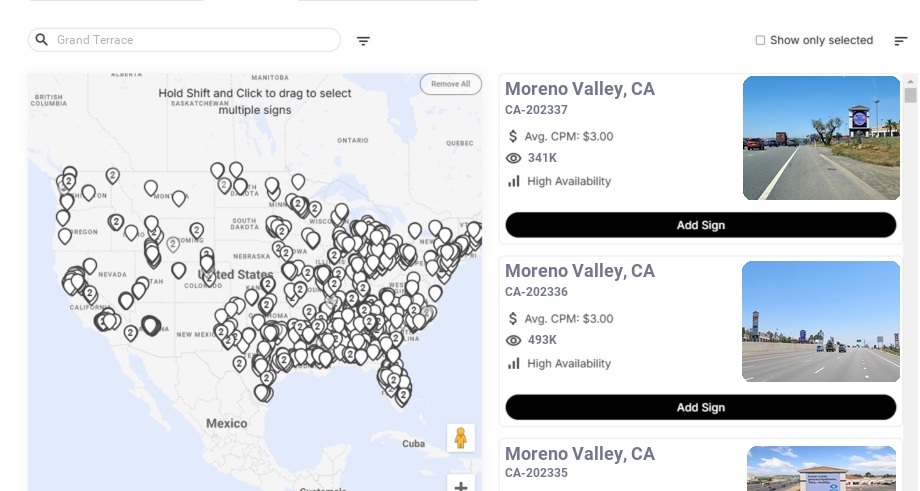
The 10 digital billboards serving the Grand Terrace area are positioned primarily in nearby Riverside, San Bernardino, and Moreno Valley. These corridors consistently rank among the busiest in the Inland Empire, generating enormous daily impression potential for billboard advertising near Grand Terrace. This allows advertisers to tap into dense freeway traffic and diverse local audiences while keeping budgets flexible and campaigns highly targeted.
What kind of audience do Grand Terrace billboards reach?
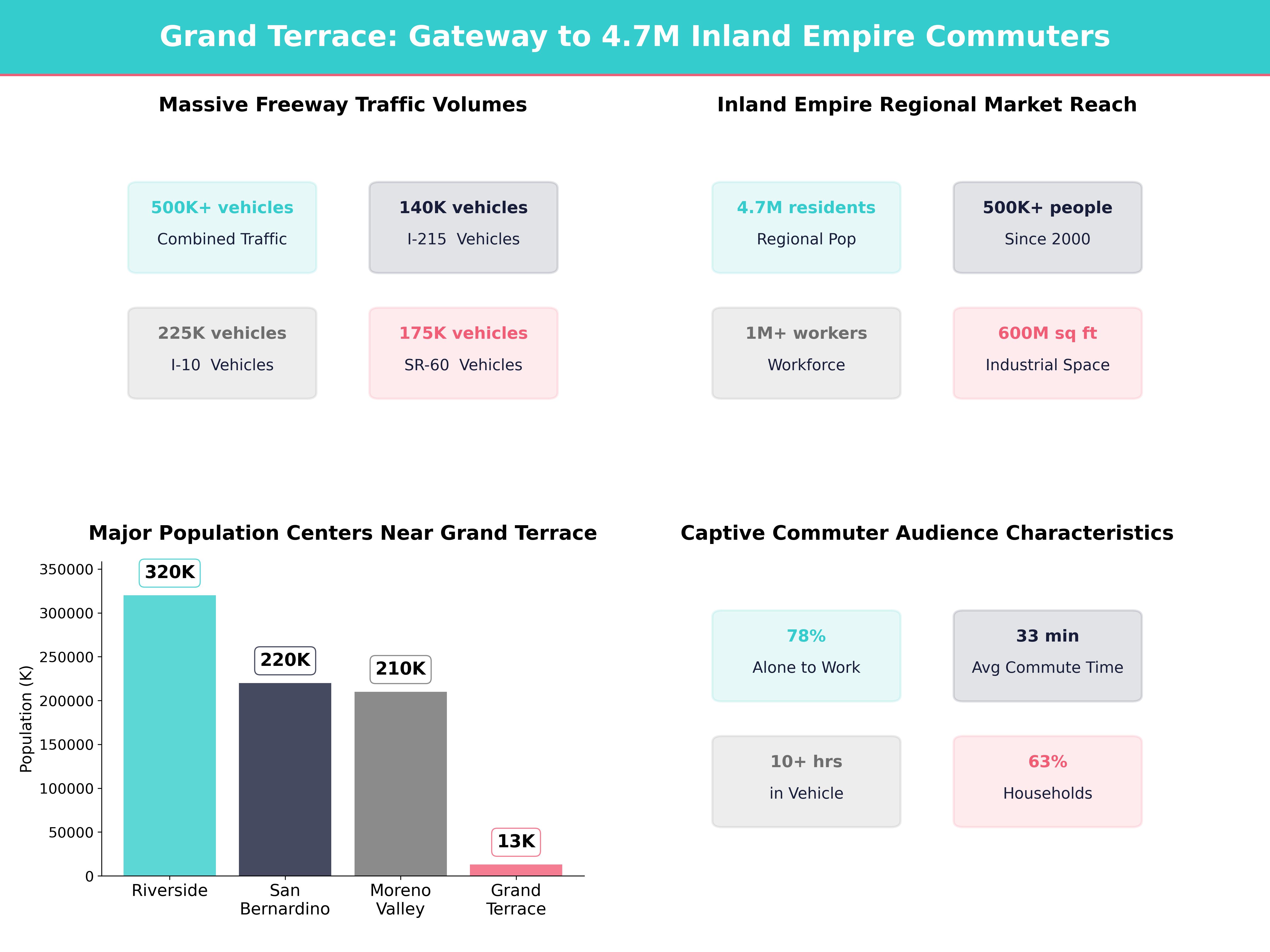
Grand Terrace is a compact, primarily residential community of about 13,000 residents in roughly 3.5 square miles, nestled between Riverside and San Bernardino along the I‑215 corridor. Even though the city is small, it sits inside the much larger Inland Empire, which now has roughly 4.6–4.7 million residents and has added well over 500,000 people since 2000. The area audience is diverse and mobile, including commuting families, logistics and industrial workers, students, faculty, and healthcare, government, and education workers.
When is the best time to run billboards near Grand Terrace with Blip?
Using Blip, we can align campaign schedules with real-world behavior in the Grand Terrace area and the Inland Empire’s consistent commute patterns. Morning commute, midday, and evening commute all offer valuable windows, with evening commute often bringing the heaviest overall traffic and slower speeds that increase dwell time in view of boards. Weekend shopping and leisure traffic also increases, and the region can see double-digit percentage increases in traffic on Saturdays compared with midweek days.
What roads and traffic patterns make Grand Terrace billboards effective?
The Grand Terrace area is served by major freeway corridors including I‑215, I‑10, and SR‑60, which consistently rank among the busiest in the Inland Empire. Nearby segments on I‑215 commonly carry 130,000–150,000 vehicles per day, while some I‑10 segments in San Bernardino County carry more than 200,000–250,000 vehicles per day. Combined daily traffic across these three corridors in the region easily surpasses 500,000 vehicles, creating strong impression potential for billboard advertising near Grand Terrace.
Do I need a contract to advertise with Blip near Grand Terrace?
No, Blip has no long-term contracts or minimum commitments. You can start, pause, or stop your campaign at any time.
How fast can I launch a billboard campaign with Blip near Grand Terrace?
You can have your campaign live in minutes. Create a free account, select your locations, set your budget, upload your design, and start running once approved.
Where can I advertise with Blip near Grand Terrace?
Blip has digital billboards near Grand Terrace. You can browse available locations on a map, choose the ones that fit your audience, and start advertising right away.
Still have questions? Launch a campaign in minutes — no contracts, no commitments.
Start Your CampaignGrand Terrace Billboard Advertising Guide
The Grand Terrace Inland Empire Riverside, San Bernardino, and Moreno Valley. With 10 digital billboards near Grand Terrace serving the area from these nearby cities, advertisers can use Blip to tap into dense freeway traffic and diverse local audiences while keeping budgets flexible and campaigns highly targeted for billboard advertising near Grand Terrace.
Understanding the Grand Terrace Area Market
Grand Terrace is a compact, primarily residential community of about 13,000 residents in roughly 3.5 square miles, nestled between Riverside and San Bernardino along the I‑215 corridor. Even though the city is small, it sits inside the much larger Inland Empire, which now has roughly 4.6–4.7 million residents across Riverside County San Bernardino County and has added well over 500,000 people since 2000, making it one of the fastest‑growing large metro areas in the United States. This regional growth means Grand Terrace billboards benefit from a much larger draw area than the city’s population alone might suggest.
Key nearby cities serving the Grand Terrace area include:
-
Riverside (about 6.6 miles away) – Population around 320,000, making it one of the 15 largest cities in California, with more than 150,000 jobs in education, government, healthcare, logistics, and professional services.
- City information: City of Riverside
- Tourism and events: Visit Riverside
- Local news coverage: The Press-Enterprise
-
San Bernardino (about 8.5 miles away) – Population around 220,000, with the broader San Bernardino area supporting more than 180,000 jobs and serving as a major logistics, government, and healthcare center.
- City information: City of San Bernardino
- Local news coverage: San Bernardino Sun
-
Moreno Valley (about 6.6 miles away) – Population around 210,000, with more than 60 million square feet of industrial and logistics space and thousands of jobs tied to distribution, warehousing, and e‑commerce.
- City information: City of Moreno Valley
- Business & logistics: Moreno Valley Economic Development
- Local government hub for residents at the core of this market: City of Grand Terrace
- County context: San Bernardino County and Riverside County
Household incomes in the Grand Terrace area and neighboring cities are mixed but generally middle‑income, with many dual‑income and commuting households:
- Grand Terrace’s median household income is in the low‑$80,000s, higher than both state and national medians.
- Nearby Riverside and Moreno Valley tend to fall in the mid‑to‑upper‑$70,000s to low‑$80,000s, while San Bernardino is more in the low‑to‑mid‑$60,000s, creating a wide affordability and income mix in the immediate trade area.
- Across the Inland Empire, roughly 60–65% of households are family households, and more than one‑third include children under 18, creating steady demand for family‑oriented goods and services that can be effectively promoted with billboard advertising near Grand Terrace and its commuting corridors.
Job growth in the Inland Empire has consistently outpaced the California average over the last decade, driven heavily by:
- Logistics and warehousing: logistics and transportation jobs in the region have grown by more than 30% since 2010, with hundreds of millions of square feet of industrial and warehouse space concentrated along I‑10, I‑215, and SR‑60.
- Healthcare: healthcare and social assistance now account for roughly 1 in 7 local jobs, supported by regional anchors like Loma Linda University Medical Center and Loma Linda University Children’s Hospital plus major county health systems.
- Education and government: tens of thousands of jobs at University of California, Riverside (UCR), California State University, San Bernardino (CSUSB), Riverside City College (RCC) Loma Linda University, K‑12 school districts, and county offices.
- Retail and services: population growth has fueled continuous expansion of regional shopping centers, restaurants, and service businesses.
For advertisers, this means we can:
- Target family‑oriented, commuter‑heavy neighborhoods that drive daily traffic through the I‑215 and I‑10 corridors
- Reach students and staff commuting to nearby colleges and universities, where combined enrollment within a 20‑mile radius exceeds 60,000–70,000 students plus tens of thousands of staff and faculty
- Connect with blue‑ and white‑collar workers in logistics, warehousing, healthcare, and education across a labor force of well over 1 million workers in the two‑county region
- Use messages that work for both Spanish‑speaking and English‑speaking audiences—nearby cities like Riverside, San Bernardino, and Moreno Valley all have Latino majorities or strong pluralities, and in many neighborhoods 40–60% of residents speak Spanish at home
Where Billboard Views Come From: Key Corridors and Traffic Patterns
The 10 digital billboards serving the Grand Terrace area are positioned primarily in nearby Riverside, San Bernardino, and Moreno Valley, capturing traffic on some of Southern California’s most important freeways. These corridors consistently rank among the busiest in the Inland Empire, generating enormous daily impression potential for billboard advertising near Grand Terrace.
-
I‑215 corridor – Runs north–south through the Grand Terrace area, connecting to San Bernardino and Riverside.
- Nearby Caltrans District 8 segments between Riverside and San Bernardino commonly carry 130,000–150,000 vehicles per day (AADT), meaning a single board can deliver millions of weekly impressions when rotated across the day.
- Access information and traffic updates: Caltrans District 8 – San Bernardino/Riverside
-
I‑10 corridor – Major east–west freeway just south of the Grand Terrace area, funneling traffic between Los Angeles, the Inland Empire, and the Coachella Valley.
- Several nearby segments in San Bernardino County carry more than 200,000–250,000 vehicles per day, especially around the I‑10/I‑215 interchange.
- With just 8–10 seconds of typical viewing time at freeway speeds, concise creative is critical to capture this volume.
-
SR‑60 corridor – Connects Moreno Valley and Riverside toward Los Angeles.
- Typical daily traffic volumes on nearby segments frequently exceed 160,000–190,000 vehicles per day, much of it tied to container and warehouse freight plus commuter flows.
Because many Grand Terrace area residents commute to nearby cities for work or school, they frequently travel these freeways:
- In the broader Riverside–San Bernardino metro, more than 75–80% of workers drive alone to work, and another 10–12% carpool; transit and walking/biking comprise a relatively small share.
- Average one‑way commute times for Inland Empire residents are typically 32–35 minutes, with many freeway commuters spending 45–60 minutes each way.
- That translates into 10+ hours per week in vehicles for a typical full‑time worker, creating repeated, high‑frequency exposures to boards along habitual routes.
Tens of thousands of residents in the Riverside–San Bernardino metro commute daily along I‑10, I‑215, and SR‑60, with combined daily traffic across these three corridors in the region easily surpassing 500,000 vehicles. By using Blip’s tools, we can push ads during heavy commute times and on the corridors most relevant to the Grand Terrace area, helping local and regional advertisers “own” key driving windows with Grand Terrace billboards that align with daily travel patterns.
For local travel and visitor context, see:
- Regional travel info: Visit Greater Ontario/Inland Empire
- Countywide updates: San Bernardino County – Transportation & Infrastructure
Who You’re Reaching Near Grand Terrace
The Grand Terrace area audience is diverse and mobile. When planning creative and targeting, it helps to think in terms of the major audience segments flowing through the nearby billboard locations.
1. Commuting families and residents
- Across Grand Terrace and its neighboring cities, 60–70% of occupied housing units are owner‑occupied, and many are 2–4 person households.
- In much of the surrounding area, more than one‑third of residents are under age 25, and around 25–30% are children under 18, fueling demand for family, youth, and school‑related services.
- With typical commutes over 30 minutes and heavy reliance on cars, residents use the same routes day after day—ideal for frequency‑based messaging such as brand awareness, promotions, recurring services (dental, auto repair, after‑school programs), and seasonal offers.
2. Logistics and industrial workers
- The Riverside–San Bernardino region is one of the nation’s largest logistics hubs. Inland Empire industrial inventory has grown to well over 600 million square feet, with vacancy rates often in the low‑single digits, indicating intense usage and employment.
- Moreno Valley’s March Air Reserve Base surrounding logistics centers tens of thousands of jobs when combined with adjacent warehouse and distribution parks.
- The corridor between Moreno Valley, Riverside, and San Bernardino handles a large share of Southern California’s e‑commerce and port‑related freight, and shifts often start early (5–7 a.m.) or late (2–11 p.m.), aligning with non‑traditional drive‑time windows.
-
This group is highly responsive to messages about:
- Quick‑service restaurants and drive‑thrus near freeway exits
- Automotive services and tire shops
- Payday/financial services and check‑cashing
- Cellular and electronics
- Local retail, discount stores, and entertainment
3. Students, faculty, and staff
Within about a 15–20 mile radius of the Grand Terrace area, there are more than 60,000 college and university students across several institutions, plus tens of thousands of employees:
- University of California, Riverside (UCR) – Around 26,000 students and 3,000+ faculty and staff
- California State University, San Bernardino (CSUSB) – Roughly 19,000 students and 2,000+ faculty and staff
-
Riverside City College (RCC) – About 19,000 students
- RCC
- Loma Linda University – Approximately 4,000–5,000 students and thousands more staff and clinicians
Students and staff frequently travel I‑215 and nearby arterials between housing, campus, and jobs. Many live in Riverside, San Bernardino, Moreno Valley, or nearby suburbs while taking classes or working near Grand Terrace, and they regularly see billboards near Grand Terrace along those routes.
They’re ideal targets for:
- Apartments and student housing
- Food & beverage (especially fast‑casual, coffee, and late‑night options)
- Fitness, wellness, and medical clinics
- Entertainment and events
- Tech, apps, streaming, and online services with subscription or trial offers
4. Healthcare, government, and education workers
The Grand Terrace area is near major employers such as:
- Loma Linda University Medical Center and Children’s Hospital employing thousands of physicians, nurses, and staff
- County government offices in San Bernardino County and Riverside County tens of thousands of workers across justice, health, social services, and administration
- Regional medical centers, school districts, and specialized clinics that draw staff from across the Inland Empire
These professionals have predictable commute patterns, are typically in vehicles during standard peak hours, and respond well to messages about:
- Financial services, banking, and credit unions
- Professional services (law, insurance, real estate, accounting)
- Continuing education, certification programs, and graduate degrees
- Higher‑end auto, retail, and dining, along with wellness and lifestyle brands
For more context on jobs and employers, see:
- Riverside County Economic Development
- San Bernardino County Economic Development
Timing Your Campaign: When Impressions Are Most Valuable
Using Blip, we can align campaign schedules with real‑world behavior in the Grand Terrace area and the Inland Empire’s consistent commute patterns.
Weekday patterns
-
Morning commute (6:00–9:00 a.m.)
- Heavy north–south movement on I‑215 between Grand Terrace, Riverside, and San Bernardino, plus east–west flows on I‑10 and SR‑60.
- In many Inland Empire corridors, 30–40% of daily traffic passes through during morning and evening peaks combined.
- Best for coffee, food, quick‑service restaurants, gas, and “start your day” messaging.
-
Midday (11:00 a.m.–2:00 p.m.)
- Lunchtime traffic from office parks, logistics centers, campuses, and medical centers.
- Retail and dining districts in Riverside, San Bernardino, and Moreno Valley often see noticeable spikes in foot traffic during this window.
- Great for lunch specials, same‑day services, and health/errand messaging.
-
Evening commute (3:30–7:00 p.m.)
- Heaviest overall traffic; many corridors experience peak congestion and slower speeds, increasing dwell time in view of boards.
- People are more receptive to entertainment, dining, and family‑oriented offers.
- Ideal for retail, restaurants, gyms, after‑school programs, and event promotion.
Weekend patterns
- Weekend shopping and leisure traffic increases around local malls and entertainment nodes in Riverside and San Bernardino. Regional centers can see double‑digit percentage increases in traffic on Saturdays compared with midweek days.
- The region hosts events at venues like the National Orange Show Event Center, Downtown Riverside
-
Use Blip to ramp up impressions on Fridays and Saturdays for:
- Retail sales
- Special events
- Attractions, entertainment, and nightlife
Seasonal considerations
- Back‑to‑school (August–September) – K‑12 and college campuses in Riverside, San Bernardino, and Loma Linda see surges in traffic; UCR and CSUSB alone bring back more than 40,000 students each fall. Promote tutoring, supplies, after‑school activities, and student services.
- Holiday season (November–December) – Malls and shopping centers around Riverside and San Bernardino experience some of their highest sales weeks of the year, with regional visitation increases commonly in the 20–30% range over typical months. Use countdown‑style promotions and gift messaging.
- Spring and summer – Tourism and outdoor activities increase, supported by events, festivals, and regional attractions. Signature draws like Riverside’s Festival of Lights hundreds of thousands of visitors each season, boosting freeway and downtown traffic and making event‑based, hospitality, and attraction advertising more powerful.
Because Blip lets us schedule by hour, day, or budget thresholds, we can concentrate spending during the highest‑value traffic windows rather than buying every hour of the day, helping you capture a larger share of impressions when your customers are most likely to notice and act.
Creative Strategies That Resonate in the Grand Terrace Area
To stand out on busy Inland Empire freeways serving the Grand Terrace area, billboard creative needs to be bold, culturally aware, and instantly understandable. With board rotations often in 8–10 second increments and freeway speeds of 55–70 mph, clarity is everything for Grand Terrace billboards reaching fast‑moving traffic.
1. Design for fast‑moving freeway traffic
- Use 5–8 words maximum plus logo or URL; legibility studies show recall drops sharply when word counts climb beyond 8–10 words at freeway speeds.
- Opt for high‑contrast colors (dark text on a bright background, or vice versa). Avoid thin fonts or low‑contrast color combos.
- Keep a single, dominant focal point: one product, one face, or one bold icon.
- Include one clear call‑to‑action: “Take Exit 42,” “Order at [Brand].com,” or “Text GRAND to 12345.”
2. Reflect the local culture and language mix
Nearby Riverside, San Bernardino, and Moreno Valley all have strong Latino communities, and bilingual households are common in the Grand Terrace area:
- In many neighborhoods, 50% or more of residents identify as Hispanic/Latino, and 40–60% of households speak Spanish at home.
- Consider bilingual headlines or alternating English/Spanish creatives using multiple Blip slots to reach both language groups effectively.
- Use familiar visual cues: local landscapes, family scenes, or references to local landmarks (e.g., Box Springs Mountains, downtown Riverside skyline, San Bernardino Mountains, local sports and high schools).
- Avoid overly generic “stock‑photo suburbia”; instead, lean into the Inland Empire’s identity as hard‑working, diverse, and community‑oriented.
3. Emphasize convenience, value, and proximity
Many Grand Terrace area drivers are commuting under time pressure, balancing work and family:
-
Use exit numbers, minutes away, or cross‑streets in copy:
- “3 Minutes Ahead on Barton Rd”
- “Exit Mt. Vernon – Next Right”
- Highlight time savings, easy parking, curbside pickup, or drive‑thru options.
- Make value propositions explicit: “$39 Exam & X‑Ray,” “2 For $20,” “First Month Free,” “$10 Oil Change Discount.”
4. Rotate messages strategically with digital
Unlike static boards, Blip‑supported digital allows us to run multiple pieces of creative in sequence:
- Awareness + offer: One creative for brand recognition, another for a specific discount or event; switching between them keeps content fresh for commuters who see the board multiple times per week.
-
Dayparted creative:
- Morning – “Coffee & Breakfast – Exit …”
- Afternoon – “Lunch Specials Until 3 PM”
- Evening – “Family Dinner Tonight?” or “Gym Open Late – Join Today”
-
Audience‑tailored creative on different boards:
- Boards closer to campuses show student offers (e.g., “Show Student ID – 10% Off”).
- Boards closer to logistics hubs emphasize grab‑and‑go meals, auto repair, and services that match shift‑work schedules.
Matching Message to Place: Using Nearby Cities to Reach the Grand Terrace Area
Because the 10 digital billboards serving the Grand Terrace area are physically located in Riverside, San Bernardino, and Moreno Valley, we can tailor creative based on the specific geography of each board while keeping Grand Terrace area residents at the core of the plan.
Riverside‑facing boards (serving the Grand Terrace area from the southwest)
-
Ideal for reaching Grand Terrace area residents who commute to or through Riverside for:
- Office work, government jobs, and education at UCR or RCC
- Shopping and dining in downtown Riverside or major retail centers like Galleria at Tyler
- Riverside attracts millions of visitors annually to its historic downtown, university district, and events, giving boards in this direction both local and visitor reach.
-
Use messaging such as:
- “Grand Terrace Families – Save 20% at Our Riverside Location”
- “Working in Riverside? Stop Here on Your Way Home”
- “UCR & RCC Students – Discount with ID – Just Off I‑215”
San Bernardino‑facing boards (serving the Grand Terrace area from the north)
- Capture northbound and southbound drivers between San Bernardino and the Grand Terrace area.
- This corridor serves a mix of government employees, logistics workers, and residents from San Bernardino, Colton, and Grand Terrace.
-
Ideal for businesses located in or near:
- San Bernardino city center
- Government offices, courts, and the National Orange Show complex
- Focus on: legal services, healthcare, auto repair, regional retail, and events drawing from Grand Terrace area commuters. Emphasize easy access from I‑215/I‑10 and clear directional messaging.
Moreno Valley‑facing boards (serving the Grand Terrace area from the southeast)
- Great for targeting logistics workers, military‑affiliated populations at March Air Reserve Base, and eastbound/westbound commuters along SR‑60.
- Moreno Valley’s industrial base, including the March JPA area, collectively supports tens of thousands of jobs tied to e‑commerce, distribution, and aviation.
- Messages especially suited to: quick‑service food, fuel, auto, mobile services, discount retail, and employment/recruiting ads for logistics, warehousing, and trades.
With Blip, we can pick exactly which boards to show each creative on, so a single campaign can combine:
- One set of creatives for Riverside‑facing boards
- A slightly different set for San Bernardino‑facing boards
- Another tailored set for Moreno Valley‑facing boards
—all still reaching and reinforcing your brand with Grand Terrace area residents who move through all three directions over a typical week. Many residents routinely visit multiple cities in a given month for work, school, shopping, and healthcare, multiplying the chances of repeated exposure from billboards near Grand Terrace and throughout the Inland Empire.
Using Data and Blip Tools to Optimize ROI
To get the most out of digital billboards serving the Grand Terrace area, we can continually refine campaigns using data and Blip’s flexible setup.
1. Align with your customer catchment area
- Use your customer ZIP codes or store locations near Grand Terrace; map them to likely freeway routes (I‑215, I‑10, SR‑60, and key arterials like Barton Rd, Mt. Vernon Ave, and Washington St).
- Select Blip boards that intersect the heaviest overlap between your locations and the Grand Terrace area’s commuter flows.
- If 60–70% of your customers come from a few ZIP codes, prioritize boards that those ZIP codes most commonly pass during commute hours.
2. Tactical budgeting with impressions and dayparts
-
Instead of a fixed monthly spend, set a daily or campaign‑level budget and allocate more impressions to:
- Rush hours (if you’re a QSR, gas station, or coffee shop) where 30–40% of daily traffic may occur
- Weekends (if you’re retail, attractions, or events), especially Saturdays during peak shopping seasons
- Specific days (paydays, holidays, or event dates) when your category historically sees 10–30% higher sales
- Use Blip’s budgeting tools to cap spend while still buying into high‑value time blocks, ensuring you never overspend on low‑impact hours.
3. Creative testing across multiple boards
-
Use at least 2–3 creative variations and rotate them on the same boards serving the Grand Terrace area:
- Version A: Brand‑first (logo + tagline)
- Version B: Specific offer or price
- Version C: Urgency and timeline (“This Week Only,” “Ends Sunday”)
- Run each version for a minimum volume of impressions (for example, 10,000–20,000 impressions per creative) to gather meaningful performance signals.
- Monitor store traffic, web visits, call volume, or promo code redemptions around each version’s run time, then shift more spend to the best performers.
4. Track indirect metrics
While we can’t track clicks the way we can online, we can still tie billboard activity near the Grand Terrace area to outcomes:
- Use unique URLs, QR codes, or phone numbers on billboard creative; QR adoption has climbed sharply in recent years, especially among younger and bilingual audiences.
- Track search volume for your brand name around your campaign dates—local businesses often see notable lifts in branded search during active billboard runs.
- Look at website traffic by city—if Riverside, San Bernardino, Moreno Valley, Colton, and Grand Terrace sessions jump when your billboards run, your boards are working.
- Where possible, compare sales or lead volume in the Inland Empire versus other markets not exposed to the boards to estimate lift.
For broader market and business climate insights, local outlets such as Inland Empire Business Journal and Inland Empire Community News can provide additional context on growth sectors and consumer trends.
Practical Campaign Ideas for the Grand Terrace Area
To translate all of this into action, here are some high‑impact ways businesses can use Blip billboards serving the Grand Terrace area:
-
Local service businesses (auto repair, dental, insurance, home services)
- Run during weekday commute hours on I‑215‑facing boards, where daily traffic can exceed 130,000–150,000 vehicles.
- Emphasize “near Grand Terrace” and exit/cross‑street.
- Use strong offer‑based creative, such as “Free Inspection,” “$0 Down,” or “Same‑Day Appointments Available.”
-
Restaurants and coffee shops near freeway exits
- Daypart for breakfast (6–9 a.m.), lunch (11 a.m.–2 p.m.), and dinner (4–7 p.m.).
- Call out “Next Exit,” “On Your Way Home,” or “5 Minutes Ahead.”
- Highlight features that matter to commuters: drive‑thru, mobile ordering, or open‑late hours.
-
Retailers and shopping centers
- Increase frequency on weekends and before holidays, when shopping trips can spike 20–30% above typical weeks.
- Use “Grand Terrace Families Save This Weekend” language to localize.
- For outlets or big‑box locations in Riverside, San Bernardino, or Moreno Valley, pair geographic cues (“By the Mall,” “Near Downtown”) with exit directions.
-
Healthcare clinics and medical offices
- Target boards closest to your office and along Grand Terrace area commuter routes.
- Promote screenings, urgent care, dental specials, or new‑patient offers with clear pricing or insurance language.
- Emphasize access and convenience (“Walk‑Ins Welcome,” “Open 7 Days,” “Evening Appointments”).
-
Schools, colleges, and training programs
- Focus campaigns around enrollment periods and semester starts when inquiries and applications spike.
- Use boards near campuses and on the main commuting routes from Grand Terrace area neighborhoods.
- Highlight outcomes and timelines (“Graduate in 12 Months,” “Job‑Ready Programs”).
-
Events and attractions
- Ramp up frequency 1–3 weeks before event dates; for large festivals and concerts, consider a two‑phase approach (awareness, then last‑minute reminders).
- Reference iconic regional anchors—Riverside’s downtown, San Bernardino venues, National Orange Show, or local fairgrounds—to ground the ad locally.
- Use countdown messaging (“3 Days Left,” “This Weekend Only”) to create urgency.
For any of these ideas, Blip functions as on‑demand billboard rental near Grand Terrace, allowing you to start small, adjust quickly, and scale only when you see results.
Bringing It All Together
The Grand Terrace area sits at a strategic junction of the Inland Empire’s freeways, with dense commuter flows, a diverse and family‑oriented population, and strong employment centers in nearby Riverside, San Bernardino, and Moreno Valley. With 10 digital billboards serving the Grand Terrace area across these nearby cities—and daily freeway traffic that commonly exceeds hundreds of thousands of vehicles across I‑215, I‑10, and SR‑60—we can:
- Pinpoint the exact boards your audience is most likely to see, based on commute routes and customer ZIP codes
- Schedule ads for the hours and days that matter most, aligning with real commute and shopping patterns
- Rotate and test creative tailored to commuters, students, workers, and families, using data to refine over time
- Scale up or down quickly as your objectives change, without multi‑month commitments or large minimum buys
By combining local insight, regional traffic and demographic data, and Blip’s flexible digital platform, advertisers can turn the freeways near Grand Terrace into a reliable, data‑informed engine for awareness, foot traffic, and sales—while maintaining precise control over budget, timing, and message through targeted billboard advertising near Grand Terrace.