Billboards near Florence Graham, CA
No Minimum Spend. No Long-Term Contracts. Just Results.
Trusted by Leading Brands


Billboard advertising
near Florence Graham has never been easier
How much is a billboard near Florence Graham?
Why Choose Blip for Billboard Advertising near Florence Graham
Blip lets you launch Florence-Graham billboards in minutes, reaching I-110 and I-105 commuters without sales calls or setup delays.
Set flexible budgets on Florence-Graham billboards and test South Gate, Lynwood, and Compton traffic before scaling what works.
Use Blip dayparting to hit Florence-Graham families at school pickup, weekend shopping, and evening return commutes on Firestone and Florence Ave.
No contracts mean you can pause or pivot Florence-Graham campaigns for back-to-school, tax season, or holiday surges on local corridors.
Track Florence-Graham results in real time with Blip, then shift spend toward the busiest freeway and arterial routes around Southeast LA.
Blip's creative tools make bilingual Florence-Graham ads easy, helping Spanish-dominant households on Long Beach Blvd and Atlantic.
Frequently Asked Questions About Billboard Advertising near Florence Graham
How much does a billboard cost near Florence-Graham, California with Blip?
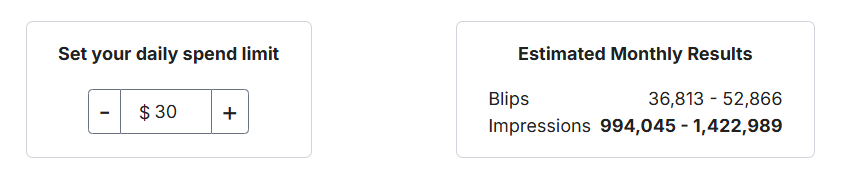
With Blip, you can run eye-catching Florence-Graham billboards on any budget, because you only pay per “blip” — a 7.5 to 10-second ad display on digital billboards near Florence-Graham, California. You set a daily budget during campaign setup, and Blip automatically keeps your ads in the Florence-Graham area within that limit, while still giving you the flexibility to adjust your budget whenever you like. The cost of each blip changes based on when and where you choose to show your message and on advertiser demand, so you’re always paying a fair, market-driven price.
Where can I advertise with Blip near Florence-Graham, California?
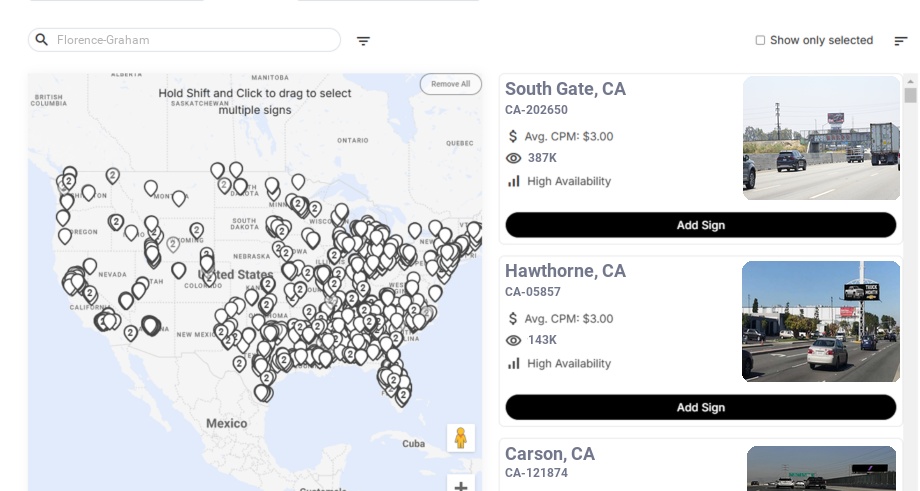
The Florence-Graham area is served by 36 digital billboards from nearby cities like Lynwood, Los Angeles, South Gate, Compton, and others. These locations are within about 10 miles and intersect critical traffic routes that residents use daily, effectively forming a ring of billboards near Florence-Graham. The network includes freeway and major arterial coverage along I-110, I-105, I-710, Florence Ave, Firestone Blvd, Atlantic Blvd, and more.
What kind of people live in Florence-Graham, California for billboard advertising?
The Florence-Graham area is roughly 60,000–63,000 people packed into about 3.6 square miles, which means a density of around 17,000 residents per square mile. The median age is approximately 28–29 years, and about 55–58% of residents are under 35. The area is predominantly Latino/Hispanic, at roughly 85–90% of the population, and an estimated 70–80% of households speak Spanish at home.
When is the best time to run Blip ads in Florence-Graham, California?
Weekday patterns suggest early morning commute traffic between 5–9 a.m. and evening peak traffic between 3–7 p.m. are especially strong, while midday can be more cost-efficient and deliver high repetition locally. Late evening is lighter but still meaningful, making it good for brand-building at lower cost. On weekends, traffic shifts toward shopping, church, events, and family outings, so 10 a.m. to 8 p.m. can work well around retail and food corridors.
Why are Florence-Graham, California billboards a good fit for local businesses with Blip?
The Florence-Graham area has high density, long commute times, and a large share of residents who drive the same routes repeatedly, which increases billboard exposure. The surrounding market is strong for value-focused and community-focused brands, youth- and family-centric products and services, and essentials like food, telecom, healthcare, education, auto, and financial services. The network is especially useful for campaigns that benefit from high repetition in a tight radius, especially for businesses within 3–8 miles of the neighborhood.
Do I need a contract to advertise with Blip near Florence Graham?
No, Blip has no long-term contracts or minimum commitments. You can start, pause, or stop your campaign at any time.
How fast can I launch a billboard campaign with Blip near Florence Graham?
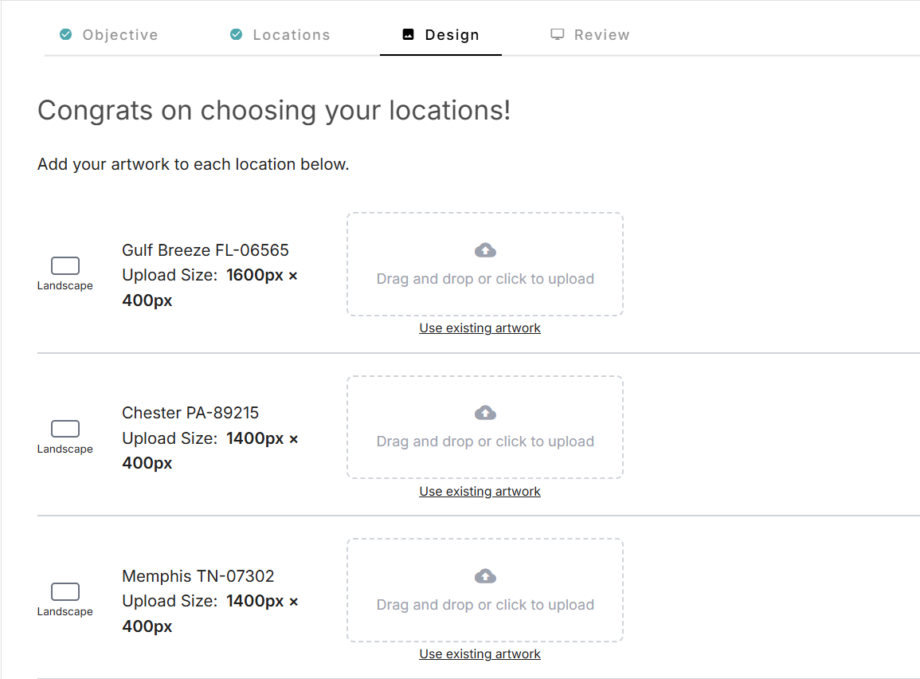
You can have your campaign live in minutes. Create a free account, select your locations, set your budget, upload your design, and start running once approved.
Where can I advertise with Blip near Florence Graham?
Blip has digital billboards near Florence Graham. You can browse available locations on a map, choose the ones that fit your audience, and start advertising right away.
Still have questions? Launch a campaign in minutes — no contracts, no commitments.
Start Your CampaignFlorence Graham Billboard Advertising Guide
The Florence-Graham area sits at the heart of Southeast Los Angeles, surrounded by dense neighborhoods, busy commuter corridors, and major retail and industrial zones. With 36 digital billboards serving the Florence-Graham area from nearby cities like Lynwood, Los Angeles, South Gate, Compton, and others, we can build tightly targeted campaigns that reach residents where they actually drive, shop, and commute every day. For advertisers looking specifically for billboards near Florence-Graham, this clustered network effectively functions as a single, coordinated marketplace.
Understanding the Florence-Graham Area Market
The Florence-Graham area is an unincorporated community of Los Angeles County, part of the broader Florence-Firestone region recognized by Los Angeles County
-
Population density
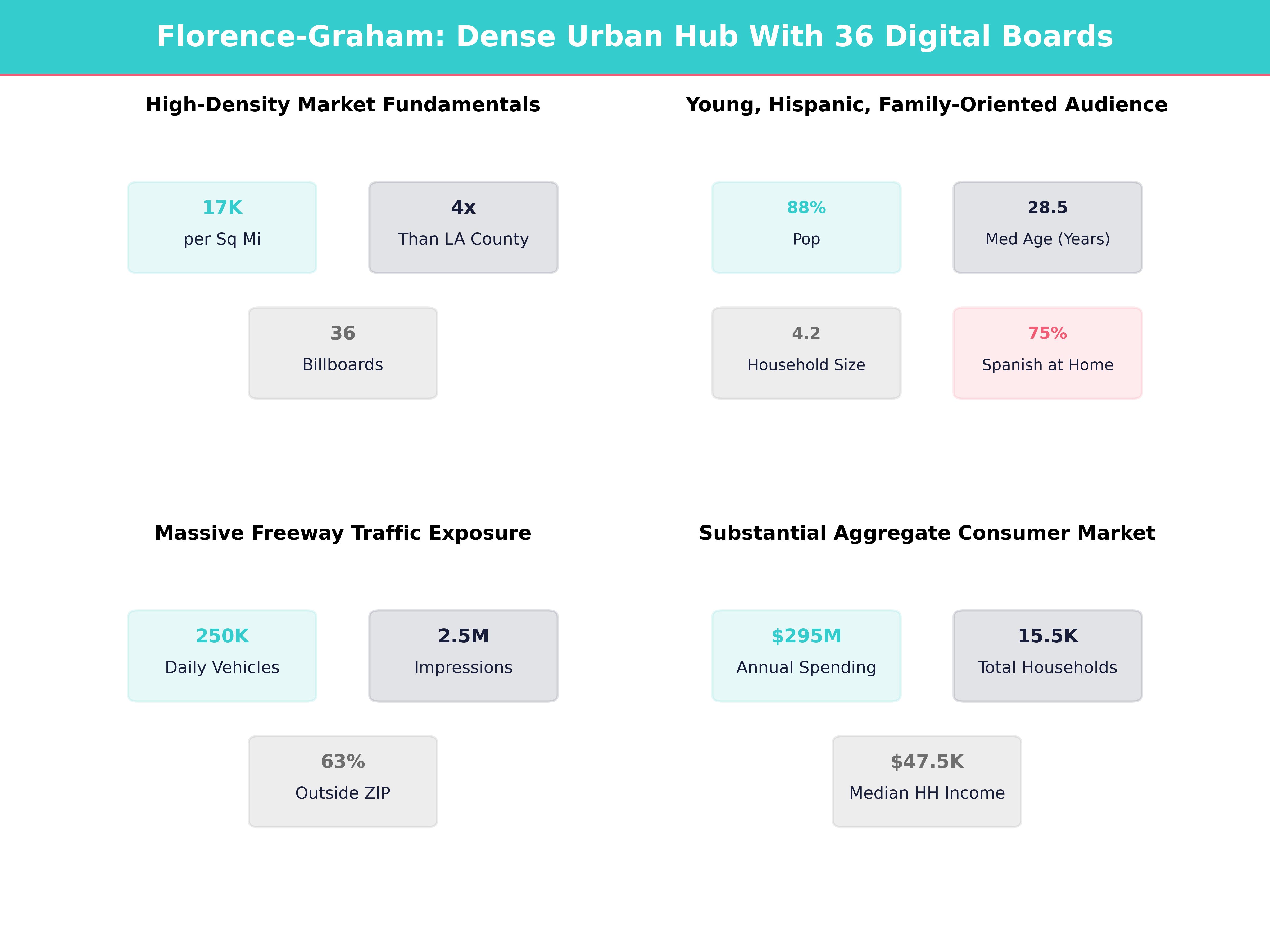
- Population in the immediate Florence-Graham area is roughly 60,000–63,000 people packed into about 3.6 square miles, which means a density of around 17,000 residents per square mile—over 4x denser than the overall Los Angeles County average (about 4,700 residents per square mile).
- This is comparable to some of the most crowded neighborhoods in central Los Angeles, where densities above 15,000 residents per square mile are associated with high daytime pedestrian and vehicular activity.
- This density amplifies the value of each billboard impression: short drives still generate repeated exposure, and even a 5–10 minute local trip can pass the same board multiple times per week, increasing the impact of billboard advertising near Florence-Graham.
-
Age profile
- The median age in the Florence-Graham area is approximately 28–29 years, versus about 36 years for Los Angeles County overall, making it one of the younger pockets in the county.
- Around 30–32% of residents are under 18, and about 55–58% are under 35. Adults 25–44, a prime consumer and working-age group, make up roughly 27–30% of the population.
- Seniors (65+) account for only about 6–8%, which is lower than the county share (about 13%), reinforcing the value of youth-oriented, mobile-first messaging.
-
Household income & spending power
- Median household income in the Florence-Graham area is roughly $45,000–$50,000, compared with about $77,000–$80,000 countywide. Roughly 20–25% of households fall under $25,000 per year, while around 15–18% exceed $75,000.
- Average household size is about 4.0–4.3 people, versus roughly 2.9–3.0 for the county, which concentrates spending on food, housing, transportation, and family needs.
- Despite lower median income, high density means substantial aggregate spending: at a conservative annual spend of $18,000–20,000 per household on everyday goods and services, a local base of 15,000–16,000 households translates into more than $270–320 million in annual consumer spending in and around the community.
- In Los Angeles County overall, households spend about 13–16% of their budget on food at home, 5–7% on food away from home, 16–20% on transportation, and 5–8% on healthcare—categories that map directly to quick-service restaurants, auto services, transit, and clinics, all of which can benefit from Florence-Graham billboards that keep brands top of mind on everyday routes.
-
Housing & mobility
- Roughly 65–70% of households are renters, which typically means higher turnover and constant demand for local services like moving, home furnishings, education, and healthcare. Owner-occupied housing makes up about 30–35%.
- Overcrowding (more than one person per room) is significantly higher than the county average, with estimates around 25–30% of households, which further pushes demand for nearby parks, after-school programs, and community services.
- Car ownership is still high, with over 80% of households having at least one vehicle and about 30–35% having two or more vehicles.
- At the same time, about 15–20% of workers in the broader South Los Angeles area commute via public transportation, walking, or biking—above the national average—with bus and rail usage supported by the nearby LA Metro 900,000 average weekday boardings systemwide in recent years, with the A Line among the busiest light rail routes in the region.
- Typical commute times in Southeast Los Angeles are in the 30–35 minute range one-way, with a significant share of commuters (around 25–30%) spending 45 minutes or more on their daily trip, creating long exposure windows along freeway and arterial routes that make billboard advertising near Florence-Graham particularly efficient.
These numbers tell us that digital billboards serving the Florence-Graham area are ideal for:
- Value-focused and community-focused brands
- Youth- and family-centric products and services
- Essentials: food, telecom, healthcare, education, auto, and financial services
- Campaigns that benefit from high repetition in a tight radius, especially for businesses within 3–8 miles of the neighborhood that want consistent visibility on Florence-Graham billboards and nearby routes
Where Our 36 Billboards Reach: Key Corridors Near Florence-Graham
Our 36 digital billboards serving the Florence-Graham area are located in nearby cities within about 10 miles:
- Lynwood (≈3.8 miles) – City of Lynwood
- Los Angeles (≈3.9 miles) – especially South LA and Downtown corridors, via City of Los Angeles
- Bell Gardens (≈4.3 miles) – City of Bell Gardens
- South Gate (≈4.7 miles) – City of South Gate
- Compton (≈6.6 miles) – City of Compton
- Montebello (≈6.6 miles) – City of Montebello
- Hawthorne (≈7.3 miles) – City of Hawthorne
- Carson (≈9.5 miles) – City of Carson
These locations intersect critical traffic routes that residents of the Florence-Graham area use daily, effectively forming a ring of billboards near Florence-Graham that capture both local and regional trips:
- Freeways: I‑110, I‑105, I‑710, I‑405, and CA‑91
- Major arterials: Florence Ave, Firestone Blvd, Century Blvd, Imperial Hwy, Alameda St, Long Beach Blvd, Atlantic Blvd, and Compton Ave
Caltrans District 7 reports that many of these freeways carry 200,000–300,000 vehicles per day on key segments in Southeast LA and South Bay—for example:
- I‑105 between I‑110 and I‑605 often exceeds 230,000 vehicles daily
- I‑110 through South LA can reach 250,000–280,000 vehicles daily
- I‑710 near the South Gate/ Commerce 200,000 vehicles daily, with a high share of trucks serving the ports
That translates into 1.4–2.1 million vehicle trips per week per segment, and when you factor in average vehicle occupancy of 1.3–1.5 people, you are looking at 2–3 million weekly impressions on a single high-traffic freeway stretch—impressions that are accessible with flexible Blip campaigns for billboard rental near Florence-Graham and its surrounding corridors.
We should think of the Florence-Graham area as a hub: residents may live near Florence Ave or Firestone Blvd, but they work, shop, or attend events in Lynwood, South Gate, Downtown LA, or Carson. Nearly 60–65% of workers in this part of the county commute to jobs outside their home ZIP code, and over 70% work within Los Angeles County but outside their immediate neighborhood. Our billboard network mirrors these real movement patterns, following trips to:
- Industrial and logistics jobs around Vernon Commerce
- Healthcare, education, and office jobs in Downtown LA and USC-adjacent areas
- Retail and service jobs in malls and shopping centers like Plaza Mexico in Lynwood, Azalea Regional Shopping Center SouthBay Pavilion in Carson
Traffic Patterns: When and Where to Focus Your Blips
To get the most from digital billboards serving the Florence-Graham area, aligning your schedule with real-world traffic is essential. Across Los Angeles County, weekday traffic volumes on major freeways can be 30–50% higher during peak periods than in off-peak hours, and average freeway speeds in central LA often drop below 25 mph in rush hour—both factors that increase dwell time and impressions.
Weekday patterns (Monday–Friday)
-
Early morning (5–9 a.m.)
- Outbound commute towards Downtown LA, Vernon, Commerce, and the South Bay.
- In many South LA corridors, 35–40% of daily traffic passes during the combined morning and evening peaks, with a sizable spike between 6:30–8:30 a.m.
- Focus on boards near I‑110, I‑105, and I‑710 corridors and arterials feeding those routes.
- Best for: job recruitment, education, coffee/fast food breakfast, transit, and rideshare.
-
Midday (10 a.m.–3 p.m.)
- Traffic from errands, shift workers, and parents with school-age children, including the significant share of workers (about 15–20%) in service and shift-based jobs.
- These time blocks are typically more cost-efficient and can deliver high repetition locally, with lower competition for digital ad slots.
- Best for: clinics, dental offices, grocery, local retail, auto repair, community events.
-
Evening peak (3–7 p.m.)
- Return commute and after-school pickup; high congestion on Florence Ave, Firestone Blvd, and freeway segments.
- Regional data shows some corridors carrying 10–12% of their total daily volume in just one peak hour during the afternoon.
- Best for: dining, entertainment, sports viewing spots, evening classes, streaming services.
-
Late evening (7–11 p.m.)
- Lighter, but still meaningful volumes, often 40–60% of peak-hour volumes—great for brand-building at lower cost.
- Best for: always-on awareness, entertainment, nightlife, and digital products.
Weekend patterns (Saturday–Sunday)
-
Traffic shifts from commuter-heavy to shopping, church, events, and family outings. Weekend trips to regional shopping centers in South Gate, Lynwood, Compton, and Carson frequently account for 25–30% of weekly retail foot traffic.
- These changing patterns make weekend-focused billboard advertising near Florence-Graham especially useful for retailers, restaurants, and event promoters targeting family audiences.
- Regional retail destinations like Plaza Mexico, Azalea Regional Shopping Center The Shops at Montebello, and SouthBay Pavilion see surges, with many centers reporting double-digit percentage increases in foot traffic on Saturdays compared to weekdays.
- Consider heavier Blip schedules from 10 a.m. to 8 p.m. around retail and food corridors, especially near freeway exits and arterials leading to these centers.
Using Blip’s flexible scheduling, we can:
- Concentrate budget during commute peaks on freeway-facing boards when traffic volumes are 30–50% higher than midday.
- Shift impressions to arterial streets (Florence, Firestone, Atlantic, Long Beach Blvd) during midday and weekends, when local errand trips are more common.
- Test different dayparts to find the highest impressions per dollar, then increase spend on time blocks that deliver strong store-visit or call responses.
Demographics & Culture: Crafting Messages That Resonate
The Florence-Graham area has a strong, distinct local culture. Effective creative respects and speaks to that reality.
Language & ethnicity
- The area is predominantly Latino/Hispanic, at roughly 85–90% of the population.
- An estimated 70–80% of households speak Spanish at home, and in many nearby South LA ZIP codes, more than 50% of adults report speaking English “less than very well.”
- There is also a meaningful African American community (approximately 7–10% in the broader Florence-Firestone area) and a mix of other groups, including small but growing Asian and Pacific Islander communities.
Implications for creative:
- Consider bilingual artwork (English + Spanish), especially for essential services, food, retail, and political or community campaigns. Bilingual or Spanish-dominant creatives can significantly improve recall in markets where Spanish is the primary language for 2 out of 3 households.
- If using only one language, know your audience: Spanish-only can be extremely powerful if your offer is clearly local and family-centered.
- Use authentic imagery—families, workers, students—that reflect the ethnic and age makeup of the area.
Family & community orientation
-
With larger-than-average household sizes (often 4–5 people) and a high share of children, messaging around:
- Family savings and everyday value
- Youth programs and education
- Healthcare, insurance, and safety
- Faith-based and community events
tends to perform very well.
- Roughly 30–32% of residents are under 18, and around 10–12% are under age 5, which keeps demand high for pediatric care, daycare, early education, and family recreation.
- School enrollment rates in surrounding areas show that 90%+ of children attend public schools, connecting families to institutions like the Los Angeles Unified School District
Media & local trust
- The broader market is served by outlets like the Los Angeles Times LAist, and Spanish-language TV and radio such as Univision and Telemundo’s local affiliates.
- Local TV and radio continue to reach a high share of Latino households in Los Angeles; audience studies frequently show that 70%+ of adults in Spanish-dominant homes consume Spanish-language TV weekly.
- Billboards near the Florence-Graham area function as high-visibility “street media”, much like murals or community posters—ideal for building trust and presence for local brands, churches, community organizations, and small businesses. In dense urban neighborhoods, outdoor advertising can deliver dozens of weekly exposures per resident when campaigns are properly saturated on primary travel routes.
Creative Best Practices for the Florence-Graham Area
To succeed on our digital billboards serving the Florence-Graham area:
-
Prioritize readability at a glance
- Keep text to 7–10 words maximum; drivers at 35–55 mph typically have only 5–7 seconds to absorb your message.
- Use high-contrast color combinations (e.g., white/yellow on dark backgrounds, or dark text on light backgrounds).
- Avoid thin fonts; use bold, sans-serif typography for legibility. Studies of out‑of‑home (OOH) recall show that legible, high‑contrast designs can improve message retention by 20–30% versus cluttered creative.
-
Emphasize value and clarity
-
This is a cost-conscious market. Lead with:
- “$X off,” “2 for $Y,” “Family combo $9.99,” “Free consultation,” or “No credit needed” (where compliant).
-
Include one clear call to action, such as:
- “Exit at Long Beach Blvd”
- “On Florence & Compton”
- “Text FLORENCE to 55555”
- Campaigns with a single, strong offer can see higher response rates than those with multiple mixed messages, particularly where income levels require clear value propositions.
-
This is a cost-conscious market. Lead with:
-
Local cues and landmarks
- Reference nearby anchors like Florence Ave, Firestone Blvd, Watts Towers (via Watts Towers Arts Center South Gate Park, or “near the 105/110.”
- Phrases like “Serving the Florence-Firestone community” can increase relevance and trust. Local referencing in OOH creative has been associated with double-digit lifts in perceived relevance in many brand studies.
- Consider referencing local government or community resources when appropriate, such as events supported by Los Angeles County Discover Los Angeles.
-
Use bilingual smartly
-
Consider side-by-side or stacked messaging:
- “Low-Cost Insurance / Seguro Económico”
- Keep each language concise; the message still must be scannable at 55–65 mph. A good benchmark is 3–5 words per language plus a logo or icon.
- Where you have multiple creatives running, dedicate some slots to Spanish-forward and some to English-forward executions to avoid overcrowding.
-
Consider side-by-side or stacked messaging:
-
Visuals that fit the commute
- During morning/evening commutes, simple icons (burger, car, tooth, graduation cap, cross) plus 1–2 powerful words can outperform crowded layouts.
- On slower local arterials (near stoplights, retail clusters), you can include slightly more detail, like a short URL or one extra benefit point.
- In neighborhoods like Florence-Graham where average speeds on arterials can drop below 20 mph during peak hours, boards on surface streets can support a bit more information than freeway-facing units.
Because Blip allows multiple creatives in a single campaign, we can:
- Run English-dominant and Spanish-dominant versions side by side.
- Test value-focused vs. brand-focused creatives.
- Swap creatives by time of day (e.g., breakfast vs. dinner offers) and adjust based on performance indicators like call volume, web traffic, or in-store redemptions.
Aligning with Key Sectors in the Florence-Graham Area
Different industries can leverage the same 36-board network differently. Here’s how we can think about a few major categories:
Local Retail & Restaurants
- The local audience regularly travels to nearby centers in Lynwood, South Gate, Compton, and Carson; retail employment in Southeast LA cities accounts for roughly 10–12% of local jobs, supporting heavy shopping flows.
- Focus on boards along Florence Ave, Firestone Blvd, Long Beach Blvd, Alameda St, and freeway exits leading to your business.
- Use distance-based calls to action: “2 miles ahead,” “Next right off 710,” or “On Florence near Central.”
- Highlight value and convenience: “Open late,” “Drive-thru,” “Family combo $9.99,” “Kids eat free Tuesday.”
- Restaurants and limited-service food concepts are especially well-suited; in LA County, households spend roughly 40–45% of food budgets on food away from home, a major opportunity for QSR and casual dining.
Healthcare, Clinics, and Dental
- With dense populations and many families, demand for primary care, urgent care, pediatric, and dental services is constant. In many South LA neighborhoods, uninsured rates are in the 15–20% range, and Medi-Cal participation is substantially above the county average, driving heavy reliance on community clinics.
- For clinics within 5–7 miles, schedule heavy weekday daytime and early evening coverage to reach parents with children and working adults before and after shifts.
-
Emphasize:
- Walk-in availability
- Medi-Cal acceptance
- Bilingual staff
- Same-day appointments
- Weekend hours (Saturday/Sunday), which can differentiate you from competitors
- Example layout: “Clínica Cerca / Same-Day Visits / Florence & Atlantic.”
- Consider referencing public-health partnerships or community programs where applicable, in alignment with messaging from Los Angeles County
Education & Training Providers
-
The area’s young population and working adults create strong potential for:
- K‑12 tutoring and after-school programs
- Charter and private schools
- Trade schools and community colleges
- ESL and GED programs
- Nearby institutions like Los Angeles Southwest College East Los Angeles College
- Use commuter routes towards Downtown LA, Vernon, and Commerce for working adult programs, and local arterials for K‑12 messaging during school-year enrollment pushes.
- CTAs like “Classes desde $X al mes” or “Enroll by Sept 15” work well with short enrollment windows. OOH is especially strong for deadlines and countdowns, which can prompt immediate action.
Automotive Services & Dealerships
- Many residents rely on cars, and vehicles often endure heavy use in urban traffic; in Los Angeles County, average vehicle miles traveled per driver can exceed 25–30 miles per day.
-
Auto repair, tires, and used car dealers in nearby cities can:
- Target I‑110, I‑105, I‑710 and major surface streets feeding those freeways.
- Promote financing flexibility, warranties, “No licencia OK,” and “Se habla español.”
- Rotate creatives by service: brakes one week, tires the next, then full-service checkups or smog inspections, aligning with paydays (often biweekly) and seasonal needs such as back-to-school or holiday travel.
- Automotive spending often accounts for 15–20% of household budgets when you factor in gas, insurance, and repairs, making persistent visibility in this category particularly valuable.
Financial Services & Credit Unions
- Products like check-cashing alternatives, credit unions, community banks, and remittance services are especially relevant in communities with large immigrant populations and mixed documentation statuses.
- In many South LA neighborhoods, a notable share of adults—often 15–20%—are underbanked or unbanked, relying on alternative financial services.
-
Focus on messages that build trust and transparency:
- “Sin cargos ocultos”
- “Low-cost transfers to Mexico & Central America”
- “Cuenta gratis sin saldo mínimo”
- Drive traffic to branches in South Gate, Lynwood, Compton, or Downtown with location-specific creatives and recognizable financial institution logos.
- Consider coordinating messaging with community-partner initiatives promoted through local organizations and regional news outlets like LAist or the Los Angeles Times
Seasonality & Event-Driven Opportunities
The Florence-Graham area is tied into the broader Los Angeles event calendar, which we can tap for timely campaigns:
-
Back-to-school (late July–September)
- Perfect for clothing, shoes, electronics, tutoring, and healthcare (immunizations, school physicals).
- Across LA County, public schools serve more than 400,000 K‑12 students, and many local families make concentrated purchase trips in the 4–6 weeks leading up to the first day of school.
- Focus on afternoons and weekends along retail-heavy routes.
-
Tax season (January–April)
- Promote tax prep, refund-advance products (where compliant), and large-ticket retail items such as appliances, used cars, or furniture.
- Lower- and middle-income households that qualify for refunds often receive a substantial share of their annual disposable cash in this window; in some neighborhoods, 60–70% of filers receive a refund.
- Bilingual creative is especially important for tax and financial services.
-
Holidays (November–January)
- Black Friday, Christmas, and New Year promotions for retail, electronics, and remittances.
- U.S. holiday retail sales often rise 5–10% over average monthly sales, and local immigrant households frequently increase remittances and gift purchases in this period.
- Weekend and evening coverage around major shopping corridors in South Gate, Lynwood, and Carson helps capture this spike.
-
Sports & entertainment
- Pro and college sports draw viewers to TV, bars, and streaming platforms regionwide. Major venues and attractions promoted by Discover Los Angeles and covered by outlets like the Los Angeles Times
- Campaigns tied to big events (playoffs, boxing matches, concerts, cultural festivals) can benefit from short, high-frequency bursts scheduled just 3–7 days before the event date.
With Blip’s ability to start, stop, or adjust campaigns quickly, we can spin up short, intense bursts around these windows without long-term contracts, then pivot budgets to evergreen, always-on messaging between peak seasons.
Using Blip’s Flexibility to Dominate a Tight Radius
Digital billboards serving the Florence-Graham area can behave like a “giant digital flyer” system when we use Blip tactically, giving advertisers cost-controlled access to billboard rental near Florence-Graham without needing to commit to a single static board:
-
Radius-focused strategy
- Select boards within 3–7 miles of your business for hyperlocal saturation, particularly in Lynwood, South Gate, and Compton, where combined populations exceed 250,000 residents within a short drive.
- Combine freeway and street-level boards to reach both commuters and neighborhood shoppers; for many businesses, a mix of 60–70% freeway and 30–40% arterial coverage works well.
-
Daypart segmentation
- Run worker-focused offers in the early morning commute, such as transit passes, rideshare promos, coffee, or breakfast deals.
- Shift to family and shopping messages in the evening and on weekends, when households are together and planning group activities or purchases.
- In markets like this, evening and weekend impressions can represent 35–45% of weekly traffic volume, making them essential for B2C brands.
-
Budget control
- Start at low daily budgets to test (e.g., $10–$25/day), then scale up for top-performing boards and dayparts. Many advertisers find that incremental increases of 20–30% in spend on proven boards produce outsized gains in awareness and foot traffic.
- Use the variable pricing of Blips to prioritize times and locations with the best mix of cost and traffic, shifting away from high-cost, low-response windows.
-
Creative rotation & A/B testing
-
Run at least 2–3 versions of your design:
- English-only vs. bilingual
- Price-focused vs. benefit-focused
- Address-based vs. “Near Florence Ave & [major cross street]”
- Track which versions correlate with higher web traffic, calls, coupon redemptions, or in-store visits over 2–4 week periods.
- Simple A/B tests where only one element changes (e.g., price vs. “No credit needed”) can reveal 10–20% differences in response rates, allowing you to optimize quickly.
-
Run at least 2–3 versions of your design:
Measuring Impact in the Florence-Graham Area
Outdoor campaigns in the Florence-Graham area often aim at awareness, foot traffic, and phone calls, rather than direct online conversions alone. We can still measure impact:
- Unique URLs or QR codes on creatives (simple, short, and high-contrast). Even modest scan rates of 0.1–0.3% of viewers can translate into meaningful lead volumes in high-traffic corridors.
- Dedicated phone numbers or extensions to distinguish billboard-driven calls; many local service providers report noticeable call spikes within days of launching strong OOH campaigns.
- “Mention this billboard” promotions to track in-store responses (e.g., “Show this ad on your phone for 10% off”).
- Watch for lift in search volume for your brand name from ZIP codes covering Florence-Graham and neighboring cities; many businesses see search impressions rise 20–40% after sustained billboard exposure.
- Given the tight geography and high density, even small businesses typically notice changes in walk-in inquiries within 1–3 weeks of sustained exposure, especially when running at consistent dayparts around commute times.
Local Context & Compliance Considerations
Outdoor advertising near the Florence-Graham area is governed by a mix of city regulations (for Los Angeles, Lynwood, South Gate, etc.) and county oversight. While Blip and our sign operators handle permitting and technical compliance, advertisers should be mindful of:
- Truthful, non-deceptive offers.
- Clearly stated conditions on credit or financing where required.
- Avoiding misleading “government look-alike” designs, particularly for immigration, tax, or legal services.
- Respecting guidelines and community standards that may be highlighted by local jurisdictions such as Los Angeles County City of Los Angeles, and nearby municipalities like South Gate and Compton
For broader regional context and policy discussions, local sources like Los Angeles County Los Angeles Times LAist are useful references as you frame community-sensitive messaging and stay informed about local economic and cultural trends.
By understanding the unique density, youthfulness, cultural makeup, and commuting patterns of the Florence-Graham area—and by leveraging Blip’s 36 digital billboards in nearby cities—we can craft campaigns that feel local, appear at the right times and places, and drive real-world results for brands of any size. Whether you are exploring billboard advertising near Florence-Graham for the first time or optimizing ongoing Florence-Graham billboards, this network provides a flexible, data-informed way to reach the community where they live, work, and shop.