Billboards near North Fair Oaks, CA
No Minimum Spend. No Long-Term Contracts. Just Results.
Trusted by Leading Brands


Billboard advertising
near North Fair Oaks has never been easier
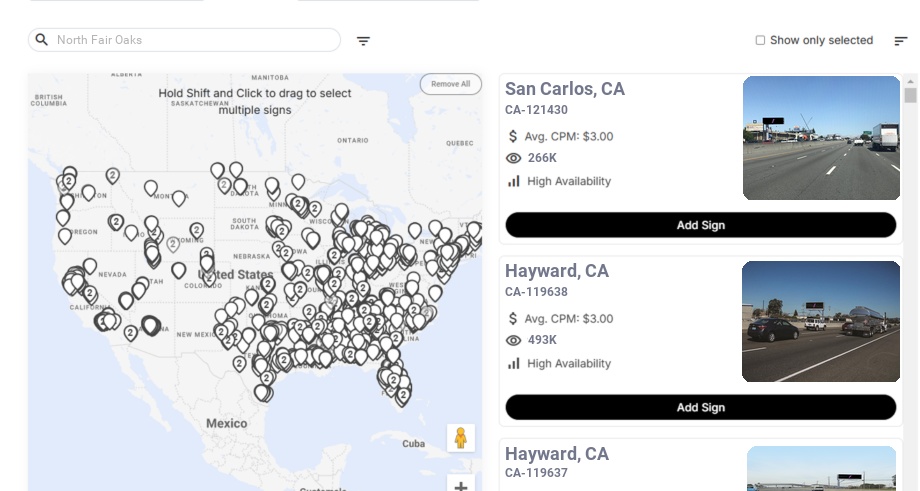



How much is a billboard near North Fair Oaks?
Why Choose Blip for Billboard Advertising near North Fair Oaks
Blip lets you launch North Fair Oaks ads in minutes, reaching US-101 and El Camino Real commuters without a long contract.
Set a flexible daily budget for North Fair Oaks and focus spend on morning rush, lunch, or evening traffic near San Carlos.
Use Blip dayparting to hit North Fair Oaks families, Spanish-speaking households, and Peninsula workers when they’re on the road.
Track real-time results for North Fair Oaks and shift creative fast as US-101 traffic, school runs, or weekend shopping patterns change.
Create bilingual North Fair Oaks billboards with Blip’s tools to speak to the community’s Spanish-heavy audience and dense local trade.
Frequently Asked Questions About Billboard Advertising near North Fair Oaks
How much does a billboard cost near North Fair Oaks, California with Blip?
With Blip, you choose your own daily budget for North Fair Oaks billboards, and our pay-per-blip model means you only pay for the brief 7.5–10 second ad displays you actually receive. You can start small, adjust your spend anytime, and still get your message on digital billboards near North Fair Oaks, California during the times and days that matter most to your audience. As advertiser demand, time of day, and location change, each blip is individually priced, so your total cost over any period is simply the sum of those blips.
Where are the Blip billboards for North Fair Oaks, California located?
Our two digital billboards serving the North Fair Oaks area are located in San Carlos, about 3.1 miles away. San Carlos lies along the US-101 corridor, one of the most heavily traveled roadways in the region and a key connection between San Francisco and Silicon Valley. For advertisers looking for flexible billboard advertising near North Fair Oaks, this close-by US-101 presence delivers both commuter and local neighborhood reach.
Who sees North Fair Oaks, California billboards from Blip?
North Fair Oaks sits in the heart of Silicon Valley’s Bayside corridor, between Redwood City and Menlo Park, so these billboards can reach a dense, diverse, and mobile audience that lives locally, works up and down the Peninsula, and spends heavily on services, food, tech, and family experiences. Within a 10-mile radius, the reach includes a combined population of 350,000+ residents, plus a weekday workforce that swells significantly due to major employers in the area. The corridor also sees heavy commuting and shopping traffic along US-101, El Camino Real, and nearby transit routes.
When is the best time to run billboards near North Fair Oaks, California with Blip?
Blip’s flexibility allows advertisers to buy only the times that matter, down to specific hours. Morning commute hours from 6:30–9:30 a.m. are ideal for readability, while the evening commute from 3:30–7:30 p.m. is strong for family-focused ads, grocery stores, childcare, gyms, and entertainment. Late night can also work for nightlife, delivery apps, and 24-hour services at a lower cost per blip.
What kinds of businesses work best for billboards in North Fair Oaks, California?
The North Fair Oaks area is especially strong for local and regional service businesses such as auto repair, insurance, legal, medical, dental, home services, and real estate. Restaurants and grocery brands also do well, especially for last-mile food decisions and commuter traffic. Recruiting campaigns, education providers, healthcare providers, and events can also benefit from the corridor’s strong local reach and repeat exposure.
Do I need a contract to advertise with Blip near North Fair Oaks?
No, Blip has no long-term contracts or minimum commitments. You can start, pause, or stop your campaign at any time.
How fast can I launch a billboard campaign with Blip near North Fair Oaks?
You can have your campaign live in minutes. Create a free account, select your locations, set your budget, upload your design, and start running once approved.
Where can I advertise with Blip near North Fair Oaks?
Blip has digital billboards near North Fair Oaks. You can browse available locations on a map, choose the ones that fit your audience, and start advertising right away.
Still have questions? Launch a campaign in minutes — no contracts, no commitments.
Start Your CampaignNorth Fair Oaks Billboard Advertising Guide
North Fair Oaks sits in the heart of Silicon Valley’s Bayside corridor, between Redwood City Menlo Park San Carlos, we can reach a dense, diverse, and mobile audience that lives locally, works up and down the Peninsula, and spends heavily on services, food, tech, and family experiences. These high‑impact billboards near North Fair Oaks give local businesses an affordable way to stand out in a crowded online‑first marketplace. This guide breaks down how to translate the unique character of the North Fair Oaks area into a highly efficient, data‑driven digital billboard campaign.
Understanding the North Fair Oaks Area Audience
North Fair Oaks is an unincorporated community in San Mateo County, represented locally by the North Fair Oaks Community Council
Key demographic and economic characteristics (using the latest available estimates around 2020–2023):
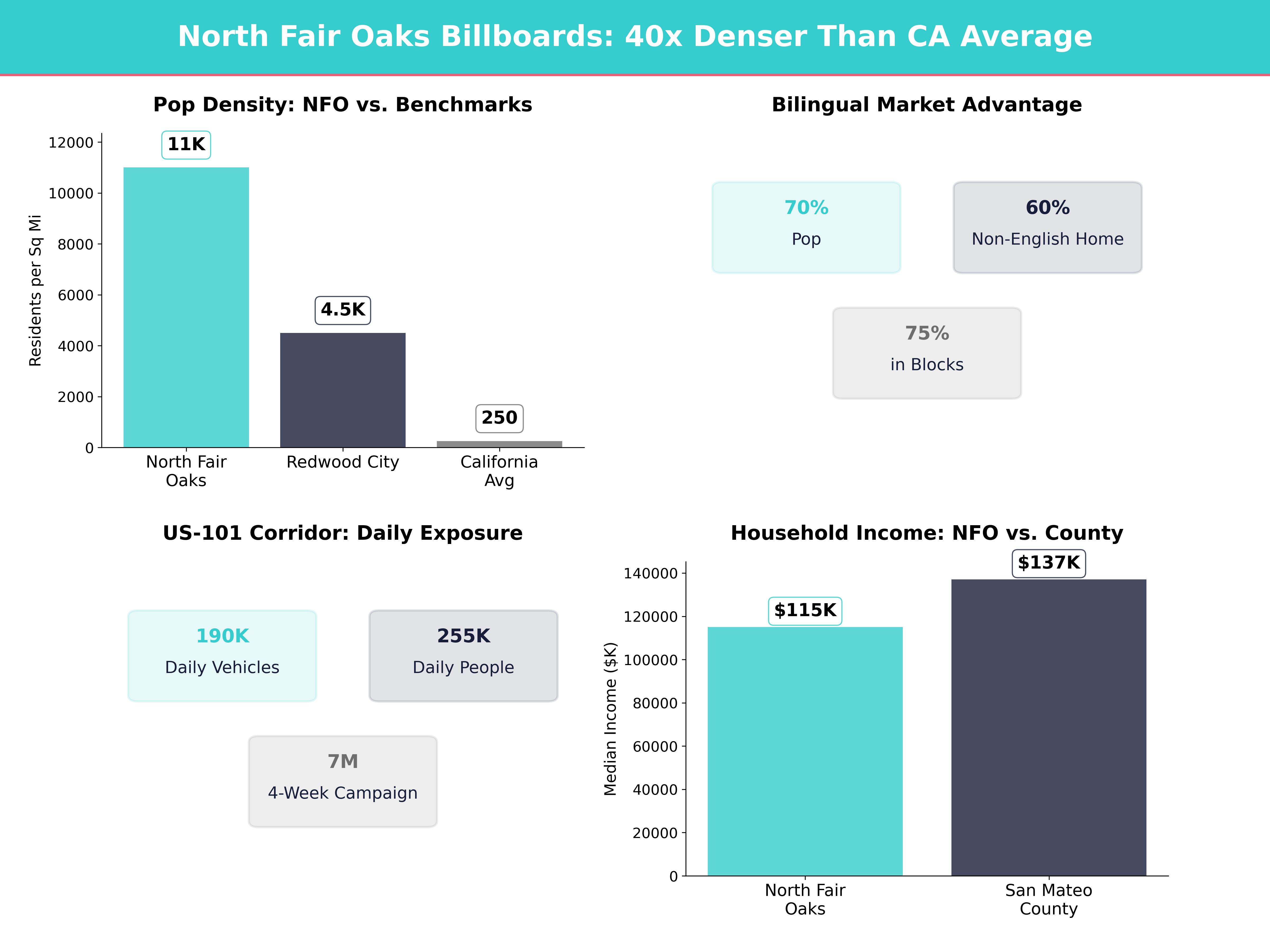
- Population: About 14,000 residents in roughly 1.25 square miles, yielding an estimated density of 11,000+ residents per square mile—over 40 times higher than the California average of ~250 residents per square mile and several times higher than the Redwood City
- Age profile: Median age is around 33 years, a few years younger than the statewide median near 37. This concentration of adults in their 25–44 prime earning and child‑rearing years supports strong demand for childcare, quick‑service food, healthcare, and financial services.
- Household income: Median household income in the North Fair Oaks area is typically estimated in the $110,000–$120,000 range, consistent with the broader San Mateo County median of about $136,700. Roughly 60–65% of households in the surrounding ZIP codes earn $100,000+ per year, and around 25–30% are above $200,000—providing both value‑oriented and premium‑spending segments.
- Ethnic and language mix: Roughly 70%+ of residents identify as Hispanic or Latino, and in nearby census tracts over 60% of households speak a language other than English at home, with Spanish dominating. In some blocks, Spanish‑speaking rates exceed 75%, making bilingual (English/Spanish) messaging especially powerful.
- Housing: The area includes a high share of renters—often 60%+—and multigenerational households, with some nearby tracts averaging 3.5–4.0 persons per household versus a U.S. average near 2.6. This intensifies local, repeat spending on groceries, quick‑service restaurants, personal services, and value‑oriented retail.
- Digital behavior: In affluent Peninsula markets, broadband adoption exceeds 90% of households, and smartphone ownership is typically above 85%. This makes billboard‑driven searches and website visits especially likely.
Within a 10‑mile radius (including Redwood City Menlo Park San Carlos, Belmont Palo Alto), we reach a combined population of 350,000+ residents, plus a weekday workforce that swells significantly due to major employers such as Meta in Menlo Park, Oracle in Redwood Shores, and numerous tech, biotech, and professional services firms clustered along US‑101 and El Camino Real. Office recovery data for the Peninsula shows weekday office occupancy commonly in the 45–60% range of pre‑pandemic levels, still translating into tens of thousands of additional daily trips.
Implication for billboards:
Campaigns serving the North Fair Oaks area work best when they:
- Speak to working families and service‑oriented small businesses who collectively spend tens of millions of dollars annually on housing, food, transportation, and education within a short drive, and who repeatedly pass by billboards near North Fair Oaks on their daily routes.
- Use bilingual or culturally aware creative that acknowledges a community where a majority of households are comfortable in Spanish.
- Emphasize value, convenience, and trust—important themes in an area where local small businesses, trades, and family‑owned restaurants remain central to daily life even amid high regional incomes.
Where Our Boards Are and Who Sees Them
Our two digital billboards serving the North Fair Oaks area are located in San Carlos, about 3.1 miles away. San Carlos lies along the US‑101 corridor, one of the most heavily traveled roadways in the region and a key connection between San Francisco and Silicon Valley. For advertisers looking for flexible billboard advertising near North Fair Oaks, this close‑by US‑101 presence delivers both commuter and local neighborhood reach.
Important traffic and mobility facts:
- US‑101 traffic: Caltrans counts on the US‑101 segment between Redwood City and San Carlos typically show 180,000–200,000 vehicles per day on peak segments. Even assuming an average of 1.3–1.4 occupants per vehicle, that’s roughly 230,000–280,000 people passing through daily. Over a 4‑week campaign, your message can appear in the same corridor seen by 6–8 million vehicle trips.
- El Camino Real (SR‑82): Parallel to 101, El Camino Real in the mid‑Peninsula often carries 25,000–45,000 vehicles per day depending on the exact segment, drawing local shopping, dining, and service trips from North Fair Oaks residents and nearby neighborhoods in Redwood City and Menlo Park.
-
Transit:
- The Caltrain corridor runs just west of North Fair Oaks with Redwood City, Atherton, Menlo Park, and San Carlos stations. System‑wide, Caltrain has been averaging roughly 25,000–30,000 weekday riders in recent recovery periods, up more than 50% from early‑pandemic lows as hybrid office routines return.
- SamTrans bus routes carry roughly 30,000–35,000 weekday riders county‑wide. Key lines running along Middlefield Road, El Camino Real, and to Caltrain stations bring workers, students, and seniors through the corridor, increasing repeated exposure opportunities.
- Commuting patterns: In San Mateo County, roughly 70–75% of workers commute by car, 8–10% use transit, and 10–15% walk, bike, or telecommute. Typical one‑way commute times fall in the 25–35 minute range, meaning many residents see the same stretches of roadway—and your boards—hundreds of times per year.
Because our digital billboards are on high‑flow corridors near San Carlos, they effectively intersect:
- North Fair Oaks residents commuting to tech hubs in Menlo Park, Palo Alto, and Mountain View.
- Workers commuting into Redwood City government, legal, and healthcare jobs around the San Mateo County Center and Sequoia Hospital
- Shoppers traveling to big‑box retail clusters in San Carlos and Redwood City, including auto dealerships, home improvement stores, and regional shopping centers.
Industry research shows that out‑of‑home (OOH) ads can deliver 3+ impressions per week per commuter on their main route and that roughly 45–55% of drivers report visiting a business after seeing an outdoor ad. With Blip, we can selectively buy impressions on specific boards in San Carlos that align with the direction and time of day most relevant to your audience near North Fair Oaks, keeping your effective cost per thousand impressions (eCPM) competitive with or below social and search in many dayparts. This makes our approach to North Fair Oaks billboards especially efficient for small and mid‑sized advertisers.
Key Industries and Local Business Opportunities
The North Fair Oaks area presents a mix of neighborhood‑scale businesses and nearby corporate giants, tied into the wider Peninsula economy that supports more than 400,000 jobs across San Mateo County and southern San Mateo County cities like Redwood City and San Carlos
Major local and nearby sectors:
-
Construction, trades, and home services:
- Construction and related trades account for roughly 6–8% of county employment, and the mid‑Peninsula continues to see hundreds of millions of dollars in annual residential and commercial building permits.
- With median single‑family home values routinely above $1.5–$1.8 million in nearby cities and older housing stock in parts of Redwood City and Menlo Park, remodeling and maintenance demand is strong.
- Contractors, landscapers, roofers, plumbers, and HVAC firms can all use billboards to reach homeowners along their daily commute routes.
-
Restaurants and food service:
- Food service typically represents 8–10% of local jobs, and North Fair Oaks and nearby Middlefield Road corridors are known for taquerias, bakeries, and family‑run markets.
- Household spending data for high‑income Bay Area corridors shows average annual food‑away‑from‑home spending above $4,000–$5,000 per household, creating a substantial audience for quick‑service, casual dining, and specialty food brands.
-
Professional and tech services:
- Nearby employment nodes in Menlo Park, Redwood City, and Palo Alto host tens of thousands of workers in software, venture capital, law, finance, and consulting. In some nearby business districts, professional services account for 20–30% of total jobs.
- These workers have high disposable incomes and frequent needs for financial, legal, medical, and lifestyle services, making them attractive billboard targets.
-
Healthcare and education:
- Healthcare jobs in the county have grown steadily, now comprising roughly 10–12% of employment, anchored by Sequoia Hospital
- Education institutions, including local school districts and Stanford University a short drive away, provide stable employment and a constant flow of students, parents, and staff traveling the corridor.
Campaign implications:
- Local services (plumbers, HVAC, auto repair, dentists, etc.): Emphasize speed, proximity, and trust—“Same‑day service in the North Fair Oaks area,” “Se habla español,” and strong review counts. Research on service businesses shows that more than 60% of customers choose a provider within 5–10 miles of home or work, which aligns perfectly with billboard coverage patterns and makes billboard rental near North Fair Oaks particularly attractive for hyper‑local service providers.
- Restaurants and retail: Promote lunch specials for commuters, family dinners, and weekend promotions targeted around peak drive times. National OOH studies indicate that about 35–40% of consumers have tried a restaurant they first noticed on a billboard or outdoor sign.
- Recruiting campaigns: With a strong working‑class and service‑oriented labor pool, billboards are powerful for hiring campaigns—“Now hiring in the North Fair Oaks area—$X/hr + benefits.” Employers often see a spike of 20–30% more applications during sustained outdoor hiring pushes in local corridors.
Timing: When to Run Your Campaign
Blip’s flexibility allows advertisers to buy only the times that matter, down to specific hours. To plan effectively, consider how people move through and around the North Fair Oaks area and the US‑101/El Camino Real spine.
Weekday Patterns
-
Morning commute (6:30–9:30 a.m.):
- Caltrans peak‑direction counts show some 101 segments operating at 90–100% of capacity during the morning rush, with traffic moving more slowly—ideal for billboard readability.
- Heavy southbound and northbound flow as workers travel between San Francisco, the Peninsula, and Silicon Valley.
- Ideal for coffee, breakfast, quick‑service restaurants, transit‑oriented offers, and employer branding when commuters are mentally planning their day.
-
Midday (11:00 a.m.–2:00 p.m.):
- Local errands, lunch trips, and tradespeople moving between jobs create a steadier but still substantial flow.
- Many retail centers report 25–35% of daily visitor counts in this window, making it effective for B2B services, building materials, professional services, and lunch promotions.
-
Evening commute (3:30–7:30 p.m.):
- Strong traffic returning to the North Fair Oaks area and adjacent neighborhoods; evening peak often lasts longer than the morning.
- Grocery and restaurant sales data typically shows 40–50% of daily revenue occurring after 4 p.m., making this window perfect for family‑focused ads: dinner offers, grocery stores, childcare, gyms, and entertainment.
-
Late night (after 9:00 p.m.):
- Lower volume but still relevant for nightlife, delivery apps, 24‑hour services, and branding at a lower cost per blip.
- Advertisers can often secure more frequent rotations at night due to lighter competition in Blip’s auction, improving share of voice among the vehicles still on the road.
Weekend and Seasonal Nuances
-
Weekends:
- Traffic shifts from commuter to leisure/shopping trips along the corridor. Regional tourism and shopping statistics for the Peninsula show that Saturdays often match or exceed weekday peak volumes around major retail hubs.
- Target Saturdays heavily for retail, auto dealers, and events; Sundays for restaurants, churches, and family activities, when local congregations and community groups increase mid‑morning and mid‑day traffic.
-
School year vs. summer:
- The North Fair Oaks area is tied into nearby school systems like the Redwood City School District and the Sequoia Union High School District. Together, these systems serve tens of thousands of students, plus teachers and staff who travel in predictable patterns.
- During the school year, morning and afternoon volumes are steadier and more predictable; summer brings more midday family and leisure trips, with youth programs and camps adding to mid‑day movement.
-
Local events:
- Redwood City’s calendar of street fairs, music events, and seasonal celebrations (highlighted via the city’s event listings 5,000–20,000 attendees over a weekend, adding out‑of‑town eyes to your reach.
- You can ramp up Blip schedules a week or two ahead of large events to catch both residents and visitors driving in from San Jose
Crafting Creative that Resonates in the North Fair Oaks Area
Creative quality is one of the biggest determinants of return on your billboard spend. In a community like the North Fair Oaks area—dense, diverse, and bilingual—small design choices matter. Industry benchmarks show that strong creative can improve recall by up to 30–40% versus average designs.
Use Bilingual and Culturally Tuned Messaging
Given the high share of Spanish‑speaking households:
- Consider bilingual creative (English and Spanish) or alternate English and Spanish versions using separate Blip creatives. In neighborhoods where 60–70% of residents are Hispanic or Latino, Spanish‑forward creative can outperform English‑only for certain categories.
- Keep Spanish text equally bold and visible, not a tiny translation. Aim for no more than 2–3 lines of text per language.
- Use culturally familiar imagery where appropriate: families, community gatherings, local foods, and neighborhood scenes that feel like Middlefield Road or local parks featured in Redwood City Parks & Recreation
Examples:
- “Seguro de auto rápido y económico” paired with “Fast, affordable auto insurance” on separate lines.
- Restaurant ads highlighting authentic dishes with a clear value proposition and address or simple directions (“5 min from Middlefield Rd. – salida 410”).
Design for Fast-Moving Traffic
On US‑101 and major arterials, drivers have 2–4 seconds to absorb your message:
- Use 8–10 words or fewer whenever possible. Studies of OOH readability suggest comprehension drops sharply beyond 12–14 words.
- Prioritize one key message and one call to action (e.g., “Free estimates” or “Order online tonight”).
- Maintain a high contrast color scheme; avoid thin fonts or script fonts that blur at speed. Bold sans‑serif fonts can improve legibility by 20–25% at freeway speeds compared with light or script fonts.
- Use large, legible contact info: short URLs, easy phone numbers, or “Exit X, 5 minutes from here.” URLs with 10 characters or fewer see higher recall.
Because Blip allows multiple creatives in a rotation, you can:
- Run separate creatives for awareness (“Brand + benefit”) and response (“Limited‑time offer – This week only”), and allocate more budget to whichever delivers stronger results.
- A/B test background colors or headlines to see which version drives more web traffic or store visits. Many advertisers observe 10–20% performance differences between creative variants.
Reflect the Local Environment
The North Fair Oaks area and mid‑Peninsula have strong visual identities:
- The Bayshore: shots of the bay, bridges, and marshes along the Don Edwards San Francisco Bay National Wildlife Refuge.
- The hills: tree‑lined foothills and neighborhoods that people associate with “Peninsula living.”
- Neighborhoods: colorful storefronts, murals, and small businesses featured regularly by local outlets like the San Mateo Daily Journal and The Almanac.
You do not need hyper‑local photography, but referencing the environment (skyline angles, bay imagery, or foothill silhouettes) helps signal “this is for you” to the local audience and can subtly improve relevance and recall.
Targeting Strategies Using Blip’s Tools
Because our boards serving the North Fair Oaks area are digital and sold by the “blip” (each display), you can fine‑tune your campaign instead of committing to a single rigid buy. Digital OOH has been shown to increase brand awareness by up to 20–30% when layered with online campaigns, and Blip’s flexibility allows you to capture these gains efficiently.
Dayparting for Precision
You can schedule your ads for specific days and hours to match your customer’s behavior near North Fair Oaks:
- Service providers (plumbers, HVAC, electricians): Run heavier during early mornings (6–9 a.m.) and evenings (4–9 p.m.) when homeowners are home and more likely to search for help after spotting your ad. Service calls often spike 20–40% after work hours and on weekends.
- Restaurants: Use 11 a.m.–2 p.m. (lunch) and 4–8 p.m. (dinner) slots and focus Friday–Sunday for weekend business. Industry data suggests that about 50% of weekly restaurant spend happens Friday through Sunday.
- Recruiting and HR: Concentrate on weekday rush hours (6:30–9:30 a.m. and 4–7 p.m.) to catch workers actively commuting from or to the North Fair Oaks area, especially for jobs within a 10–15 mile radius.
Budget Scaling and Testing
Blip’s auction‑style model means:
- You can start with a small daily budget (for example, $10–$20 per day) to test creative, timing, and board selection, often generating hundreds to a few thousand impressions per day depending on your bid and competition.
- Increase your bid to win more blips during your most valuable hours once you see patterns in traffic, calls, or web visits. Many advertisers find that a 20–30% bid increase during top time slots can significantly boost share of voice.
Testing structure that works well:
- Week 1–2: Two creatives (A/B), moderate bid, broad daytime coverage. Measure website traffic, call volume, or store visits against your baseline.
- Week 3–4: Shift spend toward the higher‑performing creative and strongest hours (based on response). Reduce or eliminate low‑performing dayparts.
- Month 2+: Layer in additional creatives around promotions, events, or seasonal themes (back‑to‑school, holidays, tax season) and retest. Over several months, iterative optimization can improve your cost per lead or store visit by 20–40%.
Aligning with Local Media and Information Sources
To maximize brand awareness, align your billboard presence with other local media channels that residents in the North Fair Oaks area trust.
Key local information and news sources include:
- San Mateo County – county services, alerts, and public information, including updates on transportation, public works, and community initiatives that influence daily travel.
- North Fair Oaks Community Council
- Redwood City government
- Local news outlets such as the San Mateo Daily Journal, Palo Alto Online, and The Almanac, which collectively reach tens of thousands of readers each week across web and print.
- Regional guides and tourism resources like Discover San Mateo County that promote attractions, hotels, and dining—useful reference points if you are marketing to visitors.
Consider:
- Coordinating campaign timing with stories or seasons relevant to your brand (back‑to‑school, tax season, health enrollment, wildfire season preparedness, etc.). For example, health providers can align with open enrollment periods, while retailers can focus on late August and early September for school shopping.
- Matching billboard messaging with topics you’re also discussing in local digital ads, social campaigns, email newsletters, or community sponsorships—creating 3–5 cross‑channel touchpoints that significantly increase recall and response.
Who Benefits Most from Billboards Near North Fair Oaks
While nearly any advertiser can benefit from exposure along this corridor, certain categories see especially strong upside:
- Local and regional service businesses: Auto repair, insurance, legal, medical, dental, home services, and real estate. These categories often see high local search volumes (thousands of monthly Google searches in nearby ZIP codes) that billboards can help capture by reinforcing brand names and URLs. For many of these businesses, billboard rental near North Fair Oaks is one of the most direct ways to reach nearby homeowners and renters.
- Restaurants and grocery: Taquerias, family restaurants, quick service franchises, and ethnic markets serving nearby neighborhoods. Outdoor advertising is particularly effective for “last‑mile” food decisions—nationally, around 30–35% of diners report choosing a place to eat after seeing an outdoor sign or billboard.
- Education and training providers: Language schools, trade schools, community colleges, and test prep centers. Peninsula residents invest heavily in education; local data shows bachelor’s degree attainment rates of 50–70% in many nearby cities, supporting strong awareness and demand for training and upskilling programs.
- Healthcare providers: Clinics, dental practices, urgent care, and vision centers drawing patients from the North Fair Oaks area. In high‑traffic corridors, healthcare advertisers often use billboards to raise awareness of new locations, extended hours, or bilingual services—factors that can influence first‑time patient choice.
- Recruiting campaigns: Employers needing skilled tradespeople, drivers, warehouse staff, or entry‑level office staff in a tight labor market. OOH recruitment campaigns can boost applicant volume by 15–25% during active runs, especially when paired with easy‑to‑remember URLs or QR codes.
- Events and attractions: Festivals, live music, cultural events, and family attractions in the broader Peninsula and Bay Area. For one‑time or seasonal events, billboards provide fast reach; event promoters often see 30–40% of ticket buyers citing “saw it around town” as one of their discovery sources.
By tailoring your schedule, creative, and budget to the specific travel patterns and demographics of the North Fair Oaks area, you can turn a relatively small billboard budget into consistent, measurable visibility and make the most of billboard advertising near North Fair Oaks.
Putting It All Together
To succeed with digital billboards serving the North Fair Oaks area:
- Define your audience clearly: Families, tradespeople, tech commuters, or Spanish‑speaking households—each may require a different message, offer, and creative language mix.
- Match the message to the moment: Use Blip dayparting to reach commuters, lunch crowds, or weekend shoppers at precisely the right times and on the right boards.
- Design for speed and clarity: Short copy, bold visuals, and bilingual text where appropriate, with no more than 8–10 total words whenever possible.
- Use testing and iteration: Rotate multiple creatives, monitor results (calls, web visits, store traffic), and refine over time. Aim for continuous improvements of 10–20% per optimization cycle.
- Align with local rhythms: School calendars, local events, and seasonal needs (back‑to‑school, tax season, holidays, healthcare enrollment) should shape your promotions and scheduling.
With two highly visible digital billboards near San Carlos serving the North Fair Oaks area, we can help you tap into one of the Bay Area’s most dynamic and diverse local markets—efficiently, flexibly, and on your terms, whether you’re exploring billboard rental near North Fair Oaks for the first time or scaling an existing outdoor campaign.