Billboards in Alameda, CA
No Minimum Spend. No Long-Term Contracts. Just Results.
Trusted by Leading Brands


Billboard advertising
in Alameda has never been easier
How much is a billboard in Alameda?
Why Choose Blip for Billboard Advertising in Alameda
Blip lets you launch Alameda billboards in minutes and reach commuters on I-880 and Bay Bridge approaches without a sales cycle.
Set a flexible budget for Alameda and test the Webster Tube, Posey Tube, or I-80/I-580 traffic before scaling up.
Daypart your Alameda ads for 6:30-9:30 a.m. and 3:30-7 p.m. rushes, when I-880 and bridge slowdowns boost visibility.
No contracts mean Alameda brands can run spring-summer waterfront promos or back-to-school bursts, then pause anytime.
Track Alameda campaign results in real time and shift spend toward Oakland, Berkeley, or SF corridors that drive more response.
Use Blip creative tools to make Alameda ads pop for Bay Area commuters, UC Berkeley riders, and Park Street shoppers.
Frequently Asked Questions About Billboard Advertising in Alameda
How much does a billboard cost near Alameda, California with Blip?
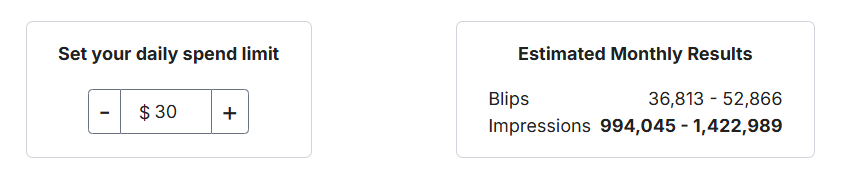
With Blip, you control exactly how much you spend on Alameda billboards by setting a daily budget that can be adjusted at any time. Because you only pay per blip—a 7.5 to 10-second ad display—the total cost of your campaign in the Alameda area is simply the sum of the individual blips you receive. This makes billboards near Alameda, California accessible to small and large advertisers alike.
Where can I advertise with Blip near Alameda, California?
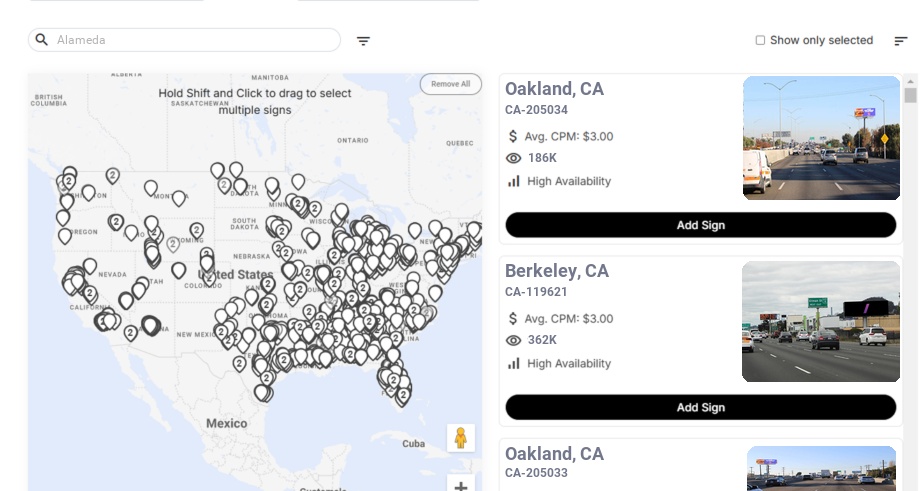
With 25 digital billboards serving the Alameda area from nearby Oakland, Berkeley, and San Francisco, advertisers can naturally reach Alameda commuters and nearby audiences. Boards on I-880 and approaches to the Bay Bridge in Oakland are ideal for reaching Alameda commuters during morning and evening rush. Boards in Berkeley and San Francisco can also capture students, professionals, and visitors traveling to and from the Alameda area.
When is the best time to run Alameda billboards with Blip?
Morning drive is roughly 6:30–9:30 a.m., when heavy flows move from Alameda-area neighborhoods into Oakland, Berkeley, Emeryville, and across the Bay Bridge to San Francisco. Evening drive is roughly 3:30–7:00 p.m., when return traffic toward the Alameda area often creates longer viewing times. Midday can also be effective because CPMs are often more favorable and the audience includes shift workers, freelancers, retirees, and parents on errands.
Who do Alameda billboards with Blip reach in the local market?
The Alameda area audience skews educated, tech-friendly, and diverse, with a mix of families, young professionals, and long-term homeowners. Alameda County is one of the most diverse counties in the state, and nearby cities have strong representation from Asian, Latino, Black, and multiracial communities. Many Alameda-area households also sit in middle to upper-middle income brackets, with substantial pockets of households earning $150,000+ annually.
What roads are best for Alameda billboard advertising with Blip?
The Alameda area is shaped by water crossings and a few high-volume connections, which directly influence billboard strategy. The Webster and Posey Tubes link Alameda to Oakland, and I-880 near Oakland carries roughly 180,000–220,000 vehicles per average weekday. The San Francisco–Oakland Bay Bridge and nearby I-80/I-580 corridors are also major routes for reaching Alameda-area commuters and visitors.
Do I need a contract to advertise with Blip in Alameda?
No, Blip has no long-term contracts or minimum commitments. You can start, pause, or stop your campaign at any time.
How fast can I launch a billboard campaign with Blip in Alameda?
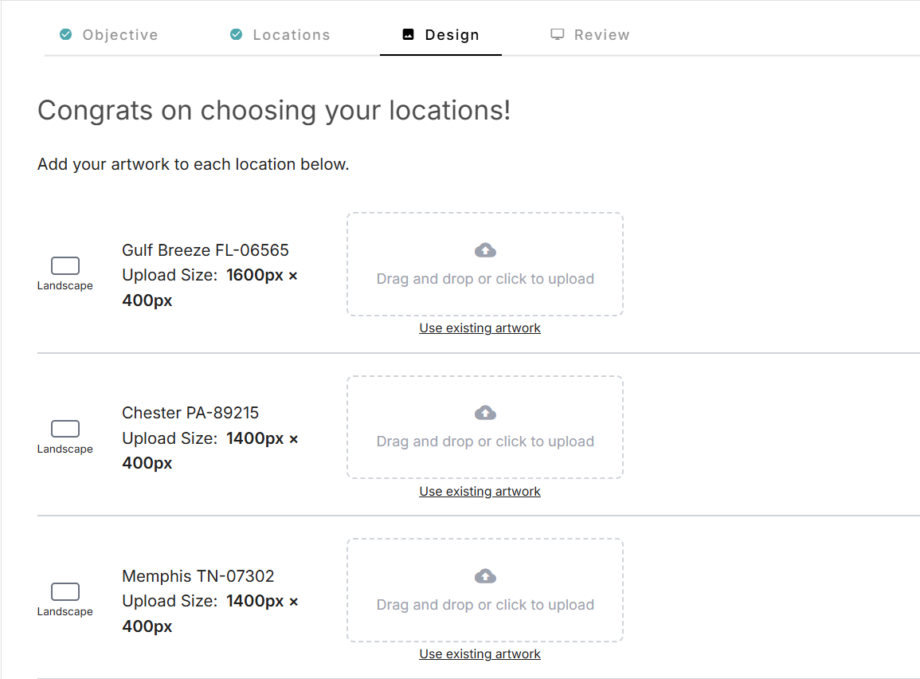
You can have your campaign live in minutes. Create a free account, select your locations, set your budget, upload your design, and start running once approved.
Where can I advertise with Blip in Alameda?
Blip has digital billboards in Alameda. You can browse available locations on a map, choose the ones that fit your audience, and start advertising right away.
Still have questions? Launch a campaign in minutes — no contracts, no commitments.
Start Your CampaignAlameda Billboard Advertising Guide
Alameda sits at the heart of the inner East Bay, surrounded by high-traffic corridors linking Oakland, Berkeley, and San Francisco. With 25 digital billboards serving the Alameda area from nearby Oakland, Berkeley, and San Francisco, we can tap into dense commuter flows, affluent urban audiences, and a tech-savvy population that sees outdoor media every day. This guide walks through how to use those boards strategically to reach the Alameda area with smart creative, precise timing, and data-driven planning—whether you’re exploring billboards near Alameda for the first time or scaling an existing campaign.
Understanding the Alameda Area Market
Alameda is a compact island city with strong ties to the broader Bay Area:
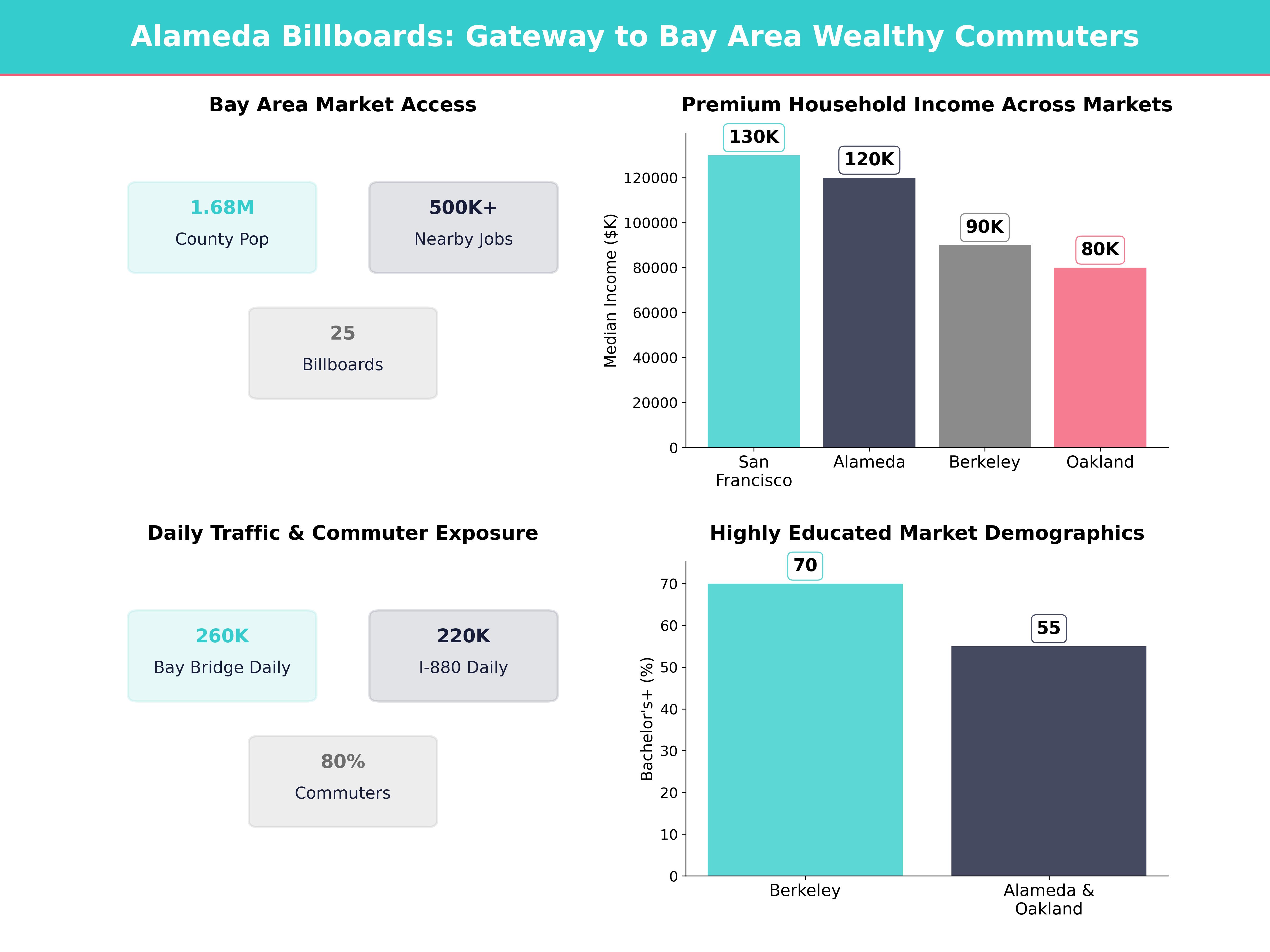
- The City of Alameda reports a population of roughly 78,000 residents within about 10 square miles, for a density of around 7,800 residents per square mile—more than triple the overall density of Alameda County’s approximately 1.68 million residents.
- Oakland, about 1.8 miles from Alameda, has roughly 430,000 residents according to City of Oakland figures; Berkeley, 7.5 miles away, has around 120,000 residents per the City of Berkeley; and San Francisco, 8.5 miles away, has roughly 808,000 residents per the City and County of San Francisco.
- The Bay Area is one of the wealthiest regions in the U.S. Median household income is commonly above $100,000 in many nearby ZIP codes, including around the low–$120,000s in Alameda, upper–$80,000s in Oakland, mid–$90,000s in Berkeley, and mid–$130,000s in San Francisco, based on recent city and regional economic reports.
Alameda itself blends historic neighborhoods, naval-base redevelopment, and waterfront recreation. Key local economic drivers include:
- Major redevelopment at Alameda Point and the former Naval Air Station, with plans for thousands of new housing units and hundreds of thousands of square feet of commercial space highlighted in Alameda Point
- A strong small-business and restaurant scene along Park Street and Webster Street, supported by the Downtown Alameda Business Association West Alameda Business Association, which together represent hundreds of local merchants.
- Proximity to employment centers in downtown Oakland, San Francisco’s Financial District, and UC Berkeley
Because our 25 digital billboards serving the Alameda area are located in Oakland, Berkeley, and San Francisco, advertisers can naturally reach:
- Alameda residents commuting off the island—more than 80% of employed Alameda residents work outside the city limits according to local transportation planning studies.
- East Bay workers and shoppers traveling near Alameda on I‑880, I‑80/I‑580, and key surface streets who are frequently exposed to Alameda billboards on their daily routes.
- San Francisco and Berkeley audiences who visit Alameda for dining, breweries, festivals, and waterfront events; the Downtown Alameda
Useful local references for understanding the broader market include the City of Alameda, Alameda County, and regional visitor resources like Visit Oakland and San Francisco Travel Metropolitan Transportation Commission and Alameda County Transportation Commission.
Mobility Patterns That Shape Billboard Strategy
The Alameda area is defined by water crossings and a few high-volume connections, which directly influence how we use nearby billboards:
-
Bridges & Tunnels:
- The Webster and Posey Tubes link Alameda to Oakland, funneling thousands of vehicles per hour during peak commute times toward I‑880 and downtown Oakland.
- Segments of I‑880 near Oakland carry roughly 180,000–220,000 vehicles per average weekday, according to Caltrans District 4 traffic counts summarized by regional agencies.
- The San Francisco–Oakland Bay Bridge (I‑80) regularly sees around 260,000 vehicles per weekday, making it one of the busiest bridges in the country, per data cited by the Bay Area Toll Authority
-
Freeways Near Alameda:
- I‑880 (Nimitz Freeway): Primary route for Alameda commuters heading to Oakland, downtown San Francisco (via the Bay Bridge), and the South Bay. It connects directly to the Port of Oakland, Oakland International Airport, and key job centers.
- I‑580 & I‑80: Connect East Bay suburbs, Berkeley, and Richmond with Oakland and San Francisco. Combined, certain segments serve well over 200,000 vehicles daily around the MacArthur Maze interchange, according to regional traffic monitoring.
- I‑980 & Highway 24: Feed downtown Oakland and connect to Lafayette/Walnut Creek, capturing East Bay professionals commuting through Oakland who may also shop, dine, or live in and around Alameda.
-
Transit Integration:
- The Alameda-Contra Costa Transit District (AC Transit) operates dozens of routes in central Alameda County. Systemwide weekday ridership has been in the 100,000–150,000 range in recent years as it rebounds from pandemic lows.
- BART reports around 180,000–200,000 average weekday riders in its latest ridership updates, with Oakland and Berkeley stations among the busiest outside San Francisco. Many riders are first exposed to digital billboards from highways and major arterials on their way to park-and-ride lots or station garages.
- Alameda’s ferry services, operated by San Francisco Bay Ferry
What this means for billboard advertisers:
- Boards on I‑880 and approaches to the Bay Bridge in Oakland are ideal for reaching Alameda commuters during morning and evening rush, when corridor speeds can drop below 25 mph and dwell time on your message increases.
- Boards in Berkeley capture Alameda-area students, faculty, and professionals traveling to UC Berkeley—where enrollment is over 45,000 students, with thousands of faculty and staff—and the I‑80/I‑580 junction.
- Boards in San Francisco are great for driving visitors back toward the Alameda area for weekend outings, waterfront attractions, or real estate open houses. San Francisco welcomed more than 23 million visitors in a recent year, according to San Francisco Travel
With digital inventory, we can prioritize specific roadways and directions of travel that align with where Alameda-area consumers actually drive, adjusting in near-real time as traffic patterns shift.
Who You’re Reaching: Demographics and Lifestyles
The Alameda area audience skews educated, tech-friendly, and diverse, with a mix of families, young professionals, and long-term homeowners. Based on regional and local data:
- Education: Alameda County has one of the highest educational attainment levels in California. In Berkeley, more than 70% of adults have a bachelor’s degree or higher, supported by City of Berkeley and UC Berkeley
- Income: Many Alameda-area households sit in middle to upper-middle income brackets. Median household income levels in nearby cities typically range from the upper–$80,000s to mid–$130,000s, with substantial pockets of households earning $150,000+ annually, especially among tech, healthcare, finance, and professional services workers.
- Diversity: Alameda County is one of the most diverse counties in the state. Local demographic profiles show that no single racial or ethnic group holds an absolute majority, with strong representation from Asian, Latino, Black, and multiracial communities, as well as a large foreign-born population in many ZIP codes.
-
Age Mix:
- Young professionals in their 20s and 30s living in apartments and condos near downtown Oakland, Uptown, Jack London Square, and transit corridors.
- Families with children in Alameda’s and Oakland’s public and charter schools; the Alameda Unified School District alone serves roughly 9,000–10,000 students.
- Empty-nesters and retirees in older single-family homes, many of whom have significant home equity and strong local brand loyalty built over decades.
Implications for billboard creative:
- Inclusive visuals: Use imagery that reflects racial and cultural diversity and family/household diversity (single professionals, couples, multigenerational households).
- Bilingual options: For sectors like healthcare, education, and public services, consider bilingual English–Spanish or English–Chinese versions on different boards or timeframes, reflecting the significant share of residents who speak a language other than English at home.
- Value + ethics messaging: Surveys and local reporting consistently show that Bay Area consumers respond to brands that highlight sustainability, local impact, and social responsibility, not just price.
Local news outlets such as the Alameda Post, Alameda Sun East Bay Times, and the San Francisco Chronicle
Where to Focus: Key Corridors Serving the Alameda Area
With 25 digital billboards serving the Alameda area across Oakland, Berkeley, and San Francisco, placement strategy matters. While specific board locations vary, there are common pattern zones that consistently reach Alameda area audiences and function as the most impactful billboards near Alameda:
-
I‑880 Corridor (Oakland)
- Primary artery for Alameda residents commuting to Oakland, downtown San Francisco, and Silicon Valley. Some segments carry nearly 200,000 vehicles per weekday, making it one of the East Bay’s heaviest-traveled corridors.
- Heavy truck traffic bound for the Port of Oakland, which handles more than 2 million TEUs (twenty-foot equivalent units) of containerized cargo annually, plus daily commuter volumes into downtown Oakland and the airport.
-
Best for:
- Auto, insurance, and financial services targeting high-mileage commuters and small business owners.
- Logistics, B2B, and industrial services serving port users and warehouse/distribution hubs.
- Job recruitment and trade schools, especially for logistics, construction, and healthcare roles.
-
Downtown Oakland & Approaches to the Bay Bridge
- Captures drivers heading from Alameda-area neighborhoods toward San Francisco via I‑880, I‑980, and I‑580 connectors.
- High repeat exposure: daily commuters can see the same board 200+ times per year if they maintain a consistent route, based on a typical 5-day commute pattern.
-
Best for:
- Big consumer brands seeking repeated exposure and upper-funnel awareness.
- Entertainment, concerts, and sports events in both Oakland and San Francisco, including events at venues highlighted by Visit Oakland.
- Tourism and experiences in the Alameda area (breweries, festivals, waterfront dining) that can convert weekend travelers and after-work explorers.
-
I‑80 / I‑580 Near Berkeley
- Connects North Oakland, Emeryville, and Berkeley with Richmond and Marin, carrying a mix of commuters, students, and regional visitors.
- Reaches professionals and students linked to UC Berkeley (over 45,000 students plus faculty/staff), the Emeryville biotech and tech cluster, and large retail centers.
-
Best for:
- Education (universities, bootcamps, tutoring) reaching both traditional students and adult learners.
- Tech products, startups, and SaaS aimed at a highly connected audience with high smartphone and broadband penetration.
- Lifestyle brands (fitness, eco-friendly products) that align with Berkeley’s strong environmental and wellness culture.
-
San Francisco Approaches to the Bay Bridge & Downtown
- Ideal for targeting high-income urban professionals and tourists; San Francisco’s visitor economy generates billions of dollars annually in spending, according to San Francisco Travel
- Captures traffic heading back toward the East Bay and the Alameda area in the evening and on weekends, when many visitors look for dining, nightlife, or more affordable lodging across the Bay.
-
Best for:
- Real estate promoting open houses or new developments near the Alameda area, where price-per-square-foot often compares favorably to central San Francisco.
- Dining and entertainment that make the Alameda area a destination: craft breweries, waterfront restaurants, and family attractions.
- Healthcare systems and specialty clinics serving East Bay patients, emphasizing shorter waits and easier parking than downtown SF.
With Blip’s flexibility, you can concentrate spending on the boards and corridors most relevant to your audience, instead of locking into a fixed, all-or-nothing buy, and then reallocate as performance data and traffic conditions evolve. This approach makes billboard rental near Alameda more efficient and accessible for businesses of all sizes.
Timing Your Campaign: When Alameda Area Audiences Are On The Road
Travel patterns in the Alameda area follow classic commuter rhythms, but the Bay Area also has distinct weekend and event-related spikes tied to stadium events, festivals, and university calendars.
Weekday Commuter Peaks
-
Morning drive: Roughly 6:30–9:30 a.m.
- Heavy flows from Alameda-area neighborhoods into Oakland, Berkeley, Emeryville, and across the Bay Bridge to San Francisco. During this window, some freeway segments operate near capacity, with volume often exceeding 8,000–10,000 vehicles per peak hour.
- Best for: coffee shops, transit info, employment ads, and quick brand awareness messages that people can recall later at work.
-
Evening drive: Roughly 3:30–7:00 p.m.
- Return traffic toward the Alameda area, often with stop-and-go congestion on I‑880 and I‑80 leading to longer viewing times—sometimes 20–60 seconds of intermittent visibility per pass in slowdowns.
- Best for: grocery, meal kits, restaurants, entertainment, and family services positioned as “on the way home” solutions.
Midday & Off-Peak
-
Midday (10 a.m.–3 p.m.):
- Reaches shift workers, freelancers, retirees, and parents on errands, plus tourists and day-trippers.
- CPMs are often more favorable because demand from large commuter-focused advertisers is lower, allowing more frequent blips and higher share-of-voice.
- Great for local retail, healthcare appointments, and services aimed at flexible schedules.
-
Late night (after 9 p.m.):
- Lower volume but less competition on screens.
- Good for nightlife, streaming apps, on-demand services, and awareness campaigns that value frequency and share-of-voice over precise demographic targeting.
Seasonality in the Alameda Area
-
Spring–Summer:
- Peak season for events, festivals, and tourism around the Bay and the Alameda waterfront. The East Bay sees spikes in hotel occupancy and restaurant sales during major events and holiday weekends, as reported by Visit Oakland and local business districts.
- Promote outdoor dining, breweries, tours, and summer programs.
- Leverage local calendars from sites like Visit Oakland and Berkeley’s visitor resources to time short, high-intensity bursts around specific festivals, concerts, and street fairs.
-
Back-to-School (Aug–Sept):
- Heavy traffic patterns as K–12 schools and universities restart. UC Berkeley, Oakland schools, and Alameda schools collectively bring tens of thousands of students and staff onto the roads and transit system in a tight window.
- Strong window for education, tutoring, after-school programs, youth sports, and college-prep services.
-
Holiday Season (Nov–Dec):
- Retail and e-commerce promotions, local gift guides, and end-of-year fundraising.
- Traffic is more spread throughout the day due to flexible work schedules and shopping, but evening and weekend congestion around malls and commercial districts often increases.
- Nonprofits and civic campaigns can use this period to tap into charitable giving and year-end tax planning.
By using Blip’s scheduling tools, we can concentrate impressions around these high-impact windows without paying for every hour of the day, and quickly pause or expand based on performance metrics for your billboard advertising near Alameda.
Creative That Works For Alameda Area Drivers
Digital billboards near the Alameda area are often viewed at highway speeds with complex sightlines (interchanges, curves, and bridge approaches). To maximize effectiveness:
1. Keep It Ultra-Clear and Legible
- Limit to 6–10 words plus logo/URL; recall studies for roadside advertising consistently show steep drop-offs in comprehension beyond about 7–8 words.
- Use large, sans-serif fonts with high contrast (e.g., white on dark blue, or yellow on black).
- Avoid dense fine print or complex website URLs—use brand names or short URLs that people can easily search from memory.
2. Reflect Local Identity
- Incorporate visual cues: the Bay Bridge, Port of Oakland cranes, waterfront views, or classic Alameda Victorians, all of which are instantly recognizable to East Bay residents.
- Mention “serving the Alameda area” rather than specific cross-street addresses; drivers can’t retain detailed directions at high speed, especially in congested, multi-lane interchanges.
- Highlight local credibility: “Locally owned since 2005,” “Proud to serve East Bay families,” or references to partnerships with local institutions and nonprofits.
3. Align With Bay Area Values
-
Emphasize sustainability, quality, and fairness where genuine:
- “100% renewable energy plans.”
- “Zero-waste packaging available.”
- “Support East Bay artists / makers.”
- Local surveys and reporting from outlets like the East Bay Times and San Francisco Chronicle
4. Design for Digital Flexibility
-
Prepare multiple versions for different audiences or times:
- Version A: Morning commuter message (e.g., “Beat Bay Bridge traffic – Try our ferry-friendly cowork space”).
- Version B: Evening message (e.g., “Dinner near the Alameda area? Exit now.”).
-
Use day-specific creative:
- “Weekend on the water near Alameda” (Fri–Sun only).
- “Midweek happy hour near Alameda” (Mon–Thu afternoons).
- Swap creative quickly during weather events (e.g., heat waves, rainstorms) or major news weeks to remain relevant.
5. Make Calls-to-Action Simple
Because most drivers can’t act immediately, aim for actions that are easy to remember or search:
- “Search: ‘Alameda solar rebates’”
- “Visit: GreenDentistBay.com”
- “Text ALAMEDA to 12345”
Then, reinforce with search, social, and local news sponsorships so people who saw your billboard find you instantly when they reach their phones or laptops.
Using Blip’s Flexibility to Test and Optimize
Blip allows campaigns serving the Alameda area to run like always-on experiments instead of one-time bets. Key approaches:
A/B Test Creatives
- Run two or more designs on the same set of boards and monitor differences in click-through rates to your site or landing page traffic from East Bay ZIP codes.
- Shift your budget toward the creative driving more web visits, search volume, phone calls, or store traffic. Even a 10–20% improvement in response can yield substantial ROI over a multi-month campaign.
- Compare simple variables: color scheme, headline, CTA, offer size, or inclusion of a local reference (“near the Webster Tube,” “Alameda Point”).
Daypart and Day-of-Week Strategy
-
Concentrate spend:
- Weekday rush for B2B, commuting services, and professional services, when a high share of viewers are workers with stable incomes and regular schedules.
- Evenings and weekends for dining, events, and entertainment in or near the Alameda area, when discretionary spending peaks.
- Reduce or pause during low-value intervals for your audience, then reallocate to periods with better performance, using Blip reporting in combination with tools like Google Analytics or your CRM.
Micro-Campaigns Around Events
Use short bursts around:
- Alameda area festivals, street fairs, and waterfront events promoted by the City of Alameda and Downtown Alameda
- Home games and concerts at major Bay Area sports and entertainment venues that increase bridge and freeway traffic.
- Large conventions in San Francisco that fill East Bay hotels and restaurants, reported on by San Francisco Travel
By timing campaigns to these spikes, your message reaches audiences when they are already in motion and more open to trying something new or exploring a nearby neighborhood.
Industry-Specific Strategies for the Alameda Area
Different sectors can leverage the Alameda area’s unique mix of commuters, families, and urban professionals in distinct ways.
Local Retail, Dining, and Entertainment
- Promote proximity and ease: “5 minutes from the Webster Tube” or “Near downtown Alameda ferry terminal.” Reference local landmarks like Park Street, Webster Street, or Alameda Point.
- Run lunchtime and evening dayparts targeting commuters on I‑880 and downtown Oakland approaches. Many corridors see elevated traffic volumes again around the 12–2 p.m. lunch window.
- Rotate offers: weekday lunch specials vs. weekend brunch or live music. Digital boards make it easy to switch creative by day-of-week.
- Encourage discovery: “New rooftop near the Alameda area – Search ‘Skyline Taps’.” Pair with features or event listings in outlets like the Alameda Sun Alameda Post.
Real Estate and Development
- The Alameda area frequently features new townhome and apartment developments, especially around Alameda Point and nearby Oakland waterfront districts like Jack London Square. Local planning documents project thousands of new units in pipeline projects across these neighborhoods.
-
Use San Francisco-facing boards to attract renters and buyers priced out of SF:
- “More space near the Alameda area – 25 minutes from downtown SF.”
- Include simple wayfinding like exit numbers or neighborhood names (e.g., “Alameda Point,” “Harbor Bay”) and highlight commute times via ferries, BART, or freeway routes.
Education and Training
- Target boards along I‑80/I‑580 and I‑880 where students and staff from UC Berkeley, Laney College, College of Alameda
- Promote intensive bootcamps, language schools, or certificate programs with clear benefits: “New IT career in 6 months” or “English classes evenings & weekends in the Alameda area.”
- Use back-to-school windows and graduation seasons for maximum resonance, and run heavier rotations near financial aid deadlines or application peaks.
Healthcare and Wellness
- Large regional hospital systems and independent practices alike serve the Alameda area, including facilities in Alameda, Oakland, and Berkeley. Many local clinics report appointment volumes concentrated in weekday mornings and late afternoons.
- Focus on access: easy parking, short waits, multi-lingual staff, and proximity to major corridors or transit.
- Align with wellness trends: “Whole-person care for East Bay families,” “Mental health support serving the Alameda area,” or “Same-day urgent care near the Webster Tube.”
- Schedule heavier rotations at the start of the year (benefits reset), during open enrollment periods, and in late summer when families handle school physicals and vaccinations.
Nonprofits, Civic Campaigns, and Public Information
- The Alameda area has an engaged civic culture, with active local journalism and community organizations. Voter turnout in Alameda County often exceeds state averages in major elections.
-
Use billboards to support:
- Voter registration or ballot measures, directing to official sources like the Alameda County Registrar of Voters.
- Public-health campaigns coordinated with the Alameda County Public Health Department
- Arts festivals and cultural initiatives produced by local arts organizations and city cultural affairs offices.
- Leverage concise, non-partisan calls to action with URLs pointing to official resources like the City of Alameda or Alameda County sites where appropriate.
Measuring Impact in a Complex, Cross-Bridge Market
Because drivers move between multiple cities and counties in the Alameda area, measurement should be multi-layered:
-
Web analytics:
- Watch for lifts in direct traffic and branded search terms when your campaign is running, especially from Bay Area IP addresses and mobile devices.
- Compare behavior from ZIP codes near key corridors (e.g., Alameda, Chinatown/Oakland, Jack London Square, North Oakland, West Berkeley, SOMA/SF) before, during, and after your flight.
-
Promo codes and vanity URLs:
- Use short, trackable URLs or codes specific to the billboard creative (e.g., alamedadeal.com or brand.com/alameda).
- Example: “ALAMEDA20” for first-time customers and measure redemption share from Alameda and Oakland locations.
-
Store or appointment data:
- Track foot traffic spikes or appointment requests aligned with campaign dates and dayparts. Many POS and scheduling systems allow tagging by source or promo code.
- Ask new customers, “How did you hear about us?” and flag those who mention “billboard,” “sign on the freeway,” or a specific corridor.
-
Brand lift surveys:
- Especially for larger spends, run simple digital surveys before and after to measure changes in brand awareness within the Alameda area. Recruit respondents via local news sites, social media, or email lists.
- Look for statistically meaningful changes (e.g., 5–10 percentage point increases in unaided or aided awareness) in Alameda, Oakland, and Berkeley audiences.
With digital billboards, you can adjust quickly: if a certain corridor underperforms, reallocate impressions to other boards in Oakland, Berkeley, or San Francisco that better reach your Alameda area audience, and iterate creative based on what data shows is working. This nimble approach is what sets modern Alameda billboards apart from traditional, fixed campaigns.
Putting It All Together
To reach consumers in the Alameda area effectively with Blip:
- Anchor your strategy in mobility: Focus on I‑880, Bay Bridge approaches, and I‑80/I‑580 to intercept Alameda-area commuters who collectively generate hundreds of thousands of daily trips.
- Respect the region’s diversity and values: Use inclusive, sustainability-minded creative that reflects real East Bay life and local concerns around equity, climate, and community.
- Leverage timing and flexibility: Concentrate on rush hours, key seasons, and event windows that matter to your customers, instead of buying 24/7 exposure you don’t need.
- Test, learn, and refine: Use multiple creatives, dayparts, and corridors, and optimize based on real performance data from web analytics, in-store activity, and survey feedback.
By combining local insight with the flexibility of our 25 digital billboards serving the Alameda area, we can build campaigns that stand out on some of the busiest and most influential roads on the West Coast—and turn everyday commutes into high-impact, measurable marketing opportunities through efficient billboard advertising near Alameda.