Billboards near Rancho Cucamonga, CA
No Minimum Spend. No Long-Term Contracts. Just Results.
Trusted by Leading Brands


Billboard advertising
near Rancho Cucamonga has never been easier



How much is a billboard near Rancho Cucamonga?
Why Choose Blip for Billboard Advertising near Rancho Cucamonga
Blip lets Rancho Cucamonga brands launch fast and self-serve, reaching I-10 and SR-210 commuters without a media buy bottleneck.
Set a daily budget for Rancho Cucamonga and test billboard ads near Upland with low risk—then scale when the commute traffic converts.
Use Blip dayparting to hit Rancho Cucamonga shoppers at lunch and evenings on Foothill Blvd, Victoria Gardens, and Route 66 routes.
No contracts means Rancho Cucamonga campaigns can flex for back-to-school, holiday shopping, or City events as traffic shifts.
Track real-time results for Rancho Cucamonga and adjust creative or timing quickly when weekday commuters outperform weekend retail trips.
Blip's creative tools help tailor bold Rancho Cucamonga messages for sunny freeway views and fast reads at 40-65 mph.
Frequently Asked Questions About Billboard Advertising near Rancho Cucamonga
How much does a billboard cost near Rancho Cucamonga, California with Blip?
With Blip, you control exactly what you spend on Rancho Cucamonga billboards by setting a daily budget that can start low and be adjusted at any time, so you only pay for the digital billboard advertising you actually receive. Each short ad display, or “blip,” is priced based on when and where it runs and on advertiser demand, making billboards near Rancho Cucamonga, California flexible for any marketing plan. Because your total cost is simply the sum of all your individual blips, you can test the impact of billboard advertising in the Rancho Cucamonga area with minimal risk, then scale your pay-per-blip campaign up whenever you’re ready for more exposure.
Where are Blip billboards serving the Rancho Cucamonga area located?
Blip’s digital billboards serving the Rancho Cucamonga area are located in nearby Upland, roughly 4.5 miles away. For advertisers evaluating billboard rental near Rancho Cucamonga, these nearby Upland faces function as practical Rancho Cucamonga billboards because Upland and Rancho Cucamonga share key arterial corridors, commuter flows, and retail trade areas. These placements are highly effective for reaching Rancho Cucamonga residents and visitors.
What makes Rancho Cucamonga a good market for Blip billboard advertising?
Rancho Cucamonga is one of the Inland Empire’s most attractive residential and business communities, with a population of roughly 175,000–180,000 residents and a median household income over $100,000. That income level is 20–30% higher than the overall California median and more than 50% higher than the San Bernardino County median, indicating strong consumer spending power. The city also has a stable base of long-term residents and a family-oriented profile that supports a wide range of local campaigns.
When is the best time to run billboards near Rancho Cucamonga with Blip?
The Rancho Cucamonga area is heavily commuter-oriented, with morning peak traffic around 6:30 a.m.–9:00 a.m. and evening peak traffic from 3:30 p.m.–7:00 p.m. Retail and dining campaigns should focus on lunchtime and late afternoon to early evening, especially Thursday through Sunday. Because Blip allows you to buy individual “blips” of time, you can concentrate spend into just a few hours per day with the highest traffic volumes.
What traffic corridors can Blip reach near Rancho Cucamonga, California?
Major nearby corridors include Interstate 10, State Route 210, and Foothill Boulevard / Historic Route 66. I-10 carries well over 200,000 vehicles per day through the western Inland Empire, while SR-210 typically sees 140,000–160,000 vehicles per day in this region. Foothill Boulevard also has many segments above 35,000–45,000 vehicles per day, feeding strip centers, auto dealers, restaurants, and service businesses.
Do I need a contract to advertise with Blip near Rancho Cucamonga?
No, Blip has no long-term contracts or minimum commitments. You can start, pause, or stop your campaign at any time.
How fast can I launch a billboard campaign with Blip near Rancho Cucamonga?
You can have your campaign live in minutes. Create a free account, select your locations, set your budget, upload your design, and start running once approved.
Where can I advertise with Blip near Rancho Cucamonga?
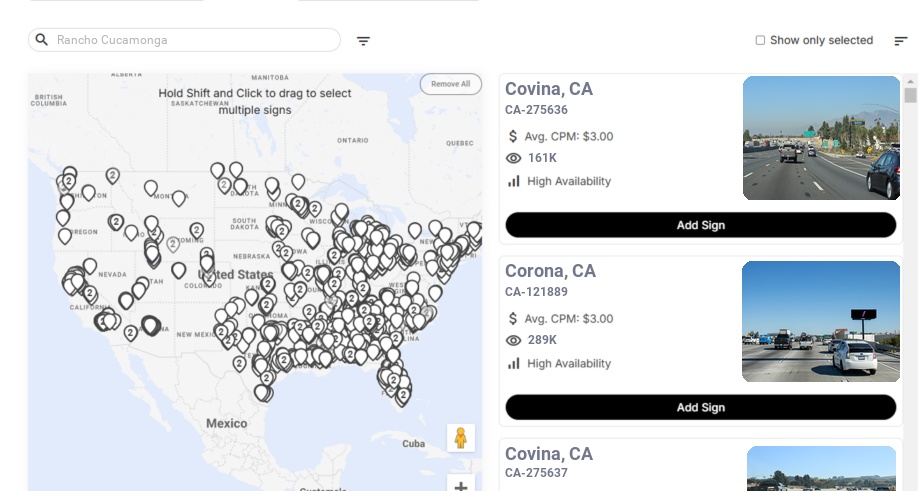
Blip has digital billboards near Rancho Cucamonga. You can browse available locations on a map, choose the ones that fit your audience, and start advertising right away.
Still have questions? Launch a campaign in minutes — no contracts, no commitments.
Start Your CampaignRancho Cucamonga Billboard Advertising Guide
Rancho Cucamonga sits at a pivotal crossroads of Southern California’s Inland Empire, with strong household incomes, heavy commuter traffic, and fast‑growing logistics and retail sectors. With Blip’s digital billboards in nearby Upland serving the Rancho Cucamonga area, advertisers can tap into tens of thousands of impressions per day with flexible budgets and precise timing. For businesses searching for billboards near Rancho Cucamonga, these placements provide a powerful way to appear in front of local residents and visitors along their everyday routes. Below, we explore how to design, schedule, and target digital billboard campaigns that resonate with people who live, work, and shop near Rancho Cucamonga.
Understanding the Rancho Cucamonga Area Market
Rancho Cucamonga is one of the Inland Empire’s most attractive residential and business communities, and that shows up in the data:
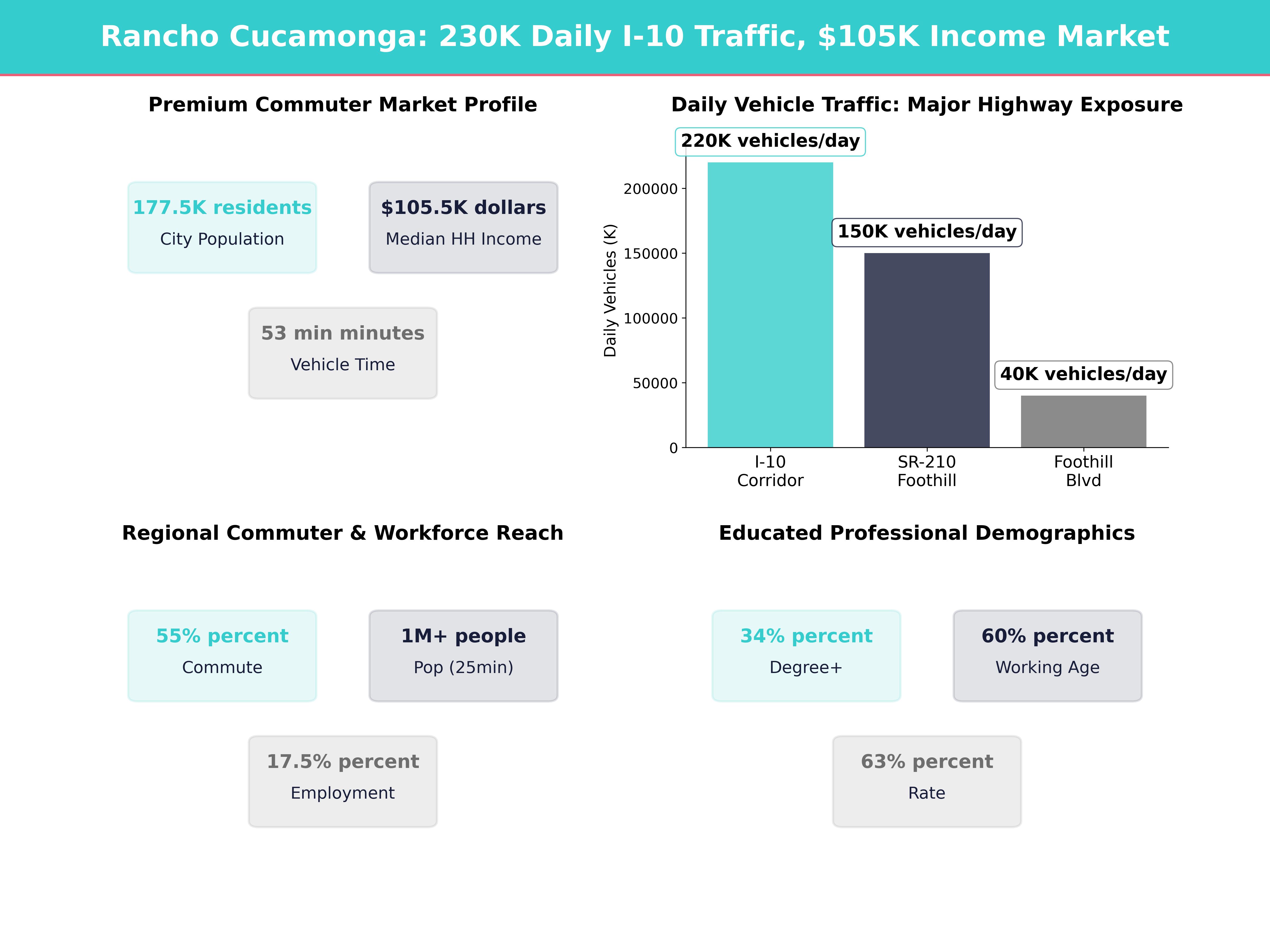
- The City of Rancho Cucamonga reports a population of roughly 175,000–180,000 residents (most recent estimates place it around 177,000–178,000), making it one of the top 10 largest cities in the Inland Empire and among the largest in San Bernardino County.
- The median household income is over $100,000 (recent estimates place it in the $103,000–108,000 range), which is 20–30% higher than the overall California median and more than 50% higher than the San Bernardino County median, indicating strong consumer spending power.
- The median age is around 35–36 years, slightly younger than the statewide median, with roughly 60% of residents in prime working ages (20–64) and a sizable share of children and teens, reinforcing its family‑oriented profile.
- More than 1 in 3 adults (approximately 32–36%) hold a bachelor’s degree or higher, well above county averages, a profile that supports higher‑value service industries, healthcare, professional services, and education.
- Owner‑occupied housing rates hover around 60–65%, signaling a stable base of long‑term residents with ongoing needs for home services, remodeling, and local amenities that can be promoted effectively through Rancho Cucamonga billboards.
You can explore official city data, economic development information, and community stats via the City of Rancho Cucamonga and its Economic Development pages, as well as regional context from San Bernardino County.
What this means for advertisers:
- Higher disposable income and stable homeownership support campaigns for automotive, home improvement, financial services, education, healthcare, and premium retail, all of which can benefit from always‑on billboard advertising near Rancho Cucamonga.
- A relatively young, family‑oriented population (with roughly one‑quarter of residents under 18) encourages messaging around schools, kids’ activities, entertainment, QSR/fast casual, and family health.
- Educated and professional audiences respond well to clear value propositions, time‑savings, and quality‑of‑life benefits, especially when combined with convenient location cues and digital call‑to‑actions.
- With unemployment in the Inland Empire often tracking 1–2 percentage points below statewide peaks during strong years, local employers compete aggressively for talent—making recruitment‑driven campaigns on billboards near Rancho Cucamonga especially effective.
Where Our Billboards Serve the Rancho Cucamonga Area
Blip’s digital billboards serving the Rancho Cucamonga area are located in nearby Upland, roughly 4.5 miles away. For advertisers evaluating billboard rental near Rancho Cucamonga, these nearby Upland faces function as practical Rancho Cucamonga billboards because Upland and Rancho Cucamonga share key arterial corridors, commuter flows, and retail trade areas, making these boards highly effective for reaching Rancho Cucamonga residents and visitors.
Major nearby corridors include:
- Interstate 10 (I‑10) – One of the busiest freeways in California, carrying well over 200,000 vehicles per day through the western Inland Empire. Some segments between Montclair, Upland, and Ontario regularly record 210,000–230,000 average daily vehicles, according to regional counts from Caltrans District 8.
- State Route 210 (SR‑210) – A primary east‑west commuter route north of Rancho Cucamonga, typically seeing 140,000–160,000 vehicles per day in this region, with peak hours often pushing volumes 20–30% above the daily average.
- Foothill Boulevard / Historic Route 66 – A dense local commercial corridor linking Upland, Rancho Cucamonga, and surrounding communities, with many segments above 35,000–45,000 vehicles per day, feeding strip centers, auto dealers, restaurants, and service businesses.
Because Upland and Rancho Cucamonga are functionally part of the same urbanized corridor, creative shown on boards in Upland can effectively reach shoppers heading to:
- Victoria Gardens and the regional retail clusters in the Rancho Cucamonga area, which collectively draw millions of visits annually and serve as a regional magnet for shoppers from across the Inland Empire.
- Industrial and logistics jobs concentrated near Ontario International Airport—which handled more than 6 million passengers per year in recent reporting—and along the I‑10 / I‑15 corridors, which form one of the largest freight corridors on the West Coast. You can see broader visitor and travel context at Ontario International Airport and Visit Greater Ontario.
- Residential neighborhoods that stretch from Baseline Road down to Arrow Route and beyond, where thousands of trips per day funnel onto north‑south arterials like Haven Ave, Milliken Ave, and Archibald Ave before connecting to Upland‑side surface streets and freeways.
When you choose specific Blip boards near Upland, you are effectively targeting:
- Daily commuters who live in the Rancho Cucamonga area and use I‑10, SR‑210, or Foothill Blvd, many of whom spend 45–60+ minutes per day in their vehicles and see recurring billboard advertising near Rancho Cucamonga during their drive.
- Shoppers and diners moving between Upland, Rancho Cucamonga, Ontario, and Fontana—part of an Inland Empire retail trade area serving well over 1 million residents within a 20–25 minute drive.
- Students, faculty, and visitors associated with nearby institutions like the Claremont Colleges corridor to the west and local campuses served by Chaffey College and K‑12 districts.
Commuter Patterns and Peak Viewing Times
The Rancho Cucamonga area is heavily commuter‑oriented. Many residents work in Los Angeles County, Orange County, or other parts of the Inland Empire, with daily flows along I‑10, SR‑210, and local arterials. In many Inland Empire communities, 50–60% of workers commute outside their home city, and average one‑way commute times often exceed 30 minutes.
Typical traffic patterns near Rancho Cucamonga and Upland:
- Morning peak: approximately 6:30 a.m.–9:00 a.m. (westbound and southbound heavier), when peak hour volumes can be 2–3 times overnight levels.
- Midday shoulder: 11:00 a.m.–1:30 p.m. (errands, lunch, local shopping), often representing 15–20% of total daily vehicles.
- Evening peak: 3:30 p.m.–7:00 p.m. (eastbound and northbound return trips), typically the highest‑volume window of the day for many freeway segments.
How to use Blip’s scheduling tools around these patterns:
-
B2B and professional services (staffing, legal, accounting, software, logistics)
- Prioritize 6:30–9:00 a.m. and 4:30–6:30 p.m. on weekdays to catch decision‑makers during commutes, when digital billboard recall can be 20–30% higher than in light‑traffic periods due to denser exposure.
-
Retail and dining
- Focus on lunchtime (11:00 a.m.–1:30 p.m.) and late afternoon/early evening (4:00–7:00 p.m.), particularly Thursday–Sunday when restaurant and retail transactions often account for 40%+ of weekly sales.
-
Family and education services (tutoring, private schools, pediatric care, after‑school programs)
- Test 7:00–9:00 a.m. and 2:30–6:00 p.m. on weekdays, aligning with school drop‑off and pick‑up times for local districts such as Cucamonga School District, Central School District, and Etiwanda School District.
-
Entertainment, events, and nightlife
- Lean into Thurs–Sat evenings, especially when promoting concerts, games, or shows at destinations like Toyota Arena in Ontario or seasonal events promoted by the Rancho Cucamonga Community Services Department.
Because Blip allows you to buy individual “blips” of time, you can:
- Concentrate spend into just a few hours per day with the highest traffic volumes, rather than paying for low‑value overnight impressions.
- Adjust schedules dynamically when you see performance trends in your other channels (e.g., search or in‑store traffic), and respond quickly to weather‑driven surges (e.g., hot days driving cooling, beverage, and indoor entertainment demand).
Key Audience Segments in the Rancho Cucamonga Area
The Rancho Cucamonga area is not a single homogeneous market. To use your Blip campaign effectively, align your creative with the area’s major audience segments.
1. Commuter Professionals
- A large share of residents commute to job centers in Los Angeles, Pasadena, Ontario, and Riverside, with regional data showing that well over half of working residents in many Inland Empire cities travel to another city for work.
- Professional and office‑based industries—such as healthcare, education, logistics management, finance, and government—represent a sizable portion of local employment.
- These commuters are likely to be time‑pressed, tech‑savvy, and responsive to clear value and convenience.
Messaging tips:
- Highlight speed, convenience, and savings (“Save 30 minutes this week with pickup in Rancho Cucamonga area”).
- Use short, punchy copy that can be absorbed in 2–3 seconds, which aligns with typical billboard view times at 40–65 mph.
- Include a clear CTA tied to location (“Exit at Mountain Ave – 2 miles ahead”) and consider short URLs or QR codes that are easy to remember.
2. Families and Suburban Households
Rancho Cucamonga is consistently ranked as a family‑friendly community, with strong public schools and many parks and sports programs overseen by the RC Parks & Recreation division. The city maintains 30+ parks and facilities, hundreds of acres of open space, and year‑round youth and adult sports leagues.
Family‑oriented indicators:
- Roughly 25–30% of residents are under age 18, supporting a robust base for K‑12, childcare, healthcare, and activity‑driven advertising.
- Local school districts often report graduation rates above 85–90%, and some high schools rank among the stronger performers in the Inland Empire.
- Household sizes average around 3.0–3.2 persons, above many coastal markets, signaling multi‑person purchasing decisions that can be influenced by billboards near Rancho Cucamonga seen on daily family trips.
Messaging tips:
- Focus on safety, trust, and local roots (“Trusted pediatric care serving Rancho Cucamonga area families since 2005”).
- Promote weekend activities, kids’ programs, and seasonal offers, especially around back‑to‑school and holidays.
- Use imagery of families, youth sports, and recognizable local landscapes (foothills, palm‑lined boulevards) to increase local recognition and trust.
3. Logistics, Manufacturing, and Blue‑Collar Workforce
The broader Inland Empire is one of the nation’s largest logistics hubs, with hundreds of millions of square feet of warehouse and distribution space stretching from Rancho Cucamonga and Ontario east through Fontana and beyond. Logistics, transportation, and warehousing can represent 15–20% or more of local employment in certain Inland Empire sub‑regions.
Messaging opportunities:
- Perfect for recruitment, training programs, industrial suppliers, and trade schools, including CDL programs, forklift certification, and vocational education.
- Inland logistics wages for entry‑level warehouse roles frequently run in the $18–$25 per hour range, with CDL drivers and skilled roles earning more—numbers you can feature directly in your creative.
Messaging tips:
- Emphasize pay rates, benefits, and easy access (“$23/hr+ warehouse roles – 10 minutes from Rancho Cucamonga area”).
- Schedule heavily during shift changes, often 5:30–7:30 a.m., 1:30–3:30 p.m., and 9:30–11:00 p.m. depending on local employers near I‑10, I‑15, and the Ontario Airport corridor.
- Use bold, simple calls to action like “Apply Today – Text ‘JOB’ to 55555”.
4. Students and Education‑Focused Audiences
Within a 10–15 mile radius you’ll find community colleges, career schools, and the Claremont Colleges cluster. This opens opportunities for:
- Colleges, vocational schools, language institutes, exam prep centers
- Financial services aimed at younger adults (banking, auto loans, first‑time renter resources)
- Local institutions such as Chaffey College, which serves tens of thousands of students across multiple campuses, and nearby private schools.
Messaging tips:
- Lean on career outcomes and financial aid (“Earn in‑demand certifications in 9 months or less”).
- Highlight flexible formats—evening, weekend, or online programs—to appeal to working adults.
- Keep design bold and modern, with one key benefit and a simple URL or QR code; campaigns targeting students often see the best response when the path from impression to sign‑up is reduced to 1–2 steps.
Crafting Effective Creative for the Rancho Cucamonga Area
Digital billboards near Rancho Cucamonga are typically seen at 40–65 mph. That leaves only a few seconds to communicate your message. At these speeds, drivers often have only 3–6 seconds within a clear viewing cone, so message discipline is critical.
We recommend:
1. Keep Copy Ultra‑Short
Aim for:
- 6–8 total words
- 1 main idea per creative
- 1 logo and 1 call‑to‑action, with minimal supporting text
Examples tailored to the area:
- “New Urgent Care – Serving Rancho Cucamonga Area”
- “Drive‑Thru Coffee – 2 Miles Ahead on Foothill”
- “Now Hiring CDL Drivers – Up to $30/hr”
2. Leverage Local Landmarks and Context
Using recognizable local cues helps build trust and relevance. Consider referencing:
- Victoria Gardens, Foothill Blvd/Route 66, SR‑210, or “near Ontario Airport”
- City‑specific terms like “Cucamonga” or “Inland Empire” to signal locality
- Popular local destinations highlighted by Discover Rancho Cucamonga and regional attractions promoted by Visit Greater Ontario
Example:
- “Inland Empire’s Newest Showroom – Just off I‑10 at Vineyard”
3. Color and Contrast for Sunny Conditions
Rancho Cucamonga averages over 275 sunny days per year, with intense midday brightness and frequent clear‑sky conditions, especially from April through October.
Design for:
- High contrast: light text on a dark background or vice versa
- Bold colors that pop against blue sky and concrete (deep blues, reds, high‑saturation colors)
- Large fonts: at least 18–24 inches in real‑world size (your designer/agency can translate this into pixels based on board specs), which typically allows legibility at distances of 400–600 feet.
- Minimal fine detail—avoid thin lines or small icons that disappear at freeway speeds.
4. Use Multiple Rotations Strategically
Because Blip supports multiple creative files in a single campaign, consider:
- Rotating 2–3 variations highlighting different benefits (Price, Speed, Location), then comparing which one correlates with higher website visits or promo‑code use.
-
A sequential story across impressions:
- Frame 1: “Back‑to‑School Dental Checkups?”
- Frame 2: “Evening & Saturday Appointments Near Rancho Cucamonga”
- Frame 3: “Book Today – SmileRC.com”
Advertisers that test multiple creatives and optimize often see 10–30% better response compared with “set‑and‑forget” single‑ad campaigns.
Geographic Targeting Strategy With Upland Boards
While the boards are in Upland, your real objective is often Rancho Cucamonga households and shoppers. Here’s how to make that geographic relationship work in your favor.
1. Target Flows Into Key Rancho Cucamonga Destinations
Think in terms of where your ideal customer is going:
- Retail and dining near Victoria Gardens, which can see especially heavy foot and vehicle traffic on weekends and during Q4 holiday periods.
- Professional offices and medical clusters along Day Creek Blvd, Haven Ave, and Milliken Ave, which serve thousands of patient and client visits every week.
- Industrial and business parks closer to the I‑15 and I‑10 corridors, tying into broader employment centers across Ontario, Fontana, and Rancho Cucamonga.
Use Blip’s location filters to focus on:
- Boards along corridors that drivers use before reaching Rancho Cucamonga area destinations (Upland‑side approach).
- Dayparts that line up with arrival times (e.g., lunch and dinner times for dining, late afternoon for retail).
- If your catchment area extends beyond Rancho Cucamonga, consider pairing Upland boards with placements closer to Ontario International Airport or Downtown Ontario for multi‑city coverage.
2. Multi‑Location Businesses
If you have locations in both Rancho Cucamonga and neighboring cities (Upland, Ontario, Fontana):
- Call out multiplicity of access: “3 clinics serving the Rancho Cucamonga area – Upland, Ontario, Fontana.”
- Emphasize short drive times: “5 minutes from Rancho Cucamonga city limits” or “Within 10 minutes of I‑10 & I‑15.”
- Note that many shoppers in the Inland Empire are willing to drive 15–20 minutes for compelling offers, so regional messaging supported by billboard rental near Rancho Cucamonga can pull from a broader radius.
3. Serving Visitors and Pass‑Through Traffic
Rancho Cucamonga and its neighbors attract:
- Visitors attending events, shopping trips, and wine‑related tourism associated with the area’s heritage at Historic Route 66 and local destinations highlighted by Discover Rancho Cucamonga.
- Travelers moving between Los Angeles and the desert/mountain destinations via I‑10 and I‑15, which collectively carry hundreds of thousands of vehicles per day through the region.
For this audience:
- Use simple location anchors (“Exit Mountain Ave – Next Right”)
- Highlight easy parking, quick service, and proximity to major roads (“Just 2 minutes off I‑10”).
- Consider bilingual or Spanish‑inclusive messaging, as many Inland Empire communities have significant Spanish‑speaking populations, broadening your reach and improving the effectiveness of billboard advertising near Rancho Cucamonga for hospitality, attractions, and services.
Seasonal and Event‑Driven Opportunities
The Rancho Cucamonga area has a well‑defined calendar of seasonal activities and community events. Pairing your Blip schedule with these spikes can significantly increase relevance.
1. Back‑to‑School and Youth Sports
- Back‑to‑school timeframe: typically late July through early September (local districts may start earlier than coastal regions, sometimes in the first or second week of August).
- Youth sports leagues and school athletics drive heavy evening and weekend traffic to parks and fields managed by RC Parks & Recreation and neighboring cities.
- Families often make major purchases—clothing, electronics, medical and dental checkups—during this 6–8 week window.
Ideal advertisers:
- Tutoring centers, after‑school programs, pediatricians, optometrists, clothing retailers, sports facilities.
- Rotate messages such as: “Back‑to‑School Physicals – Same‑Day Appointments serving Rancho Cucamonga Area” or “Fall Soccer Sign‑Ups – Register by Aug 15.”
2. Holiday Shopping Peaks
Regional centers like Victoria Gardens and surrounding power centers capture large holiday flows:
- Pre‑Black Friday ramp: early to mid‑November, as retailers begin promotions.
- Core holiday traffic: late November through December 24, often representing 25–30% of annual sales for some retailers.
- Gift card and returns wave: December 26 through mid‑January, when restaurants and entertainment venues also see strong demand.
Ideal advertisers:
- Retail, restaurants, entertainment venues, car dealers, financial institutions.
- Consider dynamic or rotating copy: “Holiday Deals This Week Only” or “Tonight Only – ½ Off Appetizers.”
- Aim heavier frequency on Fridays, Saturdays, and Sundays, when shopping trips and dining can spike 30–50% above weekday levels.
3. Local Festivals and City Events
The City promotes events through the Community Calendar and RC Now updates, including:
- Community festivals and concerts
- 5Ks and charity runs
- Seasonal celebrations and cultural events
- Library programs and family nights hosted by RC Public Library
Align your campaigns to:
- Build awareness in the 2–4 weeks prior, when early ticket sales and RSVPs occur.
- Emphasize time, date, and simple URL or QR code; events with clear, visible dates on outdoor creative tend to have higher recall.
- Shift from awareness (“Event Sept 14 – Rancho Cucamonga Area”) to urgency (“This Saturday – Don’t Miss It”) in the final 3–5 days.
You can also cross‑reference your timing with local coverage from outlets like Inland Valley Daily Bulletin and San Bernardino Sun, which frequently highlight major area events.
Budgeting and Optimizing With Blip
Because Blip uses a pay‑per‑blip model, you can start modestly and ramp up as you learn what works in the Rancho Cucamonga area.
1. Establish a Test Budget
As a starting framework:
-
For small local businesses:
- Allocate $10–$25 per day for 2–3 weeks to get directional data, yielding potentially hundreds to a few thousand impressions per day depending on competition and time of day.
-
For regional brands or multi‑location businesses:
- Consider $50–$150 per day, especially if you are targeting multiple dayparts or boards, which can push total impressions into the tens of thousands per week.
Track results indirectly through:
- Website traffic spikes during your scheduled hours (via analytics). Monitor hour‑by‑hour sessions, and look for 10–20% lifts during billboard‑active windows.
- Promo codes or URLs unique to the billboard (“/rcdeal”), which allow you to attribute redemptions and calculate basic return on ad spend.
- In‑store questions (“How did you hear about us?”), tracked in a simple tally sheet or POS notes.
2. Optimize by Daypart and Creative
Within a few weeks, you will usually see patterns:
- If evenings outperform mornings, gradually shift more budget to 3:00–8:00 p.m., when leisure and shopping trips peak.
- If one creative gets more direct responses (“text this keyword”, specific URL visits), prioritize that version and test a new variation against it.
- Many advertisers find that focusing on the top 2–3 performing dayparts can increase cost‑effectiveness by 15–30% compared with all‑day buying.
Because traffic patterns in the Rancho Cucamonga area can vary by weekday (with Friday and Saturday often seeing heavier retail and dining activity), test:
- Weekday‑only vs. weekend‑heavy schedules.
- “Commuter focus” (Mon–Fri peaks) vs. “Leisure focus” (Thurs–Sun).
- Seasonal adjustments during school breaks and holidays, when commute traffic may soften but shopping and recreation trips increase.
Integrating Billboards With Local Media and Digital Channels
Rancho Cucamonga residents consume a mix of local and regional media, including:
- Inland Valley Daily Bulletin – local news and community coverage.
- San Bernardino Sun – county‑level news.
- Regional TV outlets (e.g., ABC7, NBC4, KTLA) that frequently report on Inland Empire stories.
- Community information from the City of Rancho Cucamonga and business‑focused updates from the Rancho Cucamonga Chamber of Commerce.
Use billboards to reinforce the messages people see elsewhere:
- Mirror a headline or tagline from your local print or digital ads. Consistency across channels can increase brand recall by 20–30%.
- Use the same key visual, so recognition builds when your audience sees you in multiple places.
- Add a board creative that references media coverage: “As seen in the Daily Bulletin – Now Open Near Rancho Cucamonga.”
On digital:
- Align billboard messaging with search and social campaigns target‑geofenced around the Rancho Cucamonga and Upland ZIP codes.
- Time limited‑time offers so that billboard impressions and paid social boosts overlap, maximizing recall and click‑through rates.
- Use location extensions in search ads (“Near Victoria Gardens” or “Off I‑10 at Vineyard Ave”) that match wording on your board, reinforcing your billboard advertising near Rancho Cucamonga with consistent local phrasing online.
Putting It All Together
To make the most of Blip’s digital billboards serving the Rancho Cucamonga area:
- Define your audience clearly – commuter professionals, families, logistics workers, students, or visitors.
- Select boards in Upland that capture the traffic flows your audience uses to reach Rancho Cucamonga‑area destinations along I‑10, SR‑210, and Foothill Blvd, effectively functioning as billboards near Rancho Cucamonga.
- Schedule your blips around local peak times – commute windows, lunch, evenings, weekends, and event‑specific surges, using data‑driven adjustments over the first 2–4 weeks.
- Design bold, simple, and locally relevant creative that can be read in 2–3 seconds and references the Rancho Cucamonga area when appropriate.
- Start with a focused test budget, watch how your audience responds, and then refine by daypart, creative message, and board mix for incremental gains in response and efficiency.
With its strong income levels, diverse workforce, and strategic Inland Empire location, the Rancho Cucamonga area offers a high‑value market for brands of all sizes. By leveraging Blip’s flexibility and the strategic placement of our digital billboards near Upland, we can help you reach the right people, at the right times, with messages that move them to act—making Rancho Cucamonga billboards an accessible and measurable part of your local marketing mix.