Billboards in Pasadena, CA
No Minimum Spend. No Long-Term Contracts. Just Results.
Trusted by Leading Brands


Billboard advertising
in Pasadena has never been easier




How much is a billboard in Pasadena?
Why Choose Blip for Billboard Advertising in Pasadena
Blip’s self-serve setup lets you launch Pasadena billboards fast on I-210, SR-134, or Colorado Blvd. No contracts means you can test and scale as traffic responds.
Set a Pasadena daily budget with Blip and reach commuters, Caltech, PCC, and JPL audiences without upfront commitments. You only pay for the blips you receive.
Daypart your Pasadena campaign for Rose Parade crowds, Rose Bowl arrivals, or 4–8 PM commuter traffic. Blip helps you time ads when the city is most active.
Track Pasadena results in real time and shift spend as Old Pasadena weekends, hotel peaks, or event surges change. Blip keeps your campaign agile.
Use Blip’s creative tools to make Pasadena ads pop for an affluent, design-savvy audience. Tailor bold, simple messages for Colorado Boulevard, Lake Ave, and the 210 corridor.
Frequently Asked Questions About Billboard Advertising in Pasadena
How much does a billboard cost in Pasadena, California with Blip?
With Blip, you set your own daily budget, so advertising on Pasadena billboards can work for almost any business and any price point. Each “blip” is a brief 7.5–10 second display, and you only pay for the blips you receive, making it easy to start small and scale up as you see results. The cost per blip changes based on when and where your ad appears and current advertiser demand, and Blip automatically keeps your campaign within the budget you choose.
Where can I advertise with Blip in Pasadena, California?
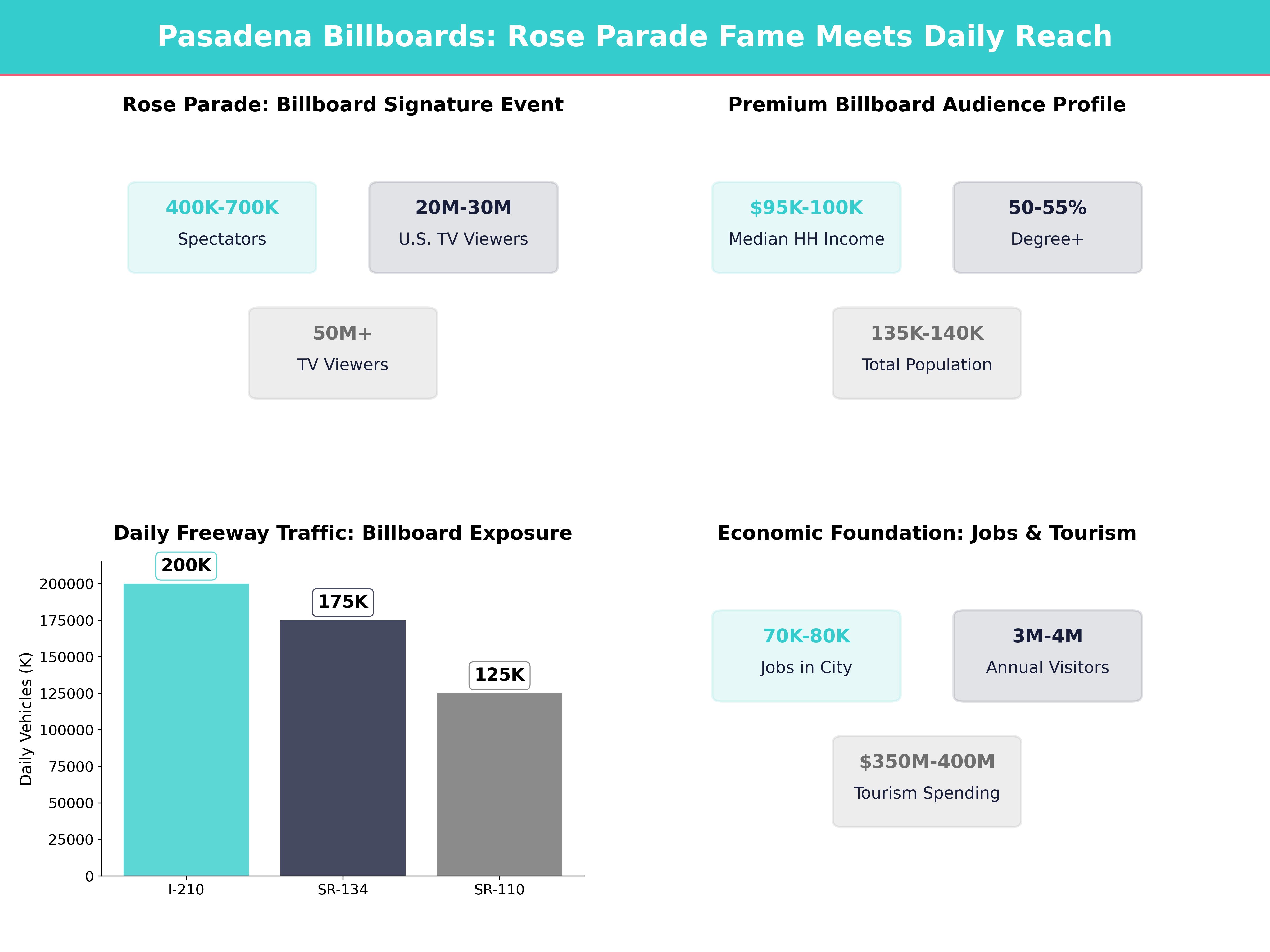
I‑210 is a prime corridor for high-reach awareness buys, with busy Pasadena-adjacent segments carrying roughly 190,000–210,000 vehicles per day. SR‑134 near Pasadena registers around 160,000–190,000 vehicles per day and over-indexes for entertainment-industry professionals and media workers. Colorado Boulevard, Lake Avenue, and Arroyo Parkway / Fair Oaks Avenue are also valuable for reaching shoppers, diners, commuters, and visitors.
What makes Pasadena, California a strong market for Blip billboard ads?
Pasadena gives us a rare combination of dense local life, national visibility, and steady tourism—all within a compact, highly drivable city. Pasadena is one of the most economically attractive midsize cities in Southern California, with a median household income in the $95,000–$100,000 range and a highly educated population. That makes Pasadena billboards especially valuable for brands that need both local depth and regional reach.
When is the best time to run Pasadena, California billboards with Blip?
Pasadena’s calendar is far from flat, so strategic timing can multiply the impact of the same budget. The Rose Parade and Rose Bowl routinely bring 400,000–700,000 visitors into Pasadena around January 1, and November–December shopping periods can send weekend foot traffic in Old Pasadena and the Playhouse District up 20–40% versus typical fall weekends. Major event days, academic enrollment periods, and holiday shopping seasons all create strong windows for campaign bursts.
How should I target Pasadena, California billboards with Blip for local audiences?
For Old Pasadena and Colorado Boulevard, the content recommends retail, dining, nightlife, attractions, hospitality, and tourism-facing services. East Pasadena and the I‑210 corridor are best for regional businesses drawing from Arcadia, Monrovia, Duarte, and the wider San Gabriel Valley, while South Pasadena and SR‑110 access are strong for commuters heading into Pasadena. Boards near medical and academic clusters are also recommended for healthcare, wellness, childcare, financial services, and student-facing products.
Do I need a contract to advertise with Blip in Pasadena?
No, Blip has no long-term contracts or minimum commitments. You can start, pause, or stop your campaign at any time.
How fast can I launch a billboard campaign with Blip in Pasadena?
You can have your campaign live in minutes. Create a free account, select your locations, set your budget, upload your design, and start running once approved.
Where can I advertise with Blip in Pasadena?
Blip has digital billboards in Pasadena. You can browse available locations on a map, choose the ones that fit your audience, and start advertising right away.
Still have questions? Launch a campaign in minutes — no contracts, no commitments.
Start Your CampaignPasadena Billboard Advertising Guide
Pasadena gives us a rare combination of dense local life, national visibility, and steady tourism—all within a compact, highly drivable city. When we plan digital billboard campaigns here, we can speak simultaneously to affluent residents, daily commuters, students and researchers, and major-event visitors who flood the streets several times a year. That makes Pasadena billboards especially valuable for brands that need both local depth and regional reach.
Understanding the Pasadena Market
Pasadena is one of the most economically attractive midsize cities in Southern California, and that shapes how we think about billboard messaging and targeting—and how we position Pasadena billboard advertising against neighboring LA markets.
-
Population & households
- The City of Pasadena reports a population in the 135,000–140,000 range within about 23 square miles, giving a density of roughly 5,800–6,000 residents per square mile—denser than most San Gabriel Valley cities and dense enough that main corridors are consistently busy.
- Pasadena has just over 55,000 households, with average household size around 2.4–2.5 people. Owner-occupied housing accounts for roughly 40–45% of units, while 55–60% are renter-occupied, which is useful for campaigns tied to leasing, moving, and home services that can be front-and-center on billboards in Pasadena.
-
Income & education
- Median household income in Pasadena is in the $95,000–$100,000 range—roughly 15–25% higher than the broader Los Angeles County median—creating above-average purchasing power for everything from healthcare to premium dining.
- Around 50–55% of residents ages 25+ hold a bachelor’s degree or higher, with more than 20% holding graduate or professional degrees. This is reinforced by institutions like Caltech, Pasadena City College, and nearby research universities.
- Higher education and income levels also mean a strong base for categories like financial services, elective healthcare, arts and culture, and sophisticated B2B offerings that benefit from sustained visibility on Pasadena billboards.
-
Employment & key institutions
- According to local economic development figures, Pasadena supports roughly 70,000–80,000 jobs within city limits, giving it a high jobs-to-residents ratio compared with neighboring cities.
- Major employers include Caltech (about 3,000+ employees), Huntington Health (an affiliate of Cedars-Sinai) with roughly 2,500–3,000 staff, Pasadena Unified School District (around 1,800–2,000 employees), and the City of Pasadena municipal workforce (about 2,000 employees).
- The Jet Propulsion Laboratory (JPL), operated by Caltech for NASA just outside city limits, adds another 6,000+ employees and contractors, and attracts thousands of visitors annually for tours, open houses, and conferences—many of whom travel through Pasadena’s key corridors.
- Professional and technical services, healthcare, education, and creative industries are heavily represented, which means a large audience of high-intent, research-oriented, and brand-sensitive consumers who respond to expertise, innovation, and proof of quality.
-
Tourism & events
- Pre‑pandemic visitor data from Visit Pasadena indicates Pasadena has hosted on the order of 3–4 million visitors annually, generating hundreds of millions of dollars in visitor spending. In strong years, tourism-related spending has exceeded $350–$400 million, supporting thousands of local jobs.
- The city’s roughly 3,000+ hotel rooms often run annual occupancies in the 75–80% range in solid tourism years, with average daily rates that can crest $180–$220 on peak nights. Occupancy and room rates spike sharply around hallmark Pasadena events, as well as during major conventions at the Pasadena Convention Center.
-
According to the Pasadena Tournament of Roses and local coverage from outlets like Pasadena Star-News and Pasadena Now:
- The Rose Parade draws an estimated 400,000–700,000 in‑person spectators to the Colorado Boulevard area each year.
- Global television audiences frequently top 20–30 million U.S. viewers and 50+ million worldwide, providing huge brand-alignment opportunities for sponsors and ambush-marketing plays.
- The Rose Bowl Game typically approaches the stadium’s capacity of about 88,500–90,000 seats, with additional tailgaters and nearby visitors who interact with the city before and after the game.
Implication for advertisers: Pasadena’s audience is relatively affluent, highly educated, and used to seeing polished marketing. We should lean into clean, sophisticated creative, sharp value propositions, and clear calls to action that feel at home in a premium environment and justify investment in Pasadena billboard advertising.
Traffic Patterns and Key Travel Corridors
To maximize impact with digital billboards, we want to intersect the most valuable flows of people.
-
Freeways
- I‑210 (Foothill Freeway): Running east–west along the north side of Pasadena, I‑210 carries heavy commuter and goods-movement traffic from the San Gabriel Valley, Inland Empire, and Glendale/Burbank. Caltrans District 7 counts show busy Pasadena-adjacent segments carrying roughly 190,000–210,000 vehicles per day, with peak weekday hours often topping 9,000–10,000 vehicles per hour in each direction. This corridor is prime for high-reach awareness buys.
- SR‑134 (Ventura Freeway): Connecting Pasadena to Glendale, Burbank, and the San Fernando Valley, SR‑134 registers around 160,000–190,000 vehicles per day near Pasadena. It over‑indexes for entertainment-industry professionals and media workers commuting to studios in Burbank and Hollywood.
- SR‑110 (Arroyo Seco Parkway): As one of the oldest freeways in the country, SR‑110 funnels vehicles from Downtown Los Angeles, Lincoln Heights, and South Pasadena directly into Pasadena. Daily volumes typically land in the 110,000–140,000 vehicles per day range through this stretch, with especially slow‑moving peak traffic that increases billboard dwell time.
-
Major surface streets
- Colorado Boulevard: As the heart of Old Pasadena and the Rose Parade route, Colorado Boulevard sees consistent vehicle traffic plus dense pedestrian activity. On typical weekends, tens of thousands of pedestrians traverse the Old Pasadena area, with peak shopping days in November–December seeing double‑digit percentage increases in foot traffic compared with off‑season months, according to Visit Pasadena and downtown merchant associations such as the Old Pasadena Management District. This is ideal for dining, retail, nightlife, and tourism campaigns that can be reinforced with well-placed billboards in Pasadena nearby.
- Lake Avenue: Lake Avenue links high-income residential neighborhoods in the south with offices, medical centers, and retail to the north and near I‑210. Daytime traffic is boosted by office workers and medical visitors; midday and early evening see strong flows for lunch breaks, appointments, and errands.
- Arroyo Parkway / Fair Oaks Avenue: These primary north–south conduits feed to and from SR‑110 and Old Pasadena. They catch a mix of commuters, local residents, and visitors headed to the historic core, making them valuable for campaigns that bridge regional and hyperlocal audiences.
-
Transit and walkability
- The LA Metro A Line (formerly Gold Line) has multiple Pasadena stops—Del Mar, Memorial Park, Lake, and Allen—bringing in riders from Downtown LA, East LA, and the San Gabriel Valley. Pre‑pandemic weekday ridership on the Gold/A Line corridor regularly climbed above 50,000+ weekday boardings, with stations like Memorial Park and Del Mar each handling thousands of riders per weekday.
- Pasadena Transit operates a network of local routes carrying thousands of riders per weekday across key commercial and residential areas. Regional services like Foothill Transit and other Arroyo Verdugo‑area buses add further coverage, feeding additional daily riders past billboard-visible corridors.
- Walkability scores in central Pasadena neighborhoods routinely fall in the 80–95 “Very Walkable to Walker’s Paradise” range, and bike scores are often 70+, supporting campaigns that rely on last‑mile walk‑up traffic.
Implication for advertisers: We can use Blip’s location controls to favor units along I‑210 and SR‑134 for regional reach (hundreds of thousands of daily impressions), and boards near Colorado and Lake for hyperlocal, purchase-intent messaging targeting shopping, dining, and entertainment. This lets billboard rental in Pasadena serve both as a broad awareness tool and a precise local driver.
Seasonality: When Pasadena Is Most “Billboard-Active”
Pasadena’s calendar is far from flat. Strategic timing can multiply the impact of the same budget.
-
New Year’s peak (Rose Parade & Rose Bowl Game)
- The Rose Parade and Rose Bowl routinely bring 400,000–700,000 visitors into Pasadena around January 1, on top of the city’s 135,000+ residents. Local hotel data shared by Visit Pasadena and coverage in outlets like LAist show citywide hotel occupancy approaching near‑sellout levels (90–100%) in the nights immediately around New Year’s, with room rates often 50–100% higher than off‑peak averages.
- Local restaurants, bars, and attractions often report double or more their typical daily revenue during parade and game days, with extended hours and special menus.
-
Blip strategy:
- Run countdown creatives (“3 days until…”, “Tomorrow: kickoff sale”) to build urgency and capture trip‑planning behavior in the 10–14 days before January 1.
- Focus on hospitality, dining, attractions, rideshare, and retail in that two‑week window, especially for businesses within 1–2 miles of the parade route or stadium.
- Target units on I‑210, SR‑134, SR‑110, and corridors leading into Old Pasadena and the Arroyo Seco areas.
-
College football & stadium events
- The Rose Bowl Stadium hosts the annual Rose Bowl Game, UCLA football home games, international soccer friendlies, AmericaFest, large‑scale music festivals, and major concerts. Many individual events draw 40,000–90,000 attendees; sellout or near‑sellout events can push 88,000+ fans plus thousands more in surrounding tailgate and viewing areas.
- Stadium event calendars can feature 20–30+ major event days per year, each generating large, predictable traffic surges on I‑210, SR‑134, and local arterials like Orange Grove, Colorado, and Arroyo.
-
Blip strategy:
- Use dayparting to concentrate impressions on event days, focusing on 3–4 hours pre‑event (arrival) and 2–3 hours post‑event (departures and after‑event plans).
- Tailor creatives to parking, rideshare, quick-service restaurants, bars, and last-minute tickets, and test “Show your ticket for X% off tonight” offers.
-
Academic year cycles
- Caltech, Pasadena City College, ArtCenter College of Design, and nearby institutions together bring on the order of 30,000–40,000 students, plus thousands of faculty and staff, to the Pasadena area from late August through early June.
- Enrollment and move‑in periods (late August to mid‑September, and again in January) reliably spike demand for housing, furnishings, electronics, and food delivery. Finals periods can trigger increased late‑night food, coffee, and wellness/mental‑health usage.
-
Blip strategy:
- Late August/early September: focus on student housing, furniture, electronics, food delivery, banking, and cell phone plans with strong call‑to‑action offers (e.g., “$0 student checking, walk‑in today”).
- Mid‑terms and finals (typically October–November and April–May): highlight cafés, study spots, tutoring, and mental health services with stress-aware messages and extended‑hours promotions.
-
Holiday and shopping seasons
- Data from downtown business groups and Visit Pasadena indicate November–December shopping periods can send weekend foot traffic in Old Pasadena and the Playhouse District up 20–40% versus typical fall weekends. Special events like tree lightings, holiday markets, and seasonal performances further boost flows.
-
Blip strategy:
- Increase frequency on Thursday–Sunday, and particularly evenings after 4 PM, when shoppers and diners are most active.
- Use offer‑driven creatives with deadlines (“This weekend only”, “Ends Sunday at 6 PM”) to nudge impulse visits and encourage cross‑shopping between nearby stores and restaurants.
Audience Segments and How to Speak to Them
Because Pasadena combines multiple high-value audiences, our creative and scheduling can be segmented for best results.
Affluent Professionals and Families
-
Characteristics:
- Many work in professional services, tech, healthcare, or academia; commute data show substantial flows between Pasadena, Downtown LA, Glendale/Burbank, and the wider San Gabriel Valley.
- Median household income in key ZIP codes like 91105, 91106, and 91107 often exceeds $100,000, with significant shares of households above $150,000.
- Frequently own homes or live in high-rent apartments and townhomes, with typical home values frequently well above $1 million in many central and hillside neighborhoods.
-
Messaging tips:
- Emphasize quality, time-saving, and trust over deep discounting. This audience often trades up when a brand feels reliable and expert.
- Headlines like “Pasadena’s Most Trusted…”, “Premium Care in Minutes from Home”, or “Upgrade Your Commute” resonate, especially when paired with professional visuals and clean typography that stand out on Pasadena billboards.
- Use clean, minimal design, with just 1–2 benefits and 1 call-to-action, since these viewers may be multitasking between navigation, calls, and traffic.
Students and Young Creatives
-
Institutions: Caltech, Pasadena City College, ArtCenter College of Design, and nearby campuses.
-
Characteristics:
- High social media usage and heavy reliance on transit, walking, and biking—ideal for billboard messages that push to mobile search or quick QR scans.
- Often budget-conscious but willing to pay for convenience, experiences, and brands that feel authentic and aligned with their values (sustainability, inclusivity, local focus).
-
Messaging tips:
- Highlight value, convenience, and community: “$5 Student Lunch Special”, “Show your ID for 10% Off”, “Free Wi‑Fi & outlets at every table.”
- Use short, bold text and clear visual hierarchy so information is legible at 55+ mph or from a transit window.
- Consider time-based messages that reflect actual late‑night behavior: “Late-night bites until 1 AM on Lake Ave.” or “Study-ready coffee until midnight.”
Visitors and Event Attendees
-
Characteristics:
- High concentration during Rose Parade, Rose Bowl events, conventions at the Pasadena Convention Center, and major concerts or festivals.
- Many stay in hotels along Colorado, Los Robles, and near the I‑210 corridor; they’re often unfamiliar with local options and rely on visible cues and simple directions.
- Visitor‑spend profiles from Visit Pasadena indicate strong spending on dining, shopping, arts/culture, and attractions, with per‑trip expenditures often higher than regional day‑trip visitors.
-
Messaging tips:
- Use directional cues: “Exit Lake Ave – 2 minutes to Old Pasadena Dining” or “Next right: Boutique shopping on Colorado Blvd.”
- Highlight parking, walkability, and unique local experiences (“Historic courtyard dining 0.5 miles ahead”, “Art & architecture tours today at 2 PM”).
- Keep URLs and QR codes short and bold; consider brand names + simple instructions (“Search ‘[Brand] Pasadena’”) since many will default to search on mobile.
Geographic Targeting Within Pasadena
Not all parts of Pasadena serve the same purpose in a campaign. We can tailor board selection to specific goals.
-
Old Pasadena & Colorado Boulevard
- Best for: Retail, dining, nightlife, attractions, hospitality, and tourism-facing services.
- This district, covered frequently by local outlets like Pasadena Now, concentrates dozens of restaurants, national retailers, and independent boutiques within a walkable grid that can see tens of thousands of visitors on peak weekends.
-
Strategy:
- Emphasize offers that can be acted on within minutes of seeing the billboard (“Park once, shop all day”, “Brunch 0.3 miles ahead”).
- Perfect for “You’re 2 minutes away from…” types of creatives and for campaigns keyed to event times (pre‑theater dinners, post‑concert drinks).
-
East Pasadena / I‑210 Corridor
- Best for: Regional businesses drawing from Arcadia, Monrovia, Duarte, and the wider San Gabriel Valley (medical, auto dealers, big-box retail, home services).
- East Pasadena retail clusters, including big-box centers near Sierra Madre Villa and Rosemead, pull customers from a 10–15 mile radius; traffic counts parallel strong regional catchment.
-
Strategy:
- Focus on destination messaging (“Worth the drive”, “Your San Gabriel Valley [category] hub”) that feels relevant to a multi-city audience.
- Daypart toward commute windows and Saturdays, when shoppers are already traveling along I‑210 for errands and big-ticket purchases.
-
South Pasadena & SR‑110 Access
- Best for: Reaching commuters from Downtown LA, Northeast LA, and South LA heading into Pasadena, along with South Pasadena residents.
- SR‑110’s constrained geometry and frequent congestion can mean longer sight lines on billboards and more time to absorb messages.
-
Strategy:
- Promote services near SR‑110 exits and central city areas (Old Pasadena, Playhouse Village, medical and civic centers).
- Use fast, benefit-first messages that cut through heavy-traffic fatigue: “Skip DTLA parking – Work in Pasadena”, “Stress-free pediatric care 5 minutes ahead.”
-
Near medical and academic clusters
- Around Huntington Health, Kaiser Permanente Pasadena Medical Offices, and campuses such as Caltech, Pasadena City College, and ArtCenter College of Design.
- Best for: Healthcare, wellness, childcare, financial services, higher-end retail, and student-facing products.
-
Strategy:
- Stress convenience, trust, and proximity (“Across from Huntington Hospital”, “5 minutes from campus”, “Same-day appointments on Lake Ave.”).
- Consider campaigns focused on specific service lines—orthopedics, urgent care, dental, dermatology—aligned with seasonal demand (sports seasons, back-to-school, allergy season).
Creative Best Practices for Pasadena Billboards
Pasadena audiences are visually sophisticated—thanks to the presence of ArtCenter and a strong design community—so we should aim for standout, uncluttered creative whenever we invest in Pasadena billboard advertising.
-
Keep it simple and premium
- Limit to 7 words or fewer when possible; studies of billboard recall often show sharp drop‑offs beyond 7–10 words.
- Use high contrast: dark text on light background or vice versa, ensuring legibility in bright Southern California sun.
- One primary visual + one short headline + one clear action (“Visit Today”, “Schedule Online”, “Exit Lake”) keeps messages scannable in 3–5 seconds at freeway speeds.
-
Localize the message
-
Reference specific landmarks, streets, or districts that appear regularly in local reporting from sources like Pasadena Star-News:
- “Steps from Colorado & Fair Oaks”
- “Next to the Playhouse District”
- “Across from Pasadena City College”
- Local references instantly increase credibility and recall, signaling that the business truly operates in Pasadena (not just “greater LA”) and making your billboards in Pasadena feel relevant, not generic.
-
Reference specific landmarks, streets, or districts that appear regularly in local reporting from sources like Pasadena Star-News:
-
Tap into Pasadena’s identity
-
Themes that work well:
- Innovation and science (Caltech, JPL, bioscience and tech firms).
- Heritage and tradition (Rose Parade, historic architecture, century‑old neighborhoods).
- Art and design (Playhouse Village, museums, Norton Simon Museum, ArtCenter).
-
Example lines:
- “Where Pasadena Innovates in [Your Category]”
- “A New Tradition Off Colorado Blvd.”
- “Science‑backed skincare, Pasadena style.”
-
Themes that work well:
-
Designing for motion and traffic
- I‑210 and SR‑134 traffic can often move at 45–65 mph; drivers typically have 3–5 seconds to process a billboard.
- Use large fonts (think 18–24 inches tall in physical size), avoid thin scripts, and ensure logos are bold and uncomplicated.
- Avoid detailed paragraphs or small disclaimers; place those on your website or landing page, not on the billboard. Use the board to drive a single clear action (search, call, exit, scan).
Using Blip’s Flexibility for Smarter Campaigns
Digital billboards in Pasadena shine when we tailor when, where, and how often ads appear.
-
Dayparting by purpose
- Morning commute (6–9 AM): Great for coffee, breakfast, healthcare reminders, and financial planning (“Schedule your checkup today”, “Refinance while rates are still low”). Freeway counts show some corridors peaking at 9,000–10,000 vehicles per hour during this window.
- Midday (11 AM–2 PM): Target lunch, retail, and quick errands—especially relevant near Colorado Blvd., Lake Ave., and medical and office clusters.
- Evening (4–8 PM): Focus on dining, events, gyms, and family services, catching commuters who decide where to eat or work out on the way home.
- Late night (after 9 PM): Emphasize delivery, nightlife, entertainment, particularly near Old Pasadena, Playhouse Village, and key hotel corridors.
-
Weather and context
- Pasadena routinely experiences 50–70 days per year with highs above 90°F, especially from June through September, according to regional climate summaries. These are strong windows for promoting indoor attractions, HVAC services, and seasonal menus (iced drinks, cold desserts).
- The San Gabriel Valley’s basin geography can lead to periodic smoggy or poor-air-quality days, which make health and HVAC campaigns (“Breathe easier at home”, “Hospital-grade filtration for Pasadena homes”) more resonant.
- Rainy days—though fewer, often 30–40 days per year with measurable precipitation—are ideal for delivery, e‑commerce, indoor entertainment, and auto care messaging.
-
Burst campaigns around events
- For Rose Parade, Rose Bowl events, major conventions at the Pasadena Convention Center, or large concerts, run short, high-frequency bursts a few days before and during the event to saturate an audience that may swell by tens of thousands of people per day.
-
Change creatives before and after the event:
- Pre-event: “Book now”, “Reserve parking”, “Plan your visit”, “Brunch before the game.”
- During/post-event: “Show your ticket for 15% off tonight”, “Extend your Pasadena stay”, “Breakfast specials for parade fans tomorrow.”
- Use geo-targeting to lean on boards along I‑210, SR‑110, and gateways into Old Pasadena and the Arroyo Seco.
-
A/B testing creatives
-
Rotate multiple designs:
- Version A: Brand-focused (“Pasadena’s [Category] Leader”, “Serving Pasadena for 25 Years”).
- Version B: Offer-focused (“$0 enrollment this week”, “Free consultation through Friday”).
-
Track which version correlates with:
- Higher web sessions from Pasadena and adjacent ZIPs.
- Increased calls or form fills.
- In-store visits or redemptions of billboard-only promo codes.
- After 2–4 weeks of data, shift more impressions to the better-performing creative and iterate with a new challenger.
-
Rotate multiple designs:
Industry-Specific Opportunities in Pasadena
Certain categories perform especially well in a market like Pasadena. We can tailor our campaigns accordingly.
Healthcare and Wellness
-
Pasadena’s older historic neighborhoods and established families create a strong base for:
- Primary care, urgent care, dental, specialty clinics (cardiology, orthopedics, dermatology).
- Fitness studios, physical therapy, chiropractic, and mental health services.
-
Within a 10‑minute drive of Huntington Health and the nearby medical clusters, the resident base numbers tens of thousands of higher-income adults, many with robust commercial insurance and Medicare coverage—ideal for elective and specialty services.
-
Strategy:
- Use reassuring, expertise-focused headlines: “Board-Certified Care 5 Minutes from Old Pasadena”, “Same-Day Urgent Care by Huntington.”
- Target boards near Huntington Health, along I‑210, and on major surface streets feeding medical offices (Lake, Fair Oaks, Arroyo).
- Time campaigns around open enrollment (October–January), flu season (roughly October–March), and back-to-school months (August–September) when families are especially health‑focused.
Education and Enrichment
-
With a highly educated population and strong school expectations, demand is high for:
- Private schools, tutoring, test prep, college counseling.
- STEM programs, coding camps, robotics clubs, arts and music classes.
-
Pasadena-area families invest heavily in enrichment; in affluent ZIPs, annual spending on children’s activities can easily reach four figures per child, supporting robust after‑school and weekend programs.
-
Strategy:
- Run heavier from July–October (back-to-school and enrollment windows) and again in January for spring term enrollments.
- Use parent-focused headlines: “Raise Their Score, Lower Their Stress”, “From C’s to A’s on Colorado Blvd.”
- Focus on boards near residential areas and school corridors, including routes used by Pasadena Unified School District buses and major private schools.
Home Services and Real Estate
-
High home values and aging housing stock mean strong ongoing demand for:
- Remodeling, roofing, solar, HVAC, landscaping, and historic-home specialists.
- Real estate brokerage, mortgage lending, staging, and property management.
-
Median home values in many Pasadena neighborhoods are well above $1 million, and a significant share of homes are over 70–100 years old, driving continual need for maintenance and upgrades.
-
Strategy:
- Position your business as the local Pasadena expert: “Historic-home specialists since 2005”, “Pasadena Craftsman restoration pros.”
- Use weather and seasonal cues (“Get summer-ready AC before July heat”, “Roof inspections before the rainy season starts.”).
- Target commuters who live in Pasadena but work elsewhere—especially on I‑210 and SR‑134—using messages like “Your Pasadena electrician, home by 6 PM.”
Dining, Retail, and Entertainment
-
Old Pasadena, the Playhouse District (also known as Playhouse Village), and East Pasadena host a dense mix of:
- Restaurants, bars, boutiques, galleries, music venues, and performance spaces like the Pasadena Playhouse.
-
Event nights, including theater performances and museum events, can push restaurant and bar occupancy to near capacity in central districts, as highlighted in local coverage by Pasadena Now and Pasadena Star-News.
-
Strategy:
- Promote time-sensitive offers: “Happy hour 4–6 PM on Colorado Blvd.”, “Post‑Playhouse dessert special until 11 PM.”
- Highlight unique experiences over generic claims: “Rooftop views of the San Gabriels”, “Jazz in a 1920s courtyard”, “Craft cocktails steps from Memorial Park Station.”
- Run heavier on Thursday–Sunday, when nightlife and weekend shoppers surge; consider micro‑bursts keyed to curtain times (e.g., 6–8 PM before shows).
Measuring Success and Refining Over Time
To get the most from Pasadena billboards, we should treat campaigns as ongoing experiments.
-
Define clear goals early
-
Are we driving:
- In-store visits in Old Pasadena or East Pasadena centers?
- Website traffic from Pasadena ZIP codes (e.g., 91101, 91103, 91105, 91106, 91107) and adjacent cities (South Pasadena, Altadena, San Marino)?
- Phone calls, appointment bookings, or event registrations?
-
Are we driving:
-
Use simple tracking tactics
- Billboard-only promo codes: “Mention PASADENA10” or “Show this code for free dessert.”
- Short, memorable URLs: “BrandNamePasadena.com” or “Visit[Brand].com/Pasadena.”
- Dedicated phone numbers or text short codes reserved for billboard campaigns.
-
Correlate with local data
- Compare site traffic, calls, or sales from Pasadena and nearby ZIPs during active billboard windows vs. baseline periods. Look for percentage lifts (e.g., “+25% website sessions from 91101 in the two weeks after launch”).
- Note spikes around specific date ranges when you changed creatives, boards, or dayparts, and map them against local event calendars from Visit Pasadena or coverage in LAist.
- For physical locations, track same‑store sales or foot traffic counts (door counters, POS data) before and after campaigns go live.
-
Iterate by geography
- If boards along I‑210 drive more web visits but less in-store traffic, treat them as brand awareness and regional reach tools and measure success via digital engagement and long‑term brand lift.
- If boards near Old Pasadena or Playhouse Village correlate with immediate sales bumps, shift more budget toward action-oriented promotions in that zone and refine offers based on redemption patterns.
- Over time, build a simple internal map of “high-response corridors” vs. “brand-building corridors” in Pasadena and allocate spend accordingly so your billboard rental in Pasadena aligns with clear performance roles.
Leveraging Pasadena’s Unique Character
Pasadena is more than just a suburb of Los Angeles—it’s a self-contained city with a strong identity. When we build campaigns here, we tap into:
- A population that values heritage, design, and innovation, with over half of adults holding college degrees and median incomes near or above $100,000 in many areas.
- Consistent inflows of visitors and event attendees—from the 400,000–700,000 people who pack the city for the Rose Parade and Rose Bowl each New Year’s to the thousands of convention-goers passing through the Pasadena Convention Center.
- High-value professionals and families who are ready to spend on services, experiences, and quality brands, and who respond to marketing that respects their time and intelligence.
By combining thoughtful geographic targeting, seasonally aware scheduling, and clean, localized creative, we can use digital billboards through Blip to become part of Pasadena’s daily rhythm—from the morning commute on I‑210 and SR‑134 to evening strolls along Colorado Boulevard and nights out in Old Pasadena and Playhouse Village. Done well, Pasadena billboard advertising turns these everyday journeys into consistent touchpoints that build familiarity, trust, and measurable results.