Billboards near Diamond Bar, CA
No Minimum Spend. No Long-Term Contracts. Just Results.
Trusted by Leading Brands


Billboard advertising
near Diamond Bar has never been easier




How much is a billboard near Diamond Bar?
Why Choose Blip for Billboard Advertising near Diamond Bar
Blip lets you launch fast on Diamond Bar's SR-57/SR-60 commute corridors with self-serve control—no agency delays, just instant live campaigns.
Set a flexible budget for Diamond Bar and scale up during weekday rush or weekend shopping trips near Puente Hills Mall, all without long-term contracts.
Use dayparting in Diamond Bar to hit 6:30-9 a.m. westbound commuters and 4-7 p.m. return traffic, when the 57/60 interchange slows and eyes stay on your ad.
Track Diamond Bar billboard performance in real time, then shift spend toward City of Industry, Covina, or La Puente when the data shows stronger response.
Blip's creative tools make it easy to swap in bilingual, family-focused ads for Diamond Bar's Asian-majority audience and tie them to Lunar New Year or back-to-school.
Frequently Asked Questions About Billboard Advertising near Diamond Bar
How much does a billboard cost near Diamond Bar, California with Blip?
With Blip, you control exactly what you spend on Diamond Bar billboards by setting a daily budget that can be adjusted anytime, so you can start small and scale up as you go. Each ad “blip” is a brief 7.5–10 second display on digital billboards near Diamond Bar, California, and you only pay for the individual blips you receive. Costs vary based on when and where your ads run and on advertiser demand, so your total spend is simply the sum of all those blips over time.
Where can I advertise with Blip near Diamond Bar, California?
We have 8 digital billboards serving the Diamond Bar area, all within roughly 10 miles, strategically positioned in City of Industry, Covina, and La Puente. These nearby cities are tightly interlinked through commuting and shopping patterns, so boards in these locations effectively reach residents and workers in the Diamond Bar area throughout the day. For advertisers comparing Diamond Bar billboards with placements in immediately adjacent cities, this cluster functions as one continuous, high-frequency coverage zone.
Why are Diamond Bar billboards with Blip a good fit for commuters?
Diamond Bar sits at the crossroads of major regional commuting routes in eastern Los Angeles County, making the Diamond Bar area a high-value market for digital billboard advertisers. Diamond Bar’s location at the junction of SR-57 and SR-60 means many residents commute west to job centers such as City of Industry, downtown Los Angeles, and Pasadena. Morning and evening peak traffic create repeated daily exposure, which makes commuter-focused billboard advertising near Diamond Bar especially efficient.
What kind of audience do Diamond Bar billboards reach?
Diamond Bar is a largely residential, upper-middle-income community in the eastern San Gabriel Valley. The community is highly educated, with roughly 50–55% of adults 25+ holding a bachelor’s degree or higher, and over 60% of residents identifying as Asian. Owner-occupied housing typically accounts for 70–75% of occupied homes, signaling long-term, stable residents and strong neighborhood ties.
When is the best time to run Diamond Bar billboards with Blip?
Morning (6:30–9:00 a.m.) is best for coffee shops, breakfast spots, transit and rideshare promotions, urgent services, and brand awareness. Evening (4:00–7:00 p.m.) is great for restaurants, grocery, gyms, entertainment, and home services, while weekends are strong for retail, entertainment venues, open houses, and local events. Because Blip lets us buy digital billboard “blips” in flexible segments, we can align your spend with the Diamond Bar area’s real-world rhythms.
Do I need a contract to advertise with Blip near Diamond Bar?
No, Blip has no long-term contracts or minimum commitments. You can start, pause, or stop your campaign at any time.
How fast can I launch a billboard campaign with Blip near Diamond Bar?
You can have your campaign live in minutes. Create a free account, select your locations, set your budget, upload your design, and start running once approved.
Where can I advertise with Blip near Diamond Bar?
Blip has digital billboards near Diamond Bar. You can browse available locations on a map, choose the ones that fit your audience, and start advertising right away.
Still have questions? Launch a campaign in minutes — no contracts, no commitments.
Start Your CampaignDiamond Bar Billboard Advertising Guide
Diamond Bar sits at the crossroads of major regional commuting routes in eastern Los Angeles County, making the Diamond Bar area a high‑value market for digital billboard advertisers. With 8 digital billboards near Diamond Bar in City of Industry La Puente, we can tap into dense daily traffic on the SR‑60, I‑10, and surrounding arterials to reach affluent suburban households, commuters, and local shoppers at scale. For brands looking for flexible billboard advertising near Diamond Bar, these locations create a powerful, interconnected coverage net across everyday driving routes.
Understanding the Diamond Bar Area Market
Diamond Bar is a largely residential, upper‑middle‑income community in the eastern San Gabriel Valley. According to recent city and regional estimates compiled from local planning and economic development reports:
- Diamond Bar’s population is approximately 55,000–57,000 residents, with the City of Diamond Bar frequently citing figures just over 55,000 in its planning documents.
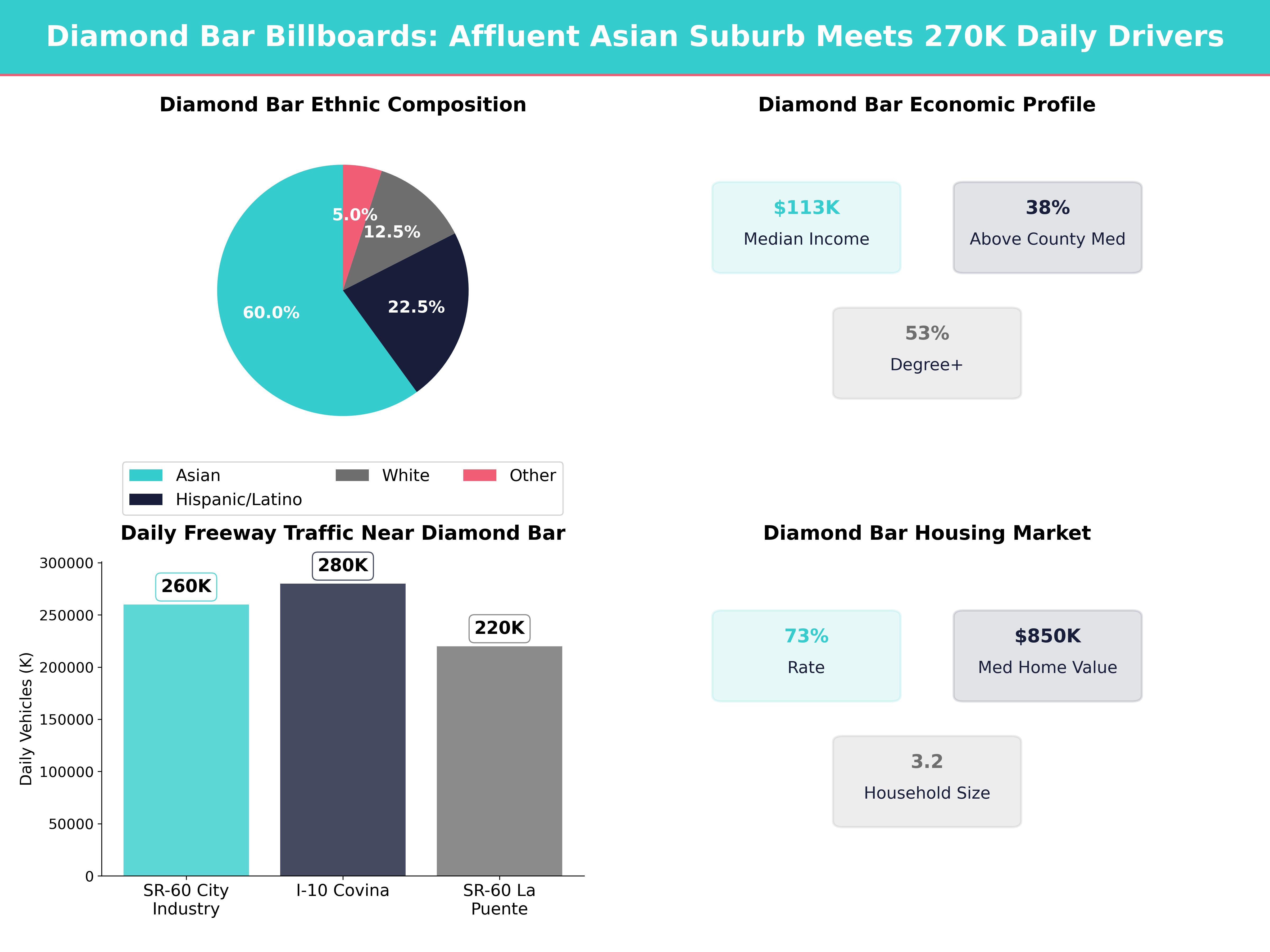
- Median household income is high for Los Angeles County, estimated around $110,000–$115,000 per year—roughly 35–40% higher than the countywide median.
- The community is highly educated: roughly 50–55% of adults 25+ hold a bachelor’s degree or higher, compared with about one‑third of adults countywide.
- The city reports that over 60% of residents identify as Asian (predominantly Chinese, Korean, and Filipino), with Hispanic/Latino residents typically around 20–25%, and non‑Hispanic White residents around 10–15%.
- Average household size in Diamond Bar is about 3.1–3.3 persons per household, higher than the national average and consistent with family‑oriented suburbs.
- Owner‑occupied housing typically accounts for 70–75% of occupied homes, signaling long‑term, stable residents and strong neighborhood ties.
Local government and community data can be explored through the City of Diamond Bar and the city’s Economic Development lacounty.gov
What this means for advertisers:
- Higher disposable income supports campaigns for financial services, education, autos, home improvement, travel, healthcare, and premium consumer products, especially in the $75,000+ income households that make up a majority of the area.
- A large commuter population—many with average commute times in the 30–40 minute range—traveling to Los Angeles, the San Gabriel Valley, and Orange County makes commute‑time messaging on billboards near Diamond Bar extremely valuable.
- Multilingual and culturally aware creative (English with optional Chinese or Korean call‑outs) can strongly resonate in the Diamond Bar area, where Asian‑language media consumption and bilingual households are common.
Where Our Boards Reach the Diamond Bar Area
We have 8 digital billboards serving the Diamond Bar area, all within roughly 10 miles, strategically positioned in:
-
City of Industry (about 3.2 miles from Diamond Bar)
- Heavy traffic on SR‑60 (Pomona Freeway) and major commercial corridors around the City of Industry civic area
- Recent Caltrans corridor data show segments of SR‑60 in this area carrying roughly 250,000–270,000 vehicles per day (average annual daily traffic, AADT), with truck volumes often in the 8–12% range because of the city’s industrial base.
-
Covina (about 5.7 miles from Diamond Bar)
- Access to I‑10 and major arterials drawing commuters between the San Gabriel Valley and the Inland Empire, including traffic feeding into Downtown Covina
- I‑10 in the Covina area typically carries 260,000–300,000 vehicles per day, with peak‑hour flows exceeding 12,000 vehicles per hour in each direction on the busiest segments.
-
La Puente (about 7.2 miles from Diamond Bar)
- Additional access to SR‑60 and dense neighborhood traffic, with daily volumes often above 220,000 vehicles on nearby freeway segments and significant spill‑over onto arterials leading to La Puente’s commercial corridors.
Because these nearby cities are tightly interlinked through commuting and shopping patterns—Los Angeles County travel surveys show that over half of weekday trips by local residents cross city boundaries—boards in City of Industry, Covina, and La Puente effectively reach residents and workers in the Diamond Bar area throughout the day. For advertisers comparing Diamond Bar billboards with placements in immediately adjacent cities, this cluster functions as one continuous, high‑frequency coverage zone.
For broader regional context and transportation initiatives that influence traffic flow, advertisers can reference Los Angeles County’s transportation resources via LA Metro lacounty.gov dot.ca.gov/d7.
Commuter Patterns and Traffic Hotspots
Diamond Bar’s location at the junction of SR‑57 (Orange Freeway) and SR‑60 makes it a classic bedroom community, with many residents commuting west to job centers such as City of Industry downtown Los Angeles, and Pasadena
Regional travel surveys and corridor studies in eastern Los Angeles County highlight:
- A large share of residents working outside their home city, often traveling 10–25 miles each way.
- SR‑57 and SR‑60 interchange segments where peak‑hour speeds can drop below 25 mph, increasing dwell time in view of digital billboards.
- Weekday peak‑period traffic volumes in excess of 220,000 vehicles per day through the 57/60 interchange influence area.
Key traffic insights:
-
Morning peak (approx. 6:30–9:00 a.m.)
- Heavy westbound traffic on SR‑60 toward City of Industry and central LA, with some studies noting 60–65% of vehicles traveling westbound during the morning peak on certain segments.
- Many Diamond Bar residents pass through or near our City of Industry and La Puente billboard locations, offering repeated daily exposure and making commuter‑focused billboard advertising near Diamond Bar especially efficient.
-
Evening peak (approx. 4:00–7:00 p.m.)
- Reverse flow as commuters head back toward Diamond Bar, Walnut, Rowland Heights, and Chino Hills. Evening directional splits often show 55–60% eastbound traffic in this window.
- This is ideal for branding campaigns and reminders for local services, dining, and retail, especially impulse‑oriented calls‑to‑action.
-
Weekend patterns
- Strong traffic to regional shopping destinations such as Puente Hills Mall, the City of Industry business/retail zones, and dining corridors in the San Gabriel Valley. Puente Hills Mall alone reports millions of visits annually, with weekend days often accounting for 35–40% of weekly foot traffic.
- Weekend mid‑day impressions (11:00 a.m.–3:00 p.m.) can be especially productive for family‑oriented, retail, entertainment, and restaurant campaigns, when many households combine errands, dining, and leisure trips.
Local news outlets like the San Gabriel Valley Tribune and ABC7 Los Angeles often highlight traffic, construction, and commuting trends in the area; these can inform when you should increase or decrease your digital billboard presence. For incident‑driven spikes or slowdowns, California Highway Patrol traffic updates and LA County emergency alerts
Demographics and How They Shape Your Message
The Diamond Bar area has a distinctive demographic mix that should inform both creative and scheduling:
-
Affluent suburban families
- High homeownership and larger household sizes (many homes with 3–4+ members), with a significant share of married‑couple families with children.
- In many Diamond Bar neighborhoods, median home values exceed $800,000–$900,000, and new listings frequently cross the $1 million mark, signaling strong capacity for big‑ticket spending.
- Strong audience for financial services, college prep, extracurricular education, automobiles (including EVs and luxury brands), and home services.
-
Asian‑majority community
- With roughly 60% of residents of Asian descent, brands that understand and reflect local culture can stand out.
- Local Asian grocery chains, restaurants, and services draw customers from across the San Gabriel Valley; some individual centers report weekend parking utilization above 90%, proving the pull of culturally relevant businesses.
- Simple bilingual elements (e.g., an English headline with a short Chinese or Korean sub‑line) can signal cultural relevance and improve ad recall among bilingual households.
-
Young professionals and students
- Proximity to institutions like Mt. San Antonio College (serving 25,000–30,000+ credit students each term), Cal Poly Pomona (with roughly 25,000–27,000 students), and other nearby campuses means the region captures a sizable young adult audience.
- Many students commute via SR‑57 and SR‑60 corridors, creating daily repeated exposures.
- Campaigns for tech, telecom, food delivery, nightlife in nearby cities, and education services perform well with this group.
Implications for your creative:
- Use clean, premium design that matches an upper‑income suburban aesthetic; studies on digital OOH readability consistently show that creative with fewer elements and high contrast can raise recall by up to 20–30% versus cluttered designs.
- Highlight value plus quality, not just low price: e.g., “Premium orthodontics close to Diamond Bar” or “Upgrade your family SUV this weekend,” which align with households frequently spending on vehicles, education, and home upgrades.
- Consider using familiar local references, such as “Near the 57/60 interchange,” “Minutes from Diamond Bar,” or “Serving the San Gabriel Valley,” to help audiences immediately place your business. Location‑based cues have been shown to increase intent‑to‑visit by 10–20% in OOH brand‑lift studies and are particularly effective when used on Diamond Bar billboards that target nearby neighborhoods.
Local Economy and Business Opportunities
The Diamond Bar area’s economic gravity is reinforced by surrounding job centers:
- City of Industry is an employment powerhouse with roughly 60,000–70,000 jobs but fewer than 1,000 residents, according to local economic reports—a 60:1+ jobs‑to‑residents ratio. It hosts large concentrations of logistics, manufacturing, and wholesale trade, with many workers driving in from Diamond Bar, Walnut, and other neighborhoods every day.
- Retail clusters and restaurant corridors in Rowland Heights Walnut, Hacienda Heights Covina
- Within Diamond Bar itself, the Diamond Bar Town Center and retail areas
Advertisers can leverage this:
-
B2B and workforce campaigns
- Recruit employees for logistics, warehouse, manufacturing, or professional roles with boards near City of Industry, where industrial parks operate multiple shifts and often advertise wages in the $18–$30/hour range.
- Promote staffing agencies, training programs, or trade schools with commute‑time messaging aimed at the tens of thousands of daily workers entering and leaving the area.
-
Retail and service campaigns
- Use boards near La Puente and Covina to drive shoppers to nearby malls, auto dealers, and specialty grocers that Diamond Bar area residents frequent. Regional retail trade areas often extend 5–10 miles, comfortably encompassing Diamond Bar, Rowland Heights, and Walnut.
- Auto corridors along major arterials can see thousands of car shoppers per week, especially around holiday and year‑end sales events.
-
Healthcare and education
- High‑income, family‑oriented households respond well to campaigns for medical specialists, dental services, tutoring, and test prep located within a 10–15 minute drive—a distance many local residents report as their preferred radius for recurring services.
- Pediatric, vision, and dental practices that emphasize convenience and quality often see higher conversion when their location is clearly tied to familiar local landmarks and freeway exits.
The City of Diamond Bar’s Business Resources Los Angeles County Economic Development Corporation San Gabriel Valley Economic Partnership.
Timing Your Blips for Maximum Impact
Because Blip lets us buy digital billboard “blips” in flexible segments, we can align your spend with the Diamond Bar area’s real‑world rhythms. Traffic studies in similar suburban freeway corridors show that concentrating spend in peak periods can increase effective impressions by 20–40% without increasing total budget. This flexibility makes it easy to treat our inventory of billboards near Diamond Bar as an on‑demand channel you can dial up or down throughout the week.
- Commuter‑Focused Campaigns
-
Morning (6:30–9:00 a.m.)
- Best for coffee shops, breakfast spots, transit and rideshare promotions, urgent services (urgent care, dental emergencies), and brand awareness.
- This period can account for 25–30% of weekday freeway traffic volumes; capturing it ensures daily repeated exposure.
- Ideal for messages like “Call before 10 a.m. for same‑day service” or “Order before work and pick up tonight.”
-
Evening (4:00–7:00 p.m.)
- Great for restaurants, grocery, gyms, entertainment, and home services (plumbers, HVAC, contractors).
- Many households make same‑day decisions about dinner and errands during this window, and OOH studies suggest evening drive‑time can generate higher immediate response rates for food and retail offers.
- Use calls‑to‑action such as “Tonight only,” “Book while you’re on your way home,” or “Weekend sale starts Friday.”
- Family and Student Windows
-
After‑school and early evening (3:00–6:00 p.m.)
- Target parents shuttling kids to sports, tutoring, and activities. Local recreation guides indicate strong youth participation in club sports, music, and academic enrichment, with many families making 2–3 after‑school trips per week.
- Promote tutoring centers, music schools, martial arts, and youth sports organizations.
-
Weekends (10:00 a.m.–4:00 p.m.)
- Strong for retail, entertainment venues, open houses, and local events. Retail analytics often show weekend mid‑day hours generating 30–40% of weekly in‑store traffic for family‑oriented businesses.
- Date‑Driven and Seasonal Scheduling
-
Lunar New Year, Mid‑Autumn Festival, and other cultural holidays
- Brands that tailor creative and timing to major Asian holidays can connect authentically with much of the Diamond Bar area audience. Many local shopping districts report double‑digit percentage increases in sales around these holidays.
- Consider adding festive imagery, greetings in Chinese or Korean, and limited‑time offers.
-
School year milestones (back‑to‑school in August/September, exam seasons, graduations)
- Prime times for education, tutoring, and extracurricular campaigns. Local schools and colleges see spikes in enrollment activities from late July through early October and again from January through March.
- Align heavier blip schedules with these enrollment periods.
-
Real estate cycles
- Spring and early summer often see increased home buying and moving; real‑estate and mortgage activity can rise 15–25% over winter levels in many Southern California suburbs.
- A strong time to push real‑estate, mortgage, and home‑services messaging, with directional cues such as “Open House This Weekend – Near Diamond Bar.”
We can use Blip’s scheduling tools to adjust bids and frequency around these patterns, ensuring your budget is most active when your audience is.
Creative Best Practices for the Diamond Bar Area
To stand out on busy corridors near the Diamond Bar area, artwork must communicate quickly and clearly. Industry research on digital out‑of‑home shows that ads with simple layouts and clear calls‑to‑action can improve message recall by up to 30% compared to more complex designs.
- Clarity and Minimal Text
- Aim for 6–10 words total plus your logo and a short URL or phone number; drivers typically have 5–8 seconds to process your message at freeway speeds.
- Use large, high‑contrast fonts; avoid script fonts or cluttered backgrounds.
- Include a single main call‑to‑action, such as “Exit at Grand Ave,” “Schedule Online,” or “Visit This Weekend.”
- Local and Directional Cues
Diamond Bar area drivers respond well when they immediately know relevance and proximity:
- Use phrases like “10 minutes from Diamond Bar,” “Near the 57/60,” or “Serving the Diamond Bar area.”
- If your business is in nearby cities like Walnut, Rowland Heights (unincorporated but commonly referenced in local media), or Chino Hills
- Directional cues and distance markers have been shown to increase visit intent and navigation app searches by 10–20% in OOH attribution studies, particularly when used on Diamond Bar billboards that are part of a broader, multi‑location campaign.
- Culturally Attuned Messaging
- Consider light use of Chinese or Korean text where appropriate, especially for family‑oriented or community‑focused services.
- Visuals that reflect local families, students, and professionals can make your brand feel “from here,” even if it’s not.
- Community‑oriented messages (e.g., congratulating local schools or supporting neighborhood events) can improve brand favorability metrics by 5–15 percentage points in follow‑up surveys.
- Multiple Variants
With digital boards, it’s easy to rotate creative:
-
Run at least 2–3 variations:
- One brand‑heavy (“Trusted Dentist for Diamond Bar Families”)
- One offer‑heavy (“Free Whitening with New Patient Exam”)
- One event‑ or season‑specific (“Back‑to‑School Checkups Available”)
- Campaigns that test multiple creatives and optimize to top performers typically see 15–25% lower cost per response than single‑creative campaigns.
- Use Blip’s tools to A/B test different headlines or images, then invest more in the best‑performing versions.
Using Blip’s Targeting Tools Around Diamond Bar
Blip’s flexible platform pairs naturally with the structure of the Diamond Bar area and makes it easy to manage billboard rental near Diamond Bar without long‑term contracts:
-
Geographic precision
- Concentrate impressions on our boards in City of Industry and La Puente during weekday rush hours if you want to focus on Diamond Bar commuters.
- Add Covina boards to reach a broader San Gabriel Valley footprint, especially for regional businesses drawing customers from multiple cities within a 10–15 mile radius.
-
Budget control
- Start with modest daily budgets (for example, testing in the $10–$30/day per board range) and scale based on performance, adjusting bids higher during your best time windows.
- Historical Blip user patterns show that concentrating spend into peak 4–6 hour windows can increase on‑target impressions without increasing total spend.
-
Day‑parting
- Use day‑parting to avoid paying for low‑value impressions (e.g., overnight for a daytime retail store) and focus on hours when your target customers are actually on the roads.
- For service businesses, day‑parting can improve response rates by 10–20% by aligning messaging with decision windows.
-
Flighting campaigns
- For events or promotions, consider a “burst” strategy: heavy blips for 7–10 days before the event (e.g., an open house or major sale), then taper off after.
- Short, high‑intensity flights are especially effective for grand openings, holiday sales, and ticketed events.
Pair your billboard activity with trackable elements (unique URLs, QR codes large enough to be scanned at low speeds, or dedicated phone numbers) so you can connect spikes in site traffic or calls with your Blip flights. Many advertisers report that campaigns with clear tracking elements see 2–3x better measurability and more confident budget scaling decisions.
Aligning With Local News, Events, and Community Life
Staying in tune with local happenings helps your message feel timely and relevant:
-
Follow local outlets like the San Gabriel Valley Tribune, KTLA 5 Spectrum News 1 SoCal to anticipate:
- Road construction that might shift traffic patterns, such as lane closures on SR‑57 or SR‑60 discussed in regional transportation coverage.
- Local sports runs, festivals, or street fairs drawing visitors; some city events can attract 1,000–5,000+ attendees, boosting nearby traffic.
- Economic or education news that may alter consumer sentiment or drive interest in specific sectors (e.g., housing, jobs, or school performance).
-
Check the City of Diamond Bar Events Calendar for:
- City festivals, concerts in the park, and cultural events held at popular venues like Sycamore Canyon Park Diamond Bar Center.
- Community meetings or initiatives that your brand could support or reference, such as public safety campaigns or environmental clean‑ups.
-
Tie promotions to:
- Local school events (football games, graduations, back‑to‑school nights) through the Walnut Valley Unified School District
- Holiday seasons (Thanksgiving, Christmas, Lunar New Year, summer travel), when discretionary spending in categories like retail, dining, and travel can rise 20–40% compared with off‑season weeks.
Use Blip to rapidly update creative when something timely emerges—such as “Congrats Diamond Bar Class of 20XX” or “Celebrate Lunar New Year With Us in Rowland Heights”—so your brand stays relevant and present in the community conversation. Digital OOH’s fast‑refresh capabilities mean you can swap or add messages within hours, not weeks, across multiple Diamond Bar billboards and nearby placements.
Example Campaign Strategies for the Diamond Bar Area
To make the Diamond Bar area context more concrete, here are a few campaign blueprints that show how to use billboards near Diamond Bar effectively:
- Local Family Restaurant Expansion
- Objective: Drive Diamond Bar area families to a restaurant in City of Industry or Walnut.
-
Tactics:
- Focus spend on evening and weekend hours on boards in City of Industry and La Puente, when family dining trips are highest; restaurant analytics often show 50–60% of weekly revenue concentrated in these windows.
- Creative: “Family Dinner 10 Minutes from Diamond Bar – Kids Eat Free Sun–Thu.” Consider including a short Chinese or Korean line on a second creative.
- Rotate a second creative during major cultural holidays with themed imagery and limited‑time menus.
- Track reservations or redemptions tied to a unique URL or promo code mentioned only on billboards.
- Tutoring Center in the San Gabriel Valley
- Objective: Attract K‑12 students from Diamond Bar, Walnut, and Rowland Heights.
-
Tactics:
- Concentrate on after‑school hours (3:00–7:00 p.m.) on weekdays, which align with the peak school dismissal and activity window.
- Increase bids in August–September and January–March (back‑to‑school and test prep peaks) when demand for tutoring can rise 20–30%.
- Creative: “Top Scores Start Here – Math & SAT Prep Near Diamond Bar,” with a clear “Enroll This Week” call‑to‑action.
- Align messaging with local test dates and academic calendars posted by districts like Walnut Valley Unified
- Healthcare Specialist (Dental, Orthodontics, or Vision)
- Objective: Build brand trust and appointment volume from affluent families.
-
Tactics:
- All‑day presence at moderate bids with heavier morning/evening pushes to mirror commuting patterns and school drop‑offs.
- Use a mix of brand‑focused creative (“Trusted Orthodontist for Diamond Bar Families”) and offer‑based creative (“0% Financing • Free Consultation”).
- Add clear location cues: “Grand Ave & [Street] – Serving the Diamond Bar area.”
- Many practices see new‑patient growth of 10–20% within the first few months of consistent OOH exposure when paired with online retargeting.
- Regional Auto Dealer
- Objective: Draw buyers from across the Diamond Bar area and broader San Gabriel Valley.
-
Tactics:
- Run daily during commute times and weekends; add flighted pushes for holiday sales (Memorial Day, Labor Day, year‑end), when auto sales can spike 20–40% over typical weeks.
- Creative variants: “0.9% APR This Weekend Only” and “Hybrid & EVs in Stock – 15 Min from Diamond Bar,” highlighting inventory and urgency.
- Use boards in City of Industry, Covina, and La Puente to blanket main approach routes from the 57, 60, and 10 freeways.
- Incorporate unique URLs or dedicated phone numbers to measure lead volume attributable to billboard exposure.
By combining Diamond Bar area–specific knowledge—demographics, commuting patterns, cultural dynamics—with Blip’s flexible, data‑driven tools for billboard rental near Diamond Bar, we can craft campaigns that reach the right drivers, at the right moments, with messages that truly resonate and deliver measurable results for your business.