Billboards near West Sacramento, CA
No Minimum Spend. No Long-Term Contracts. Just Results.
Trusted by Leading Brands


Billboard advertising
near West Sacramento has never been easier
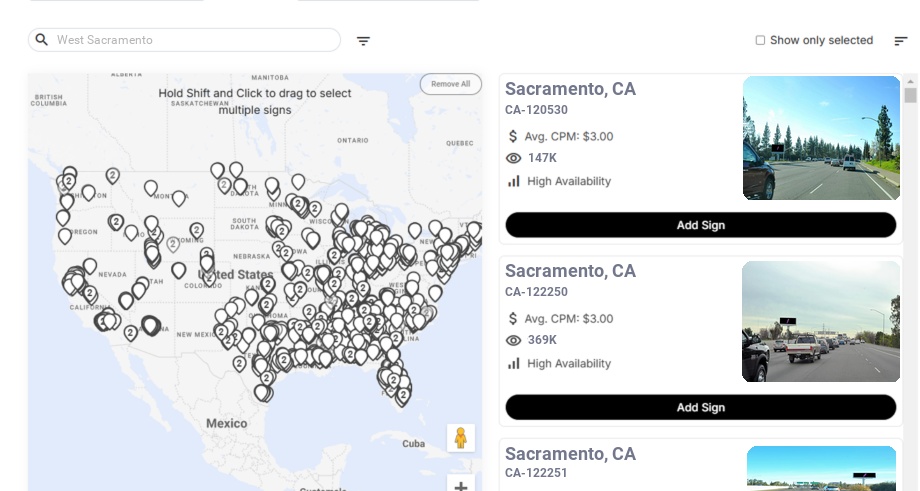



How much is a billboard near West Sacramento?
Why Choose Blip for Billboard Advertising near West Sacramento
Blip lets West Sacramento launch billboards fast on I-80, US-50, and I-5, reaching daily commuters without a long setup.
Set flexible budgets in West Sacramento and scale up for Kings nights, River Cats games, or Capitol rushes—only pay for the exposure you want.
Daypart your West Sacramento ads for 6–9 a.m. commutes or 3:30–7 p.m. returns, when freeway traffic is heaviest.
No contracts make West Sacramento ideal for testing against state workers, families, and logistics traffic across the river.
Blip's real-time analytics show which West Sacramento corridor and time slot drives the most response, so you can adjust fast.
Use Blip's creative tools to run bold, simple ads for West Sacramento's diverse, multilingual audience and high-speed freeway views.
Frequently Asked Questions About Billboard Advertising near West Sacramento
How much does a billboard cost near West Sacramento, California with Blip?
With Blip, you control exactly how much you spend on West Sacramento billboards by setting a daily budget that can be adjusted anytime, so you only pay for the exposure you actually receive. Each "blip" is a 7.5 to 10-second display on digital billboards near West Sacramento, California, and the price of each blip depends on when and where you choose to advertise, as well as current advertiser demand. The total cost of reaching people in the West Sacramento area is simply the sum of all your blips over time, making it easy to scale your campaign up or down as needed.
Where can I advertise with Blip near West Sacramento, California?
Our four digital billboards in nearby Sacramento serve the West Sacramento area and are positioned along corridors that heavily serve local traffic. They typically intercept Interstate 80, U.S. Route 50, Interstate 5, and local arterials and bridges serving the West Sacramento area. With digital billboards located roughly 6–10 miles from the West Sacramento area, your campaign can reach daily commuters, regional travelers, and suburban shoppers traveling through central freeway segments.
Who do West Sacramento billboards reach in the West Sacramento area?
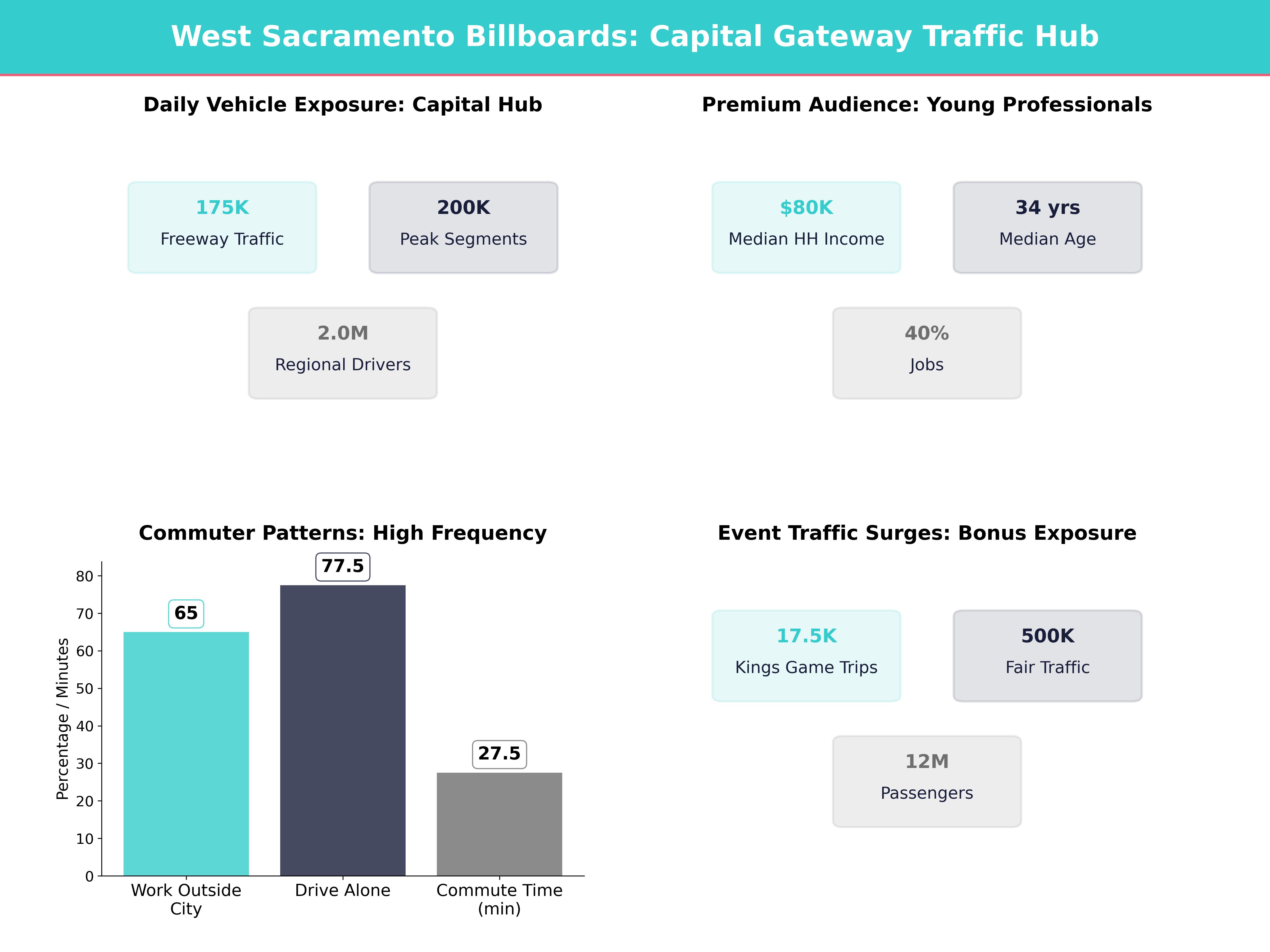
West Sacramento sits at the crossroads of state government, logistics, and fast-growing residential neighborhoods, making it one of the most strategic out-of-home markets in the Sacramento Valley. The audience includes commuters, families, state workers, and visitors moving along some of Northern California’s busiest corridors. The area’s median age is around 33–35 years, and median household income is in the $75,000–$85,000 range, depending on specific neighborhoods and sources.
When is the best time to run Blip ads near West Sacramento, California?
Traffic counts from Caltrans and regional transportation studies consistently show that peak-period volumes on I-5, I-80, and US-50 can be 30–40% higher than mid-day levels. Morning commute, midday lunch traffic, and evening commute are all strong dayparts near West Sacramento. Weekend late morning to afternoon and Friday and Saturday evening are also valuable for shopping, dining, and entertainment campaigns.
Why are billboards near West Sacramento, California effective for local brands?
A large share of adults living in the West Sacramento area commute across the river for work, shopping, and events, creating repeat, high-frequency exposures on major arterials and freeways. Typical commuter behavior means many drivers pass the same signs 10–20 times per week, supporting high frequency and brand recall. For advertisers exploring billboard advertising near West Sacramento, this daily cross-river flow ensures campaigns on nearby Sacramento boards still reach core local audiences.
Do I need a contract to advertise with Blip near West Sacramento?
No, Blip has no long-term contracts or minimum commitments. You can start, pause, or stop your campaign at any time.
How fast can I launch a billboard campaign with Blip near West Sacramento?
You can have your campaign live in minutes. Create a free account, select your locations, set your budget, upload your design, and start running once approved.
Where can I advertise with Blip near West Sacramento?
Blip has digital billboards near West Sacramento. You can browse available locations on a map, choose the ones that fit your audience, and start advertising right away.
Still have questions? Launch a campaign in minutes — no contracts, no commitments.
Start Your CampaignWest Sacramento Billboard Advertising Guide
West Sacramento sits at the crossroads of state government, logistics, and fast‑growing residential neighborhoods, making it one of the most strategic out-of-home markets in the Sacramento Valley. With our four digital billboards in nearby Sacramento serving the West Sacramento area, we can help you reach commuters, families, state workers, and visitors moving along some of Northern California’s busiest corridors. For brands searching for billboards near West Sacramento that still capture regional freeway traffic, these placements offer a powerful blend of reach and flexibility. The combination of more than 2 million licensed drivers in the greater Sacramento region and freeway segments that routinely carry 150,000–200,000 vehicles per day creates a dense, repeat‑exposure environment for your message, comparable to the performance of the best West Sacramento billboards.
Understanding the West Sacramento Area Market
The West Sacramento area has grown rapidly over the last two decades and continues to densify:
- The City of West Sacramento 53,000 residents within city limits, up from about 31,000 in 2000—an increase of roughly 70% in just over twenty years, making it one of the faster‑growing cities in the Sacramento Valley.
- The broader Sacramento–Roseville–Folsom metropolitan area, which anchors jobs and entertainment for the West Sacramento area, is home to about 2.4 million people across six counties, with regional forecasts from the Sacramento Area Council of Governments (SACOG)
- Downtown Sacramento, directly across the river, has an estimated 100,000+ daytime workers between state government, professional services, and hospitality, according to the City of Sacramento and Downtown Sacramento Partnership
Housing and development indicators further underscore the market’s momentum. West Sacramento has added thousands of new housing units since 2000, with city housing element documents showing more than 20,000 housing units in total, and large master‑planned neighborhoods such as Southport and the Bridge District continuing to build out. Regional home price data cited by outlets like the Sacramento Bee mid‑$400,000s to low‑$500,000s, signaling solid homeowner equity and spending power.
This tight integration between West Sacramento neighborhoods and Sacramento’s employment core is critical for billboard advertisers. A large share of adults living in the West Sacramento area commute across the river for work, shopping, and events, creating repeat, high-frequency exposures on major arterials and freeways. For advertisers exploring billboard advertising near West Sacramento, this daily cross‑river flow ensures campaigns on nearby Sacramento boards still reach core local audiences. SACOG commute profiles show that the typical commute time for area residents is in the 25–30 minute range, enough to generate multiple daily touchpoints with freeway‑facing digital signs.
Key economic pillars near the West Sacramento area include:
- Government & public administration – Sacramento is the California state capital; the State of California is the region’s largest employer, with over 70,000 state workers in the area according to state workforce figures. Legislative, judicial, and agency offices concentrated around the Capitol draw tens of thousands of additional visitors annually for hearings, advocacy days, and public events, as tracked by outlets like KCRA and ABC10.
- Logistics & warehousing – The West Sacramento area benefits from the Port of West Sacramento 400,000–600,000 tons of cargo annually, and industrial vacancy rates in nearby Yolo and Sacramento counties have often hovered in the low single digits, signaling strong demand for warehousing space.
- Food & agriculture – Proximity to Yolo County farms, food processing, and farm‑to‑fork branding; Visit Sacramento promotes the region as “America’s Farm-to-Fork Capital.” Yolo and Sacramento counties together account for well over $2 billion in annual agricultural production, supporting everything from wine grapes and tree nuts to rice and tomatoes.
- Health care & education – UC Davis UC Davis Medical Center in Sacramento), Sutter Health, and Dignity Health bring tens of thousands of employees and students into the region daily. UC Davis alone serves about 40,000 students and employs more than 20,000 faculty and staff, while Sutter Health and Dignity Health each employ several thousand in the Sacramento area.
- Sports & entertainment – The Golden 1 Center 17,000+ fans per sold‑out event, plus concerts and special events throughout the year, routinely pushing downtown attendance into the tens of thousands on peak nights. Across the river, Sutter Health Park, home of the Sacramento River Cats, has a capacity of about 14,000 and hosts baseball, festivals, and community events in the heart of West Sacramento’s riverfront.
For advertisers, this means broad, economically diverse audiences traveling near West Sacramento every day, with strong purchasing power spread across blue‑collar, white‑collar, and professional households. Regional labor force figures for the Sacramento metro show over 1.1 million employed residents, with unemployment rates often tracking 1–2 percentage points below many other Central Valley counties. For businesses evaluating West Sacramento billboards or nearby digital options, these fundamentals support both brand awareness and direct‑response goals.
Who You’re Reaching Near West Sacramento
Understanding who lives and works near the West Sacramento area helps refine your message and targeting.
Based on regional planning data from SACOG and city demographic profiles:
-
Age profile
- Median age near the West Sacramento area is around 33–35 years, younger than the national median, reflecting a relatively youthful and dynamic population.
- Roughly 27–30% of residents are under 18, reflecting a strong family presence and a sizeable K‑12 student base served by districts such as the Washington Unified School District.
- A sizable 25–30% are aged 25–39, prime years for household formation, apartment leasing, and big-ticket purchases like vehicles and home furnishings.
-
Household & income
- Average household size in the West Sacramento area is about 2.7–2.9 people, similar to the Sacramento regional average and higher than many coastal metros.
- Median household income is in the $75,000–$85,000 range, depending on specific neighborhoods and sources, slightly above many Central Valley communities but below Bay Area levels. Nearby communities in Yolo and Sacramento counties commonly report median incomes in the $70,000–95,000 band.
- A material portion of households commute to professional jobs in downtown Sacramento, UC Davis, and the wider metro; regional surveys suggest that more than 40% of employed residents work in management, business, science, sales, or office occupations, raising effective disposable income.
-
Commuter behavior
- SACOG estimates that 60–70% of employed residents in the West Sacramento area work outside the city limits, with many crossing the Sacramento River daily.
- About 75–80% of commuters in the region drive alone, with another 10–12% carpooling, according to regional transportation surveys; this heavily favors roadside advertising.
- Transit usage via buses and light rail operated by SacRT 3–5% of commute trips), but still contributes to downtown foot traffic and multimodal visibility.
-
Cultural & language diversity
- The Sacramento region is routinely ranked among the most diverse large metros in the U.S. Local media note that more than 100 languages are spoken in area homes.
- Spanish, Russian, Hmong, Punjabi, and Tagalog are all present in the market. In some Sacramento‑area school districts, more than 40% of students speak a language other than English at home, highlighting the importance of culturally informed messaging.
- For some campaigns, bilingual or culturally tailored creative can significantly increase response; regional case studies published by outlets like ABC10 and The Sacramento Bee
What this implies for your billboard campaigns near the West Sacramento area:
- Emphasize family-oriented value propositions (education, healthcare, groceries, home services, entertainment).
- Use clear, easily understood visuals that resonate across languages.
- Consider Spanish-language variants for campaigns focused on consumer services, retail, and community events.
These audience traits make billboards near West Sacramento especially effective for local service businesses, family attractions, and brands with multilingual messaging.
Key Roadways and Traffic Flows Near West Sacramento
Our four digital billboards in Sacramento are strategically positioned along corridors that heavily serve the West Sacramento area. While individual signs vary by location, they typically intercept:
-
Interstate 80 (I‑80) – The primary east–west interstate connecting the Bay Area to Sacramento and onward to Reno.
- Caltrans’ latest available traffic counts show segments of I‑80 in the Sacramento area carrying up to 190,000–210,000 vehicles per day.
- Annual average daily traffic on I‑80 through West Sacramento and north Sacramento translates to roughly 70–75 million vehicle trips per year on key segments.
- Drivers from the Bay Area and Vacaville/Davis traverse I‑80 through or alongside the West Sacramento area for both commuting and weekend travel, with Friday volumes often 5–10% higher than midweek.
-
U.S. Route 50 (US‑50) – Major commuter route feeding downtown Sacramento from the west and east.
- Select urban segments handle 140,000–160,000 vehicles per day, according to Caltrans District 3.
- Peak hour volumes during the morning inbound and evening outbound rush routinely exceed 7,000–8,000 vehicles per hour on the heaviest sections.
- Many West Sacramento area residents commuting to downtown or East Sacramento use US‑50 for at least part of their trip.
-
Interstate 5 (I‑5) – North–south spine of the state, crossing the Sacramento River and connecting to the airport and Central Valley.
- Through Sacramento, I‑5 commonly carries 170,000–200,000 vehicles per day.
- It’s a critical route for travelers heading to the Sacramento International Airport, which served about 12 million passengers in 2023 per the Sacramento County Department of Airports. That volume has grown from roughly 10 million passengers in 2018, reflecting strong regional travel demand.
- I‑5 also channels significant freight traffic, with heavy trucks often accounting for 10–15% of total volume, reaching decision‑makers in logistics, construction, and agriculture.
-
Local arterials & bridges serving the West Sacramento area:
- The historic Tower Bridge, I Street Bridge corridor, and the future I Street Bridge replacement connect the West Sacramento area to the Capitol Mall and downtown grid. City and Caltrans planning documents anticipate these crossings collectively handling tens of thousands of vehicles per day, with peak hour traffic spiking around commute and event times.
- These crossings see heavy peakhour flows of commuters, state workers, and event attendees heading to attractions such as Old Sacramento Waterfront, the Capitol, and Golden 1 Center.
With digital billboards located roughly 6–10 miles from the West Sacramento area in neighboring Sacramento, your campaign can hit:
- Daily commuters between the West Sacramento area and downtown/midtown Sacramento.
- Regional travelers from Davis, Woodland, Fairfield, and the Bay Area passing near West Sacramento toward Sacramento events or airport trips.
- Suburban shoppers heading to major retail clusters like Arden, Elk Grove, and Roseville, who must travel through central freeway segments first.
Typical commuter behavior—two trips per weekday plus additional weekend trips—means many drivers pass the same signs 10–20 times per week, supporting high frequency and brand recall. For many advertisers, this makes our network function like a high‑impact ring of billboards near West Sacramento, delivering repeated impressions to the same local households. This network effect produces repeated impressions: the same West Sacramento area resident may see your creative on multiple trips per day, amplifying recall.
When to Run Your Blips: Daypart & Weekly Strategy
Using Blip’s flexible scheduling, we can zero in on the busiest and most relevant times for your audience.
Traffic counts from Caltrans and regional transportation studies consistently show that peak‑period volumes on I‑5, I‑80, and US‑50 can be 30–40% higher than mid‑day levels, and travel times can increase by 20–50% during the height of rush hour. Aligning your digital billboard schedule with these windows improves cost‑per‑impression and visibility.
Weekday patterns (Monday–Friday):
-
Morning commute (6–9 a.m.)
- Heavy inbound traffic toward downtown Sacramento from the West Sacramento area and Davis; in some locations, more than 50% of daily inbound flows occur in the morning and evening commute peaks.
-
Ideal for:
- Coffee, QSR, and breakfast offers (“Exit 5 for drive‑thru coffee in 2 miles”).
- Service reminders (auto repair, dental, home services) delivered while people plan their day.
- B2B or professional services messaging for state workers and office staff, who collectively represent tens of thousands of high‑income professionals.
-
Midday (11 a.m.–2 p.m.)
- Lunch traffic plus government employees and downtown workers running errands.
- Many downtown and West Sacramento restaurants report weekday lunch peaks contributing 30–40% of daily revenue, according to local business coverage in the Sacramento Bee
- Good for restaurants, fast casual, retail, and same-day service promotions.
-
Evening commute (3:30–7 p.m.)
- One of the strongest dayparts: outbound flow back toward the West Sacramento area, plus event traffic for Golden 1 Center, River Cats games at Sutter Health Park, and Old Sacramento.
- Typical freeway usage in this window can spike to 8,000–10,000 vehicles per hour on some segments.
-
Perfect for:
- Family-oriented messaging (dining, groceries, kids’ activities).
- Entertainment and local events near the West Sacramento area.
- Reminder messaging for e‑commerce or online appointments (“Book tonight, save 20%”).
Weekend patterns:
-
Saturday late morning to afternoon (10 a.m.–4 p.m.)
- Shopping, day trips, and youth sports traffic, including people from the West Sacramento area heading to malls, parks, and events. Regional mall operators frequently report weekend foot traffic that is 20–30% higher than weekdays.
- Focus on retail sales, home improvement, family attractions, and tourism.
-
Friday & Saturday evening (6–10 p.m.)
- Entertainment and dining, especially around Kings games, concerts, and Old Sacramento nightlife.
- Kings home games and major concerts can add 15,000–20,000 extra visitors downtown on a single night, based on attendance figures cited by local news outlets.
- Align bids during high-profile events for maximum impact.
Using Blip, we can:
- Increase bids during these high-value windows (commutes, event nights).
- Reduce or pause spending during low-return hours while still maintaining baseline visibility.
- Test different schedules over 2–4 week periods and compare response metrics such as web traffic and in‑store visits from West Sacramento and surrounding ZIP codes.
For many brands, this targeted approach to billboard advertising near West Sacramento yields better results than a one‑size‑fits‑all schedule.
Seasonal and Event-Driven Opportunities
The West Sacramento area’s calendar offers repeatable seasonal peaks that pair well with flexible digital billboards. Patterns observed in hotel occupancy, airport passenger counts, and attendance at major venues show that visitor volumes can jump 20–50% during key periods.
Sports & entertainment:
-
Sacramento Kings season (October–April, plus potential playoffs):
- Home games at Golden 1 Center can add 15,000–20,000 extra trips into downtown on game days, not including additional rideshare and transit use.
- Local coverage from outlets like KCRA and ABC10 often highlights downtown businesses reporting strong game‑day sales lifts of 10–30%.
- Promote bars, restaurants, rideshare, parking, and entertainment near the West Sacramento area that benefit from pre- and post-game traffic.
-
Sacramento River Cats season at Sutter Health Park in the West Sacramento area (April–September):
- Minor league baseball draws thousands of fans per game; in strong seasons, total attendance can surpass 500,000 fans across the season.
- Timed evening and weekend campaigns can target families and youth sports audiences, many of whom drive in from surrounding suburbs and rural communities.
Government & education cycles:
-
Legislative sessions at the State Capitol (roughly January–September):
- Increased presence of lobbyists, advocacy groups, and visiting delegations; large rallies on the Capitol grounds can attract several thousand participants in a single day.
- Perfect time for public affairs campaigns, policy messaging, and cause marketing targeting both policymakers and the general public.
-
School year & UC Davis calendar:
- UC Davis serves around 40,000 students (undergrad and grad) plus staff, many moving through freeway corridors that serve the West Sacramento area.
- Each fall, local apartment markets in Davis, West Sacramento, and central Sacramento see occupancy often exceeding 95%, reflecting strong student and faculty demand.
- Back‑to‑school (August–September) and graduation periods (May–June) are ideal for banking, telecom, housing, and job recruitment messages.
Tourism & festivals:
-
Visit Sacramento highlights major events such as:
- Farm-to-Fork Festival and Tower Bridge Dinner (September), which can draw 100,000+ attendees over the festival weekend.
- The California State Fair at Cal Expo (July), drawing several hundred thousand visitors annually—attendance has regularly exceeded 500,000 visitors in strong years, according to fair organizers.
- Seasonal events in Old Sacramento Waterfront, including holiday programming and the Theatre of Lights, which attract families from across the region.
-
During these dates, we recommend:
- Boosting budgets on corridor-facing boards leading into downtown and Old Sacramento, as traffic volumes on adjacent freeway segments can rise 10–20%.
- Promoting attractions, hotels, and dining options near the West Sacramento area that can capture spillover demand from sold‑out downtown properties.
Retail & holiday:
- Major sales periods (Memorial Day, Labor Day, Black Friday, Christmas shopping season) see pronounced traffic increases to major retail hubs, with some regional malls and power centers reporting holiday season sales rising 20–40% over typical months.
- The Sacramento region’s retail spending is estimated in the tens of billions of dollars annually, with local business coverage
-
With Blip, you can:
- Launch short-run, high-frequency bursts for 3–10 days around each key weekend.
- A/B test discount levels or offers in real time and adjust creative within 24–48 hours based on early performance.
Creative Best Practices for the West Sacramento Area
To stand out on busy freeways and urban approaches, your creative must be built for speed and clarity. At freeway speeds of 55–65 mph, drivers typically have only 2–4 seconds of optimal viewing time for a single digital rotation.
Design fundamentals:
-
Keep it ultra-simple
- Aim for 6–8 words or fewer of main copy; creative testing in OOH studies consistently shows recall dropping sharply once copy exceeds 10–12 words.
- Use one strong visual focal point—a product close-up, bold logo, or short headline.
- Avoid cluttered detail; think of your board as a moving postcard, not a brochure.
-
Use high-contrast colors
- Dark backgrounds with light text, or vice versa.
- Avoid combinations that wash out under strong California sun (e.g., pale yellow on white).
- Remember that many drivers near the West Sacramento area view boards at freeway speed; if it’s not legible in 2 seconds, simplify.
-
Prioritize logo and call to action
- Your logo should be visible at a glance from 400–600 feet.
- Use short web domains, or emphasize brand name plus a simple action: “Search: XYZ Plumbing Sacramento,” “Scan to order,” or “Exit ___ for today’s deal.”
- Many advertisers find that adding a simple geographic hook (“in West Sacramento,” “near the Tower Bridge”) improves response rates by signaling proximity.
Messaging angles tailored to the local market:
-
For commuters from the West Sacramento area
- Pain points: long commute times, child care logistics, quick meals, home maintenance. Regional commute data show that more than 30% of workers travel 30 minutes or more each way.
- Example: “Dinner solved. Order now, pick up near home in 20 mins.”
-
For families and young professionals
- Emphasize convenience, experiences, and price transparency.
- Example: “All‑in dental membership – no insurance needed – West Sacramento area.”
- Highlight flexible hours (early morning, evening, weekend), as local surveys often show 40–50% of households juggle dual full‑time earners.
-
For bilingual or multicultural audiences
- Consider dual-language boards with a primary headline in English and subline in Spanish if targeting broad consumer categories.
- Use imagery that reflects the region’s diversity; local audiences notice when they are authentically represented, and inclusive campaigns often see higher engagement reported in local case studies and coverage on ABC10.
-
Event-triggered creative
- Rotate artwork synced with Kings games, River Cats games, or big concerts.
- Example: “Post‑game happy hour, 5 minutes from the bridge – Tonight Only.”
- On days with major events or festivals, consider creative emphasizing parking, transit access, or quick‑serve options along the primary approach routes.
Because Blip is digital, we can easily run multiple creative versions and monitor which appeals most during different times of day or event cycles, comparing metrics such as click‑through rates on matching digital ads or store traffic changes on specific days. This is especially valuable for advertisers testing which West Sacramento billboards or nearby units generate the strongest response.
Using Blip’s Flexibility to Target the West Sacramento Area
Our four digital billboards in Sacramento are within about 10 miles of the West Sacramento area, allowing us to build coverage patterns that track actual travel behavior documented by SACOG origin‑destination studies. For many clients, this functions as a flexible alternative to traditional billboard rental near West Sacramento, but with the added advantage of precise scheduling and budgeting.
With Blip’s tools, we can:
-
Target by location
-
Select boards that specifically intercept:
- Commuters between the West Sacramento area and downtown.
- Regional traffic from Davis and the Bay Area heading into Sacramento.
- Visitors traveling from the airport via I‑5, or from Roseville/Folsom via I‑80 and US‑50.
- Overlay your customer ZIP codes with likely travel routes to choose the best inventory; for many West Sacramento‑focused businesses, ZIPs such as 95691, 95605, 95814, 95818, and 95833 tend to be high‑value.
-
Select boards that specifically intercept:
-
Control budget precisely
- Set a total budget (for example, $20–$50 per day to start) and pay per “blip” impression.
- Increase bids during key hours or events and taper during lower-value times.
- This is ideal for small businesses near the West Sacramento area that want to test billboards without committing to large, long-term contracts that can run into the thousands of dollars per month on traditional static boards.
-
Rotate multiple creatives
-
A/B test:
- Different offers (10% off vs. free add‑on).
- English-only vs. bilingual versions.
- Brand-focused vs. direct response messaging.
- Shift spend toward top-performing creatives as you see what drives web traffic, calls, or store visits. Even a 10–20% improvement in response rate from better creative can significantly improve ROI at the same budget.
-
A/B test:
-
Align with your digital marketing
- Coordinate billboard messages with social, search, and streaming campaigns aimed at IPs and devices near the West Sacramento area.
- Use the same core headline or visual theme to reinforce brand recall across channels; cross‑channel studies often show brand recognition lifts of 20–30% when OOH and digital share consistent creative.
- Monitor local web analytics for traffic spikes from Sacramento and West Sacramento ZIP codes during and after your flights.
If you have previously only considered static billboard rental near West Sacramento, this level of control can open up new strategies and price points that weren’t practical with traditional, fixed‑term buys.
Matching Campaign Types to Local Objectives
Different advertiser goals call for different tactics. Below are examples of how we would design campaigns for the West Sacramento area using Blip.
1. Local service business (home services, medical, legal) serving the West Sacramento area
- Objective: Lead generation from homeowners and families.
-
Strategy:
- Focus boards on commute corridors into and out of downtown Sacramento that serve the West Sacramento area.
- Run heavier during weekday morning and evening commutes, when 60–70% of daily freeway trips occur.
- Use simple, benefit-led creative: “24/7 Emergency Plumbing – Serving the West Sacramento Area – XXX‑XXX‑XXXX.”
- For search‑driven categories, mention that you’re “seen on billboards near West Sacramento” to connect offline impressions with online discovery.
-
Measurement ideas:
- Track call volume and form fills; ask callers how they heard about you.
- Monitor lift in branded searches from ZIP codes in and near the West Sacramento area.
- Compare average weekly leads during billboard flights to a 4–8 week pre‑campaign baseline.
2. Restaurant or entertainment venue in or near downtown, drawing from the West Sacramento area
- Objective: Increase visits before and after games and concerts.
-
Strategy:
- Daypart campaigns to activate just before Kings or River Cats home games and major Golden 1 Center concerts.
- Use event-tailored lines: “Show your game ticket, get 10% off tonight.”
- Increase bids 2–3 hours pre-event on the most relevant boards and extend 1–2 hours post‑event for late‑night traffic.
-
Measurement ideas:
- Simple offer code: “Mention ‘Blip Kings’ for special pricing.”
- Compare sales on event nights with and without billboard flights.
- Track average ticket size; many downtown venues report game‑day check averages 10–20% higher than typical days.
3. Regional brand recruitment or hiring campaign
- Objective: Attract applicants from the West Sacramento area and wider Sacramento metro.
-
Strategy:
- Run all day on weekdays along main commuter freeways where warehouse, logistics, or healthcare workers travel.
- Focus copy on wages, benefits, and location convenience (“Work 10 minutes from the West Sacramento area – $X/hr + benefits”).
- Highlight specific hiring incentives—sign‑on bonuses or starting rates—since regional job postings frequently compete around starting wages in the $18–$30 per hour range for many in‑demand roles.
-
Measurement ideas:
- Dedicated careers URL and QR code.
- Track applications by ZIP and campaign dates, aiming for a measurable uplift (for example, 15–25% more applications during flight periods).
4. Public information or advocacy campaign aimed at state policymakers and the public
- Objective: Raise awareness and influence conversation during legislative session.
-
Strategy:
- Heavy rotation during January–June along corridors leading to the Capitol.
- Short, high-impact messages with a clear URL or hashtag.
- Align with key committee hearings or budget milestones, as covered by outlets like KCRA or ABC10.
- Consider synchronizing billboard messaging with op‑eds or news coverage in local outlets such as the Sacramento Bee
-
Measurement ideas:
- Monitor website visits and social engagement from the Sacramento region on flight dates.
- Pair with earned media coverage from local outlets and track mentions, shares, and hashtag usage over time.
These structures apply whether you’re using traditional West Sacramento billboards or flexible digital units just across the river; the key is matching your objectives to where, when, and how often your audience is on the road.
Data-Driven Tips to Maximize ROI Near West Sacramento
Bringing the local context and Blip’s capabilities together, we recommend:
-
Anchor your boards to real travel paths
- Start by mapping where your customers in the West Sacramento area live and work, then select boards on the freeways they most likely use. SACOG origin‑destination analyses show clear commuting ties between West Sacramento, downtown Sacramento, Davis, and northern suburbs.
- If your target is state workers who live in the West Sacramento area, prioritize boards on routes into downtown and midtown, where daily inbound worker volumes exceed 100,000 people.
-
Layer time-of-day, not just days-of-week
- Concentrate spend into 6–9 a.m. and 3:30–7 p.m. on weekdays for commuter-heavy audiences, when traffic volumes can be 30–40% higher than at mid‑day.
- For nightlife and events, skew toward 6–10 p.m. on event days; scale back early mornings when traffic is lighter and attention is lower for some categories.
-
Adapt to air quality and weather
- The Sacramento Valley can experience smoky days from wildfires and summer heat waves, with local agencies occasionally issuing Spare the Air alerts when ozone or particulate levels rise.
- Use dynamic creative (if available) to adjust messaging: indoor activities, HVAC services, or health alerts can be particularly relevant and timely, improving resonance during these periods.
-
Watch local news and events
- Keep an eye on calendars and coverage from Visit Sacramento and local news outlets such as KCRA, ABC10, and the Sacramento Bee
- When something big is happening (e.g., State Fair, major protest, championship run, riverfront festival), briefly increase your budget to ride the wave of added traffic and heightened community attention.
-
Iterate monthly
-
Use one month to establish a baseline, then tweak:
- Board selection (which locations deliver more inquiries or store visits).
- Creative (clarity of message, offer type).
- Daypart mix (are evenings outperforming mornings for your category?).
- Over a quarter, these small optimizations can dramatically improve cost per result; achieving even a 10–15% efficiency gain in each round can compound to 30–40% better ROI over several months.
-
Use one month to establish a baseline, then tweak:
By combining local insights about the West Sacramento area with the precision and flexibility of digital billboards in nearby Sacramento, we can build campaigns that match how people actually move, work, and play. Whether you’re testing billboard advertising near West Sacramento for the first time or expanding from existing West Sacramento billboards, Blip lets you scale intelligently. With Blip, you’re not locked into one long static buy—you can test, learn, and scale your presence on some of the region’s highest-traffic corridors, all while keeping your message aligned with the rhythms of life near West Sacramento.