Billboards near Union City, CA
No Minimum Spend. No Long-Term Contracts. Just Results.
Trusted by Leading Brands


Billboard advertising
near Union City has never been easier



How much is a billboard near Union City?
Why Choose Blip for Billboard Advertising near Union City
Blip lets you launch Union City billboards fast, reaching I-880 commuters near Hayward and San Lorenzo without sales calls or delays.
Set a daily budget for Union City and adjust anytime—ideal for testing ads near Union Landing, CA-92, and I-580 traffic.
Use dayparting on Blip to hit Union City school runs, commute peaks, and Friday weekend rushes along I-880 and Dublin routes.
No contracts means Union City advertisers can pause or scale around back-to-school, holiday shopping, or tax season demand.
Track Union City results in real time and shift spend toward the boards and hours driving the most clicks, calls, or visits.
Blip's creative tools make it easy to run simple, bold Union City ads in English, Spanish, or Tagalog for the area's multilingual audience.
Frequently Asked Questions About Billboard Advertising near Union City
How much does a billboard cost near Union City, California with Blip?
With Blip, you choose your own daily budget for Union City billboards, so you can advertise in the Union City area with just a few dollars a day or scale up whenever you’re ready. Each “blip” is a 7.5–10 second ad on rotating digital billboards near Union City, California, and you only pay for the blips you receive. Pricing per blip changes based on the time of day, location, and advertiser demand, and your total cost is simply the sum of all your blips.
Where can I advertise with Blip near Union City, California?
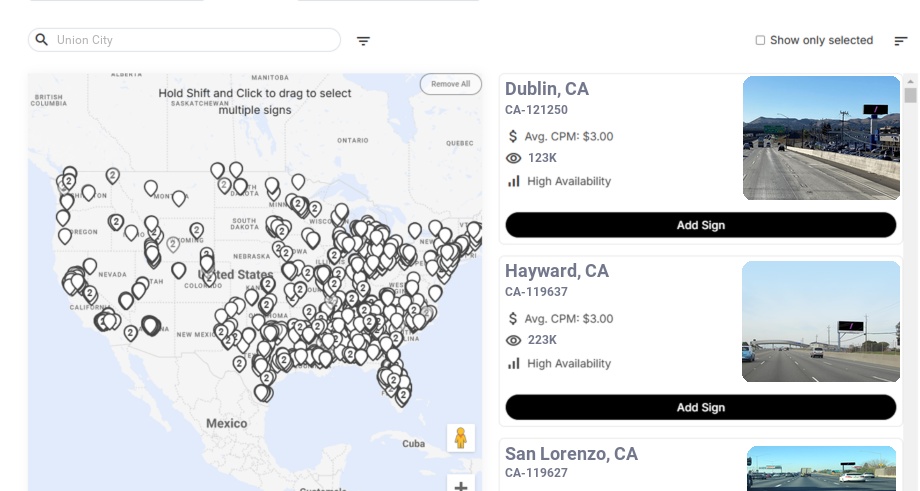
We have 7 digital billboards serving the Union City area, all strategically placed in nearby high-traffic corridors. These locations are in Hayward, San Lorenzo, and Dublin, and they sit along or near key freeway routes that Union City residents and workers use daily. The I‑880 corridor in Hayward and San Lorenzo, CA‑92 near the San Mateo Bridge approach, and the I‑580 corridor in Dublin are the main routes highlighted for reach.
What kind of people see Union City billboards?
Union City sits at a powerful crossroads of the East Bay and Silicon Valley, with highly diverse, affluent, and commuter-heavy audiences moving through nearby corridors every day. Union City is known for its multicultural population, with large Asian and Latino communities, and multiple languages are widely spoken at home, including Tagalog, Mandarin, Cantonese, Hindi, and Spanish. Union City is also one of the more affluent communities in the East Bay, with a median household income often estimated in the $120,000–$140,000 range.
When is the best time to run Blip ads in Union City?
Union City area residents are highly mobile, with long commute times and heavy freeway usage, so dayparting is especially powerful. East Bay commute windows commonly run from roughly 6:30–9:30 AM and 3:30–7:00 PM, with many corridors now experiencing extended peak congestion rather than a short rush hour. Mid-day traffic remains robust too, and on many corridors mid-day volumes can still reach 60–75% of peak flows.
Do I need a contract to advertise with Blip near Union City?
No, Blip has no long-term contracts or minimum commitments. You can start, pause, or stop your campaign at any time.
How fast can I launch a billboard campaign with Blip near Union City?
You can have your campaign live in minutes. Create a free account, select your locations, set your budget, upload your design, and start running once approved.
Where can I advertise with Blip near Union City?
Blip has digital billboards near Union City. You can browse available locations on a map, choose the ones that fit your audience, and start advertising right away.
Still have questions? Launch a campaign in minutes — no contracts, no commitments.
Start Your CampaignUnion City Billboard Advertising Guide
Union City sits at a powerful crossroads of the East Bay and Silicon Valley, with highly diverse, affluent, and commuter-heavy audiences moving through nearby corridors every day. With digital billboards near Union City in Hayward, San Lorenzo Dublin, we can help you tap into the daily routines of residents, workers, and shoppers across the Union City area with flexible, data-driven campaigns. Whether you’re exploring billboard advertising near Union City for the first time or expanding existing placements, these nearby boards give you regional coverage with a strong local feel.
Understanding the Union City Area Market
Union City is a compact but economically strong community with outsized buying power and diversity, making it ideal for finely tuned billboard messaging. Well-planned Union City billboards can capitalize on this dense, high-income audience moving between home, work, and shopping destinations every day.
Population and growth
- Union City’s population is approximately 70,000–72,000 residents (around 70,500–71,000 in many recent estimates), according to recent city profiles from the City of Union City.
- Over the last decade, Union City’s population has remained relatively stable, typically fluctuating within a 1–3% band year to year, which gives advertisers a reliable base audience rather than a market in rapid decline or explosive growth.
- It’s part of Alameda County, which has over 1.7 million residents, meaning the Union City area sits in the heart of a very dense regional market anchored by nearby cities like Oakland, Hayward, Fremont
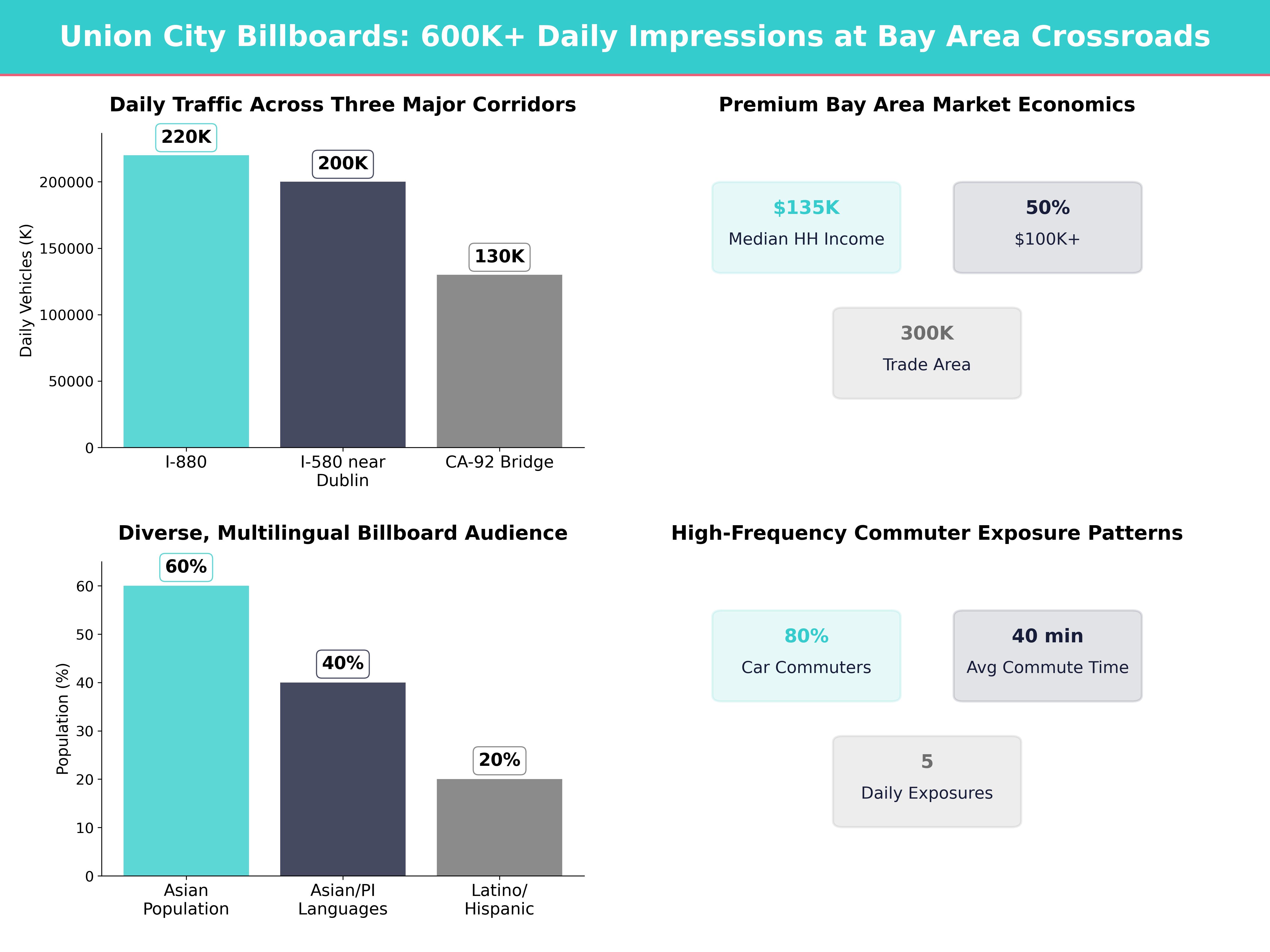
- Within a 10‑mile radius of Union City, the broader trade area can encompass 300,000+ residents, depending on how far north (toward San Leandro/Oakland) or south (toward Fremont Milpitas) you draw your radius.
Income and spending power
- Union City is one of the more affluent communities in the East Bay. City and regional economic development materials consistently place the median household income in the $120,000–$140,000 range, with many recent estimates near $130,000–$135,000.
- Roughly 40–50% of households are often estimated to earn $100,000 or more per year, and a substantial share of those exceed $150,000, reflecting a large base of dual‑income professional households.
- Alameda County as a whole has a median household income in the $110,000–$120,000 range, so Union City typically tracks 10–20% above the county average, positioning it closer to Silicon Valley income levels than many East Bay communities.
- High housing costs (with many estimates placing median home values well above $900,000 and typical monthly rents above $2,500–$3,000) mean residents balance strong incomes with high fixed expenses—making clear value propositions, financing options, and loyalty programs especially persuasive in billboard messaging.
Age and household makeup
Based on regional and city-level data:
- A significant portion of residents are working‑age adults (25–54)—often making up 45–50% of the population—many in professional, technical, healthcare, logistics, and public sector roles due to proximity to Silicon Valley and the broader Bay Area tech economy.
- Children and teens (under 18) typically represent around 20–25% of the Union City population, while older adults (65+) account for roughly 10–15%, providing a meaningful but not dominant senior audience.
-
Union City has a strong presence of family households, with many estimates indicating that 65–70% of occupied housing units are family households, and a substantial portion include children under 18. This is valuable for:
- Education services (tutoring, private schools, enrichment programs)
- Family entertainment and attractions
- Healthcare, dental, and orthodontic services
- Retailers and QSR/fast‑casual dining
- Educational attainment is relatively high, with many sources indicating that 40% or more of adults 25+ hold at least a bachelor’s degree, and a meaningful segment have graduate or professional degrees—supporting campaigns for professional services, advanced training, and high‑involvement purchases like financial products and home services.
Diversity and languages
Union City is known for its multicultural population:
- City data consistently highlight large Asian (particularly Filipino, Chinese, and Indian) and Latino communities. In many estimates, Asian residents make up 50–60% of the population, Latino/Hispanic residents around 15–20%, and White and other groups sharing the remainder.
- In regional data, more than 60% of residents in similar East Bay cities speak a language other than English at home, and Union City typically follows or exceeds this pattern.
- Multiple languages are widely spoken at home, including Tagalog, Mandarin, Cantonese, Hindi, and Spanish, alongside English. In comparable local profiles, it’s common to see 30–40%+ of households speaking Asian and Pacific Islander languages and 10–20% speaking Spanish at home.
For billboard creative, this implies:
- Consider bilingual or multilingual headlines for campaigns with clear ethnic or cultural targeting (e.g., healthcare, real estate, community events). Even adding a single line in Spanish or Tagalog can increase relevance for tens of thousands of local residents.
- Use culturally resonant imagery where appropriate (e.g., family gatherings, local community scenes) while keeping designs clean and universally understandable at a glance.
- Avoid heavy text blocks—simple, inclusive visuals can bridge linguistic differences for the 30–40%+ of viewers who may be more comfortable in a language other than English.
Where Our Digital Billboards Are and Who They Reach
We have 7 digital billboards serving the Union City area, all strategically placed in nearby high‑traffic corridors:
- Hayward (about 6.2 miles from Union City)
- San Lorenzo (about 6.6 miles from Union City)
- Dublin (about 9.3 miles from Union City)
These locations sit along or near key freeway routes that Union City residents and workers use daily, making them some of the most efficient billboards near Union City for reaching both local and regional drivers.
-
I‑880 corridor (Hayward & San Lorenzo)
- Connects Union City to Oakland, Fremont, and San Jose
- Caltrans traffic counts on I‑880 between Hayward and Union City often show 200,000–220,000 vehicles per day on the busiest segments, with some interchanges near Oakland exceeding 230,000 vehicles per day.
- If you conservatively assume 1.2–1.4 occupants per vehicle, that equates to 240,000–300,000 daily impressions potential in each direction on heavily traveled stretches.
- Perfect for reaching Union City residents commuting north toward Oakland/Berkeley or south toward Silicon Valley employment hubs.
-
CA‑92 / San Mateo Bridge approach (Hayward)
- Links I‑880 to the San Mateo-Hayward Bridge and the Peninsula.
- Caltrans estimates regularly exceed 120,000–130,000 vehicles per day on the bridge corridor itself, with some years approaching 140,000 vehicles per day.
- Around 25–35% of these trips are often work commutes, creating a strong weekday B2B and professional audience, while weekends skew more toward shopping and leisure trips across the Bay.
- Strong for campaigns targeting Union City area residents who work on the Peninsula or visit the mid‑Peninsula for shopping, tech, and services.
-
I‑580 corridor (Dublin)
- Major connection between the East Bay and the Tri‑Valley region.
- Certain segments of I‑580 near Dublin see 180,000–200,000+ vehicles per day, with spikes on Friday evenings and Sunday afternoons as people travel to and from the Central Valley and Tri‑Valley.
- When you factor average occupancy, that can represent 220,000–260,000+ person‑trips per day, a powerful reach for retail, dining, and tourism‑oriented campaigns.
- Ideal for reaching Union City area residents who shop or work in Dublin/Pleasanton, or who travel toward the Central Valley.
We can use Blip’s flexible scheduling to allocate more impressions to specific boards depending on where your core audience is most likely to travel—for example:
- Local Union City brick‑and‑mortar: lean heavily on Hayward and San Lorenzo boards along I‑880, capturing the tens of thousands of daily trips that originate in or pass near Union City neighborhoods with always-on Union City billboards exposure.
- Tri‑Valley or Central Valley businesses: allocate more budget to Dublin boards to catch Union City area drivers heading east—especially during weekend windows, when traffic on I‑580 can increase 10–20% over weekday off‑peak volumes.
- Peninsula or cross‑bay services: focus on Hayward boards near CA‑92 to reach commuters before they cross the bridge, where AM peak flows can exceed 6,000 vehicles per hour in each direction on busy days.
For more context on nearby communities that influence traffic patterns, you can review local resources such as the City of Hayward, Dublin’s city site, and the Alameda County website. You can also monitor transportation updates through regional agencies like AC Transit and Bay Area Rapid Transit (BART), which help shape commuting habits along these corridors and the effectiveness of billboard advertising near Union City.
Daily Traffic Patterns and When to Run Your Ads
Union City area residents are highly mobile, with long commute times and heavy freeway usage. That makes dayparting—choosing which times your ads appear—especially powerful.
Commuter traffic
- In many East Bay communities similar to Union City, 70–80% of workers commute by car (alone or carpool), while public transit captures 10–15% and the rest walk, bike, or work from home. Union City’s location near I‑880 and CA‑92 supports a similarly car‑dependent pattern.
- Average one‑way commute times for local workers often fall in the 30–40 minute range, with many residents spending an hour or more per day on I‑880, I‑580, or CA‑92. That means frequent, repeated exposure to freeway billboards.
- Union City commuters frequently use I‑880, CA‑92, and I‑580 to reach jobs in Oakland, San Jose, the Peninsula, and Tri‑Valley.
-
East Bay commute windows commonly run:
- Morning: roughly 6:30–9:30 AM, with peak flows often around 7:30–8:30 AM
- Evening: roughly 3:30–7:00 PM, with many corridors now experiencing extended peak congestion rather than a short rush hour
- Many workers in tech, healthcare, and logistics may have flexible or off‑peak schedules, meaning mid‑day and late‑evening traffic remains robust. On many corridors, mid‑day volumes (10 AM–3 PM) still reach 60–75% of peak flows.
How to use Blip scheduling around this:
-
B2B, professional services, and recruitment
- Prioritize morning and evening peak hours on weekdays near Hayward and San Lorenzo to catch commuters from the Union City area heading toward office, industrial, and warehouse districts in Oakland, Fremont, and the Peninsula.
- Consider slightly earlier starts (6:00–6:30 AM) if you’re targeting healthcare, logistics, or construction workers, who often begin shifts earlier than office employees.
- Emphasize short, benefit‑driven calls to action (“Now Hiring Engineers – Exit 30A”, “Same‑Day Logistics – Call Today”) that can be understood in under 3 seconds.
-
Retail, restaurants, and entertainment
- Add mid‑day (11 AM–2 PM) and late afternoon (4–6 PM) slots for lunch and after‑work decisions—critical periods for quick‑service restaurants and shopping centers.
- On Fridays and weekends, extend coverage into the evening (5–9 PM) to capture going‑out and shopping behavior; in many shopping districts, Friday and Saturday evenings can account for 30–40% of weekly foot traffic.
- Align bursts of impressions with local pay cycles (1st and 15th of the month) when discretionary spending typically spikes.
-
Service businesses (healthcare, auto, home services)
- Consider steady presence during commuter hours plus weekends, when families are more likely to make appointment, maintenance, or improvement decisions.
- Many service providers see 20–30% of appointment bookings cluster on Mondays; consider extra visibility Sunday evening and Monday morning to influence this behavior.
Because Blip allows budgets to be adjusted down to very small increments and scheduled by hour, we can:
- Heavily weight a few “power hours” (e.g., 7–9 AM and 4–6 PM) for a higher effective frequency during the busiest times, aiming for 3–5 average daily exposures for regular commuters where budgets allow.
- Test different dayparts week by week and compare response (web traffic, calls, walk‑ins) to determine which windows drive the best results for your business. Even simple A/B tests—such as one week focused on AM only vs. another on PM only—can reveal 20–50% performance differences in some categories.
Key Local Anchors to Build Your Strategy Around
Understanding where people in the Union City area go tells us what kind of messaging will feel timely and relevant, and where billboard advertising near Union City can have the most impact.
Employment and industry
Union City and its neighbors support a mix of:
- Advanced manufacturing, distribution, and logistics
- Healthcare and biotech (with major centers in the broader East Bay and South Bay)
- Professional and technical services
- Retail and hospitality
The Union City‐Hayward‐Fremont corridor is home to hundreds of industrial and logistics businesses, supported by nearby freight routes and proximity to the Port of Oakland and Silicon Valley. It’s common for individual business parks to house dozens of employers and hundreds to thousands of employees within a few square blocks.
Many workers commute to Silicon Valley, the Peninsula, Oakland, and San Francisco, while living in or near Union City for relatively more attainable housing. That creates:
-
A large audience of time‑pressed professionals—ideal for:
- Commuter‑friendly services (mobile car wash, meal solutions, delivery services)
- Financial planning, tax, and legal services
- Continuing education and professional training
- A significant shift‑based workforce in logistics and manufacturing, often working early mornings, swing shifts, or nights—supporting campaigns that run beyond traditional rush hours.
You can keep an eye on local business trends through sites like Union City’s Economic & Community Development and regional news from outlets such as the East Bay Times and The Mercury News. For Union City–specific coverage, you can also follow local updates from Union City TV and community news highlighted by Alameda County.
Shopping and lifestyle hubs
Union City area residents regularly frequent:
- Local and regional shopping centers in Union City, Hayward, and Dublin, including large power centers like Union Landing Shopping Center, which spans over 1 million square feet of retail space and hosts dozens of stores, restaurants, and entertainment venues.
- Big‑box retail corridors along I‑880 and I‑580, where a single cluster of national chains can draw thousands of visits per day and tens of thousands per weekend from across the East Bay.
- Entertainment zones and dining districts across the Tri‑Valley and East Bay, including movie theaters, family entertainment centers, and regional dining destinations.
If your business is near one of these hubs:
- Use distance‑based copy (“Just 5 minutes ahead at Industrial Blvd”) on boards closest to your location. Studies of out‑of‑home effectiveness frequently show that proximity cues can lift response rates by 10–20% compared to generic messaging.
- Use different creatives by direction of travel when possible (e.g., “Stop in on your way home” vs. “Grab coffee before work”) to reflect that AM traffic flows and PM traffic flows often have very different purposes (workbound vs. homebound, errands vs. leisure).
Education and families
Union City’s schools are part of the New Haven Unified School District, which you can learn more about via the district’s website thousands of students across multiple elementary, middle, and high schools in Union City and South Hayward, supported by hundreds of teachers and staff moving through local corridors daily.
With this sizable school community:
- Education programs, test prep, after‑school care, and youth sports can benefit from family‑oriented messaging during early morning (7–9 AM) and late afternoon (3–6 PM), when school drop‑off and pick‑up traffic peaks.
- Healthcare providers, dentists, and orthodontists can schedule back‑to‑school and seasonal health campaigns (e.g., sports physicals, immunizations, braces) from late July through September, when families are planning the school year.
- Enrichment programs (music, coding, language, arts) can leverage report‑card periods and mid‑semester advertising to catch parents when academic performance is top of mind.
For park and recreation‑focused campaigns, you can also reference Union City Community & Recreation Services and nearby outdoor destinations managed by the East Bay Regional Park District, which draw millions of visits annually across the region.
Creative Strategies That Resonate in the Union City Area
With fast‑moving freeway traffic and a highly diverse audience, creative decisions are critical for making your Union City billboards stand out.
Keep it simple and bold
At 55–65 mph, drivers have about 6–8 seconds to absorb a message; research across out‑of‑home campaigns often shows that recall drops sharply when messages exceed 10–12 words or cram in multiple offers.
For the Union City area:
- Aim for 6–8 words or fewer in your main message to maximize comprehension at highway speeds.
- Use large, high‑contrast fonts (e.g., white on dark, or bold colors against simple backgrounds); many OOH design standards recommend letter heights of at least 18–24 inches on large freeway boards for optimal readability at 500–600 feet.
- Avoid clutter—one key image, one message, one clear call to action. Reducing your design from three focal points to one can significantly increase recall and click‑through to your website or search traffic.
Localize your message
Union City area audiences respond well to brands that feel “nearby” and relevant:
-
Reference nearby landmarks or corridors:
- “Serving the Union City area – Off I‑880 at Whipple Rd”
- “Near the San Mateo Bridge – Same‑Day Service”
- “Minutes from Union Landing Shopping Center”
-
Highlight local credibility:
- “Trusted by Union City families since 1998”
- “Proud to serve East Bay businesses”
- “Rated 4.8★ by your Union City neighbors”
Including a specific neighborhood or corridor name can help prospects quickly place your brand geographically, a key factor when over 50% of drivers say they are more likely to visit a location they perceive as “on their way.”
Use language thoughtfully
Given the area’s multilingual population:
- For broad campaigns, keep English copy simple and visual so it’s easy to comprehend even for non‑native speakers. Use universally recognized icons (fork & knife for restaurants, tooth symbol for dentists, wrench for auto repair) to support understanding in a fraction of a second.
-
For specialized campaigns targeting specific communities (e.g., medical clinics, real estate, immigration law), consider:
- Running multiple creatives in different languages during the same campaign. Even rotating a 20–30% share of impressions in Spanish, Tagalog, or Mandarin can resonate deeply with targeted groups.
- Testing bilingual headlines, such as English plus Spanish or Tagalog, to see which yields more response. For example: “Abogados de Accidentes – Accident Attorneys – Exit Now” or “Care for Your Heart – Alaga sa Puso Mo.”
Highlight offers that match local cost of living
In a high‑cost region where many households earn over $100,000–$150,000 but also face high housing and childcare costs:
- Emphasize value and convenience: “Flat‑rate Auto Service”, “Transparent Pricing”, “No Hidden Fees”, “Union City Area Free Delivery.”
- Consider percentage‑based savings that feel meaningful in a high‑ticket environment: “Save 20–30% vs. Big Box” or “First Month 50% Off” for recurring services.
- For premium products, lean into quality and status: “Premium Kitchen Remodels for East Bay Homes”, “Executive Coaching for Bay Area Leaders”, or “Union City’s Luxury Auto Detail Experts”—appealing to the upper‑income tier households that make up a significant slice of the market.
Using Blip’s Flexibility to Your Advantage
Blip’s platform is built for testing and optimization, which is especially valuable in a complex, high‑traffic market like the Union City area. It also makes billboard rental near Union City straightforward, since you can scale your presence up or down without committing to a long-term static board.
Test multiple creatives
We recommend:
-
Running 2–4 creative variations at a time with:
- Different headlines (price vs. benefit vs. urgency)
- Different calls to action (URL, QR code, “Exit now”, “Call today”)
- Monitoring your own metrics—website visits, promo code redemptions, phone calls—by week. Many advertisers see 20–60% performance swings between their best‑ and worst‑performing creatives, so reallocating spend can produce quick wins.
- Shifting more budget toward the best‑performing creatives while phasing out weaker ones, using 2–4 week test cycles for statistically meaningful comparisons in a high‑traffic environment.
Align budgets with your goals
Because Blip charges per “blip” (each ad play), you can:
- Start with a modest daily budget to gain baseline visibility across 2–3 boards, then scale based on observed impact (search volume, direct traffic, or in‑store mentions of the campaign).
-
Concentrate spends on:
- Peak commute hours if you’re focused on awareness among working professionals; these windows often deliver the highest impressions per dollar.
- Weekends if you’re retail, dining, or entertainment, when shopping and leisure trips can represent 30–50% of weekly sales for some categories.
-
Gradually increase your budget around key seasonal periods, such as:
- Back‑to‑school (late July–September)
- Holiday shopping (November–December), which can account for 20–30% of annual revenue for many retailers
- Tax season (January–April) for financial and professional services
- Real estate peak months (spring and early summer), when listing activity and open houses increase substantially in Alameda County
- Major regional events and 3‑day weekends (Memorial Day, Labor Day), when traffic volumes and discretionary spending both climb.
Target by location and direction
Where possible, choose boards based on:
-
Inbound vs. outbound direction relative to Union City and neighboring hubs.
- Inbound (toward Union City): great for “Visit us today” and “Next exit” messaging, particularly for businesses near Union Landing, major intersections, or local corridors like Alvarado‑Niles Rd.
- Outbound (toward Oakland, Peninsula, or Tri‑Valley): better for brand awareness and regional services, such as healthcare systems, colleges, or regional attractions.
- Proximity to major junctions (e.g., I‑880/CA‑92 interchange, I‑580/680 near Dublin), where drivers naturally slow down and have slightly more time to view your message. Some of these interchanges can handle 250,000–300,000 vehicle movements per day, amplifying your reach.
Seasonal and Event‑Driven Opportunities
Union City and nearby communities host a variety of cultural, community, and shopping events that create spikes in traffic and attention. Planning your billboard advertising near Union City around these moments can significantly increase response.
Community and cultural events
Union City, Hayward, and Dublin regularly promote festivals, cultural celebrations, and community gatherings on sites such as:
Across the year, these calendars can feature dozens of events, from large cultural festivals and holiday parades to night markets, concerts in the park, and recreation programs—each drawing anywhere from a few hundred to several thousand attendees.
As these events occur:
- Local sponsors, vendors, and nearby businesses can run short, high‑intensity campaigns 1–3 weeks before the event. Concentrating impressions in a shorter window can boost ad recall by up to 2–3x compared with spreading the same impressions thinly over several months.
- Use countdowns (“This Weekend”, “3 Days Only”) and clear directional copy (“Just off I‑880 near Union City”).
- Consider adding event‑specific URLs or QR codes so you can directly measure ticket sales, RSVPs, or coupon downloads tied to your billboard impressions.
Retail and tourism in the broader region
The Union City area sits between:
- The Tri‑Valley (Dublin, Pleasanton, Livermore), marketed via sites like Visit Tri‑Valley, which promotes wineries, shopping districts, and outdoor attractions that collectively attract hundreds of thousands of visitors annually.
- The greater East Bay attractions and coastal access via the Peninsula and San Mateo Bridge, where beaches, regional parks, and downtown shopping/dining corridors draw strong weekend and holiday traffic.
Hotels, wineries, regional attractions, and shopping centers can use Union City area billboards to:
- Reach East Bay residents planning weekend activities, especially on Thursdays and Fridays, when many travelers research and finalize plans.
- Encourage spontaneous visits (“Exit 44 for Wine Country Today”) during weekend travel windows; visitor behavior research often shows that a notable share—sometimes 20–30%—of leisure stops along highways are influenced by on‑route signage.
- Promote seasonal experiences (harvest festivals, holiday light displays, summer concert series) to Union City–area families looking for short‑drive outings (often 30–60 minutes away).
Sample Campaign Approaches for the Union City Area
To make these ideas concrete, here are a few ways advertisers commonly structure campaigns near Union City using our digital billboards.
1. Local service business (e.g., dental clinic)
- Objective: Drive appointments from families within 10–15 miles of Union City.
- Boards: Focus on Hayward and San Lorenzo along I‑880; add Dublin if 15–25% of patients come from Tri‑Valley ZIP codes.
-
Schedule:
- Weekdays: 7–9 AM, 3–7 PM (aligned with school and work commutes)
- Saturdays: 10 AM–4 PM, when many families book appointments
-
Creative:
- “Family Dentist Serving the Union City Area – New Patients Welcome”
- “Kids’ Checkups – Most Insurance Accepted – Exit Whipple Rd”
- Integrate a simple URL or QR code; clinics often report noticeable upticks in website appointment requests within 1–3 weeks of launching localized OOH.
2. Regional retailer (e.g., furniture or electronics store)
- Objective: Build store traffic from commuters and weekend shoppers.
- Boards: Mix of Hayward, San Lorenzo, and Dublin to cover I‑880 and I‑580 flows, targeting a potential audience of hundreds of thousands of vehicle trips per day across routes.
-
Schedule:
- Weekdays: 4–8 PM to catch after‑work shoppers
- Weekends: 11 AM–7 PM, when many big‑ticket purchases occur
-
Creative:
- “Big Sale Near the Union City Area – Up to 40% Off – This Weekend Only”
- “Exit [X] for Showroom – Easy Parking, East Bay Location”
- Use bold sale percentages (20–40%) and limited‑time language, which have been shown in retail OOH campaigns to increase store visits by 10–30% during promotional windows.
3. Tech or logistics employer recruiting
- Objective: Attract skilled workers living in the Union City area and commuting along I‑880 or I‑580.
- Boards: Heavy focus on Hayward and San Lorenzo, plus Dublin for Tri‑Valley commuters.
-
Schedule:
- Weekdays: 6:30–9:30 AM, 4–7 PM to intercept both office and shift workers
-
Creative:
- “Now Hiring Engineers – Competitive Pay, Union City Area Roles – Apply at [short URL]”
- “Logistics Pros Wanted – Benefits Day One – Text ‘UNION’ to 12345”
- Employers in similar markets often see OOH contribute measurable lifts in applications within specific ZIP codes when ads run consistently for 4–8 weeks.
4. Local restaurant or café
- Objective: Capture lunchtime and evening traffic from nearby offices and commuters.
- Boards: Closest available boards to your location; primarily Hayward for many Union City dining spots and Union Landing‑area restaurants.
-
Schedule:
- Weekdays: 11 AM–2 PM, 4–7 PM
- Friday evening focus (4–9 PM) for social traffic
-
Creative:
- “Lunch Near Union City? Exit Now – Fresh Bowls & Sandwiches”
- “Happy Hour 4–7 PM – 2 Miles Ahead, Union City Area”
- Adding simple food photography and a short, memorable name can improve unaided brand recall by 15–25% in many OOH benchmarks.
Bringing It All Together
The Union City area offers a high‑value combination of affluent households, cultural diversity, and intense commuter traffic on some of the Bay Area’s most important corridors. With tens of thousands of local residents, hundreds of thousands of daily vehicle trips, and a strong base of working‑age, family, and professional households, it’s an ideal environment for well‑planned digital billboard campaigns.
By leveraging our 7 digital billboards near Union City—in Hayward, San Lorenzo, and Dublin—and using Blip’s flexible scheduling and creative testing, we can:
- Zero in on the right times of day for your ideal customer, from early‑morning commuters to weekend shoppers.
- Choose the best boards along I‑880, CA‑92, and I‑580 to match real‑world travel patterns shaped by local employment centers, schools, retail hubs, and regional attractions.
- Tailor simple, bold, locally relevant creative that speaks to Union City area residents where they live, work, and shop, taking advantage of the area’s high incomes and diverse languages.
With data‑informed planning and continuous optimization, digital billboards near Union City can become a powerful, measurable driver of awareness, visits, and sales for your brand—anchored in the real traffic flows and demographics that define this unique East Bay crossroads, and supported by flexible billboard rental near Union City that fits your goals and budget.