Billboards near San Jose, CA
No Minimum Spend. No Long-Term Contracts. Just Results.
Trusted by Leading Brands


Billboard advertising
near San Jose has never been easier



How much is a billboard near San Jose?
Why Choose Blip for Billboard Advertising near San Jose
Blip lets you launch fast in San Jose, reaching US-101 and I-880 commuters without the old-school buy process.
Set flexible budgets in San Jose and tap tech pros, shoppers, and airport traffic near SJC, Levi's Stadium, and the Great Mall.
Use dayparting in San Jose to hit 7-9 a.m. and 4-7 p.m. rushes when Silicon Valley commuters are on the road.
No contracts means San Jose brands can test game days, concerts, and conference spikes near SAP Center and McEnery.
Track San Jose performance in real time, then shift creative as traffic changes on CA-237, Montague, and Milpitas corridors.
Blip's creative tools help San Jose ads stay crisp for a diverse, multilingual audience driving fast past the billboard.
Frequently Asked Questions About Billboard Advertising near San Jose
How much does a billboard cost near San Jose, California with Blip?
With Blip, you can advertise on San Jose billboards on any budget, because you only pay per “blip”—each 7.5 to 10-second ad display on rotating digital billboards serving the San Jose area. You set your own daily budget during campaign creation, and Blip automatically keeps your advertising within that limit, so you stay in control of your costs at all times. The price of individual billboards near San Jose, California varies based on when and where your ads run and current advertiser demand, and your total spend is simply the sum of all the blips you receive.
Where can I advertise with Blip in San Jose, California?
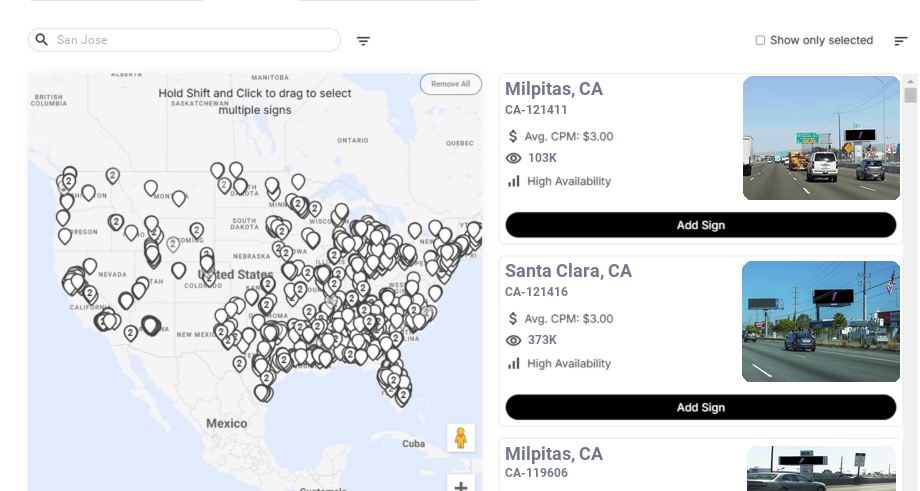
We have four digital billboards serving the San Jose area, all within about 10 miles of downtown, making them ideal for brands looking for San Jose billboards without paying downtown static-board rates. Santa Clara is about 7.8 miles from San Jose, and Milpitas is about 8.9 miles from San Jose. These boards are positioned along commuter and commercial corridors to reach workers, shoppers, families, and drivers using regional arteries like US-101, I-880, CA-237, and Montague Expressway.
What kind of audience will my Blip ads reach in San Jose, California?
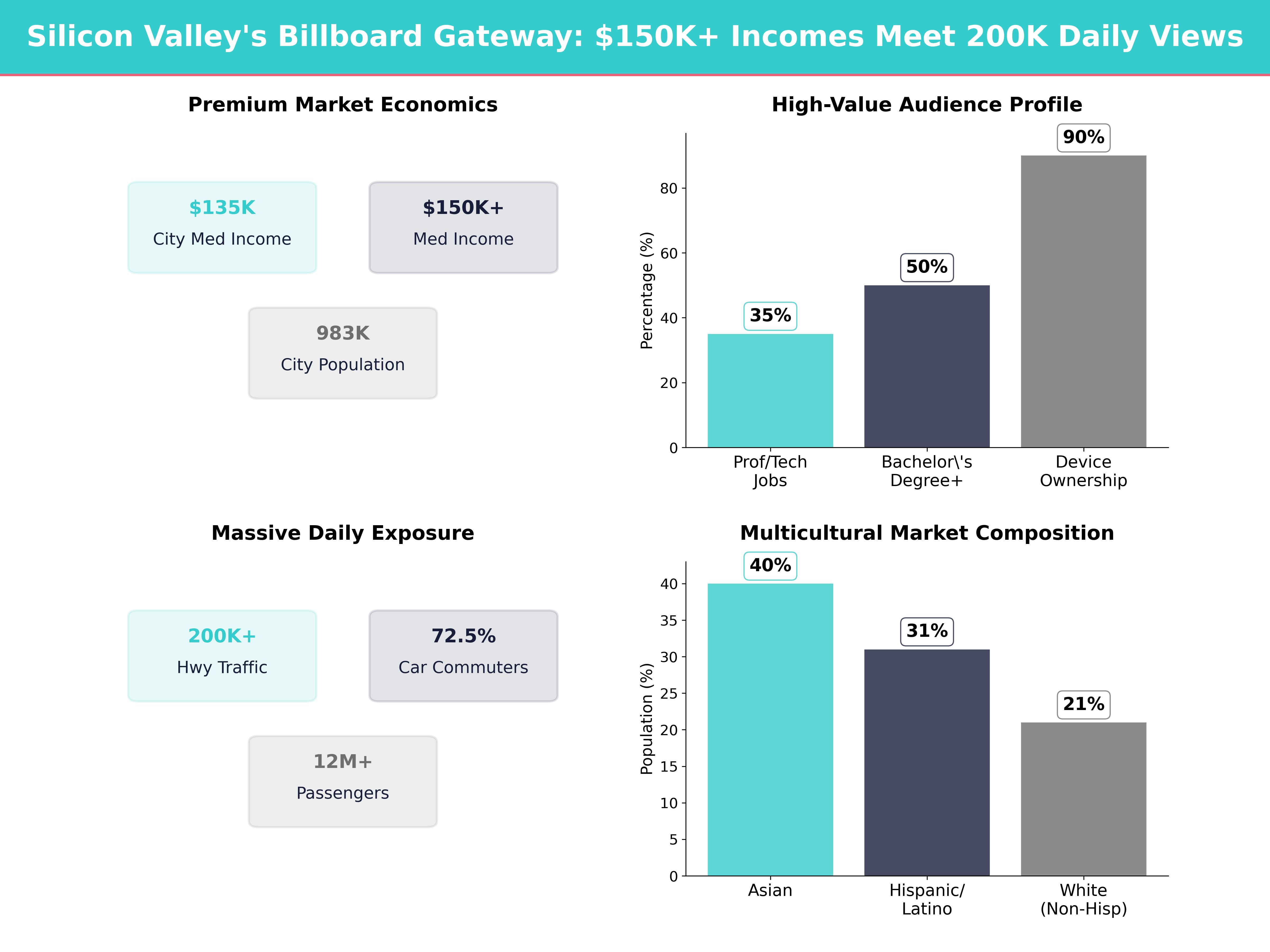
San Jose sits at the heart of Silicon Valley, with nearly a million residents, some of the highest median incomes in the country, and heavy daily commuter and visitor traffic. The region has about 983,000 residents in the city and more than 1.9 million people across Santa Clara County, with a median household income of about $135,000 in San Jose and over $150,000 in Santa Clara County. More than 56% of residents speak a language other than English at home, and the area is majority non-white, giving advertisers an exceptionally diverse audience.
When is the best time to run billboard ads in San Jose with Blip?
Peak congestion on freeways and expressways typically runs in the morning from 6:30–9:30 a.m. and in the evening from 3:30–7:00 p.m. The page recommends morning commute, lunchtime, evening commute, and weekend afternoons as high-value target windows for campaigns serving the San Jose area. With Blip, you can selectively schedule ads during these high-impact time blocks rather than paying for low-yield overnight impressions near San Jose.
Why are Santa Clara and Milpitas good places for Blip billboards near San Jose?
Santa Clara is home to Levi’s Stadium and a cluster of large tech campuses, while Milpitas is a key commuter hub connecting I-880, I-680, and CA-237. The Great Mall in Milpitas is a 1.4-million-square-foot outlet center with 200+ stores that draws several million shoppers annually. Placed along these commuter and commercial corridors, the boards are well positioned to reach workers, shoppers, families, and regional drivers.
Do I need a contract to advertise with Blip near San Jose?
No, Blip has no long-term contracts or minimum commitments. You can start, pause, or stop your campaign at any time.
How fast can I launch a billboard campaign with Blip near San Jose?
You can have your campaign live in minutes. Create a free account, select your locations, set your budget, upload your design, and start running once approved.
Where can I advertise with Blip near San Jose?
Blip has digital billboards near San Jose. You can browse available locations on a map, choose the ones that fit your audience, and start advertising right away.
Still have questions? Launch a campaign in minutes — no contracts, no commitments.
Start Your CampaignSan Jose Billboard Advertising Guide
San Jose sits at the heart of Silicon Valley, with nearly a million residents, some of the highest median incomes in the country, and heavy daily commuter and visitor traffic. With four digital billboards near San Jose—located in Santa Clara and Milpitas—we can help advertisers tap into this high-value market with flexible, data‑driven campaigns tailored to the rhythms of the San Jose area. These San Jose billboards give brands a way to extend their reach beyond online channels and into the daily commute.
Understanding the San Jose Area Market
San Jose is the 12th‑largest city in the U.S., with an estimated population of about 983,000 residents, and more than 1.9 million people across Santa Clara County. Local government and economic development sources such as the City of San José Santa Clara County San José Office of Economic Development & Cultural Affairs
- The median household income in San Jose is about $135,000, and in Santa Clara County it exceeds $150,000, placing the region in the top tier of U.S. metropolitan areas for earnings.
- Roughly 34–36% of employed residents work in professional, scientific, management, and information sectors, reflecting the dominance of tech and professional services centered around companies like Adobe, Cisco, Zoom, and scores of startups clustered in North San Jose, Santa Clara, and along the US‑101 and CA‑237 corridors.
- Educational attainment is high: more than 50% of adults 25+ in the San Jose–Santa Clara area hold a bachelor’s degree or higher, and in some neighborhoods adjacent to major campuses the share exceeds 65%.
- More than 56% of residents speak a language other than English at home, with particularly strong Spanish, Vietnamese, Chinese, and Indian language communities. In several East San Jose and Milpitas ZIP codes, the share of non‑English‑at‑home households surpasses 70%.
- The region is majority non‑white, with roughly 40% Asian, 31% Hispanic or Latino, 21% White (non‑Hispanic), and a growing multiracial population, giving advertisers an exceptionally diverse audience.
These facts mean advertisers serving the San Jose area with billboard advertising near San Jose are speaking to:
- High‑disposable‑income professionals (engineers, managers, founders, VC investors) who often work at firms along the North First Street, Tasman, and Great America corridors in San Jose and Santa Clara.
- Multicultural families who value education, technology, and upward mobility, in a county where over 70% of households have broadband‑internet subscriptions and more than 90% of households own a computer or smart device.
- Commuters and business travelers moving between San Jose, Santa Clara, Milpitas, and the greater Bay Area, in a county that supports hundreds of thousands of daily work trips across city boundaries.
Useful local references as you plan your campaigns include the City of San José Santa Clara County Visit San Jose, the San José Downtown Association, and business resources from the Silicon Valley Central Chamber.
Where Our Billboards Reach Near San Jose
We have four digital billboards serving the San Jose area, all within about 10 miles of downtown, making them ideal for brands looking for San Jose billboards without paying downtown static-board rates:
- Santa Clara (about 7.8 miles from San Jose) – Home to Levi’s Stadium, the San Francisco 49ers, and a cluster of large tech campuses. The stadium seats about 68,500 fans for NFL games and can exceed 75,000 attendees for major concerts. Santa Clara also hosts corporate campuses for multiple Fortune 500 companies and a large visitor base supported by the City of Santa Clara Discover Santa Clara
- Milpitas (about 8.9 miles from San Jose) – A key commuter hub connecting I‑880, I‑680, and CA‑237, with major retail such as the Great Mall, a 1.4‑million‑square‑foot outlet center with 200+ stores that draws several million shoppers annually. Milpitas continues to add multifamily housing near transit and employment centers, as documented by the City of Milpitas
Placed along these commuter and commercial corridors, our boards are well positioned to reach:
- Workers driving to and from office parks and campuses in Santa Clara, North San Jose, and Milpitas, where large business districts each contain tens of thousands of daily employees.
- Shoppers and families heading to the Great Mall California’s Great America, and nearby retail centers in Santa Clara, Berryessa, and Milpitas.
- Drivers using regional arteries like US‑101, I‑880, CA‑237, and Montague Expressway to access the San Jose area. On some segments of US‑101 and I‑880 through San Jose and Santa Clara, average annual daily traffic (AADT) exceeds 200,000 vehicles per day, according to Caltrans District 4.
By combining these locations with Blip’s flexible scheduling, you can align impressions with when your audience is actually on the road near San Jose—capturing a share of the hundreds of thousands of daily vehicle trips that move through Santa Clara and Milpitas. This gives both national brands and local businesses an efficient option for billboard rental near San Jose.
Traffic, Commuting, and Daily Rhythms
According to regional transportation agencies like VTA and Caltrans District 4, the San Jose area has some of the densest traffic in Northern California:
- Average commute times in San Jose are roughly 29–30 minutes, slightly above the national average, with many commuters traversing Santa Clara and Milpitas to reach major employment zones.
- Mode share data show that a strong majority of workers still drive: about 70–75% of commuters travel by car, with carpooling and solo driving together dominating daily trips, while public transit and active modes (bike/walk) account for most of the remainder.
-
Peak congestion on freeways and expressways typically runs:
- Morning: 6:30–9:30 a.m.
- Evening: 3:30–7:00 p.m.
On some freeway segments near San Jose and Santa Clara, speeds during peak periods can drop below 25 mph, stretching travel times and increasing billboard dwell opportunities.
- Norman Y. Mineta San José International Airport (SJC) served over 12 million passengers in 2023, recovering strongly toward pre‑pandemic levels. Holiday and summer peaks can push monthly passenger counts above 1.2 million, sending large flows of travelers and rideshare traffic along the same corridors near our boards.
- VTA carries around 100,000+ average weekday passenger trips across bus and light rail services, and nearby Caltrain and ACE Rail
This suggests several high‑value target windows for campaigns serving the San Jose area:
- Morning commute (7–9 a.m.) – Ideal for B2B, productivity tools, coffee, breakfast, fintech, and app‑based services when tens of thousands of tech workers travel toward North San Jose, Santa Clara, and Milpitas business parks.
- Lunchtime (11 a.m.–1 p.m.) – Food delivery, quick‑serve restaurants, retail promotions, and health/fitness messaging, especially near large office clusters and shopping centers like the Great Mall and Santa Clara Square.
- Evening commute (4–7 p.m.) – Entertainment, local events, family‑oriented services, and big‑ticket purchases (autos, real estate) as workers disperse to residential areas throughout Santa Clara County.
- Weekend afternoons – Shopping, leisure, tourism, and event‑driven campaigns around games, concerts, or festivals, when regional freeways can still see traffic volumes comparable to weekday peaks during major events.
With Blip, you can selectively schedule ads during these high‑impact time blocks rather than paying for low‑yield overnight impressions near San Jose, making billboard advertising near San Jose more efficient and measurable.
Key Audiences in the San Jose Area (and How to Speak to Them)
Tech Professionals & Startups
The San Jose area is the epicenter of Silicon Valley. Large tech employers and startups generate a constant flow of:
- Software engineers, product managers, and designers working at companies that collectively employ hundreds of thousands of tech workers in Santa Clara County.
- Founders and investors traveling between offices, coworking hubs, and airports such as SJC and nearby private aviation facilities in San Jose and Santa Clara.
Supporting data from local economic reports and groups like Silicon Valley Leadership Group tens of billions of dollars in annual venture capital investment, and tech and professional services account for a significant share of local GDP, reinforcing the value of B2B and high‑end consumer messaging.
Effective billboard strategy for this segment:
- Messaging style: Short, clever, “insider” language (“Ship faster.” “Your infra, actually observable.”).
- Value props: Time savings, performance, career advancement, modern tools—key in a market where many workers routinely put in 50–60‑hour weeks and manage multiple projects.
- CTAs: URLs and short vanity domains, app names, or simple search prompts (“Search: ‘Acme DevOps’”).
- Design: Clean, minimal, with strong contrast and brand colors that can be recognized in under 3 seconds of viewing time at freeway speeds.
Digital OOH can complement online B2B campaigns by building familiarity on the commute routes serving the San Jose area, reinforcing impressions from channels like LinkedIn, tech media, and local outlets such as The Mercury News and San José Spotlight
Families & Suburban Households
Santa Clara County’s household composition includes a large share of multi‑generational and family households:
- Roughly two‑thirds of occupied housing units are family households, and multi‑generational living is common among Asian and Latino communities.
- Local school districts like San José Unified, Santa Clara Unified, and Milpitas Unified serve tens of thousands of K–12 students, with strong focus on college readiness and STEM.
- Homeownership rates hover around 55–60% in many parts of the county, with median single‑family home prices often above $1.4 million, driving demand for financial planning, mortgage, and home‑improvement services.
For campaigns targeting families near San Jose:
- Highlight trust, safety, value, and convenience (“Pediatric care 10 minutes away,” “Coding camps this summer”).
- Use real people and inclusive imagery reflecting local diversity, including Asian, Latino, and mixed‑race families.
- Promote local presence (“Serving families across the San Jose area”) even if your physical store is in nearby cities, and consider referencing recognizable hubs like Downtown San Jose, Berryessa, or the Great Mall.
Multilingual & Multicultural Communities
San Jose’s population includes substantial Latino, Vietnamese, Chinese, Indian, and Filipino communities:
- In several East San Jose ZIP codes, Latino/Hispanic residents make up 60–70% of the population, while in parts of North San Jose, Santa Clara, and Milpitas, Asian residents exceed 60%.
- Vietnamese is one of the most widely spoken Asian languages in the region; some neighborhoods near Story Road and Tully Road have Vietnamese‑speaking populations above 25–30%.
- Many households are bilingual; local surveys indicate that well over half of non‑English‑at‑home households also speak English “very well.”
Strategies:
- Consider bilingual creatives (e.g., English + Spanish or English + Vietnamese) for broad‑reach consumer products, especially for services like healthcare, banking, telecom, and grocery where trust and clarity are crucial.
- For highly localized services (immigration law, community health clinics, ethnic grocers, specialty schools), test fully localized language ads in specific time blocks, such as evenings and weekends in corridors serving East San Jose and Milpitas.
- Use culturally resonant visuals while still keeping designs simple and legible from a distance—aim for no more than 1–2 key visual elements plus a clear CTA.
Events, Sports, and Seasonal Opportunities
The San Jose area’s event calendar creates powerful short‑term spikes in traffic and attention.
Key anchors include:
-
Sports & Major Venues
- Levi’s Stadium in Santa Clara: Home of the NFL 49ers, who play 8 regular‑season home games plus potential preseason and playoff games. The venue also hosts 10–20 large‑scale concerts and special events annually, each drawing 40,000–70,000+ attendees and generating significant traffic on US‑101, CA‑237, and Great America Parkway.
- SAP Center in San Jose: Home of the NHL San Jose Sharks, with 41+ regular‑season home games plus preseason and potential playoff games. The arena, which seats about 17,500 people, also hosts 100+ concerts, family shows, and events per year.
- PayPal Park: Home of the San Jose Earthquakes (MLS) with around 17,000–18,000 seats and dozens of soccer matches and events annually.
-
Conventions & Tech Conferences
- The San Jose McEnery Convention Center hosts hundreds of events and meetings each year, including major tech conferences and fan conventions that can each bring 5,000–20,000 attendees into downtown and surrounding hotels.
-
Tourism & Seasonal Travel
- Visit San Jose has reported millions of annual visitors to the city, with visitor spending in recent years exceeding $1.5–2.0 billion annually as travel recovers.
- Visitor volumes peak in spring, summer, and the year‑end holidays, with strong demand for hotels, dining, and attractions like Winchester Mystery House and Happy Hollow Park & Zoo
- SJC passenger volumes spike around Thanksgiving, winter holidays, and summer, reinforcing the value of flexible, travel‑oriented campaigns.
How to capitalize using Blip:
- Event‑specific bursts – Increase your blip budget on game or concert days, targeting pre‑event (3–7 p.m.) and post‑event (9–11 p.m.) windows near Santa Clara and Milpitas corridors. For a sold‑out NFL game, you can reach a portion of the 60,000–70,000 fans plus thousands of service workers and nearby visitors.
- Conference alignment – Run B2B or hiring creatives during large conventions to reach attendees traveling between hotels in San Jose, Santa Clara, and Milpitas and venues like the McEnery Convention Center and SAP Center.
-
Seasonal campaigns –
- Spring: Tax services, home improvement, spring break travel, college‑prep programs.
- Summer: Camps, attractions, back‑to‑school prep, especially when local districts serve tens of thousands of students transitioning between grades.
- Fall: Sports bars, apparel, holiday layaway and big‑ticket purchases as football and hockey seasons overlap.
- Winter holidays: Retail, e‑commerce, travel, and gifting when regional retail centers see double‑digit percentage increases in foot traffic compared with off‑season months.
Local media like The Mercury News, San José Spotlight Visit San Jose and Discover Santa Clara
Creative Best Practices for the San Jose Area
In a fast‑moving, tech‑oriented market, your creative must be extremely clear and instantly understandable.
Design recommendations:
- 6–8 words max on the main line; avoid dense text. At freeway speeds of 55–65 mph, drivers often have 3–5 seconds of clear viewing time.
- Large, high‑contrast fonts that stand out against bright Bay Area daylight and nighttime glare; use type sizes that are easily legible from 400–600 feet.
- One key focal point (logo, product shot, or visual metaphor) to avoid cognitive overload in heavy‑traffic conditions.
- High‑resolution images that hold up on large digital faces; aim for assets suitable for displays that can be 14 feet high and 48 feet wide.
- Strong color contrast (e.g., light text on dark background or vice versa) so the message remains visible in bright sun and foggy mornings that are common in parts of the valley.
Message strategies for this market:
- Value on time – People in the San Jose area are busy and often in traffic; emphasize how you save time or simplify life (“Save 10 hours this week,” “Skip the line, order ahead”).
- Proof and credibility – Mention adoption figures or local ties (“Trusted by 10,000 Bay Area families,” “Serving Silicon Valley companies since 2010,” “Rated 4.8★ locally”).
- Local relevance – Reference recognizable touchpoints like “near Levi’s Stadium,” “minutes from SJC,” or “off 237 by the Great Mall” for brick‑and‑mortar businesses.
- Digital calls‑to‑action – Encourage quick actions: “Scan to book,” “Download today,” “Apply now.” QR codes can work if they are large, high‑contrast, and placed with enough clear space; keep the landing page short and mobile‑optimized.
Because digital boards enable you to run multiple creatives, we recommend:
- Testing two to four variants with different headlines or offers and monitoring which produce higher scan rates, promo‑code usage, or web traffic from local ZIP codes.
- Tailoring language by time of day (e.g., “Order lunch in 15 minutes” vs. “Dinner delivered home”).
- Running multilingual versions during specific time blocks that align with target neighborhoods and commuting patterns (for example, more Spanish‑language impressions on east‑west routes serving East San Jose during evening commute).
Using Blip’s Flexibility to Your Advantage
Blip lets you buy individual “blips” (ad plays) on our screens near San Jose rather than committing to traditional static buys. For the San Jose area, this unlocks several strategic advantages for anyone exploring billboard advertising near San Jose:
-
Dayparting by Audience
- B2B and professional services: heavier weighting during weekday commutes when the majority of the region’s ~1 million workers are on the road.
- Retail and entertainment: evenings and weekends, especially when malls and dining districts can see 20–40% higher foot traffic than weekday daytime periods.
- Travel, hospitality, and events: around flight peaks at SJC and game days at Levi’s Stadium, SAP Center, or PayPal Park.
-
Budget Control in a High‑Cost Market
- Even in an expensive media market like Silicon Valley, you can start with modest daily caps (for example, a test budget over 7–14 days) and then scale based on indicators like uplift in web sessions, app downloads, or store visits.
- Increase budgets during key periods (e.g., a new product launch week, major conference, or holiday season), then return to a maintenance level once peak demand passes.
-
Rapid Creative Swaps
- Update pricing, product shots, or CTAs without printing costs or waiting for manual poster changes.
- Run real‑time promotions (e.g., “Tonight only,” “This weekend,” “Pre‑order through Friday”) tied to local events, weather, or inventory levels.
-
Localized Targeting within the Region
- Emphasize Santa Clara boards when promoting events at Levi’s Stadium, California’s Great America, or targeting North San Jose tech workers.
- Emphasize Milpitas boards for campaigns around outlet shopping, East Bay commuters using I‑680 and I‑880, or residents of North/East San Jose and South Fremont.
Sample Campaign Ideas for the San Jose Area
Local Tech Startup Launch
- Goal: Brand awareness among engineers and product managers.
-
Strategy:
- Run weekday campaigns 7–10 a.m. and 4–7 p.m. near Santa Clara and Milpitas, capturing a share of the tens of thousands of daily commuters traveling between San Jose, Santa Clara, and the East Bay.
- Use sharp, minimal creative (“Monitor everything. In seconds.” with logo and short URL).
- Coordinate with online campaigns on LinkedIn, tech podcasts, and local tech news, as well as sponsorships in outlets like San José Spotlight The Mercury News.
- Result: Establish credibility and mindshare with the exact commuters who build and buy software in the San Jose area, boosting direct and branded search volume during and shortly after the flight.
Multi‑Location Restaurant or QSR Chain
- Goal: Drive dine‑in and delivery orders.
-
Strategy:
- Daypart lunch (11 a.m.–2 p.m.) and dinner (5–9 p.m.) on weekdays; expand hours on weekends and on big event days at Levi’s Stadium, SAP Center, or PayPal Park.
- Use appetizing food imagery with short CTAs (“Order on DoorDash,” “Exit at Great Mall”).
- Rotate creatives for seasonal offers and big game days, and test limited‑time promo codes tied to local teams (e.g., “WIN4NINERS” or “GOQUAKES”) to measure response.
Education & Enrichment Programs
- Goal: Enroll students in coding camps, test prep, or after‑school programs.
-
Strategy:
- Focus on late winter and spring (registration season) and late summer (back‑to‑school), aligning with enrollment deadlines in districts such as San José Unified and Milpitas Unified.
- Run bilingual creatives (e.g., English/Spanish or English/Vietnamese) that highlight outcomes (“Get ahead in coding,” “STEM skills for tomorrow’s jobs”) and data points (“90% of our students improve a full grade level”).
- Concentrate impressions on commute times when parents are driving to and from schools and activities, typically 7–9 a.m. and 3–7 p.m.
Compliance, Local Sensitivities, and Best Practices
When advertising in a diverse and civic‑engaged area like San Jose, advertisers should keep a few guidelines in mind:
- Be culturally respectful and inclusive. Avoid stereotypes; use imagery that reflects the region’s diversity across ethnicity, age, and family structure.
- Follow local and state regulations for legal, cannabis, alcohol, and healthcare advertising. The City of San José City of Santa Clara City of Milpitas
- Stay timely and accurate. For events or limited‑time offers, update or pause creatives when promotions end to avoid compliance or customer‑service issues.
- Avoid information overload. In high‑speed traffic corridors, overly complex visuals or small text reduce effectiveness and can be distracting; keep designs aligned with recommended 6–8 word limits and clear focal points.
Measuring and Optimizing Campaign Performance
While billboards near San Jose are a top‑of‑funnel and mid‑funnel channel, there are practical ways to measure impact:
- Track lift in branded search volume during and after your Blip flight using analytics tools; look for week‑over‑week or year‑over‑year increases that correlate with your flight dates.
- Use unique URLs, promo codes, or QR codes to attribute responses. For example, a short link plus a “SJ20” discount can help isolate conversions from the San Jose boards.
- Compare location analytics (store visits, app usage, web traffic) from ZIP codes nearest Santa Clara and Milpitas versus control areas elsewhere in the Bay Area. Track changes in metrics such as cost per store visit or cost per lead during your campaign.
-
Rotate creatives and test:
- Headline A vs. Headline B
- Single‑language vs. bilingual versions
- Different calls‑to‑action (download, visit, call)
Monitor which versions produce higher engagement—such as QR scans or online conversions—and refine your mix accordingly.
Over time, this data will show which messages, languages, and time blocks yield the best engagement for your brand in the San Jose area, letting you continuously improve ROI from your San Jose billboards.
By combining the economic strength and diversity of the San Jose area with precise, flexible scheduling on digital billboards near Santa Clara and Milpitas, we can help you build campaigns that are both cost‑efficient and highly targeted. With clear creative, smart timing, and iterative testing informed by local data and resources like Visit San Jose, VTA, and The Mercury News, your brand can stand out in one of the most competitive and opportunity‑rich markets in the country—and get maximum value from billboard advertising near San Jose.