Billboards near Citrus, CA
No Minimum Spend. No Long-Term Contracts. Just Results.
Trusted by Leading Brands


Billboard advertising
near Citrus has never been easier



How much is a billboard near Citrus?
Why Choose Blip for Billboard Advertising near Citrus
Blip lets you launch on Citrus corridors like I-10, I-210, and SR-60 fast—ideal for the commuter flow through Citrus, Covina, and Baldwin Park.
Set a daily budget in Citrus and Blip stays within it, so you can test ads near City of Industry and La Puente without overcommitting.
Use Blip dayparting to hit Citrus drivers at 6–9 a.m. or 3–7 p.m., when commuters and school runs pack Arrow Hwy and Azusa Ave.
No contracts means Citrus businesses can turn campaigns on for back-to-school, tax season, or Plaza West Covina holiday traffic, then pause anytime.
Blip's real-time analytics help Citrus advertisers see what's working on routes to El Monte and City of Industry, then shift spend quickly.
Create bilingual, local-friendly creative in Blip for Citrus families—simple Spanish/English messages built for dense, family-heavy neighborhoods.
Frequently Asked Questions About Billboard Advertising near Citrus
How much does a billboard cost near Citrus, California with Blip?
With Blip, you can advertise on Citrus billboards on any budget by setting a daily amount that works for you, and Blip automatically keeps your campaign within that limit. Each “blip” is a brief 7.5–10 second display on digital billboards near Citrus, California, and you only pay for the blips you receive. Prices adjust based on when and where you choose to show your ad and on advertiser demand, so you stay in control at all times.
Where can I advertise with Blip near Citrus, California?
The 20 digital billboards serving the Citrus area sit in high-traffic corridors in Covina, Irwindale, Baldwin Park, La Puente, City of Industry, and El Monte. Collectively, these cities account for well over 250,000 local residents plus tens of thousands of inbound workers each day. The City of Industry alone has only a few hundred residents but hosts 2,500+ businesses and an estimated 60,000–80,000 jobs, funneling massive worker flows from surrounding communities.
What kind of people does Blip reach around Citrus, California?
According to 2020 data, the Citrus area has a population of about 10,700 residents, packed into roughly 0.9 square miles. That’s a density of around 11,800 people per square mile, which is significantly higher than the U.S. average and even higher than the City of Los Angeles’ roughly 8,300 per square mile. The area also has a strong presence of young families, early-career professionals, and working-age adults.
When is the best time to run billboard ads in Citrus, California with Blip?
The Citrus area is deeply commuter-oriented, with many residents leaving home between 6:00–8:30 a.m. and additional surges during the evening commute and school activities from 3:00–7:00 p.m. There are also midday errands and service-worker windows from 11:00 a.m.–2:00 p.m., plus late-night shifts from 9:00 p.m.–1:00 a.m. Because Blip lets us choose how often our ad appears and at what times, we can target the most valuable traffic windows around Citrus instead of paying for 24/7 exposure we may not need.
What kind of billboard creative works best in Citrus, California with Blip?
Given that 60–80% of the population in many nearby communities identify as Hispanic/Latino, bilingual ads with both English and Spanish on the same creative can be effective. National out-of-home research consistently finds that simple copy leads to higher recall, and we should keep total text to 7 words or fewer when possible. At freeway speeds, drivers have about 3–5 seconds to process an ad, so a clear visual hierarchy and a simple CTA are important.
Do I need a contract to advertise with Blip near Citrus?
No, Blip has no long-term contracts or minimum commitments. You can start, pause, or stop your campaign at any time.
How fast can I launch a billboard campaign with Blip near Citrus?
You can have your campaign live in minutes. Create a free account, select your locations, set your budget, upload your design, and start running once approved.
Where can I advertise with Blip near Citrus?
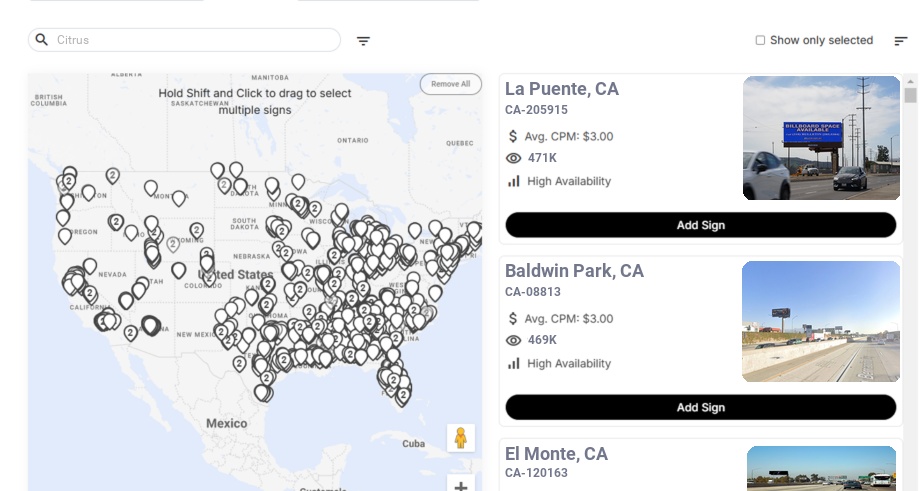
Blip has digital billboards near Citrus. You can browse available locations on a map, choose the ones that fit your audience, and start advertising right away.
Still have questions? Launch a campaign in minutes — no contracts, no commitments.
Start Your CampaignCitrus Billboard Advertising Guide
Citrus, California may be compact, but it sits at the heart of a dense, commuter-heavy slice of the San Gabriel Valley Irwindale Baldwin Park La Puente, City of Industry El Monte hundreds of thousands of vehicles per corridor, putting your message in front of both local residents and regional commuters. This guide is built to help us design smarter Blip campaigns that speak directly to people who live, shop, and commute near Citrus, and to show how to get the most from billboards near Citrus for a wide variety of local businesses and organizations.
Understanding the Citrus Area Market
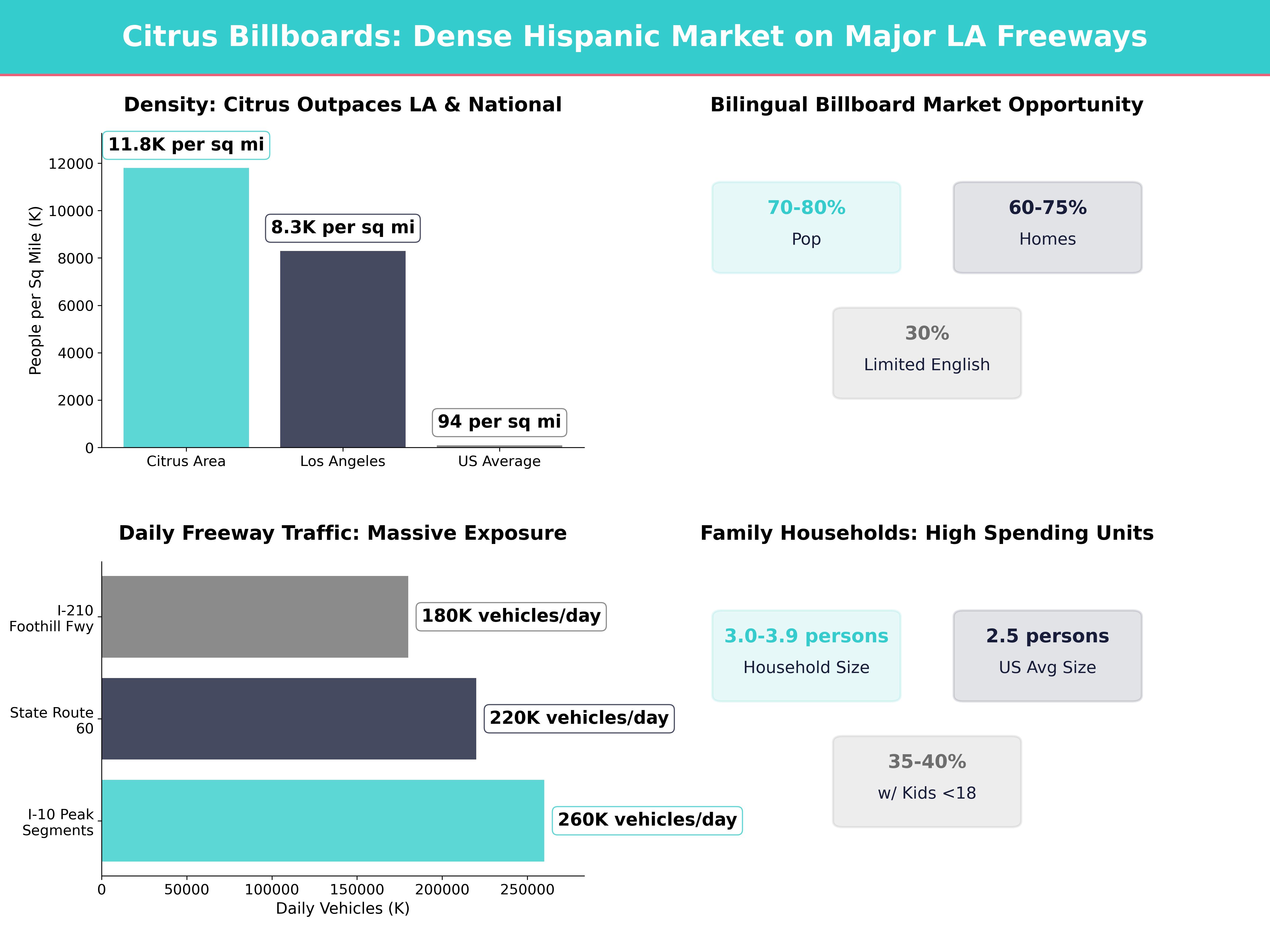
Citrus is an unincorporated community of Los Angeles County Covina Azusa 10,700 residents, packed into roughly 0.9 square miles. That’s a density of around 11,800 people per square mile—significantly higher than the U.S. average of about 94 per square mile, and even higher than the City of Los Angeles’ roughly 8,300 per square mile. Neighboring cities are also dense: Covina has around 51,000 residents in 7.0 square miles (~7,300 per square mile), Baldwin Park has about 72,000 residents in 6.8 square miles (~10,600 per square mile), and La Puente has nearly 39,000 residents in 3.5 square miles (~11,100 per square mile). This density matters: a relatively small footprint yields a lot of impressions when we advertise along the roads people actually use, making Citrus billboards and nearby placements especially efficient.
Key demographic and lifestyle characteristics of the Citrus area and immediate surroundings:
-
Age profile:
Median age in the Citrus area is around 33–35 years, similar to nearby cities like Covina (~37 years) and Baldwin Park (~33 years). This means a strong presence of young families, early‑career professionals, and working-age adults, with a large share in the 25–44 and 5–17 age brackets that drive household purchase decisions. -
Household structure:
Average household sizes in nearby Covina and Baldwin Park are around 3.0–3.9 persons per household, compared with about 2.5 nationally. In some nearby cities, more than 35–40% of households include children under 18, and multi-generational living is common. This signals many multi-generational and family households where decisions are often made with value, convenience, and proximity in mind. -
Income:
Median household incomes in adjacent cities generally fall in the $65,000–$80,000 range:- Covina: roughly $78,000–$80,000
- Baldwin Park: roughly $70,000–$75,000
- La Puente: roughly $70,000–$73,000
- El Monte: roughly $60,000–$65,000
This reflects a large working- and middle-class base who are highly value‑driven but still willing to spend on quality and convenience, particularly on food, healthcare, auto services, and education.
-
Ethnicity and language:
Hispanic/Latino residents make up roughly 70–80% of the population in Citrus and neighboring cities like Baldwin Park and La Puente. In several nearby communities, 60–75% of households speak a language other than English at home—primarily Spanish—and in some areas more than 30% of residents report speaking English “less than very well.” This directly supports the use of bilingual and Spanish‑forward creative. -
Commuting and car reliance:
In the eastern Los Angeles County region, more than 70–75% of workers commute by driving alone, another 10–12% carpool, and only a small share use transit, biking, or walking. Typical one‑way commute times are 30–35 minutes, with many residents traveling to job centers in the City of Industry
These patterns tell us that effective billboard advertising near Citrus should:
- Prioritize family-oriented, value-forward messaging
- Consider bilingual (English/Spanish) creatives
- Speak to commuters and service workers whose schedules may not be a standard 9–5
- Recognize that many decisions are made in the car, often with kids or multiple adults present
Local context and official resources we can reference include Los Angeles County Covina Irwindale Baldwin Park La Puente, City of Industry El Monte San Gabriel Valley Tribune and other regional sources such as Pasadena Star-News and LAist offer insight into regional trends, development projects, and community priorities that can inform how we use Citrus billboards throughout the year.
Where Our 20 Billboards Reach Drivers Near Citrus
The 20 digital billboards serving the Citrus area sit in high-traffic corridors in:
- Covina (about 3.4 miles from Citrus)
- Irwindale (about 5.4 miles from Citrus)
- Baldwin Park (about 6.3 miles from Citrus)
- La Puente (about 7.8 miles from Citrus)
- City of Industry (about 8.3 miles from Citrus)
- El Monte (about 8.8 miles from Citrus)
Collectively, these cities account for well over 250,000 local residents plus tens of thousands of inbound workers each day. The City of Industry alone has only a few hundred residents but hosts 2,500+ businesses and an estimated 60,000–80,000 jobs, funneling massive worker flows from surrounding communities and greatly expanding the reach of any billboard advertising near Citrus.
These cities hug some of the busiest freeways and arterials in the San Gabriel Valley:
- I‑10 (San Bernardino Freeway):
In the eastern Los Angeles County stretch near West Covina Baldwin Park El Monte Caltrans traffic counts often exceed 250,000–270,000 vehicles per day on peak segments. - I‑210 (Foothill Freeway):
In adjacent corridors serving Azusa Irwindale 180,000+ vehicles per day. - State Route 60 (Pomona Freeway):
Through the City of Industry La Puente, volumes are often 200,000–240,000 vehicles per day or higher on key links that carry both regional commuters and heavy truck traffic. - Primary arterials such as Arrow Highway, Azusa Avenue, Puente Avenue, Citrus Avenue, and Ramona Boulevard connect Citrus residents to jobs, schools, warehouses, and retail. Many of these surface streets support 25,000–45,000 vehicles per day, making them powerful for neighborhood‑level and point‑of‑sale messaging.
Because digital billboards cycle multiple advertisers, a single sign can generate tens of thousands of impressions daily. If one sign sits on a roadway carrying 200,000 vehicles per day and your ad runs in 1 of every 10 ad slots, a conservative estimate might be 20,000+ daily ad plays on that board alone. If we assume even a 1–2% glance rate, that’s 200–400 daily visual contacts per 10,000 ad plays. Spread across 20 boards in the Citrus area radius, even a modest schedule can quickly add up to hundreds of thousands of impressions per week and millions of impressions per quarter, particularly among repeat commuters who pass the same locations 5–10 times per week.
With Blip’s pay‑per‑“blip” model, we choose how often our ad appears and at what times, allowing us to target the most valuable traffic windows around Citrus instead of paying for 24/7 exposure we may not need. This flexibility effectively turns our Citrus billboards into a precision tool, not just a broad awareness play.
Commuter Patterns and Dayparting Strategy
The Citrus area is deeply commuter-oriented. Many residents work in:
- Industrial and logistics centers in the City of Industry Irwindale
- Retail and service jobs in Covina West Covina Baldwin Park El Monte
- Farther commutes toward downtown Los Angeles and the Inland Empire via I‑10, I‑210, and SR‑57
In the broader region, a large share of workers leave home between 6:00–8:30 a.m., and 60–70% of workers have typical daytime schedules, with a notable minority in evening and night shifts for logistics, healthcare, and hospitality. This creates predictable traffic surges we can target with billboard advertising near Citrus:
- Morning commute: Roughly 6:00–9:00 a.m.
- Midday errands and service workers: 11:00 a.m.–2:00 p.m.
- Evening commute and school activities: 3:00–7:00 p.m.
- Late-night shifts (warehouses, logistics, food service): 9:00 p.m.–1:00 a.m.
How to apply this with Blip’s scheduling tools:
- B2B and trade services (wholesale, logistics, industrial supply):
Focus on early mornings (5:30–8:30 a.m.) and late afternoons (3:00–6:00 p.m.) on billboards in the City of Industry and Irwindale, where warehouse and manufacturing workers are concentrated and where truck traffic can account for 10–20% of total vehicles on some corridors. - Family-focused retail, restaurants, healthcare, education, and local events:
Concentrate near Covina, Baldwin Park, and La Puente during school drop-off and pick-up (7:00–9:00 a.m., 2:00–4:00 p.m.) and evening mealtime hours (5:00–8:00 p.m.). Local school districts in the surrounding cities enroll tens of thousands of K–12 students, creating reliable surges near school zones and family retail corridors. - Entertainment, nightlife, and quick-service food:
Use evening and late-night slots (7:00 p.m.–midnight) on high-traffic freeway-adjacent boards, especially heading back toward the Citrus area from City of Industry and El Monte. Quick‑service restaurant and delivery decisions skew heavily to these hours; many chains see 30–40% of daily sales in the dinner and late‑night windows.
Because we pay per blip, we can shift budget to the exact hours when our ideal customers are most likely to drive near Citrus, instead of buying wasteful all‑day broadcast schedules. This is one of the key advantages of digital billboard rental near Citrus versus traditional static buys.
Crafting High-Impact Creative for Citrus Area Audiences
The composition of the Citrus area and neighboring cities suggests a few powerful creative best practices.
1. Bilingual and Culturally Relevant Messaging
Given that 60–80% of the population in many nearby communities identify as Hispanic/Latino, and a majority of households speak Spanish at home:
- Consider bilingual ads with both English and Spanish on the same creative.
-
If we run multiple creatives, test:
- One primarily in English with a small Spanish tagline
- One primarily in Spanish for Spanish-dominant drivers
Examples:
- “Fast, Affordable Braces – Brackets Rápidos y Económicos. Exit Azusa Ave.”
- “Family Insurance You Can Trust – Seguro Para Toda la Familia – Call Today.”
National out-of-home (OOH) research consistently finds that simple copy leads to higher recall. We should keep total text to 7 words or fewer when possible. At freeway speeds (55–65 mph), drivers have about 3–5 seconds to process an ad and may be 500–700 feet away when they first see it. Each extra word sharply reduces comprehension and recall.
2. Simple Visual Hierarchy
In a dense visual environment:
- Use 1 main visual (a product, a dish, a smiling patient, a car, etc.).
- 1 dominant headline in large, high-contrast text.
-
1 clear CTA, typically:
- Short URL (e.g., “Visit CitrusAuto.com”)
- Directional cue (“Next Right on Azusa Ave”)
- Simple action phrase (“Order Today,” “Apply Now,” “Enroll by Aug 15”)
Studies of OOH readability show that fonts larger than 18–24 inches on a standard full‑size billboard are significantly more legible at 500+ feet. Logos, phone numbers, and website URLs should be legible at a distance of several hundred feet. If we use a phone number, it should be 10 digits in a large, bold font and avoid hyphen clutter (e.g., “626.555.1234” rather than a complex vanity number).
3. Local Landmarks and References
Residents of the Citrus area and neighboring cities readily recognize:
- Arrow Highway, Citrus Avenue, Azusa Avenue, and Puente Avenue
- Nearby hubs like Plaza West Covina (a major regional mall drawing 8–10 million visits annually, accessible via Plaza West Covina) and Baldwin Park’s major retail corridors
- The warehouse zones in the City of Industry
- Local schools and colleges such as Citrus College in nearby Glendora (serving 20,000+ students annually, see Citrus College) and local high schools across Covina, Azusa, and Baldwin Park
We can boost relevance by referencing these anchors:
- “Just 5 Minutes from Plaza West Covina”
- “2 Miles South of Citrus College – Enroll Now”
- “Serving the San Gabriel Valley for 20+ Years”
Hyper-local mentions give viewers a clear sense that the advertiser is “one of us,” which is powerful in tight‑knit communities where local trust and word‑of‑mouth remain strong. This sense of familiarity is especially valuable when your Citrus billboards are introducing a new brand or location to the community.
Seasonal and Event-Based Opportunities Near Citrus
The Citrus area’s calendar is packed with school cycles, holidays, and regional events that we can leverage. Local K–12 districts and colleges operate on predictable schedules, with tens of thousands of students starting or returning to campuses every August and January. Using Blip, we can spin up, pause, or adjust campaigns by date to align with these peaks.
Key seasonal moments:
-
Back-to-school (August–September):
Citrus area families prepare for K–12 and college. Regional back‑to‑school spending often accounts for $800–900 per household across apparel, supplies, and electronics. Great for:- After-school programs, tutoring, and test-prep
- Clothing and shoe retailers
- Healthcare and dental checkups
-
Tax season (February–April 15):
A large share of local residents file with paid preparers and tax services. In working‑class communities, many households receive refunds that can equal 5–10% of annual income, often spent on auto repairs, appliances, debt payoff, or major purchases. Billboards in Baldwin Park, City of Industry, and La Puente can catch workers heading home at the exact time they are planning tax-related errands. -
Holiday retail (November–December):
Traffic to shopping centers and big-box stores swells. Nationally, retail sales in November–December often account for 18–20% of annual retail revenue, and malls like Plaza West Covina and nearby centers see notable spikes in foot traffic and parking lot congestion. Highlight:- Gift retailers and electronics stores
- Restaurants for holiday gatherings
- Seasonal events and religious services
-
Summer (June–August):
- Camps, sports leagues, family entertainment, and water parks
- Air conditioning, home services, and travel offers
Southern California summer highs frequently reach the 90s°F in the San Gabriel Valley, driving strong demand for HVAC tune-ups, home improvement, and local indoor entertainment.
Regional events covered by outlets like the San Gabriel Valley Tribune or promoted through city websites (e.g., Covina events Irwindale El Monte summer concerts, holiday parades, cultural festivals, and night markets that draw audiences in the hundreds to several thousands per event.
Because Blip allows day-by-day and even hour-by-hour control, we can:
- Run intense bursts (e.g., more frequent blips) in the 7–10 days before a specific event.
- Scale back or pause spend immediately afterward.
- A/B test event messaging versus always-on brand messaging to see which drives more response, tracking lift in website visits, calls, or in‑store traffic during the campaign window.
This approach makes seasonal billboard rental near Citrus both flexible and cost-efficient, since you only pay when your message truly needs to be live.
Business Types That Win on Billboards Near Citrus
The economic mix in and around Citrus includes retail, logistics, manufacturing, healthcare, restaurants, automotive, and education. The City of Industry and surrounding cities host tens of thousands of warehouse, logistics, and light‑manufacturing jobs, while Covina, West Covina, Baldwin Park, and El Monte have strong retail, food service, and healthcare clusters. Specific categories that are especially well-suited for our 20 nearby digital billboards near Citrus include:
-
Local restaurants and quick-service chains
With heavy commuter traffic and family households, offering a clear mealtime solution works well. In many working‑class communities, 30–50% of meals can be eaten away from home or ordered as takeout. Messaging examples:- “2 Tacos for $3 – Next Exit Azusa”
- “Kids Eat Free on Tuesdays – Arrow Hwy & Citrus Ave”
-
Automotive services and dealerships
Car ownership rates in the region are high, often 1.8–2.1 vehicles per household, reflecting dependence on driving. Oil changes, tire shops, body shops, and dealerships can use:- Directional cues (“Exit Citrus Ave, Turn Right 0.5 Miles”)
- Value-driven offers (“Smog Check $39.99 – Today Only”)
-
Healthcare & dental clinics
Communities with large families see heavy demand for primary care, pediatrics, dental, and vision services. Many clinics in the area offer extended evening and weekend hours to accommodate commuting workers. Messaging might include:- “Walk-In Clinic – Open Late – Azusa Ave”
- “Affordable Braces – Se Habla Español”
-
Education and training
Trade schools, community colleges, and occupational training programs benefit from visibility to working adults; institutions like Citrus College and regional career schools serve thousands of adult learners pursuing upskilling each year. Billboards can reach:- Career changers
- Recent graduates
- Parents encouraging children to enroll
Example: “Train for a New Career in 9 Months – Enroll at Night”
-
Home services (HVAC, roofing, solar, plumbing, landscaping)
Property‑rich neighborhoods in places like Covina and La Puente respond well to local, trust‑building ads. Owner‑occupancy rates in some nearby census tracts are 55–65%, and many homes were built before 1980, making repairs and upgrades a recurring need:- “Local Family Plumber – Serving Citrus & Covina Since 1998”
- “Summer AC Tune‑Up $79 – Call Today”
-
B2B and industrial services
The City of Industry alone hosts thousands of businesses across logistics, distribution, and manufacturing. Billboards along I‑10, SR‑60, and local arterials can speak to decision-makers and operations staff who work in these corridors:- “Warehouse Staffing Specialists – 24/7 Support – Call Today”
- “Forklift Training & Certification – Same-Week Classes”
By mapping which of our 20 boards are closest to warehouse districts vs. residential areas vs. retail clusters, we can deploy different creatives tailored to each audience and match offers to the local land use around each sign. This type of segmentation is one of the biggest advantages of using flexible billboard rental near Citrus instead of buying a single, static unit and hoping it reaches everyone.
Using Data and Testing to Optimize Your Campaign
Even in a smaller community like the Citrus area, data-driven iteration makes a significant difference. National OOH case studies often show that campaigns using structured A/B testing and creative rotation can see 20–40% improvements in recall and response metrics over static, “set‑and‑forget” campaigns.
Here are practical ways to use Blip’s capabilities:
-
Geo-aligned CTAs
Use different phone numbers, URLs, or promo codes for different clusters of boards (e.g., “/industry,” “/covina,” “/baldwinpark”). If we see that promo code “CITRUS10” from Covina-facing boards drives 40% more redemptions than “CITRUS20” from La Puente-facing boards, we know which message and location pairing works best. Even a gap of 10–15% in performance across locations is enough to justify reallocating budget. -
Time-of-day A/B tests
Run one creative in the morning and a different creative in the evening for 2–4 weeks. Compare:- Website traffic or calls by time of day
- Promo code usage
- Store foot traffic, if you track by shift
Many advertisers find, for example, that breakfast-focused restaurant ads from 6–9 a.m. perform 30–50% better than generic brand ads at the same time. Conversely, for B2B services, afternoon and early‑evening impressions may correlate more strongly with quote requests and form fills.
-
Budget concentration vs. spread
Instead of running low-frequency blips across all 20 boards, we can:- Start by concentrating budget on 5–8 top-performing locations for 2–3 weeks.
- Evaluate results, then gradually expand to more locations.
This approach often increases recall because drivers see the same message multiple times per week on the same commute. OOH studies suggest that 3–5 exposures per week can significantly raise unaided brand awareness compared to 1–2 exposures.
-
Creative refresh cadence
In fast-moving commuter corridors, people may pass the same sign 5–10 times per week. To avoid fatigue:- Plan to refresh or rotate creatives every 4–8 weeks.
- Maintain brand consistency (colors, logo) while changing the offer or headline.
Advertisers who refresh creative on a monthly or bi‑monthly cadence typically see 10–20% better engagement versus those running the same message for six months straight.
By treating your Citrus billboards as a testable, optimizable channel—rather than a one-time media buy—you can steadily improve performance over time.
Aligning With Local Institutions and Community Values
Citrus area residents often pay close attention to local schools, churches, and community institutions. School districts, youth sports leagues, and faith‑based organizations can draw hundreds to thousands of attendees to single events like carnivals, games, or festivals. We can reinforce trust and relevance by:
- Highlighting sponsorships of local sports teams, school events, or community festivals.
- Promoting partnerships with nearby institutions (for example, offering discounts to students of local colleges or employees of nearby warehouses in the City of Industry).
- Featuring community-oriented messages (e.g., free health screenings, school supply drives, blood drives).
To stay closely aligned with community sentiment and key dates, monitoring city and county calendars is helpful:
- Los Angeles County events and updates
-
Local city calendars such as:
- Covina
- Irwindale
- El Monte
Pairing these civic touchpoints with billboard campaigns helps present your brand as a consistent, involved presence in the Citrus area, rather than just another advertiser passing through. When your billboard advertising near Citrus also highlights real community involvement, it tends to earn more goodwill and long-term loyalty.
Putting It All Together for the Citrus Area
To run an effective digital billboard campaign serving the Citrus area using our 20 nearby Blip boards, we can:
-
Define our core Citrus-area audience
Decide whether we are targeting families, commuters, warehouse workers, business owners, students, or a mix. For instance, warehouse and industrial audiences may be concentrated on SR‑60 and I‑10 corridors, while families and shoppers cluster around Covina, West Covina, Baldwin Park, and La Puente retail areas. -
Select boards by corridor and purpose
- Freeway-adjacent (I‑10, I‑210, SR‑60) for broad awareness and commuters, reaching hundreds of thousands of vehicles per day.
- Surface street boards near retail and neighborhoods for point-of-sale influence and local services, capturing lower speed traffic and more time to read directional or offer‑based messages.
Thoughtful board selection ensures your billboard rental near Citrus matches both your budget and your specific coverage goals.
-
Use data-backed scheduling
Align dayparts with when our specific audience is actually on the road, and avoid overpaying for off-peak hours that don’t match our buyer. For example, if we see that 70% of calls or web visits from a campaign occur between 3–8 p.m., we can bias blip delivery toward those hours. -
Build simple, bold, locally resonant creative
Limit text, use bilingual content where appropriate, and include local references to Citrus and its adjacent cities. Reference major corridors (Arrow Hwy, Citrus Ave, Azusa Ave), anchors like Plaza West Covina, and local schools or colleges to signal that your business is rooted in the community. -
Test, measure, and refine
Take advantage of Blip’s flexible budgeting and scheduling to run small experiments, watch performance, and then double down on what works. Shifting even 20–30% of budget from underperforming locations or times into proven high‑performing slots can meaningfully increase your overall campaign ROI.
By combining the dense, commuter-heavy nature of the Citrus area with the precision of Blip’s digital billboards in Covina, Irwindale, Baldwin Park, La Puente, City of Industry, and El Monte, we can build campaigns that reach the right people at the right moments—without needing a massive, citywide budget. Whether you’re just testing billboards near Citrus for the first time or scaling an established presence, this framework helps you get more value from every impression.