Billboards near Lake Arrowhead, CA
No Minimum Spend. No Long-Term Contracts. Just Results.
Trusted by Leading Brands


Billboard advertising
near Lake Arrowhead has never been easier



How much is a billboard near Lake Arrowhead?
Why Choose Blip for Billboard Advertising near Lake Arrowhead
Blip lets you launch Lake Arrowhead billboards fast, reaching drivers on SR-18 and SR-173 as they head up the mountain.
Set flexible daily budgets in Lake Arrowhead, so you can scale for Friday-to-Sunday visitor surges without overspending.
Use dayparting on Lake Arrowhead billboards to hit commuters on I-215/SR-210 and weekend tourists during peak arrival windows.
No contracts mean you can test Blip in Lake Arrowhead for ski season, summer lake trips, or shoulder months—and pause anytime.
Track Lake Arrowhead campaign results in real time, then shift spend when snowstorms, chain controls, or holiday traffic change.
Blip creative tools make Lake Arrowhead ads easy to tailor for the Village, mountain families, and luxury second-home buyers.
Frequently Asked Questions About Billboard Advertising near Lake Arrowhead
How much does a billboard cost near Lake Arrowhead, California with Blip?
With Blip, you can run eye-catching digital ads on Lake Arrowhead billboards on any budget, because you set your own daily limit and Blip automatically keeps your campaign within that amount. Each “blip” is a brief, 7.5–10 second ad display, and you only pay for the blips you receive, making it easy to control your spend while reaching drivers in the Lake Arrowhead area. The price of individual blips on billboards near Lake Arrowhead, California varies based on when you choose to advertise and advertiser demand, so your total cost is simply the sum of all your blips over time.
Where can I advertise with Blip near Lake Arrowhead, California?
Our digital billboards near Lake Arrowhead, California let you launch flexible, budget-friendly campaigns, tweak timing on the fly, and watch real-time results roll in. Because our Blip billboards serving the Lake Arrowhead area sit in nearby San Bernardino, we’re advertising at key decision points: when locals head off the mountain and when visitors are starting or ending the drive up the mountain. For brands searching for billboards near Lake Arrowhead without paying premium in-village rates, these San Bernardino digital faces provide a cost-efficient way to reach the same audience.
What kind of audience can Blip reach in the Lake Arrowhead area?
The Lake Arrowhead area combines resort-town tourism with year‑round mountain living, making it a powerful niche market for digital billboard advertisers. The Lake Arrowhead CDP has roughly 9,000–10,000 year‑round residents, while the broader “Rim of the World” communities add an estimated 30,000–40,000 more full‑time residents. The broader Inland Empire region tops 4.6 million residents, giving advertisers a large drive‑market audience within a 60–90‑minute radius for Lake Arrowhead billboards and other out‑of‑home formats.
When is the best time to run Blip billboards in Lake Arrowhead, California?
Friday afternoons/evenings, Saturday mornings, and Sunday afternoons/evenings are especially important because weekend visitors and return traffic create heavy flows on the mountain routes. Summer brings increased lake tourism, while winter snow season can surge dramatically with major holiday periods sometimes matching or exceeding summer visitation. Shoulder seasons often see 15–25% lower volumes than peak seasons, creating a cost‑efficient window for brand‑building campaigns using Lake Arrowhead billboards.
What traffic routes matter most for Lake Arrowhead, California billboards?
Lake Arrowhead is primarily accessed via State Route 18 (“Rim of the World Highway”) and State Route 173, connecting into the San Bernardino valley. According to Caltrans, key SR‑18 segments near the base of the mountain regularly see average daily traffic volumes in the 20,000–30,000 vehicles‑per‑day range, spiking even higher on peak winter snow and summer holiday weekends. These routes funnel a majority of mountain traffic past San Bernardino, where Lake Arrowhead billboards can repeatedly reach drivers.
Do I need a contract to advertise with Blip near Lake Arrowhead?
No, Blip has no long-term contracts or minimum commitments. You can start, pause, or stop your campaign at any time.
How fast can I launch a billboard campaign with Blip near Lake Arrowhead?
You can have your campaign live in minutes. Create a free account, select your locations, set your budget, upload your design, and start running once approved.
Where can I advertise with Blip near Lake Arrowhead?
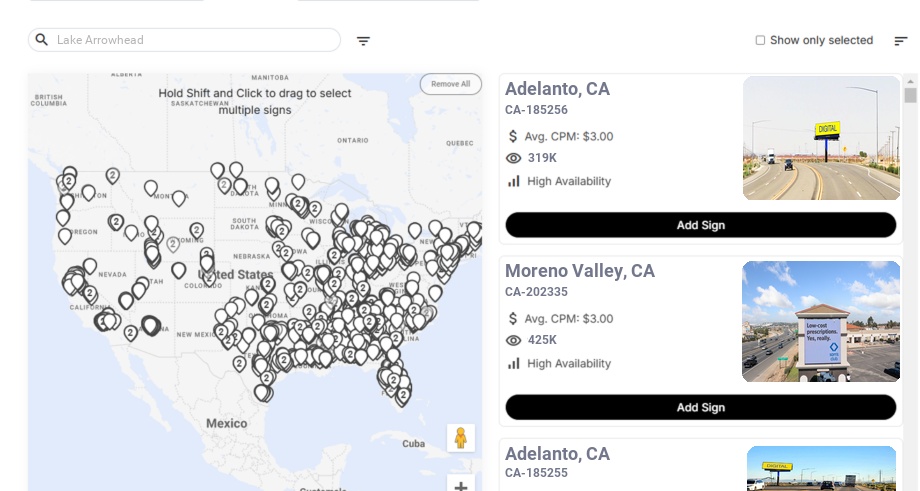
Blip has digital billboards near Lake Arrowhead. You can browse available locations on a map, choose the ones that fit your audience, and start advertising right away.
Still have questions? Launch a campaign in minutes — no contracts, no commitments.
Start Your CampaignLake Arrowhead Billboard Advertising Guide
The Lake Arrowhead area combines resort-town tourism with year‑round mountain living, making it a powerful niche market for digital billboard advertisers. With Blip, we can tap into this traffic using nearby digital billboards in San Bernardino that serve the Lake Arrowhead area—capturing drivers as they head up and down the mountain and as locals travel for work, school, and shopping. For brands searching for billboards near Lake Arrowhead without paying premium in‑village rates, these San Bernardino digital faces provide a cost‑efficient way to reach the same audience.
Understanding the Lake Arrowhead Area Market
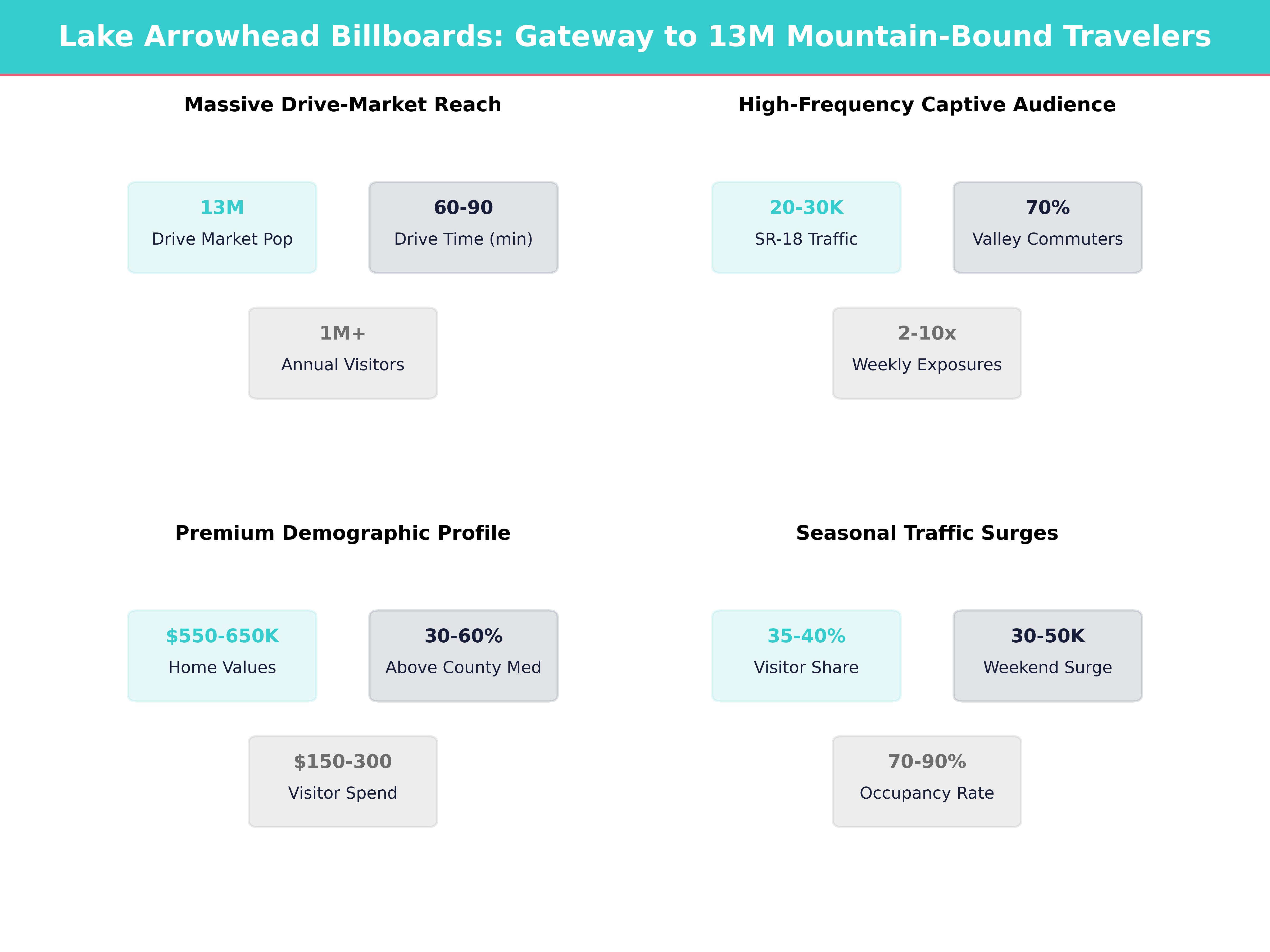
Lake Arrowhead is an unincorporated mountain community in the San Bernardino Mountains, about 25 miles northeast of downtown San Bernardino. It sits within San Bernardino County, which has more than 2.2 million residents, according to county data. The broader Inland Empire region tops 4.6 million residents, giving advertisers a large drive‑market audience within a 60–90‑minute radius for Lake Arrowhead billboards and other out‑of‑home formats.
Key data points that affect billboard strategy near the Lake Arrowhead area:
- Local population: The Lake Arrowhead CDP has roughly 9,000–10,000 year‑round residents, while the broader “Rim of the World” communities (Crestline, Running Springs, Blue Jay, etc.) add an estimated 30,000–40,000 more full‑time residents. The local Rim of the World Unified School District serves about 3,500–4,000 students each year, underscoring a sizable family and working‑age population on the mountain that regularly sees billboard advertising near Lake Arrowhead on their trips to and from the valley.
- Tourism volume: The Lake Arrowhead Communities Chamber of Commerce promotes the area as a four‑season resort. Regional tourism agencies such as Visit California and the Inland Empire Tourism Council
- Regional draw: The mountain is a quick escape for the 13+ million residents of the Greater Los Angeles region and the Inland Empire, including roughly 3.9 million in Los Angeles County Riverside County
- Income profile: Mountain resort homeowners and visitors skew more affluent than the Inland Empire average. San Bernardino County reports a median household income in the mid‑$70,000s, while housing market data frequently shows Lake Arrowhead‑area median home values 30–60% higher than the countywide median. In many Lake Arrowhead ZIP codes, typical home values exceed $550,000–$650,000, compared with county medians closer to the low‑$400,000s, making the area attractive for premium services, real estate, and hospitality brands that can leverage high‑visibility Lake Arrowhead billboards to reach this audience.
- Visitor spending: County tourism figures indicate that visitors to the San Bernardino Mountains and broader county generate more than $5 billion in direct travel spending annually, supporting tens of thousands of jobs in lodging, restaurants, retail, and recreation. Even capturing a small fraction of this spend via well‑timed billboard placements can deliver strong ROI for local advertisers considering billboard rental near Lake Arrowhead.
Because our Blip billboards serving the Lake Arrowhead area sit in nearby San Bernardino (about 8–9 miles away as the crow flies), we’re advertising at key decision points: when locals head off the mountain and when visitors are starting or ending the drive up the mountain. The City of San Bernardino and San Bernardino County Transportation Authority note that major valley corridors like I‑215 and SR‑210 carry daily traffic counts in the 100,000–200,000 vehicles‑per‑day range, giving even a small share of impressions strong reach potential for billboard advertising near Lake Arrowhead.
How People Move Around the Lake Arrowhead Area
To choose the right times and messages, it helps to understand how residents and visitors move between Lake Arrowhead and the valley, and when they are most likely to encounter billboards near Lake Arrowhead on their route.
Key traffic patterns:
- Mountain access routes: Lake Arrowhead is primarily accessed via State Route 18 (“Rim of the World Highway”) and State Route 173, connecting into the San Bernardino valley. According to Caltrans, key SR‑18 segments near the base of the mountain regularly see average daily traffic volumes in the 20,000–30,000 vehicles‑per‑day range, spiking even higher on peak winter snow and summer holiday weekends. These routes funnel a majority of mountain traffic past San Bernardino, where Lake Arrowhead billboards can repeatedly reach drivers.
- Commuter flows: Many residents of the Lake Arrowhead area commute down the mountain for work, college (e.g., at California State University, San Bernardino), or shopping at valley centers and malls such as those promoted by Visit Greater Ontario
-
Visitor arrival peaks:
- Friday afternoons/evenings: Weekend visitors from the Inland Empire and Los Angeles head up after work, with traffic volumes often 20–40% higher than mid‑week according to historical counts published by Caltrans District 8.
- Saturday mornings: Daytrippers depart early to reach the lake or snow by mid‑morning, with many families targeting a 9–11 a.m. arrival window.
- Sunday afternoons/evenings: Return trips generate heavy downhill traffic, stretching typical 35–45‑minute drives into 60–90 minutes on high‑volume weekends as reported regularly by outlets like the San Bernardino Sun.
-
Seasonal spikes:
- Summer (June–August): Increased lake tourism, concerts at Lake Arrowhead Village
- Winter (roughly December–March, depending on snow): Major snowplay and ski traffic for the entire mountain, with coverage from outlets like the San Bernardino Sun frequently highlighting road conditions and crowding. Single storm weekends can bring several feet of snow and draw 30,000–50,000 extra vehicles into the mountain region over a 2–3‑day span.
- Shoulder seasons: Fall foliage and spring wildflowers attract niche visitors, but traffic is more locally driven. These months often see 15–25% lower volumes than peak seasons, creating a cost‑efficient window for brand‑building campaigns using Lake Arrowhead billboards.
- Emergency and weather impacts: During large storm events, San Bernardino County and Caltrans may report chain controls, road closures, and extended delays. These conditions can push travel times to 2–3 hours from the valley to the lake, giving advertisers more time to make an impression on drivers.
Using Blip, we can schedule campaigns around these predictable peaks, paying only for impressions when the Lake Arrowhead–bound audience is most likely to be on the road and most likely to notice billboard advertising near Lake Arrowhead.
Key Audience Segments in the Lake Arrowhead Area
Different audience segments in the Lake Arrowhead area respond to different offers and messages.
1. Year‑Round Mountain Residents
- Many work in education, hospitality, public services, creative fields, construction, and remote/knowledge work. Public‑sector jobs (schools, fire, sheriff, and county services) and tourism‑related roles together account for a substantial share of local employment, mirroring county patterns where government and leisure/hospitality make up more than 30% of jobs.
-
They regularly travel down to the valley for:
- Big‑box shopping and malls
- Medical/dental appointments at providers such as Arrowhead Regional Medical Center and private clinics
- Higher education at institutions like CSU San Bernardino or San Bernardino Valley College
- Demographically, county data shows a median age in the mid‑30s, but many mountain communities skew slightly older, with strong clusters of 35–64‑year‑old homeowners—prime targets for home services, financial services, and healthcare that can be promoted via billboards near Lake Arrowhead on their regular commute.
-
Messaging angles:
- Everyday services (“Trusted auto repair before you head up the mountain”)
- Healthcare and professional services
- Financial services and insurance
- Home improvement, heating, and snow-related services (plowing, roofing, generators)
2. Vacation Homeowners
- Often from Los Angeles, Orange County, or the coastal areas, with higher disposable income and a high rate of second‑home ownership. In some Lake Arrowhead neighborhoods, short‑term rentals and second homes account for 40–60% of housing units.
- Visit on weekends, holidays, and summers; many spend 30–60 days per year at their mountain home.
- These visitors typically arrive by car, often spending $150–$300 per party per day on lodging, dining, and activities, according to regional travel‑spend benchmarks cited by DiscoverIE
-
Messaging angles:
- Property management, cleaners, and contractors
- Luxury dining and boutique shopping near the lake
- Real estate listings and mortgage/financial advisors
- High‑end home services (landscaping, dock repair, spa installation)
3. Overnight Tourists and Daytrippers
- Families, couples, and groups from the Inland Empire, LA, and beyond. Drive‑market data from regional tourism organizations shows that more than 90% of visitors to the San Bernardino Mountains arrive by car, placing high value on roadside visibility and well‑placed Lake Arrowhead billboards.
-
Major reasons for visiting:
- Lake recreation: boating, fishing, hiking, and lakefront dining
- Winter: snowplay and ski/snowboard trips in the broader mountain region
- Events: concerts at Lake Arrowhead Village, Oktoberfest, holiday events, and festivals promoted by the Lake Arrowhead Chamber of Commerce
- Average party sizes of 3–4 people are common for family trips, with weekend stays of 2–3 nights and average per‑trip spending often topping $600–$1,000 per party when lodging is included.
-
Messaging angles:
- Lodging (hotels, cabins, short‑term rentals)
- Restaurants, bars, and coffee shops
- Activities: tours, rentals, family attractions, live events
- Safety reminders and road condition sponsors (great for local brands wanting goodwill)
4. Valley Residents Connected to the Mountain
- People who don’t live on the mountain but regularly go up to visit friends/family, attend church or community events, or recreate in the forest. Proximity—only 25–35 minutes from much of San Bernardino in good conditions—makes repeat visits common.
- Many live and work in San Bernardino, Highland, Redlands, and other valley cities that use SR‑18 and nearby freeways weekly, placing them in front of the same billboards 2–10 times per week and making billboard rental near Lake Arrowhead a reliable way to maintain frequency.
-
Messaging angles:
- Mountain‑adjacent businesses in San Bernardino catering to mountain residents (auto shops, storage units, hardware, pet boarding)
- Repeat‑visit promotions (“Locals get 10% off every Sunday evening” for return traffic)
- Membership‑style offers that reward frequent visits
By tailoring creative and scheduling to these segments, we can use San Bernardino billboards to keep your brand top‑of‑mind for anyone heading to or from the Lake Arrowhead area.
Seasonal Strategy: When to Push Hard and When to Maintain Presence
The Lake Arrowhead area is classic “four‑season” territory, and billboard strategy should change with each season. Regional visitation studies show that peak quarters can see 30–50% higher visitor volumes than the slowest quarters, so matching spend to demand is critical when planning billboard advertising near Lake Arrowhead.
Summer (June–August)
- High visitor volume around the lake, with concerts and events promoted by the Lake Arrowhead Village
- Hotel and vacation rental occupancy often runs 70–90% on peak weekends, with average nightly rates 20–40% higher than shoulder seasons.
-
Ideal for:
- Lodging and vacation rentals
- Restaurants and lake activities (boat rentals, kayak/paddleboard, fishing charters)
- Retail in Lake Arrowhead Village or Blue Jay
-
Blip tactics:
-
Increase bid amounts and total daily budgets on:
- Friday 2–9 p.m. (uphill traffic)
- Saturday 8 a.m.–1 p.m. (daytrippers)
- Sunday 2–9 p.m. (downhill traffic)
- Rotate creatives that reference “Today,” “This Weekend,” or “Tonight” to catch spontaneous planners, who research shows can account for 30–50% of same‑day dining and activity decisions.
-
Increase bid amounts and total daily budgets on:
Fall (September–November)
- Moderate visitor traffic, with fall foliage drives and local events. Occupancy and traffic typically dip 10–25% from summer peaks but remain healthy on holiday and event weekends.
-
Great window for:
- Real estate promotion (as visitors consider buying after summer trips)
- Home services (roofing, heating, winterization) as temperatures cool
- Off‑peak discounts for lodging and restaurants
-
Blip tactics:
- Maintain evergreen brand campaigns at lower budgets, preserving frequency among locals.
- Increase impressions on holiday weekends (Labor Day, Thanksgiving) and event weekends advertised via the Lake Arrowhead Chamber
Winter (Snow Season)
- When storms bring snow, visitor numbers can surge dramatically, creating traffic and long drive times up the mountain. News outlets like the San Bernardino Sun and Mountain News frequently report gridlock conditions, with travel times doubling or tripling.
- Some winter holiday periods (Christmas–New Year’s and three‑day weekends) can match or exceed summer visitation, with lodging occupancy near 100% and day‑use parking lots filling early in the morning.
-
Perfect for:
- Lodging close to main roads and within easy winter access
- Winter gear, tire chains, and vehicle prep
- Indoor attractions and restaurants for weather‑affected days
-
Blip tactics:
- Use flexible budgeting to surge spend immediately after snowstorm forecasts and local news coverage. Even a 24–48‑hour spend increase can pay off when traffic volumes jump 30–60%.
- Run safety‑oriented or “escape the traffic” messages for travelers stuck in congestion—this can make your brand memorable and appreciated.
- Emphasize practical offers (“Chains Installed in 10 Minutes,” “Warm Up with Soup & Cocoa in the Village”) that align with traveler needs.
Spring (March–May)
- Transitional season: less intense tourism but steady local activity. Many resorts and lodging properties report occupancy in the 40–65% range outside of spring breaks and holidays.
-
Strong for:
- Home projects, remodeling, landscaping
- Health and wellness services, as residents schedule checkups after busy winter months
- Community organizations, schools, and churches promoting events, fundraisers, and registrations
-
Blip tactics:
- Test brand‑building messages with lower CPMs, as competition often dips and impression costs can be 10–30% cheaper than peak seasons.
- Use A/B creative testing (multiple artwork variations) to refine what resonates before peak summer.
Crafting Effective Creative for the Lake Arrowhead Area
Because drivers near the Lake Arrowhead area are often on curvy mountain roads or busy freeways leading to them, clarity and speed of comprehension are critical. National studies of out‑of‑home effectiveness consistently show that drivers have 6–8 seconds or less to absorb a billboard message—often less on complex routes like SR‑18.
Design principles that work especially well here:
-
Big, bold offers for distracted drivers:
- 6–8 words max for the main message.
- Large, high‑contrast fonts: white or yellow on dark backgrounds or vice versa.
- Minimal clutter—one main image, one main action.
-
Directional and distance‑based messaging:
- “Cabins 20 Min Ahead – Exit XX”
- “Lake Arrowhead Village Restaurants – 25 Minutes Up the Mountain”
- Including estimated time or distance can improve response, especially when drivers are already planning a stop on their way to businesses advertised on Lake Arrowhead billboards.
-
Weather‑aware creatives:
- Summer: blue skies, lake scenes, boating, outdoor dining.
- Winter: snow, fireplaces, hot drinks—highlight warmth and coziness.
- Shoulder seasons: highlight hiking, fall colors, or spring blooms to match what visitors see outside their window.
-
Local terminology and landmarks:
- Phrases like “Rim of the World,” “the mountain,” or “the Village” feel authentic to regulars.
- Mention nearby hubs like “Blue Jay,” “Crestline,” or “Running Springs” to signal local knowledge.
-
Time‑sensitive hooks:
- “Friday Night Live Music”
- “Snow Weekend Specials – This Saturday & Sunday”
- “Today Only: 15% Off Cabin Rentals”
- Compliance and legibility: Caltrans and safety guidance suggest maintaining simple layouts, large type, and limited animation for roadside clarity. Following these principles not only improves performance but also aligns with expectations from Caltrans District 8 and local communities.
Blip’s digital format allows us to rotate multiple creatives in a single campaign. We can use one artwork for weekend tourists, another for weekday commuters, and a third for snow days—all on the same billboard faces serving the Lake Arrowhead area.
Using Blip Tools to Target the Lake Arrowhead Area
With only two digital billboards serving the Lake Arrowhead area (both in nearby San Bernardino, within roughly 10 miles), precision scheduling and creative rotation matter more than blanket coverage. Strategic advertisers can still achieve strong frequency: drivers commuting 5 days a week may pass the same sign 20+ times per month, making efficient billboard rental near Lake Arrowhead possible even with a small footprint.
Here’s how we can use Blip’s capabilities to maximize results:
1. Dayparting by Travel Direction and Purpose
-
Weekday mornings (6–9 a.m.):
- Focus on services and businesses in the valley that mountain residents need before heading up: auto service, big‑box retail, coffee, quick breakfast, medical appointments.
- Typical weekday commuter traffic on major corridors like I‑215 and SR‑210 is heaviest during these hours, with some segments seeing 30–40% of daily volume between 6–10 a.m.
-
Weekday late afternoon/evening (4–8 p.m.):
- Aim messages at residents returning to the mountain: groceries, take‑out, last‑minute supplies, and recurring service reminders (“Book your snowplow contract before the next storm”).
-
Friday afternoon–Sunday evening:
- Highlight tourism-focused creatives: lodging, food, attractions, events.
- Drive‑time windows of 2–9 p.m. Friday, 8 a.m.–1 p.m. Saturday, and 2–9 p.m. Sunday align with documented weekend inflow and outflow patterns reported by Caltrans District 8.
2. Budget Flexibility Around Peak Weekends
-
Increase daily caps ahead of:
- Major summer holidays (Memorial Day, Independence Day, Labor Day)
- Winter holiday periods (Christmas–New Year’s, MLK Day, Presidents’ Day)
- Popular local events promoted by the Chamber of Commerce or local news outlets.
- Many local businesses see revenue jumps of 50–100% on these peak weekends compared with slower periods, so matching ad spend to these spikes can significantly improve returns from billboard advertising near Lake Arrowhead.
- Scale back to a baseline level mid‑week or in low‑traffic months, stretching your budget while maintaining steady brand visibility.
3. Creative Rotation by Season
-
Upload separate creative sets for:
- Summer tourism
- Winter snow season
- Shoulder seasons / local-focused messages
- Switch sets in your Blip dashboard as seasons change, without needing any physical production costs.
- Plan for at least 3–4 major creative refreshes per year. Advertisers who update creatives seasonally tend to see higher recall and engagement than those running the same artwork for 12 months straight.
4. Testing and Optimization
-
Run at least two creative variants at a time to:
- Test different calls‑to‑action (“Book Now” vs. “Call Today”)
- Compare deal‑driven vs. experience‑driven phrasing
-
Monitor performance using:
- Website traffic and online booking patterns by day and time
- Call volume or redemptions tied to a billboard‑only promo code
- Visitor surveys asking “How did you hear about us?”
- Even simple testing—changing a headline or image—can result in 10–30% differences in response. Use Blip’s flexibility to continuously refine campaigns over 4–8‑week cycles.
Example Campaign Approaches for Common Business Types
To make the Lake Arrowhead area strategy more concrete, here are sample approaches for different advertisers.
Lodging & Vacation Rentals
- Goal: Increase weekend occupancy and direct bookings.
-
Market context:
- Peak weekends often sell out, but mid‑week and shoulder seasons may see occupancy drop into the 40–60% range, leaving many properties with unsold nights.
-
Tactics:
- Run high‑impact “This Weekend at the Lake” creatives Friday–Sunday with photos of your best rooms or views.
- Include a short URL or memorable domain (“BookLakeCabin.com”) to track billboard‑influenced traffic.
- Highlight distance and ease (“Only 25 Minutes from Here,” “Parking on Site, No Steep Roads”).
- Promote mid‑week discounts to shift some demand into lower‑occupancy nights (e.g., “Save 20% Sun–Thu”) and feature these offers prominently on Lake Arrowhead billboards.
Restaurants & Cafés
- Goal: Capture hungry travelers before or after the drive.
-
Market context:
- Visitor research in similar mountain towns shows that 25–35% of trip spending goes to food and beverage, making dining decisions a major part of the visitor experience.
-
Tactics:
- Promote lunch and dinner specials during drive times: 11 a.m.–2 p.m. and 4–8 p.m.
- Use appetizing imagery and short copy (“Wood‑Fired Pizza in Lake Arrowhead Village”).
- Rotate creatives seasonally: iced drinks and patios in summer; soups, cocoa, and fireplaces in winter.
- Consider value‑driven offers during slower shoulder seasons (“Kids Eat Free on Weeknights”).
Real Estate & Property Management
- Goal: Attract buyers, sellers, and vacation homeowners.
-
Market context:
- Higher median home values and a large share of second homes create strong demand for lakefront and view properties, as well as for professional property management.
-
Tactics:
- Focus on peak visitation seasons when first‑time visitors fall in love with the area (summer and snowy winter).
- Use big, simple hooks: “Own Your Lake Arrowhead Cabin” or “Thinking of Selling? Free Valuation.”
- Drive to a dedicated landing page featuring Lake Arrowhead‑specific listings or services.
- Highlight stats that build urgency or credibility: “Over 50 Homes Sold on the Mountain Last Year,” “15+ Years Specializing in Lake Arrowhead.”
Home & Trade Services (Mountain and Valley)
- Goal: Stay top‑of‑mind with local residents who travel down the mountain regularly.
-
Market context:
- Many mountain homes require more intensive maintenance—snow removal, roofing, tree work, and heating—than typical valley homes. Seasonal demand spikes before and after major storms.
-
Tactics:
- Keep a year‑round presence with consistent branding and rotating seasonal offers (AC service in summer, heating/snow‑related in winter).
- Emphasize speed and reliability (“Same‑Day Service Before You Head Back Up the Mountain”).
- Highlight trust factors: years in business, local ownership, emergency availability.
- Use clear service geographies (“Serving Lake Arrowhead, Crestline, and Running Springs”).
Attractions, Events, and Nonprofits
- Goal: Boost attendance and awareness.
-
Market context:
- Local events—concerts, festivals, charity runs, and seasonal celebrations—can draw hundreds to several thousand attendees per day, especially when amplified by coverage from outlets like the San Bernardino Sun or Mountain News.
-
Tactics:
- Use countdown messaging (“Concert Tonight,” “3 Days Until Oktoberfest at the Village”).
- Partner or co‑brand with well‑known community institutions and highlight coverage from local outlets.
- Increase blips during key promotional windows (1–2 weeks pre‑event, then heavy pushes on event days).
- Include simple URLs or QR codes (when safe and legible) for ticketing information.
Local Nuances, Regulations, and Best Practices
Advertising serving the Lake Arrowhead area has a few unique considerations:
- Road safety sensitivity: Mountain driving conditions can be challenging, especially in winter. Avoid anything that encourages drivers to look too long or be distracted. Clean, simple designs not only perform better but also align with safety expectations that local agencies like Caltrans District 8 prioritize. During chain control and storm operations, Caltrans and San Bernardino County emphasize clear signage and minimal distraction.
- Community tone: The Lake Arrowhead area values its small‑town, nature‑oriented vibe. Authentic, respectful messaging that celebrates the forest, lake lifestyle, and local community tends to resonate more than overly aggressive, “hard sell” approaches. Supporting local causes, events, or nonprofits in your creative can foster goodwill and make your Lake Arrowhead billboards feel like part of the community fabric.
-
Tourism vs. local balance: The same billboard faces will be seen by weekend visitors and weekday locals. Consider a mix of:
- Year‑round brand messages aimed at residents
- Heavier, time‑sensitive promotions for visitors on peak days
- Weather disruptions: Snowstorms can close or restrict mountain roads. Use Blip’s budget controls to quickly adjust spend if traffic patterns shift dramatically (for example, pausing high‑spend weekend campaigns if major closures are reported by local authorities or county updates). Local news and alerts from sources like Mountain News can help you time pauses and restarts.
- Regulatory environment: While Blip’s digital boards are in the valley, staying aware of regional guidelines and community standards—through agencies like San Bernardino County and SBCTA—helps ensure your campaigns remain compliant and positively received.
Putting It All Together
To succeed with digital billboards serving the Lake Arrowhead area, we recommend advertisers:
- Identify core audiences (residents, second‑homeowners, weekend tourists, or all three), using local data such as school enrollment, housing trends, and visitor reports from the Lake Arrowhead Chamber.
- Match messaging to travel patterns, using dayparting to target commute times, weekend getaways, and event peaks informed by traffic data from Caltrans District 8.
- Design bold, simple creatives that can be read in a second or two on curvy or congested roads, keeping total word counts low and visuals high‑contrast.
- Leverage seasonal shifts—snow, sun, and events—to keep your message timely and compelling, increasing spend during the 30–40% of days that deliver outsized visitor volumes.
- Continuously test and refine using Blip’s flexible scheduling and multiple creatives to see what actually moves the needle, tracking changes in web traffic, calls, and bookings alongside campaign adjustments.
By aligning campaign timing, creative, and audience targeting with how people really use the Lake Arrowhead area, we can turn a small number of strategic digital billboards in nearby San Bernardino into powerful, always‑on ambassadors for your brand—and into one of the most efficient forms of billboard rental near Lake Arrowhead available today.